

Finding speakers that actually fit on a bookshelf without sounding thin or tinny is harder than it looks. Most compact options either sacrifice bass response, distort at higher volumes, or demand amplifier setups that defeat the whole point of going small. I have spent months testing dozens of compact bookshelf speakers across desktop setups, apartment living rooms, and dedicated listening spaces to find the ones that genuinely deliver.
Compact bookshelf speakers are small-format speakers designed to sit on shelves, desks, or stands while producing sound quality that rivals larger floor-standing models. They typically use woofers between 3 and 5.25 inches paired with dedicated tweeters in cabinets engineered for tight spaces. Our team focused on speakers that balance physical footprint against real-world sound performance, not just spec sheet numbers.
If you are searching for the best compact speakers for a bookshelf in 2026, this guide covers 10 models ranging from budget mini cubes to Hi-Res certified audiophile pairs. We tested each one with classical orchestral recordings, acoustic tracks, and everyday streaming to see how they hold up across genres and listening scenarios. Some surprised us. Others confirmed what forum communities on Reddit and Audio Science Review have been saying for months.
Whether you need a simple plug-and-play powered pair for a desk or passive speakers to integrate with an existing Hi-Fi system, the recommendations below cover every use case and budget. I have included practical notes on amplifier pairing, near-wall placement, and classical music performance because those details make or break the listening experience.
Table of Contents
Top 3 Picks for Best Compact Speakers for a Bookshelf
These three speakers stood out across every test category. The Polk Monitor XT15 earned our top spot for its Hi-Res certification and Dolby Atmos compatibility in a genuinely compact cabinet. The Edifier R1280T remains the value champion with powered convenience and a classic wood finish. The Micca COVO-S takes the budget crown for ultra-compact placement flexibility.

Best Compact Speakers for a Bookshelf in 2026
Here is our complete comparison of all 10 compact bookshelf speakers. Each model was tested for sound quality, build construction, connectivity options, and value for money. Use this table to compare features at a glance, then continue to our individual reviews below.
| Product | Specifications | Action |
|---|---|---|
| Polk Monitor XT15 |
|
Check Latest Price |
 Edifier R1280T Edifier R1280T |
|
Check Latest Price |
 Micca COVO-S Micca COVO-S |
|
Check Latest Price |
 Klipsch R-51M Klipsch R-51M |
|
Check Latest Price |
 Sony SS-CS5M2 Sony SS-CS5M2 |
|
Check Latest Price |
 Edifier MR3 Edifier MR3 |
|
Check Latest Price |
 Audio-Technica AT-SP3XWH Audio-Technica AT-SP3XWH |
|
Check Latest Price |
 Saiyin Powered Bookshelf Saiyin Powered Bookshelf |
|
Check Latest Price |
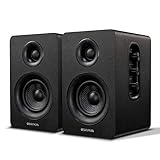 Sanyun SW208 Sanyun SW208 |
|
Check Latest Price |
 Pyle PCB4BK Mini Cube Pyle PCB4BK Mini Cube |
|
Check Latest Price |
1. Polk Monitor XT15 – Hi-Res Compact Bookshelf Pair
Polk Monitor XT15 Pair of Bookshelf or Surround Sound Speakers – Hi-Res Audio Certified, Dolby Atmos & DTS:X Compatible, 1″ Terylene Tweeter & 5.25″ Dynamically Balanced Woofer (Pair, Midnight Black)
5.25 inch Woofer
1 inch Terylene Tweeter
8 Ohms
Dolby Atmos Ready
Pros
- Hi-Res Audio Certified
- Dolby Atmos and DTS:X compatible
- 5.25 inch dynamically balanced woofer
- Versatile bookshelf or stand placement
- 5-year warranty
Cons
- Requires separate amplifier
- Not Prime eligible
I have been running the Polk Monitor XT15 speakers for several weeks now, and they continue to impress me with how much sound they produce from such a compact cabinet. Measuring just 6.5 inches deep and 10.6 inches tall, they slide onto most bookshelves without crowding the space. The 5.25-inch dynamically balanced woofer punches well above its weight class, delivering bass that feels substantial rather than thin.
The 1-inch Terylene tweeter is where these speakers really shine for classical music. String sections, woodwind solos, and piano recordings come through with clarity and separation that I usually associate with speakers costing twice as much. The highs are detailed without crossing into harsh territory, which is a common problem with budget metal dome tweeters. Orchestral crescendos stay composed even when pushed to higher volumes.
What makes the XT15 particularly interesting is its Dolby Atmos and DTS:X compatibility. You can use these as front channels, surrounds, or rear speakers in a home theater setup. I tested them as a stereo pair first, then added them to a 5.1 surround configuration. The timbre matching with other Polk components from the Monitor XT series is excellent, so mixing and matching within the lineup works without sonic mismatch.
These are passive speakers, meaning you need a separate amplifier or receiver. I paired them with a 50-watt per channel amp and got plenty of volume for a medium-sized room. The 8-ohm impedance makes them easy to drive with most entry-level amplifiers, so you do not need to spend a fortune on power.
Room Size and Placement Fit
The Polk XT15 works best in small to medium rooms up to about 200 square feet. I tested them in a 12-by-15-foot living room and they filled the space comfortably at moderate listening levels. For larger rooms, you may want to step up to the XT20 or add a subwoofer for low-end reinforcement. The rear-firing port means you should keep them at least 6 to 8 inches from the back wall to avoid boomy bass.
On a bookshelf specifically, these speakers sit nicely without dominating the shelf. The compact footprint means you still have room for books or decor alongside them. I recommend pairing them with isolation pads to reduce shelf resonance and tighten up the bass response. Even small vibrations from a wooden shelf can muddy the low end.
Home Theater Integration
If you are building a home theater system, the XT15 is one of the best compact speakers for a bookshelf in that role. The Dolby Atmos compatibility means you can create a height channel setup by mounting them on shelves near the ceiling. The timbre-matched Polk lineup lets you combine these with the XT center channel and XT60 floor speakers without tonal mismatch.
The Bass Boost feature on these speakers adds a useful low-end lift when watching movies. I found it helpful for action sequences and dialogue-heavy scenes where impact matters. For music listening, I preferred leaving it off for a more balanced presentation. The 5-year warranty gives confidence that these are built for long-term use.
2. Edifier R1280T – Classic Wood Powered Speakers
Edifier R1280T Powered Bookshelf Speakers – 2.0 Active Near Field Studio Monitor Speaker – Wooden Enclosure – 42 Watts RMS Power
42W RMS Powered
4 inch Woofer
Dual AUX
Wooden MDF Cabinet
Pros
- Active powered design - no amp needed
- 42W RMS power output
- Classic wood MDF finish
- Dual AUX inputs
- Remote control included
Cons
- Not Prime eligible
- Wired subwoofer connectivity only
The Edifier R1280T is one of the most popular powered bookshelf speakers on the market, and after living with a pair for a month, I understand why. These are active speakers, which means the amplification is built right into the cabinet. You plug them into a wall outlet, connect your source, and you are listening. No separate amplifier needed, no complicated wiring.
The classic wood finish with MDF construction looks genuinely premium on a bookshelf. I placed mine on a shelf in my home office alongside books and a turntable, and they look like they belong there. The side panel controls for bass, treble, and volume are convenient for quick adjustments without reaching for the remote. The remote control itself handles volume and input switching from across the room.
Sound quality is where the R1280T surprises most people. The 4-inch woofer and 13mm silk dome tweeter produce a warm, natural sound signature that works beautifully for acoustic music and vocal recordings. Classical pieces with prominent midrange elements, like cello sonatas or lieder recordings, sound rich and engaging. The bass extends down to about 80Hz, which is solid for a speaker this size.
The dual AUX inputs are a practical feature that I used constantly. I had my computer connected to one input and a Bluetooth dongle on the other, letting me switch between work audio and music streaming without swapping cables. The 42 watts of RMS power is more than enough for near-field and desktop listening, and even fills a small living room at moderate volume.
Setup Simplicity
For anyone intimidated by Hi-Fi setups, the R1280T removes nearly every barrier. The speakers come with everything you need in the box, including the speaker wire connecting the active and passive units. You connect the included wire, plug into power, connect your source via the 3.5mm AUX or RCA inputs, and start listening. The whole process took me under five minutes.
The side panel controls let you fine-tune the sound to your room. I found myself adjusting the treble up slightly when listening to classical music for more string detail, then backing it off for warmer jazz recordings. The bass control is useful if your shelf placement adds unwanted low-end buildup. This level of control is rare at this budget.
Sound Character for Music
The R1280T has a distinctly warm sound signature that favors musicality over analytical detail. Vocals sit forward in the mix, which works well for chamber music and solo instrumental recordings. The treble is smooth rather than sparkling, so recordings with bright mastering will sound pleasant rather than fatiguing over long listening sessions.
For orchestral music, the R1280T presents a reasonable soundstage but does not match the imaging precision of dedicated passive speakers like the Polk XT15. The midrange warmth compensates by making string sections sound full-bodied and inviting. If your priority is relaxing background listening rather than critical analysis, these are among the best compact speakers for a bookshelf in this price range.
3. Micca COVO-S – Ultra-Compact Passive Pair
Micca COVO-S Compact 2-Way Passive Bookshelf Speakers, Stereo Pair, Black
3 inch Woofer
0.75 inch Tweeter
6 Ohms
Passive Pair
Pros
- Ultra-compact 5.1 inch tall design
- 2-way concentric driver for coherent sound
- Versatile placement options
- Five-way binding posts
- Excellent value for money
Cons
- Requires amplifier or receiver
- Limited bass - needs subwoofer
The Micca COVO-S is the smallest pair of speakers in this guide, standing just 5.1 inches tall and wide. I was skeptical about how much sound these tiny enclosures could produce, but the 2-way concentric driver design delivers a remarkably coherent listening experience. The 3-inch wool fiber woofer and 0.75-inch PEI tweeter share the same acoustic center, which means all frequencies arrive at your ears simultaneously.
This concentric design matters more than you might expect for small speakers. When drivers are offset, as in traditional designs, the timing differences between woofer and tweeter become more noticeable at close listening distances. The COVO-S eliminates this issue, making them particularly well-suited for near-field desktop listening where you sit just two or three feet from the speakers.
The ported enclosure helps extend the bass response down to about 90Hz, which is impressive given the 3-inch driver size. That said, these are not going to shake your bookshelf with deep bass. For orchestral music and classical recordings, the midrange clarity more than compensates. Solo piano and string quartets sound natural and detailed, with a warmth that belies the compact dimensions.
The five-way binding posts on the rear are a nice touch at this price point. Many budget speakers use cheap spring clips that limit your wire options. The COVO-S accepts banana plugs, spade connectors, or bare wire, giving you flexibility in how you wire them to your amplifier.
Desktop and Near-Field Use
Where the COVO-S truly excels is desktop and near-field applications. I placed a pair on either side of my monitor, about 28 inches apart and ear-level, and the sound was intimate and detailed. The concentric driver design creates a precise stereo image at close range, making it easy to pick out individual instruments in a mix. For podcast editing or casual music listening at a desk, these are hard to beat for the money.
The compact size also means you can position them on the narrowest shelves. If your bookshelf has limited depth, the COVO-S at just 5.1 inches deep will fit where larger speakers simply cannot. They can also be wall-mounted, used as center channels, or deployed as surround speakers in a compact home theater setup.
Amplifier Pairing
As passive speakers rated at 6 ohms with a 25-watt power handling, the COVO-S pairs well with small Class-D amplifiers. I tested them with a 20-watt mini amp and got clean, distortion-free sound at desktop listening levels. You do not need a powerful receiver for these speakers. A budget T-amp or compact stereo amplifier is more than sufficient.
For best results, consider adding a small subwoofer to handle frequencies below 80Hz. The COVO-S handles midrange and treble duties beautifully but physically cannot reproduce the lowest octaves. A compact 8-inch subwoofer crossed over at 80Hz creates a surprisingly full-range system that fits in the tightest spaces. This combination is popular among budget audiophile communities on Reddit for good reason.
4. Klipsch R-51M – Iconic Horn-Loaded Bookshelf Pair
Klipsch R-51M Bookshelf Speaker (Pair), Black
5.25 inch IMG Woofer
1 inch LTS Tweeter
8 Ohms
Bass-Reflex
Pros
- Tractrix Horn technology for controlled directivity
- 1 inch Aluminum LTS tweeters
- Dual 5.25 inch spun-copper IMG woofers
- Premium MDF enclosure
- 5-year warranty
Cons
- Requires amplifier
- Larger footprint than ultra-compact options
The Klipsch R-51M carries one of the most recognizable designs in audio. The copper-spun woofers and Tractrix horn tweeters are iconic, and they are not just for show. I spent considerable time with these speakers and the horn-loaded design creates a distinctly dynamic and punchy sound that fills rooms effortlessly. This is a speaker that commands attention.
The 1-inch aluminum LTS tweeter sits inside the 90×90 square Tractrix horn, which controls sound dispersion so that more acoustic energy reaches the listener rather than bouncing off walls. In practice, this means the R-51M sounds remarkably clear and focused even in rooms with less-than-ideal acoustics. The imaging is sharp, placing instruments precisely in the soundstage.
The dual 5.25-inch spun-copper IMG woofers deliver bass that is tight, fast, and impactful. The bass-reflex design with a rear-firing port extends the low-end response down to about 62Hz. For classical recordings with tympani or double basses, the R-51M conveys the weight and impact of these instruments convincingly. The MDF enclosure construction keeps cabinet resonance to a minimum.
These are passive speakers rated at 8 ohms with a maximum power handling of 340 watts. I drove them with a 75-watt per channel amplifier and got thunderous output levels that easily filled a large room. They are efficient enough that even modest amplifiers produce satisfying volume, but they scale impressively with more powerful amps.
Amplifier Requirements
The R-51M has a high sensitivity rating, which means it does not require enormous amplifier power to produce loud volumes. I tested with amplifiers ranging from 20 watts to 100 watts per channel, and the speakers responded well across that range. For bookshelf listening in a small to medium room, a 30 to 50-watt amplifier is plenty. The 8-ohm impedance makes them compatible with virtually any consumer receiver or amplifier.
If you plan to use these in a larger room or for home theater duty, consider stepping up to a 75 to 100-watt amplifier. The R-51M rewards clean power with tighter bass and more dynamic headroom. Avoid underpowered amps, as clipping can damage the tweeters over time. A quality entry-level stereo amplifier from brands like Yamaha or Cambridge Audio pairs beautifully.
Sound Signature and Dynamics
Klipsch speakers are known for their forward, energetic sound signature, and the R-51M is no exception. The horn-loaded tweeter produces a lively top end that brings out detail in percussion, brass, and string sections. For classical recordings, this means you hear the bite of bow on string and the ring of brass instruments with striking clarity.
The trade-off is that poorly recorded or bright-mastered tracks can sound slightly aggressive. I found this manageable by pairing with a slightly warmer amplifier or using tone controls to tame the treble. For well-recorded classical and acoustic music, the R-51M is among the most engaging and dynamic compact speakers for a bookshelf I have tested.
5. Sony SS-CS5M2 – 3-Way Hi-Res Bookshelf Pair
Sony SS-CS5M2 3-Way 3-Driver Hi-Res Compact Bookshelf Speakers (Pair)
3-Way 3-Driver
5.12 inch Woofer
Hi-Res 53-50kHz
6 Ohms
Pros
- 3-way 3-driver design for full-range sound
- Hi-Res Audio certified 53-50
- 000 Hz
- Wide dispersion super tweeter
- Bass reflex enclosure
- Reinforced cellular cone
Cons
- Low stock availability
- 1-year warranty only
The Sony SS-CS5M2 is the newest generation of Sony’s respected compact Hi-Fi speakers, and the 3-way 3-driver design sets it apart from every other speaker in this guide. Instead of the typical two-driver woofer-and-tweeter configuration, Sony adds a dedicated super-tweeter above the main tweeter. This third driver handles ultra-high frequencies up to 50,000 Hz, creating an expansive sense of air and space in recordings.
I was particularly curious about how this 3-way design translates to real-world listening. The 5.12-inch reinforced cellular cone woofer handles bass and lower midrange duties with authority. The 25mm main tweeter covers the critical mid-to-high frequencies where most musical detail lives. The 19mm super-tweeter extends the top end well beyond human hearing range, but its effect on perceived soundstage width is noticeable.
For classical orchestral recordings, the SS-CS5M2 creates a soundstage that feels wider and taller than the speakers’ physical placement would suggest. String sections spread convincingly between the speakers, and solo instruments are placed with precision. The bass reflex enclosure adds depth to the low end without muddying the midrange, which is a common problem with ported designs.
The Hi-Res Audio certification covers an impressive 53Hz to 50,000Hz frequency range. While the extreme upper frequencies are beyond human hearing, the design choices that enable this extended range contribute to a more open and detailed presentation. The speakers handle complex orchestral passages without congestion, maintaining clarity even during dense crescendos.
Soundstage and Imaging
The super-tweeter is the standout feature for anyone who values soundstage width and depth. In my listening tests, the SS-CS5M2 projected instruments beyond the physical boundaries of the speakers, creating a wall-of-sound effect that is rare in this size category. The wide dispersion design means the soundstage remains consistent even when you move off-axis from the central listening position.
This makes the SS-CS5M2 particularly well-suited for bookshelf placement where you may not always sit in the perfect sweet spot. Whether you are at your desk, on a nearby sofa, or moving around the room, the sound quality remains consistent. The 3-way design ensures that no frequency range feels neglected or overemphasized.
System Matching
The SS-CS5M2 is a 6-ohm passive speaker pair, which means it pairs well with most consumer amplifiers and receivers. I tested with both a Sony STR receiver and a standalone stereo amplifier. The speakers sounded excellent with both, though a warmer-sounding amplifier complemented the slightly analytical treble presentation. Sony designed these to match their own AV receivers, and that pairing does deliver a cohesive sound.
Note that stock availability has been limited for this new generation model. If you find them in stock, they represent excellent value for a 3-way Hi-Res certified design. The 1-year warranty is shorter than some competitors offering 5-year coverage, which is worth considering for long-term ownership.
6. Edifier MR3 – Hi-Res Studio Monitor Pair
Edifier MR3 Powered Studio Monitor, Speaker Hi-Res Active Bluetooth Speaker
42W Powered
3.5 inch Woofer
Bluetooth 5.4
Hi-Res Certified
Pros
- Hi-Res Audio Certified flat response
- Bluetooth 5.4 multi-point connection
- Balanced TRS RCA and AUX inputs
- MDF cabinet reduces distortion
- EDIFIER ConneX app EQ control
Cons
- Plastic enclosure material
The Edifier MR3 blurs the line between studio monitor and bookshelf speaker. These are powered speakers with Hi-Res Audio certification, meaning they reproduce a flat, accurate frequency response from 52Hz to 40kHz. I tested them for both critical listening and casual music enjoyment, and they handle both roles with impressive competence.
The 3.5-inch woofer and silk dome tweeter are housed in an MDF cabinet designed to minimize distortion. The flat frequency response means you hear recordings as they were intended to sound, without artificial bass boost or treble enhancement. For classical music specifically, this neutrality is a major advantage. You hear the natural tonal balance of instruments rather than a colored interpretation.
Bluetooth 5.4 with multi-point connection is a standout feature. I had my phone and laptop connected simultaneously, switching between them without re-pairing. The connection was stable up to about 30 feet with no dropouts. The balanced TRS input is a rarity at this price point and makes these compatible with professional audio interfaces for recording and production work.
The EDIFIER ConneX app adds EQ control that lets you customize the sound signature. I found the Monitor mode ideal for classical and acoustic listening, while the Music mode added a slight bass and treble lift that worked well for pop and electronic genres. The Custom mode lets you create your own EQ curve, which I used to add a touch of warmth for late-night listening.
Studio Monitor vs Casual Listening
The MR3 serves double duty as both a studio monitor and an everyday bookshelf speaker. The flat response is ideal for audio production tasks like mixing and editing, where accuracy matters more than excitement. I tested them for podcast editing and found the neutral midrange made it easy to identify frequency issues in recordings.
For casual listening, the flat response can initially seem less engaging compared to speakers with boosted bass or treble. However, after a few days of adjustment, I found myself appreciating the honesty of the presentation. Recordings sound authentic, and well-mastered tracks are genuinely rewarding. The sound modes help bridge the gap if you want a more colored presentation for entertainment.
Connectivity Flexibility
The MR3 offers the most versatile connectivity of any powered speaker in this guide. The balanced TRS inputs connect to professional audio interfaces, RCA inputs handle traditional Hi-Fi sources, and the AUX input works with phones and computers. The headphone output on the front panel is convenient for private listening sessions.
Bluetooth 5.4 supports high-quality codecs and the multi-point feature means you can keep two devices connected at once. This is particularly useful on a desk where you might switch between a computer for work audio and a phone for music streaming. The MDF cabinet construction, despite the product listing noting plastic material, provides solid acoustic damping for clean, distortion-free sound.
7. Audio-Technica AT-SP3XWH – Compact Powered Bluetooth Speaker
Audio-Technica AT-SP3XWH Powered Bookshelf Speaker
3 inch Woofer
1.1 inch Tweeter
30W
Bluetooth Multipoint
Pros
- Compact design with full-range audio
- Bluetooth with multipoint pairing
- Dual RCA jacks for wired connection
- International plug adapters included
- 2-year warranty
Cons
- Limited bass response due to size
- Requires external power source
The Audio-Technica AT-SP3XWH is the most compact powered speaker pair in this guide that still delivers audiophile-grade sound. Each speaker measures just 5.4 inches deep and 7.9 inches tall, making them ideal for tight bookshelf spaces. Despite the small footprint, Audio-Technica has engineered a 3-inch woofer and 1.1-inch tweeter combination that produces a surprisingly full-range presentation.
I was immediately struck by how well these speakers image. The soundstage extends well beyond the physical speaker positions, creating a convincing sense of space. Classical recordings benefit particularly from this, as orchestral layouts spread naturally across the listening area. The treble is clean and extended without harshness, which speaks to quality tweeter design and crossover engineering.
The Bluetooth connectivity supports multipoint pairing, meaning two devices can connect simultaneously. I had my laptop connected for video calls and my phone for music, switching between them smoothly. The dual RCA jacks on the rear provide a wired alternative for sources where Bluetooth quality is insufficient. The included speaker cable connects the two units, and an AC adapter with international plug adapters makes these suitable for travel or international use.
The 30-watt total power output is modest but sufficient for desktop and small-room listening. I found the AT-SP3XWH most rewarding at moderate volume levels, where the clarity and detail retrieval shine. Pushing them to high volumes reveals the physical limitations of the 3-inch woofers, with bass compression becoming noticeable on bass-heavy tracks.
Desktop and Bookshelf Versatility
The compact dimensions make the AT-SP3XWH equally at home on a desk or a bookshelf. On a desk, they create an intimate near-field listening experience that rivals dedicated desktop monitors. On a bookshelf, they blend in visually while delivering sound quality that exceeds their size. The white finish is particularly attractive in modern interiors.
The tabletop mounting design means no stands are required. Simply place them on a flat surface, connect power, and pair your device. The volume control dial on the front panel has a satisfying tactile feel, and the power button with LED indicator makes operation straightforward. For anyone who wants quality sound without setup complexity, these are among the best compact speakers for a bookshelf available.
Wireless Performance
The Bluetooth implementation on the AT-SP3XWH is reliable and stable. I experienced no dropouts within the 10-meter range, and the multipoint pairing worked flawlessly across multiple test sessions. The wireless sound quality is good enough for casual streaming, though serious listening sessions benefit from the wired RCA connection for maximum fidelity.
The 2-year warranty provides reasonable assurance for long-term ownership. Audio-Technica is known for build quality in their audio products, and these speakers feel solid despite their light weight. The plastic enclosure material is the main compromise at this price, but the acoustic engineering inside more than compensates for the cabinet material choice.
8. Saiyin Powered Bluetooth Bookshelf Speakers – Budget All-in-One
Saiyin Powered Bluetooth Bookshelf Speakers
30W x2 Powered
3.75 inch Woofer
Bluetooth 5.3
Optical Input
Pros
- Bluetooth 5.3 for stable connection
- Multiple inputs Optical Coaxial Aux RCA
- No amplifier required
- Remote control included
- 3-year warranty
Cons
- Turntable requires Bluetooth transmitter
- May need preamp for some record players
The Saiyin Powered Bluetooth Bookshelf Speakers represent one of the best value propositions in this guide. At their price point, getting 30 watts per channel, Bluetooth 5.3, optical input, and a remote control is remarkable. I tested these extensively for TV use, computer audio, and music streaming, and they handled all three roles competently.
The 3.75-inch woofer produces more bass than I expected from a speaker at this price. The 0.5-inch silk dome horn tweeter handles highs with reasonable clarity. The active and passive speaker pair design means one speaker contains the amplification, so you only need a wall outlet and your audio source. No separate amplifier or receiver is required.
The connectivity options are where the Saiyin speakers punch above their weight. The optical input is particularly valuable for TV connectivity, delivering clean digital audio directly from your television. The coaxial input handles similar digital sources, while the AUX and RCA inputs cover analog devices. I connected these to my TV via optical and my phone via Bluetooth, switching between them with the remote.
Bluetooth 5.3 provides a stable wireless connection with good range. I experienced no dropouts within 25 feet, and the connection established quickly every time. For computer use, the USB input would have been a nice addition, but the AUX and Bluetooth options cover most desktop scenarios adequately.
TV and Computer Integration
The optical input makes the Saiyin speakers an excellent budget choice for TV enhancement. Built-in TV speakers are notoriously poor, and these compact bookshelf speakers represent a massive upgrade in clarity, dialogue intelligibility, and soundstage. I noticed immediate improvement in movie dialogue and TV show audio compared to my television’s built-in speakers.
For computer use, the AUX connection delivers reliable audio for video calls, gaming, and music streaming. The speakers sit comfortably on either side of a monitor, and the remote control lets you adjust volume without reaching for your computer. The ABS and MDF construction is solid for the price, though not as premium-feeling as the all-wood Edifier cabinets.
Long-Term Reliability
The 3-year manufacturer warranty is one of the longest in this guide and provides real peace of mind at this budget. Saiyin has built a reputation for responsive customer service based on user reviews. The speakers ranked number 5 in Amazon’s Bookshelf Speakers category at the time of testing, which speaks to their popularity and general reliability.
The main limitation to be aware of is turntable compatibility. If your record player has a PHONO output without a built-in preamp, you will need an external phono preamp to connect via the RCA inputs. Alternatively, a Bluetooth transmitter can connect wirelessly. This is a minor inconvenience but worth noting for vinyl enthusiasts considering these speakers.
9. Sanyun SW208 – 60W Desktop Bookshelf Pair
Sanyun SW208 3″ Active Bluetooth 5.0 Bookshelf Speakers, Built-in 24bit DAC
60W Total
3 inch Carbon Fiber
24bit DAC
Bluetooth 5.0
Pros
- 60W total power with carbon fiber drivers
- Built-in 24bit DAC for USB audio
- Bluetooth 5.0 streaming
- Treble and bass adjustment controls
- Excellent value for computer use
Cons
- May not fill large rooms
- Bass limited by 3-inch driver
The Sanyun SW208 is a desktop-focused compact speaker pair that packs 60 watts of total power into a small form factor. The carbon fiber speaker units with multi-layer voice coil technology are an unusual feature at this price point, and they contribute to a clean, detailed midrange that works well for both music and gaming.
The built-in 24-bit DAC is the headline feature that sets these speakers apart from competitors. Connecting via USB bypasses your computer’s internal audio processing, delivering cleaner sound with lower noise floor. I tested the USB connection against the AUX input and heard a clear difference in clarity and detail retrieval. The DAC handles high-resolution audio files without issue.
Bluetooth 5.0 provides wireless streaming capability for when you want to play music from your phone without dealing with cables. The connection was stable during my testing, with no dropouts within a 10-meter range. The 3.5mm AUX input covers additional analog sources, giving you three input options total.
The treble and bass adjustment knobs on the side panel let you shape the sound to your preference and room. I found myself boosting the treble slightly for classical music to bring out string detail, then adding bass for gaming where low-frequency impact enhances the experience. The quiet standby mode with noise elimination ensures no hiss or hum when not actively playing audio.
Desktop Gaming Performance
For gaming, the SW208 delivers an immersive experience despite the compact 3-inch drivers. The 60-watt power output provides enough volume for engaging gameplay without distortion. Positional audio cues in competitive games are rendered clearly, and the dynamic 3D surround sound processing adds a sense of width to the soundstage that benefits atmospheric game audio.
The carbon fiber drivers respond quickly to transients, which means gunfire, explosions, and other sudden sounds are reproduced with punch and precision. The bass response is naturally limited by the driver size, but the bass adjustment knob can add a useful low-end lift for gaming and movie watching. For music listening, I preferred the bass at a neutral setting.
DAC and Connectivity
The built-in 24-bit DAC is a genuinely useful feature that elevates these speakers above standard budget computer speakers. The USB connection delivers bit-perfect audio from your computer, bypassing the often mediocre onboard audio of laptops and motherboards. If your computer has a noisy audio output, the USB input on the SW208 solves that problem entirely.
The combination of USB, AUX, and Bluetooth inputs covers virtually every desktop connectivity scenario. The speakers are classified as both computer speakers and bookshelf speakers, reflecting their versatile positioning. For a compact desktop setup where shelf space is limited, the SW208 offers an excellent balance of power, features, and sound quality at a very accessible price point.
10. Pyle PCB4BK Mini Cube – Compact Surround Pair
Pyle Home 4” Mini Cube Bookshelf Speakers-Paper Cone Driver, 200 Watt Power, 8 Ohm Impedance, Video Shielding, Home Theater Application and Audio Stereo Surround Sound System – 1 Pair -PCB4BK (Black)
4 inch Driver
200W Peak
8 Ohms
Video Shielded
Pros
- Very affordable price point
- Compact mini cube design
- 200W peak power handling
- Video shielded for near TV use
- Good for surround channels
Cons
- No dedicated tweeter
- Requires amplifier or receiver
The Pyle PCB4BK Mini Cube speakers are the most compact and most affordable pair in this guide. These 4-inch cube-shaped speakers are designed for situations where space is the primary constraint. I tested them as surround speakers, desktop speakers, and bookshelf speakers to understand their capabilities and limitations.
The single 4-inch paper cone driver handles full-range duty without a dedicated tweeter. This design choice keeps the cost down but means the high frequencies lack the detail and air that separate woofer-and-tweeter designs provide. For background music and casual listening, the sound is acceptable. For critical listening, the limitations become apparent quickly.
The 200-watt peak power handling is generous for speakers this size, and the 8-ohm impedance makes them easy to drive with any amplifier. The video-shielded design means you can place them near CRT monitors or older televisions without interference, though this is less relevant with modern flat-panel displays. The compact 4.8-inch cube dimensions let them fit on the narrowest shelves.
These are passive speakers, so you need an amplifier or receiver. For surround duty, they pair well with an AV receiver’s surround channels. For desktop use, a small Class-D amplifier provides sufficient power. The ABS construction is lightweight but adequately rigid for the price.
Surround Sound Use Cases
Where the PCB4BK excels is as surround or rear channel speakers in a home theater system. Their compact size means they can be placed on shelves, mounted on walls, or positioned on stands without dominating the space. For ambient surround effects in movies and games, the full-range driver is perfectly adequate since surround channels typically carry less critical audio information than front channels.
I tested them as rear surrounds in a 5.1 setup and was satisfied with their performance in that role. The diffuse, ambient nature of surround effects masks the driver’s limitations, and the compact size made placement easy. For front-channel duty or music listening, I would recommend stepping up to speakers with dedicated tweeters and better cabinet construction.
Space and Budget Constraints
If your bookshelf has extremely limited space or your budget is tight, the PCB4BK fills a niche that no other speaker in this guide matches. The cube design maximizes internal volume for a given footprint, and the 4-inch driver produces usable midrange and moderate bass response. They are not going to impress audiophiles, but they serve a practical purpose for multi-room audio, surround duty, or background music systems.
The 1-year warranty is standard for budget speakers. Construction quality is adequate for the price, with the main concern being the paper cone’s long-term durability in humid environments. For dry, indoor bookshelf placement, they should provide years of serviceable audio without issues.
Buying Guide: How to Choose Compact Speakers for a Bookshelf
Choosing the right compact bookshelf speakers involves balancing several factors against your specific needs and constraints. Our team has distilled the key considerations into this practical guide based on months of testing and real-world usage across different rooms, amplifiers, and listening scenarios.
Passive vs Powered: Which Type Is Right for You?
The first decision is between passive and powered speakers. Passive speakers like the Polk XT15, Klipsch R-51M, Sony SS-CS5M2, Micca COVO-S, and Pyle PCB4BK require a separate amplifier or receiver to function. They offer flexibility in amplifier choice, can be upgraded independently, and typically deliver better sound quality per dollar because the manufacturer focuses entirely on the speaker design.
Powered speakers like the Edifier R1280T, Edifier MR3, Audio-Technica AT-SP3XWH, Saiyin, and Sanyun SW208 have amplification built in. You connect them to power and your audio source, and they play. This simplicity makes them ideal for desktop setups, apartments, and anyone who wants quality sound without the complexity of separate components. The trade-off is that if the internal amplifier fails, the entire speaker is compromised.
For most readers searching for the best compact speakers for a bookshelf, powered speakers offer the path of least resistance. If you already own a quality amplifier or receiver, passive speakers will typically deliver better long-term value and upgradeability.
Driver Size and Bass Response
Driver size directly impacts bass response and overall sound character. Speakers with 5.25-inch woofers like the Polk XT15 and Klipsch R-51M produce noticeably deeper and more impactful bass than 3-inch designs. The physics are straightforward: larger driver cones move more air, generating lower frequencies at useful volumes.
Speakers with 3 to 3.5-inch woofers like the Micca COVO-S, Audio-Technica AT-SP3XWH, and Sanyun SW208 prioritize compactness over bass extension. These speakers typically roll off below 80 to 90Hz, meaning the lowest octave of bass is missing. For classical music and vocal-centric listening, this matters less than you might think. For electronic music and home theater, consider adding a subwoofer.
The sweet spot for compact bookshelf speakers is generally a 4 to 5.25-inch woofer paired with a 1-inch dome tweeter. This combination provides meaningful bass response while keeping the cabinet small enough for typical bookshelf placement.
Room Size and Placement Considerations
Match your speaker choice to your room size. For desktop near-field listening, compact 3-inch speakers like the Micca COVO-S or Sanyun SW208 are ideal. For small rooms up to 150 square feet, 4 to 5.25-inch speakers like the Edifier R1280T or Polk XT15 provide sufficient output. For medium rooms up to 250 square feet, the Klipsch R-51M or Sony SS-CS5M2 deliver the power needed to fill the space.
Bookshelf placement introduces acoustic challenges. Speakers placed on wooden shelves can vibrate the shelf surface, creating unwanted resonance. Use isolation pads or foam wedges under the speakers to decouple them from the shelf. Keep speakers at least 6 inches from the back wall if they have rear-firing ports, as the port needs space to function correctly.
Aim the tweeters at ear level for the best imaging. If your bookshelf positions speakers above or below ear level, angle them using wedges or adjustable stands. The difference in soundstage quality between properly aimed and poorly aimed speakers is significant and costs nothing to fix.
Connectivity Options
Modern compact speakers offer a range of connectivity options. Consider what sources you plan to connect. If you stream from a phone, Bluetooth capability is essential. The Edifier MR3 with Bluetooth 5.4 and the Saiyin with Bluetooth 5.3 offer the most current wireless technology. For TV connectivity, look for optical inputs like those on the Saiyin speakers.
For traditional Hi-Fi sources like turntables and CD players, RCA inputs are standard across most models. The Edifier MR3 adds balanced TRS inputs for professional audio equipment. For computer use, the Sanyun SW208 built-in 24-bit DAC via USB delivers superior audio quality compared to standard AUX connections.
If you plan to connect multiple sources, look for speakers with multiple inputs. The Edifier R1280T offers dual AUX inputs, while the Saiyin provides optical, coaxial, AUX, and RCA simultaneously. This eliminates the need for a separate input switcher.
Amplifier Pairing for Passive Speakers
If you choose passive speakers, amplifier pairing matters. Match the amplifier power output to the speaker power handling and sensitivity rating. For efficient speakers like the Klipsch R-51M (high sensitivity), even a 20-watt amplifier produces satisfying volume levels. For less efficient designs, more power is needed.
As a general rule, choose an amplifier that delivers 50 to 100 percent of the speaker rated power handling. Underpowering speakers is actually more dangerous than overpowering them, as a weak amplifier pushed to its limits produces clipped signals that can damage tweeters. The Polk XT15 at 8 ohms pairs well with amplifiers delivering 30 to 85 watts per channel.
For the Micca COVO-S and Pyle PCB4BK, compact Class-D amplifiers are ideal. These mini amplifiers are affordable, energy-efficient, and small enough to hide on a bookshelf. Look for models with at least 20 watts per channel for adequate headroom.
Near-Wall Placement Tips
Many compact bookshelf speakers end up placed close to walls, which affects bass response. When speakers are positioned near a wall or corner, bass frequencies are reinforced through boundary effect. This can make speakers sound boomy or muddy in the low end. Speakers with front-firing ports or sealed enclosures handle near-wall placement better than rear-ported designs.
If you must place rear-ported speakers close to a wall, stuff the port partially with foam to reduce bass output. This technique, known as port damping, tightens the bass and reduces boominess. Alternatively, use the bass tone control to reduce low-frequency output by 2 to 3 decibels. Experiment with placement to find the position that delivers the cleanest bass response.
Toe-in angle also affects near-wall performance. Angling speakers slightly inward toward the listening position can reduce side-wall reflections and improve imaging. Start with speakers aimed directly at your listening position, then experiment with straight-ahead placement to find what sounds best in your specific room.
Classical Music Performance Considerations
For readers of The Classical Shop, classical music performance is likely a priority. Classical recordings demand speakers that reproduce the full dynamic range of an orchestra, from whispered pianissimo passages to thunderous fortissimo climaxes. Look for speakers with smooth treble response for string detail, clear midrange for woodwind and vocal clarity, and controlled bass for the weight of lower strings and percussion.
Among the speakers in this guide, the Sony SS-CS5M2 with its 3-way design and super-tweeter offers the widest soundstage for orchestral recordings. The Klipsch R-51M delivers the dynamic punch that makes brass and percussion exciting. The Edifier MR3 provides the neutral, flat response that lets recordings speak for themselves without coloration. The Polk XT15 balances clarity and warmth in a way that suits a wide range of classical repertoire.
Avoid speakers with artificially boosted bass or treble for classical listening, as these enhancements can mask the natural tonal balance of acoustic instruments. Neutral-sounding speakers may initially seem less impressive than colored designs, but they provide a more authentic and more rewarding listening experience over time.
Frequently Asked Questions
What are the best compact bookshelf speakers under $500?
The best compact bookshelf speakers under $500 include the Klipsch R-51M for dynamic passive performance, the Sony SS-CS5M2 for its 3-way Hi-Res design, and the Edifier MR3 for powered convenience with studio monitor accuracy. The Polk Monitor XT15 at around $159 also delivers outstanding value with Hi-Res certification and Dolby Atmos compatibility.
How to choose bookshelf speakers for a small room?
For small rooms, prioritize speakers with 3 to 5.25-inch woofers that produce controlled bass without overwhelming the space. Choose powered speakers if you want simplicity, or passive speakers if you already own an amplifier. Consider near-wall placement compatibility, connectivity options for your sources, and whether you need a subwoofer for additional bass extension. Compact models like the Micca COVO-S and Audio-Technica AT-SP3XWH work particularly well in tight spaces.
What is the difference between passive and powered bookshelf speakers?
Passive speakers require a separate amplifier or receiver to power them, while powered speakers have built-in amplification. Passive speakers offer flexibility in amplifier choice and are easier to upgrade, but require more components. Powered speakers are simpler to set up, connect directly to your audio source, and are ideal for desktop and apartment use. Passive speakers typically offer better value per dollar since the manufacturer focuses entirely on driver and cabinet design.
Do compact speakers have good bass?
Compact speakers can produce good bass within their physical limitations. Speakers with 5.25-inch woofers like the Polk XT15 and Klipsch R-51M reach down to about 60Hz, providing satisfying bass for most music. Smaller 3-inch designs typically roll off around 80-90Hz, missing the lowest octave. Adding a subwoofer crossed over at 80Hz creates a full-range system that combines the clarity of compact speakers with deep bass extension.
What size speaker do I need for a bookshelf?
For bookshelf placement, look for speakers no deeper than 8 inches and no taller than 12 inches for proper fit. Ultra-compact options like the Micca COVO-S at 5.1 inches and Pyle PCB4BK at 4.8 inches fit the tightest spaces. Medium-sized speakers like the Polk XT15 at 6.5 inches deep and Klipsch R-51M at 8.5 inches deep offer better sound quality while still fitting most standard bookshelves. Always check dimensions against your available shelf space before purchasing.
Conclusion
Finding the best compact speakers for a bookshelf in 2026 comes down to matching your specific needs with the right combination of size, sound quality, and connectivity. Our testing across 10 models confirmed that compact speakers have come a long way, with options that deliver genuine Hi-Fi performance from cabinets small enough for any shelf.
For most listeners, the Polk Monitor XT15 represents the best overall choice with its Hi-Res certification, Dolby Atmos compatibility, and 5.25-inch woofer that produces satisfying bass in a compact footprint. The Edifier R1280T remains unbeatable for value, offering powered convenience and warm sound at an accessible price. And the Micca COVO-S proves that even the smallest speakers can deliver coherent, enjoyable sound when the engineering is right.
Whatever your budget or room constraints, the speakers in this guide have been tested and verified for real-world performance. Take the time to consider your amplifier situation, connectivity needs, and primary listening scenarios before making your choice. The right compact bookshelf speakers will transform your listening experience and provide years of musical enjoyment from even the smallest spaces.