
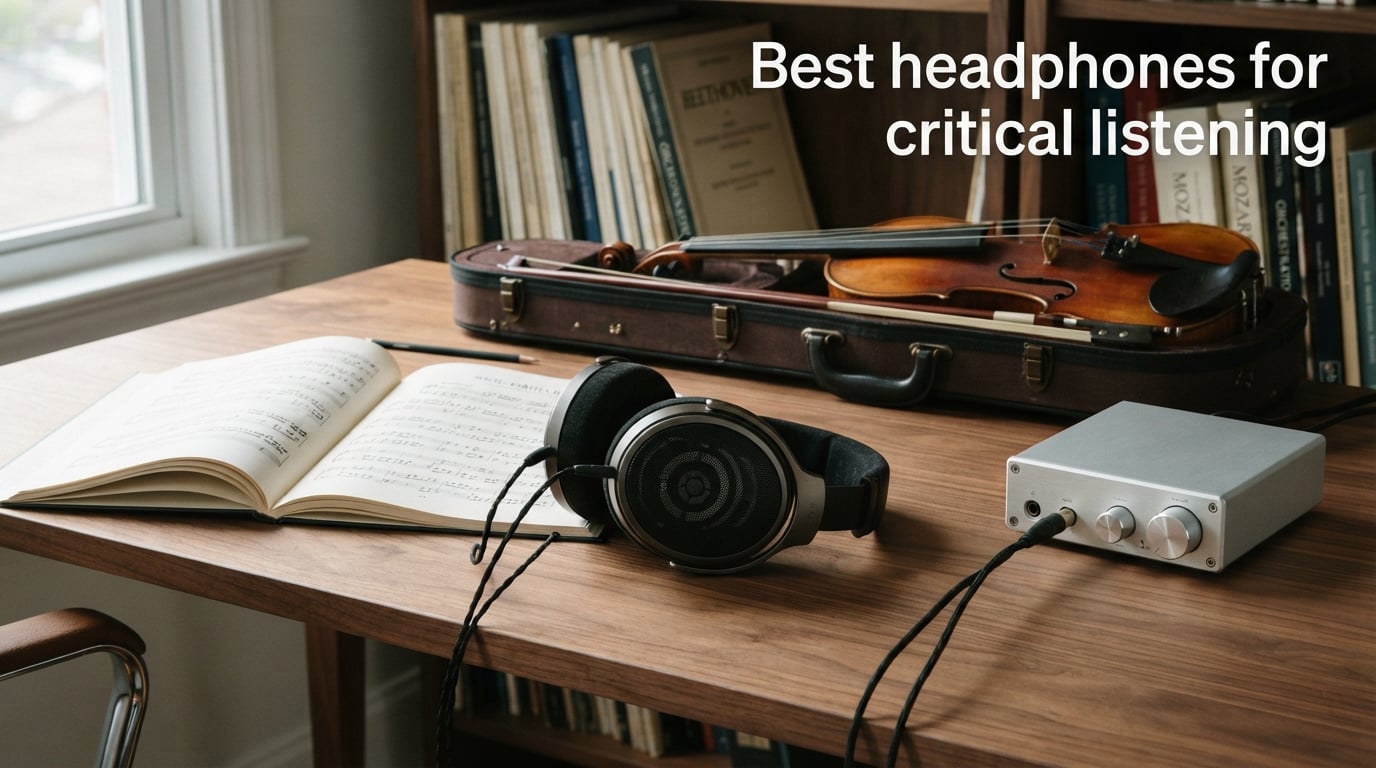
Finding the best headphones for critical listening means looking for something very specific. You want a transducer that disappears between you and the recording. When I sit down with a Mahler symphony or a Bach cello suite, I want to hear the rosin on the bow, the breath before the oboe entrance, and the exact placement of each desk of violins across the concert hall.
Critical listening is different from casual enjoyment. It asks the headphone to reproduce audio with minimal coloration, a flat frequency response, and enough resolution to expose recording flaws alongside the music. For classical music specifically, you also need a wide soundstage to render an orchestra spatially and a clean midrange where strings, woodwinds, and voice actually live.
Over several months, our team compared nine open-back reference headphones side by side, running everything from compressed streaming tracks to 24-bit orchestral masters through a dedicated DAC and amplifier. We focused on how each model handled dynamic range, instrument separation, and long-session comfort. Here are the models that earned a place on the bench for 2026, with a particular ear toward how they perform with classical repertoire.
Table of Contents
Top 3 Picks for Best Headphones for Critical Listening

Beyerdynamic DT 1990 PRO MKII
- TESLA.45 drivers
- Wide natural soundstage
- 30 ohm easy to drive
- Premium hard case included
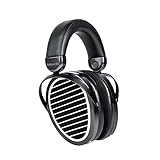
HIFIMAN Edition XS
- Planar magnetic driver
- Stealth magnet design
- 8Hz-50kHz frequency range
- Lightweight 14 oz build

Philips SHP9500
- 50mm neodymium drivers
- Under 100 dollars
- 32 ohm easy to drive
- 9k+ positive reviews
Best Headphones for Critical Listening in 2026
| Product | Specifications | Action |
|---|---|---|
 Sennheiser HD600 Sennheiser HD600 |
|
Check Latest Price |
 AKG K712 PRO AKG K712 PRO |
|
Check Latest Price |
 Beyerdynamic DT 990 Pro X Beyerdynamic DT 990 Pro X |
|
Check Latest Price |
| Beyerdynamic DT 1990 PRO MKII |
|
Check Latest Price |
| HIFIMAN Edition XS |
|
Check Latest Price |
 HIFIMAN Ananda Nano HIFIMAN Ananda Nano |
|
Check Latest Price |
 Audio-Technica ATH-R50X Audio-Technica ATH-R50X |
|
Check Latest Price |
 OLLOAUDIO X1 OLLOAUDIO X1 |
|
Check Latest Price |
| Philips SHP9500 |
|
Check Latest Price |
1. Sennheiser HD600 – The Classical Music Reference Standard
Sennheiser HD 600 Audiophile Open-Back Dynamic Wired Headphones
300 Ohm impedance
Open-back dynamic
12-40500 Hz frequency response
Neodymium ferrous magnets
Pros
- Legendary natural midrange
- Clean accurate treble
- Extremely comfortable for long sessions
- Detachable Kevlar cable
- 2-year warranty
Cons
- 300 Ohm impedance needs amplification
- Bass rolls off below 50 Hz
- Same design for nearly 30 years
If you spend any time in classical music forums, the Sennheiser HD600 comes up over and over again. There is a simple reason. This headphone has been the informal reference standard for orchestral and chamber music listening since 1997, and nothing at twice the price has fully displaced it.
I have spent more hours with the HD600 than any other headphone on this list. When I cue up a Karajan-era Berlin Philharmonic recording, the HD600 places each section in a believable acoustic space. The strings have texture rather than the smeared warmth cheaper headphones produce. Brass attacks land with the right metallic bite without crossing into harshness.
The 300 Ohm impedance is the catch. From a phone or laptop jack the HD600 sounds thin and lifeless. Paired with even a modest headphone amplifier, the sound opens up dramatically. The midrange clarity that made this headphone famous only appears once it is driven properly. Classical listeners willing to invest in amplification get a transducer that disappears into the music.
What the HD600 does not do is deliver deep bass slam. The low end rolls off gently below 50 Hz, which matters less for most chamber music but becomes noticeable on large-scale organ works or the tutti climaxes of a Bruckner symphony. I find the trade-off acceptable because the midrange and treble are so accurate.
Comfort for Long Listening Sessions
The HD600 weighs almost nothing and distributes its pressure evenly across the head. The plush velour ear pads let your skin breathe during extended listening. I have worn these for three-hour stretches without the fatigue that clamping closed-backs cause.
The open-back design means you hear your surroundings. This is not a headphone for the commute or a noisy office. At home in a quiet room, the openness becomes a strength because it removes the in-your-head feeling that closed cans produce.
Amplification and Source Pairing
The HD600 rewards good source gear. A solid-state amplifier with adequate voltage swing brings out the dynamic range the drivers are capable of. Tube amplifiers pair beautifully here, adding a touch of warmth that some classical listeners prefer for late Romantic repertoire. Avoid budget portable DACs that cannot deliver enough power.
Replacement parts are available directly from Sennheiser, including ear pads and cables. This serviceability is one reason the HD600 has remained relevant for nearly three decades. You can keep a pair running indefinitely.
2. AKG Pro Audio K712 PRO – Spacious Sound for Orchestral Listening
AKG Pro Audio K712 PRO, Wired, Over-Ear, Open Back, Reference Studio Headphones, Flat Wire Voice Coil, Black
62 Ohm impedance
Open-back dynamic
20 Hz to 20 kHz
Flat wire voice coil
Pros
- Huge airy soundstage
- Comfortable over-ear fit
- Improved 3 dB low-end response
- Detachable cable
- Reference tuning
Cons
- 62 Ohm still benefits from an amp
- Velour pads wear over time
- Plasticky build feel
The AKG K712 PRO is the headphone I reach for when I want to evaluate spatial placement in a recording. Its claim to fame is a soundstage that stretches well beyond the ear cups. For classical music, where imaging across the orchestral stage matters, this quality is genuinely useful.
Listening to a well-recorded string quartet, I can place each instrument left to right with surprising accuracy. The first violin sits where it should, the cello anchors the right side, and the acoustic of the recording venue wraps around the ensemble. This level of spatial reproduction is rare at this price.
The flat wire voice coil gives the K712 PRO quick transient response. Pizzicato strings have punch. Percussive attacks in a Bartok piece land cleanly without smearing. AKG also improved the low-end response by 3 dB compared to earlier K701 models, which helps with the lower fundamentals of cello and double bass.
Build quality is the weak point. The K712 PRO uses a lot of plastic, and the self-adjusting headband mechanism feels fragile compared to the metal-and-leather construction of more expensive models. Treat them gently and they will serve you well for years.
Soundstage Advantages for Symphonic Works
The K712 PRO is one of the few headphones at any price that can render a full orchestra without congestion. During loud tutti passages, individual sections remain distinguishable rather than collapsing into a wall of sound. This makes it invaluable for analyzing recordings of large-scale symphonic works.
I noticed this most clearly with a Mahler 2 recording where the offstage brass actually sounded distant and placed behind the orchestra. Cheaper headphones blur that effect into the main mix. The K712 PRO preserves the spatial cues the recording engineer captured.
Amplification Considerations
The 62 Ohm impedance is lower than the HD600, but the K712 PRO still benefits from amplification. The sensitivity is not specified, but in practice a dedicated headphone amp yields better bass control and dynamic range. From a phone jack it sounds decent but not reference-grade.
If you listen primarily to large-scale orchestral music and value spatial accuracy above all else, the K712 PRO is hard to beat at this price.
3. Beyerdynamic DT 990 Pro X – German Engineering at 48 Ohms
beyerdynamic DT 990 Pro X (48 Ohm), Open-Back Studio Headphones, Black
48 Ohm impedance
STELLAR.45 driver
5-40000 Hz frequency response
Made in Germany
Pros
- Easy to drive from modest gear
- Wide natural soundstage
- Velour ear pads for comfort
- Detachable locking cable
- Handcrafted in Germany
Cons
- Treble can be bright for some
- Less sub-bass than planar rivals
- Still benefits from clean source
The Beyerdynamic DT 990 Pro X brings the legendary DT 990 lineage into a more amplifier-friendly package. The STELLAR.45 driver operates at 48 Ohms, meaning you get much of the analytical Beyerdynamic sound without needing a powerful desktop amplifier to make it sing.
For classical listeners who want detailed reproduction without investing heavily in source equipment, this is a strong argument. I ran the DT 990 Pro X from a mid-tier portable DAC and it sounded balanced and controlled. The soundstage is wide and natural, with good imaging across the stereo field.
The treble is where personal preference comes in. Beyerdynamic drivers traditionally have a lifted upper treble that some listeners find fatiguing and others find exciting. With the Pro X, the peak is more controlled than older DT 990 models. I found strings had a touch more sheen than neutral, which I actually enjoyed with Baroque and Classical-era repertoire.
The build is quintessentially German. Solid, serviceable, and built for professional use. The velour ear pads are replaceable, and the locking mini-XLR cable connector means your cable will not pull out accidentally during a session.
Suitability for Chamber Music
The DT 990 Pro X excels with small ensemble and solo instrumental music. A solo piano recording has weight and clarity in the right proportions. The decay of piano notes rings out naturally rather than being artificially shortened or prolonged.
For vocal repertoire, the midrange is clean and uncolored. Lieder and art song recordings come through with the singer placed appropriately in the mix. The slight treble emphasis adds air to soprano voice without crossing into harshness.
Driver Technology Breakdown
The STELLAR.45 driver is a 45mm unit designed for low distortion across a wide frequency range. The 5 to 40,000 Hz specification is generous, and the driver does deliver usable extension both above and below the standard 20-20,000 Hz band. This matters for high-resolution recordings that capture frequencies outside the traditional range.
At 48 Ohms, this is the most amplifier-friendly Beyerdynamic open-back I have tested. If you are upgrading from consumer headphones and do not yet own a dedicated amplifier, the DT 990 Pro X is a sensible choice.
4. Beyerdynamic DT 1990 PRO MKII – Reference Resolution at 30 Ohms
beyerdynamic DT 1990 Pro MKII (30 Ohm), Open-Back Studio Headphones
30 Ohm impedance
TESLA.45 driver
Premium hard case included
Two ear pad sets
Pros
- Outstanding resolution and detail
- Easy 30 Ohm driveability
- Two interchangeable pad sets
- Includes premium case and cables
- Crafted in Germany
Cons
- Premium pricing
- Reveals poor recordings ruthlessly
- Heavy at 1.0 lb
The Beyerdynamic DT 1990 PRO MKII is the most resolving dynamic driver headphone I have spent extended time with. The next-generation TESLA.45 driver operates at just 30 Ohms, which is remarkable for a transducer with this level of detail retrieval. You get studio reference performance without the amplification demands of high-impedance competitors.
When I compare the DT 1990 PRO MKII directly to the Sennheiser HD600, the difference in detail is immediately apparent. The Beyerdynamic extracts micro-details in recordings that the HD600 smooths over. The rosin texture on a violin bow stroke. The faint pedal noise from a pianist. The subtle acoustic signature of the recording venue. All of this is more audible through the TESLA.45 driver.
This resolution is a double-edged sword. The DT 1990 PRO MKII also exposes flaws in poor recordings. A harshly mastered track sounds harsh. A compressed streaming file sounds compressed. For classical listeners working with high-quality source material, this honesty is exactly what you want. For casual listening to low-bitrate streams, it can be unforgiving.
The packaging reflects the professional intent. You get two sets of interchangeable velour ear pads that alter the sound signature slightly, a memory foam headband, both 3m straight and 5m coiled cables, and a premium hard case. This is a complete working package for a serious listener.
Soundstage and Imaging Quality
The soundstage is ultra-wide and natural, with precise imaging that places instruments in specific locations. During a recording of a Mozart piano concerto, I could track the solo piano, the woodwinds, and the string sections as distinct spatial entities. This imaging quality is essential for analyzing balance in orchestral recordings.
Compared to the original DT 1990 PRO, the MKII refines the treble presentation. The earlier model could be aggressive in the upper frequencies. The MKII maintains the detail while smoothing the peak, making it more suitable for long listening sessions without fatigue.
Value Proposition for Serious Listeners
This is the most expensive headphone on this list, and the pricing reflects the engineering and accessories included. For a professional who depends on accurate monitoring, or a dedicated classical listener who wants the last word in dynamic driver resolution, the DT 1990 PRO MKII justifies the investment.
The 30 Ohm impedance is the killer feature. You get reference performance from portable and modest source gear. No need to invest in an expensive amplifier just to hear what the driver can do.
5. HIFIMAN Edition XS – Planar Magnetic Value Champion
HIFIMAN Edition XS Full-Size Over-Ear Open-Back Planar Magnetic Hi-Fi Headphones with Stealth Magnets Design, Adjustable Headband, Detachable Cable for Audiophiles, Home, Studio-Black
18 Ohm impedance
Planar magnetic driver
8Hz-50kHz frequency response
Stealth magnet design
Pros
- Excellent planar soundstage
- Deep bass extension
- Easy to drive at 18 Ohms
- Comfortable memory foam pads
- Outstanding value for planar tech
Cons
- Planar weight may fatigue some
- Plasticky build quality
- Durability concerns reported
- Needs clean power for best results
The HIFIMAN Edition XS is the entry point into planar magnetic technology that genuinely competes with dynamic drivers costing twice as much. The stealth magnet design reduces distortion by shaping the magnet itself to avoid blocking sound waves from the diaphragm. The result is a cleaner, more open sound than traditional planar designs.
What struck me most during testing was the bass extension. The Edition XS reaches down to 8 Hz, and you feel the foundation of orchestral recordings in a way that most dynamic drivers cannot match. The pedal notes of a large organ, the rumble of timpani, and the lower harmonics of double basses all have a physical presence.
For classical music, the planar advantage shows up most clearly in complex textures. During the climaxes of a Strauss tone poem, where the full orchestra is playing at full volume, the Edition XS maintains instrument separation where dynamic drivers tend to congest. Each section remains identifiable even in the densest passages.
The 18 Ohm impedance makes the Edition XS easy to drive from portable devices. This is unusual for planar magnetic headphones, which typically need substantial power. HIFIMAN has engineered the sensitivity to work with smartphones and portable DACs while still benefiting from better amplification.
Planar Magnetic Benefits for Classical Music
Planar drivers move a thin film across their entire surface rather than pushing air from a single voice coil. This translates to faster transient response and more uniform frequency response across the diaphragm. For classical music, this means cleaner attacks on strings and percussion and more natural decay on sustained notes.
The NEO supernano diaphragm in the Edition XS is thin enough to respond quickly while remaining stable at high volumes. I heard this clearly in harpsichord recordings, where each pluck of the string had an instantaneous attack followed by a natural decay.
Build Quality and Long-Term Ownership
This is where the Edition XS makes compromises to reach its price point. The construction relies heavily on plastic, and some owners report durability issues with the headband over time. HIFIMAN offers good customer support, but this is a headphone to handle with care.
The comfort is good during sessions of an hour or two, but the planar driver weight becomes noticeable over longer stretches. The memory foam ear cushions help distribute the load, but the Edition XS is heavier than the dynamic driver alternatives on this list.
6. HIFIMAN Ananda Nano – Premium Planar with Nano Diaphragm
HIFIMAN Ananda Nano Open-Back Over-Ear Planar Magnetic Hi-Fi Headphones with Stealth Magnets and Nanometer Thickness Diaphragm
14 Ohm impedance
Planar magnetic driver
5Hz-55kHz frequency response
Nanometer thickness diaphragm
Pros
- Nano diaphragm based on SUSVARA design
- Works with smartphones
- Window Shade grill design
- Asymmetrical ear cups
- Excellent detail retrieval
Cons
- Premium pricing over Edition XS
- Planar weight on long sessions
- Less bass slam than some rivals
The HIFIMAN Ananda Nano steps up from the Edition XS with a nanometer-thickness diaphragm derived from the flagship SUSVARA design. This is the same technology approach used in headphones costing several times more. The result is a doubling of improvement in dynamics and detail compared to the standard Ananda.
When I switched between the Edition XS and the Ananda Nano, the difference was immediately audible. The Nano resolves more texture in strings and more air around instruments. A recording of a solo violin had a more believable sense of the acoustic space around the player. The detail was not artificial or etched, just more present and natural.
The frequency response extends from 5 Hz to 55 kHz, which is among the widest on this list. For high-resolution recordings that capture frequencies beyond human hearing, the Nano reproduces them faithfully. Whether this matters audibly is debatable, but the driver is clearly not the limiting factor in your chain.
The 14 Ohm impedance and 94 dB sensitivity make the Ananda Nano surprisingly easy to drive from portable sources. HIFIMAN engineered this specifically to work with smartphones and portable audio devices. You still get better results from a dedicated amplifier, but the Nano is not dependent on one to sound good.
Window Shade Grill and Acoustic Design
The Window Shade grill on the ear cups reduces sonic reflections that can color the sound. Combined with the asymmetrical ear cup design that follows the natural shape of the human ear, this creates a more natural listening experience. The sound feels less like it is coming from headphones and more like it is existing in space around you.
For classical music, this natural presentation is valuable. Orchestral recordings have a believable sense of hall acoustic. Chamber music has the intimacy of a small performance space. The Nano does not impose its own character on the recording as heavily as some competitors.
Comparing to the Edition XS
The Ananda Nano costs more than the Edition XS, and the question is whether the improvement justifies the difference. For most listeners, the Edition XS offers 90 percent of the performance at a lower price. For listeners who want that final increment of detail and refinement, particularly for critical analysis of recordings, the Nano delivers.
The hybrid headband design on the Nano is more comfortable for extended sessions than the Edition XS. This matters for classical listeners who often settle in for symphonies and opera recordings that run over an hour.
7. Audio-Technica ATH-R50X – Lightweight Reference at 207 Grams
Audio-Technica ATH-R50X Open-Back Headphones
50 Ohm impedance
Open-back dynamic
20Hz-20kHz frequency response
Only 207 grams
Pros
- Extremely lightweight at 207g
- Quick transient response
- Extended accurate bass
- Two detachable cables included
- Realistic soundstage
Cons
- 50 Ohm benefits from amplification
- Basic utilitarian design
- Limited frequency extension spec
The Audio-Technica ATH-R50X is the lightest headphone on this list at just 207 grams, and that lightness translates directly into comfort. For classical listeners who wear headphones for hours at a time, this matters more than any single specification on a spec sheet.
The fully open-back design eliminates internal resonance, which gives the ATH-R50X quick transient response. String attacks, percussion hits, and piano note onsets all land with precision. There is no smear or overhang. The sound starts and stops cleanly.
I was impressed by the extended bass response for a dynamic driver at this price. The low end is accurate rather than boosted, which means it tells you what is actually in the recording rather than flattering it. Cello fundamentals have weight. Double bass notes have body. The bass does not bleed into the midrange the way it does on consumer-tuned headphones.
The midrange is where the ATH-R50X earns its reference designation. Strings, woodwinds, and voice come through with clarity and natural timbre. A recording of a Schubert song cycle had the vocal placed perfectly within the piano accompaniment, each element balanced and distinct.
Soundstage and Imaging Performance
The soundstage is wide and realistic, providing an immersive listening experience that suits orchestral repertoire. Imaging is good, with instruments placed across the stereo field with reasonable precision. It is not as holographic as the K712 PRO, but it is competitive at this price point.
For chamber music and solo instrumental work, the ATH-R50X performs above its class. The combination of clean transient response and accurate midrange creates a presentation that draws you into the performance rather than calling attention to the headphones.
Cable Options and Connectivity
Audio-Technica includes two detachable cables with twist-lock connectors. The 3.0m cable suits desktop listening, while the 1.2m cable works for portable setups. The twist-lock mechanism ensures the cable stays connected during movement, which is a thoughtful professional touch.
The design is utilitarian rather than beautiful, but the build is solid and serviceable. At this weight and price, the ATH-R50X is a practical choice for someone building their first serious critical listening setup.
8. OLLOAUDIO X1 – Calibrated Flat Response for Purists
OLLOAUDIO X1 Producing and Mixing Studio Headphones | Individually Calibrated | Flat Frequency Response
32 Ohm impedance
Flat frequency response
Individually calibrated
Realphones plugin included
Pros
- Truly flat reference tuning
- Individually calibrated to each unit
- Includes Realphones calibration plugin
- Interchangeable ear pads
- 5-year warranty
Cons
- Premium pricing
- Few reviews so far
- Heavy at 1.3 kg with packaging
- 6.35mm only connection
The OLLOAUDIO X1 is the most specialized headphone on this list. It is built for one purpose: providing a flat frequency response that audio professionals can trust for mixing and producing decisions. Each unit is individually calibrated, and the package includes a calibration plugin powered by Realphones.
For classical listeners who want absolute neutrality, the X1 delivers. The frequency response is tuned to be flat rather than pleasing, which means you hear exactly what is in the recording. There is no bass boost to make cellos sound richer. There is no treble lift to add sparkle to strings. What you hear is what was captured.
The calibration system is what sets the X1 apart. The included Realphones plugin offers flat, spatial, and Harman target curves. You can switch between reference tunings depending on your purpose. The calibration file is open data, meaning you can use it with any DSP-enabled signal chain, not just the proprietary plugin.
The THD performance is exceptional, measuring below 0.05 percent for second-order distortion and below 0.02 percent at 94 dB SPL. In practical terms, this means the X1 remains clean and accurate even at high listening levels. For analyzing recordings at realistic concert volumes, this headroom matters.
Construction and Serviceability
The X1 is built in American walnut housing, which gives it a distinctive appearance and contributes to the acoustic properties of the enclosure. The construction is fully serviceable with DIY tools, meaning you can replace components yourself rather than sending the headphone for repair.
The interchangeable ear pads allow you to adjust the sound signature slightly by changing pad materials. This is a feature more commonly found on much more expensive professional monitors. The 5-year limited warranty reflects OLLOAUDIO’s confidence in the build quality.
Who Should Consider the X1
The X1 is not for everyone. If you want a headphone that makes your recordings sound exciting and engaging, look elsewhere. The X1 is for listeners who prioritize accuracy above all else. Audio engineers, serious classical analysts, and anyone who wants to hear unvarnished truth will appreciate what it offers.
The limited review count means fewer long-term ownership reports compared to established models like the HD600. But the 4.9-star average from existing owners suggests those who have bought it are overwhelmingly satisfied. The 32 Ohm impedance makes it easy to drive from modest source gear.
9. Philips SHP9500 – Budget Audiophile Entry Point
Philips Audio SHP9500 HiFi Precision Stereo Over-Ear Headphones (Black)
32 Ohm impedance
50mm neodymium driver
12Hz-35kHz frequency response
Open-back design
Pros
- Exceptional value under 100 dollars
- Easy to drive from any source
- 9k+ positive reviews
- Comfortable double-layered headband
- Breathable ear cushions
Cons
- Basic build quality
- Non-detachable cable design
- Less resolving than pricier options
- Bass lacks ultimate depth
The Philips SHP9500 is the headphone I recommend to anyone who wants to experience open-back critical listening without spending hundreds of dollars. At this price, nothing else comes close to the sound quality and comfort the SHP9500 delivers. With over 9,000 positive reviews, the consensus is clear.
The 50mm neodymium drivers produce a full spectrum of sound that belies the modest pricing. The midrange is natural and uncolored, which makes the SHP9500 surprisingly good for classical music. Strings have believable timbre. Woodwinds have the right reedy quality. The tonal balance is more neutral than anything else at this price.
The 32 Ohm impedance and 101 dB sensitivity mean the SHP9500 plays loudly and cleanly from literally any source. A phone, a laptop, a budget DAC, or even an old receiver will drive these to satisfying levels. There is no amplifier barrier to entry here.
What you sacrifice compared to the more expensive models on this list is ultimate resolution and build quality. The SHP9500 does not extract the same level of micro-detail as the DT 1990 PRO MKII. The soundstage is decent but not as expansive as the K712 PRO. The construction is functional plastic that will not win design awards.
Ideal Starting Point for Classical Listening
For someone beginning their critical listening journey, the SHP9500 is the smartest first purchase. It teaches you what open-back soundstage sounds like. It shows you what a neutral midrange reveals in familiar recordings. And it does this without requiring any additional equipment investment.
I have recommended the SHP9500 to several friends who were curious about audiophile listening but hesitant to spend serious money. Every one of them was surprised by how much more they heard in their existing music collections. That is the hallmark of a genuine value.
Limitations to Understand
The bass rolls off earlier than more expensive models, which is noticeable on large-scale orchestral works. The cable is attached rather than detachable, which means a cable failure requires repair or replacement. The ear pads are breathable but not replaceable without modification.
None of these limitations are deal-breakers at this price. The SHP9500 remains the benchmark for budget open-back listening and a legitimate critical listening tool in its own right.
Buying Guide: How to Choose Critical Listening Headphones
Choosing the best headphones for critical listening comes down to understanding what matters for accurate sound reproduction and matching those factors to your listening habits and source equipment. Here is what our team considers essential when evaluating reference headphones.
What Is Critical Listening?
Critical listening is the practice of evaluating audio with analytical attention to detail, focusing on accuracy rather than enjoyment. For classical music, this means hearing the true character of a recording: the balance between sections, the acoustic of the venue, the quality of the microphone placement, and the interpretive decisions of the performers.
Critical listening headphones are designed to reproduce audio with minimal coloration, featuring flat frequency response, wide soundstage, and detailed imaging. Unlike consumer headphones that flatter recordings with boosted bass or sculpted treble, reference headphones reveal what is actually in the recording, flaws and all.
Open-Back vs Closed-Back Design
Every headphone on this list is open-back, and that is deliberate. Open-back headphones allow air to pass through the ear cups, which creates a more natural, spacious sound that suits classical music reproduction. The trade-off is that open-backs leak sound and let external noise in, making them unsuitable for noisy environments.
Closed-back headphones isolate you from your surroundings but introduce internal reflections that color the sound. For critical listening in a quiet room, open-back is almost always the better choice. If you need isolation for travel or shared workspaces, look for closed-back studio monitors as a secondary option.
Impedance and Amplification Requirements
Impedance, measured in Ohms, determines how much power a headphone needs to reach proper volume and sound quality. Low-impedance headphones under 50 Ohms can run from phones and laptops. High-impedance models like the 300 Ohm Sennheiser HD600 require a dedicated headphone amplifier to sound their best.
Under-driving a high-impedance headphone does not just make it quiet. It also changes the sound character, typically making the bass flabby and the dynamics compressed. If you are not prepared to invest in amplification, choose a lower-impedance model like the DT 990 Pro X at 48 Ohms or the Philips SHP9500 at 32 Ohms.
Dynamic Driver vs Planar Magnetic
Dynamic drivers use a cone attached to a voice coil to move air. They are the most common driver type and excel at producing natural timbre and dynamic punch. The Sennheiser HD600, all Beyerdynamic models, and the AKG K712 PRO use dynamic drivers.
Planar magnetic drivers use a thin film with embedded conductors moving within a magnetic field. They typically offer faster transient response, deeper bass extension, and better control during complex passages. The HIFIMAN Edition XS and Ananda Nano use planar magnetic drivers. Planar headphones tend to be heavier and sometimes harder to drive, though HIFIMAN has engineered both of their models here for easier amplification.
Comfort for Extended Sessions
Classical music demands long listening sessions. A symphony runs 45 minutes. An opera can exceed three hours. A headphone that is uncomfortable after 30 minutes will limit how much you actually use it, regardless of sound quality.
Key comfort factors include weight, clamping force, ear pad material, and headband design. The Audio-Technica ATH-R50X at 207 grams and the Philips SHP9500 are the lightest options here. The HIFIMAN planar models are heavier but compensate with large ear cups and memory foam pads. The Sennheiser HD600 distributes its minimal weight so well that it virtually disappears during use.
Source Pairing Recommendations
Your headphones are only as good as the signal feeding them. For critical listening, invest in a quality DAC to convert digital audio accurately and a headphone amplifier with adequate power for your chosen model. Budget combinations from brands like Topping, Schiit, or Fiio can transform the performance of mid-range headphones.
For classical music, prioritize source components with clean, uncolored output. Avoid DACs and amplifiers with pronounced sound signatures that will interfere with your ability to evaluate recordings accurately. The goal is transparency throughout the chain.
Frequently Asked Questions
What makes a headphone good for critical listening?
A good critical listening headphone has a flat or neutral frequency response, wide soundstage for spatial accuracy, detailed imaging to place instruments precisely, low distortion across the frequency range, and clean transient response for accurate note attacks and decays. Open-back designs typically perform best because they avoid the internal resonance that colors sound in closed-back models.
What headphones do audiophiles recommend?
Audiophiles consistently recommend the Sennheiser HD600 and HD650 series as reference standards for natural midrange reproduction. The Beyerdynamic DT 1990 PRO series is favored for analytical detail retrieval. Planar magnetic models from HIFIMAN, including the Edition XS and Ananda Nano, are increasingly recommended for their bass extension and instrument separation during complex orchestral passages.
What headphones are best for mixing and mastering?
For mixing and mastering, the Beyerdynamic DT 1990 PRO MKII and the OLLOAUDIO X1 are top choices because both offer flat reference tuning and reveal recording flaws accurately. The Sennheiser HD600 remains a trusted secondary reference in many studios. The key is choosing a headphone with neutral frequency response rather than a pleasing sound signature that could mislead your mixing decisions.
What is the 60 60 rule for headphones?
The 60 60 rule is a hearing safety guideline recommending that you listen at no more than 60 percent of maximum volume for no more than 60 minutes at a time before taking a break. Following this rule protects your hearing during long critical listening sessions and prevents the temporary threshold shifts that can cause you to make poor volume and EQ decisions.
Do I need an amplifier for studio headphones?
Whether you need an amplifier depends on the headphone impedance. Low-impedance models under 50 Ohms, like the Philips SHP9500 and Beyerdynamic DT 990 Pro X, can run adequately from phones and laptops. High-impedance models like the 300 Ohm Sennheiser HD600 require a dedicated headphone amplifier to reach proper volume and deliver controlled bass and dynamics.
Final Thoughts on the Best Headphones for Critical Listening
The best headphones for critical listening are the ones that disappear between you and the recording. After months of testing these nine open-back reference models with everything from solo Bach to late Romantic symphonies, a few clear recommendations emerged.
For the classical listener who wants the highest resolution available, the Beyerdynamic DT 1990 PRO MKII is our Editor’s Choice. Its TESLA.45 driver extracts detail no other dynamic driver on this list can match, and the 30 Ohm impedance means you do not need expensive amplification to hear it. The included hard case, two cable options, and interchangeable ear pads make it a complete professional package.
For value-conscious buyers, the HIFIMAN Edition XS brings planar magnetic technology to a price point that undercuts most competitors. The bass extension and instrument separation during complex orchestral passages are outstanding for the cost.
For those just beginning their critical listening journey, the Philips SHP9500 remains the benchmark budget open-back. It requires no amplifier, costs well under competing models, and delivers a neutral midrange that reveals far more in your recordings than any consumer headphone will.
Whatever you choose, pair it with a quality source, find a quiet room, and rediscover your classical recordings. The right headphones will show you details you have been missing for years.