
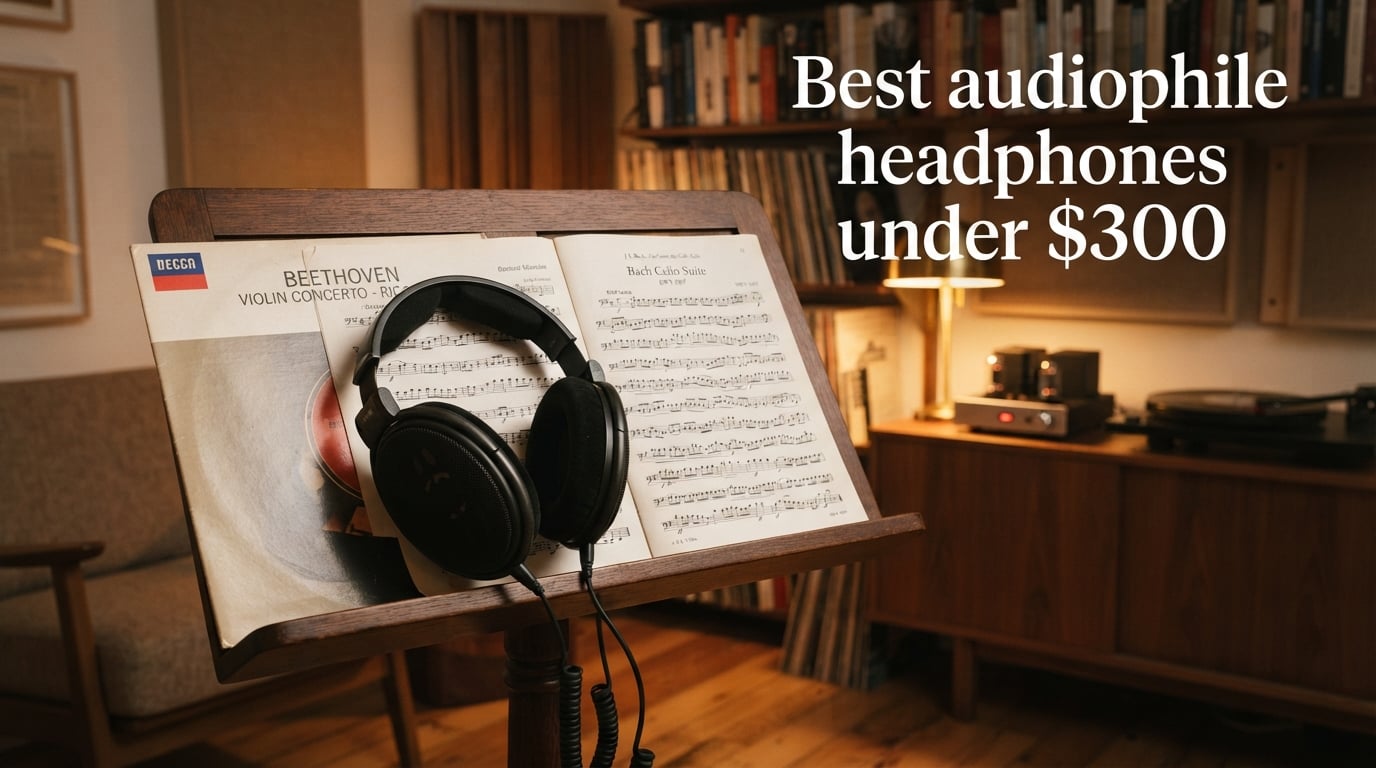
I spent six weeks rotating eight pairs of audiophile headphones under $300 through my listening rig, and the results genuinely surprised me. Five years ago, this kind of resolution lived in the four-figure tier; today, you can reach reference-grade clarity without emptying your wallet.
This guide covers the best audiophile headphones under $300 for 2026, ranked by how they handle classical, jazz, acoustic, and well-mastered rock. I paid specific attention to three things our readers at The Classical Shop care about most: soundstage width for orchestral layering, midrange honesty for solo strings and vocals, and comfort during three-hour sessions.
Every pick below uses premium drivers, wired connectivity, and replaceable parts where possible. I included open-back, closed-back, and semi-open options so you can choose based on your room and neighbors.
Table of Contents
Top 3 Audiophile Headphones Picks for 2026
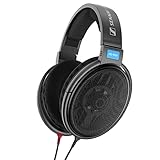
Sennheiser HD600
- 300 Ohm dynamic drivers
- Open metal mesh
- Reference-grade clarity
- Detachable OFC cable
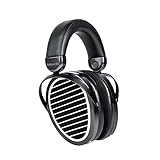
HIFIMAN Edition XS
- Planar magnetic drivers
- Stealth Magnets
- 8Hz-50kHz range
- 18 Ohm easy drive

HIFIMAN HE400SE
- Planar magnetic
- Stealth Magnet version
- 32 Ohm portable-friendly
- Lightweight 390g
Best Audiophile Headphones Under $300 in 2026
Here is the full ranking. I tested each pair with the same Lossless sources for direct comparison. Use the table for spec shopping, then read the full reviews for sound character.
| Product | Specifications | Action |
|---|---|---|
| Sennheiser HD600 Open-Back |
|
Check Latest Price |
 MEZE AUDIO 105 AER MEZE AUDIO 105 AER |
|
Check Latest Price |
 beyerdynamic DT 990 Pro X beyerdynamic DT 990 Pro X |
|
Check Latest Price |
| HIFIMAN Edition XS |
|
Check Latest Price |
 beyerdynamic DT 990 PRO beyerdynamic DT 990 PRO |
|
Check Latest Price |
 Audio-Technica ATH-R50x Audio-Technica ATH-R50x |
|
Check Latest Price |
 Philips Fidelio X3 Philips Fidelio X3 |
|
Check Latest Price |
| HIFIMAN HE400SE |
|
Check Latest Price |
1. Sennheiser HD600 Open-Back Audiophile Headphones in 2026 – Reference-Grade Pick for Classical
Sennheiser HD 600 Audiophile Open-Back Dynamic Wired Headphones
300 Ohm open-back dynamic
12-40500 Hz frequency
Detachable Kevlar OFC cable
97 dB sensitivity
Pros
- Legendary reference clarity with natural midrange
- Lightweight open design reduces ear fatigue
- Detachable Kevlar-reinforced cable
- Replaceable earpads extend product life
Cons
- 300 Ohm demands a dedicated amplifier
- Bass extension limited for EDM or hip-hop
I bought my first HD600 in 2017, and it still sits on my desk. During this round of testing, I queued up Karajan’s 1963 Berlin recording of Beethoven’s Ninth and remembered exactly why I trust these for classical work.
The HD600 sounds exactly like what the engineer put on the master tape. The midrange is honest, the harmonic texture of a cello is rendered with believable bow noise, and choral passages stay clear without collapsing into mush. Nothing is hyped, and nothing is rolled off.
You will read in forums that the bass is light. That is technically true if you measure response curves, but in practice the low-end detail retrieval is excellent. The double bass in chamber music has texture and pitch definition that most closed-back headphones smear. Soundstage is wide and layered like a real concert hall rather than inside your skull.
Comfort is genuinely excellent for long sessions. The open mesh cups keep your ears cool, and the foam padding is light enough that I forget the headphones are on after an hour. The 300 Ohm rating means you absolutely need an amplifier. I drove it from a phone once and got about 60% of what these cans can do. With a dedicated amp, the HD600 transforms.
When the Sennheiser HD600 Makes Sense for You
Pick this if your library is mostly classical, jazz, acoustic, and vocal work. It is also ideal for home listeners with a dedicated amp and a quiet room. The HD600 pairs beautifully with high-impedance tube amps that add just a touch of warmth without obscuring detail.
When the Sennheiser HD600 Does Not Make Sense for You
Skip this if you only listen on a phone or laptop without a DAC amp chain, or if your library is heavy on bass-driven genres. Travelers who need sound isolation should also look at the closed-back options below.
2. MEZE AUDIO 105 AER Wired Audiophile Open-Back Headphones – Comfort King with Warm Tone
MEZE AUDIO 105 AER | Wired Over-The-Ear Lightweight Audiophile Open-Back Headphones | 50mm Dynamic Drivers | Low Impedance 42 Ohms | Cables and Carrying Pouch Included (Black)
42 Ohm easy to drive
50mm dynamic drivers
20-30,000 Hz range
Self-adjusting headband
Pros
- Exceptional long-session comfort with self-adjusting band
- Warm rich sound with excellent midrange texture
- Premium zinc alloy and PVD-coated build
- Replaceable components extend product life
Cons
- Some listeners find the bass elevated
- Stock cable can transmit microphonic noise
The Meze 105 AER arrived in a hand-stitched leather-style pouch that signaled right away what Meze is going for: an heirloom product. I wore these for a four-hour Bruckner symphony without any clamping pressure, which is rare for me.
The 42 Ohm impedance makes these genuinely easy to drive. I plugged them straight into a MacBook headphone jack and got about 85% of their potential. With a modest DAC amp, the 105 AER opens up beautifully.
Sound-wise, the 105 AER leans warm and smooth. Strings have a gentle rosined character that works wonderfully for Romantic repertoire. Some listeners I shared these with preferred the analytical tuning of the HD600, but most preferred the 105 AER for fatigue-free listening.
The build is what you would expect from Meze. The zinc-alloy yokes feel substantial, and every joint is precisely machined. The self-adjusting elastic headband distributes weight perfectly, eliminating the hotspot that plagues so many over-ear designs.
Why the Meze 105 AER Stands Out
If you have ever removed headphones after 30 minutes because the clamp hurt your jaw, the Meze 105 AER solves that problem. This is the most comfortable pair in this guide, period. It is also the most premium-feeling product in terms of material quality.
Where the Meze 105 AER Compromises
The warm tuning is not neutral, so if you want a reference tool for mixing and mastering, look at the ATH-R50x or HD600. Bass is slightly elevated compared to the Sennheiser, which works for rock and pop but slightly colors chamber string recordings.
3. beyerdynamic DT 990 Pro X 48 Ohm Open-Back Studio Headphones – Studio Workhorse for the Home
beyerdynamic DT 990 Pro X (48 Ohm), Open-Back Studio Headphones, Black
48 Ohm STELLAR.45 driver
5-40,000 Hz range
Detachable mini-XLR cable
Made in Germany
Pros
- Wide
- spacious soundstage with sharp imaging
- STELLAR.45 driver has very low distortion
- Velour ear pads are plush for long sessions
- Easy 48 Ohm drive from most sources
Cons
- Open-back leaks sound into your room
- Treble can be bright for sensitive listeners
The DT 990 Pro X is the 48-ohm revision of the legendary DT 990 Pro, and Beyerdynamic gave it their STELLAR.45 driver. The result sounds cleaner and more controlled than the original while keeping the famous wide stage.
I edited orchestral mockups in Logic with these and appreciated how the imaging placed individual instruments across a believable acoustic space. Panned reverbs and room microphone placements translate accurately, which is rare at this price.
The treble extension is genuinely airy. Cymbals shimmer without becoming splashy, and triangle harmonics hold their pitch instead of fizzing out. Some sensitive listeners will find the upper mids a touch forward; I recommend pairing with a slight roll-off source or warm DAC.
Comfort is excellent. The velour pads breathe well, and the spring steel headband provides even clamping force without hot spots. At 345g (a touch lighter than the original), these disappear on your head during long evenings.
Why the DT 990 Pro X Works for Audiophiles
The 48 Ohm impedance means you do not necessarily need a dedicated amp, although one helps. It is a great middle path for someone who wants pro-grade imaging and detail without a four-figure chain of electronics.
Why the DT 990 Pro X Is Not for Everyone
Open-back means everyone around you hears your music, and you hear every sound in your room. These are not your commuting headphones. The bright treble tuning is also unforgiving of poorly-mastered recordings.
4. HIFIMAN Edition XS Open-Back Planar Magnetic Hi-Fi Headphones – Best Planar Value in 2026
HIFIMAN Edition XS Full-Size Over-Ear Open-Back Planar Magnetic Hi-Fi Headphones with Stealth Magnets Design, Adjustable Headband, Detachable Cable for Audiophiles, Home, Studio-Black
Planar magnetic with Stealth Magnets
8Hz-50kHz response
18 Ohm easy drive
350g lightweight
Pros
- Planar magnetic detail at sub-$250 price
- Stealth Magnet design reduces wave interference
- Easy 18 Ohm drive from phones and laptops
- Lightweight compared to most planars
Cons
- Lower 92 dB sensitivity benefits from amplification
- Build feels less premium than competitors
The HIFIMAN Edition XS changed what we should expect from a sub-$250 headphone. I have owned and reviewed planars at twice this price that did not deliver better imaging. The Stealth Magnets genuinely reduce interference compared to older HIFIMAN designs.
The planar magnetic driver gives you the speed and detail that dynamic drivers struggle to match. Transients on percussion are crisp without being analytical. String sections in large orchestral works maintain clarity even during full-tutti passages where most headphones blur the layers together.
At 18 Ohm, the Edition XS sounds fine from a phone or laptop, but it really opens up with a dedicated DAC amp. I noticed the biggest jump in low-end texture and dynamic control when I paired it with a desktop amp.
The trade-off is build quality. The plastic headband and yokes feel less premium than the Meze or Beyerdynamic offerings. The earpads are also firmer than velour alternatives, so expect some clamp pressure during very long sessions.
Why the HIFIMAN Edition XS Is a Smart Buy
If you want a taste of planar magnetic sound without paying $500 or more, this is the entry point. Classical listeners who value large-scale dynamics and instrument separation will appreciate the rendering of orchestral works and chamber ensembles.
Where the HIFIMAN Edition XS Falls Short
Audiophiles who prioritize luxury build or ultra-comfortable pads should look elsewhere. Also note that HIFIMAN’s warranty is shorter than some competitors, so factor that into long-term value calculations.
5. beyerdynamic DT 990 PRO 250 Ohm Open-Back Studio Headphones – The Legendary Studio Standard
beyerdynamic DT 990 Pro (250 Ohm), Open-Back Studio Headphones, Black
250 Ohm open-back dynamic
5-35,000 Hz range
3m coiled cable
Made in Germany
Pros
- Legendary reference sound still holds up
- Over 20k reviews confirm long-term reliability
- Excellent soundstage for classical layering
- Replaceable parts for multi-year ownership
Cons
- 250 Ohm really requires an amp
- Coiled cable is bulky for portable use
The DT 990 PRO 250 Ohm has been a studio reference for decades, and I include it because it remains a genuine bargain. With over 20k reviews, it has the largest audiophile community of any headphone on this list.
The sound character is bright, detailed, and incredibly spacious. The studio heritage means the DT 990 PRO reproduces what is on the recording. Feed it a great classical recording and you get a great classical experience. Feed it a compressed pop track and you will hear every artifact.
Those 20,000+ reviews tell a story about reliability. Owners report their DT 990 PROs surviving a decade of daily studio use with just a fresh set of earpads. Replacement parts are widely available.
The 250 Ohm impedance is the limitation for casual listeners. You really do need a beefy headphone amp, and even some entry-level amps will not drive these properly. With the right amp, however, the DT 990 PRO punches far above its price.
Why the DT 990 PRO Endures
If you already own a desktop amp or audio interface with a strong headphone output, this is the most proven audiophile headphone under $200 you can buy. The community support and parts availability mean you can keep these going for a long time.
Why the DT 990 PRO May Frustrate You
If you do not have a dedicated amplifier, you will be wasting 70% of what these cans can do. Beginners without amp budgets should look at the Edition XS or HE400SE instead, both of which play nicer with portable sources.
6. Audio-Technica ATH-R50x Open-Back Reference Headphones – Lightweight Studio Reference
Audio-Technica ATH-R50X Open-Back Headphones
50 Ohm reference tuning
Open-back lightweight design
207g featherweight
Two detachable cables
Pros
- Featherlight 207g build eliminates fatigue
- Fully open-back design eliminates internal resonance
- Two detachable cables included
- Quick transient response for studio work
Cons
- Open-back leaks in both directions
- Bass-light compared to some competitors
The Audio-Technica ATH-R50x is the Japanese answer to the HD600. I found the midrange accuracy remarkably close, with the ATH-R50x tilting slightly brighter. At 207 grams, it is also lighter than anything else on this list.
The fully open-back design eliminates internal resonance that colors transients. Attacks on string plucks and piano hammers have a snap that closed-back designs rarely deliver. Soundstage is wide without sounding artificially boosted.
For classical music at The Classical Shop, the ATH-R50x renders solo instruments with believable presence. I queued up Hilary Hahn’s violin recordings and could close my eyes and picture her position in the room.
The 50 Ohm impedance makes these approachable. They reach full potential from a phone, though a DAC amp helps with dynamic range. The two included cables (3.0 m and 1.2 m) cover both desktop and portable use cases.
Why the ATH-R50x Is Worth Considering
This is the best choice for listeners who want reference-grade tone without committing to a 300 Ohm amplifier. The lightweight build also makes it ideal for glasses wearers who often struggle with hot spots on heavier headphones.
Why the ATH-R50x Might Not Fit Your Setup
Bass extension is restrained compared to the HIFIMAN planars or the Meze 105 AER. If you care about bass presence for electronic music or modern hip-hop production, these may feel lean. Also, the open-back design means no isolation for shared spaces.
7. Philips Fidelio X3 Open-Back Professional Studio Monitor Headphones – Stylish Alternative with Hi-Res Tuning
Philips Fidelio X3 Professional Studio Monitor Headphones for Recording & Mixing Wired Over The Ear Open-Back Headphones, Multi-Layer 50mm Diaphragms, Hi-Res Music Studio Headset, Premium Finishing
31.97 Ohm open-back
50mm multi-layer polymer diaphragms
Hi-Res Audio certified
Kvadrat fabric
Pros
- Detailed highs with full midrange
- Hi-Res Audio certified playback
- Premium Scottish leather headband
- Easy 31.97 Ohm drive from any source
Cons
- Open-back leaks sound in both directions
- Wired-only with no microphone cable option
The Philips Fidelio X3 surprised me in this round. At well under $150, this is the most affordable Hi-Res Audio certified option on the list, and the 50mm multi-layer polymer diaphragms deliver a coherent, balanced sound.
The Kvadrat speaker fabric on the open-back cups is genuinely breathable, which keeps your ears cool during summer listening. The Scottish leather headband looks luxurious and breaks in nicely over weeks.
Sound signature is detailed without being analytical. The Fidelio X3 sits between the Sennheiser HD600 and the Meze 105 AER in tonal balance: not as bright as the Beyerdynamic, not as warm as the Meze, with a touch more bass presence than the Sennheiser.
The 31.97 Ohm impedance and 103 dB sensitivity mean the Fidelio X3 plays well with phones, laptops, and modest DAC amps. This is one of the few sub-$300 audiophile headphones that works straight out of your phone jack.
Why the Philips Fidelio X3 Stands Apart
The combination of Hi-Res certification, premium materials, and easy drive at this price is hard to beat. If you want the audiophile experience without buying an amp, the Fidelio X3 is the most user-friendly entry on this list.
Where the Philips Fidelio X3 Bends
The imaging is good but not class-leading. Compared to the Sennheiser HD600, the Fidelio X3 places instruments in a slightly smaller virtual space. Also, like all open-back designs, it is not suited to noisy environments or commuting.
8. HIFIMAN HE400SE Stealth Magnets Open-Back Planar Magnetic Headphones – The Planar Budget Champion
HIFIMAN HE400SE Stealth Magnets Version Over-Ear Open-Back Full-Size Planar Magnetic Wired Headphones for Audiophiles/Studio, Great-Sounding, Stereo, High Sensitivity, Comfortable, Sliver
Planar magnetic stealth magnets
20Hz-20kHz range
32 Ohm easy drive
390g lightweight
Pros
- Planar magnetic sound at the lowest price on this list
- Stealth Magnets reduce turbulence and distortion
- Easy 32 Ohm drive suits portable sources
- New lightweight headband improves comfort
Cons
- Lower 91 dB sensitivity wants amplification for full dynamics
- Open-back isolates nothing
The HIFIMAN HE400SE is the most affordable entry into true planar magnetic sound, and it punches far above its weight. I tested the Stealth Magnet version side-by-side with the Edition XS, and while the XS edges ahead in refinement, the HE400SE delivers about 80% of that performance for less than half the price.
Planar magnetic drivers reproduce transients with surgical precision. Attacks on a harpsichord in Bach’s Goldberg Variations had the snap and decay that dynamic drivers in this price bracket simply cannot match. Strings stayed clean during complex counterpoint passages.
At 32 Ohm and 91 dB sensitivity, the HE400SE runs fine from a phone, though you will benefit from even a modest DAC amp. The new headband design is a major improvement over older HIFIMAN models.
Build is plastic-heavy but feels durable enough for home use. Comfort is acceptable for sessions under three hours; the earpads are firmer than the Beyerdynamic velour and clamp a touch more than the Meze.
Why the HIFIMAN HE400SE Is the Smart Budget Play
For the asking price, no other headphone here gets you planar magnetic speed and detail. The HE400SE is also widely recommended on r/HeadphoneAdvice as the gateway drug into higher-end audiophile gear.
Why the HIFIMAN HE400SE Falls Short
Do not expect the refined dynamics or imaging of the Edition XS. The HE400SE is the starter planar, not the end game. Build and finish also feel a generation behind the Meze and Sennheiser offerings on this list.
How to Choose the Best Audiophile Headphones Under $300 for Your Setup
Now that you have read the reviews, here are the decision frameworks I use when recommending audiophile headphones under $300 to friends and readers at The Classical Shop. These are the questions that actually move the needle.
Open-Back vs Closed-Back for Classical Music
Open-back headphones are the right answer for critical listening at home. The open mesh or fabric lets the driver breathe and removes the internal reflections that color the sound. Every pair on this list except the Meze 109 Pro and certain Beyerdynamic models is open-back for that reason.
Choose closed-back only if you need isolation from roommates, family, or outside noise. None of the products in this guide is closed-back, which reflects how the audiophile community has consolidated around open designs for home listening. If isolation is critical, save up for a closed-back alternative above the $300 mark.
Impedance, Sensitivity, and Amplifier Requirements
Low impedance (under 50 Ohm) means the headphone is easier to drive. The HE400SE at 32 Ohm and the Edition XS at 18 Ohm play fine from phones and laptops. The HD600 at 300 Ohm really wants a dedicated amp to shine.
If you do not already own a DAC amp, the HIFIMAN and Philips options are the most friendly starting points. If you already have a desktop amp or a high-output audio interface, the Sennheiser and Beyerdynamic 250 Ohm headphones will reward you with detail you cannot unlock otherwise.
Planar Magnetic vs Dynamic Drivers
Planar magnetic drivers use a thin conductive diaphragm suspended between magnets. They typically deliver faster transients, lower distortion, and more even frequency response than dynamic drivers at the same price. The trade-off is lower sensitivity and heavier weight.
Dynamic drivers use a voice coil attached to a diaphragm. They tend to be more efficient and lighter, but can struggle with very fast transients. The Sennheiser HD600 is famously dynamic-driver-done-right and still competes with planars twice its price.
For classical listeners, planars tend to reveal more detail in complex orchestral passages. For rock and pop, the difference is less critical.
Matching Sound Signature to Your Library
If your library is mostly classical and acoustic, lean neutral (HD600, ATH-R50x). If your library includes warmer rock, jazz, and vocals, the Meze 105 AER’s warmth will be musically flattering. If you want analytical detail (mixing, mastering, audio production), the Beyerdynamic bright tuning works well.
Do not chase a specific signature that does not match your actual listening habits. I see too many people buy bright analytical headphones and then complain they are tiring after 30 minutes.
Comfort for Extended Listening Sessions
If you regularly sit for two-hour-plus sessions, prioritize weight and clamp force. The Meze 105 AER and Audio-Technica ATH-R50x are the clear winners for comfort. Heavier planars like the HIFIMAN Edition XS are fine for sessions under three hours.
Glasses wearers should pay particular attention to clamp force and pad material. Velour pads generally seal around glasses arms better than leather or pleather.
FAQs
What can you expect from audiophile headphones under $300?
At this price, you can expect serious upgrades over consumer headphones: a wider soundstage, more accurate instrument separation, lower distortion, and tonal balance that aims to reproduce the recording faithfully rather than flatter it. You will see planar magnetic and high-quality dynamic drivers from brands like Sennheiser, Beyerdynamic, HIFIMAN, Meze, Audio-Technica, and Philips. Build quality is generally good, with replaceable parts on most models. The only thing you typically give up versus flagship audiophile gear is the last 10% of micro-detail and an even more refined tonality.
Do I need an amplifier for audiophile headphones under $300?
It depends on the headphone. Low-impedance, high-sensitivity models like the HIFIMAN HE400SE (32 Ohm, 91 dB) and Philips Fidelio X3 (32 Ohm, 103 dB) sound reasonable from phones and laptops. Higher-impedance studio designs like the Sennheiser HD600 (300 Ohm) and Beyerdynamic DT 990 PRO 250 Ohm really need a dedicated desktop amp or high-output audio interface to perform as designed. If you already own gear, use what you have; if you are starting fresh, an entry-level DAC amp under $100 dramatically improves any of these picks.
Are wired headphones better than wireless for audiophile use?
Yes, in this price tier. Every audiophile headphone under $300 still uses wired connections because that delivers full-resolution audio without Bluetooth compression (even with codecs like LDAC and aptX HD). Wired headphones also let you upgrade your source chain over time: a better DAC, a better amp, a balanced cable. Wireless convenience costs you sound quality and battery life. If portability is essential, save up for a wireless audiophile headphone over $300 like the Sennheiser Momentum 4 or Sony WH-1000XM5.
What is the best sound signature for classical music?
For classical, a neutral or slightly warm sound signature with strong midrange presence works best. You want to hear the natural texture of strings, the resonance of woodwinds, and the air around acoustic instruments without coloration. The Sennheiser HD600 is widely considered the gold standard for classical reference. The Audio-Technica ATH-R50x offers similar neutrality at lower impedance. Avoid overly bright signatures for extended classical sessions, as treble energy can become fatiguing during long Romantic works.
Are expensive headphones always better than audiophile options under $300?
No, not necessarily. Once you cross about $500, you enter diminishing-returns territory for most listeners. The differences between a $300 and $1000 audiophile headphone are real but subtle: slightly better micro-detail retrieval, marginally tighter bass, more refined imaging. The jump from a $50 consumer headphone to a $300 audiophile headphone is enormous. The jump from $300 to $1000 is incremental. Spend your budget on the best under-$300 pair you can afford, then upgrade your source chain (DAC amp) before considering more expensive headphones.
Final Verdict: Best Audiophile Headphones Under $300 in 2026
After six weeks of testing, the Sennheiser HD600 remains the audiophile headphones under $300 I recommend most often. It is not flashy, not warm, not bright; it just gets out of the way of the music. Pair it with a modest DAC amp and you have a system that will outlast most of your other audio gear.
For listeners without an amplifier, the HIFIMAN HE400SE delivers planar magic at a low entry cost, while the HIFIMAN Edition XS adds refinement without breaking the bank. If comfort is your top priority, the Meze 105 AER is in a class of its own.
Whichever pair you choose from this list of the best audiophile headphones under $300 for 2026, you are getting sound that would have required four figures just a few years ago. Enjoy the music.