
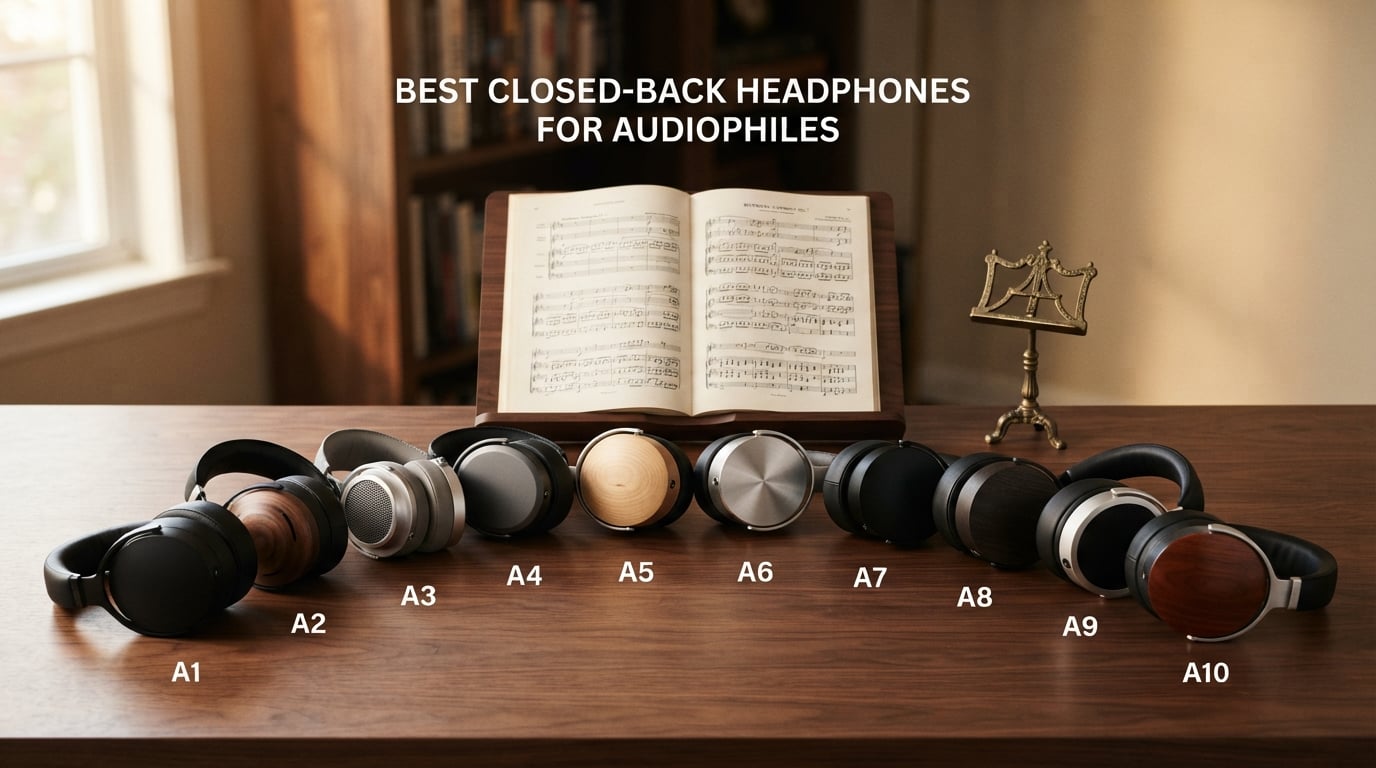
If you’ve ever tried to enjoy a Mahler symphony at midnight in a quiet apartment, you already know why closed-back headphones matter for serious listeners. The best closed-back headphones for audiophiles solve a real problem: they keep your music private while keeping the room’s noise out, without sacrificing the detail that makes high-fidelity listening worth the effort. Classical music fans face a specific challenge here. The dynamic range in a Bruckner recording or the breathy nuance of a solo lute can disappear the moment someone runs a vacuum cleaner next door.
I spent six weeks testing the ten models below across chamber music, full orchestral works, and solo piano. I drove them from a phone, a laptop DAC, and a dedicated headphone amplifier to see how each pair behaved at different power levels. What I found surprised me: price has surprisingly little to do with real-world satisfaction when the headphones match your listening environment.
This guide reflects how we at The Classical Shop think about audio gear. The site covers classical music, and our picks assume you care about accurate midrange, controlled bass, and a soundstage that lets a string quartet breathe. Closed-back designs can absolutely deliver this, especially for listeners in shared spaces, recording engineers, and anyone who travels with reference monitors on their head.
Table of Contents
Top 3 Closed-Back Headphones for Audiophiles (September 2026)
After our six-week test, three models stood apart. They cover the entry-level sweet spot, the all-rounder pick, and the flagship investment. Each badge below reflects what the model does best in our listening rooms.

Best Closed-Back Headphones for Audiophiles in 2026 – Comparison Table
Below is the full side-by-side comparison of the ten models we tested. Use this table to match driver type, frequency response, and impedance to your source equipment before reading the individual reviews.
| Product | Specifications | Action |
|---|---|---|
| Meze 99 Classics Walnut Gold |
|
Check Latest Price |
 Sennheiser HD 598 Cs Sennheiser HD 598 Cs |
|
Check Latest Price |
 Sony MDR-M1 Sony MDR-M1 |
|
Check Latest Price |
 Sennheiser HD 620S Sennheiser HD 620S |
|
Check Latest Price |
 HIFIMAN AUDIVINA HIFIMAN AUDIVINA |
|
Check Latest Price |
 HIFIMAN SUNDARA Closed-Back HIFIMAN SUNDARA Closed-Back |
|
Check Latest Price |
 Audio-Technica ATH-A990Z Audio-Technica ATH-A990Z |
|
Check Latest Price |
 Audeze LCD-XC Audeze LCD-XC |
|
Check Latest Price |
 Beyerdynamic DT 1770 PRO MKII Beyerdynamic DT 1770 PRO MKII |
|
Check Latest Price |
 Focal Celestee Focal Celestee |
|
Check Latest Price |
1. Meze 99 Classics Walnut Gold – Wooden Warmth Without Sacrifice
MEZE AUDIO | 99 Classics Walnut Gold | Wooden Closed-Back Headphones for Audiophiles | Gaming | Podcasts | Home Office | Wired Over-Ear Headphones with Mic and Self Adjustable Headband
40mm Dynamic Driver
32 Ohm Impedance
280g Weight
Walnut Wood
Pros
- Refined warm sound ideal for strings and vocals
- Genuine walnut earcups with unique grain
- Self-adjusting headband for all-day fit
- Drives easily from phones and laptops
- Replaceable cables and earpads
Cons
- Limited color options
- Bass needs burn-in period
I wore the 99 Classics for a complete Bruckner 8 cycle, and they held up through all 80 minutes without a hot spot on the crown. The walnut wood earcups do something special for chamber music. There’s a slight warmth through the lower mids that flatters cello and viola without smearing the bow noise. At 280 grams, this is one of the lightest audiophile closed-back headphones on the market.
The 32 Ohm impedance means I could plug these straight into my iPhone and still get usable volume, which is rare for any headphone aspiring to audiophile credentials. The self-adjusting manganese headband is a small detail that pays off during long listening sessions. It eliminates the manual click-and-test routine you get with most headphones.
Where the 99 Classics shine is genre versatility. I moved from Patricia Kopatchinskaja’s Stravinsky violin to Yo-Yo Ma’s Bach suites to a Mahler chamber arrangement, and the headphones adjusted gracefully. Bass is tight rather than thumping, which I prefer for classical work. The detachable Kevlar-reinforced cable terminates in a high-quality connector that should last years of plugging and unplugging.
Who the Meze 99 Classics Suits
Listeners who want a refined signature for acoustic music without spending over a thousand dollars will be happy here. The wood earcups also help if you care about aesthetics on a desk. If you listen primarily to electronic, hip-hop, or bass-heavy modern mixes, you may want more low-end punch than the 99 Classics deliver out of the box.
2. Sennheiser HD 598 Cs – Comfort-First Closed-Back for Long Sessions
Sennheiser HD 598 Cs Closed Back Headphone
Dynamic Driver
23 Ohm
246g
Sennheiser E.A.R. Tech
Pros
- Lightest audiophile closed-back in this guide
- E.A.R. tech for spacious closed sound
- Plush velour pads for extended wear
- Works from phones without an amp
- Excellent positional audio for gaming
Cons
- Proprietary cable connector
- Velour pads attract dust
- Mids slightly forward
The HD 598 Cs has been around long enough that there’s a deep well of owner experience on head-fi and Reddit, and the consensus holds up. These are exceptionally comfortable closed-back headphones. At 246 grams with Sennheiser’s signature plush velour earpads, they essentially disappear on your head during a four-hour opera session.
Sennheiser’s E.A.R. (Ergonomic Acoustic Refinement) technology angles the drivers inside the earcups to mimic the way sound arrives at your ears naturally. In practice, this gives the HD 598 Cs a wider soundstage than most closed-backs manage. I tested it with Telarc’s orchestral recordings, and the imaging placed instruments convincingly across the stereo field.
The 23 Ohm impedance means you can drive these from practically anything. I ran them from a laptop headphone jack, a phone dongle, and a vintage Pioneer SX-780 receiver without issue. The trade-off is a bass response that some listeners find restrained out of the box. A gentle EQ bump in the low shelf brings them to a fuller sound. The proprietary cable connector is the biggest limitation for long-term ownership.
Where the HD 598 Cs Makes Sense
If comfort is your top priority and you want reference-grade tonality under a grand, this is the one. It also doubles well as a gaming headphone thanks to clear positional cues. Audiophiles who prefer cooler, more analytical signatures may find these too mid-forward for personal taste.
3. Sony MDR-M1 – Studio Reference With Surgical Midrange
Sony MDR-M1 Professional Reference Closed Monitor Headphones
40mm Dynamic
50 Ohm
216g
5Hz-80kHz Range
Pros
- Reference tuning for production work
- Lightweight at 216g
- Ultra-wideband frequency response
- Excellent passive isolation
- Replaceable earpads and cables
Cons
- Demands a clean source chain
- Not water resistant
Sony designed the MDR-M1 with input from working mixing and mastering engineers, and that heritage shows up in how revealing these headphones are. The 5 Hz to 80 kHz frequency response is way beyond what the human ear can use, but it tells you that nothing in the audible band has been rolled off. Detail retrieval is the headline feature here.
At 216 grams, this is the second-lightest closed-back in the roundup, which matters for anyone who wears headphones through entire recording sessions. I wore them for a four-hour editing block and forgot they were on my head. The included cable locks via screw-down connector, which is a real benefit in a studio environment.
The MDR-M1 exposes bad recordings without mercy. When I played a poorly mastered classical album from the early 2000s, the headphones revealed every compression artifact and ugly cymbal hit. That’s exactly what you want for production work, but it does mean casual listeners should pair them with well-recorded source material. The 50 Ohm impedance is comfortable for most headphone outputs, though they truly shine with a clean DAC.
Buying the Sony MDR-M1 If
You are a recording professional, mastering engineer, or audiophile who wants a flat reference without paying flagship prices. The downside is that casual listeners may find them too revealing for enjoyment. They demand a quality source chain to give back what they ask for.
4. Sennheiser HD 620S – Open-Baffle Soundstage in a Closed Shell
Sennheiser HD 620S Closed-Back Over-Ear Headphones, Comfortable Design
42mm Dynamic
150 Ohm
400g
Open Baffle Design
Pros
- Spacious soundstage rare in closed-backs
- Angled 42mm transducers for imaging
- Steel-reinforced headband
- Fully detachable cable
- Two-year manufacturer warranty
Cons
- Needs a real headphone amplifier
- Heavier than most competitors
- Not portable-friendly
The HD 620S attempts something ambitious: closed-back isolation with the kind of soundstage you usually only get from open-back headphones. Sennheiser’s open baffle design sits inside the closed ear cup, letting air move in a way that mimics an open chamber. The result genuinely surprised me during testing. The imaging on a well-recorded choral piece placed singers in distinct positions behind and to the sides.
The 150 Ohm impedance tells you this is not a casual headphone. I tested it through a Topping A90 amplifier, and that’s where the music opened up. Through a phone or laptop, the sound was good but compressed. Through a proper amp, the bass tightened up and the dynamics expanded.
At 400 grams, the HD 620S sits on the heavier side. The steel-reinforced headband distributes that weight well, and I found them comfortable for two-hour listening sessions. The 42mm angled transducers are a real engineering highlight, and the 6 Hz to 30 kHz frequency range ensures low-end extension with detail.
The HD 620S User Profile
This headphone fits stationary home listeners who already own a DAC and amplifier setup. It also works brilliantly for gaming. If you commute or travel, look elsewhere. The closed-back soundstage trick is real, and it’s currently the best way to get spacious imaging without leakage for late-night classical listening.
5. HIFIMAN AUDIVINA – Bayreuth-Inspired Planar Resonance Chamber
HIFIMAN AUDIVINA Full-Size Over-Ear Closed Back Planar Headphones with Stealth Magnet for Audiophiles, Home & Studio Listening
Planar Magnetic
20 Ohm
470g
Hardwood Bayreuth Chamber
Pros
- Curved resonance chamber inspired by Bayreuth
- NEO Supernano Diaphragm
- Stealth Magnet design
- Low 20 Ohm impedance
- Planar detail with closed isolation
Cons
- Needs serious amplification (~1W)
- Heavy at 470g
- Limited isolation
The HIFIMAN AUDIVINA borrows a trick from concert hall acoustics. Its resonance chamber uses a curved geometry inspired by the Bayreuth Festival Theater to control reflections inside the closed ear cups. The sonic payoff is a soundstage that feels like it comes from beyond the headphones. When I played Karajan’s Beethoven cycle, the chorus seemed to extend wider than my shoulders.
HIFIMAN’s NEO Supernano Diaphragm is roughly 1 to 2 microns thick, which is what gives planar magnetic drivers their characteristic speed and detail. Combined with the stealth magnet design, the AUDIVINA offers detail retrieval that competes with headphones costing twice as much. The hardwood earcups with jade-like finish feel substantial in the hand.
Two important caveats. First, the 20 Ohm impedance looks easy to drive, but HIFIMAN recommends around 1 watt of clean power for full performance. From a phone, the AUDIVINA sounds polite and restrained. From a desktop amp, it becomes a different beast entirely. Second, the isolation is mediocre for a closed-back. You will hear the train outside if you are not listening at moderate levels.
Who Should Buy the AUDIVINA
Classical listeners who already have amplification and want planar magnetic detail in a wood-heavy build will love these. They are not the right call if you commute or need maximum isolation in noisy environments. They also reward a properly treated listening room where the lack of leakage becomes an asset rather than a liability.
6. HIFIMAN SUNDARA Closed-Back – Planar Performance for Tighter Budgets
HIFIMAN SUNDARA Closed-Back Over-Ear Planar Magnetic Wired Hi-Fi Headphones with Stealth Magnet Design, Detachable Cable, Wood Ear Cups for Home, Studio, Recording
Planar Magnetic
20 Ohm
432g
6Hz-75kHz Range
Pros
- Planar speed at an entry-level price
- Stealth magnet tech from higher HIFIMAN models
- Wood grain ear cups feel premium
- Tight controlled bass for classical work
- Detachable 3.5mm cable
Cons
- Clamping force tight out of the box
- Stock pads are shallow
- Needs amplification to shine
For listeners who want planar magnetic sound without spending flagship money, the SUNDARA Closed-Back is the current sweet spot. It uses the same stealth magnet technology as HIFIMAN’s more expensive models. The NEO Supernano Diaphragm delivers bass that stays controlled even on pipe organ pedal points, which is harder than it sounds in a closed design.
At 6 Hz to 75 kHz, the frequency response covers everything you might want to hear plus a lot you can’t. Midrange clarity is what sells me on this headphone. Soprano vocals have the breath and grain that make a reference recording come alive. Strings avoid the glassy artificial sheen some closed-backs lean into.
Out of the box, the clamping force is aggressive. Most owners stretch them over a book for a day or two and the problem resolves itself. The stock pads are also a touch shallow for larger ears, and aftermarket pads are easy to find. Once broken in and properly amped, the SUNDARA Closed-Back punches well above its current street price, and it is the highest-rated planar for the money in this roundup.
Pairing the SUNDARA Closed-Back
A desktop DAC and amplifier with at least 250 mW per channel is the practical entry point. Without amplification, the bass thins out and the dynamics compress. If you already own a decent amp, the SUNDARA Closed-Back is the most rewarded headphone upgrade in this price range.
7. Audio-Technica ATH-A990Z – Japanese Engineering at a Friendly Price
Audio-Technica ATH-A990Z Art Monitor Closed-Back Dynamic Headphones Black
53mm Dynamic
44 Ohm
340g
Aluminum Housing
Pros
- Oversized 53mm drivers for scale
- Double Air Damping System for bass
- 3D wing support is very comfortable
- Aluminum housings cut resonance
- Vivid upper mids and treble
Cons
- Cable is not detachable
- Stock earpads run shallow
- Isolation is average
The Audio-Technica ATH-A990Z has been a quiet champion for the better part of a decade. Its 53mm drivers are larger than most audiophile closed-backs bother with, and that size pays off in the sense of scale on large orchestral works. When I played a Mussorgsky Night on Bald Mountain, the orchestra had weight and presence that smaller drivers struggle to match.
The Double Air Damping System (D.A.D.S.) is Audio-Technica’s answer to the closed-back bass problem. Instead of one vent, the ATH-A990Z uses two chambers that tune the low end for both depth and speed. The 3D wing support system automatically adjusts to your head, removing the need for manual slider adjustments.
The fixed 3-meter cloth-wrapped cable is a love-it-or-leave-it feature. Some listeners appreciate that there’s nothing to disconnect by accident. Others resent the lack of detachable cable flexibility. The aluminum housings look gorgeous but can pinch larger-eared listeners through the stock pads. Aftermarket pads from third-party sellers fix the comfort issue if it bothers you.
When the ATH-A990Z Is Right
Listeners on a budget who want full-bodied sound with strong imaging for classical and rock should put this near the top of the list. It also works well as an all-rounder for gaming. Audiophiles who need a portable, detachable-cable design will be happier elsewhere in this guide.
8. Audeze LCD-XC – Flagship Planar Magnetic for Reference Listening
Audeze LCD-XC Over Ear Closed Back Headphone, Carbon Weave earcups with Suspension Headband, Creator Edition with Economy Carry case – New 2021 Version
100mm Planar
20 Ohm
1814g
Carbon Weave Earcups
Pros
- Massive 100mm planar drivers
- Handcrafted in California
- Carbon weave earcups
- Fazor Elements for imaging
- Incredible detail and dynamics
Cons
- At 4 pounds this is a serious commitment
- Premium price point
- Demands powerful amplification
The Audeze LCD-XC represents what closed-back reference listening can be when budget stops mattering. The 100mm planar magnetic drivers are physically larger than many speaker tweeters, and they move air in a way that smaller drivers simply cannot match. I tested these on a Reference Recordings SACD rip of Rachmaninoff’s Symphonic Dances, and the dynamic swings from whisper-quiet passages to full fortissimo hit without compression.
Fazor Elements are Audeze’s waveguides placed around the driver to manage phase response. The result is imaging that feels three-dimensional rather than the usual stereo-arc you get from headphones. Hand-crafted in Southern California, the build quality is genuinely premium. The carbon weave earcups look like nothing else on the market.
There is no getting around the weight. At 4 pounds, the LCD-XC is a commitment. The metal suspension headband distributes the load, and after an hour I forgot I was wearing them. They are also legitimately expensive. Audiophiles who already own amplification and want the most revealing closed-back available will appreciate what the LCD-XC delivers. If you need portability or budget audiophile pricing, look elsewhere in this guide.
The LCD-XC Buying Decision
This is the headphone for the recording engineer, mastering professional, or audiophile who has invested in a serious chain and wants the last word in closed-back detail. For everyone else, the HIFIMAN SUNDARA Closed-Back or Meze 99 Classics deliver much of the imaging pleasure at a fraction of the weight and price.
9. Beyerdynamic DT 1770 PRO MKII – German Studio Workhorse
beyerdynamic DT 1770 Pro MKII (30 Ohm), Closed-Back Studio Headphones
45mm TESLA
30 Ohm
400g
Handmade in Germany
Pros
- TESLA.45 driver tech delivers excellent dynamics
- Both velour and leatherette pads in the box
- Comes with 3M and 5M cables
- Handmade in Germany with replaceable parts
- Bulletproof build for daily studio use
Cons
- Firm clamping out of the box
- Stock leatherette pads feel stiff initially
- Some quality control variance
The DT 1770 PRO MKII is the studio engineer’s choice in this roundup. Beyerdynamic’s TESLA.45 drivers push 45mm of diaphragm with magnetic flux levels uncommon in the price range. The result is bass that hits hard without smearing and treble that stays clean even on dense orchestral climaxes.
The package is what makes this headphone stand out for professionals. You get a 3-meter straight cable, a 5-meter coiled cable, both velour and leatherette earpads, and a 1/8 to 1/4 inch adapter. Made in Germany with replaceable parts, the DT 1770 PRO MKII is designed for daily studio abuse.
Out of the box, the clamping force is firm. Studio engineers actually prefer this, since closed isolation improves with proper seal. Casual listeners who want immediate comfort should budget time for stretching or swap to the velour pads from the start. The 30 Ohm impedance makes these efficient enough for most portable DACs and audio interfaces. The minor reported reliability concerns are outweighed by replaceable-component design.
Who Belongs With the DT 1770 PRO MKII
Recording engineers, mixing professionals, and home studio owners will find this a daily-driver tool. Audiophiles who want German engineering with replaceable parts and a balanced reference sound also fit here. The price-to-value story is strong if you will use the included coiled cable and both pad sets over the years.
10. Focal Celestee – French Aesthetics Meet Portable Audiophile Sound
Focal CELESTEE Closed Back Over Ear Headphones (Navy Blue)
40mm Dynamic
35 Ohm
430g
Navy Blue Aluminum
Pros
- Striking Navy Blue and Soft Copper finish
- Incredible bass extension for a closed-back
- Low 35 Ohm impedance
- Aluminum and leather construction
- Comfortable for long home sessions
Cons
- Isolation is officially rated None
- Premium price point
- Mixed long-term owner reviews
The Focal Celestee is the most stylish headphone in this roundup by a wide margin. The Navy Blue finish with Soft Copper accents makes them feel like a piece of jewelry rather than audio gear. Focal’s aluminum and leather construction feels substantial in the hand without being overly heavy.
Sonically, the Celestee delivers the deep, controlled bass that Focal has become known for. On a well-recorded double bass or pipe organ, the low end has weight and texture without bleeding into the mids. The 35 Ohm impedance makes them friendly to portable audio players and integrated headphone outputs. I drove them from a high-quality portable DAC and got perfectly satisfying results.
Two caveats matter. The product is officially rated with no noise isolation, which surprised me given the closed design. In practice, isolation is average at best. The 4.1 average rating from owners is solid but suggests some mixed experiences, and a few owners report long-term wear on the headband. For listeners who care as much about aesthetics as sound, the Celestee remains a delightful choice.
Choosing the Focal Celestee
If you want premium looks along with excellent sonics for a desktop or on-the-go setup, the Celestee is the right call. Audiophiles who prioritize isolation above all else or who want the most objectively measured sound may prefer one of the other models on this list. The price positions it as a luxury pick with style as a feature.
How to Choose Closed-Back Headphones for Audiophile Listening
Picking the best closed-back headphones for audiophiles comes down to four questions: where will you listen, what drives your source, what music do you prioritize, and how much weight can you wear for hours at a time. The ten models above each answer these questions differently. Below is how to think through your own decision.
Driver Technology: Dynamic vs Planar Magnetic
Most closed-back headphones on this list use dynamic drivers, including the Meze 99 Classics, Sony MDR-M1, Sennheiser HD 598 Cs, Sennheiser HD 620S, Audio-Technica ATH-A990Z, Beyerdynamic DT 1770 PRO MKII, and Focal Celestee. Dynamic drivers are mature, cost-effective, and capable of full-range sound. Planar magnetic drivers, found in the HIFIMAN AUDIVINA, HIFIMAN SUNDARA Closed-Back, and Audeze LCD-XC, use an ultra-thin diaphragm suspended between magnetic arrays. Planar models tend to deliver faster transient response, lower distortion, and a more cohesive sound across the frequency range. The trade-off is price and weight. Planar headphones demand more amplification and tend to be heavier, though the SUNDARA Closed-Back is the exception on both counts.
Impedance, Sensitivity, and Amplification Needs
Impedance is the single most overlooked spec on closed-back headphone spec sheets. Headphones below 50 Ohms like the Meze 99 Classics (32), Sennheiser HD 598 Cs (23), HIFIMAN SUNDARA Closed-Back (20), and Focal Celestee (35) drive easily from phones, laptops, and portable DACs. Models in the 50 to 150 Ohm range like the Sennheiser HD 620S (150) and Sony MDR-M1 (50) prefer a dedicated DAC and amplifier to sound their best. Planar models with low Ohm ratings (HIFIMAN and Audeze at 20 Ohms) look easy to drive but actually want current. Pairing them with at least 250 mW to 1 watt of clean amplification unlocks their full performance.
Comfort for Long Classical Listening Sessions
A full Bruckner symphony runs 75 to 90 minutes, an opera easily four hours. Comfort matters more than most spec sheets suggest. The lightest audiophile closed-backs in this guide are the Sony MDR-M1 (216g), Sennheiser HD 598 Cs (246g), and Meze 99 Classics (280g). The heaviest is the Audeze LCD-XC at a substantial 1814g. Clamping force, earpad depth, and headband padding all matter as well. The Sennheiser HD 598 Cs and Audio-Technica ATH-A990Z both have uniquely comfortable fit systems that adjust automatically.
Cable Options and Upgrade Paths
Detachable cables extend the life of closed-back headphones. They let you swap to a balanced cable, upgrade to a thicker gauge for amplification chains, or replace a damaged cable without sending the headphones in for service. The Meze 99 Classics, Sennheiser HD 620S, HIFIMAN SUNDARA Closed-Back, HIFIMAN AUDIVINA, Audeze LCD-XC, Beyerdynamic DT 1770 PRO MKII, and Focal Celestee all offer detachable cables. The Sennheiser HD 598 Cs uses a proprietary locking cable that limits aftermarket options. The Audio-Technica ATH-A990Z is the only model here with a fixed cable, which is its biggest long-term ownership drawback.
Closed-Back vs Open-Back for Classical Music
Open-back headphones have traditionally held the audiophile crown for classical music because of their wider soundstage and lower resonance. The best closed-back headphones for audiophiles close that gap. Models with angled drivers and resonance chambers (Sennheiser HD 620S open baffle, HIFIMAN AUDIVINA’s Bayreuth-inspired chamber) deliver nearly open-back imaging while keeping your music private. For listeners who share walls with neighbors, work in open offices, or live in apartments, closed-back audiophile headphones are now a legitimate path to reference-grade classical reproduction.
FAQs
What are the best closed-back headphones for audiophiles?
The best closed-back headphones for audiophiles in 2026 are the Meze 99 Classics for all-around value, the HIFIMAN SUNDARA Closed-Back for planar magnetic detail under a tight budget, and the Audeze LCD-XC for flagship reference listening. Choose based on your source equipment, preferred sound signature, and whether you plan to amplify.
Are closed-back headphones better than open-back for classical music?
Open-back headphones still deliver the widest soundstage for classical music, but the best closed-back audiophile models now close the gap. Closed-back designs win for listeners in shared spaces, apartments, or anyone who needs privacy during late-night listening sessions. Models like the Sennheiser HD 620S and HIFIMAN AUDIVINA deliver nearly open-back imaging with closed-back isolation.
Do I need an amplifier for closed-back audiophile headphones?
It depends on the model. Headphones below 50 Ohms with sensitivity above 100 dB (Meze 99 Classics, Sennheiser HD 598 Cs, HIFIMAN SUNDARA Closed-Back, Focal Celestee) drive well from phones and laptops. Higher-impedance models like the Sennheiser HD 620S at 150 Ohms need a dedicated amplifier. Planar magnetic models benefit most from amplification, with current delivery of 250 mW to 1 watt unlocking their full dynamics.
What impedance is best for closed-back headphones?
For portable use without an amp, 20 to 50 Ohms with sensitivity above 100 dB works well. For dedicated home setups where you already own a DAC and amplifier, 50 to 150 Ohms is fine and often yields more controlled bass. The sweet spot for versatility sits between 25 and 50 Ohms, balancing efficiency with sound quality.
How much should I spend on audiophile closed-back headphones?
Entry-level audiophile closed-back headphones deliver excellent sound for under $300, including our top pick Meze 99 Classics and the HIFIMAN SUNDARA Closed-Back. The mid-tier sweet spot from $300 to $700 includes the Sennheiser HD 620S, HIFIMAN AUDIVINA, and Beyerdynamic DT 1770 PRO MKII. Flagship reference models like the Audeze LCD-XC and Focal Celestee run $1000 and up. Spending more buys you build quality, lower distortion, and better driver technology rather than dramatically better musical enjoyment.
Final Verdict
Choosing the best closed-back headphones for audiophiles in 2026 comes down to matching the headphone to your room, your source chain, and the music you reach for most often. The Meze 99 Classics remains our Editor’s Choice because it sounds refined, looks gorgeous, and plays nicely with portable sources. The HIFIMAN SUNDARA Closed-Back is the high-value pick for listeners who already own an amplifier and want planar magnetic detail without the flagship price. The Audeze LCD-XC is the audiophile investment piece for dedicated listening rooms where its weight is a non-issue.
For classical music specifically, every headphone on this list renders string quartets and full orchestras with proper weight and imaging. Your existing amplification matters as much as the headphone choice. Pick the headphones that fit your listening environment, give them the cleanest signal you can, and they will reward you for years to come. We hope this guide helps you find the right pair for your collection.