
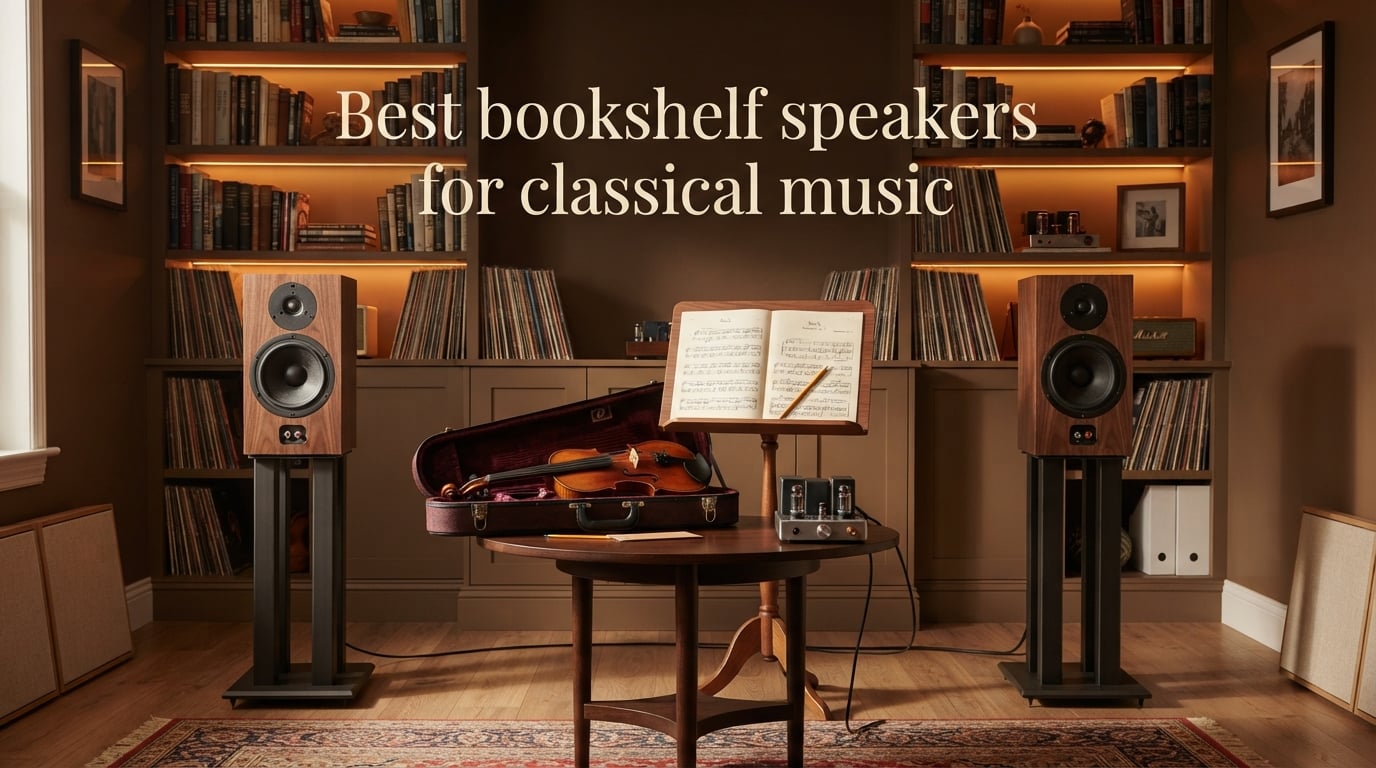
Finding the best bookshelf speakers for classical music is a different challenge than shopping for any other genre. Classical recordings capture real acoustic instruments performing in real acoustic spaces, and your speakers need to reproduce all of that information faithfully. A speaker that sounds fantastic with electronic pop or hip-hop can sound muddy, bloated, or even harsh when asked to handle a Mahler symphony or a solo piano sonata.
I have spent years helping classical music listeners understand why their expensive speakers sometimes sound worse than a friend’s modest setup. The answer almost always comes down to one thing: the speakers were designed for excitement rather than accuracy. Classical music does not need excitement added to it. It needs transparency, dynamic range, and the ability to place you inside the concert hall acoustic that the recording engineer captured.
This guide breaks down exactly what makes bookshelf speakers suitable for classical music in 2026. Whether you are building your first dedicated listening setup or upgrading from a pair that rattles during orchestral crescendos, you will learn the specific qualities and specifications that matter. We will cover soundstage, imaging, midrange transparency, dynamic headroom, room placement, amplifier pairing, and how to evaluate technical specs without getting lost in the numbers.
Table of Contents
Why Classical Music Demands Special Speakers
Classical music places demands on speakers that almost no other genre does. A single orchestral recording can contain a whisper-quiet violin solo followed seconds later by a full 100-piece fortissimo. The speaker must handle both extremes without distortion, without compression, and without losing the spatial detail that tells your brain where each instrument sits on the stage.
The Concert Hall Problem
Every classical recording captures two things at once: the instruments themselves and the acoustic space surrounding them. When an engineer records a symphony in a great concert hall, the microphones pick up not just the direct sound of the strings and brass but also the reverberant decay bouncing off the walls, ceiling, and floor. That reverberation is a huge part of what makes live classical music sound live.
Good bookshelf speakers for classical music preserve that spatial information. They reproduce the subtle cues that tell your ears how large the hall is, how far away the musicians are, and how the sound lingers in the air after a chord ends. Speakers that blur these details collapse the sound into a flat, lifeless wall of noise. You lose the sense of being there, which is the entire point of listening to classical recordings at home.
Strings are especially revealing. A well-recorded violin should sound like rosin on gut, not like a synthetic tone. Woodwinds should have breath and woodiness. Piano should have weight in the lower register and shimmer in the upper octaves. A speaker that gets these textures right will reward you for decades. One that gets them wrong will make even great recordings feel fatiguing.
Why Consumer Speakers Fall Short for Classical
Most consumer speakers are voiced to sound impressive in a brief showroom demo, not accurate over a two-hour listening session. They boost the bass and treble to create what audio enthusiasts call a V-shaped frequency response. That signature adds punch and sparkle to pop music, but it wrecks the tonal balance of acoustic instruments.
I see this complaint constantly in audiophile forums. One Reddit user described it perfectly: consumer speakers with boosted bass sound “ridiculous” for classical music because a cello ends up sounding like it has a subwoofer attached. Another listener, a retired symphony musician, reported that his 40-year-old loudspeakers simply could not handle complex Mahler passages without rattling. The speakers were not broken; they were never designed for that level of dynamic and textural demand.
The same V-shaped voicing that makes a kick drum feel powerful makes a violin section sound thin and a piano sound tinny. Classical recordings assume neutral playback. When you add coloration, you are fighting against the intentions of the recording engineer, the conductor, and the performers. This is why experienced classical listeners almost always prefer speakers with a flat, honest frequency response.
What Makes Bookshelf Speakers Good for Classical Music
Three qualities separate classical-friendly speakers from the rest: a neutral frequency response, a transparent midrange, and enough dynamic headroom to handle the explosive swings between pianissimo and fortissimo. Get these right and almost everything else follows.
Neutral Frequency Response
Neutral frequency response means the speaker reproduces all frequencies at roughly equal volume, without boosting the bass for impact or the treble for excitement. This is the foundation of accurate classical reproduction. When the frequency response is flat, a flute sounds like a flute, a cello sounds like a cello, and a piano sounds like a piano. The tonal colors the composer and performer intended come through unchanged.
Stereo measurement communities like Audio Science Review publish frequency response graphs that show exactly how flat a speaker is. For classical music, look for speakers that measure within a few decibels of flat across the midrange and treble regions, roughly from 200 Hz to 10 kHz. Deviations in this range are what color instrumental timbres and make recordings sound wrong.
Be wary of marketing language that emphasizes “warm” or “punchy” sound. Warmth often means a boosted upper bass that muddies cellos and violas. Punch usually means elevated mid-bass that drowns out inner voices in complex orchestral textures. The most respected classical speakers are described as clean, accurate, and uncolored, never as warm or punchy.
Transparent Midrange for Acoustic Instruments
The midrange, roughly 300 Hz to 3 kHz, is where almost all classical instruments live. Violins, violas, cellos, woodwinds, the human voice in opera, and most of the piano keyboard all have their fundamental tones in this region. A transparent midrange lets you hear individual instruments within a section, follow a melody buried in a chord, and sense the texture of bow on string.
Midrange transparency is what separates a speaker that lets you relax into the music from one that keeps you vaguely unsatisfied. With a transparent speaker, you forget you are listening to equipment at all. You just hear music. With a less transparent speaker, something always feels slightly off, even if you cannot identify what.
Soft-dome tweeters and well-designed midrange drivers tend to produce the smooth, grain-free midrange that classical demands. Metal dome tweeters can sound detailed but sometimes add a metallic edge to strings. Ribbon and planar tweeters can offer extraordinary detail but may lack the body that brass and woodwinds need. There is no single right answer, but the goal is always the same: no audible grain, no harshness, and no smearing of complex textures.
Dynamic Headroom for Orchestral Crescendos
Dynamic range is the difference between the softest and loudest sounds a speaker can reproduce cleanly. Classical music has the widest dynamic range of any genre. A string quartet pianissimo might sit 40 decibels below a full orchestra fortissimo. Your speakers need to handle both extremes in the same listening session without compressing the quiet parts or distorting the loud ones.
Dynamic headroom specifically refers to the ability to reproduce sudden loud transients without clipping or compression. Think of a timpani strike, a brass fanfare, or the final chord of a symphony. A speaker with good dynamic headroom reproduces these moments with impact and clarity. A speaker without it turns them into a congested blur.
This is where many older or budget speakers fail with classical music. They sound fine during quiet passages but fall apart during loud ones. The retired symphony musician I mentioned earlier was experiencing exactly this problem: his speakers simply did not have the dynamic headroom to reproduce Mahler’s massive orchestral climaxes without audible distortion.
Soundstage and Imaging Explained
Soundstage and imaging are the two qualities that let a pair of bookshelf speakers disappear from your awareness and transport you into the concert hall. They are related but distinct, and understanding the difference is essential for evaluating speakers for classical music.
Soundstage vs Imaging: What is the Difference
Soundstage is the perceived three-dimensional space in which the music exists. It is the width, depth, and height of the sonic picture your speakers paint between and beyond the physical speaker cabinets. A wide soundstage makes a full orchestra feel vast, with strings on the left, brass at the back, and percussion spread across the rear. A shallow soundstage makes the same orchestra sound cramped and flat.
Imaging is the precision with which individual instruments are placed within that soundstage. Good imaging lets you point to exactly where the first violin sits, where the oboe soloist is standing, and how far back the double bass section is. This is what classical listeners mean when they talk about “pinpoint imaging.” You hear not just the instruments but their positions on a virtual stage.
So are imaging and soundstage the same thing? No. Soundstage is the size of the stage; imaging is the sharpness of the players on it. You can have a wide soundstage with blurry imaging, where the orchestra sounds big but individual instruments are hard to locate. You can also have precise imaging in a narrow soundstage, where instruments are easy to place but the overall picture feels small. The best bookshelf speakers for classical music deliver both: a wide, deep soundstage with razor-sharp imaging.
For classical music specifically, soundstage depth matters as much as width. A great speaker conveys how far back the brass section sits behind the strings, and how the concert hall’s reverberation extends behind and around the performers. This depth cue is what gives classical recordings their sense of real space.
Key Technical Specifications to Evaluate
Technical specifications will not tell you everything about how a speaker sounds, but they help you narrow your options and avoid obvious mismatches. Here are the specs that matter most for classical music reproduction.
Frequency Response
Frequency response describes the range of frequencies a speaker can reproduce and how evenly it reproduces them. Human hearing spans roughly 20 Hz to 20 kHz. No bookshelf speaker covers that entire range perfectly, but the best ones come close across the critical midrange and treble bands.
For classical music, look for a stated frequency response of at least 50 Hz to 20 kHz with minimal variation. The low end matters less than you might think because most classical material does not contain energy below 40 Hz. A pipe organ pedal note is one of the few exceptions. What matters far more is smoothness across the band rather than raw extension.
Pay attention to how the frequency response is described. A spec that says “55 Hz to 22 kHz” without a tolerance range is nearly meaningless. A spec that says “55 Hz to 22 kHz, plus or minus 3 dB” tells you the response stays within a 6-decibel window across that range. That tolerance figure is what separates honest specifications from marketing fluff.
Sensitivity and Impedance
Sensitivity measures how loudly a speaker plays for a given amount of amplifier power, typically expressed in decibels at one watt measured at one meter. A speaker rated at 88 dB sensitivity will play noticeably louder than one rated at 84 dB with the same amplifier. This matters for classical music because orchestral crescendos demand significant power peaks.
Sensitivity interacts directly with what some listeners call the 83% rule, a guideline suggesting that a speaker should reach comfortable listening levels using no more than about 83% of your amplifier’s rated power. If you regularly push your amplifier near its limits during loud orchestral passages, the amplifier will clip, producing harsh distortion that is particularly audible on strings and brass. Speakers with higher sensitivity give you more headroom and reduce the risk of amplifier strain.
Impedance, measured in ohms, describes how much electrical resistance the speaker presents to the amplifier. Most bookshelf speakers are nominally rated at 8 ohms or 6 ohms. Lower impedance speakers draw more current and can stress modest amplifiers. For classical listening at moderate volumes, almost any modern amplifier handles 8-ohm speakers easily. If you choose 4-ohm speakers, make sure your amplifier is rated for that load.
Driver and Tweeter Design
The drivers are the actual cones and domes that produce sound. Most bookshelf speakers use a two-way design: a tweeter for high frequencies and a midrange-woofer for everything else. This simple configuration works extremely well for classical music because it keeps the critical midrange reproduced by a single driver, avoiding the crossover discontinuities that three-way designs can introduce.
Tweeter material affects the character of strings and high-frequency detail. Soft-dome tweeters, made of silk or fabric, are the most popular choice for classical because they produce smooth, natural treble without fatigue. Metal-dome tweeters, typically aluminum or titanium, can offer more detail and extension but may sound bright with some recordings. Concentric drivers, where the tweeter sits in the center of the woofer, offer exceptional imaging because all frequencies originate from the same point.
Midrange-woofer size typically ranges from 4 to 6.5 inches in bookshelf speakers. Smaller drivers image better and integrate more smoothly with the tweeter. Larger drivers move more air and produce more bass. For classical music in a small to medium room, a 5-inch driver is often the sweet spot, offering enough midbass weight for cellos and piano while maintaining the imaging precision that orchestral music requires.
Cabinet Design: Sealed vs Ported
Bookshelf speakers come in two basic cabinet designs: sealed and ported. A sealed cabinet is airtight. A ported cabinet has a tuned opening, or port, that extends bass response using Helmholtz resonance. Each approach has trade-offs for classical music.
Sealed cabinets produce tighter, more controlled bass with a gentle roll-off. They tend to image well and integrate cleanly with subwoofers. For chamber music, solo piano, and small ensemble works, sealed speakers often sound more accurate and composed. Their bass never calls attention to itself, which is exactly what classical listeners want.
Ported cabinets produce deeper bass from a smaller enclosure, which helps with larger orchestral works and organ music. However, a poorly designed port can introduce boominess or chuffing noise during fast bass transients. When ported speakers are well-designed, they offer excellent bass extension without obvious drawbacks. The key is to listen for bass that sounds tight and controlled, not bloated or one-note.
For classical music, either design can work beautifully. The implementation matters more than the topology. Trust your ears, or trusted measurements, over the label on the box.
Bookshelf vs Floorstanding Speakers for Classical
Many classical listeners wonder whether they should choose bookshelf speakers or floorstanding towers. The honest answer is that well-designed bookshelf speakers can match or exceed floorstanders for classical music in most real-world listening rooms. Floorstanders produce more bass and fill larger rooms more easily, but bookshelf speakers often win on imaging precision, midrange clarity, and room integration.
The biggest advantage of bookshelf speakers is imaging. Because they use a single midrange-woofer rather than multiple bass drivers, there are no crossover discontinuities in the midrange to blur instrumental textures. The soundstage tends to be more focused and three-dimensional. For a genre where hearing exactly where each instrument sits on stage is part of the experience, this matters enormously.
The biggest advantage of floorstanding speakers is bass extension and dynamic effortlessness. They can reproduce the lowest organ pedal notes and the full weight of an orchestral tutti without a subwoofer. If your listening room is large and you listen at high volumes, floorstanders may be the better choice.
For most classical listeners in typical rooms, bookshelf speakers paired with a quality subwoofer offer the best of both worlds. You get the imaging and midrange purity of a two-way monitor plus the bass extension of a floorstander. This is a common recommendation in audiophile forums for good reason.
Room Placement and Soundstage Optimization
Even the best bookshelf speakers will underperform if they are placed poorly. Room placement affects soundstage width, imaging precision, bass response, and tonal balance more than any tweak or upgrade you can buy. Getting placement right costs nothing and transforms the listening experience.
Start with the classic equilateral triangle arrangement. Place your two speakers the same distance apart from each other as they are from your listening position, forming a triangle. The speakers should point directly at you, or slightly toed-in toward your listening seat. This geometry creates the foundation for accurate imaging and a stable soundstage.
Keep speakers away from room boundaries when possible. Placing a speaker too close to a wall boosts bass unevenly and smears midrange detail. A good starting point is 2 to 3 feet from the front wall and at least 2 feet from the side walls. Experiment with small position changes, because even a few inches can noticeably shift the tonal balance and imaging focus.
Speaker height matters too. The tweeters should sit at roughly ear level when you are in your listening position. If the speakers sit too low on a shelf, the treble will be muted and the soundstage will collapse downward. Quality speaker stands are one of the most cost-effective upgrades for bookshelf speakers, often delivering more improvement than a cable or amplifier upgrade.
Finally, treat your room if possible. Soft furnishings, rugs, and bookshelves absorb reflections that can blur imaging and add harshness. You do not need dedicated acoustic panels to hear an improvement. Even a well-placed rug between the speakers and the listening position can tame floor reflections and tighten the soundstage.
Amplifier Pairing Considerations
Your amplifier is the other half of your speaker system, and the pairing matters for classical music more than many listeners realize. A good match brings out the best in your speakers. A poor match can make accurate speakers sound harsh, compressed, or lifeless.
Power is the first consideration. Classical music’s wide dynamic range means your amplifier needs clean headroom to handle orchestral peaks without clipping. As a general guideline, choose an amplifier rated for at least 1.5 to 2 times the power handling of your speakers. This ensures the amplifier can deliver sudden transient peaks without running into distortion.
Speaker sensitivity determines how much power you actually need. A speaker rated at 90 dB sensitivity needs very little power to reach realistic listening levels. A speaker rated at 84 dB needs significantly more. High-sensitivity speakers pair well with lower-powered tube amplifiers. Low-sensitivity speakers generally need solid-state power to perform their best.
The character of the amplifier also matters. Some amplifiers sound warm and smooth, which can complement slightly bright speakers. Others sound neutral and revealing, which pairs well with speakers that have a laid-back treble. For classical music, the goal is a combination that sounds clean and unforced at all volumes, with no harshness during loud passages and no murkiness during quiet ones.
Trust the synergy between amplifier and speaker over raw specifications. A modest amplifier perfectly matched to sensitive speakers can outperform a powerful amplifier poorly matched to difficult speakers. If possible, audition the combination before committing.
Frequently Asked Questions
What are the best bookshelf speakers for classical music?
The best bookshelf speakers for classical music are those with a neutral frequency response, transparent midrange, and strong dynamic headroom. Models frequently recommended by audiophile communities include the KEF LS50 Meta, SVS Prime Bookshelf, Klipsch RP-600M II, ELAC Debut 3.0, and Monitor Audio Silver 100. The right choice depends on your room size, amplifier, budget, and personal tonal preferences.
What to look for when buying bookshelf speakers?
When buying bookshelf speakers for classical music, look for five key qualities: a flat frequency response that does not boost bass or treble, a transparent midrange for acoustic instrument accuracy, wide dynamic headroom for orchestral crescendos, precise imaging and soundstage, and solid build quality with a well-braced cabinet. Also consider sensitivity and impedance to ensure compatibility with your amplifier.
What is the 83% rule for speakers?
The 83% rule is an informal guideline suggesting that a speaker should reach your desired listening volume using no more than about 83% of your amplifier’s rated power. This leaves clean headroom for dynamic peaks in classical music. If you regularly push your amplifier past this threshold during loud orchestral passages, the amplifier may clip and produce audible distortion, especially on strings and brass.
Which speakers are best for classical music?
The best speakers for classical music are those that reproduce acoustic instruments accurately without adding coloration. They should have a neutral tonal balance, smooth treble for strings and brass, a revealing midrange for woodwinds and voice, and the dynamic range to handle the gap between pianissimo and fortissimo. Both bookshelf and floorstanding designs can work, but bookshelf speakers often excel in imaging and midrange clarity.
Are imaging and soundstage the same?
No, imaging and soundstage are not the same. Soundstage refers to the perceived size and dimension of the sonic space, including width, depth, and height. Imaging refers to the precision with which individual instruments are placed within that space. A speaker can have a wide soundstage with blurry imaging, or a narrow soundstage with precise imaging. The best classical speakers deliver both.
What makes bookshelf speakers good for classical music?
Bookshelf speakers are good for classical music when they reproduce instruments honestly and preserve the spatial information of the original recording. Key qualities include a neutral frequency response, transparent midrange, dynamic headroom for crescendos, precise imaging for locating instruments, and a smooth treble that never fatigues. Avoid speakers with boosted bass or treble, as this coloration ruins the natural timbre of acoustic instruments.
Conclusion: Choosing the Right Bookshelf Speakers for Classical Music
The best bookshelf speakers for classical music are not the ones that sound most exciting in a brief demo. They are the ones that disappear and let the music speak for itself. That means a neutral frequency response, a transparent midrange, enough dynamic headroom for orchestral climaxes, and the imaging precision to place every instrument on a virtual concert hall stage.
If you take one lesson from this guide, let it be this: avoid coloration. Speakers with boosted bass, elevated treble, or aggressively voiced profiles will make pop music sound lively but will distort the natural timbres of strings, woodwinds, piano, and voice. Classical recordings are engineered for neutral playback. Honor that intention by choosing speakers that measure flat and sound honest.
Do not underestimate the importance of room placement and amplifier pairing. The most accurate speakers in the world will underperform if they sit poorly in your room or are driven by an underpowered amplifier. Take the time to position your speakers carefully, invest in solid stands, and match your amplifier to your speaker’s sensitivity and impedance. These steps cost little or nothing and deliver dramatic improvements.
Finally, trust your own ears over any specification sheet or marketing claim. Listen to recordings you know intimately, especially pieces with wide dynamic range and complex orchestration. The right speakers will make you forget the equipment entirely and let you focus on the performance. That is the real goal of any classical music listening setup, and the standard by which you should judge every speaker you consider.