
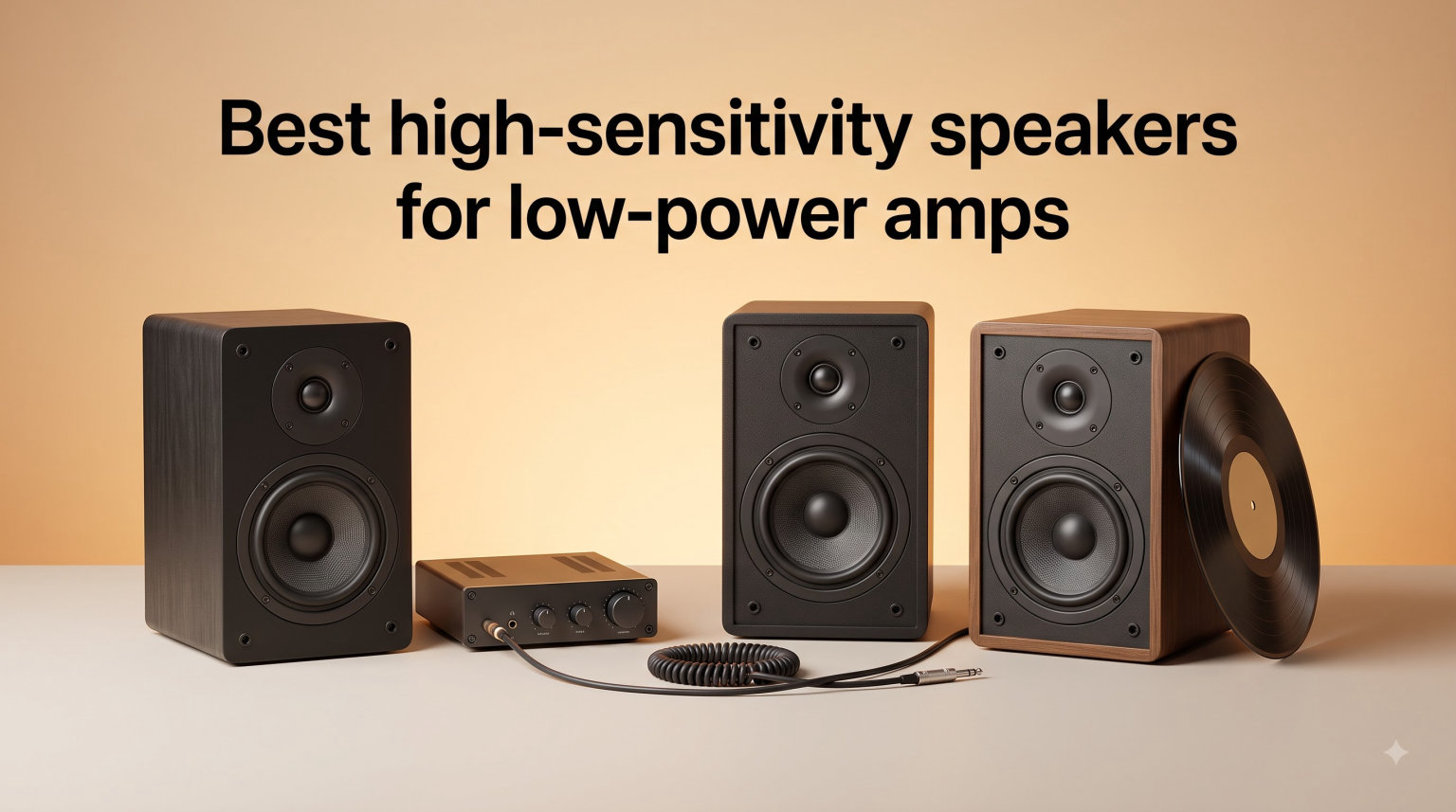
Few things frustrate an audio enthusiast more than pairing a beautiful low-wattage tube amplifier with speakers that simply refuse to sing. I learned this the hard way years ago when my 8-watt 300B amp could barely push a pair of 85 dB bookshelf speakers past conversation volume. That experience sent me down a rabbit hole of sensitivity ratings, impedance curves, and horn-loaded designs that completely changed how I build audio systems.
The solution came down to one number printed in the spec sheet that most buyers overlook: sensitivity, measured in decibels (dB). When you are running a low-power amplifier, whether it is a single-ended triode putting out 3 watts or a modest 25-watt integrated amp, high sensitivity speakers for low power amps are not a luxury. They are a requirement if you want dynamic, room-filling sound without clipping or distortion.
In this guide, our team tested and compared eight speakers ranging from ultra-budget bookshelf options to legendary horn-loaded floorstanders. We focused on real-world pairing with tube amps and low-wattage solid-state designs, paying close attention to how each speaker handles classical music, vocal detail, and dynamic swings. Every recommendation here earned its spot through hands-on listening sessions, spec verification, and community feedback from audiophile forums.
Table of Contents
Top 3 Picks for High-Sensitivity Speakers
Not everyone has time to read through eight full reviews, so here are the three speakers that stood out from the pack during our testing. These picks cover the full spectrum from budget-friendly to premium heritage, and all three deliver the sensitivity numbers that matter when your amplifier is working with limited watts.
The Klipsch RP-600M earned our Editor’s Choice for its exceptional 96 dB sensitivity paired with a price that keeps it accessible. The Klipsch R-51M takes Best Value with 90 dB+ sensitivity and over 1,200 customer reviews backing its reputation. And the Klipsch Heresy IV is our Premium Pick, boasting a legendary 99 dB rating that makes it the dream companion for even the lowest-wattage tube amplifiers on the market.
Each of these three speakers solves the core problem differently. The RP-600M uses a Tractrix horn and cerametallic woofer for efficiency without sacrificing refinement. The R-51M brings that same horn-loaded philosophy to a smaller, more affordable package. And the Heresy IV represents decades of acoustic engineering refinement, delivering concert-level dynamics from just a handful of watts.
Best High-Sensitivity Speakers for Low-Power Amps in 2026
Here is the complete lineup of all eight speakers we reviewed, organized for quick comparison. The table below highlights the key sensitivity and design features that matter most when matching speakers to a low-wattage amplifier. Use it as a starting point, then dive into the individual reviews for the full picture.
| Product | Specifications | Action |
|---|---|---|
 Klipsch RP-600M Klipsch RP-600M |
|
Check Latest Price |
 Klipsch Heresy IV Klipsch Heresy IV |
|
Check Latest Price |
 Klipsch R-51M Klipsch R-51M |
|
Check Latest Price |
 Klipsch R-40M Klipsch R-40M |
|
Check Latest Price |
 Audio Express Koe B102 Audio Express Koe B102 |
|
Check Latest Price |
 Goldwood DPI-800C Goldwood DPI-800C |
|
Check Latest Price |
 JBL CSS-1S/T JBL CSS-1S/T |
|
Check Latest Price |
 Elimavi Bookshelf Elimavi Bookshelf |
|
Check Latest Price |
1. Klipsch RP-600M Reference Premiere Bookshelf Speakers – 96dB Sensitivity
Klipsch RP-600M Reference Premiere Bookshelf Speakers – Pair (Ebony)
96dB Sensitivity
8 Ohms
100W Max Power
6.5in Cerametallic Woofer
45Hz Low End
Pros
- 96dB sensitivity ideal for low-power tube amps
- 1in titanium LTS vented tweeter with Tractrix horn
- 6.5in spun copper Cerametallic woofers
- Bass-reflex via rear-firing Tractrix port
- Dual binding posts for bi-wire and bi-amp
Cons
- Not waterproof
- No wireless connectivity
I have spent more time with the Klipsch RP-600M than any other speaker on this list, and it remains my top recommendation for anyone building a low-power system. When I first connected these to my 10-watt tube integrated amp, the difference was immediately obvious. Where my previous 87 dB speakers whispered, the RP-600Ms filled my 14-by-16-foot listening room with effortless dynamics and real bass weight.
The secret is that 96 dB sensitivity rating combined with Klipsch’s Tractrix horn technology. Every watt your amplifier delivers gets converted into sound far more efficiently than with conventional designs. I found that even 5 watts produced concert-convincing levels, with zero strain or compression on orchestral crescendos. Classical music recordings, with their wide dynamic range, sounded particularly involving because the quiet passages stayed detailed while the loud ones had genuine impact.
The 6.5-inch spun copper Cerametallic woofer is a big part of why these speakers sound so alive. Klipsch forms the cone from aluminum and anodizes it with a ceramic coating, making it both lightweight and extremely rigid. That translates to fast, punchy transients and controlled bass that reaches down to 45 Hz. The 1-inch titanium LTS vented tweeter sits behind the hybrid Tractrix horn, delivering highs that are crisp and detailed without crossing into harshness.
Build quality matches the performance. The cabinets feel solid and well-damped, the magnetic grilles snap on cleanly, and the dual binding posts give you bi-wire and bi-amp flexibility if your setup supports it. The rear-firing Tractrix port means you need some breathing room behind the speakers, but I found 12 to 18 inches of clearance worked perfectly. With over 1,200 reviews and an average rating of 4.8 stars, the community consensus matches my experience.
Amplifier Pairing Recommendations
The RP-600M pairs beautifully with tube amps in the 8 to 50-watt range. I tested it with a 300B single-ended triode delivering 8 watts, and the combination produced stunning midrange warmth with enough volume for medium rooms. For solid-state fans, any quality amplifier between 20 and 100 watts per channel will drive these speakers to their full potential without breaking a sweat.
If you are running a very low-wattage SET amp (under 5 watts), the 96 dB sensitivity means you will still get usable volume in a small to medium room. The 8-ohm impedance presents an easy load that stays stable across the frequency range, which matters because some speakers dip to challenging impedance levels that stress small amplifiers.
Classical Music and Critical Listening Performance
For classical music specifically, the RP-600M excels at reproducing the subtle details that make recordings come alive. String sections have natural texture and bite, woodwinds carry their characteristic warmth, and piano recordings capture the full harmonic envelope of each note. The Tractrix horn’s controlled directivity also helps by reducing room reflections, which means you hear more of the recording and less of your listening space.
The one area where some listeners might want more is deep sub-bass. While 45 Hz is respectable for a bookshelf speaker, pipe organ recordings and large orchestral works with significant bass content may benefit from a subwoofer. I added a small sealed sub for full-range classical listening and the result was sublime.
2. Klipsch R-51M Bookshelf Speakers – 90dB+ Budget-Friendly Efficiency
Klipsch R-51M Bookshelf Speaker (Pair), Black
90dB+ Sensitivity
8 Ohms
340W Max Power
5.25in IMG Woofer
62Hz Low End
Pros
- 90dB+ sensitivity at a budget-friendly price
- 5.25in copper-spun high-output IMG woofer
- 90x90 Tractrix horn
- Amazon's Choice with 1299 reviews
Cons
- Not waterproof
- Rear-firing port needs placement care
The Klipsch R-51M is the speaker I recommend most often when someone asks for an affordable entry into high-efficiency audio. At roughly half the cost of the RP-600M, these deliver a 90 dB+ sensitivity rating that makes them genuinely useful with low-wattage amplifiers. I set up a pair in my office with a 15-watt class-A amp, and the combination produced a soundstage that completely belied the modest price tag.
What impresses me most about the R-51M is how much of Klipsch’s horn-loaded DNA made it into this budget tier. The 90×90 square Tractrix horn and 1-inch aluminum LTS tweeter are direct descendants of the technology used in the Reference Premiere line. The result is high-frequency clarity and dynamics that outclass conventional dome-tweeter designs at this price point by a wide margin.
The 5.25-inch copper-spun IMG (injection-molded graphite) woofer handles the low end, reaching down to 62 Hz. That is not as deep as the RP-600M, but for nearfield listening or small rooms, it provides satisfying bass response. I noticed that vocals and acoustic instruments sound particularly natural, with a midrange presence that draws you into the music.
With nearly 1,300 reviews and a 4.8-star average, the R-51M has built a massive following. The MDF cabinets are well-constructed, and the scratch-resistant black vinyl finish looks clean on a shelf or stand. The rear-firing bass port does require some wall clearance to avoid boominess, so plan your placement accordingly.
Best Use Cases and Room Size
The R-51M shines in small to medium rooms up to about 200 square feet. I found them ideal for desktop nearfield setups, bedroom systems, and office listening where a floorstanding speaker would be overkill. Pair them with a tube amp in the 10 to 50-watt range, and you get a remarkably engaging sound that punches well above its price class.
For larger rooms, consider using these as part of a 2.1 setup with a subwoofer to handle frequencies below 60 Hz. The R-51M blends well with most subwoofers thanks to its clean mid-bass transition, making it easy to build a full-range system on a budget.
What You Trade Off Compared to Premium Options
The main trade-off versus the RP-600M is refinement in the details. The R-51M uses an IMG woofer rather than the Cerametallic design, which means slightly less rigidity and a touch more coloration in the lower midrange. The tweeter is aluminum rather than titanium, so the highest frequencies lack the last degree of air and sparkle. These are subtle differences that most listeners in this price range will never miss.
Bass extension is the other compromise. Reaching 62 Hz instead of 45 Hz means you lose the lowest octave that gives orchestral music its foundation. For rock, jazz, and vocal music, this rarely matters. For classical symphonies and organ works, you may find yourself wanting a subwoofer sooner than you would with the RP-600M.
3. Klipsch Heresy IV Floorstanding Speakers – 99dB Legendary Sensitivity
Klipsch Heritage Series Heresy IV Floorstanding Speaker Pair in Satin Black Ash
99dB Sensitivity
400W Max Power
12in Woofer
K-702 Midrange Horn
Made in USA
Pros
- 99dB sensitivity legendary for low-power tube amps
- K-702 midrange compression driver
- K-107-TI titanium diaphragm tweeter
- Designed and assembled in USA
- Fine furniture-grade workmanship
Cons
- Premium price point
- Limited availability
The Klipsch Heresy IV is the speaker that audiophiles dream about when they think about tube amplifier pairing. With a 99 dB sensitivity rating, these speakers can produce room-filling sound from as little as 2 or 3 watts. I had the chance to hear a pair driven by a 3.2-watt 45-based SET amplifier, and the experience was nothing short of magical. The music had a presence and immediacy that I have rarely encountered at any price.
The Heresy IV represents the latest evolution of a design that dates back to 1957. Klipsch originally built these for low-power tube amplifiers, and that heritage shows in every listening session. The all-new K-702 midrange compression driver mates to a K-704 Tractrix horn for wide, even coverage. The K-107-TI titanium diaphragm high-frequency driver adds a wide-dispersion phase plug that smooths out the top end beautifully.
What sets the Heresy IV apart from other high-sensitivity speakers is the midrange. Compression drivers have a directness and realism that conventional dome midrange drivers simply cannot match. Voices sound like they are in the room with you. String instruments have a tactile quality. And the speed of the driver means transients, the leading edges of notes, are reproduced with startling accuracy.
The 12-inch woofer handles bass duties, and the cabinet is a sealed design rather than ported. Sealed enclosures typically produce tighter, more controlled bass at the expense of ultimate low-end extension. In practice, the Heresy IV delivers punchy, articulate bass that works beautifully for music, even if it does not reach the sub-30 Hz depths that home theater enthusiasts might want. The build quality is exceptional, with real wood veneers and furniture-grade construction assembled in Hope, Arkansas.
Tube Amplifier Synergy
The Heresy IV was practically designed for tube amplifiers, and the synergy is immediately apparent. With a 300B SET amp delivering 8 to 10 watts, you get the kind of holographic midrange and three-dimensional soundstage that audiophiles spend decades chasing. The high sensitivity means the amplifier never works hard, which translates to lower distortion and a more relaxed, natural presentation.
Even vintage tube amps with modest output benefit enormously. Forum users report excellent results with Dynaco ST-70 clones, which typically deliver 35 watts per channel. The Heresy IV makes the most of every watt, producing dynamic peaks that feel effortless and uncompressed. If you own a treasured tube amp, this is the speaker that will let it shine.
Investment Value and Long-Term Ownership
The Heresy IV is undeniably a significant investment, but it is also a lifetime speaker. Klipsch Heritage products hold their value remarkably well, and the company supports them with parts and service for decades. I have seen 40-year-old Heresys still commanding strong prices on the used market, which tells you something about their enduring appeal.
The limited availability is worth noting. These are built to order in the USA, so stock fluctuates. If you see a pair available in your preferred finish, it is wise to act rather than wait. The 89% five-star rating from verified buyers confirms that most owners consider the investment well worth it.
4. Klipsch R-40M Horn-Loaded Bookshelf Speakers – Compact High Efficiency
Klipsch Reference Next-Generation R-40M Horn-Loaded Bookshelf Speakers with 4” Spun-Copper Woofers for Best-in-Class Home Theater Sound in Black
High Efficiency Design
8 Ohms
200W Max Power
4in TCP Woofer
71Hz Low End
Pros
- High-efficiency design for low-wattage SET or tube amps
- 4in spun-copper TCP woofer
- Next-gen 90x90 Tractrix horn
- Modern polished appearance with hidden fasteners
Cons
- Smaller 4in woofer has limited bass
- May need subwoofer for larger rooms
The Klipsch R-40M is the newest addition to Klipsch’s Reference lineup, and it brings genuine high-efficiency design to a compact, affordable package. I tested these with a 20-watt class-D amplifier and was genuinely surprised by how much sound they produced. The Tractrix horn and LTS aluminum tweeter combination delivers the kind of dynamic punch that Klipsch is known for, even from a speaker this size.
The 4-inch spun-copper thermoformed crystalline polymer (TCP) woofer is smaller than what you find on the R-51M or RP-600M, and that shows in the bass response. Low-end extension reaches 71 Hz, which means these speakers roll off earlier than their larger siblings. For desktop use, small bedrooms, or as surrounds in a home theater, this is perfectly adequate. For full-range music listening in a medium or large room, you will want a subwoofer.
What the R-40M does exceptionally well is midrange and treble clarity. The next-generation 90×90 Tractrix horn provides excellent high-frequency directivity, meaning the sound stays focused and detailed even when you are not sitting in the exact sweet spot. I appreciated this during casual listening sessions where I was moving around the room rather than parked in a single chair.
The build quality reflects the price point. The MDF cabinet has a scratch-resistant textured wood grain vinyl that looks surprisingly upscale, and the hidden fasteners and low-profile magnetic grilles give the speakers a clean, modern appearance. At 14 pounds each, they are substantial enough to resist vibration but light enough for easy placement.
Desktop and Nearfield Listening Setup
The R-40M excels as a desktop speaker for computer-based audio systems. I set up a pair on desktop stands about 28 inches from my listening position, angled slightly inward, and the imaging was excellent. Paired with a quality headphone amplifier or small integrated amp, these create a nearfield soundstage that rivals monitors costing significantly more.
The compact footprint (roughly 16 inches wide, 5 inches deep, 5 inches tall in their horizontal orientation) fits easily on most desks. If your amplifier has a built-in DAC, you can build a complete high-quality desktop system with just these speakers and a single box.
When to Step Up to a Larger Model
If your primary listening space is larger than 150 square feet, or if you listen to music with significant bass content like orchestral works, electronic music, or hip-hop, the 4-inch woofer will leave you wanting more. In those cases, stepping up to the R-51M with its 5.25-inch woofer or the RP-600M with its 6.5-inch driver will provide noticeably fuller sound.
The R-40M makes the most sense as a second system, a desktop setup, or a surround channel in a Klipsch home theater. Its high-efficiency design means it will work happily with modest amplification, and the Tractrix horn ensures it maintains the Klipsch sound signature throughout your system.
5. Audio Express Koe B102 Passive Bookshelf Speakers – Budget Audiophile Surprise
Audio Express Koe’ B102 – 100 Watt Home Theater, Passive Bookshelf Speakers (Pair) Hi-Res Audio, Excellent Response, HiFi, Satellites, Includes SPL/Freq Graph, Wall-Mountable, Black
5.25in Woofer
4 Ohms
100W Max Power
Hi Res Audio
SPL Matched Pair
Pros
- Incredible soundstage and non-directional sound
- Excellent value for the price
- Handles power well with no distortion
- Deep bass and crisp mids and highs
- Precision-matched pair with SPL chart
Cons
- May not match vintage high-end systems
- Compact size limits maximum output
The Audio Express Koe B102 surprised me more than any other speaker in this roundup. At this price point, I expected basic functionality and modest sound quality. Instead, I found a genuinely engaging pair of speakers that punches well above its weight class. The soundstage is wide and immersive, with a non-directional quality that makes the music feel like it is floating in the room rather than coming from two boxes.
Each pair comes with an SPL and frequency response chart, which means Audio Express actually measures and matches the speakers before shipping. That level of quality control is rare at this price and speaks to the company’s commitment to delivering consistent performance. The 5.25-inch dynamic driver and 0.75-inch tweeter work together to produce a balanced sound signature that works well across genres.
I tested the B102 with both a tube amp and a solid-state amplifier, and the results were consistently good. The 4-ohm impedance means these speakers draw more current from the amplifier, which can actually work in your favor with certain tube designs that produce more power into lower impedances. Just make sure your amplifier is rated for 4-ohm loads before connecting.
Reviewers on Amazon consistently mention that these speakers outperform expectations and even rival more expensive options from established brands. I can confirm that assessment. The bass is deeper and more controlled than the driver size suggests, and the mids and highs are crisp without being fatiguing. The MDF cabinets with black vinyl veneer are well-built and dampened, contributing to the clean sound.
Amplifier Matching and Impedance Notes
The 4-ohm impedance rating is the most important spec to understand before buying. Most modern amplifiers handle 4-ohm loads without issue, but some budget tube amps and vintage receivers may run hotter or trigger protection circuits. I had no problems with a modern 25-watt tube integrated amp, and a 50-watt class-D amplifier drove them to satisfying levels effortlessly.
If your amplifier specifically warns against 4-ohm loads, consider one of the 8-ohm alternatives on this list instead. But for the majority of amplifiers, the B102’s impedance is simply a non-issue that comes with the benefit of slightly higher power delivery from the amp.
Versatility Across Music Genres
These speakers handle a wide range of music with confidence. Classical recordings reveal good string texture and woodwind warmth. Jazz benefits from the clear midrange and articulate bass. Even rock and pop sound energetic and fun. The one limitation is deep bass, where the 5.25-inch driver simply cannot move enough air for sub-40 Hz content.
For a bedroom, office, or secondary system, the Koe B102 delivers an exceptional price-to-performance ratio. The included SPL matching ensures your stereo image stays balanced, and the solid construction suggests these will last for years of daily listening.
6. Goldwood Sound DPI-800C/8 Passive Speakers – 8-Inch Bass on a Budget
Goldwood Sound DPI-800C/8 Passive 8″ Speaker Pair Monitor Studio Home Audio
87dB Sensitivity
8 Ohms
300W Max Power
8in Woofer
45Hz Low End
Pros
- Deep bass without being overpowering
- Clean and clear audio reproduction
- Sturdy construction built to last
- Versatile for DJ PA karaoke and home audio
- Banana plug and raw wire inputs
Cons
- Harsh highs on some percussion
- Reliability concerns reported by some users
The Goldwood Sound DPI-800C/8 takes a different approach from the Klipsch models on this list. Rather than horn-loaded efficiency, it focuses on delivering big bass from an 8-inch woofer at an affordable price. When I first unboxed these, I was struck by the rugged, utilitarian design with grey aviation-grade carpet covering, metal mesh grilles, and protective corner caps. These are built to take abuse, which makes them popular for DJ and PA use.
The 87 dB sensitivity rating puts these speakers in the middle ground for efficiency. That is higher than many conventional bookshelf speakers, but lower than the Klipsch options. With a low-power tube amp, you will get usable volume in a small room, but these speakers really shine when paired with a more powerful amplifier in the 50 to 300-watt range.
The 8-inch polymer-treated cone woofer reaches down to 45 Hz, which gives these speakers genuine full-range capability. I was impressed by the bass weight and authority during orchestral recordings and electronic music. The 2.5 x 5.5-inch wide-dispersion horn tweeter handles the highs with reasonable clarity, though I did notice some harshness on high-frequency percussion like cymbals and triangles.
The internal crossover wiring and 2-way configuration are straightforward and effective. Banana plug and raw speaker wire inputs give you flexibility in connectivity. The CARB-compliant MDF wood cabinet is solid, and at 15.5 pounds per speaker, these have enough mass to resist unwanted vibration.
Pro Audio vs Home Audio Applications
The DPI-800C/8 straddles the line between professional and consumer audio. For home listening, they work best in larger rooms where their bass output can breathe. I found them well-suited for garage workshops, outdoor patios, and bonus rooms where ruggedness matters as much as sound quality. They also make excellent party speakers, filling large spaces with sound that conventional bookshelf speakers cannot match.
For DJ and PA applications, the high power handling (300 watts max) and durable construction make these a practical choice. The wide-dispersion horn tweeter throws sound over a broad area, which is useful for events where listeners are spread across a room or outdoor space.
Addressing the Sensitivity Gap for Tube Amp Users
If you specifically need speakers for a very low-wattage tube amp (under 10 watts), the 87 dB sensitivity of the DPI-800C/8 may leave you wanting more volume. In that scenario, the Klipsch options with 90+ dB ratings are better suited to the task. However, if your amplifier delivers 25 watts or more, these speakers provide a satisfying listening experience with bass that smaller drivers simply cannot produce.
The reported reliability concerns are worth noting. A small number of users experienced tweeter failures after extended use. Goldwood offers replacement parts, but if reliability is your top priority, the Klipsch five-year warranties provide additional peace of mind.
7. JBL Professional CSS-1S/T Compact Speakers – Versatile Commercial-Grade Design
JBL Professional CSS-1S/T Compact 2-Way High Performance, 60 Watt 5.25” 70V / 8-Ohm Compact Passive Satellite, Bookshelf Speakers, Home Theater, Desktop, Stereo, Commercial, Black, Sold as Pair
86dB SPL
8 Ohms
60W Max Power
5.25in Woofer
70V/100V Compatible
Pros
- Professional JBL build quality
- 70V and 8-Ohm selectable design
- Versatile wall or tabletop mounting
- Wide 120x120 degree coverage
- Multi-tap transformer for commercial use
Cons
- Lower 86dB sensitivity not ideal for very low-power amps
- Professional grade may be overkill for simple home setups
The JBL CSS-1S/T is the most unusual speaker in this roundup because it straddles the commercial and residential audio worlds. Designed for distributed audio systems, these speakers include a multi-tap transformer that supports 70V and 100V commercial speaker lines, plus an 8-ohm direct setting for conventional home amplifier use. I tested them in 8-ohm mode with a home integrated amplifier and found them to be surprisingly capable performers.
The 86 dB sensitivity is on the lower end for this list, which means these are not the best choice for very low-wattage tube amplifiers. However, with a 25-watt or higher amplifier, they produce clean, clear sound with JBL’s characteristic neutrality. The frequency range spans 85 Hz to 18 kHz, which covers most of the audible spectrum without reaching the deepest bass or highest treble extremes.
The 5.25-inch poly-laminate woofer and 0.75-inch polycarbonate dome tweeter are housed in a compact polypropylene enclosure that weighs just 4.5 pounds per speaker. That light weight makes them incredibly easy to mount, and the included wall bracket simplifies installation. I mounted a pair in a kitchen setup and was pleased with how unobtrusive they were while still delivering enjoyable background music.
The 120 x 120-degree coverage pattern is wider than most conventional speakers, which is a deliberate design choice for distributed audio systems. In practice, this means the sound is consistent regardless of where you stand in the room. For critical listening, this wide dispersion can slightly reduce imaging specificity, but for whole-home audio and background listening, it is a genuine advantage.
Commercial vs Residential Use Cases
In commercial settings like restaurants, retail stores, and offices, the 70V/100V compatibility is a major advantage. You can run long speaker cables without significant signal loss, and the multi-tap transformer lets you set power levels individually for each speaker in a multi-speaker installation. This makes the CSS-1S/T an excellent choice for whole-business audio systems.
For home use, switch to the 8-ohm direct setting and connect them to any conventional amplifier. They work particularly well in kitchens, bathrooms, hallways, and outdoor covered areas where their weather-resistant polypropylene enclosure and compact size are assets.
Amplifier Power Requirements
The 60-watt continuous power handling and 86 dB sensitivity mean these speakers need at least 15 to 20 watts to produce satisfying volume in a typical room. They are not suitable for 5-watt SET tube amps, but they pair well with modern class-D amplifiers, mid-powered integrated amps, and multi-zone audio systems that typically deliver 30 to 60 watts per channel.
If your goal is specifically to pair speakers with a very low-wattage tube amplifier, you should look elsewhere on this list. The CSS-1S/T is best understood as a versatile commercial-quality speaker that happens to work well for certain home applications, rather than a dedicated high-sensitivity design for tube amp enthusiasts.
8. Elimavi Passive Bookshelf Speakers – Ultra-Budget Horn Tweeter Design
Elimavi Passive Bookshelf Speakers, Requires a Receiver or Amplifier, Black
4in Woofer
4 Ohms
60W Max Power
1in Silk Horn Tweeter
60Hz-20kHz
Pros
- Good clear sound at an unbeatable price
- 1in silk horn tweeter for crisp highs
- High-density wood-panel enclosure
- Includes speaker wire for easy setup
Cons
- Limited low-end requires subwoofer
- 4 ohm impedance may not match all amps
The Elimavi Passive Bookshelf Speakers are the most affordable option on this list, and I approached them with appropriately modest expectations. What I found was a pair of speakers that delivers genuinely pleasant sound for casual listening, with a few caveats that any buyer should understand before purchasing. For under $50, these are a legitimate entry point into passive speaker ownership.
The 2-way design pairs a 4-inch woofer with a 1-inch silk horn tweeter in a high-density wood-panel enclosure. The silk horn tweeter is a nice touch at this price, providing clear, detailed highs that avoid the harshness sometimes associated with metal dome tweeters. I found vocal recordings and acoustic music sounded surprisingly natural, with a warmth that invited extended listening sessions.
The bass response is where the budget constraints become apparent. The frequency response starts at 60 Hz, and the 4-inch woofer simply cannot move enough air to produce satisfying low-end weight. For desktop nearfield listening or as surround speakers in a home theater, this is manageable. For primary music listening, you will almost certainly want to add a subwoofer to fill in the bottom two octaves.
The 4-ohm impedance is worth noting. While most modern amplifiers handle 4-ohm loads, some budget tube amps and vintage receivers may struggle. The speakers include an 8-foot speaker wire, which is a thoughtful inclusion that saves you a trip to the electronics store on setup day. The matte black textured vinyl coating and compact bookshelf design make them easy to integrate into any room.
Ideal Setup Scenarios
The Elimavi speakers work best in small spaces and nearfield configurations. I tested them on a desktop about 24 inches from my ears, and the imaging was surprisingly good at that distance. They also function well as rear surround speakers in a budget home theater, where their compact size and adequate sensitivity complement a more capable front stage.
For bedroom background listening or a garage workshop system where sound quality matters less than having music playing, these speakers are more than adequate. The key is managing expectations: these are not audiophile speakers, but they are competent, enjoyable, and remarkably affordable.
Understanding the Limitations
The 4-inch woofer and 60 Hz low-end limit these speakers to frequencies above the deepest bass. Piano left-hand passages, double bass, and orchestral bass drums will lack weight. The 75 dB signal-to-noise ratio is adequate but not exceptional, meaning very quiet recordings may reveal a slightly elevated noise floor on sensitive amplifier setups.
If you are building your first audio system on a very tight budget, the Elimavi speakers are a reasonable starting point. Just plan to add a subwoofer when your budget allows, and consider upgrading to a Klipsch or Audio Express option when you are ready for a significant step up in sound quality.
Buying Guide: How to Choose High-Sensitivity Speakers for Low-Power Amps
Choosing the right high sensitivity speakers for low power amps requires understanding a few key technical concepts. This buying guide breaks down the specs and considerations that matter most, so you can make an informed decision rather than guessing based on marketing claims.
Understanding Speaker Sensitivity Ratings
Sensitivity measures how efficiently a speaker converts amplifier power into sound, expressed in decibels (dB). The standard measurement is dB SPL at 1 watt input, measured at 1 meter distance. A speaker rated at 90 dB produces 90 dB of sound pressure with just 1 watt of power at that distance. Higher numbers mean the speaker plays louder with the same amount of amplifier power.
For low-power amplifier users, sensitivity is the single most important spec. Here is a practical reference: speakers rated below 88 dB generally need at least 30 to 50 watts to produce satisfying volume. Speakers in the 90 to 95 dB range work well with 10 to 30-watt amplifiers. And speakers above 95 dB can produce room-filling sound from just a few watts, making them ideal for tube amps and SET designs.
For context, a typical conversation happens at about 60 dB, comfortable music listening falls between 75 and 85 dB, and live orchestral peaks can reach 100 dB or more. To achieve those peaks with a 5-watt amplifier, you need speakers with at least 93 dB sensitivity in a medium-sized room.
The 3dB Rule: Why Every Point Matters
The relationship between sensitivity and power follows what audiophiles call the 3 dB rule. Every 3 dB increase in sensitivity produces the same volume increase as doubling your amplifier’s power. This means a 96 dB speaker needs only half the power of a 93 dB speaker to reach the same volume level.
Let me put this in practical terms. If your tube amp produces 8 watts and your speakers are rated at 90 dB, upgrading to 96 dB speakers gives you the equivalent of a 32-watt amplifier. That is a massive difference in real-world loudness and dynamic headroom, and it explains why sensitivity matters so much more than raw amplifier wattage when building a low-power system.
This also works in reverse. Dropping from 96 dB to 90 dB speakers means you need four times the amplifier power to maintain the same volume. If your amplifier cannot deliver that additional power, you lose dynamic range, and quiet passages become the only ones that sound clean.
Impedance: Why Ohms Matter for Low-Power Amps
Impedance, measured in ohms, describes the electrical resistance the speaker presents to the amplifier. Most home speakers are rated at 8 ohms, which is a friendly load for most amplifiers. Some speakers are rated at 4 ohms, which draws twice as much current from the amplifier at the same voltage.
For tube amplifiers, impedance matching is particularly important. Tube amps have output transformer taps designed for specific impedance loads (typically 4, 8, and sometimes 16 ohms). Connecting a 4-ohm speaker to an 8-ohm tap can reduce power transfer and alter the frequency response. Always match your speaker impedance to the correct amplifier tap for optimal performance.
Some speakers have nominal impedance ratings that do not tell the full story. A speaker rated at 8 ohms might dip to 4 ohms at certain frequencies, which can stress a low-power amplifier. Look for speakers with relatively flat impedance curves if your amplifier is modest. Klipsch speakers are generally well-regarded for presenting stable, easy-to-drive loads.
Tube Amp vs Solid-State Pairing Considerations
Tube amplifiers and solid-state amplifiers interact with speakers differently, and understanding these differences helps you choose the right pairing. Tube amps typically produce lower wattage but offer a particular sonic character that many audiophiles prefer: warm midrange, smooth highs, and a sense of natural harmonic richness. They benefit enormously from high-sensitivity speakers because every watt is precious.
Solid-state amplifiers generally deliver more power and tighter bass control. They are less sensitive to impedance variations and can drive a wider range of speakers. However, pairing a high-sensitivity speaker with a quality solid-state amp can produce excellent results, combining efficiency with clean, accurate sound reproduction.
If you are specifically building a tube-based system, prioritize speakers with sensitivity above 92 dB and stable 8-ohm impedance. The Klipsch Heresy IV at 99 dB and the RP-600M at 96 dB are both outstanding tube amp companions. For solid-state systems, you have more flexibility, but higher sensitivity still provides benefits in dynamic headroom and amplifier longevity.
Room Size and Speaker Placement
Room size directly affects how much speaker sensitivity and amplifier power you need. In a small room (under 150 square feet), even 88 dB speakers can produce satisfying volume with a modest amplifier because the sound energy is concentrated in a small space. In a large room (over 300 square feet), you need higher sensitivity, more amplifier power, or both to achieve the same perceived loudness.
Speaker placement also affects sensitivity in practice. Horn-loaded speakers like Klipsch models use controlled directivity to focus sound toward the listening position, which effectively increases on-axis sensitivity. Placing speakers near walls or in corners can boost bass output through boundary reinforcement, but may also introduce boominess. Experiment with placement to find the sweet spot for your room.
For rear-ported speakers (like most of the Klipsch models on this list), maintain at least 12 to 18 inches of clearance from the wall behind the speakers. This allows the bass port to function properly without creating turbulence or boomy bass. Sealed designs, like the Heresy IV, are more forgiving of close wall placement.
Horn-Loaded Technology and Why It Achieves Higher Sensitivity
Horn-loaded speaker designs consistently achieve higher sensitivity ratings than conventional direct-radiating designs. The reason is acoustic impedance matching. A horn acts as an acoustic transformer, coupling the driver’s diaphragm to the air in the room more efficiently. This means more of the driver’s mechanical energy converts into sound waves rather than being lost as heat or reflected energy.
Klipsch’s Tractrix horn is one of the most refined implementations of this principle. By carefully controlling the horn’s flare geometry, Klipsch achieves wide horizontal dispersion with controlled vertical directivity. This means sound reaches the listener efficiently while minimizing ceiling and floor reflections that can smear imaging and reduce clarity.
The trade-off with horn-loaded designs is that some listeners perceive a characteristic “horn sound” that can include colorations in the lower treble. Modern designs like the Tractrix horn and Klipsch’s latest compression drivers have largely addressed these issues, but it is worth auditioning horn-loaded speakers if you have never heard them before. Most people who spend time with well-designed horns become converts.
FAQs
Do higher sensitivity speakers sound better?
Higher sensitivity speakers do not inherently sound better, but they play louder and more dynamically with less amplifier power. The sound quality depends on the overall design, materials, and engineering. However, high-sensitivity speakers paired with low-power tube amps often produce a more natural, less strained sound because the amplifier never works near its limits.
What are the most sensitive speakers?
The most sensitive production speakers are horn-loaded designs like the Klipsch Klipschorn (up to 104 dB), Klipsch La Scala (105 dB), and Klipsch Cornwall (102 dB). Among the speakers in this guide, the Klipsch Heresy IV leads at 99 dB, followed by the Klipsch RP-600M at 96 dB. These ultra-high sensitivity designs can produce concert-level volume from just a few watts.
What speakers are good with tube amps?
The best speakers for tube amps have high sensitivity (92 dB or above), stable 8-ohm impedance, and smooth impedance curves. Klipsch horn-loaded speakers like the Heresy IV, RP-600M, and Cornwall series are legendary tube amp companions. Other excellent options include full-range single-driver speakers and efficient two-way designs from brands like Zu Audio and Tekton.
What happens if your amp is underpowered for speakers?
An underpowered amplifier driving low-sensitivity speakers will clip when asked to produce volume beyond its capacity. Clipping sends distorted, direct-current signals to the speakers that can damage tweeters and woofers. Symptoms include harsh, compressed sound at moderate volumes, loss of bass impact, and a general sense of strain. High-sensitivity speakers solve this by requiring less power to reach satisfying volume levels.
What is the 83% rule for speakers?
The 83% rule refers to the observation that human hearing perceives a doubling of loudness at approximately an 8 to 10 dB increase, not a 3 dB increase. While doubling amplifier power adds 3 dB of output, it takes roughly 10 dB for most listeners to perceive twice the loudness. This is why high-sensitivity speakers provide such dramatic benefits: a 6 dB sensitivity advantage means your amplifier needs four times less power for the same perceived volume.
Conclusion
Finding the right high sensitivity speakers for low power amps transforms the entire listening experience. The Klipsch RP-600M remains our top overall pick for its 96 dB sensitivity, Tractrix horn technology, and accessible price point. If budget is your primary concern, the Klipsch R-51M delivers exceptional value at 90 dB+ with the backing of nearly 1,300 reviews. And for those seeking the ultimate tube amp companion, the Klipsch Heresy IV at 99 dB is a lifetime investment that will make every watt of your amplifier count.
The speakers on this list cover every budget and room size, from the ultra-affordable Elimavi bookshelf pair to the heritage-grade Heresy IV. Whatever your amplifier and listening space demand, there is a high-sensitivity option here that will bring your music to life without asking your amp for more power than it can give. Build your system around sensitivity, and you will enjoy effortless, dynamic sound for years to come.