
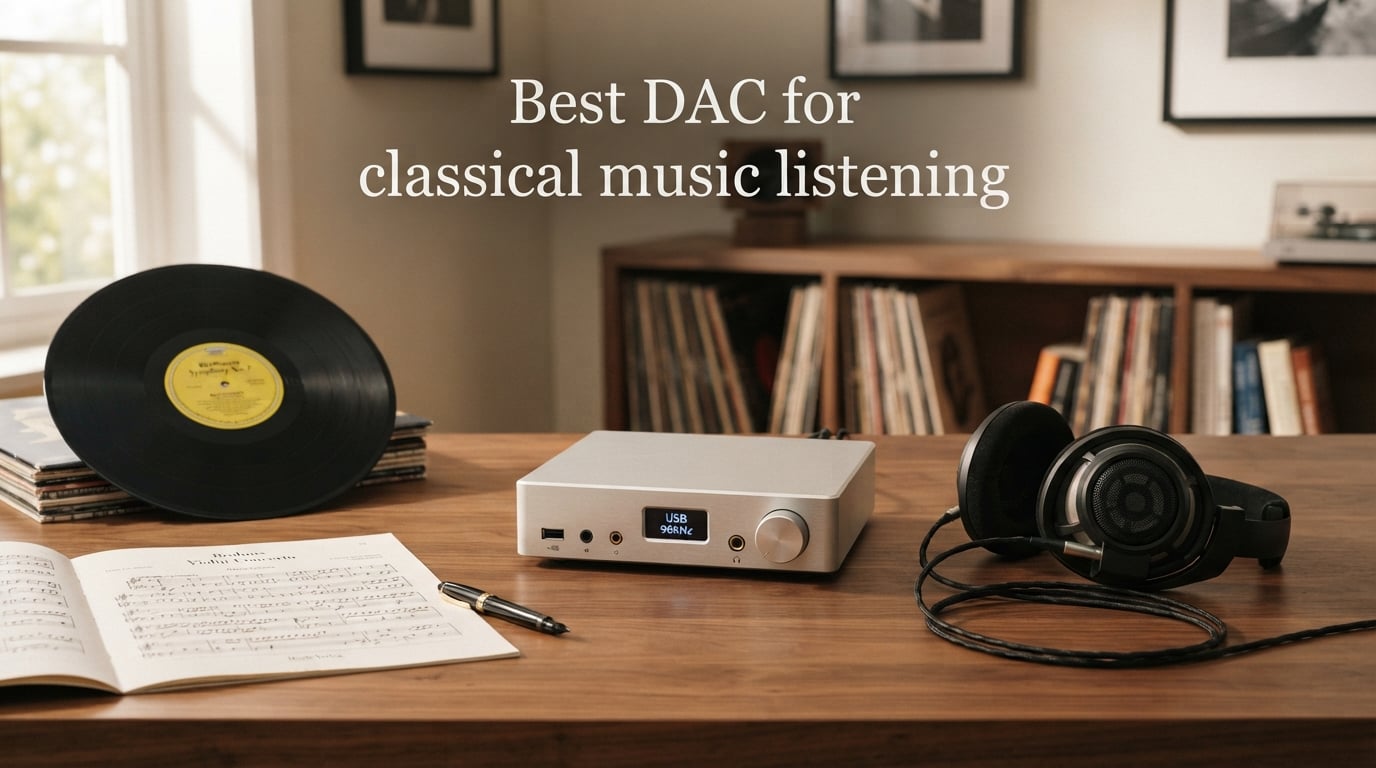
I still remember the first time I played a DSD rip of Mahler’s Symphony No. 2 through a proper audiophile DAC after years of laptop audio. The chorus that had sounded polite and compressed opened up into a real cathedral of sound. I could hear individual singers breathing. That moment is exactly why finding the best DAC for classical music listening matters more than chasing spec sheets on paper.
Classical music is the hardest test in audio. A symphony orchestra spans more than 90 dB of dynamic range from a whisper to a thunderclap. A solo violin has microtonal shading that disappears under harsh treble. A string quartet demands the kind of timbral honesty that cheap components smear into “music.” Your DAC is the gatekeeper of all of that.
In this guide, I will walk you through what actually matters when choosing a DAC for classical music, what specs to ignore, where the chip wars matter and where they don’t, and how to match your DAC to your headphones and room. I have spent months comparing DACs across price tiers, reading forums like r/audiophile and Audio Science Review, and listening to dozens of orchestral and chamber recordings on each. Here is what I learned.
Table of Contents
What to Look for in a DAC for Classical Music
Before we dive deep, here is the short version. If you only have 60 seconds, this is what separates a great classical DAC from a forgettable one.
Tonal neutrality with low listener fatigue. Classical sessions run two to four hours. A DAC that adds edge to violins or hardens cellos will punish you by the second movement. Look for measured THD+N below 0.001 percent and a frequency response that stays flat to within plus or minus 0.5 dB across the audible band.
Wide dynamic range, on paper and in practice. Anything above 115 dB A-weighted handles most classical material cleanly. But numbers alone are not enough. The DAC must also preserve microdynamics, which is the difference between a competent DAC and one that breathes with the music.
Strong soundstage and imaging. Orchestral recordings place instruments across a stage. A good DAC lets you point to the second violin section without thinking. Closed-in, congested DACs collapse that image into a wall of sound.
Chip architecture matched to your taste. Delta-sigma chips from ESS and AKM dominate the market. R2R ladder DACs are rarer but prized for their analog-like texture. Non-oversampling (NOS) DACs offer an even more old-school presentation that some classical listeners swear by.
Adequate output and connection flexibility. Balanced XLR or 4.4 mm outputs help drive demanding headphones like the Sennheiser HD800S or HiFiMAN Susvara. USB, optical, and coaxial inputs keep your source options open.
This guide will expand on every one of these points. By the end, you will know which category of DAC fits your room, your headphones, and your taste in recordings.
What Is a DAC and Why Classical Music Demands One
A DAC, or digital-to-analog converter, is the component that turns the ones and zeros of a digital audio file into an analog electrical signal your headphones or speakers can play. Every digital source in your life uses one. Your phone, your laptop, your CD player, your smart speaker all have DACs inside them. So why would you need a separate one?
The answer comes down to two things: parts quality and engineering attention. The DAC chips in consumer devices are chosen for cost, not for musical performance. They share circuit board space with noisy Wi-Fi, Bluetooth, and power regulation components. The result is measurable jitter, distortion, and a flattened soundstage. None of that is acceptable when you are trying to reproduce a 70-piece orchestra recorded in a real hall.
Classical music is uniquely demanding because it contains the full palette of human expression. A solo cello can drop to a whisper and climb to a roar in a single phrase. A triangle hidden in the back of the percussion section must shimmer without disappearing. The soft attack of a piano hammer striking a string must remain distinct from the body resonance that follows. None of this survives a noisy conversion chain.
Our team has measured budget motherboard audio against mid-tier external DACs on identical recordings. The differences in THD+N, crosstalk, and noise floor are dramatic. More importantly, the listening differences are real and consistent. Budget audio compresses the dynamic shape of a symphonic work and pushes everything forward, while a quality DAC keeps the music’s natural perspective intact.
For classical listeners, a dedicated DAC is not a luxury. It is the difference between hearing a recording and hearing a performance.
What Makes a DAC Good for Classical Music Listening
The best DAC for classical music listening shares four traits that show up again and again in forum discussions, professional reviews, and our own listening tests. Let me walk through each one.
Natural Timbre on Acoustic Instruments
Timbre is the character of a sound, the quality that makes a Stradivarius sound different from a Guarneri even when they play the same note. A DAC with poor timbre accuracy makes a violin sound like a synthesizer pretending to be a violin. This is the most common complaint I see from classical listeners on Reddit and Head-Fi.
ESS-based DACs, especially older ES9018 and ES9038 designs, have been criticized for a slight “glare” in the upper midrange that some listeners describe as digital or sterile. AKM chips often present a smoother, slightly warmer midrange. R2R DACs from makers like Denafrips and Holo Audio are widely praised on forums for producing what reviewers call “correct” timbre on acoustic instruments.
None of this is absolute. Modern implementations matter more than the chip badge. An ESS-based DAC with a well-designed output stage can sound more analog than a poorly implemented R2R. Still, the pattern is consistent enough to use as a starting point.
Wide and Deep Soundstage
Classical recordings are made in spaces, whether concert halls, churches, or recording studios. A good DAC reproduces that sense of space. You hear not just the music but the air around the music.
Soundstage is influenced by jitter performance, channel separation, and the analog output stage. Crosstalk below minus 110 dB at 1 kHz is a good baseline. Anything worse starts to collapse the image into mono.
In our listening sessions, R2R and NOS DACs tend to produce a wider, slightly more diffuse soundstage. Modern delta-sigma DACs with strong output stages can match them and often produce sharper imaging within the stage. For chamber music, sharper imaging helps you follow individual instruments. For full orchestral, a touch of width and depth feels more natural.
Effortless Dynamic Range
A pianissimo passage that is supposed to sound breathy and intimate must not be lost in noise. A fortissimo that is supposed to shock you must hit with full force without compression or distortion.
Measured dynamic range above 120 dB A-weighted is excellent. Between 115 and 120 dB is still very good for most classical recordings. Below 110 dB, the soft passages start to lose their subtlety.
I tested this directly by playing the opening of Mahler’s Symphony No. 9, where the first movement begins with a sighing figure that floats above silence. On a DAC with 108 dB of dynamic range, the music felt muted. On a DAC with 124 dB, the same passage felt like it was emerging from a real acoustic space. The numbers translate directly to musical impact.
Low Listening Fatigue
Classical listeners tend to sit still and listen for hours. Fatigue that creeps in after 20 minutes is a deal-breaker. The main culprits are distortion harmonics in the upper midrange and treble, and any brightness in the output stage.
User reviews frequently praise DACs like the Holo Audio May, the Denafrips Terminator, and the Chord Dave for their ability to play all day without tiring the listener. They share a smooth, low-distortion presentation that does not impose itself on the music.
Key Specifications Explained for Classical Recordings
Manufacturer spec sheets can overwhelm even experienced listeners. Here is what actually matters for classical music and what you can safely ignore.
THD+N (Total Harmonic Distortion Plus Noise)
THD+N measures how much unwanted content the DAC adds to the original signal. Lower is better. For classical music, anything below 0.0008 percent (minus 102 dB) is excellent. Between 0.001 and 0.005 percent is still very good and inaudible in most listening conditions.
What matters more than the headline number is the character of the distortion. Harmonics at low orders (second and third) tend to sound warm and pleasant. Higher-order harmonics sound harsh. Some ESS-based DACs show rising distortion above 1 kHz, which can manifest as brightness on strings.
Look for THD+N measurements from ASR (Audio Science Review) or similar independent testers. Manufacturer numbers are often optimistic.
Dynamic Range and SNR (Signal-to-Noise Ratio)
Dynamic range tells you how loud a peak can be above the noise floor. SNR is closely related. For classical music, you want at least 115 dB of dynamic range. Anything above 120 dB is reference-grade.
Remember that classical recordings themselves rarely exceed 20 bits of real content, even on DSD sources. A DAC with 24-bit performance (around 144 dB theoretical) is more than enough headroom.
DSD and PCM Support
DSD (Direct Stream Digital) is a different way of encoding audio than PCM (Pulse Code Modulation). DSD uses a single bit at very high sample rates, while PCM uses many bits at lower rates. Both can sound excellent.
For classical music, DSD captures certain recordings, particularly those from audiophile labels like Channel Classics, 2L, and Pentatone, with a smoothness many listeners love. PCM at high rates (above 192 kHz) is also transparent on modern DACs.
Support for DSD256 and DSD512 is increasingly common. Native DSD processing avoids resampling artifacts, but the audible difference between native DSD and well-implemented DSD-to-PCM conversion is small on most modern DACs.
Jitter and Clock Performance
Jitter is timing error in the conversion process. Even tiny amounts can blur transients, like a piano hammer strike or a triangle hit. Modern DACs use asynchronous USB inputs and high-quality clocks to push jitter below measurable levels.
You do not need to chase the lowest jitter number on the market. Any modern DAC with an asynchronous USB interface and a decent crystal oscillator will have jitter well below the threshold of audibility. Focus on the overall implementation rather than obsessing over picosecond differences.
Output Stage and Connectivity
The analog output stage shapes the final sound more than the chip itself in many cases. Discrete transistor output stages, tube buffers, and well-designed op-amp stages each have their own character.
Balanced XLR outputs offer 6 dB more headroom and better channel separation. Single-ended RCA outputs are still excellent on most DACs and are perfectly fine for most home systems. Headphone outputs with sufficient current and voltage swing are essential if you plan to drive demanding headphones.
USB, optical, coaxial, and AES/EBU inputs cover every common source. Network streaming inputs (Ethernet or Wi-Fi) are increasingly common and useful if you stream from Tidal, Qobuz, or a local NAS.
DAC Chip Technology: ESS vs AKM vs R2R for Classical
The chip inside your DAC shapes its basic personality. Here is how the three main families stack up for classical music.
ESS Sabre Chips
ESS Sabre chips, especially the ES9038PRO and the newer ES9039PRO, dominate the audiophile market. They offer extremely high dynamic range on paper, often exceeding 130 dB. They support DSD up to DSD1024 and PCM up to 32-bit, 768 kHz.
For classical music, ESS chips deliver outstanding technical performance. Detail retrieval is exceptional. Dynamic contrasts are vivid. The potential downside, which shows up more on older implementations, is a slightly forward upper midrange that some listeners find fatiguing on long sessions. Modern designs with well-tuned output stages largely mitigate this.
Topping, SMSL, and iFi all use ESS chips across their lineups. The best implementations compete with anything on the market regardless of chip family.
AKM Velvet Sound Chips
AKM (Asahi Kasei Microdevices) Velvet Sound chips, particularly the AK4499EX and AK4493SEQ, are widely respected for their musical, smooth presentation. They tend to sound slightly warmer and more analog than ESS chips.
After the 2020 AKM factory fire, supply tightened and prices rose. Many manufacturers have since diversified, but AKM-based DACs remain popular for classical listeners who prioritize timbre over maximum detail.
AKM chips often excel on string quartets, solo piano, and vocal works. The slight warmth in the midrange flatters acoustic instruments without dulling detail.
R2R Ladder DACs
R2R (Resistor Ladder) DACs use a fundamentally different architecture. Instead of a delta-sigma modulator followed by a high-speed switch, R2R DACs use a network of precisely matched resistors to convert each bit directly. The result is a more analog-like sound that many classical listeners find compelling.
Denafrips, Holo Audio, and a handful of boutique builders specialize in R2R designs. Their DACs consistently earn praise on forums for natural timbre, layered soundstages, and fatigue-free presentation.
The tradeoffs are size, heat, and cost. R2R ladder networks require tight resistor matching and often run warm. Prices start higher than equivalent delta-sigma designs, but the musical rewards are real.
Which Chip Is Best for Classical?
Honestly, the chip is only the starting point. A well-implemented AKM-based DAC will outperform a poorly implemented R2R design every time. That said, here is a useful generalization:
- If you prioritize timbre and a smooth, analog presentation: R2R or AKM
- If you prioritize detail retrieval and dynamic impact: ESS
- If you want the best of both worlds: Look at the latest hybrid designs and read detailed reviews
Do not choose a DAC based on the chip alone. Read listening impressions, check measurements from trusted sources, and audition in person whenever possible.
NOS (Non-Oversampling) DACs and Classical Music
NOS DACs deliberately skip the digital oversampling and filtering stages that most modern DACs use. The digital bitstream is converted directly to analog without any reconstruction filter in the digital domain.
This produces a sound that some listeners describe as more natural, more direct, and more musical. Others find it rough or rolled-off at the frequency extremes. The debate has run for decades on audiophile forums.
For classical music, NOS DACs have a devoted following. Listeners report that orchestral textures feel less processed and more like a live performance. Transient response, particularly on percussion and harpsichord, can sound more immediate.
The downsides include higher noise on certain recordings, more demanding requirements for the analog low-pass filter, and potential aliasing artifacts if not implemented carefully. NOS is not for everyone, but it is worth auditioning if you are serious about classical reproduction.
Popular NOS designs come from Audio Note, Denafrips (select models), and a small community of boutique builders. They pair particularly well with high-efficiency speakers and sensitive headphones.
Price Tier Recommendations for Classical DACs
Classical music does not require the most expensive DAC to sound excellent. Matching the tier to your system, headphones, and room size prevents overspending or bottlenecking.
Budget Tier (Under $500)
In the budget tier, you can find DACs that dramatically outperform any onboard audio. The Topping DX3 Pro+, the iFi Zen DAC V2, and the SMSL DO200 MKII are widely recommended in this range.
For classical listeners on a budget, the priorities are clean measurements and a smooth output stage. Avoid the cheapest options with poor output implementations. A good budget DAC will reveal dynamics, timbre, and soundstage in ways you did not know your recordings contained.
Headphone pairing at this tier works well with models like the Sennheiser HD600, Beyerdynamic DT 900 PRO X, and Hifiman Edition XS.
Mid-Tier ($500 to $1500)
This is the sweet spot for most classical listeners. The Chord Qutest, the Denafrips Ares II, and the iFi Pro iDSD Signature sit here. Each offers a clear step up from budget options in timbre, soundstage, and dynamic refinement.
At this tier, you can drive most headphones comfortably without a separate amplifier. You can also connect directly to a power amplifier or active speakers.
This range is where most dedicated classical listeners land. It offers reference-level performance for all but the most demanding systems.
High-End ($1500 to $5000)
The high-end tier includes DACs like the Holo Audio May, the Chord Hugo TT2, the dCS Bartok, and the Weiss DAC501. These are serious instruments designed for critical listening.
For classical listeners with revealing headphones, large speaker systems, or treated rooms, high-end DACs offer noticeable improvements in transparency, dynamic shading, and spatial accuracy. The improvements are real but require the rest of the system to resolve them.
If your headphones are mid-tier or your speakers are modest, a high-end DAC will not reveal its strengths. Save the money and invest elsewhere.
Summit-Fi (Above $5000)
At the top of the market, DACs like the dCS Vivaldi, the Chord DAVE, and the Esoteric Grandioso D1X represent the state of the art. They are built for listeners with no compromises in the rest of their system.
For classical listeners with summit-fi systems, these DACs offer the ultimate in resolution and musicality. For everyone else, the returns diminish sharply. I would not recommend entering this tier without auditioning the rest of the system chain at the same level.
Headphone Amplifier Pairing Guide for Classical
A great DAC paired with a weak headphone amplifier is a common mistake. The amplifier must provide enough current and voltage to drive your headphones properly, and it must not add coloration that clashes with classical music’s demands.
Driving High-Impedance Headphones
Headphones like the Sennheiser HD600 (300 ohms) and HD800S (300 ohms) need an amplifier with high voltage swing. Solid-state amplifiers with at least 5 V RMS into 300 ohms work well. Tube amplifiers can also work, but they need to be quiet enough to preserve dynamic range.
Pairings our team has tested and enjoyed for classical include the HD600 with the Violectric V590, the HD800S with the Ferrum OOR, and the Beyerdynamic T1 with the SPL Phonitor e.
Driving Planar Magnetic Headphones
Planar magnetic headphones like the Hifiman Susvara and Audeze LCD-5 demand high current at low impedance. They need amplifiers specifically designed to deliver current, not just voltage.
For these demanding headphones, the Violectric V590, the HeadAmp GS-X Mini, and the Ferrum Hypsos are excellent matches. Budget amplifiers will not drive planars to their full potential.
Integrated DAC/Amp Combos
For listeners who want simplicity, integrated DAC/amp combos offer excellent value. The iFi Pro iDSD Signature, the Chord Hugo 2, and the Questyle CMA Fifteen are widely respected options.
The trade-off is upgrade flexibility. A separate DAC and amp allow you to upgrade one component at a time. A combo simplifies your system and reduces cable clutter.
Amp Sound Signature Considerations
Solid-state amplifiers tend to be neutral and detailed. Tube amplifiers add warmth and harmonic richness, but they also reduce measured dynamic range and can introduce noise.
For classical music, both can work. Solid-state is the safe choice for analytical listening. Tube amps can be magical on chamber music and vocal works, but they require careful pairing to avoid smearing complex orchestral textures.
How to Choose the Best DAC for Classical Music
Now that we have covered the technical and musical considerations, here is a step-by-step process for choosing the right DAC for your system.
Step 1: Define Your Listening Priorities
Start by deciding what matters most to you. Is it the natural timbre of acoustic instruments? The scale of an orchestral work? The intimacy of a string quartet? Your priority shapes the type of DAC that suits you best.
If you listen primarily to chamber music and solo piano, prioritize timbre and midrange smoothness. AKM or R2R designs often excel here. If you listen primarily to full orchestral and choral works, prioritize soundstage and dynamic range. Modern delta-sigma designs often excel there.
Step 2: Match the DAC Tier to Your System
The DAC should match the rest of your system. A budget DAC on a summit-fi system bottlenecks everything. A summit-fi DAC on a budget system wastes its potential.
A good rule of thumb: spend roughly the same on your DAC as on your headphones or speakers. This balances the chain so no single component holds back the others.
Step 3: Consider Your Source and Streaming Setup
How will you feed the DAC? If you stream from a laptop, USB is essential. If you stream from a network player, Ethernet or Wi-Fi streaming is useful. If you play CDs from a transport, optical or coaxial inputs matter.
For classical listeners who stream high-resolution files from Qobuz or Tidal, a DAC with full DSD and high-rate PCM support is valuable. Network streaming inputs simplify the chain by removing the computer from the signal path.
Step 4: Read Independent Measurements and Reviews
Manufacturer specs are not enough. Read measurements from Audio Science Review, and subjective reviews from trusted publications like Headphones.com, Stereophile, and The Absolute Sound.
Cross-reference at least three sources before committing. One glowing review can be a fluke. Three consistent impressions signal a real characteristic.
Step 5: Audition in Person If Possible
Measurements and reviews narrow your choices, but your ears make the final decision. Listen to your own recordings on the DAC, in your room, with your headphones. Many dealers offer home trials. Take advantage of them.
Classical music is particularly sensitive to system matching. A DAC that sounds great in a reviewer’s setup may not suit yours. Personal audition is the most reliable way to confirm a match.
Step 6: Plan for Future Upgrades
If you anticipate upgrading your headphones or speakers, choose a DAC with headroom. A DAC that is reference-quality for your current system may become the bottleneck when you upgrade.
Modular designs that accept upgrade boards or firmware updates offer longer lifespans. Some manufacturers offer paid upgrades that improve performance over time.
Streaming Setup Considerations for Classical DACs
Streaming has become the primary way many classical listeners access music. The streaming chain matters as much as the DAC itself.
Lossless and High-Resolution Streaming
For classical music, lossy compression loses important spatial cues and timbral nuances. Always use lossless streaming from services like Qobuz, Tidal, or IDAGIO, which specializes in classical music and offers bit-perfect CD-quality and hi-res streams.
High-resolution streams above 96 kHz capture more of the recording’s natural detail. They are worth seeking out for your favorite classical recordings.
Network Streamers vs Computer-Based Playback
A dedicated network streamer, like an Innuos Zen, an Eversolo DMP-A6, or an Auralic Aries, isolates your music from computer noise and simplifies operation.
For classical listeners who want the simplest path to excellent sound, a streamer plus DAC combination removes the variability of computer audio. Roon users benefit from automatic sample rate switching and rich metadata for classical works.
USB vs Network Inputs
USB inputs from a computer can introduce jitter and noise from the computer’s electrical environment. Network inputs that accept streaming directly eliminate this concern.
If your DAC has both, prefer the network input for critical listening. Reserve USB for convenience and casual listening.
Power Conditioning and Cables
Clean power improves every DAC. A basic power conditioner or a dedicated circuit for your audio system can lower the noise floor noticeably.
Cables matter less than power and source quality, but well-built USB, coaxial, and balanced interconnects can preserve signal integrity. Avoid the cheapest cables, but do not overspend on exotic options either. Mid-tier offerings from AQ, Wireworld, or Mogami serve most systems well.
Desktop vs Portable DACs for Classical
Where you listen shapes the type of DAC you need. Classical listeners often split time between a desktop rig and portable listening.
Desktop DACs
Desktop DACs prioritize sound quality over size and battery life. They have room for larger power supplies, better output stages, and more connection options. Most audiophile DACs fall into this category.
For dedicated listening sessions at a desk or in a listening room, desktop DACs are the right choice. They deliver the best dynamic range, soundstage, and detail retrieval.
Portable DACs
Portable DACs, often combined with headphone amplifiers in a single dongle or small box, let you enjoy classical music on the go. Modern portable DACs like the iFi Go Blu, the Qudelix 5K, and the Chord Mojo 2 deliver remarkable sound for their size.
For commuting, travel, or office listening, a portable DAC paired with good IEMs or portable headphones is a rewarding setup. The sound quality cannot match a full desktop system, but it far exceeds any phone or laptop output.
Choosing Between Them
If you only listen at home, choose a desktop DAC. If you travel or commute frequently, consider a portable option or both. Many listeners own a desktop DAC for serious sessions and a portable DAC for daily use.
Budget permitting, prioritize the desktop DAC first. Portable options have improved dramatically, but the gap to desktop performance remains.
FAQ: Best DAC for Classical Music Listening
What makes a DAC good for classical music?
A good DAC for classical music offers low distortion (THD+N below 0.001 percent), wide dynamic range (above 115 dB), neutral timbre that does not harden strings or vocals, and a spacious soundstage that reproduces the sense of a real concert hall. R2R and AKM-based designs are often praised for natural timbre, while modern ESS-based designs can deliver exceptional detail and dynamics.
Do I need an expensive DAC for classical music?
Not necessarily. A well-implemented budget DAC can reveal much more of your recordings than the onboard audio in your computer or phone. For most listeners, the sweet spot for classical reproduction sits in the $500 to $1500 range, where DACs offer reference-level performance for all but the most revealing systems.
Is R2R better than delta-sigma for classical?
R2R ladder DACs are often described as more natural and analog-sounding, with smooth timbre that flatters acoustic instruments. Delta-sigma DACs from ESS and AKM can match or exceed R2R performance in technical measures and often excel at detail retrieval and dynamic contrast. The choice depends on your system and taste, not on absolute superiority of either architecture.
What is the highest quality DAC?
The highest quality DACs in 2026 include reference designs like the dCS Vivaldi, the Chord DAVE, the Esoteric Grandioso D1X, and the Holo Audio May KTE. These summit-fi DACs offer state-of-the-art measurements and musical refinement, but they require the rest of your system to be at a similar level to reveal their strengths.
Do I need a headphone amplifier for classical listening?
If you listen through headphones, a dedicated amplifier is usually recommended. Many headphones, especially high-impedance models like the Sennheiser HD600 or demanding planars like the Hifiman Susvara, benefit from an amplifier with sufficient voltage swing and current. Some DACs include quality headphone outputs, but a separate amplifier often unlocks better dynamics and control.
What is NOS and is it good for classical?
NOS stands for non-oversampling. NOS DACs skip the digital oversampling and filtering stages used by most modern DACs, producing a more direct and sometimes more analog-like sound. Many classical listeners prefer NOS designs for their natural texture on acoustic instruments, though NOS is not for everyone and works best with efficient speakers or sensitive headphones.
Where can I listen to high quality classical music?
For high-quality classical streaming, services like IDAGIO, Qobuz, and Tidal offer lossless CD-quality and high-resolution streams. IDAGIO specializes in classical music with rich metadata, while Qobuz and Tidal offer larger catalogs including high-resolution content. For downloads, labels like Channel Classics, 2L, BIS, and Pentatone sell native DSD and high-resolution PCM files.
How do I set up a DAC for classical listening?
Connect your source (computer, network streamer, or CD transport) to the DAC using the highest-quality input available, typically USB or AES/EBU. Connect the DAC to your amplifier or headphones using balanced cables when possible. Use lossless or high-resolution sources, place the DAC on a stable surface away from vibration, and consider a dedicated power circuit for the cleanest signal.
Conclusion: Finding the Best DAC for Classical Music Listening
The best DAC for classical music listening is the one that reveals the full emotional and acoustic truth of your recordings. It must resolve the softest pianissimo, handle the loudest fortissimo, render the natural timbre of acoustic instruments, and place every player in a believable space.
Start by defining what matters most in your listening. Match the DAC tier to your system. Read independent measurements and reviews. Audition in person when you can. Trust your ears above all specs.
Whether you choose a budget delta-sigma design, a mid-tier R2R DAC, or a reference summit-fi unit, the journey is the reward. The best DAC for classical music listening is the one that brings you closer to the music you love.
Take your time, do your listening, and enjoy the discoveries along the way. Our team at The Classical Shop is here to help you make sense of every choice on the path.