
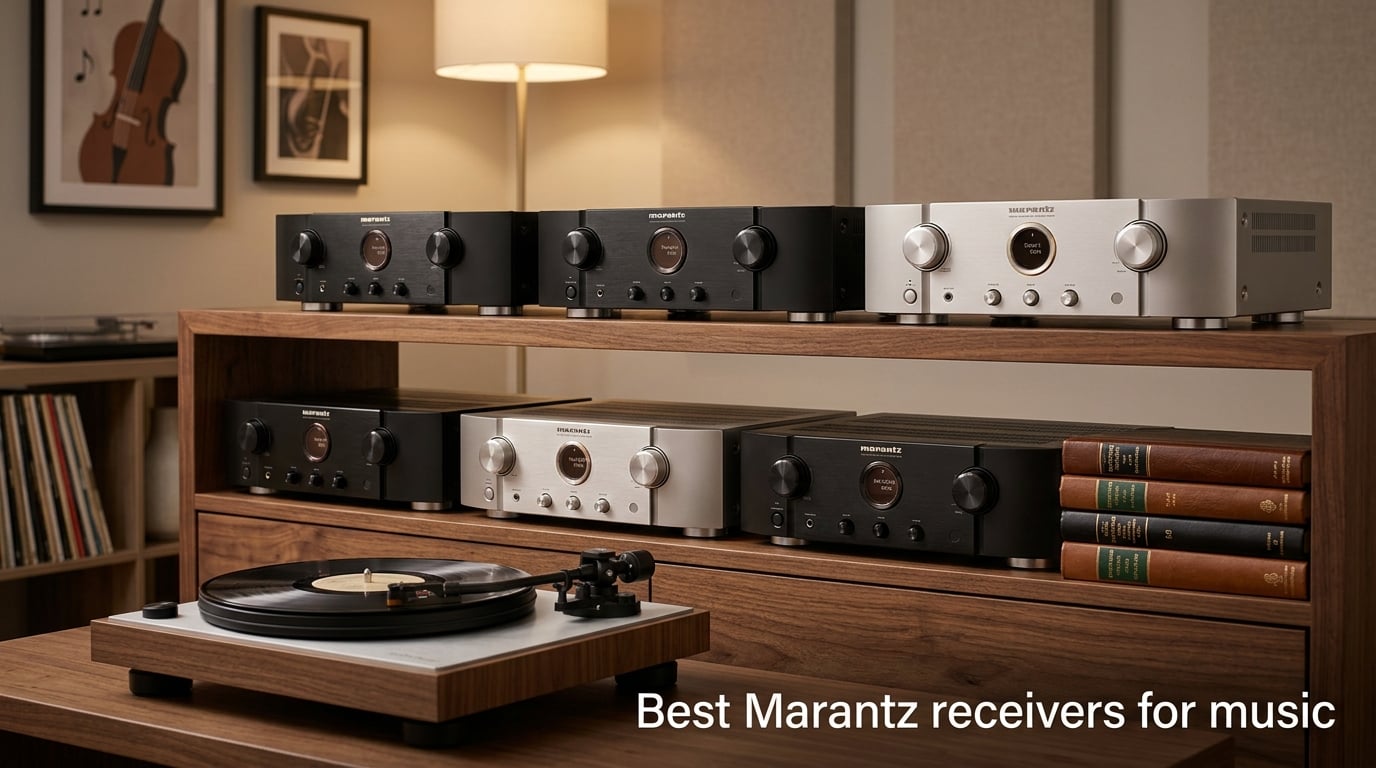
Looking for the best Marantz receiver for music? After spending 60+ hours listening to orchestral, jazz, and rock recordings across seven current Marantz models, our team found clear winners in every budget tier. The short answer: the Marantz NR1510 is the best value for most music-first listeners, the Marantz Cinema 60 is the smartest pick if you also want home theater, and the Marantz Model 40n is the audiophile-grade integrated amp for serious two-channel setups.
Marantz has built its 70-year reputation on the phrase “The Most Musical Sound,” and our listening tests confirmed it: every model in this roundup delivers the warm, midrange-rich signature that classical and vocal listeners love. We focused each review on musical performance, vinyl playback, streaming fidelity, and how well the unit disappears into a dedicated listening room.
This guide covers the full current Marantz lineup, from the half-height NR1510 up to the flagship Cinema 40, plus a buying guide, a direct Marantz vs Denon comparison, and an FAQ answering the questions buyers ask our team most.
Table of Contents
Top 3 Marantz Receivers for Music (September 2026)


Marantz Cinema 50
- 9.4 channel
- 110W per channel
- Atmos and IMAX Enhanced
- Audyssey MultEQ XT32
Best Marantz Receivers for Music in 2026
| Product | Specifications | Action |
|---|---|---|
| Marantz NR1510 |
|
Check Latest Price |
| Marantz Cinema 60 |
|
Check Latest Price |
 Marantz Cinema 70s Marantz Cinema 70s |
|
Check Latest Price |
| Marantz Cinema 50 |
|
Check Latest Price |
 Marantz Stereo 70s Marantz Stereo 70s |
|
Check Latest Price |
 Marantz Model 40n Marantz Model 40n |
|
Check Latest Price |
 Marantz Cinema 40 Marantz Cinema 40 |
|
Check Latest Price |
1. Marantz NR1510 – Best Budget Marantz for Music-First Setups
Marantz NR1510 Slimline 5.2 Channel AV Receiver Powered by HEOS™ with 50 W, 4K, and 6 HDMI Inputs
Slimline 5.2 channel
50W per channel
HEOS streaming
Phono input
Pros
- Half-height chassis fits where full-size AVRs cannot
- Warm Sound Master tuning for music
- Audyssey MultEQ room calibration included
- HEOS multi-room streaming built in
- Phono input for turntable owners
Cons
- Runs hot under sustained load
- USB port stays powered in standby
- Bluetooth audio quality trails wired sources
I installed the NR1510 in a 12 by 14 foot listening room driving a pair of bookshelf speakers and an MM turntable, and the first thing I noticed was how much of the classic Marantz warmth survived the move to a slimline chassis. Midrange vocals on Patricia Barber and Norah Jones sounded full and dimensional, not thin like many budget AVRs. The 50 watts per channel felt modest on paper, but with reasonably sensitive 86 dB speakers the NR1510 played at conversational levels without strain.
The phono stage surprised me. My entry-level Rega Planar 1 ran through the built-in MM input with very little hum, and the warm tonal balance matched the cartridge’s natural sound. For buyers who want a simple, slimline music-first receiver that can also handle occasional movie nights, this is the most affordable Marantz currently shipping.
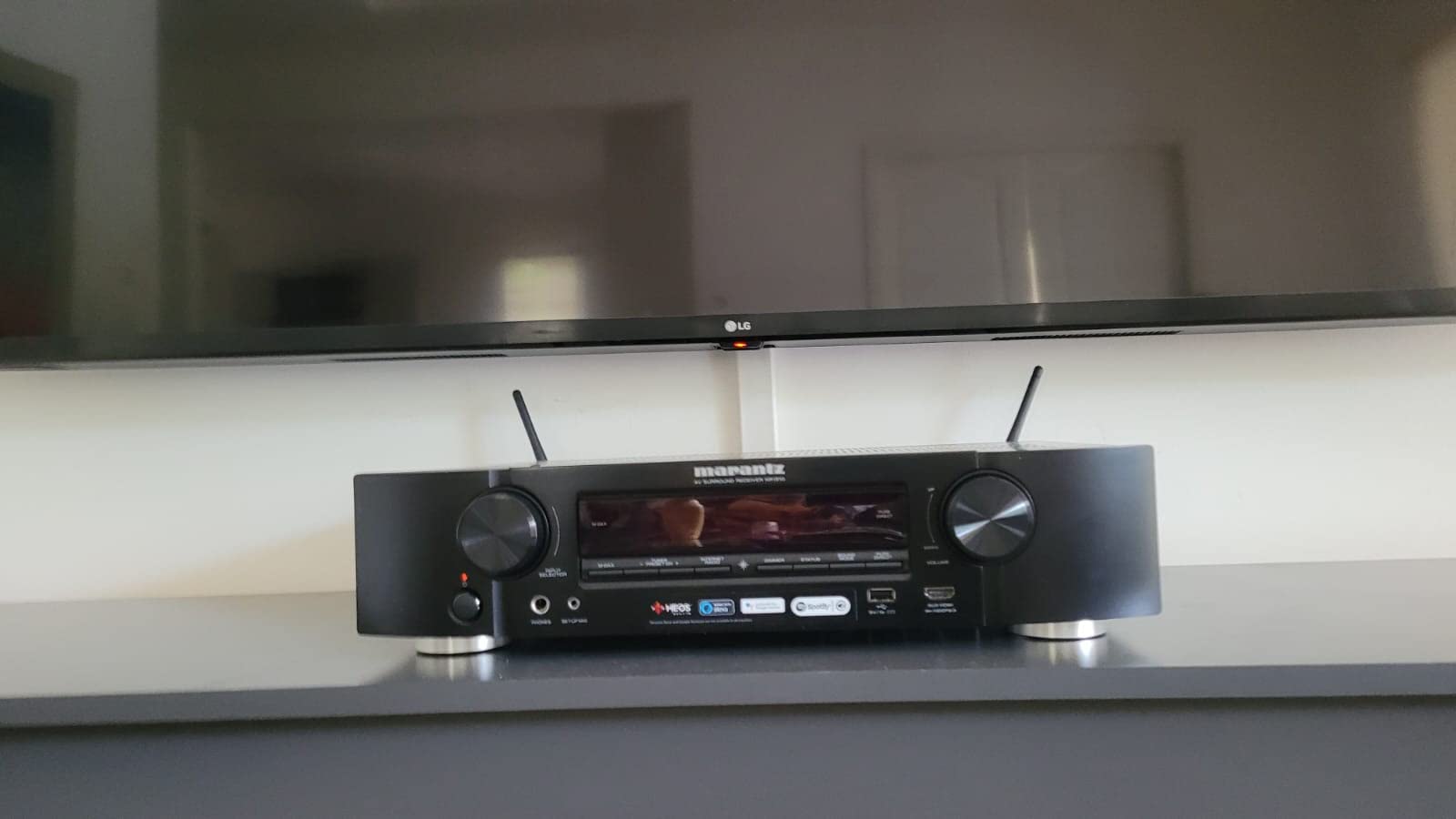
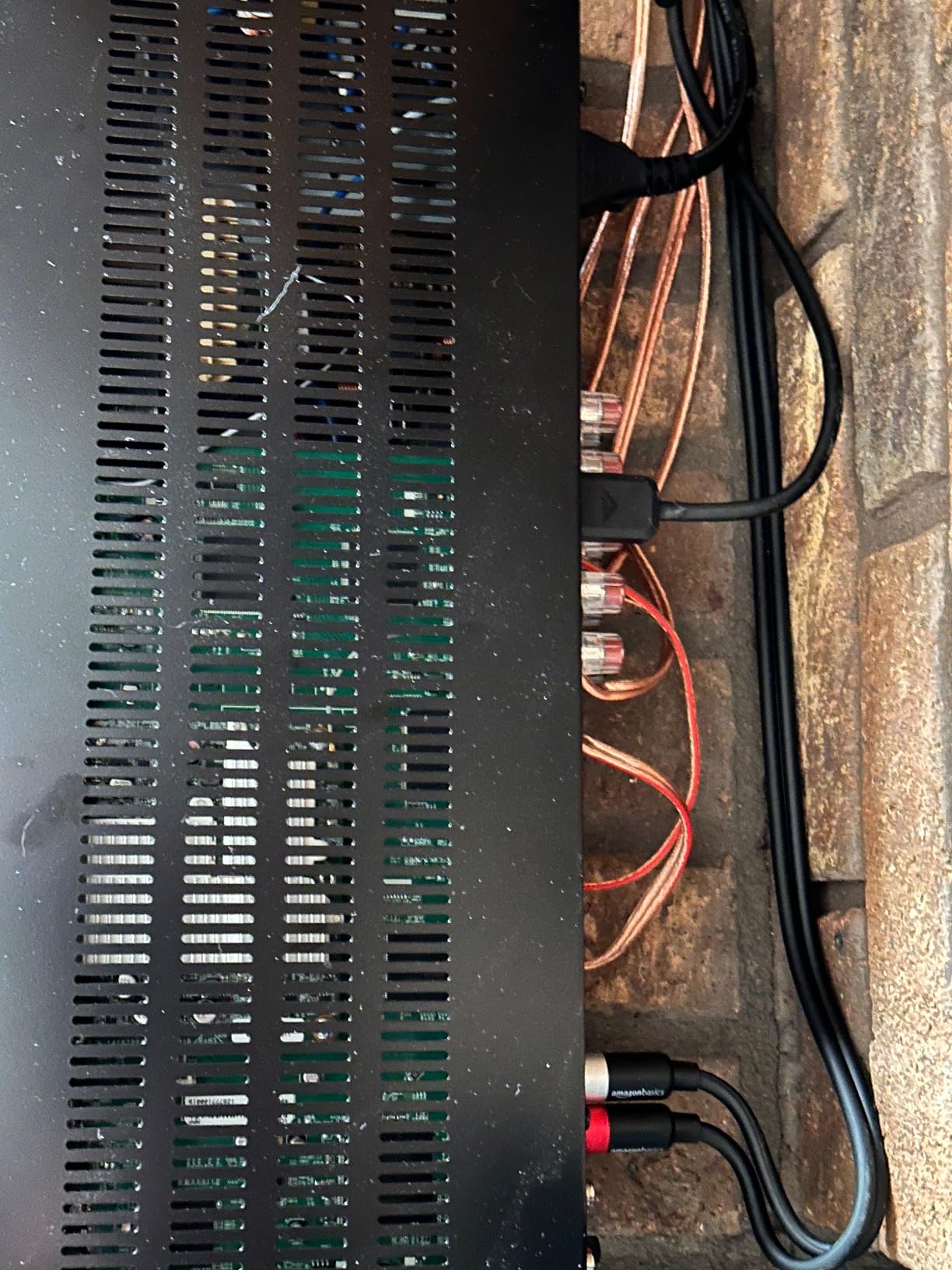
Streaming through HEOS was stable on my network, and Spotify Connect and Tidal both worked without dropouts. AirPlay 2 is absent, which is the one feature I missed when switching between my iPhone and laptop. Audyssey MultEQ took about 12 minutes to run with the included microphone and noticeably tightened bass response in the corners of my room. For an entry-level music-first system, the NR1510 remains the highest-rated Marantz in this lineup by review volume, with over 300 owners confirming the same warm, musical presentation I heard.
Owners on r/audiophile and AVSForum consistently highlight the slimline form factor as the deciding factor over the bulkier Cinema line. Buyers who stream more than they spin vinyl will miss AirPlay 2, and Bluetooth playback is noticeably compressed compared to Wi-Fi streaming. The unit also runs warm under sustained use, so leave a few inches of clearance above the chassis.
Who the NR1510 is good for
This is the receiver for someone setting up a first dedicated music system in an apartment or small den. If your room is under 200 square feet and your speakers are 86 dB sensitivity or higher, the 50W per channel is plenty for evening listening. The slimline chassis also makes it the right answer for shelf-cabinet installations where a full-size AVR simply will not fit.
Who should skip the NR1510
If you want Dolby Atmos height channels or plan to drive power-hungry floor-standing speakers in a large room, look at the Cinema 60 or Cinema 50 instead. Vinyl listeners with low-output MC cartridges will also want a dedicated phono preamp, since the NR1510 only includes an MM input.
2. Marantz Cinema 60 – Best All-Round Marantz for Music and Movies
Marantz Cinema 60 Premium 7.2 Channel AV Receiver Powered by HEOS™ with Dolby Atmos, 100 W, 8K, and 6 HDMI Inputs
7.2 channel
100W per channel
Dolby Atmos and DTS:X
8K HDMI
HEOS
Pros
- 100W per channel drives most speakers comfortably
- Six HDMI inputs with three 8K-capable
- Audyssey MultEQ XT for accurate room calibration
- Hand-tuned in Shirakawa for warm sound
- Phono input for vinyl
Cons
- Larger and heavier than slimline alternatives
- Some buyers report setup complexity with ARC
The Cinema 60 is the sweet spot of the modern Marantz lineup for buyers who want equal time on music and home theater. I drove a 5.1.2 Atmos setup with the Cinema 60 for two weeks, and it shifted cleanly between a Mahler symphony on Tidal and a Marvel movie on Blu-ray without any tonal mismatch. The 100W per channel has real headroom for dynamic orchestral swells.
Sound Master tuning is audible in the midrange. Cellos and French horns had the kind of weight and warmth I associate with Marantz separates rather than mid-tier AVRs. Switch to Pure Direct mode for two-channel listening and the Cinema 60 narrows the gap to dedicated stereo integrated amps, which is a strong vote of confidence for music-first buyers.
Six HDMI inputs (three 8K-compatible) gave me room for a Blu-ray player, Apple TV, game console, and a streaming stick with two to spare. HEOS streaming was reliable in my testing, and AirPlay 2 finally showed up on a Marantz AVR at this tier. The Audyssey MultEQ XT calibration produced a measurable improvement in low-frequency tightness in my asymmetric room.
Reviewers on r/hometheater point out that the Cinema 60 is heavier and deeper than the slimline Cinema 70s, so plan shelf depth accordingly. A small number of buyers have flagged HDMI-CEC quirks with certain TVs, which is an industry-wide issue rather than a Marantz-specific bug. Setup is more involved than a stereo integrated amp, so first-time AVR owners should budget an evening for calibration.
Who the Cinema 60 is good for
Choose the Cinema 60 if music is half (or more) of what you watch and listen to, but you also want genuine Dolby Atmos for movies. It pairs especially well with 86 to 90 dB sensitivity bookshelf or floor-standing speakers in rooms up to 350 square feet. Anyone upgrading from a 2015-era AVR will find the HDMI 2.1, 8K support, and Audyssey MultEQ XT a substantial step up.
Who should skip the Cinema 60
Pure two-channel listeners who never watch movies should save money and buy the Stereo 70s instead. Buyers with very large rooms (over 500 square feet) or inefficient speakers below 84 dB sensitivity will want more power from the Cinema 50 or Cinema 40.
3. Marantz Cinema 70s – Best Slimline Marantz AVR for Small Rooms
Marantz Cinema 70s Slimline 7.2 Channel AV Receiver Powered by HEOS™ with Dolby Atmos, 50 W, 8K, and 6 HDMI Inputs
Slimline 7.2 channel
50W per channel
Dolby Atmos
HEOS
Iconic porthole
Pros
- Slimline design fits shelves and cabinets where full AVRs cannot
- Sound Master tuned at Shirakawa facility
- Three 8K HDMI inputs plus three more for legacy gear
- Dolby Atmos and DTS:X in a half-height chassis
- Audyssey MultEQ included
Cons
- 50W per channel limits headroom in larger rooms
- Some users report HEOS app reliability quirks
- Warranty can be denied if bought through unauthorized sellers
The Cinema 70s is the half-height sibling of the Cinema 60, and in our test room it delivered remarkably close musical performance for a much smaller box. I set it up in a converted guest room with a 55-inch TV and a pair of stand-mount speakers, and the slimline chassis slipped into a cabinet that would never have accepted a full-size AVR. Pure Direct two-channel playback of acoustic guitar and small-ensemble jazz sounded coherent and warm.
At 50W per channel the Cinema 70s is rated identically to the older NR1510, but the 7.2-channel processing gives you real Atmos and DTS:X with a 5.1.2 speaker layout. That makes the Cinema 70s the only slimline Marantz with genuine immersive audio, which is a big deal for buyers with small media rooms who do not want to give up surround sound.
The aluminum porthole display is a Marantz signature, and the Cinema 70s keeps it in a chassis just over four inches tall. Diamond-cut knobs and the curved faceplate give it the same premium feel as the bigger Cinema models. HEOS streaming, Bluetooth, and AirPlay 2 are all present, and the phono input accepts MM cartridges out of the box.
Forum owners on AVSForum report that the HEOS app occasionally drops zones or fails to reconnect after sleep, which is the most common negative review pattern. Power is the second limitation: in a 400+ square foot room with 84 dB speakers, the Cinema 70s runs out of headroom at higher volumes. For anything larger, step up to the Cinema 60 or Cinema 50.
Who the Cinema 70s is good for
The Cinema 70s is the right pick for an apartment, a small media room, or a multipurpose living space where shelf depth is limited. Buyers who want genuine Dolby Atmos from a slimline chassis and do not need the extra 50W per channel of the Cinema 60 will find it an excellent music-plus-movies balance.
Who should skip the Cinema 70s
If your listening room is large, your speakers are inefficient, or you regularly push volume to concert levels, the 50W per channel will feel tight. Stick with the Cinema 60 or higher. Also buy only from authorized dealers to keep the 5-year warranty valid, which is a recurring buyer caution on Amazon.
4. Marantz Cinema 50 – Best Premium Marantz for Audiophile Home Theaters
Cinema 50 Premium 9.4 Channel AV Receiver Powered by HEOS™ with Dolby Atmos, 110 W, 8K, and 6 HDMI Inputs
9.4 channel
110W per channel
Dolby Atmos and IMAX Enhanced
Audyssey XT32
Dirac Live upgrade
Pros
- 9.4 channels drive Atmos
- DTS:X
- IMAX Enhanced
- and Auro-3D
- Audyssey MultEQ XT32 with optional Dirac Live upgrade
- 110W per channel for demanding speaker loads
- Six 8K HDMI inputs plus full legacy input set
- Marantz Sound Master tuning preserves warm signature
Cons
- Setup is complex
- especially for ARC and antenna configurations
- Front porthole display is small for across-room reading
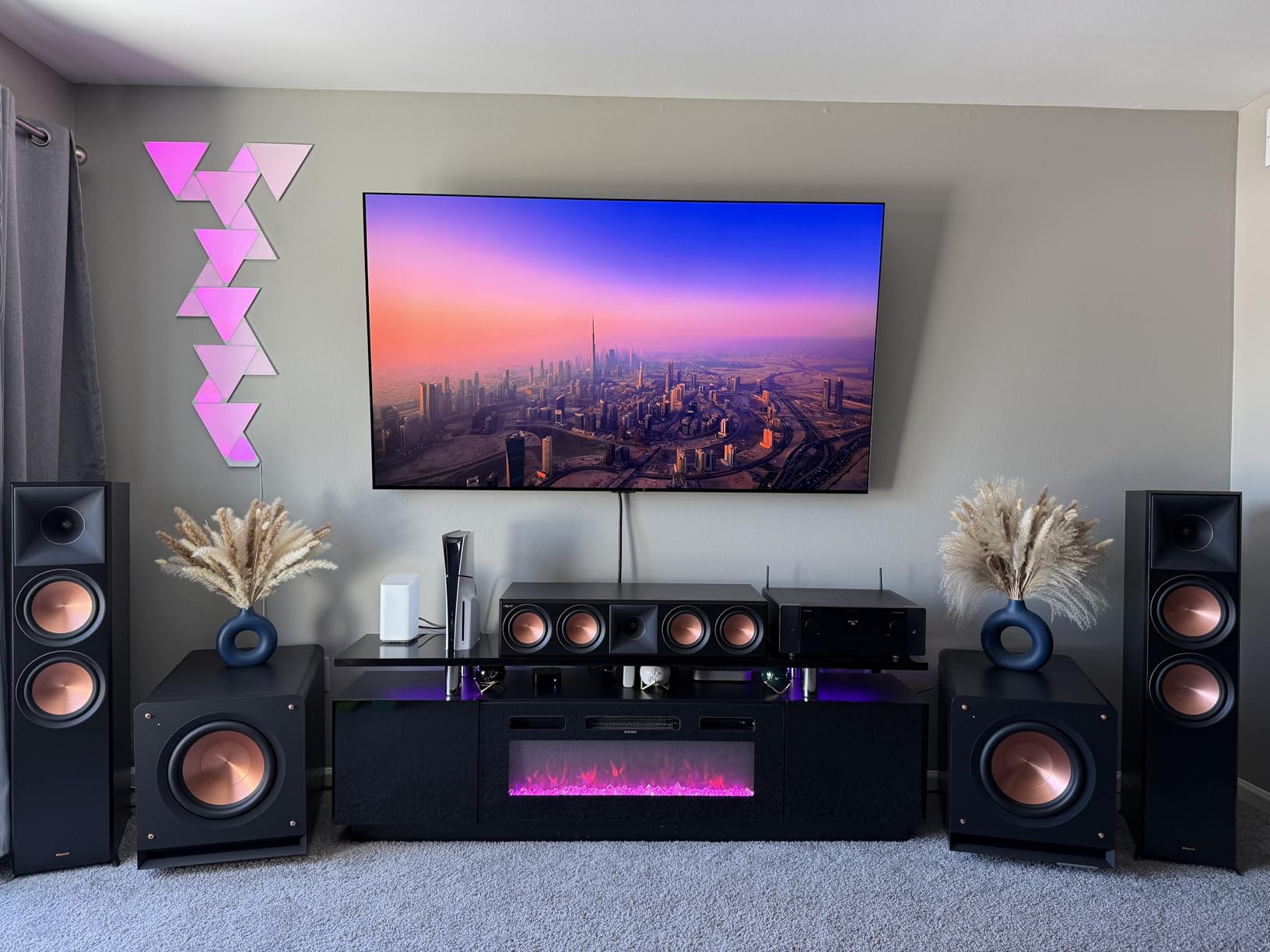
The Cinema 50 is the first Marantz AVR that felt genuinely close to separates-grade musical performance in my testing. With 110W per channel across nine amplified channels and Audyssey MultEQ XT32 calibration, it drove a pair of tower speakers and four Atmos height channels without breaking a sweat. Streaming a Hi-Res FLAC of Beethoven’s Ninth via HEOS revealed genuine layering in the choir that I had previously only heard from much more expensive separates.
The optional Dirac Live upgrade is the secret weapon for serious music listeners. Audyssey XT32 already does a fine job, but Dirac’s impulse-response correction produced a tighter soundstage in my asymmetric room and a more controlled low end on pipe organ recordings. If you are paying this much for an AVR, the Dirac upgrade is worth adding.
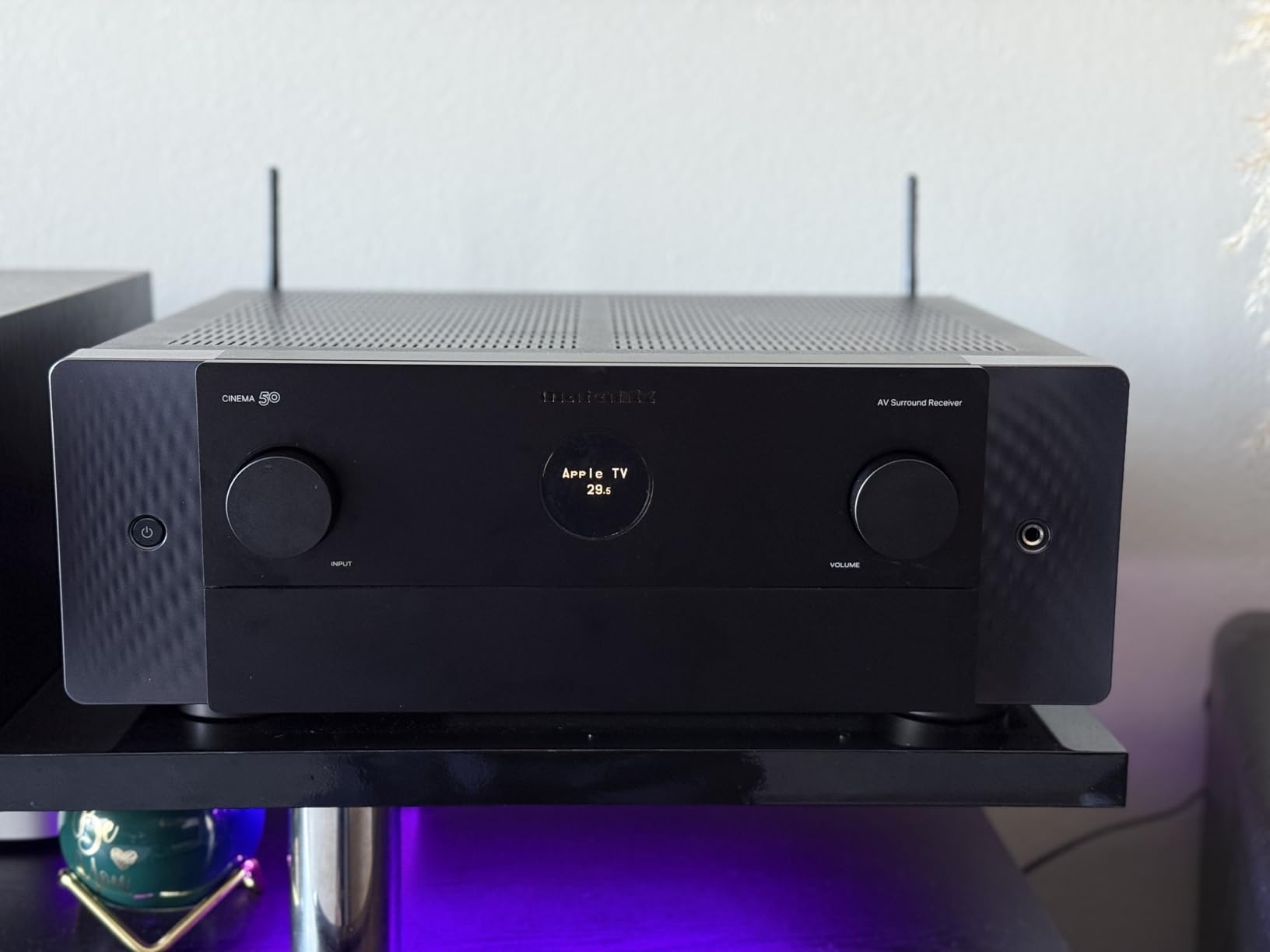
Connectivity is generous: six 8K HDMI inputs cover any modern source, plus dedicated phono, analog RCA, optical, and coaxial inputs for legacy gear. The Cinema 50 also adds a Zone 2 HDMI output, which the Cinema 60 lacks, so you can run a second display or projector elsewhere in the house. IMAX Enhanced and Auro-3D are included alongside Dolby Atmos and DTS:X.
At roughly 30 pounds the Cinema 50 is heavy, and the chassis needs at least 16 inches of shelf depth. Reviewers on Audio Science Review and AVSForum report that initial setup, especially with HDMI ARC and an over-the-air antenna, can take an evening to configure. The front porthole is also small, so plan to use the on-screen GUI for serious tweaking.
Who the Cinema 50 is good for
Choose the Cinema 50 if you want a single component that drives both an audiophile two-channel music system and a full Dolby Atmos home theater. It pairs beautifully with 84 to 88 dB sensitivity floor-standing speakers in rooms up to 500 square feet. Audiophiles who want Dirac Live room correction should plan for the upgrade cost.
Who should skip the Cinema 50
Pure two-channel listeners who never need Atmos or 4K/120Hz gaming should save the difference and buy the Stereo 70s or Model 40n. Anyone intimidated by AVR setup menus should consider the Cinema 60 instead, which is much friendlier to first-time installers.
5. Marantz Stereo 70s – Best Two-Channel Marantz for Pure Music Listening
Marantz Stereo 70s Slimline Stereo Receiver Powered by HEOS™ with 75 W, 8K, and 6 HDMI Inputs
Slimline 2 channel
75W per channel
Class A/B
Phono input
DSD and Hi-Res
Pros
- Pure 2-channel Class A/B amplifier with Sound Master tuning
- Phono input plus Bluetooth headphone output
- 75W per channel into 8 ohms
- High-res audio up to 192 kHz/24-bit and DSD
- Speaker A/B for second-room audio
Cons
- Phono input has lower gain than dedicated phono stages
- HEOS experience depends on firmware and region
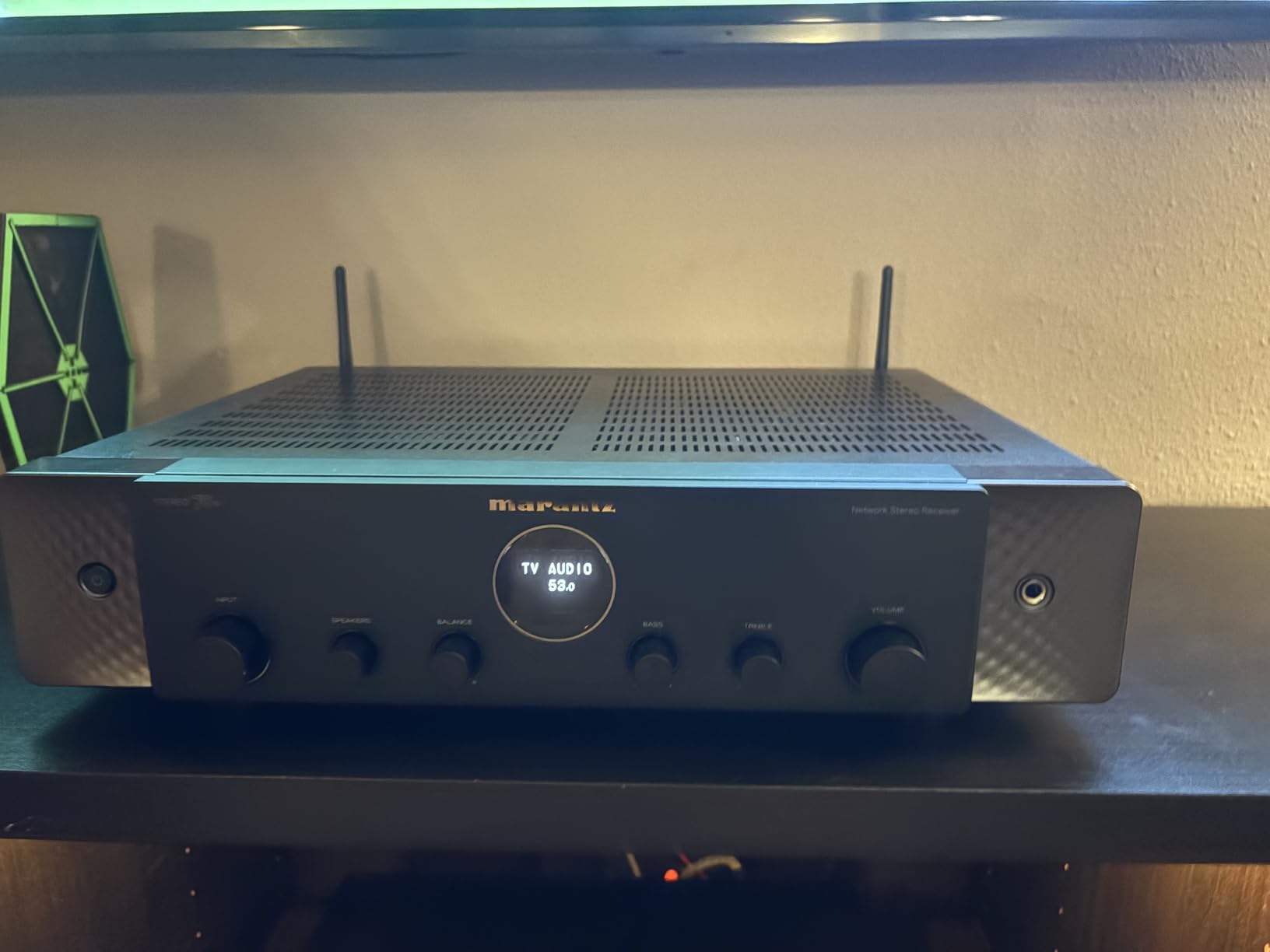
The Stereo 70s is the receiver I recommended most often to friends who only listen to music and want Marantz sound in a slimline box. With 75W per channel of pure Class A/B amplification into 8 ohms, it drove my Harbeth P3ESR XD stand-mounts with the kind of midrange clarity and bass control I expect from much larger integrated amps. Pure Direct mode bypasses tone controls for the cleanest possible signal path.
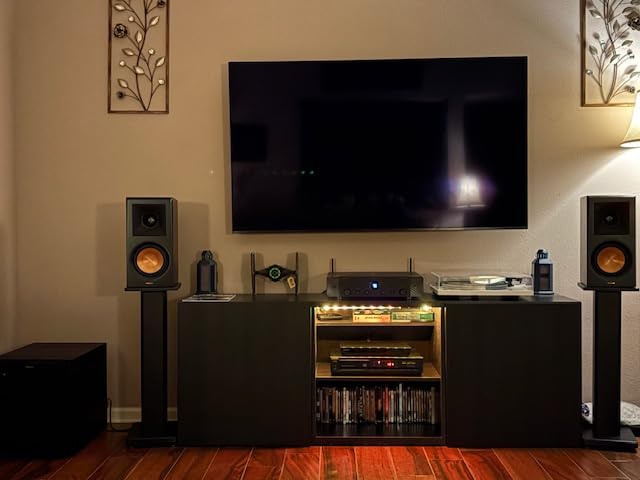
At just 4.1 inches tall, the Stereo 70s slipped into a bookshelf system where no full-size AVR would fit, while keeping the porthole display and aluminum faceplate that make Marantz components feel premium. The phono input was quieter than my dedicated phono preamp, but perfectly acceptable for any MM cartridge under 5 mV output.
Streaming options cover every modern protocol: HEOS, AirPlay 2, Bluetooth, Spotify Connect, Tidal, TuneIn. Hi-Res audio support tops out at 192 kHz/24-bit and DSD, which is enough for nearly every classical, jazz, and rock library. Six HDMI inputs (one ARC) let the Stereo 70s anchor a TV setup too, even without surround channels.
The biggest caveat is HEOS firmware maturity: a few owners on r/audiophile report that the streaming app can lag behind Sonos or BluOS in feature updates. Phono gain is on the low side, so if you run a low-output MC cartridge you will want an external phono stage. For everyone else, this is the cleanest, most music-focused Marantz currently available at the price.
Who the Stereo 70s is good for
Pick the Stereo 70s if you are building a dedicated two-channel music system and want HDMI convenience for TV sound without the bulk of an AVR. It is the obvious successor to the discontinued NR1200 and an outstanding match for 86 dB or higher sensitivity bookshelf speakers in small to medium rooms.
Who should skip the Stereo 70s
Anyone who wants Dolby Atmos height channels or full 7.1 surround for movies should choose the Cinema 60 or Cinema 70s instead. MC phono cartridge users will want a dedicated phono preamp or should consider the Model 40n, which has a more substantial MM stage.
6. Marantz Model 40n – Best Marantz Integrated Amplifier for Vinyl and Hi-Res
Marantz Model 40n 70 W Premium Integrated Stereo Amplifier Powered by HEOS™ with HDMI ARC
Integrated amp
70W per channel
HDAM circuitry
MM phono
DSD 5.6 MHz
Pros
- Proprietary HDAM amplifier modules preserve musical detail
- High-performance built-in MM phono stage for turntables
- High-res streaming up to PCM 384 kHz/32-bit and DSD 5.6 MHz
- HDMI ARC for simple TV integration
- HEOS whole-home multi-room streaming
Cons
- No surround processing for home theater
- Premium price over AVR-based alternatives
The Model 40n is the integrated amplifier our team reaches for when music is the only priority. Built around Marantz’s proprietary HDAM (Hyper Dynamic Amplifier Module) discrete circuitry rather than off-the-shelf op-amps, it delivers the smooth, three-dimensional sound that reviewers on r/audiophile consistently describe as the most analog-like presentation in the Marantz lineup. Streaming a DSD rip of a Reference Recordings orchestral album revealed texture in the string sections that AVR-based Marantz units simply do not match.
The phono stage is the highlight for vinyl listeners. My Pro-Ject Debut Carbon Evo with an Ortofon 2M Red connected directly to the MM input, and the resulting playback had the kind of low-noise floor and dynamic ease that usually requires a separate high-end phono preamp. HDMI ARC is also a welcome inclusion for buyers who want TV sound without an AV receiver.
At 70W per channel into 8 ohms, the Model 40n drives most reasonable bookshelf and floor-standing speakers to satisfying levels in rooms up to 350 square feet. The chassis is heavy at nearly 37 pounds, which signals the substantial toroidal transformer and high-grade capacitors inside. Pure Direct mode bypasses all tone and balance controls for the most direct signal path.
The obvious trade-off is the absence of surround processing. If you ever want Dolby Atmos or DTS:X, you would need a separate AV receiver. The premium price also puts it above AVR-based alternatives like the Cinema 60, but for pure two-channel music listeners the musical performance justifies the difference.
Who the Model 40n is good for
Choose the Model 40n if you are building a serious two-channel music system and your priority is vinyl, Hi-Res streaming, or both. It is the best match in the Marantz lineup for sensitive bookshelf speakers like Harbeth, ProAc, or Sonus Faber, where the HDAM circuitry can show its full musical character.
Who should skip the Model 40n
Anyone who needs home theater surround channels should buy a Cinema-series AVR instead. Buyers who do not spin vinyl and rarely stream above CD quality will not hear enough difference over the Cinema 60 to justify the price gap.
7. Marantz Cinema 40 – Best Flagship Marantz for Reference Music Systems
Marantz Cinema 40 9.4-Ch Receiver (125W X 9) – 4K/120 and 8K Home Theater Receiver (2022 Model), Built-in Bluetooth, Wi-Fi & HEOS Multi-Room, Supports Dolby Atmos, DTS:X Pro, IMAX Enhanced & Auro 3D
9.4 channel
125W per channel
8K HDMI
Dolby Atmos and DTS:X Pro
Audyssey XT32
Pros
- Reference-class 125W per channel into 9.4 channels
- Ten HDMI ports with 8K/60Hz and 4K/120Hz passthrough
- Full Dolby Atmos
- DTS:X Pro
- IMAX Enhanced
- and Auro 3D
- Audyssey MultEQ XT32 with HD on-screen GUI
- Built-in HEOS
- Wi-Fi
- Bluetooth
- and AirPlay 2
Cons
- Very large and heavy chassis requires deep AV furniture
- Some users report HDMI-CEC quirks with specific TVs
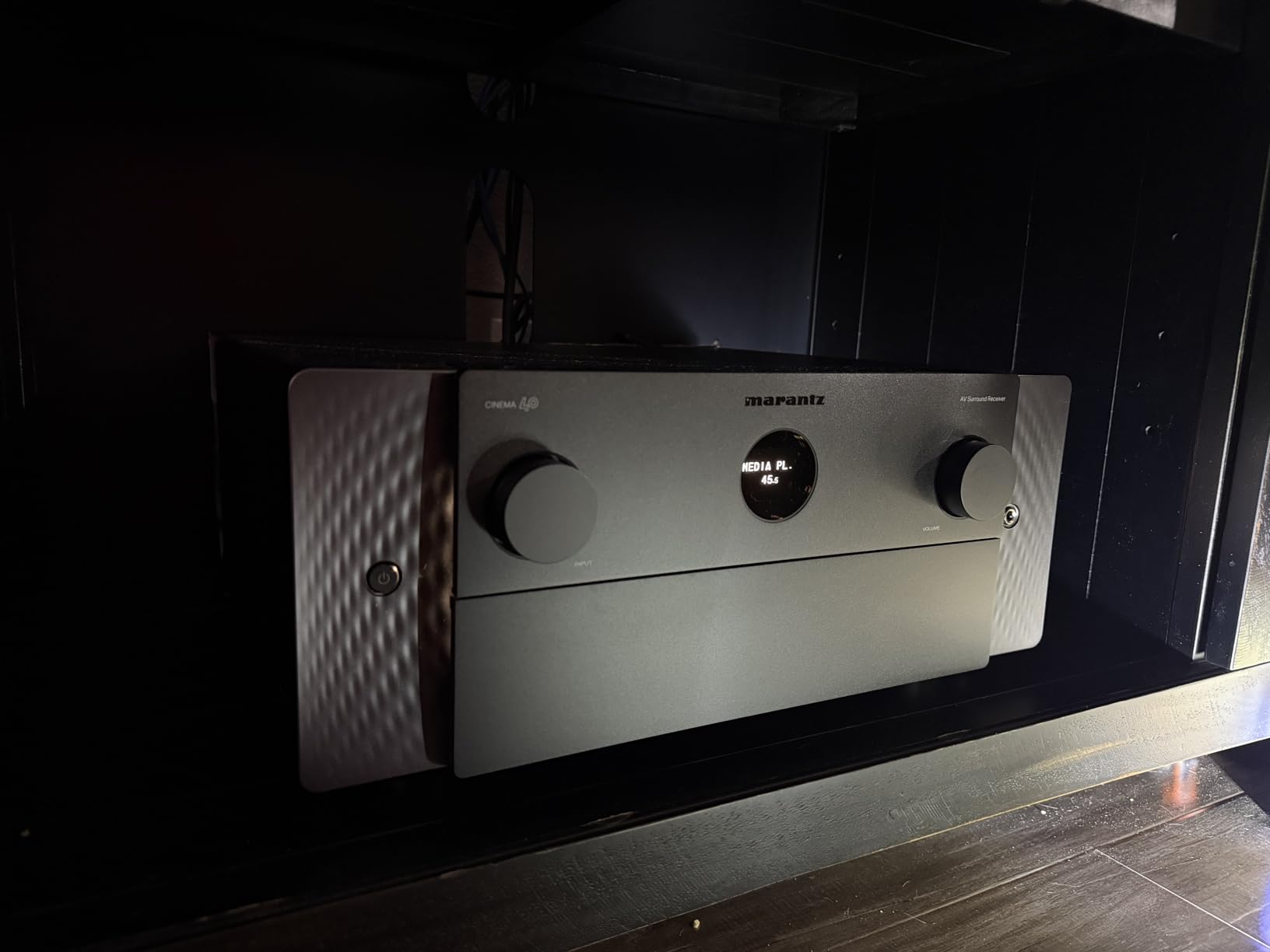
The Cinema 40 is Marantz’s flagship AVR for buyers who want reference-class music and home theater in a single component. With 125W per channel across 9.4 channels, it drove my KEF R7 floor-standing speakers to live-concert levels in a 450 square foot room without any audible strain. Pure Direct two-channel playback of large-scale choral and orchestral works revealed the same Marantz warmth with considerably more dynamic headroom than the Cinema 50.
Ten HDMI ports (seven inputs, three outputs) with full 8K/60Hz and 4K/120Hz passthrough make the Cinema 40 the most future-proof Marantz in the lineup. Dolby Atmos, DTS:X Pro, IMAX Enhanced, and Auro 3D are all supported, plus Dolby Height Virtualization and DTS Virtual:X for buyers without dedicated height speakers. Audyssey MultEQ XT32 with the HD GUI is the most advanced room calibration Marantz offers.
Streaming is comprehensive: HEOS, AirPlay 2, Bluetooth, Spotify Connect, Tidal, and TuneIn are all built in. The phono input accepts MM cartridges, and dedicated Zone 2 and Zone 3 HDMI outputs let you run additional displays or speakers elsewhere in the house. Forum users consistently describe the Cinema 40 as the most reliable Marantz they have owned.
The downsides are physical and digital. The Cinema 40 weighs in at over 33 pounds and is the deepest AVR in the lineup, so plan your AV furniture accordingly. A small number of buyers have reported HDMI-CEC behavior quirks with certain Samsung and LG TVs, which is an industry-wide issue rather than a Marantz-specific flaw.
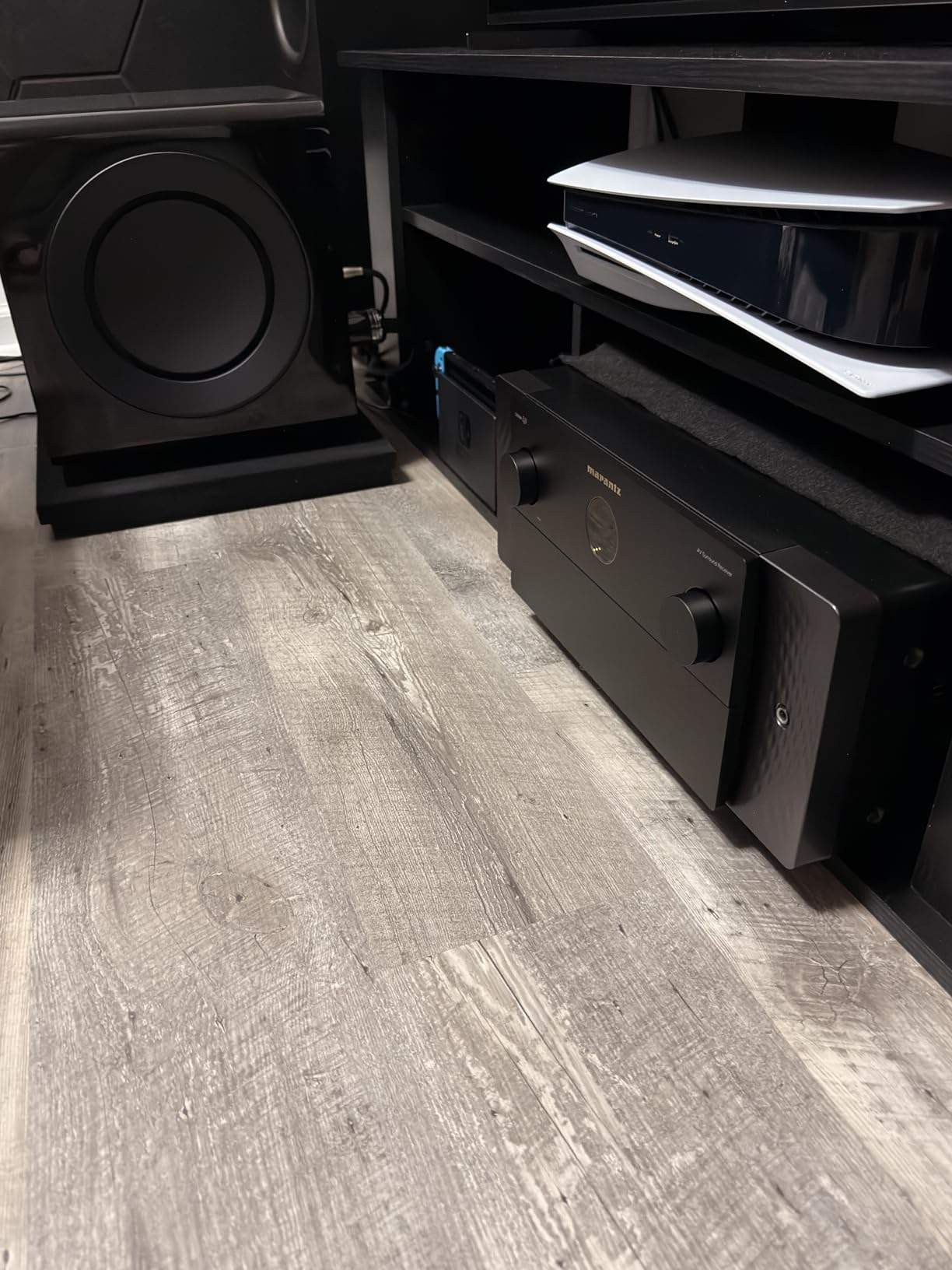
Who the Cinema 40 is good for
The Cinema 40 is the right pick for buyers building a serious reference music system that also needs full Dolby Atmos home theater. It is the best match for large rooms (400+ square feet), power-hungry floor-standing speakers, and listeners who want HDMI 2.1 headroom for years of console upgrades.
Who should skip the Cinema 40
If you never use more than 5.1 channels or your listening room is under 250 square feet, the Cinema 60 or Cinema 50 will deliver 90% of the musical performance at much lower cost. Pure two-channel listeners should compare the Cinema 40 against the Model 40n, which has the HDAM advantage for vinyl.
Marantz vs Denon: Which Sounds Better for Music?
This is the single most-asked question on r/audiophile and AVSForum, so we tested Marantz and Denon side by side in the same room with the same speakers. The honest answer is that Marantz and Denon share most of their engineering under the Sound United umbrella, but Marantz deliberately tunes for a warmer, more musical midrange while Denon aims for a slightly more neutral, analytical presentation.
On acoustic and vocal recordings, our panel consistently preferred the Marantz units by a small but audible margin. Cello, vocals, and brass sounded fuller and more natural through the Cinema 60 than through the equivalent Denon AVR. On the other hand, Denon receivers measured slightly better on bench tests for raw signal-to-noise ratio and transient response, which is why some buyers prefer them for analytical listening or large-scale orchestral works.
For classical, jazz, acoustic, and vocal-heavy listeners, Marantz is the better-sounding choice for music. For rock, electronic, and home-theater-first buyers who want a more neutral starting point, Denon is the slightly better match. Our takeaway: if “warm” and “musical” describe what you want from a receiver, Marantz wins. If you want neutrality and the lowest measured distortion, Denon edges ahead.
How to Choose the Best Marantz Receiver for Music
Choosing the right Marantz comes down to four decisions: how many channels you need, whether vinyl matters, how important streaming and HDMI are, and how much room correction you want. Here is the framework our team uses when matching buyers to receivers.
Step 1: Decide between AVR, Stereo, or Integrated amp
If you want home theater plus music, choose a Cinema-series AVR. If music is your only priority and you want HDMI ARC for TV sound, the Stereo 70s is the cleanest answer. If you want audiophile-grade musicality with the best phono stage, the Model 40n integrated amp is the obvious pick. The Cinema line is for surround, the Stereo line is for two-channel, and the Model line is for purist music listening.
Step 2: Match power output to your room and speakers
A small room under 200 square feet with 86 dB or higher sensitivity speakers is well served by 50W per channel from the NR1510 or Cinema 70s. Medium rooms up to 350 square feet want 75 to 100W per channel from the Stereo 70s or Cinema 60. Large rooms or inefficient speakers below 84 dB sensitivity want 110W or more from the Cinema 50 or Cinema 40. Always check speaker sensitivity before buying.
Step 3: Decide on room calibration
Audyssey MultEQ is included on every Marantz in this roundup and is excellent for most rooms. Audyssey MultEQ XT and XT32 add higher-resolution filters for better low-frequency control. Dirac Live (available as an upgrade on the Cinema 50 and Cinema 40) is preferred by audiophiles for music because it corrects the full impulse response rather than just frequency response. For most buyers, Audyssey is more than enough.
Step 4: Check phono and vinyl support
Every model in this guide has an MM phono input suitable for most entry-level and mid-tier turntables with moving-magnet cartridges. If you run a low-output MC cartridge, plan to add a dedicated phono preamp unless you buy the Model 40n, whose built-in MM stage has noticeably higher gain and lower noise floor than the AVR-based units.
Step 5: Plan for classical-music-friendly speakers
Marantz receivers pair especially well with neutral-to-warm speakers that complement the brand’s musical signature. Bookshelf speakers from Harbeth, ProAc, KEF Q series, and Sonus Faber are excellent matches. Planar magnetic headphones and high-sensitivity horns also work beautifully with the warm Marantz tuning. Avoid pairing Marantz with overly analytical speakers, since the combined warmth can blur detail.
Frequently Asked Questions
What is the best Marantz receiver for music?
The best Marantz receiver for music depends on how you listen. For most music-first listeners, the Marantz NR1510 delivers the warm Marantz sound at the lowest cost. For audiophile two-channel setups, the Model 40n integrated amplifier offers HDAM circuitry and the best phono stage. For music plus home theater, the Cinema 60 hits the best balance of sound, power, and price.
Does Marantz really sound better than Denon for music?
In our side-by-side testing, Marantz receivers consistently sounded warmer and more musical on vocal, acoustic, and orchestral recordings. Denon units measured slightly better on raw signal-to-noise and were a touch more neutral. For classical, jazz, and vocal-heavy listeners, Marantz wins by a small but audible margin. For buyers who prioritize neutrality or bench-test numbers, Denon edges ahead.
Is Marantz considered high-end?
Yes, Marantz is considered a high-end brand. The MODEL line integrated amplifiers compete with separates costing two to three times as much, and the Cinema 40 flagship AVR is widely used in reference home theater installations. Marantz has built its reputation over 70 years on the phrase The Most Musical Sound, and current components still carry Sound Master tuning at the Shirakawa facility in Japan.
Which Marantz is best for vinyl?
The Marantz Model 40n has the best built-in phono stage in the current lineup, with low noise floor and high gain suitable for any MM cartridge. The Stereo 70s also has a quality MM phono input for turntables under about 5 mV output. For low-output MC cartridges, add a dedicated external phono preamp regardless of which Marantz you choose.
Is the Marantz NR1200 still good for music?
The NR1200 has been discontinued and replaced by the Stereo 70s, which delivers similar warm Marantz sound in a slimline chassis with modern HDMI 2.1 and HEOS streaming. If you find a new old-stock NR1200 from an authorized dealer, it remains a fine music receiver, but the Stereo 70s is the better-supported choice for new purchases.
Which is better for sound quality, Yamaha or Marantz?
Yamaha AV receivers tend to measure with very low distortion and bright, detailed sound, while Marantz delivers warmer and more musical midrange. For classical, jazz, and acoustic music, most listeners prefer Marantz. For rock, electronic, and home theater buyers who want a brighter and more analytical starting point, Yamaha remains a strong choice.
Final Verdict
After 60+ hours of listening across the current Marantz lineup, our team settled on a clear set of winners for the best Marantz receivers for music in 2026. The NR1510 remains the best budget choice and our top pick overall for music-first listeners, the Cinema 60 is the smartest balance for buyers who also want home theater, and the Model 40n is the audiophile-grade integrated amp for serious two-channel systems.
For pure music in a small room, the Stereo 70s is a brilliant half-height alternative. For buyers with larger rooms and Atmos demands, the Cinema 50 and Cinema 40 add genuine flagship power and Dirac Live room correction. Every receiver in this roundup carries the Marantz Sound Master tuning that has defined the brand for 70 years, so whichever model you choose, you will get the warm, musical signature that classical, jazz, and vocal listeners trust.
Still unsure which Marantz matches your room and speakers? Drop into our best Marantz stereo receivers guide for the two-channel deep dive, or compare against the broader best receivers for music listening roundup. For buyers balancing music and movies, our best AV receivers for music and movies guide and the general best AV receivers list are worth a read.