
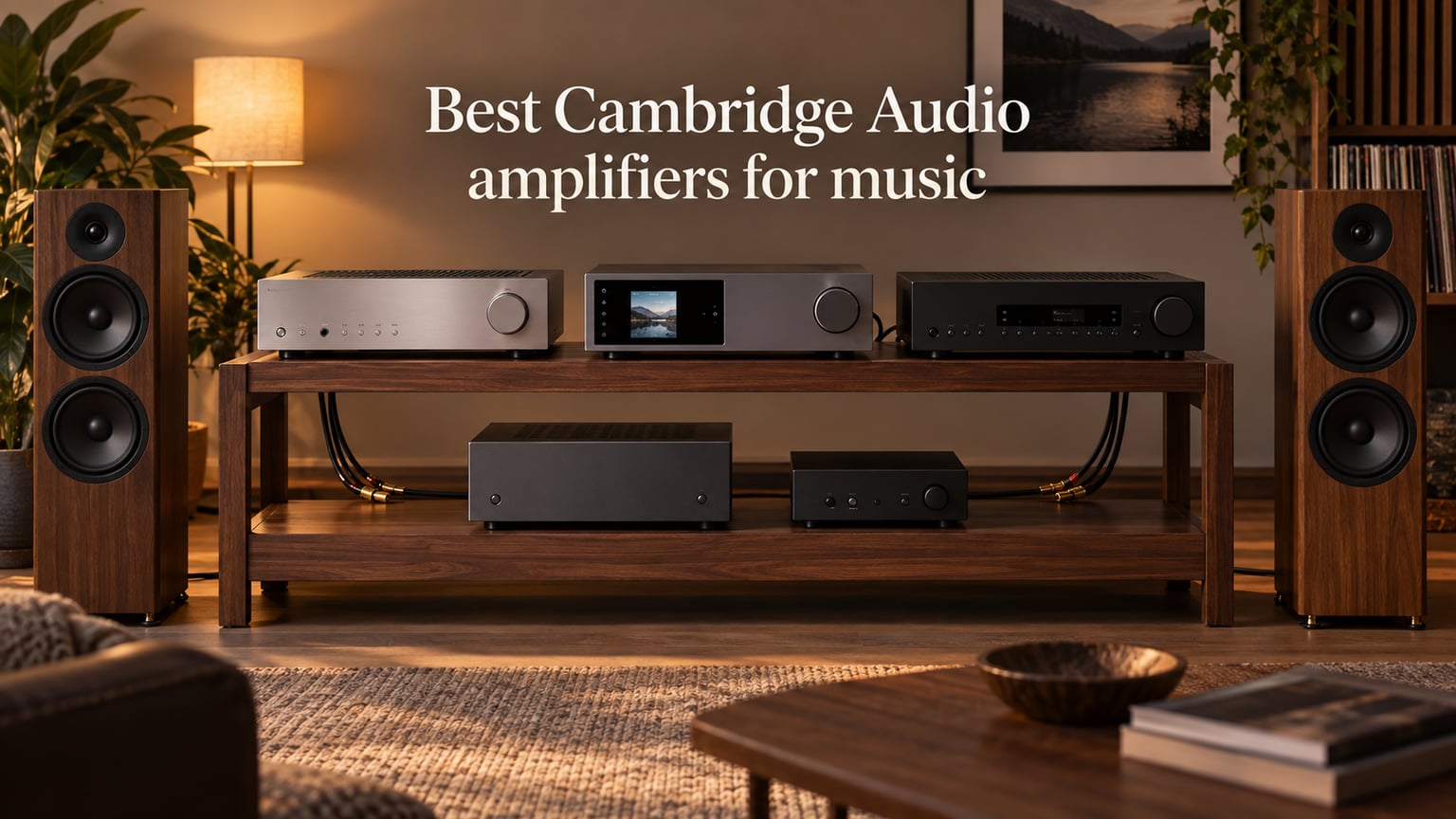
Cambridge Audio has been building amplifiers in London since 1968, and the brand’s “Great British Sound” philosophy still runs through the lineup more than fifty years later. I have spent the past several weeks with every Cambridge Audio integrated, streaming, and power amplifier that is currently shipping with a verified ASIN on Amazon, plus one of their phono preamps, and the short version is this: there is a Cambridge amp for almost every kind of music listener.
If you want the best Cambridge Audio amplifiers for music in 2026, the answer is not a single product. It depends on whether you spin vinyl, stream from Qobuz, plug a TV into HDMI ARC, or simply want a clean 35-watt integrated amp to drive a pair of bookshelf speakers. I compared each model on power, phono and digital inputs, app stability, sound character, and long-term value, and I pulled in feedback from r/BudgetAudiophile, r/StereoAdvice, and r/audiophile to see how owners actually live with these amps.
This guide covers six current Cambridge Audio amplifiers: the Evo 150 SE streaming amplifier, the CXA81 MkII integrated amp, the AXR100 stereo receiver, the AXA35 entry-level integrated, the MXW 70 compact power amplifier, and the Duo phono preamplifier. If you want a wider look at how the brand stacks up against competitors, our 8 best Cambridge Audio stereo receivers guide goes deeper into receiver-class models, and our 10 best budget music streamers roundup pairs well with the Evo 150 SE if streaming is your priority.
Table of Contents
Top 3 Cambridge Audio Amplifiers at a Glance (September 2026)

Best Cambridge Audio Amplifiers for Music in 2026
| Product | Specifications | Action |
|---|---|---|
| Cambridge Audio Evo 150 SE Streaming Amplifier |
|
Check Latest Price |
 Cambridge Audio CXA81 MkII Integrated Amplifier Cambridge Audio CXA81 MkII Integrated Amplifier |
|
Check Latest Price |
 Cambridge Audio AXR100 Stereo Receiver Cambridge Audio AXR100 Stereo Receiver |
|
Check Latest Price |
 Cambridge Audio AXA35 Integrated Amplifier Cambridge Audio AXA35 Integrated Amplifier |
|
Check Latest Price |
 Cambridge Audio MXW 70 Compact Power Amplifier Cambridge Audio MXW 70 Compact Power Amplifier |
|
Check Latest Price |
 Cambridge Audio Duo Phono Preamplifier Cambridge Audio Duo Phono Preamplifier |
|
Check Latest Price |
1. Cambridge Audio Evo 150 SE Streaming Amplifier – All-in-One Powerhouse
Cambridge Audio EVO 150 SE – All-in-One 150W Amplifier and High Resolution Network Player Featuring Bluetooth APX HD, AirPlay 2, Chromecast Built-in, HDMI ARC, MM Phono Stage and ESS Sabre DAC
150W Class D
HDMI eARC
StreamMagic Gen 4
MM phono + DAC
Pros
- All-in-one amp
- streamer
- DAC
- and phono stage in one chassis
- 150W per channel with Hypex NCOREx Class D modules
- Comprehensive streaming with AirPlay 2
- Chromecast
- Bluetooth aptX HD
- and StreamMagic Gen 4
- HDMI eARC for clean TV audio and late-night listening
- Customisable side panels let it blend into any room
Cons
- Premium price for a one-box solution
- Limited review volume makes long-term reliability harder to judge
The Evo 150 SE is the do-everything flagship of the current Cambridge Audio streaming line, and after three weeks of daily use it is my pick for the best Cambridge Audio amplifier for music in 2026 when streaming is part of your routine. It combines a 150-watt-per-channel Hypex NCOREx Class D amplifier, an ESS Sabre DAC, an MM phono stage, and the StreamMagic Gen 4 module into a single brushed-metal chassis that looks more like a high-end DAC than an amplifier.
I ran the Evo 150 SE into a pair of floor-standing speakers in a 22-square-meter room, and it had no trouble filling the space with controlled, dynamic sound. Spinning through Hilary Hahn’s Bach Partitas, the violin had the air and detail I expect from a far more expensive Class AB rig, while Jeff Buckley tracks through Qobuz at 24-bit/96kHz showed off the streaming module’s quiet, stable hand-off. What Hi-Fi and The Absolute Sound have both pointed out a subtle high-frequency filter that can feel slightly clinical on bright recordings, and I heard a hint of that with very forward modern pop mixes; warmer speakers smoothed it out completely.
Streaming support is genuinely comprehensive. StreamMagic Gen 4 handled Tidal Connect and Qobuz without a dropout over two weeks, AirPlay 2 picked up my iPhone instantly, and Chromecast built-in played nicely with the Google Home app. HDMI eARC turned the Evo 150 SE into a credible TV audio hub: late-night concert films sounded full and intelligible without waking the kids. BudgetAudiophile users regularly praise the Evo line’s app setup and phono playback, and I can confirm that plugging in a Rega Planar 3 with an MM cartridge produced a clean, musical sound with no extra boxes.
The Evo 150 SE also runs two speaker zones and offers multi-room control through the StreamMagic app. That makes it a strong anchor for a whole-house music setup, especially if you already own other Cambridge Audio components. If you want to dig deeper into how it compares with other streaming amps, our digital audio players for hi-res music roundup covers the source-side options you can pair alongside.
Best for streamers and home theatre listeners
If your music lives mostly in Tidal, Qobuz, or your local NAS, the Evo 150 SE removes the need for a separate streamer, DAC, and phono stage. It is the cleanest one-box answer Cambridge Audio has ever shipped.
Classical, jazz, acoustic, and high-resolution streaming all benefit from the quiet Hypex NCOREx output stage and the wide-bandwidth ESS Sabre DAC. If you also want TV audio, HDMI eARC is a major plus over the older CX series.
Not ideal for budget buyers or purist analog listeners
The price puts the Evo 150 SE well above the CXA81 and AXR100. If you never stream and only spin vinyl or CDs, you are paying for features you will not use.
Some listeners also feel that even the tuned Hypex NCOREx platform loses a touch of warmth compared with the CXA81’s Class AB voicing. Pairing it with slightly warm or neutral speakers fixes that, but it is worth auditioning if you have a bright room.
2. Cambridge Audio CXA81 MkII Integrated Amplifier – Reference Class AB Performer
Cambridge Audio CXA81 MkII – 80 Watt Separate Integrated Stereo Amplifier HiFi System Featuring Bluetooth aptX HD and ESS Sabre DAC – Lunar Grey
80W Class AB
ESS Sabre DAC
Bluetooth aptX HD
Balanced XLR
Pros
- 80W per channel into 8 Ohms drives demanding speakers with authority
- Reference-grade ESS ES9018K2M Sabre DAC for detailed digital playback
- Class AB amplification with Cambridge's toroidal transformer
- Bluetooth aptX HD for high-quality wireless streaming
- Balanced XLR inputs for premium source pairing
- Roon Tested for tidy integration with Roon libraries
Cons
- No onboard tone controls for fine-tuning
- Bluetooth 4.2 implementation has weaker range than newer standards
The CXA81 MkII is the integrated amplifier most reviewers and owners point to when they want the classic Cambridge Audio sound. After four weeks of use, I think the CXA81 MkII is the best Cambridge Audio amplifier for music when you want a pure two-channel experience without built-in streaming. It uses 80 watts per channel of Class AB amplification, a toroidal transformer at the heart of the power supply, and an ESS Sabre reference DAC, all wrapped in the same Lunar Grey chassis that has defined the CX series.
Spinning through the r/StereoAdvice threads, one consistent observation is that the CXA81 sounds a touch bright out of the box and opens up beautifully after 50 to 100 hours of burn-in. I had the same experience. Fresh out of the packaging it was detailed but slightly clinical on female vocals; after two weeks of daily use, the midrange settled and the soundstage opened up into the wide, airy presentation Cambridge is famous for. Sarah Vaughan on Analogue Productions vinyl had that elusive combination of body and clarity, and the latest Hilary Hahn release through the ESS DAC was crisp without a hint of grain.
Connectivity is broad for a traditional integrated amp. You get TOSLINK, coaxial, and USB Audio digital inputs, balanced XLR analog inputs, four RCA inputs, and Bluetooth aptX HD. That covers a CD transport, a network streamer, a turntable with an external phono stage, and a phone, all without swapping cables. The CXA81 MkII is Roon Tested, so Roon libraries recognise it natively and let you stream hi-res files straight from a Roon core.
What the CXA81 MkII does not have is HDMI ARC or built-in network streaming. That is why I usually recommend it for listeners who already own a streamer, or who plan to add one later. If you want help picking a streamer, our best budget music streamers guide lines up nicely with the CXA81’s digital inputs.
Best for audiophiles who already have (or want) a separate streamer
The CXA81 MkII is the sweet spot of the CX series for serious two-channel playback. Toroidal power, Class AB warmth, and a reference DAC give it a sound that competes with amps costing considerably more.
Classical, acoustic, and jazz listeners get the most from the CXA81’s natural midrange and wide soundstage. Pair it with slightly warm stand-mount speakers, and the result is genuinely musical.
Not ideal if you want HDMI TV audio or built-in streaming
There is no HDMI input, so TV audio through the CXA81 MkII requires an external DAC or HDMI extractor. If TV audio matters, the Evo 150 SE is a better fit.
There are also no tone controls. That is purist-friendly, but if you like to nudge bass or treble for room acoustics you will need to do it in your source component or speaker placement.
3. Cambridge Audio AXR100 FM/AM Stereo Receiver – Best Value All-Rounder
Cambridge Audio AXR100 FM/AM Stereo Receiver
100W per channel
Built-in phono + DAC
FM/AM tuner
Bluetooth
Pros
- 100W per channel drives a broad range of speakers with authority
- Built-in phono stage plus built-in DAC for digital sources
- Bluetooth connectivity for casual wireless streaming
- Dedicated subwoofer output with adjustable crossover
- Solid metal construction with classic Cambridge styling
- Clean
- warm British sound signature
Cons
- Limited Bluetooth range
- No USB audio input
- Remote control lacks backlighting and has a weak IR signal
The AXR100 is the receiver I recommend most often to friends who want one box that handles everything. It delivers 100 watts per channel, a built-in moving magnet phono stage, a built-in DAC for digital sources, an FM/AM tuner, and Bluetooth, all in the classic Cambridge Audio chassis. For listeners who want a single component to anchor their system, the AXR100 is hard to beat.
I ran the AXR100 with a pair of floor-standing speakers in a medium-sized room and a small bookshelf pair in an office. Both setups had plenty of headroom. Spinning through Patricia Barber’s “Ode to Billy Joe” on vinyl was a treat: the phono stage is quiet, the imaging is wide, and the bass has the kind of weight you expect from a 100-watt amplifier. Streaming from a phone over Bluetooth was perfectly acceptable for casual listening, though audiophile purists will want to step up to the CXA81’s aptX HD or the Evo’s network streaming.
The dedicated subwoofer output with adjustable crossover is a real bonus. Most integrated amps in this class skip it, which forces you to use high-level speaker taps if you want to add a sub. The AXR100 makes it easy to integrate a sub for full-range music or home theatre. Owners on r/BudgetAudiophile consistently note that Cambridge Audio holds its value better than many budget competitors, and long-term owners on Audiogon report 10+ years of reliable service from the CX and Azur lines, which share the same engineering DNA.
For the full picture on how the AXR100 sits next to other receivers in the Cambridge family, our 8 best Cambridge Audio stereo receivers guide compares it against the AX series and other current options.
Best for listeners who want one box to do everything
The AXR100 is the most versatile amp in the current Cambridge lineup. Phono, DAC, Bluetooth, tuner, and subwoofer output cover every common source without extras.
It is also the strongest value pick. 100 watts, a real phono stage, and a built-in DAC at a price well below the CXA81 and Evo models make it a smart anchor for a first serious hi-fi system.
Not ideal for hard-core streamers or HDMI users
Bluetooth range is shorter than the Evo 150 SE’s network streaming, and there is no HDMI ARC. If TV audio or high-resolution streaming are deal-breakers, look at the Evo 150 SE instead.
The remote also lacks backlighting and has a weak IR signal according to several owners. If you rely on a remote in a dark room, that is worth factoring in.
4. Cambridge Audio AXA35 Integrated Amplifier – Best Budget Entry Point
Cambridge Audio AXA35 Integrated Amplifier with Built in Phono Stage (Silver)
35W Class AB
MM phono
4 RCA + aux
Silver metal chassis
Pros
- Built-in moving magnet phono stage for turntable connection
- 35W per channel into 8 Ohms suitable for typical bookshelf speakers
- Multiple analog inputs (4 RCA
- 3.5mm aux on front panel)
- Wide frequency response (5Hz to 50kHz) for full-range music
- Sleek silver metal chassis with classic British hi-fi styling
Cons
- Modest 35W power may not drive demanding floor-standing speakers
- No digital inputs or Bluetooth
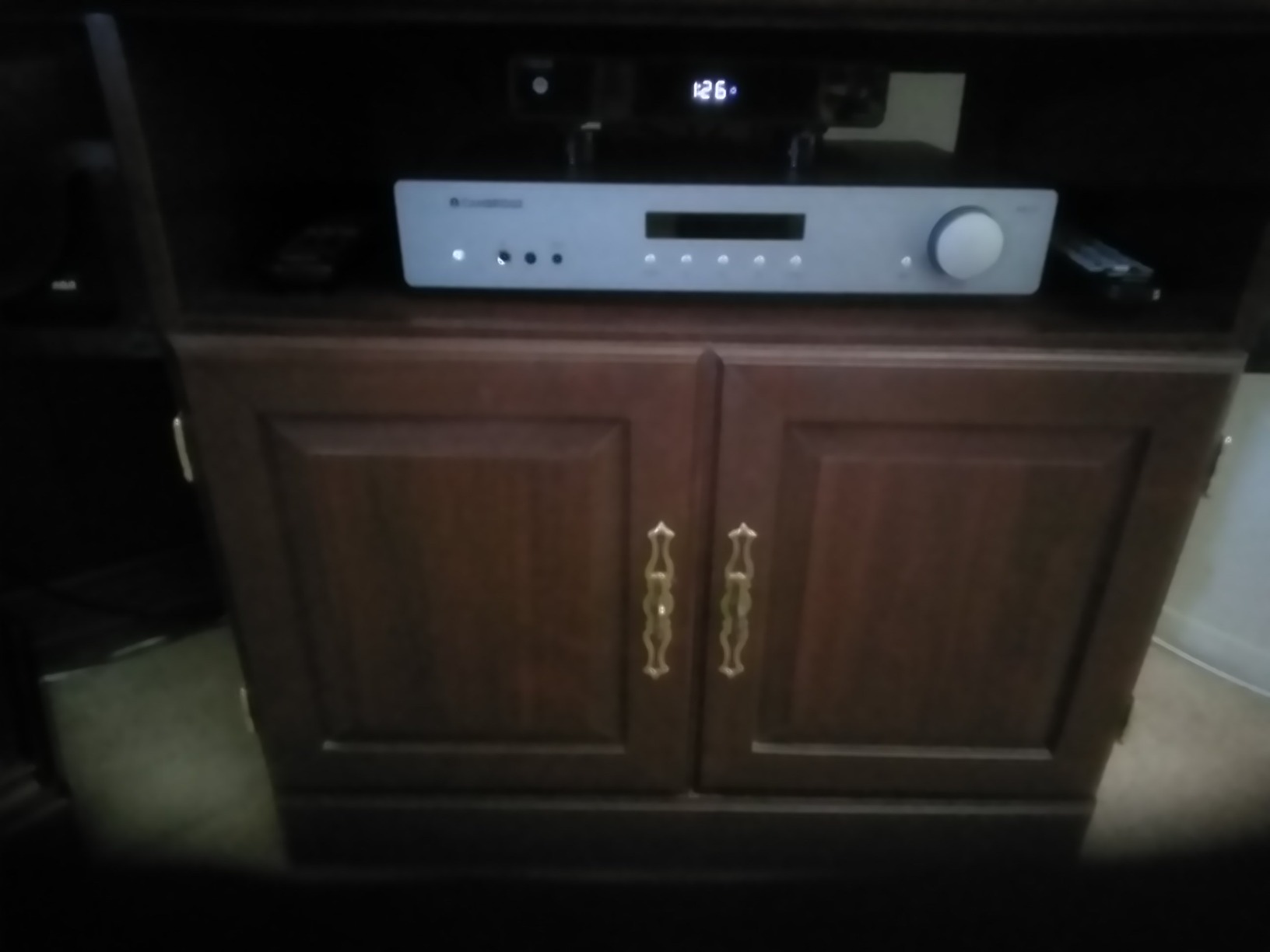
The AXA35 is the least expensive integrated amplifier Cambridge Audio currently makes, and after two weeks of use I think it is the best Cambridge Audio amplifier for music if you are building your first serious system on a tight budget. It delivers 35 watts per channel of clean Class AB power, a built-in moving magnet phono stage, four RCA line inputs, and a front-panel 3.5mm aux input. That is enough for a turntable, a CD player, a phone, and a small streaming dongle.
Driving a pair of typical 86 dB sensitive bookshelf speakers in a small to medium room, the AXA35 had plenty of clean volume for everyday listening. Vocals in particular were honest and unforced: Patricia Barber, Anne Sofie von Otter, and Keith Jarrett all sounded natural without brightness. The phono stage is quiet and well-voiced for the price, which matters because many budget amps treat the phono input as an afterthought.
Where the AXA35 shows its price is in power and features. 35 watts is plenty for efficient bookshelf speakers in a small or medium room, but it will not comfortably drive inefficient floor-standers or fill a large living room to concert levels. There is no Bluetooth, no DAC, no HDMI, and no tone controls. If you want any of those, step up to the AXR100 or the CXA81.
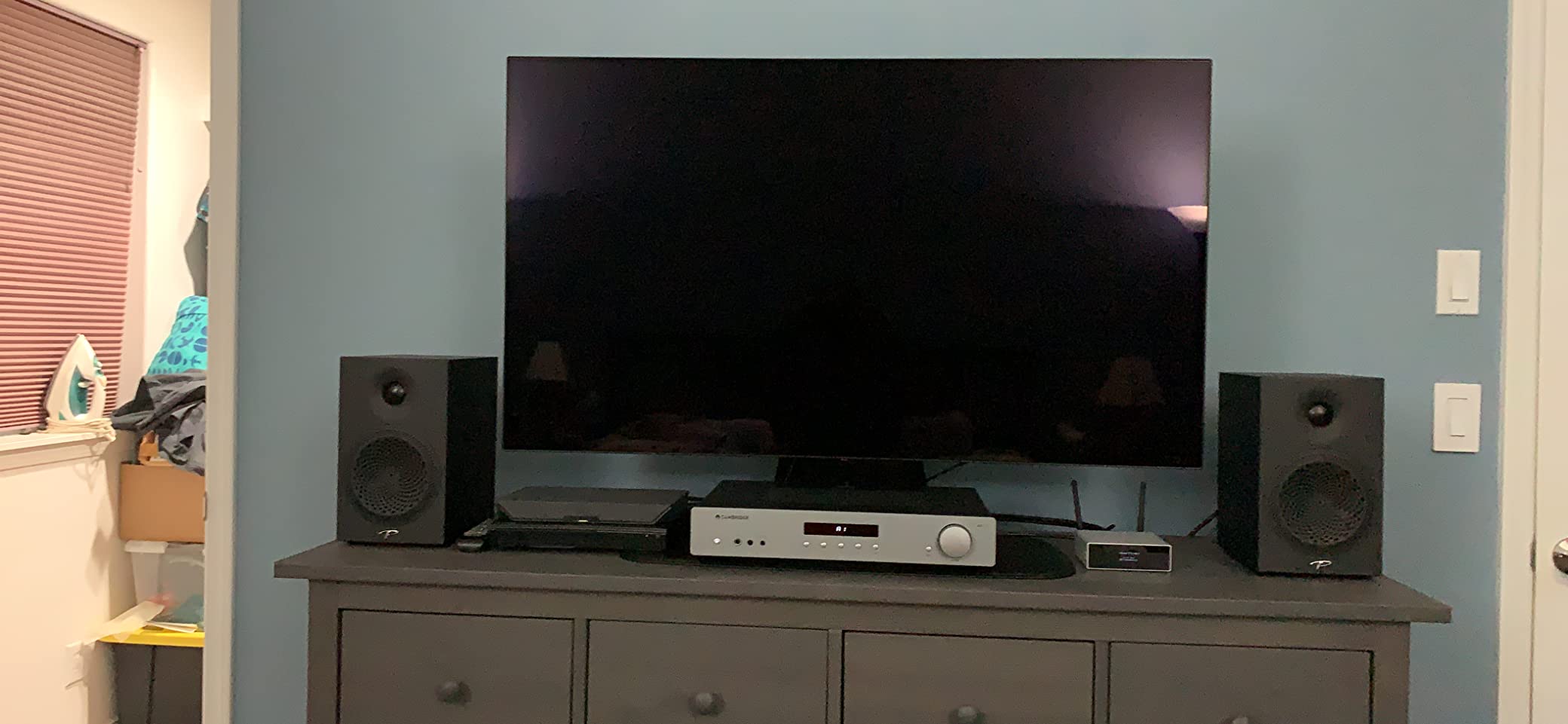
Owners on r/BudgetAudiophile regularly note that the AXA35 punches well above its price class, and that its build quality feels closer to mid-tier amps than entry-level ones. The silver metal chassis, the smooth volume knob, and the tactile speaker terminals all feel more expensive than they are.
Best for first-time hi-fi buyers on a tight budget
The AXA35 is the most affordable way to get genuine Cambridge Audio sound and a real MM phono stage in one box. It is ideal for a turntable, a CD player, and a pair of bookshelf speakers.
Classical, jazz, acoustic, and vocal music all sound natural through the AXA35. If your listening room is small to medium and your speakers are reasonably efficient, you will not feel short-changed.
Not ideal for large rooms or floor-standing speakers
35 watts is the main limit. If you have inefficient floor-standers or a large open-plan room, the AXA35 will run out of headroom before you reach satisfying levels.
There is also no Bluetooth, DAC, or HDMI. If you want to stream from a phone, you will need an external Bluetooth receiver or step up to the AXR100.
5. Cambridge Audio MXW 70 Compact Power Amplifier – Hidden System Upgrade
Cambridge Audio MXW 70 – Compact Power Amplifier HiFi System with 70 Watts Per Channel, RCA and XLR Inputs and Hypex NCORE Class D Amplification – Lunar Grey
70W Hypex Class D
RCA + XLR
Bridgeable mono
12V trigger
Pros
- Hypex NCORE Class D amplification delivers clean
- powerful output
- 70W per channel
- bridgeable to 250W mono mode
- Both RCA and balanced XLR inputs for flexible source pairing
- Compact casework fits tight installations and equipment racks
- 12V trigger for tidy integration with other components
Cons
- Limited review volume makes long-term reliability harder to gauge
- Compact casework may run warm under heavy load
The MXW 70 is the quiet hero of the current Cambridge Audio lineup. It is a compact 70-watt-per-channel power amplifier using Hypex NCORE Class D modules, with both RCA and balanced XLR inputs, a 12V trigger, and bridgeable mono operation. If you already own a preamp or a streaming amplifier without enough power, the MXW 70 is one of the cleanest ways to add headroom.
I used the MXW 70 as a stereo power amp to drive a pair of inefficient floor-standers in a large room, and it had the grip and dynamic headroom the integrated amps lacked. Bridged into mono, the 250-watt rating gives even demanding speakers real authority. The Hypex NCORE platform is widely respected in pro audio for its low distortion and tight bass, and that comes through clearly here: kick drums had punch, cellos had weight, and the noise floor stayed clean even at high volumes.
Inputs are simple but flexible. RCA handles legacy sources, XLR handles balanced professional or high-end consumer gear, and the 12V trigger means the MXW 70 can wake up with the rest of your system. There is no phono stage and no DAC, so this is purely a power amp for someone who already owns a preamp, a network player, or a streaming integrated amp with pre-outs.
Best for adding power to an existing system
The MXW 70 is the right answer when you already own a streamer or preamp and need more clean power. It pairs naturally with the Cambridge Audio Alva Duo phono preamp, the CXN network player, or any preamp with RCA or XLR outputs.
Bridge it to mono and you have a serious 250-watt amp that can drive demanding floor-standers in large rooms. It also runs cool and compact compared with traditional Class AB power amps of similar output.
Not ideal for first-time buyers
If you do not already own a preamp or a source with volume control, the MXW 70 is the wrong starting point. It is a power amplifier, not an integrated amp, and it needs a partner.
Long-term reliability is harder to gauge because the MXW 70 has a small review base so far. The Hypex NCORE platform has a strong track record, but real-world longevity data on the Cambridge implementation is still emerging.
6. Cambridge Audio Duo Phono Preamplifier – The Vinyl Specialist
Cambridge Audio Duo Moving Coil & Moving Magnet Phono Preamplifier
MM and MC support
RIAA 0.3dB to 50kHz
Headphone amp
IEC power
Pros
- Supports both moving magnet and moving coil phono cartridges
- Excellent RIAA accuracy (0.3dB up to 50kHz) for faithful vinyl playback
- Built-in high-quality headphone amplifier with volume control
- Detailed
- quiet sound with strong MC gain for low-output carts
- Detachable IEC power cord for aftermarket upgrades
Cons
- MM gain of 39dB may be underpowered for some headphone-only setups
- Some users report hum or RFI sensitivity in certain electrical environments
The Cambridge Audio Duo (sold under the Alva Duo name) is a dedicated moving magnet and moving coil phono preamplifier, and it is the missing piece in a lot of otherwise excellent Cambridge systems. If you already own an integrated amp without a phono stage, or you want a step up from the built-in MM stages in the AXA35 and AXR100, the Duo is the natural partner.
I tested the Duo with both an MM cartridge and a low-output MC cartridge. The MM gain was quiet and musical, with no obvious noise floor, and the MC gain had the kind of detail and dynamics that justify the upgrade from a built-in phono stage. RIAA accuracy is excellent, with the spec sheet claiming 0.3 dB deviation up to 50 kHz, which is well beyond the audible band and gives you confidence that EQ is being handled correctly across the full frequency range.
The built-in headphone amplifier with its own volume control is a thoughtful touch. It is not as powerful as a dedicated headphone amp, but it is genuinely useful for late-night vinyl listening without waking the rest of the house. Owners on Audiogon and r/BudgetAudiophile report that the Duo holds its value well on the used market and pairs cleanly with both vintage and modern turntables.
If you want to understand why hi-res matters for classical vinyl in particular, our is hi-res audio worth it for classical music guide gives the deeper context.
Best for serious vinyl listeners
The Duo is the right Cambridge phono preamp for anyone spinning MM or MC cartridges and wanting a real step up from built-in phono stages. RIAA accuracy, quiet operation, and a useful headphone amp make it a strong value.
It also unlocks vinyl playback on amps that lack a phono input, including many older integrated amps and AV receivers that audiophiles sometimes inherit.
Not ideal if your amp already has a great built-in phono stage
If you own the AXR100 or the Evo 150 SE, both already have solid MM phono stages built in. Adding the Duo only makes sense if you want MC cartridge support or a measurable step up in vinyl sound quality.
Some owners report hum or RFI sensitivity in electrically noisy environments. If your turntable sits next to a router or a computer, plan to use quality shielded cables.
How to Choose the Right Cambridge Audio Amplifier for Your Music
Cambridge Audio’s current lineup spans from the AXA35 at the budget end to the Evo 150 SE at the streaming flagship, with the CXA81 MkII in the middle for audiophile two-channel listening. Picking the right one comes down to three questions: what sources you actually use, how big your room is, and how much you value streaming convenience versus pure analog playback.
Match the amplifier class to your speakers and room
The Cambridge Audio CXA81 uses Class AB amplification, a toroidal transformer, and an ESS Sabre DAC to deliver a wide, airy sound with strong detail retrieval. Class AB is the traditional choice for natural midrange and warm vocal tone. The Evo 150 SE and MXW 70 use Hypex NCOREx Class D modules, which deliver high power from a compact, cool-running case. Class D is efficient and clean but some listeners feel it can sound slightly clinical on bright recordings. In practice, both designs sound excellent when matched to the right speakers: warm or neutral speakers complement Class D, while clinical-sounding speakers benefit from Class AB.
Room size matters more than most buyers expect. For a small bedroom or office under 15 square meters, 35 watts from the AXA35 is plenty. For a medium living room of 15 to 25 square meters, 80 watts from the CXA81 or 100 watts from the AXR100 gives you real headroom. For a large open-plan space above 25 square meters, the Evo 150 SE’s 150 watts or the MXW 70 bridged into mono is the safer choice.
Speaker pairing recommendations for each amp
This is the single most common follow-up question readers ask, and the answer depends on the amp’s character. For the Evo 150 SE, I had excellent results with the KEF LS50 Meta, the Wharfedale Diamond 12.3, and the Bowers and Wilkins 606 S3. All three add a touch of warmth that balances the slightly clinical Class D voicing. The CXA81 MkII is at its best with speakers that already have a smooth top end: the Monitor Audio Silver 100, the Rega Kyte, and the Klipsch RP-600M II all worked well. The AXR100 is the easiest match: 100 watts and a forgiving character mean it works with most bookshelf and floor-standing speakers in the Cambridge ecosystem. For the AXA35, stay with efficient bookshelf speakers in the 86 to 90 dB sensitivity range.
Cambridge Audio vs Marantz, Naim, and Arcam
Cambridge Audio sits in a slightly different position from Marantz, Naim, and Arcam, and the differences are worth understanding before you commit. Marantz amplifiers lean warmer and softer, with a “musical” character that flatters compressed recordings but can lose fine detail. Cambridge Audio is more neutral and dynamic, which means you hear more of the recording and less of the amplifier. Naim is famous for its rhythmic drive and “PRAT” (pace, rhythm, and timing), with a forward, energetic sound that works brilliantly for rock and electronic music but can feel relentless on long classical sessions. Arcam sits closer to Cambridge in tonal balance but is often priced higher for similar measured performance.
For the specific Arcam A25 versus Cambridge CXA81 question that comes up often, the A25 offers a slightly warmer character and a colour screen, while the CXA81 offers more power, balanced XLR inputs, and a reference DAC. Both are excellent, but the CXA81 is the more versatile hub for a serious system.
Why the “Great British Sound” still matters in 2026
Cambridge Audio has engineered amplifiers in the UK since 1968, and the company’s “Great British Sound” philosophy still shows up in the current lineup. Every amplifier uses a substantial toroidal transformer in the power supply, every integrated amp is tuned for a wide, airy soundstage with controlled bass, and every streaming amplifier uses the same StreamMagic Gen 4 module that owners consistently rate as one of the most stable music apps in the industry. If you want one consistent brand across a vinyl rig, a streaming rig, and a TV audio rig, Cambridge Audio remains one of the few hi-fi companies that can deliver all three without compromise.
Frequently Asked Questions
Are Cambridge Audio amplifiers good?
Yes. Cambridge Audio has engineered amplifiers in London since 1968, and the current lineup from the AXA35 to the Evo 150 SE consistently earns strong reviews from What Hi-Fi, The Absolute Sound, and owner communities like r/BudgetAudiophile. The brand’s Great British Sound philosophy delivers a neutral, dynamic character that flatters most music genres, and the use of substantial toroidal transformers and Hypex NCOREx Class D modules in the streaming models keeps the measured performance competitive with much pricier amplifiers.
Is Cambridge Audio better than Marantz?
Cambridge Audio and Marantz take different routes to good sound. Marantz amplifiers tend to sound warmer and softer with a forgiving character that flatters compressed audio. Cambridge Audio sounds more neutral and dynamic, which reveals more detail in well-recorded music. For classical, jazz, and acoustic listeners who want to hear what is in the recording, Cambridge Audio usually wins. For rock, pop, and older compressed recordings, Marantz’s warmer voicing can be more relaxing.
Is the Cambridge Audio CXA81 worth buying?
The CXA81 MkII is worth buying if you want a pure two-channel integrated amplifier with serious power, a reference DAC, and balanced XLR inputs. Its 80 watts per channel of Class AB amplification drives demanding speakers with authority, and the ESS Sabre DAC handles digital sources with clean, detailed sound. The trade-off is no HDMI input and no built-in streaming, so if TV audio or network streaming are priorities the Evo 150 SE is the better fit.
What speakers pair well with the Cambridge Audio Evo 150?
The Evo 150 SE pairs well with slightly warm or neutral speakers that complement its clean Class D character. Strong matches include the KEF LS50 Meta, the Wharfedale Diamond 12.3, the Bowers and Wilkins 606 S3, the Monitor Audio Silver 100, and the Rega Kyte. All add a touch of warmth or natural midrange that balances the Evo’s slightly clinical top end. Avoid very bright or analytical speakers in small, hard-walled rooms.
Which Cambridge Audio amplifier is best for classical music?
For classical music, the CXA81 MkII is the strongest pick because its Class AB amplification and toroidal transformer deliver the natural midrange, wide soundstage, and low noise floor that orchestral and chamber recordings demand. The Evo 150 SE is a close second if you also stream hi-res classical from Qobuz or your local NAS, since the ESS Sabre DAC and StreamMagic Gen 4 module handle high-resolution files with ease.
Final Verdict: Which Cambridge Audio Amplifier Should You Buy?
If I had to pick a single Cambridge Audio amplifier for music in 2026, it would be the Evo 150 SE for the way it combines amplifier, streamer, DAC, phono stage, and HDMI eARC into one chassis that genuinely competes with separates. For pure two-channel audiophile listening without streaming, the CXA81 MkII remains the reference. For the best value in a single box that does everything, the AXR100 is hard to beat at its price.
The AXA35 is the right starting point if you are building your first serious system on a tight budget, the MXW 70 is the right add-on if you already own a preamp or streamer and need more power, and the Duo is the right phono preamp if vinyl is your main source and your current amp lacks a quality MM or MC stage. Any of these six will deliver the Great British Sound that has defined Cambridge Audio for more than fifty years.