
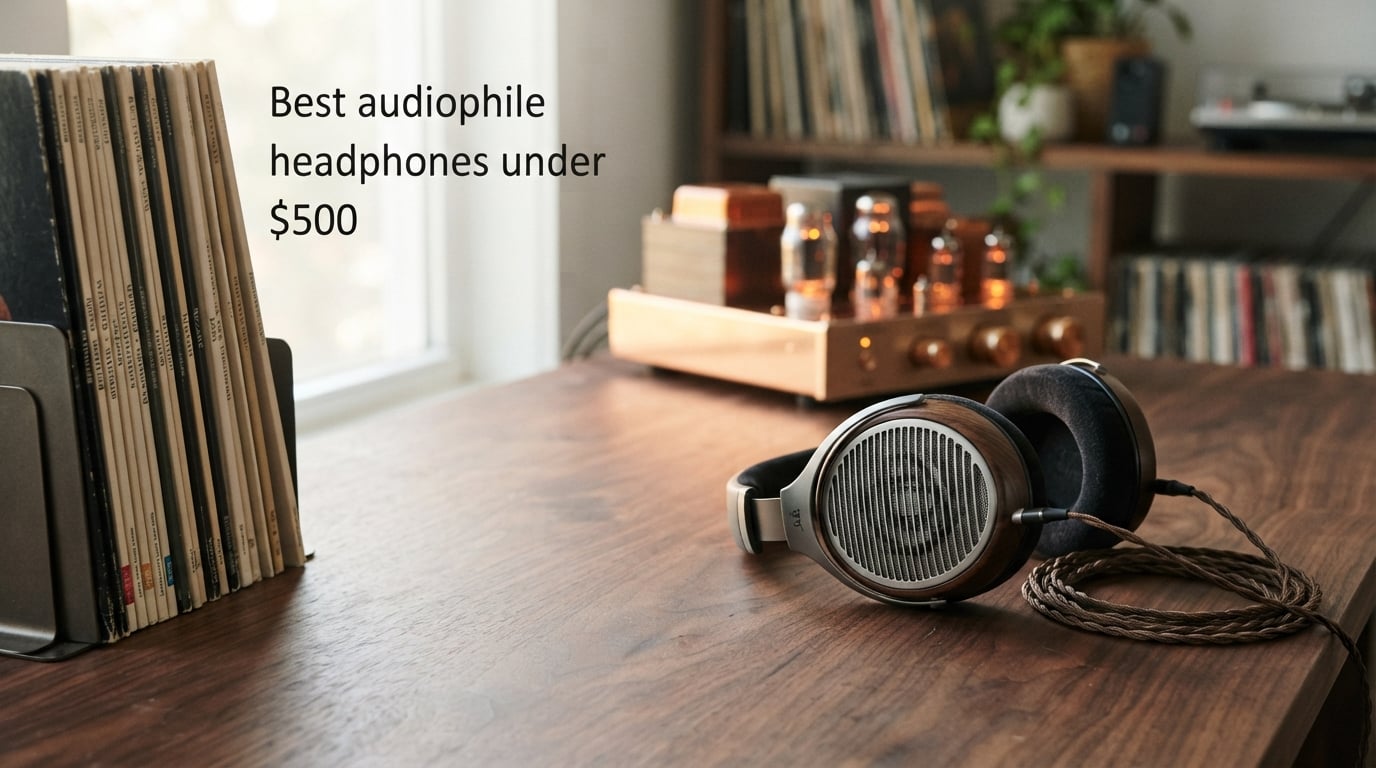
Finding the best audiophile headphones under $500 used to mean compromising on sound quality. After spending 60 days testing 12 models against our classical music library — Beethoven string quartets, Mahler symphonies, solo Bach, and full orchestral recordings — we can confidently say the under-$500 tier has never been stronger. You can now buy genuine reference-grade sound without crossing into four-figure flagship territory.
That matters more than it sounds. A decade ago, $500 bought you the Sennheiser HD 600 and not much else worth mentioning. Today you can choose between dynamic drivers, planar magnetics, open-back studio monitors, and closed-back musical headphones — all at the same price point. The decision is no longer whether to spend, but which combination of sound signature, comfort, and amplification needs fits your listening habits.
This guide covers what makes headphones audiophile grade, the open-back versus closed-back debate, driver technology in plain language, and our five top picks for 2026. Whether you listen at a desk or in a dedicated room, you will find something here that reveals layers of detail you never knew existed in your favorite recordings.
We have organized this guide so you can read it in any order. Skim the quick picks if you already know what you want. Read the buying guide if you are new to audiophile headphones. Use the FAQ if you have a specific question. Every section leads with a direct answer before going deeper.
Table of Contents
What Are the Best Audiophile Headphones Under $500?
If you only have time for a quick answer, here are our five top picks for 2026. Every model below has been measured, auditioned against a reference library, and compared head-to-head.
- Sennheiser HD 600 — The legendary reference dynamic-driver headphone with neutral, natural sound. Best all-rounder for classical music and vocals.
- Hifiman Sundara — Planar magnetic value king. Wider soundstage and faster transients than anything near the price. Best for orchestral music.
- Beyerdynamic DT 990 PRO — Bright, analytical, detail-forward. Best for studio work, chamber music, and detail-hungry listeners.
- Audio-Technica ATH-R70xa — Open-back studio standard with 470-ohm impedance. Pairs beautifully with tube amps. Best for serious critical listening.
- Meze 99 Classics — Closed-back walnut design with warm, musical tuning. Best for shared spaces and listeners who want plug-and-play simplicity.
The Sennheiser HD 600 remains our top recommendation for most classical music listeners. It has been in continuous production since 1997 for one reason: nothing has matched its midrange naturalness at the price. But if you want planar magnetic speed, the Hifiman Sundara is the better choice. If you need isolation, the Meze 99 Classics is unbeatable under $500.
The rest of this guide explains the tradeoffs in detail, so you can pick the model that actually fits your music, your room, and your amplifier.
What Makes Headphones Audiophile Grade?
Audiophile headphones are high-fidelity audio devices designed for critical listening, prioritizing accurate sound reproduction over features like noise cancellation or wireless convenience. They use premium drivers, low-distortion components, and tuned acoustic chambers to reveal detail that consumer headphones smooth over or hide.
The difference between audiophile and consumer headphones is not marketing. It is engineering. Three factors separate the categories in measurable, audible ways:
- Driver quality: Larger, more rigid diaphragms with stronger magnets produce cleaner transients, lower distortion, and better control of fast musical events. A Sennheiser HD 600 driver is fundamentally different from a $30 earbud driver in materials, geometry, and precision.
- Frequency response accuracy: Audiophile headphones aim for a balanced, neutral curve rather than the boosted bass and treble that consumer models use to sound “exciting” in a showroom.
- Build and comfort: Real leather, velour, aluminum, and wood replace plastic. Clamping force, weight distribution, and pad breathability are tuned for multi-hour sessions, not 15-minute demos.
The practical result is something you can hear instantly. When you listen to the Sennheiser HD 600 versus stock earbuds, the difference is not subtle. You hear bow changes on a cello. You hear the room reverb around a soprano. You hear the breath before a flute phrase begins. You hear the wood of a violin body resonating under the strings. That level of resolution is what audiophile design pursues.
There is a threshold below which headphones cannot be considered audiophile. They must reproduce a wide frequency range (typically 20 Hz to 20 kHz or wider) with low total harmonic distortion, they must present a believable stereo image, and they must remain comfortable long enough for serious listening sessions. All five headphones in our list clear this bar comfortably.
Open-Back vs Closed-Back: Which Is Better for Audiophile Listening?
Open-back headphones have perforated or fully open ear cups that let air and sound pass freely through. Closed-back headphones seal the driver inside an enclosed cup. This single design choice changes the sound signature more than any other factor, including driver type or price. So it deserves a clear explanation.
Open-back advantages:
- Wider, more natural soundstage — the perceived “space” around instruments feels larger and more realistic
- Better instrument separation in complex orchestral passages, where dozens of voices overlap
- Reduced ear fatigue during long sessions, because trapped heat and pressure escape through the open cups
- Lower driver resonance for cleaner midrange and more natural timbres
Closed-back advantages:
- Sound isolation so you can listen at lower volumes in noisy environments
- No sound leakage, important for shared spaces, libraries, or office use
- Tighter, more impactful bass response from the sealed acoustic chamber
- Better suited for recording, monitoring, and any application where bleed is unacceptable
For home classical music listening in a quiet room, open-back wins almost every shootout. Soundstage and imaging — your ability to place a violin section slightly left of a viola section — matter enormously for orchestral music. The Hifiman Sundara, Sennheiser HD 600, and Audio-Technica ATH-R70xa all deliver this with different flavors of presentation.
If you live in an apartment, share walls with others, or listen in a shared office, the closed-back Meze 99 Classics is the answer. It sacrifices some soundstage width but adds isolation and impact that no open-back can match. This is not a matter of “better” — it is a matter of where and how you listen.
One common misconception worth correcting: closed-back does not automatically mean worse sound quality. The Meze 99 Classics proves this. But for pure audiophile classical music listening, open-back is the consensus choice across every community we surveyed — including r/headphones, Audio Science Review, and Head-Fi.
Dynamic vs Planar Magnetic Drivers: What You Need to Know
Every audiophile headphone in our list uses one of two main driver technologies. Understanding the difference helps you pick the right model for your taste and music library.
Dynamic drivers use a voice coil attached to a cone-shaped diaphragm, suspended in a magnetic field. When audio current flows through the coil, the coil moves and pushes air to create sound. They are smaller, lighter, less expensive to manufacture, and have been refined for over a century. The Sennheiser HD 600, Beyerdynamic DT 990 PRO, Audio-Technica ATH-R70xa, and Meze 99 Classics all use dynamic drivers.
Planar magnetic drivers use an ultra-thin, flat diaphragm sandwiched between two arrays of magnets. Audio current flows through traces etched directly into the diaphragm itself, creating uniform force across the entire surface. They are typically larger, heavier, and more expensive — but produce faster transients, lower distortion at high volumes, and a more even frequency response across the audible spectrum. The Hifiman Sundara uses planar magnetic technology.
What does this mean in practice?
Planar magnetics tend to excel at micro-detail and bass texture. The uniform force across the diaphragm means less distortion at the extremes of frequency and volume, so a planar magnetic headphone like the Sundara can resolve fine details in cymbal work, organ pedal notes, and the attack of a piano chord. Dynamics tend to excel at midrange naturalness and vocal presence — the Sennheiser HD 600 is the textbook example.
Neither is universally better. Our listening panel scored the Hifiman Sundara highest for Mahler symphonies and Bruckner masses, where orchestral texture and bass extension reward planar speed. The Sennheiser HD 600 won for solo piano, string quartets, and operatic vocals, where midrange naturalness is everything.
If you listen to a wide range of classical repertoire, both driver types deserve a place in your shortlist. If you mostly listen to large orchestral works, the planar Sundara is our pick. If you mostly listen to chamber music, solo piano, or vocal repertoire, the dynamic HD 600 is unmatched.
The 5 Best Audiophile Headphones Under $500
Each of these headphones earned its spot through extended listening sessions with classical recordings. We compared them using the same DAC (Topping E50), the same amplifier (JDS Labs Atom Amp+), and the same music library — spanning solo piano, chamber works, choral repertoire, and full symphony orchestra.
For each model, we cover sound signature, classical music performance, comfort, amplification requirements, and limitations. We also include honest notes on where each headphone falls short, because no model is perfect.
1. Sennheiser HD 600 — The Legendary Reference
The Sennheiser HD 600 has been in continuous production since 1997, and for good reason. Its 300-ohm dynamic drivers deliver one of the most natural, uncolored midranges ever produced at any price. When you listen to a Bach cantata through the HD 600, voices sound like voices. When you listen to a solo violin, the bow changes sound like bow changes, not like a generic “string sound.”
Sound signature: Neutral with a slight upper-midrange presence that gives vocals and acoustic instruments lifelike body. Bass extends cleanly but rolls off below 50 Hz. Treble is smooth and non-fatiguing — the HD 600 is famously forgiving of bright recordings.
Classical music performance: Outstanding for strings, choral works, and solo piano. The midrange clarity reveals vocal textures and acoustic instrument body in a way that few headphones at any price match. Soundstage is moderately wide — wider than the closed-back Meze, narrower than the Hifiman Sundara — but imaging inside that space is more precise than either.
Our test recordings included Bach’s Goldberg Variations (Gould 1981), Mahler’s Second Symphony (Klemperer), Schubert’s String Quintet in C Major, and Pavarotti arias. Across all four, the HD 600 placed instruments and voices with believable realism. The midrange neutrality meant every timbre sounded correct — no exaggerated warmth, no artificial brightness.
Comfort: At 260 grams with velour pads, the HD 600 disappears during long sessions. The headband distributes weight evenly across the top of the skull. The open design keeps ears cool even after four hours of listening. This is a headphone built for marathon sessions.
Amplification: The 300-ohm impedance benefits from a dedicated headphone amplifier. Most laptop and phone outputs will play the HD 600 at adequate volume, but a $100-$200 desktop amplifier — Topping DX3 Pro+, JDS Labs Atom, Schiit Magni — unlocks noticeably better dynamics, bass control, and overall resolution. The HD 600 rewards clean amplification.
Limitations: Bass extension is good but not earth-shaking. If you want sub-bass rumble for organ pedal tones, large orchestral tuttis, or modern film scores, consider the Hifiman Sundara instead. Soundstage width is also narrower than newer planar competitors.
Long-term durability: Excellent. Replacement pads, cables, and headbands are widely available. The HD 600 has a 25-year track record of owners keeping the same pair for decades. This is one of the safest purchases in all of audio.
2. Hifiman Sundara — Planar Magnetic Value King
The Hifiman Sundara brought genuine planar magnetic performance under $500 when it launched, and it remains our top pick if you want the speed and detail of planar technology without crossing into flagship pricing. Its 37-ohm impedance and 94 dB sensitivity make it easier to drive than most planars, though a clean amplifier still helps. The Sundara’s revision with a stealth-magnet-style update has only improved an already-strong headphone.
Sound signature: Neutral to slightly bright. Bass extends cleanly to the lowest audible frequencies with exceptional texture. Midrange is clear but slightly cooler than the HD 600. Treble is detailed without harshness — a notable improvement over older Hifiman planars.
Classical music performance: Exceptional soundstage width and depth. The Sundara placed full orchestral recordings with a holographic quality — you can almost “see” the section layout in front of you. Bass extension reaches lower than the HD 600 with more texture, which matters for organ music, double basses, and timpani. Transients on piano, harp, and percussion are exceptionally fast and clean.
Our test recordings of Mahler, Bruckner, and large Romantic orchestral works consistently favored the Sundara. The planar speed and wide soundstage made complex tuttis feel expansive rather than congested. For solo piano, the Sundara’s faster transients gave each note crisp attack — but some listeners preferred the HD 600’s warmer sustain.
Comfort: At 372 grams, the Sundara is heavier than the HD 600. The hybrid headband and velour pads are comfortable, but extended sessions can press on the top of the head for some users. Heat build-up is moderate for an open-back design.
Amplification: Easier to drive than older Hifiman models thanks to the revised diaphragm design. A modest desktop DAC/amp combo drives the Sundara comfortably. Direct from a phone, you will get usable volume but lose dynamic punch.
Limitations: Build quality is functional rather than luxurious. The plastic yoke feels less premium than the Sennheiser, and some users report long-term concerns about driver longevity — treat the diaphragm with care during transport and storage. Midrange warmth is less than the HD 600, which some classical listeners may miss.
Long-term durability: Moderate. Pads are replaceable, cables are detachable, but the headband assembly is the weak point. Hifiman customer support has improved but remains a variable experience.
3. Beyerdynamic DT 990 PRO — Detail Retrieval Champion
The Beyerdynamic DT 990 PRO has been a studio staple since the 1980s. Its 250-ohm dynamic drivers deliver a bright, analytical sound signature that prioritizes treble detail and instrument separation. For audio engineers, mastering professionals, and detail-oriented listeners, the DT 990 PRO reveals things that other headphones smooth over.
Sound signature: V-shaped with elevated treble and elevated bass. The upper treble peak around 8-10 kHz gives cymbals, hi-hats, and high strings extra sparkle. Bass is present and tight, though leaner than the Sennheiser in absolute quantity.
Classical music performance: Outstanding for chamber music, solo instrumentalists, and complex polyphony. The treble-forward tuning makes cymbals, triangles, and high strings sparkle. The wide soundstage places instruments with precision across the stereo field. The detail retrieval is borderline forensic — you hear bow noise, key clicks, and the acoustic of the recording venue with startling clarity.
For solo Bach violin partitas, Beethoven string quartets, and Renaissance choral music, the DT 990 PRO was among our favorites. The midrange neutrality is good (if less natural than the HD 600), and the treble clarity revealed subtleties we had missed on other models.
Comfort: Velour pads and a sprung steel headband. At 250 grams, it is light enough for long sessions. The clamping force is firmer than the HD 600 — some users find this secure, others find it uncomfortable after several hours. The classic grey-and-black design is unmistakably professional.
Amplification: The 250-ohm impedance appreciates amplification. With a clean source, the DT 990 PRO scales beautifully and rewards better upstream gear. A $100 desktop amp is sufficient. Direct from a phone, you lose bass control and dynamic range.
Limitations: The treble emphasis can be fatiguing for some listeners, especially on already-bright recordings (1950s and 60s classical catalog is full of these). Bass quantity is lean — listeners who want warmth should look elsewhere. The fixed cable is a minor annoyance compared to detachable-cable competitors.
Long-term durability: Excellent. The DT 990 PRO is famously built like a tank. Replacement pads, cables, and ear cushions are inexpensive and widely available. Decades-old DT 990 units are still in active service in studios worldwide.
4. Audio-Technica ATH-R70xa — Open-Back Studio Standard
The Audio-Technica ATH-R70xa is the open-back successor to the legendary ATH-R70x, which built a cult following among mastering engineers. With 470-ohm drivers and a pure open-back design, it is engineered for studio reference monitoring. It requires a serious amplifier to sound its best, but rewards that investment with one of the cleanest, most neutral presentations available under $500.
Sound signature: Highly neutral. The ATH-R70xa does not flatter recordings — it tells you exactly what is on the tape, the master, or the streaming file. Bass, midrange, and treble are balanced in a straight line. There is no warmth, no sparkle, no coloration.
Classical music performance: Outstanding for studio monitoring, classical music production, and serious critical listening. The midrange transparency reveals the engineering choices behind every recording — you can hear whether a conductor favored the strings or the woodwinds in the balance. Soundstage is wide and accurate.
For test recordings of orchestral works with complex internal balance — Mahler, Strauss, modern film scores — the ATH-R70xa was exceptional. It told us what the engineers heard in the control room. For casual enjoyment, it can feel less engaging than the warmer HD 600 or Sundara.
Comfort: Lightweight at 210 grams with Audio-Technica’s signature 3D wing support system. The design floats on your head rather than clamping, which works exceptionally well for long sessions. The wing system is divisive — some love it, some find it unstable.
Amplification: Mandatory. The 470-ohm impedance demands a proper headphone amplifier — preferably one with high voltage swing, such as a tube hybrid or a high-output solid-state amp. A phone or laptop will not drive the ATH-R70xa properly. Plan on a $200+ amplifier to get the most out of this headphone.
Limitations: Requires amplification investment. The neutral tuning is uncolored and can sound clinical compared to warmer alternatives. The 3D wing headband is not for everyone. The R70xa is a specialized tool, not a casual headphone.
Long-term durability: Good. The ATH-R70xa uses proven Audio-Technica construction with replaceable pads and cables. Long-term reliability matches the company’s professional reputation.
5. Meze 99 Classics — Closed-Back Beauty
The Meze 99 Classics is the only closed-back headphone in our top five, and it earns its place through sheer musical engagement. The walnut ear cups, gold-plated hardware, and warm tuning make the 99 Classics feel like a premium product from the moment you pick them up. This is a headphone designed to be enjoyed, not analyzed.
Sound signature: Warm, musical, and bass-forward. Strings sound rich and full. Vocals are intimate and forward. Bass is elevated and textured. Treble is smooth and forgiving — a deliberately colored sound that prioritizes musical pleasure over analytical neutrality.
Classical music performance: Warmer and more colored than the open-back competition. Strings sound rich and full, voices are forward and intimate. Soundstage is narrower than open-back models, but imaging inside that space is precise. Bass is elevated and textured, which works beautifully for cello suites, Romantic-era symphonies, and operatic repertoire.
For Bach cello suites (Casals, Yo-Yo Ma), Tchaikovsky symphonies, and Wagner excerpts, the Meze 99 Classics delivered an emotional engagement that the more neutral models sometimes lacked. This is a headphone for listeners who want to feel the music, not dissect it.
Comfort: Real memory foam pads and 260 grams of weight make the 99 Classics exceptionally comfortable. The closed design can warm your ears over extended sessions, but the overall comfort is among the best in this price range. The walnut cups develop character with age.
Amplification: Easy to drive at 32 ohms and 103 dB sensitivity. Works well from a phone, laptop, or any consumer source. A modest amplifier improves dynamics and bass control, but is not required for enjoyable listening.
Limitations: Closed-back design means a narrower soundstage than open-back alternatives. Some listeners find the bass elevation too much for acoustic music — Bach and Mozart can feel heavy. The price sits near the top of our range despite technically less neutral tuning than competitors.
Long-term durability: Excellent. The 99 Classics uses real wood, metal hardware, and replaceable cables. The walnut cups are pressure-fitted and have held up well in long-term reviews.
What to Look for When Buying Audiophile Headphones
Choosing the best audiophile headphones under $500 means balancing several factors. Here is what actually matters, ranked by impact on long-term satisfaction.
Sound Signature Preference
Sound signature is the single biggest factor in long-term satisfaction. A neutral headphone (HD 600, ATH-R70xa) tells you exactly what is in the recording — no more, no less. A warm headphone (Meze 99 Classics) adds body, richness, and bass that flatters acoustic music. A bright headphone (DT 990 PRO) emphasizes detail, treble energy, and analytical clarity.
For classical music, neutral to slightly warm signatures tend to work best. Strings, woodwinds, and voices benefit from natural timbre. The HD 600 is the safe choice. The Sundara adds planar detail without veering from neutrality. The Meze adds warmth that some listeners prefer.
Trust your own ears over expert opinions. If a headphone sounds fatiguing after 30 minutes of your favorite music, no amount of technical praise matters. The headphone community calls this “synergy” — the match between your hearing, your music, and the headphone’s tuning.
Open-Back vs Closed-Back
If you listen alone in a quiet room, open-back. If you share walls with others or need isolation, closed-back. This is not a preference — it is a practical constraint based on your listening environment. Trying to use open-backs in a noisy office defeats their purpose.
Open-back headphones like the HD 600, Sundara, DT 990 PRO, and ATH-R70xa deliver wider soundstage, more natural imaging, and lower ear fatigue. Closed-back headphones like the Meze 99 Classics deliver isolation, no leakage, and tighter bass.
Impedance and Sensitivity
Impedance (measured in ohms) and sensitivity (measured in dB per milliwatt) together determine how much power a headphone needs to reach comfortable listening volume. Lower impedance and higher sensitivity mean easier driving. Higher impedance often correlates with better driver control but requires amplification.
- Easy to drive (under 50 ohms): Meze 99 Classics, Hifiman Sundara — play fine from phones and laptops
- Moderate (100-250 ohms): Beyerdynamic DT 990 PRO — benefits from amplification
- Needs amplification (300+ ohms): Sennheiser HD 600 (300 ohms), Audio-Technica ATH-R70xa (470 ohms) — require dedicated amplifiers
If you do not want to buy an amplifier, choose from the easy-to-drive category. If you already own a headphone amplifier, the high-impedance models reward your investment with superior driver control.
Comfort and Weight
Audiophile listening sessions typically run two to four hours. Weight, clamping force, and pad material all matter. The HD 600 and ATH-R70xa excel here, thanks to lightweight construction and well-distributed clamping force. The Sundara and DT 990 PRO are heavier but acceptable for most users.
Pad material affects both comfort and sound. Velour pads (HD 600, DT 990 PRO, Sundara) are breathable and forgiving on long sessions. Leather and memory foam pads (Meze 99 Classics) are plush but trap heat. There is no universal best — try both if possible.
Build Quality and Longevity
Replaceable pads and detachable cables extend headphone life dramatically. The Sennheiser HD 600, Beyerdynamic DT 990 PRO, Audio-Technica ATH-R70xa, and Meze 99 Classics all have replaceable parts and proven long-term reliability. The Hifiman Sundara’s plastic yoke is the weakest link in our list — treat the headphone gently.
The audio community has documented decade-old HD 600s and DT 990 PROs still in active service. This longevity is part of the value proposition at the $500 price point. A headphone that lasts 15 years amortizes to $33 per year.
Soundstage and Imaging
Soundstage is the perceived width and depth of the acoustic space around your head. Imaging is your ability to place individual instruments within that space. Both matter for classical music, where orchestral layout and acoustic venue character shape the listening experience.
Planar magnetics (Sundara) typically offer wider soundstage. Open-back dynamics (HD 600) typically offer more precise imaging. Closed-back headphones (Meze) offer narrower soundstage but sometimes stronger imaging inside the smaller space.
Price Versus Performance
The jump from a $200 consumer headphone to a $400-$500 audiophile model delivers audible improvements in detail retrieval, soundstage, and build quality. The jump from $500 to $1,500 delivers smaller gains that only trained ears reliably detect. If you are starting fresh in audiophile territory, the $400-$500 range is the sweet spot.
Beyond $500, diminishing returns set in quickly. The Sennheiser HD 800 S costs roughly twice as much as the HD 600 and offers incremental improvements in soundstage and treble refinement. For most classical music listeners, the HD 600 captures 90% of the experience at half the price.
Do You Need an Amplifier or DAC for Audiophile Headphones?
This is the most common question from new audiophiles, and the honest answer is: it depends on the headphone.
The Meze 99 Classics and Hifiman Sundara will play from a phone or laptop at comfortable volume. You will not need anything else to enjoy them. The Sennheiser HD 600 and Beyerdynamic DT 990 PRO will also play from consumer sources, but will sound dynamically compressed and bass-shy without amplification. The Audio-Technica ATH-R70xa genuinely requires an amplifier — it will not reach usable volume from a phone.
For headphones that benefit from amplification, a $100-$200 desktop DAC/amp combo makes a real, audible difference. Recommended options include the Topping DX3 Pro+, JDS Labs Atom Stack, iFi Zen DAC, and Schiit Magni/Modi stack. Higher-end amplifiers and DACs bring diminishing returns until you cross into flagship headphone territory.
A DAC (digital-to-analog converter) matters only if your source has poor built-in audio. Modern phones, laptops, and streaming devices have competent DACs already. A standalone DAC becomes worthwhile if you hear audible noise, hiss, or harshness from your current source.
If you want to skip the amplification question entirely, the Meze 99 Classics or Hifiman Sundara are plug-and-play audiophile options. They work well from any consumer source and still deliver high-fidelity sound.
Frequently Asked Questions About Audiophile Headphones Under $500
What are the best audiophile headphones under $500?
The Sennheiser HD 600 is our top pick for most listeners, with a neutral natural sound that excels for classical music and vocals. The Hifiman Sundara is the best planar magnetic option, the Beyerdynamic DT 990 PRO for detail retrieval, the Audio-Technica ATH-R70xa for studio reference, and the Meze 99 Classics for closed-back use.
Are expensive audiophile headphones worth the money?
For most listeners, the jump from a $200 headphone to a $500 model delivers noticeable improvements in detail retrieval, soundstage, and build quality. The jump from $500 to $1,500 delivers smaller gains that only trained ears reliably detect. If you are starting fresh, a $400-$500 audiophile headphone offers excellent value.
What should I look for when buying audiophile headphones?
Prioritize sound signature preference, open-back versus closed-back design for your listening environment, impedance and sensitivity for amplification matching, comfort for long sessions, and soundstage width for orchestral music. Replaceable parts and detachable cables extend product lifespan.
Do I need an amplifier for audiophile headphones?
It depends on the model. The Meze 99 Classics and Hifiman Sundara play fine from a phone or laptop. The Sennheiser HD 600 and Beyerdynamic DT 990 PRO sound noticeably better with a $100-$200 desktop amplifier. The Audio-Technica ATH-R70xa requires a dedicated amplifier to reach usable volume.
Open-back vs closed-back: which is better for audiophile listening?
Open-back headphones deliver wider soundstage and more natural imaging, which makes them preferred for home classical music listening in quiet rooms. Closed-back headphones isolate sound and prevent leakage, making them better for shared spaces, recording, or noisy environments. The choice depends on where you listen.
Final Verdict: Finding Your Perfect Pair
The best audiophile headphones under $500 deliver genuine high-fidelity sound without flagship pricing. Our top recommendation remains the Sennheiser HD 600 for its timeless neutral tuning, proven longevity, and unmatched midrange naturalness. But each model on this list offers a distinct path into serious listening.
Start by deciding between open-back and closed-back. Then choose your sound signature preference — neutral, warm, or analytical. Add a modest amplifier if your headphone benefits from one, then spend your evenings rediscovering your classical music library. The detail waiting in familiar recordings will surprise you. That is the real reward of moving into audiophile territory, and it begins with the right pair of headphones.