
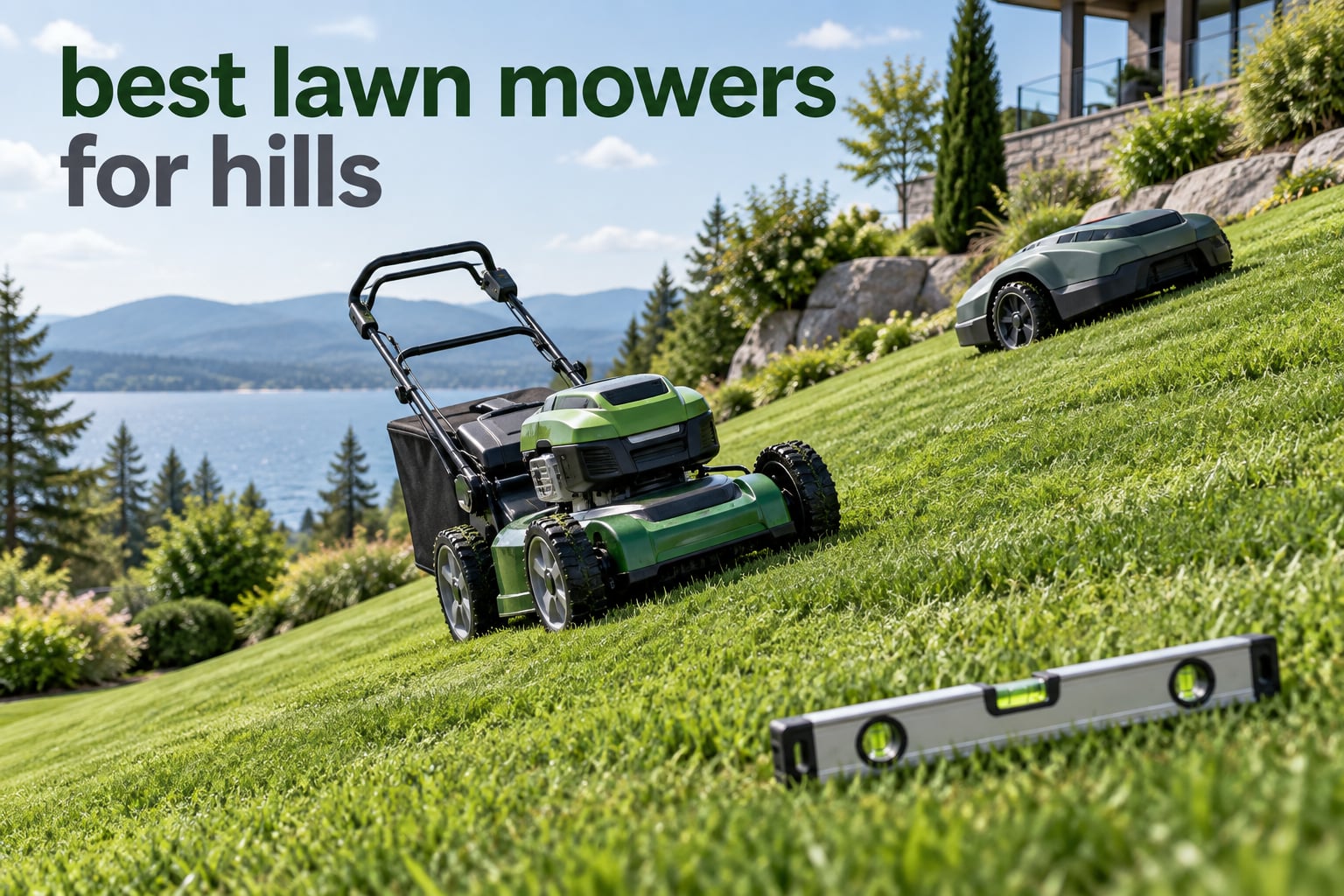
For most sloped yards, the best lawn mowers for hills are the ones that put weight and grip on the drive wheels, hold a published maximum slope rating, and let you modulate speed instead of holding the throttle wide open. On a moderate incline, a rear-wheel-drive self-propelled walk-behind will do the job for a fraction of the money. On a genuinely steep bank, a four-wheel-drive robotic mower is the safer and more capable machine, and it takes you off the slope entirely.
I spent weeks reading owner feedback and comparing drive systems, deck sizes and published incline figures for this roundup, and the pattern was consistent. What fails on a hill is almost never engine power. It is traction, balance and control. A mower with plenty of torque and rear-wheel drive will still spin its wheels on damp grass, and a mower that climbs well can slide on the way back down.
Below are the eight picks that hold up best on uneven ground in 2026, followed by the slope measurement method that tells you which one belongs in your garage. Every product here keeps its own ASIN and its own published rating, so you can check the source data yourself rather than take a blended average on faith.
Table of Contents
Top 3 Picks for Hills and Slopes (October 2026)

All 8 Best Lawn Mowers for Hills in 2026
| Product | Specifications | Action |
|---|---|---|
 Greenworks 80V 21in Self-Propelled Greenworks 80V 21in Self-Propelled |
|
Check Latest Price |
| Mammotion LUBA mini 2 AWD 1500H |
|
Check Latest Price |
 Mammotion LUBA 3 AWD 3000 Mammotion LUBA 3 AWD 3000 |
|
Check Latest Price |
 Mammotion LUBA 2 AWD 5000HX Mammotion LUBA 2 AWD 5000HX |
|
Check Latest Price |
 EGO Power+ LM2125SP EGO Power+ LM2125SP |
|
Check Latest Price |
 Skil PWR CORE 40 SM4910C Skil PWR CORE 40 SM4910C |
|
Check Latest Price |
 PowerSmart 22in Gas B8622S PowerSmart 22in Gas B8622S |
|
Check Latest Price |
 YARDMAX 22in YG2860 YARDMAX 22in YG2860 |
|
Check Latest Price |
How Steep Is Your Hill?
Buy the wrong class of mower and you will find out about it halfway up the slope. Measure first, and the buying decision takes about a minute.
You need two measurements: a straight run of known horizontal length, and the height change across it. Hold a spirit level or your phone’s level app along the slope, measure the drop with a tape, then divide the rise by the run and multiply by 100. That gives you percent grade. To convert grade to degrees, use a simple rule of thumb: 10 percent grade is about 6 degrees, 20 percent is about 11 degrees, 30 percent is about 17 degrees, 40 percent is about 22 degrees, and 50 percent is about 27 degrees.
Most of the hill-mower debate online gets framed in degrees because that is how manufacturers quote it. Where you live matters too. A 15 degree slope in a coastal plain is a gentle lawn. The same 15 degrees in a hilly inland region is a serious incline, and the wet-grass traction penalty scales with how much it rains.
Here is how those numbers translate into the classes below:
Mild, roughly 0 to 10 degrees (0 to 18 percent grade): almost any self-propelled walk-behind handles this. A push mower still works if you are fit and the grass is dry.
Moderate, roughly 10 to 15 degrees (18 to 27 percent): rear-wheel drive with variable speed is the minimum sensible choice. Front-wheel drive machines start to feel nervous here.
Steep, roughly 15 to 20 degrees (27 to 36 percent): you want all-wheel drive or a four-wheel-drive robot. Owners of rear-wheel-drive gas mowers describe constant wheel spin at this grade.
Extreme, 20 degrees and beyond (36 percent and up): a robotic mower with a published high slope rating is the practical answer. Hand-operated machines become a control problem long before they become a power problem.
One caution on the numbers manufacturers print. A stated slope rating is a ceiling, not a target, and it usually assumes dry turf, level side-to-side and a machine in good condition. Treat every rating below as the point where you should already be mowing more carefully, not a number to aim for.
1. Greenworks 80V 21in Self-Propelled – Best Overall Mower for Hills
Greenworks 80V 21in Self-Propelled Lawn Mower, 4.0 Ah Battery and Charger
80V 4.0Ah battery
21 inch stainless deck
75 pounds
7 cut positions
Pros
- Rear-wheel drive with variable speed handles moderate inclines well
- 702 ratings with a 72 percent five-star share
- Battery platform works with 75 other Greenworks 80V tools
- LED headlight extends workable mowing hours
Cons
- Rear-wheel drive gives less grip than all-wheel drive on steep ground
- 75 pounds is heavy to push manually when drive is disengaged
The Greenworks 80V 21in is the pick I keep coming back to for most sloped suburban lawns, because it does the two things that matter on a hill and does them without drama. The drive is rear-wheel, so the machine’s weight sits over the wheels doing the pushing, and the drive speed is variable, so you can crawl up a grade at walking pace instead of lunging at it.
Across 702 ratings it holds a 4.4 average with a 72 percent five-star share, which is more feedback than any other cordless walk-behind in this group. That volume matters for a hill test in particular, because slope complaints surface early in a product’s life and settle down later. They have not surfaced here.
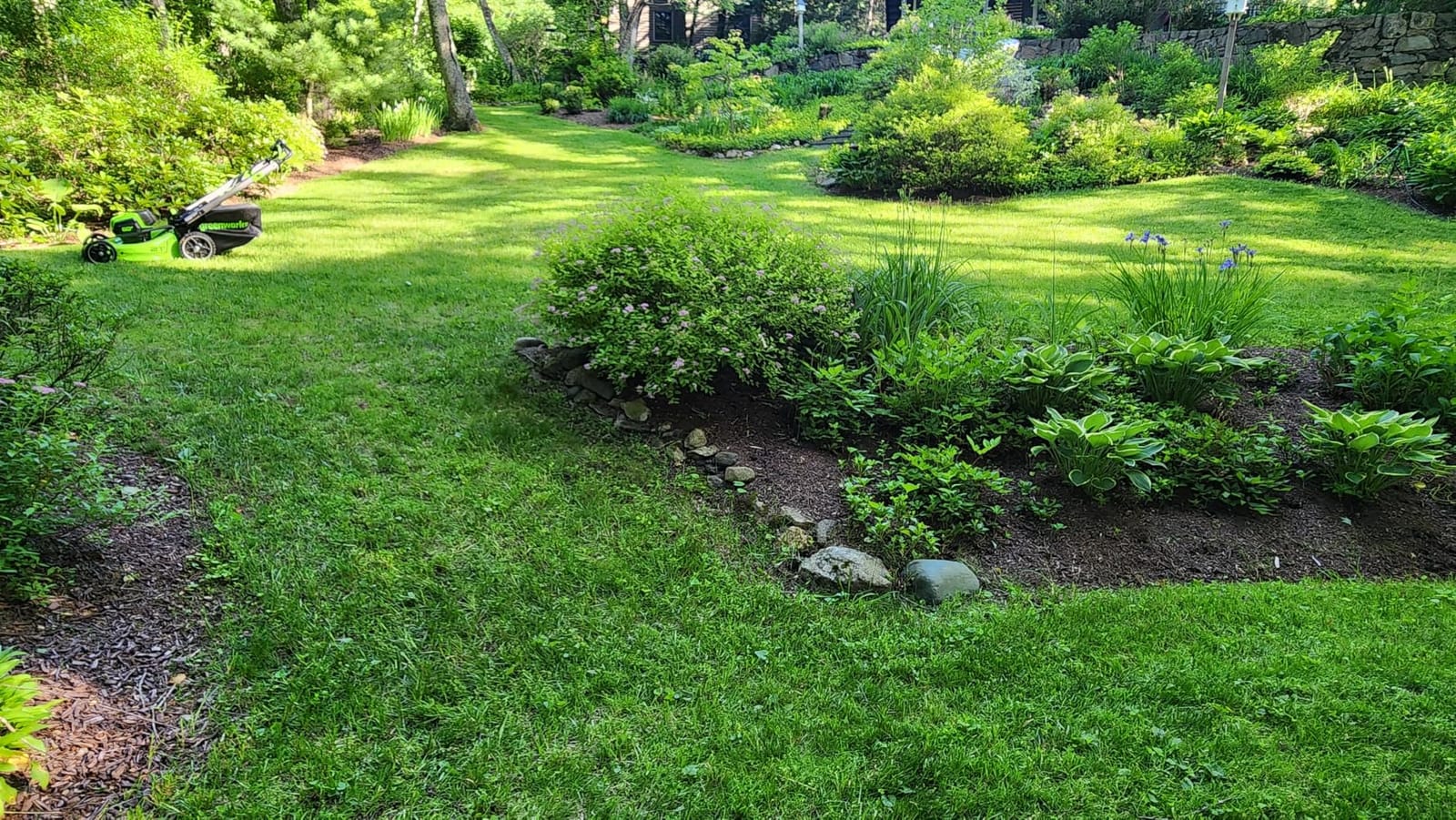
The 4.0Ah battery covers up to half an acre per charge, and the brushless motor drives a 21 inch stainless steel deck. One thing owners consistently point out is that a drive motor working against gravity draws more stored energy on a slope, so your effective runtime on hilly ground is shorter than the flat-yard figure suggests. Budget for a second battery if your hill is most of the lawn.
Height adjustment runs through seven positions with a single lever, and the battery cross-compatibility with the wider Greenworks 80V tool range is the quiet advantage for anyone already in that platform.
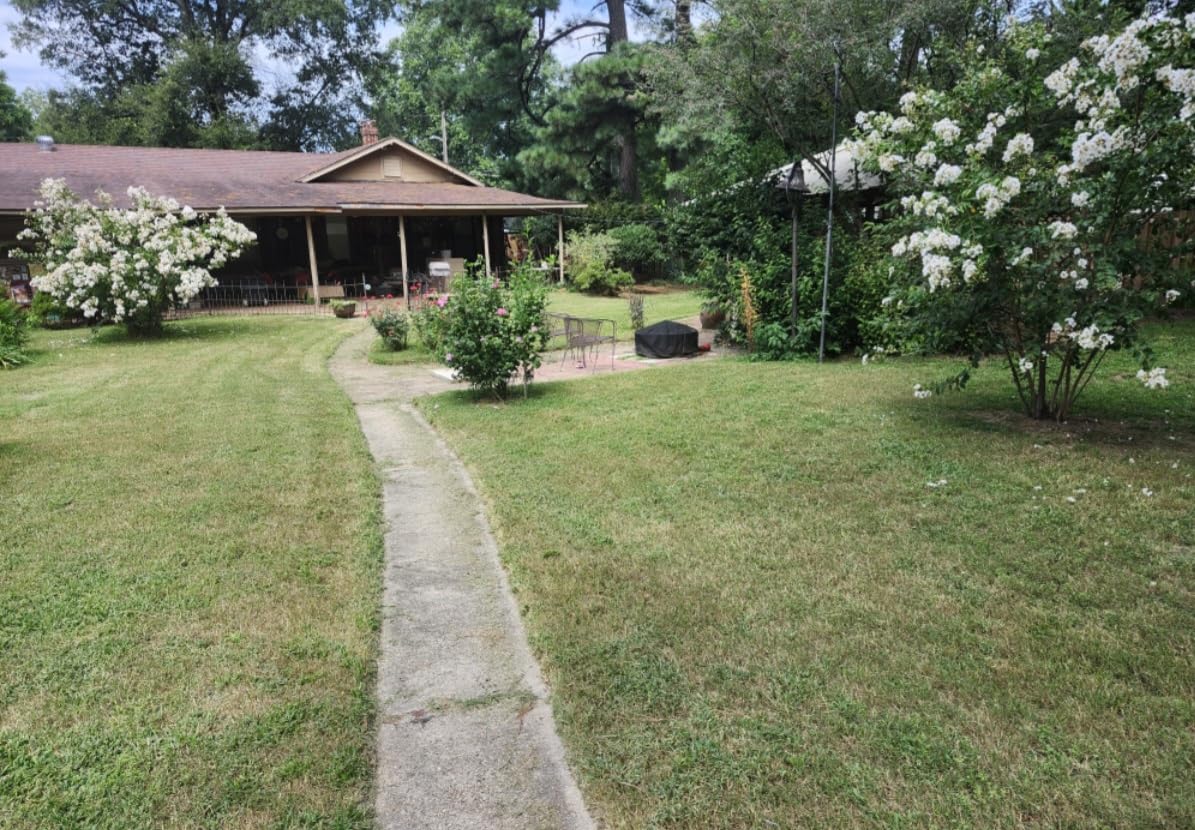
When this mower earns its place
This is the right machine for a moderate slope, a lawn that mixes flat and inclined ground, and anyone who wants cordless runtime without giving up a real drive wheel. Variable speed control is the feature that does the most work on an incline, and this one has it.
It also suits anyone mowing early or late thanks to the LED headlight, and anyone who already owns Greenworks 80V tools and can share chargers and batteries.
When to look elsewhere
Rear-wheel drive is the limit here. On a sustained slope past 20 degrees, or on a bank that holds moisture after rain, the rear tires will spin where a four-wheel-drive machine would keep moving. If your hill is steep, skip to the robotic picks.
At 75 pounds, pushing it manually with the drive disengaged is real work on a steep section, so plan your pattern so self-propel does the climbing rather than you.
2. Mammotion LUBA mini 2 AWD 1500H – Best Robot Mower for Steep Slopes
(2026 NEW) Mammotion LUBA mini 2 AWD 1500H Robot Lawn Mower with Garage, for 0.37 Acres, 360° LiDAR+Dual-Camera AI Vision, 80% Slope, DropMow, 20 Multi-Zone Management
AWD 88W motors
80 percent slope rating
7.9 inch cut width
0.37 acre coverage
Pros
- Independent suspension and omni wheel handle rough root-filled ground
- 4.4 rating across 263 reviews with only 4 percent one-star
- DropMow mode needs no mapping at all
- Sensors are over-specified for a small sloped lot
Cons
- 0.37 acre cap is a hard ceiling on mapping
- 7.9 inch cut width makes completion times long
- Charging takes two to three hours
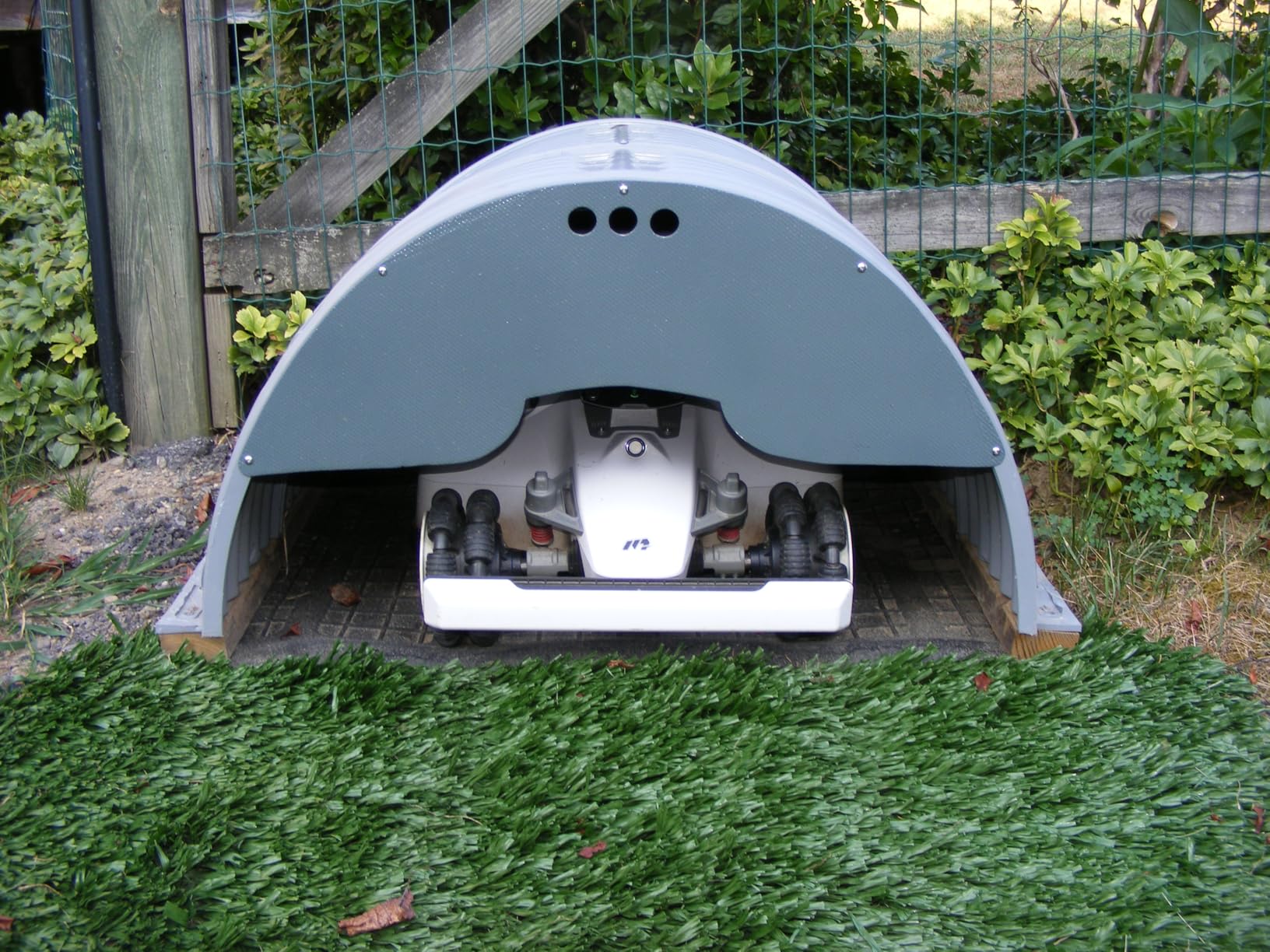
This is the answer for a genuinely steep small lawn. Two independent 88W motors drive all four wheels with an 80 percent slope rating, and the adaptive suspension steps over curbs, roots and thresholds up to 45mm. Owners with severe slopes describe it as changing how they think about the yard, because the machine simply does not care how steep it gets.
It also carries the cleanest rating distribution in the robotic group here. Across 263 ratings it averages 4.4 with 70 percent five-star and only 4 percent one-star. One owner with an 80 percent slope lawn reported no problems over two months and bought a second unit, which is the kind of report that tells you more about hill behavior than any spec sheet.
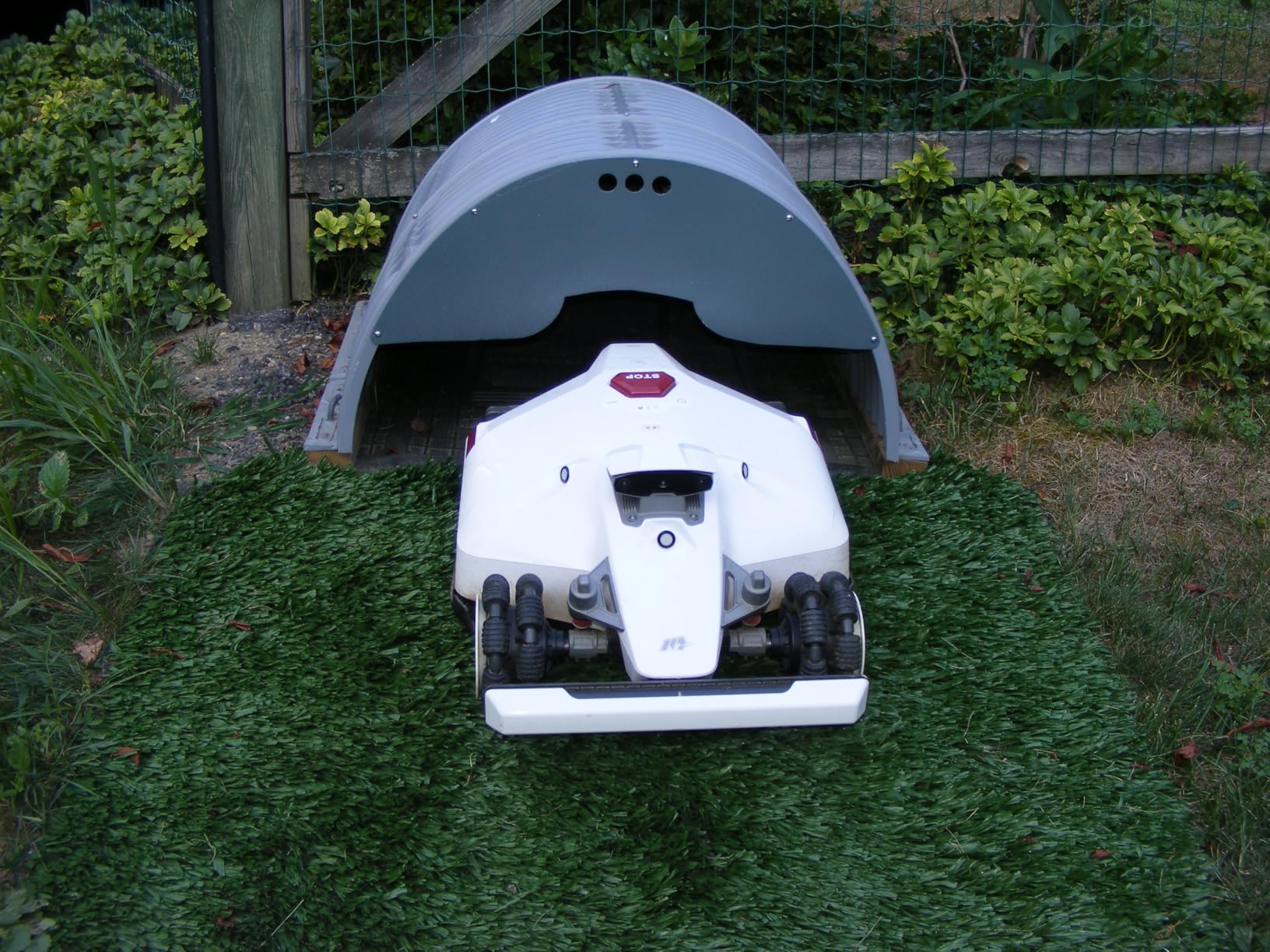
Navigation is 360 degree LiDAR at a 45 degree field of view combined with dual-camera AI vision, so the sensing is redundant rather than dependent on a single satellite fix. DropMow mode is genuinely useful on a small sloped plot: place it, press Mow and Start, and it works from a temporary map with no boundary work at all.
The main disc has app-adjustable cutting height from 2.2 to 4 inches, and a second disc handles edges. Coverage is up to 0.37 acres across as many as 20 independent zones, and it can hold a custom charge limit and charge off-peak.
When this mower earns its place
Choose this one if your slope is severe, your lawn is small enough to fit inside a third of an acre, and you would rather not walk the bank at all. It is also the one to consider if you are mowing alone and the steepest part of the property is the part that worries you.
Root-covered ground and uneven terrain do not stop it, which is where most other robots in this category give up.
When to look elsewhere
The 0.37 acre cap is a hard limit the app will not let you map past, and the 7.9 inch cut width means a quarter acre can still take half a day. If your property is larger, move up to the LUBA 3 rather than fighting the mapping ceiling.
Edging is close rather than perfect, so expect periodic manual re-edging. It also does not collect clippings or leaf litter, which means a cleanup pass stays on your list.
3. Mammotion LUBA 3 AWD 3000 – Best Robot Mower for Large Hilly Lawns
Mammotion LUBA 3 AWD 3000 Robot Lawn Mower with Cleaning Stand (Ship Separately), 360° LiDAR+NetRTK+AI Vision, AWD for 80% Slopes, 5400 sq.ft/h, Cutting Height 1.0″-2.7″
Four independent motors
80 percent slope,38.6 degrees
175 min runtime
5400 sq ft per hour
Pros
- Highest coverage rate here at up to 5400 sq ft per hour
- Four motors and adaptive suspension over 50mm obstacles
- NetRTK keeps position lock where plain GPS drifts
- Three-point turn reduces turf tearing
Cons
- Cut finish is serviceable rather than showy
- Mapping and app work frustrates some owners
- Battery pack is not user-replaceable
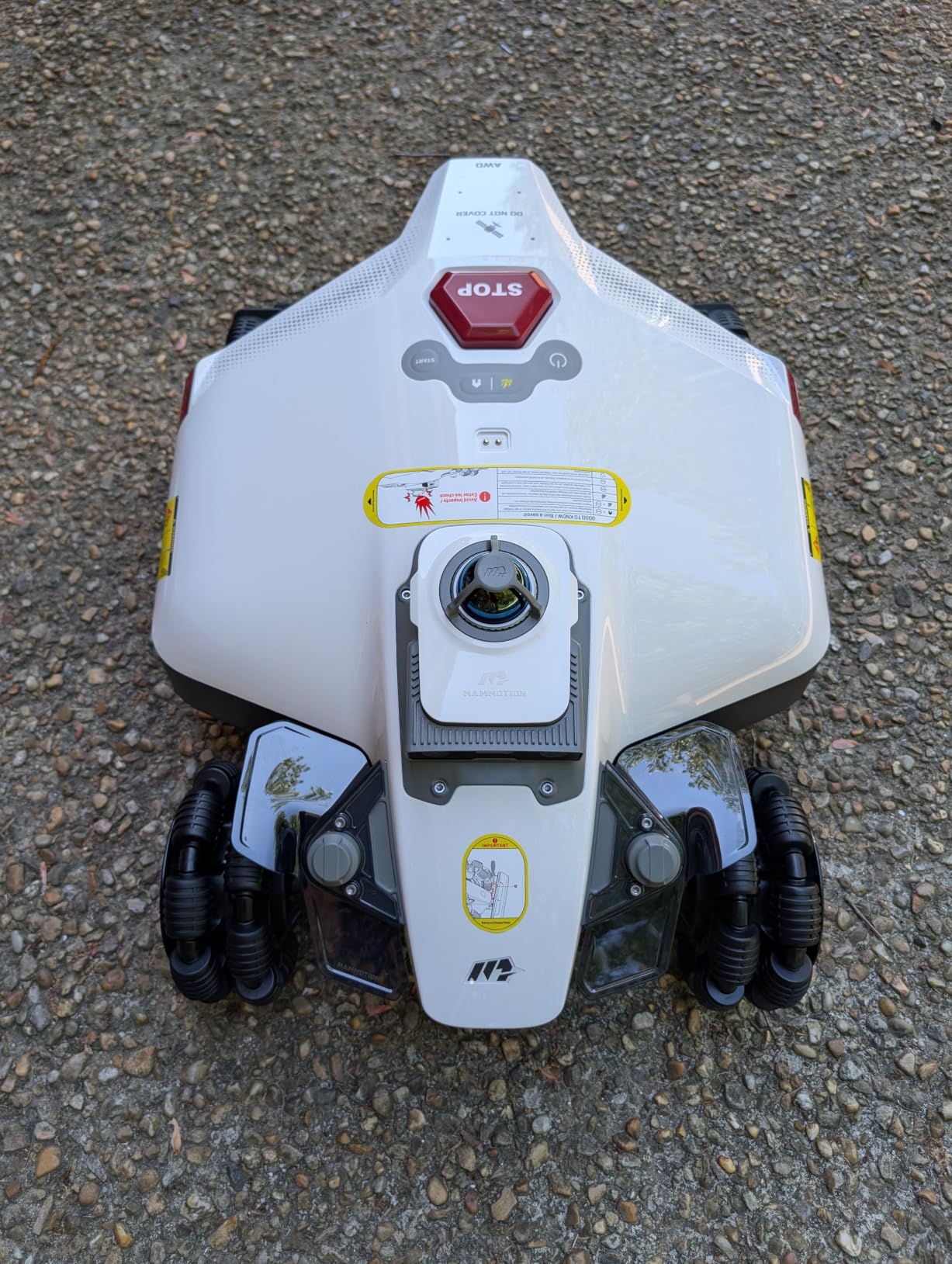
Where the mini 2 is capped, the LUBA 3 AWD 3000 is the version for a big sloped property. Four independent motors climb slopes to 80 percent, which the manufacturer rates at 38.6 degrees, and the adaptive suspension handles obstacles over 50mm. Two high-torque 165W motors drive 6-blade discs at up to 500 square meters per hour.
Navigation is Tri-Fusion: 360 degree LiDAR sweeping 59 degrees vertically with a range up to 230 feet, dual-camera AI vision, and NetRTK for correction. That vertical sweep is what builds a point cloud from ground level to tree canopy, which is why this class of machine keeps working where a satellite-only robot gives up.
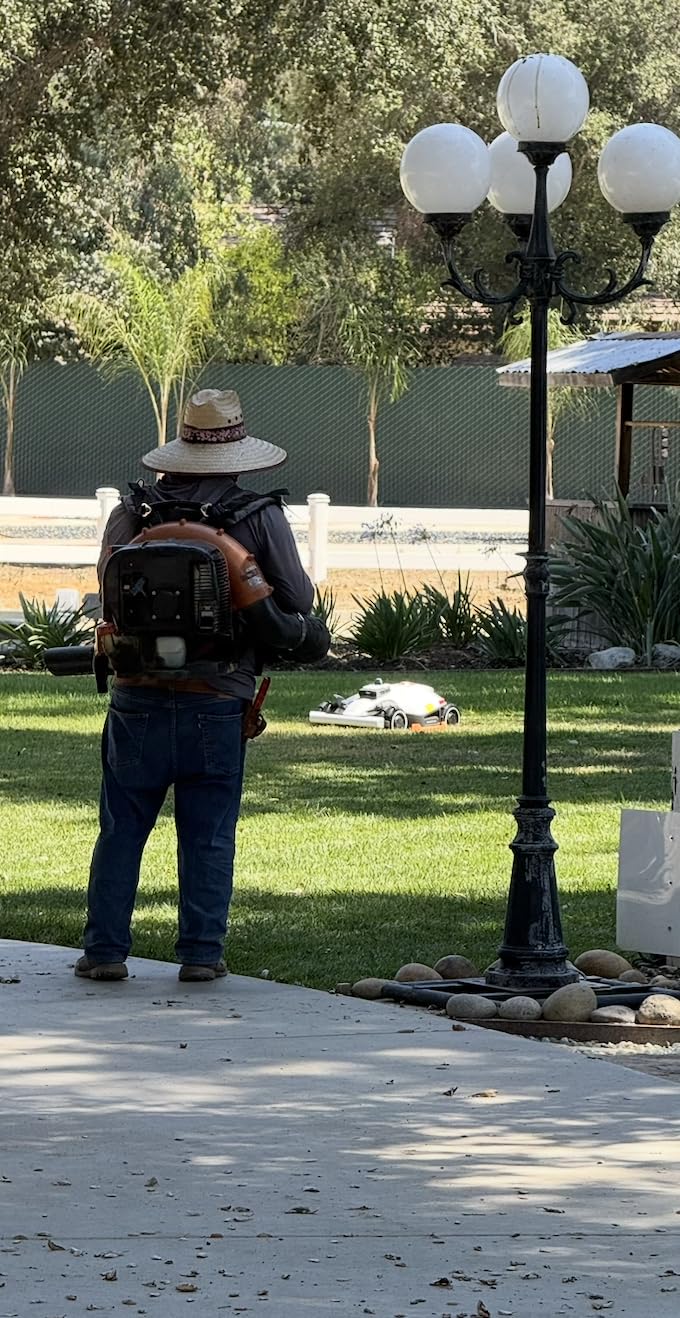
On r/lawnmowers and r/MammotionTechnology, LUBA and LUBA 3 AWD owners with slopes in the 20 degree range repeatedly report that the robot handles ground their riding mower struggled with, and the reason they give is consistent: all-wheel drive plus treaded wheels. That is a real advantage when the alternative is a machine you have to balance on a slope.
Across 154 ratings it averages 4.3. The spread is the widest of the robotic group here, with 65 percent five-star but 8 percent three-star, and two durability complaints appear against many reports of excellent results on rough, sloped, thick turf. Owners on steep wooded chalet terrain in Canada report particularly good results.
When this mower earns its place
This is the pick for rolling acreage, thick turf, and properties with mixed terrain where a walk-behind would take most of a weekend. The three-point-turn option is worth noting because turning in place tends to tear turf on a slope, and this avoids the worst of it.
Up to 30 mowing zones with no-go areas means you can protect garden beds and the edge of a retaining wall without re-mapping the whole lawn each time.
When to look elsewhere
There is no grass-lifting effect, so it can push grass over rather than cut it evenly, and the finish will not match a conventional mower’s stripes. If appearance matters more than coverage, a walk-behind is the better tool.
Setup and app learning are a real part of the purchase, and one owner reports the online manual is thin on explaining features. The battery pack is not user-replaceable, and manual edging is still needed each cycle.
4. Mammotion LUBA 2 AWD 5000HX – Best Robot Mower for Tree-Covered Hills
Mammotion LUBA 2 AWD 5000HX Robot Lawn Mower with 4G, Reception 1.25 Acres, Max. 1.48 Acres, All-Wheel-Drive for 80% Slope, UltraSense AI Vision & RTK Automatic Edge Mapping, 2.2″-4.0″ Cutting Height
165W AWD drive
80 percent slope rating
1.25 acre reception
15.8 inch cut
Pros
- Works under tree cover where RTK alone loses signal
- 165W AWD climbs 32 to 38 degree hills
- Quiet enough to be inaudible beyond a few feet
- No boundary wire required
Cons
- Mapping complexity on large properties
- Docking alignment needs attention
- Blades need replacing roughly every 30 cuts
The distinguishing feature here is UltraSense AI vision working alongside RTK navigation. That combination is the whole point of this model: owners with wooded hills report it mowing under canopy where a satellite-only robot loses its fix entirely, which is a common failure mode on the shaded side of a slope.
The drive is a 165W four-wheel motor rated for 80 percent slope, described in owner reports as 32 to 38 degree climbing on rough, hole-filled ground. It receives on up to 1.25 acres with a maximum of 1.48, and can hold up to 50 mowing areas including road sides and no-go zones.
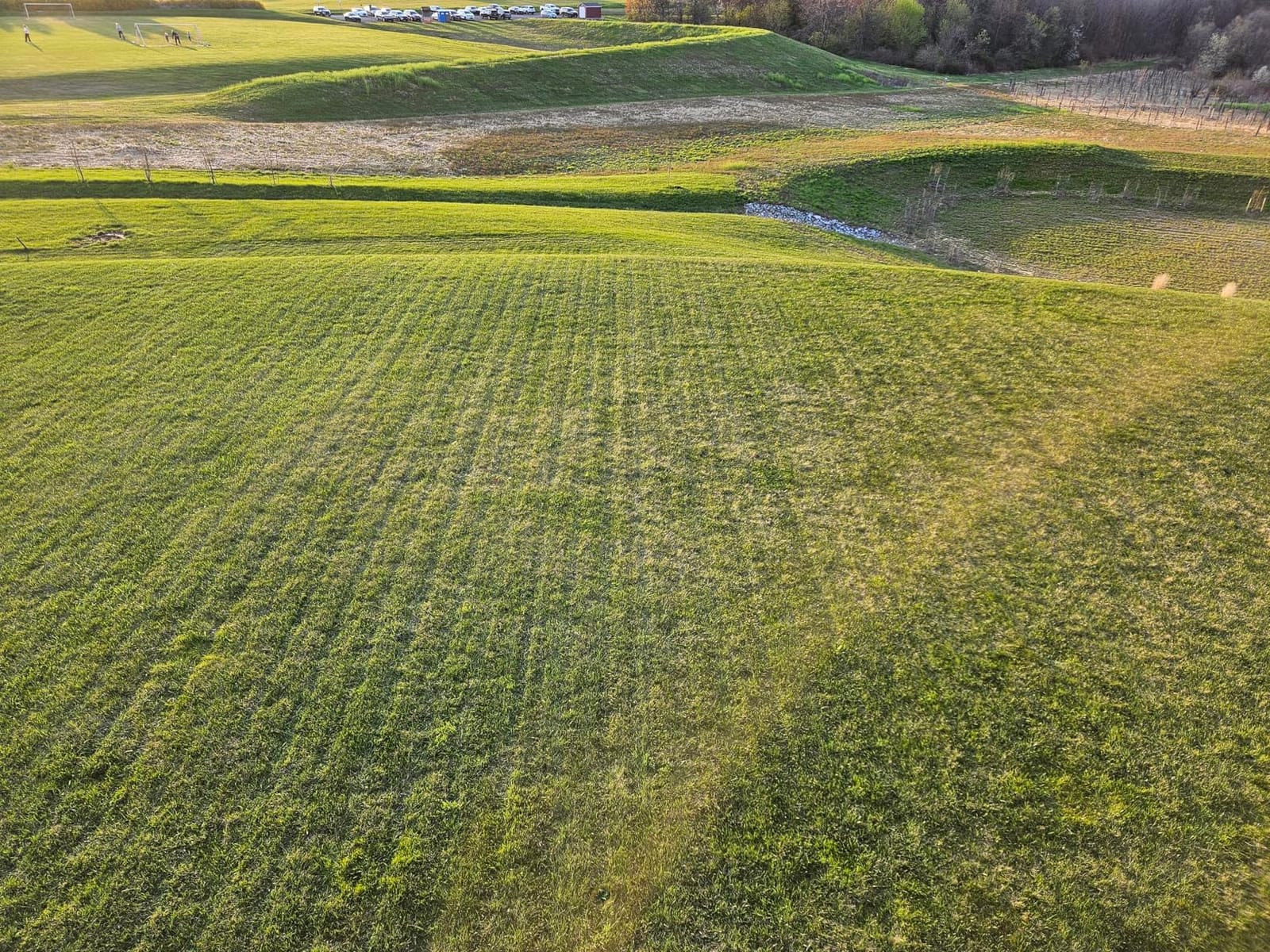
Edge cutting is the other thing worth knowing about. Automatic edge mapping gives riding-style zero-distance cutting at the perimeter, so there is less of the strip of long grass a small-deck robot leaves behind. Cutting height adjusts across 18 positions from 2.2 to 4 inches, and the dual-blade disk covers up to 13,000 square feet per charge.
Obstacle avoidance recognizes over 200 object types, and connectivity runs through 4G, Bluetooth and WiFi with GPS anti-theft tracking, a lost mode and out-of-zone notifications. Across 95 ratings it holds 4.3 with 71 percent five-star.
When this mower earns its place
Pick this if trees cast shade over your slope, because that is the scenario it is built for. The 15.8 inch dual-blade cut path with two-ended blades is also the widest in the robotic group here, which cuts completion time on a larger lawn.
It suits anyone who wants no boundary wire at all and would rather manage mowing zones from an app than run cable around a slope.
When to look elsewhere
With 95 ratings, this is the least reviewed machine in the roundup, so the long-term reliability picture is thinner than the others. Some owners find mapping and boundary setup mildly complex on large properties, and sharp turns, multiple no-mow zones and docking alignment can be fiddly.
The blades are razor-type and need replacing roughly every 30 cuts. It does not collect clippings or handle leaf litter, so manual cleanup remains.
5. EGO Power+ LM2125SP – Best Cordless Mower for Quiet Hill Work
EGO Power+ Electric Lawn Mower, Self-Propelled Cordless with Touch Drive, Includes 56V 7.5Ah Battery and Rapid Charger – LM2125SP
56V 7.5Ah battery
60 minute runtime
7 height positions
84.9 pounds
Pros
- Touch Drive modulates speed with a fingertip dial
- Brushless motor delivers up to 6.0 ft-lbs of torque
- Quiet enough to mow while listening to music or a book
- Works with all EGO 56V ARC packs
Cons
- Self-propel engagement can feel jerky and does not always disengage
- Backing up is awkward when the drive stays engaged
EGO’s Touch Drive is the control scheme that matters most on a hill here. Instead of a stiff bail lever you squeeze continuously, you engage the self-propel with palm contact and change speed with a fingertip dial. That gives fine modulation going up a grade, which is exactly the input you need when the rear wheels are near their limit.
Owners describe a specific hill technique with this machine: push it down the slope and let the self-propel pull it back up. That works because you are not fighting a lever with one hand while managing a 84.9 pound machine with the other.
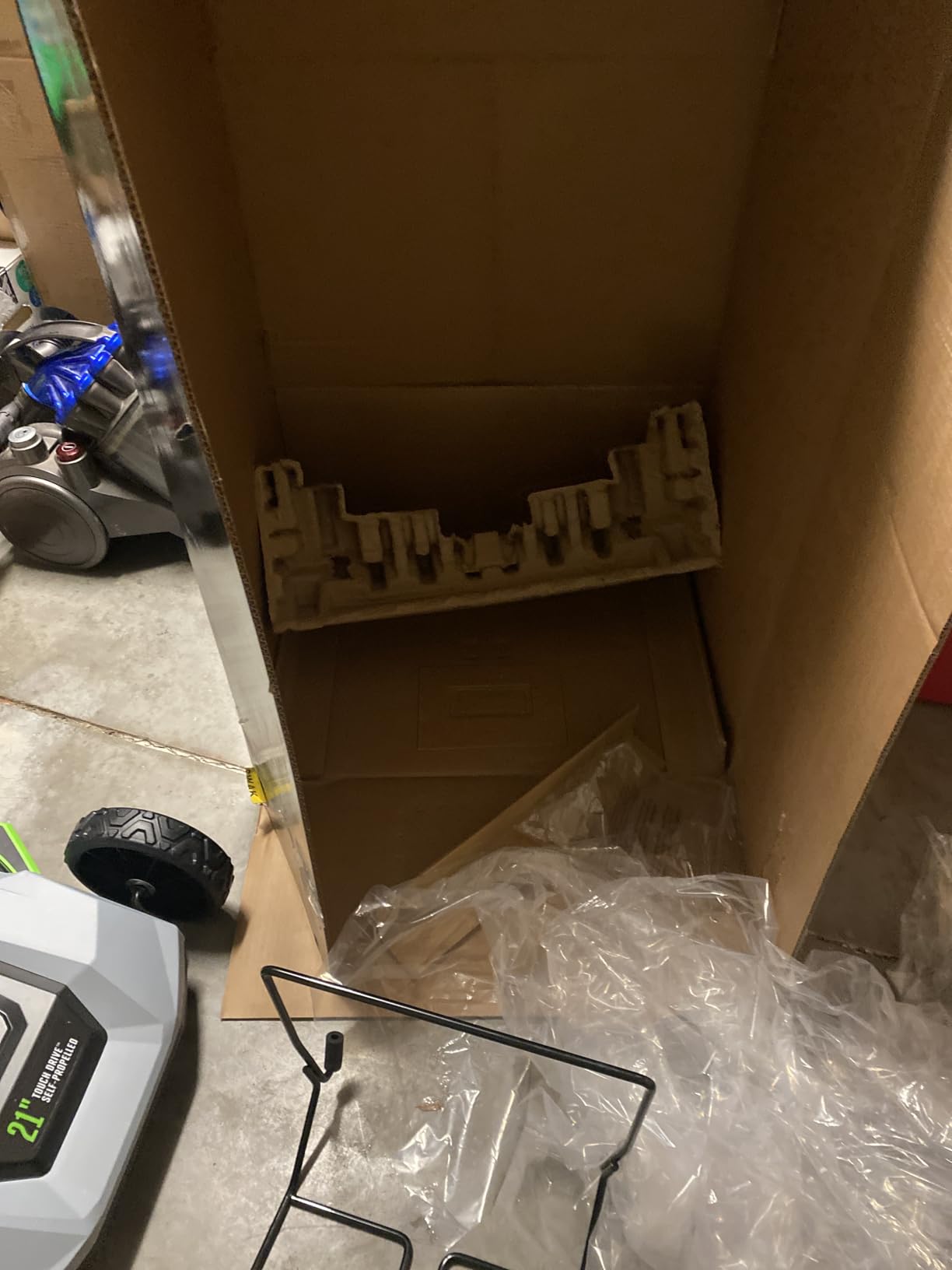
The brushless motor delivers up to 6.0 ft-lbs of cutting torque, and the included 56V 7.5Ah battery gives up to 60 minutes of runtime. Cutting height runs through seven settings from 1.25 to 4 inches with one-hand adjustment, and you can mulch, side discharge, or bag into the included two-bushel grass bag.
Across 245 ratings it averages 4.2 with a 72 percent five-star share. Quieter operation is the quiet advantage for early starts and neighbors with early routines. If you are already deep into the EGO 56V platform, this mower is compatible with all EGO 56V ARC packs.
When this mower earns its place
This suits anyone who mows a slope near neighbors or outside normal hours, and anyone who wants precise speed control rather than a fixed gear. Battery compatibility across the EGO range is the strongest ecosystem argument of the cordless group.
It is also comfortable for shared mowing duties, since one person can move it with one hand despite the battery weight.
When to look elsewhere
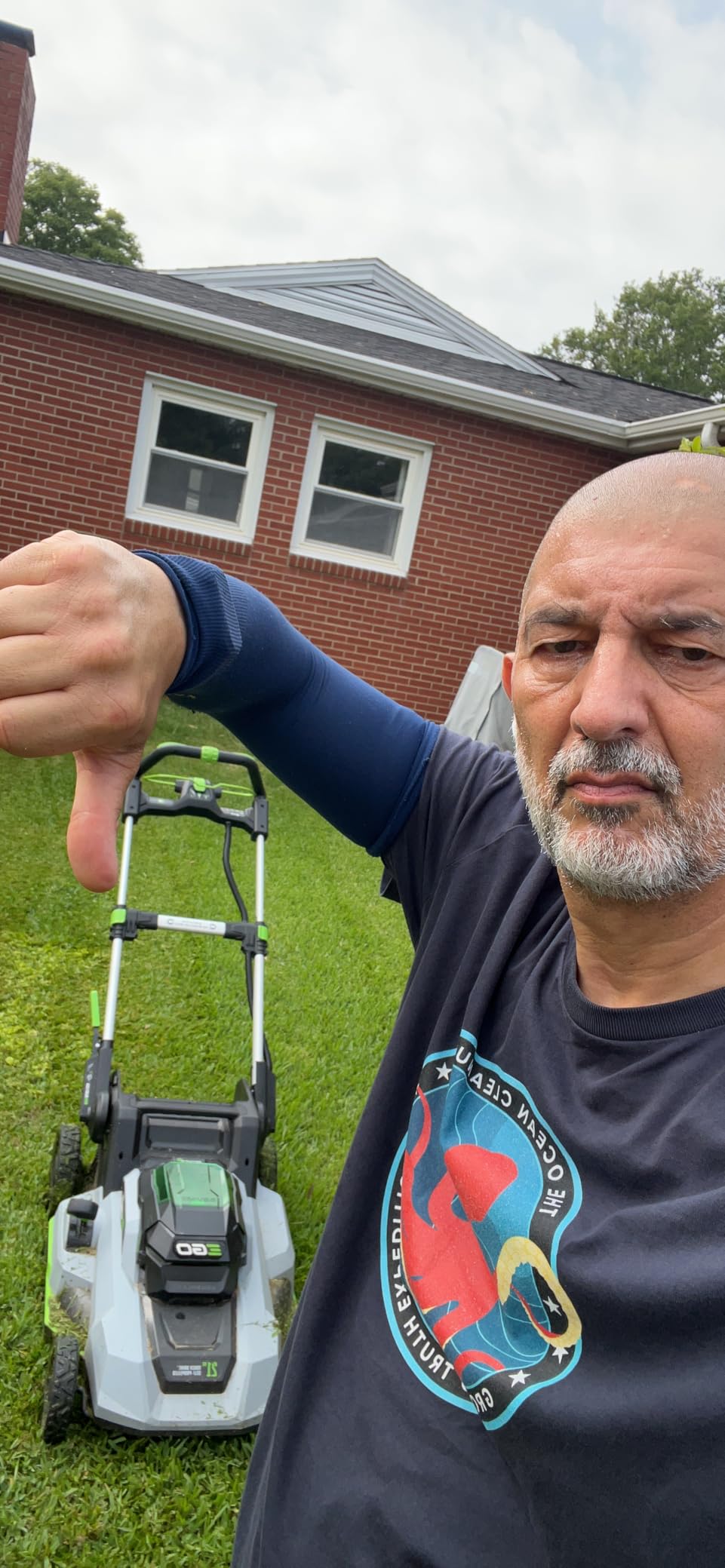
The most repeated criticism is the drive itself. Owners report self-propel engagement feels slightly jerky and does not always disengage immediately, which makes backing up awkward on a slope. Plan your passes so you rarely need to reverse.
Some owners also report runtime ending sooner than the 60 minute claim on larger properties, and on a hill the drive motor works harder, which shortens the effective figure further.
6. Skil PWR CORE 40 SM4910C – Best Lightweight Cordless Mower for Hills
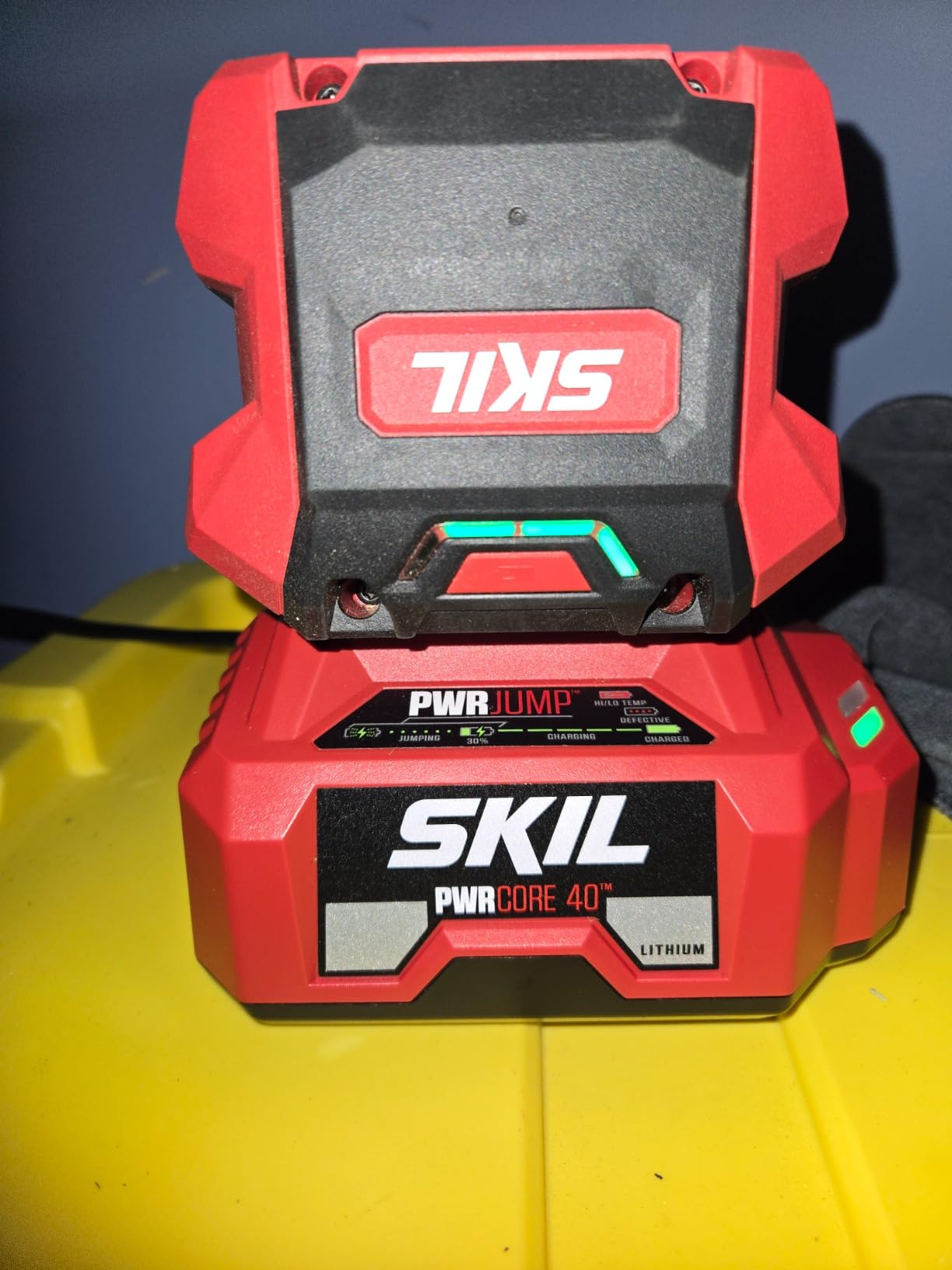
SKIL PWR CORE 40 Brushless 40V 20-Inch Self-Propelled Mower Kit, Includes 6.0Ah Battery and Auto PWR JUMP Charger – SM4910C-11
40V 6.0Ah battery
50 minute runtime
20 inch deck
7 height settings
Pros
- Light enough to lift with one hand
- Variable speed self-propel from slow to walking pace
- 6.0Ah battery covers roughly three mows of a mid-size yard
- Handles fold for compact storage
Cons
- 20 inch deck is narrower than typical 21 to 22 inch decks
- Self-propel motor is louder than the blade
- One owner reports little difference between grass settings
Weight is the underrated variable on a hill, and this is the lightest self-propelled option in the roundup. Owners lift it with one hand, which means you can use the self-propel on the steep sections and push it manually on the flat, instead of committing to full assist everywhere. That flexibility matters when a battery mower’s grip gives out mid-grade.
At 4.5 across 211 ratings, it has the highest average rating of the eight, with 75 percent five-star. The drive is variable speed self-propel dialed from slow to fast walking pace, which is the correct control for uneven ground.
The 40V 6.0Ah battery gives up to 50 minutes per charge, roughly three mows of a mid-size yard, and the digital brushless motor handles the cutting. Deck height adjusts on a single lever through seven settings from 1.5 to 4 inches, and it does 3-in-1 bagging, mulching and rear discharge.
The telescoping handle folds for vertical storage, which matters if your garage floor is where the slope work happens. Weather-resistant construction takes the dew and early-morning damp that reduces traction before it becomes a hazard.
When this mower earns its place
This is the pick for a moderate slope on a smaller lawn, and for anyone who does not want to shoulder a heavy machine at the top of a bank. The lightweight handling makes it easy to lift out of a slope bed, reposition, and keep the deck in line.
It suits buyers who want cordless convenience without committing to a large battery platform they will not use for much else.
When to look elsewhere
The 20 inch deck is narrower than the 21 and 22 inch gas decks in this roundup, so it changes your mowing pattern and adds time on a larger property. A small minority of owners report little difference between the lowest and highest grass settings, and battery cutoff under tall grass.
Note that a December 2024 battery recall applies to earlier kits. Current units are unaffected, but if you own an older kit it is worth checking before buying anything else.
7. PowerSmart 22in Gas B8622S – Best Value Mower for Slopes
PowerSmart 22-Inch Gas Lawn Mower, 150cc B&S Engine, Self-Propelled, 3-in-1 Mulching System, 6 Cutting Heights, Rear-Wheel Drive, Durable Steel Deck
B&S 150cc engine
22 inch steel deck
Rear-wheel drive
72 pounds
Pros
- Rear-wheel drive is engineered for traction on incline slopes
- 22 inch deck is the widest walk-behind in this roundup
- USA-made Briggs and Stratton engine starts in any temperature
- Steel deck with 6-position height adjustment
Cons
- 15 percent one-star share signals a wide quality spread
- Gas means fuel and oil storage plus routine maintenance
- 72 pounds is heavy when self-propel is disengaged
The PowerSmart is the value answer for a moderate slope, and the drive system is the reason it belongs here at all. The rear-wheel drive is specified for improved traction on incline slopes and uneven terrain, which is the single most important thing on a hill and the thing most cheap walk-behinds get wrong.
Power comes from a USA-made Briggs and Stratton EX625 150cc engine with ReadyStart, so it starts without fuss in any temperature. At 1,071 ratings across the roundup this is by far the most reviewed machine here, which means any pattern in owner feedback is a real pattern.
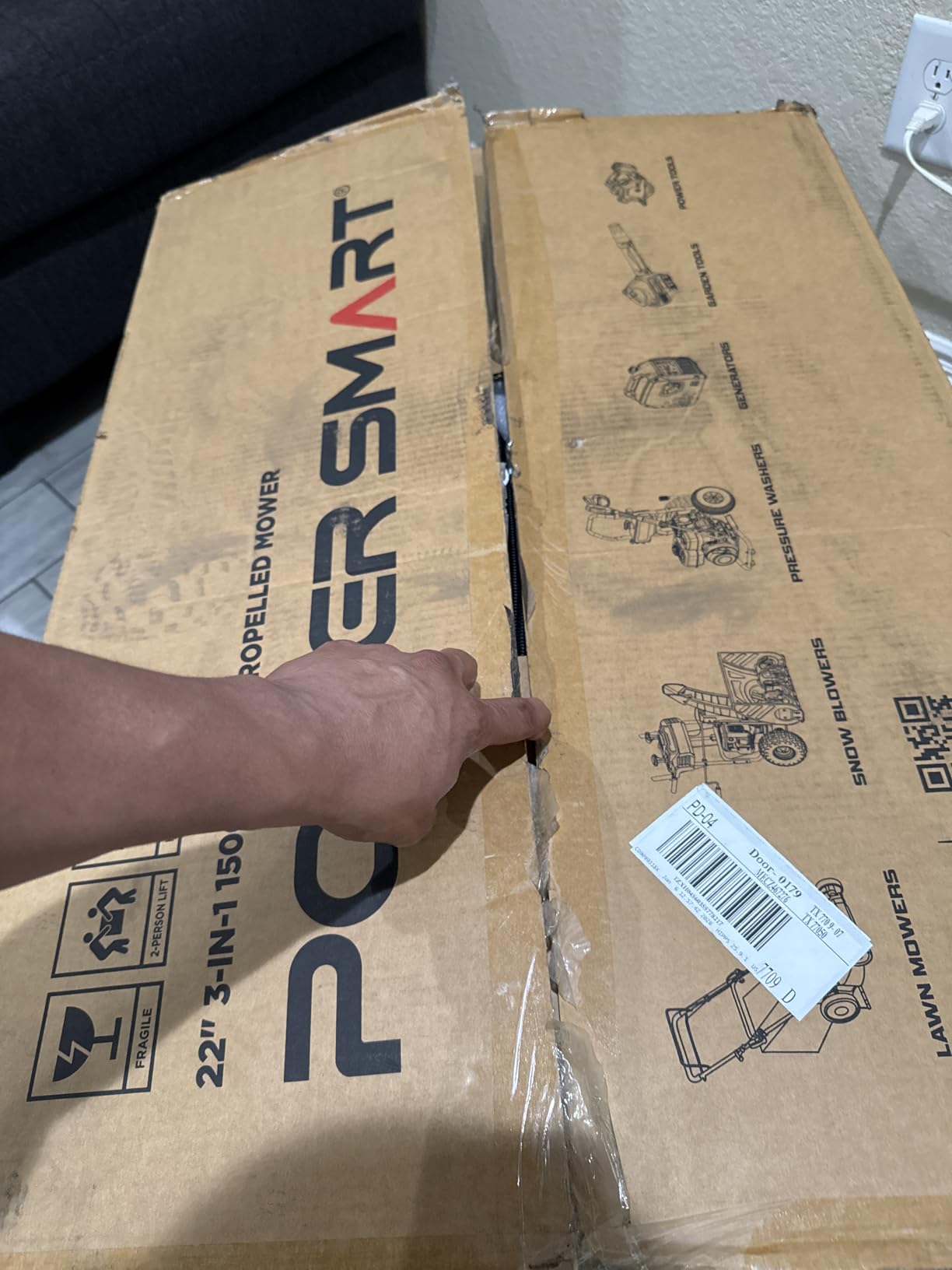
At 4.0 average with 1,071 ratings, it carries a 61 percent five-star share against a 15 percent one-star share. That spread is typical of a value-tier gas walk-behind, and it is worth weighing honestly against the smoother distributions of the cordless machines.
The 22 inch cut width is the widest deck in the roundup, the deck is steel rather than plastic, and the single lever adjusts six height positions from 1.5 to 3.9 inches. It handles mulching, rear discharge and bagging into a 1.4-bushel bag.
When this mower earns its place
Choose this if you want gas runtime without a charging routine, you have a moderate slope rather than a severe one, and you would rather buy once and maintain it than replace a battery pack in a few seasons. A wide steel deck and a known engine brand are both meaningful on uneven ground.
It is also the straightforward choice for a larger lot where a 21 inch cordless deck would mean extra passes.
When to look elsewhere
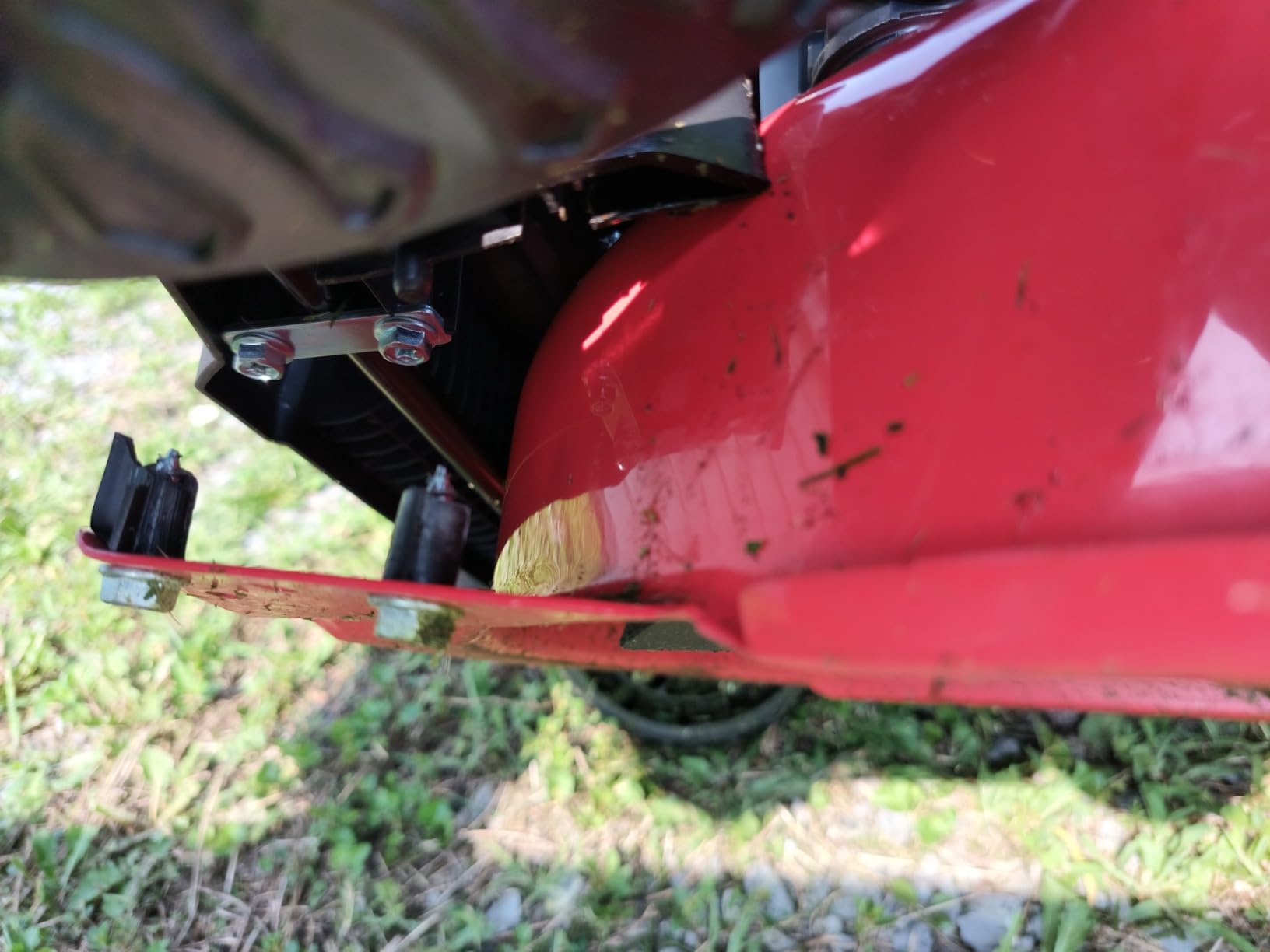
The 15 percent one-star share is the second highest in this roundup, so expect some inconsistency in assembly and finish. If you are fussy about that, the cordless picks above have tighter rating distributions.
Gas also means fuel and oil storage and routine maintenance that the battery options avoid, and at 72 pounds it is heavy to move manually when self-propel is disengaged on a steep section.
8. YARDMAX 22in YG2860 – Best Budget Gas Mower for Moderate Hills
YARDMAX 22 in. 201cc Select PACE 6 Speed CVT High Wheel FWD 3-in-1 Gas Walk Behind Self Propelled Lawn Mower, Black (YG2860)
201cc engine
22 inch deck
CVT 6-speed drive
84.9 pounds
Pros
- CVT gives continuously variable speed with a 6-speed lever
- Spiked tread rubber tires are built for traction on sloped ground
- Automatic choke removes priming and choking
- Single-lever deck adjustment
Cons
- 17 percent one-star share is the highest of any gas walk-behind here
- 84.9 pounds is demanding on steep ground
- Front-wheel drive is less sure than rear-wheel
The YARDMAX is the budget entry, and the CVT is the reason it is worth considering for a mild-to-moderate hill at all. Instead of fixed gears, the six-speed shift lever gives continuous speed variation, so you can hold a slow crawl uphill without bogging the 201cc engine.
The high-wheel design uses rubber tires with an aggressive spiked tread pattern, which is genuinely the right hardware for a slope. Grip is the deciding factor on a hill, and a tread pattern designed for traction helps more than extra engine displacement would.
It is also the least fussy machine to start. The automatic choke system means no priming and no choking, which removes the most common reason a small gas mower gets left in the garage on a Saturday morning.
The 3-in-1 deck offers mulching, bagging and discharge with a single-lever height adjustment, and a deck cleanout port lets you clear the underside quickly after the grass-knife buildup that happens fast on an incline. Across 419 ratings it averages 4.0, with 62 percent five-star.
When this mower earns its place
This suits a mild slope, a budget you want to protect, and anyone who wants gas without carburetor fuss. The spiked tread and CVT control are more hill-aware than most machines at this level, and the cleanout port saves time on a slope where clippings pack down fast.
It is a sensible first hill mower for a smaller yard where the incline is one section rather than the whole property.
When to look elsewhere
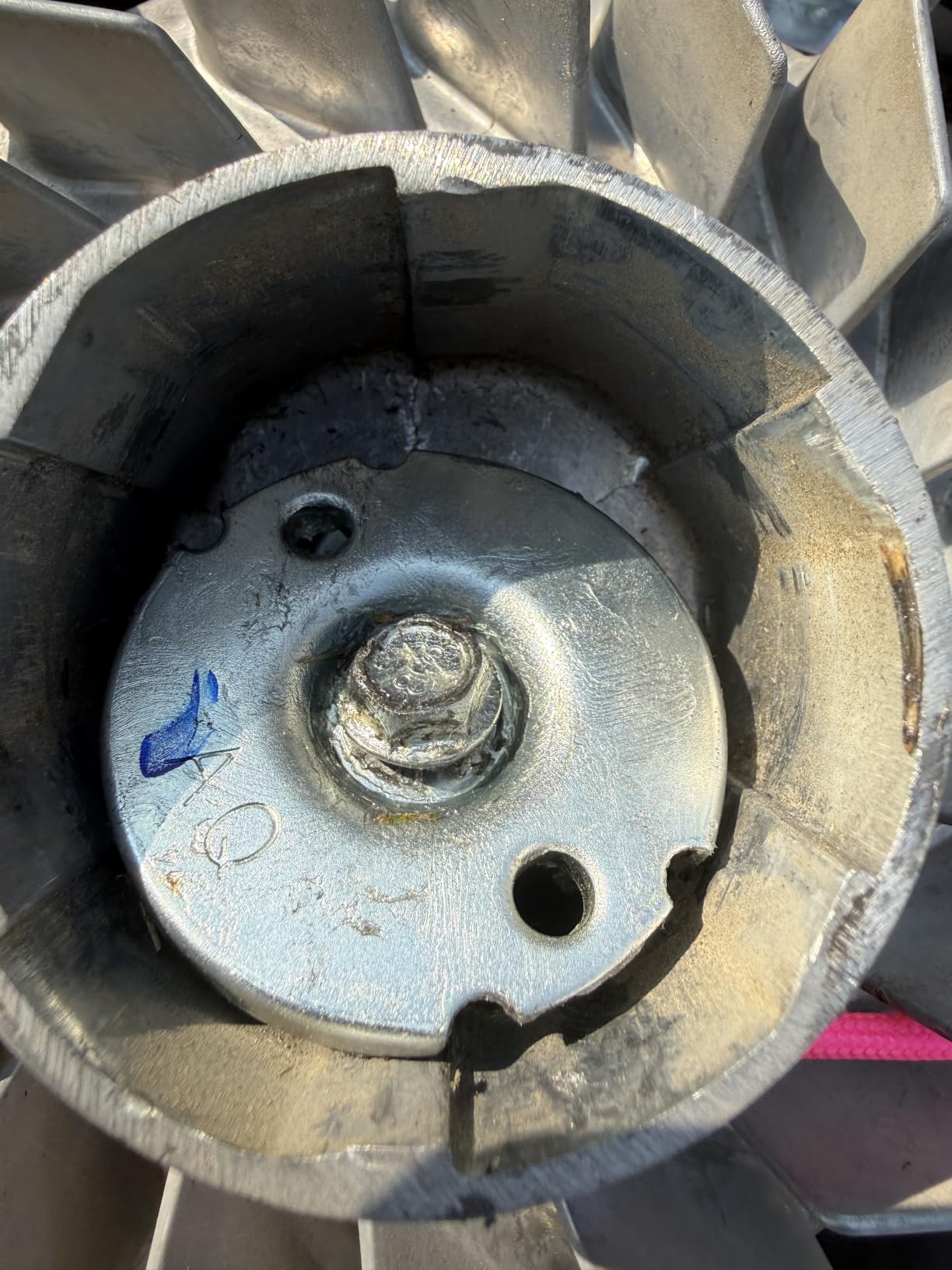
Seventeen percent of ratings are one-star, the highest one-star share of any gas walk-behind in this roundup, which points to a polarized experience around durability. At 84.9 pounds it is the joint-heaviest machine here, and that shows on a steep section.
This is a front-wheel drive design, so it has less grip on a climb than the rear-wheel drive machines above it. Keep it to mild and moderate slopes.
Why Your Current Mower Struggles on a Slope
Almost every hill complaint traces back to one of four things, and none of them is a lack of engine power.
Traction loss is the big one. Owners on ihcubcadet.com describe tires that spin at the least bit of moisture, and that matches what most people experience. Wheelspin on damp grass is grip-limited, and adding torque to a spinning wheel does not fix it. This is why drive type and tire tread matter more than displacement.
Engine strain and bogging show up when the engine is asked to climb and cut at the same time. Users on mytractorforum.com describe machines browning and stalling while climbing, and the effect worsens sharply when the cut height is set short, because the blade is pulling more load.
Oil starvation is the under-discussed one. A splash-lubricated engine can lose oil contact at the oil ring on a sustained incline, and full-pressure lubrication systems exist specifically to prevent it. On a long climb, the machine that keeps its lubrication is the machine that keeps running.
Setup, not hardware. Forum regulars repeatedly flag decks set higher at the back than the front, or under-inflated tires, as the hidden cause of wheels flattening grass before the blades can cut it. That looks exactly like a cutting failure and gets diagnosed as a dud machine. If your mower stripes a slope, check the deck before you replace the mower.
There is also a control problem owners report constantly: losing the ability to steer while descending, and sliding out from under the machine when turning at the crest or base of a hill. That is a balance issue, and no amount of extra power addresses it.
Before You Buy Anything Else: Four Cheap Fixes
If your current mower is merely struggling rather than dangerous, a few changes can move it a class. None of these appears in the ranking guides we reviewed, and together they resolve a surprising share of hill complaints.
Inflate tires correctly, and not to the maximum. Under-inflated tires flatten the turf ahead of the blades, which costs you traction and ruins the cut at the same time. Over-inflated tires reduce the contact patch, which is exactly what you do not want on a grade. Inflate to the manufacturer’s recommendation, no further.
Swap to aggressive tread or bar tires. Bar tires were the reported fix for sliding on steep slopes in the tractor forums, and the same principle applies to walk-behinds. More edges digging into the ground means more grip. This is the single highest-value retrofit available.
Level the deck. A deck sitting higher at the rear than the front will scalp on a downhill pass and leave a stripe on the uphill pass. Check it on a flat driveway before every season and correct it with the height lever.
Raise the cut height on steep sections. The uphill-stalling complaint is strongly tied to cutting short on an incline. Leaving a little more grass means more room for the tires to bite and less load on the engine, and you can drop the height back on the flat.
Two rules matter more than any of the above. Never turn on a steep slope, and go straight up or down rather than diagonally. Bar tires help, but a tire that is spinning sideways is still a slide.
Mowing Hills Safely: A Do and Do Not List by Mower Format
The direction you mow is the safety difference, and it reverses depending on the machine. This is the part most generic guidance gets wrong.
Walk-behind mowers: mow across the slope. The drive wheels sit downhill of the machine’s center of gravity, so gravity holds the drive wheels against the turf and they pull you up. Turning up or down puts the load where the drive system is weakest.
Riding and zero-turn mowers: mow up and down. The mass of the machine is over the drive wheels, so climbing and descending keeps the tires loaded and engaged. This is the opposite rule from the walk-behind, and mixing them up on a rider is how rollovers happen.
Never mow cross-slope on any riding mower. This is the single most dangerous thing you can do on a hill. Cross-slope riding transfers weight to the uphill wheels, which can lift and roll the machine.
Do not mow wet grass. Traction collapses when the turf is damp, and the same grade that is routine on a dry Saturday becomes a slide on Monday morning after rain. Wait for the dew to lift.
Do keep a bail-out switch or dead man’s switch within reach. On a walk-behind this stops the blade and drive the instant you let go. On a zero-turn, understand the neutral and brake behavior before you ever drive it on a slope.
Do not exceed the published slope rating, and do not treat it as a target. Ratings assume dry turf, level cross-slope and a maintained machine. Warranty terms frequently exclude operation beyond the stated incline, so a claim can be denied on exactly the slope the owner bought the machine for.
Do clear the slope first. Sticks, branches and pine cones are the most common cause of a mower losing traction unexpectedly mid-grade, and on a robot they are the most common cause of a stuck unit.
If noise is part of your setup, our guide to noise cancelling headphones for lawn mowing and yard work covers the over-ear options that make long slope sessions more bearable.
Frequently Asked Questions
What is the best lawnmower for a sloping lawn?
For a moderate slope of roughly 10 to 15 degrees, a rear-wheel-drive self-propelled walk-behind with variable speed is the right answer, and our top pick is the Greenworks 80V 21in. For a slope past 20 degrees, choose a four-wheel-drive robotic mower such as the Mammotion LUBA mini 2 AWD, which carries an 80 percent slope rating and removes you from the incline entirely. Measure your grade before buying, and stay inside the published slope rating.
What type of mower is best for uneven or hilly terrain?
Match the machine to the steepness. Mild slopes up to about 10 degrees suit any self-propelled walk-behind. From 10 to 15 degrees you want rear-wheel drive and variable speed. From 15 to 20 degrees, all-wheel drive or a four-wheel-drive robot. Beyond 20 degrees, a slope-rated robotic mower is the practical choice, because hand-operated machines become a control and rollover problem long before they run out of power.
Why does my lawn mower stall when I go uphill?
Stalling uphill is usually traction or load, not a lack of power. The drive wheels spin on grass, especially if it is damp, and a short cut height makes the blade pull harder, which compounds it. Check tire pressure first, then raise the cut height on the climb. Persistent climbing stalls on a long grade can also point to oil starvation on a splash-lubricated engine.
Which robot mower is best for steep slopes?
For a small property, the Mammotion LUBA mini 2 AWD handles severe slopes with two independent 88W motors, adaptive suspension and an 80 percent slope rating, and it needs no mapping in DropMow mode. For a larger hilly lawn, the LUBA 3 AWD 3000 uses four independent motors, climbs to 38.6 degrees and covers up to 5400 square feet per hour. Both clear rough, root-filled ground that stops smaller robots.
Should I mow a hill up and down or across?
It depends on the mower. Walk-behind machines should mow across the slope, because the drive wheels sit downhill of the center of gravity and pull the machine up. Riding and zero-turn mowers should mow up and down, because the machine’s weight loads the drive tires. Never mow cross-slope on a riding mower, and never turn on a steep section on any format.
Can wet grass mess up a lawn mower?
Wet grass reduces traction more than it affects cutting. Water fills the tread and slickens the root zone, so drive wheels spin where they would have gripped on dry turf, and the risk of sliding on a descent rises sharply. Mowing damp grass on a slope also ruts the turf, which makes the next pass worse. Wait for the dew to lift before working any incline.
Bottom Line
The best lawn mowers for hills are not the most powerful machines you can buy. They are the ones that load the drive wheels, modulate speed, and stay inside a slope rating you have actually measured. Our top pick for most sloped yards is the Greenworks 80V 21in rear-wheel-drive self-propelled, with 702 ratings behind it and the most consistent owner feedback of the cordless group.
If your slope is severe rather than moderate, stop walking it. The Mammotion LUBA mini 2 AWD is the right machine for a small steep property, and the LUBA 3 AWD 3000 covers large rolling acreage. Measure your grade, try the cheap traction fixes first, and buy against your number rather than against a brochure.