
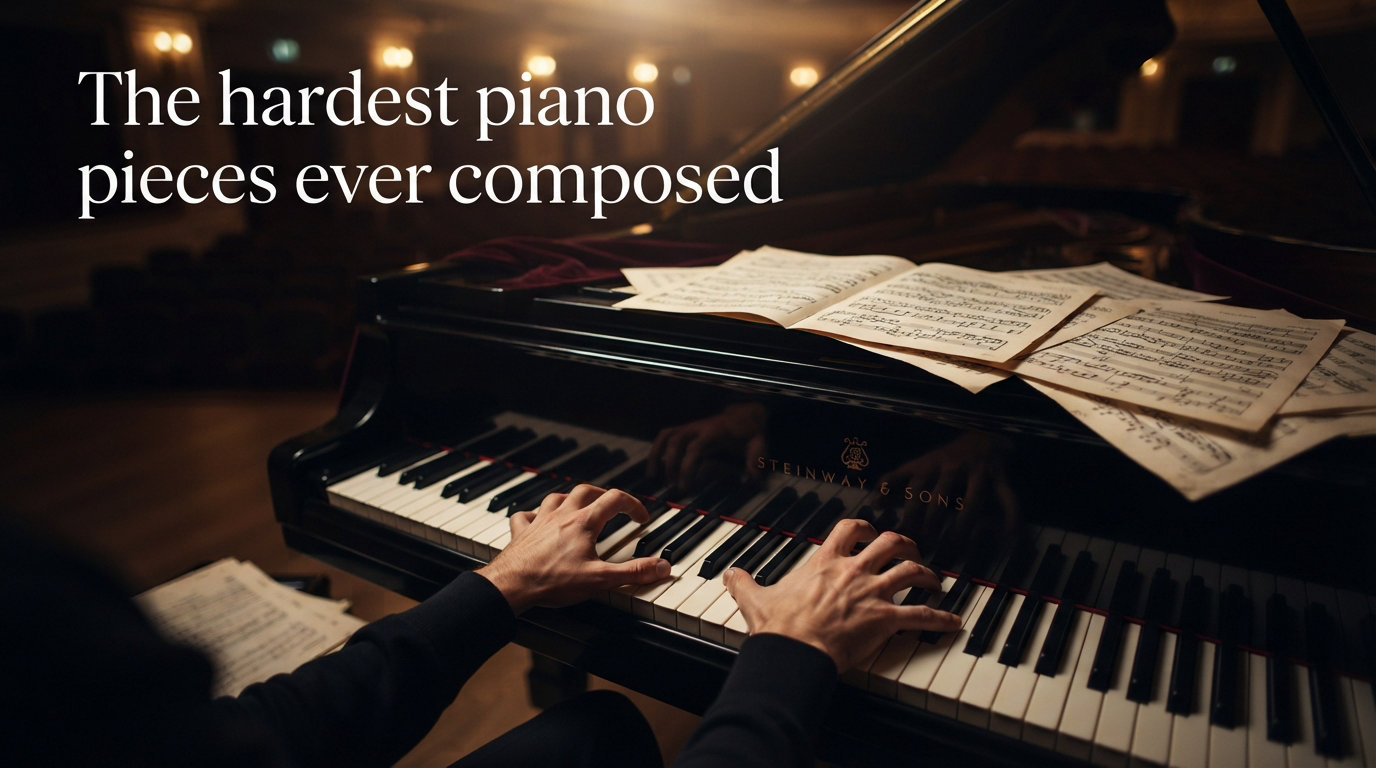
I have spent years sitting at pianos and listening to recordings of concert pianists, and I can tell you with confidence that some pieces will make even seasoned professionals tremble at the keyboard. When we talk about the hardest piano pieces ever composed, we are not talking about simple difficulty. We are talking about works that push the human hand past its perceived limits, that demand superhuman stamina, and that still inspire awe decades after they were first written.
This guide takes you through the ten most technically demanding piano works in the classical repertoire. I have ranked these based on the consensus of concert pianists, conservatory professors, and the technical elements each piece requires: rapid passagework, wide hand stretches, polyrhythms, octave tremolos, glissandi, and sheer endurance. Whether you are a curious listener or an aspiring virtuoso, by the end you will understand why these pieces earn their fearsome reputations.
Table of Contents
What Makes a Piano Piece Truly Difficult?
Before we count down the list, it helps to understand the specific technical elements that turn ordinary music into a near-impossible feat. Pianists measure difficulty by several recurring challenges.
Rapid passagework and speed. Pieces like La Campanella require finger speeds that approach the physical limits of human dexterity. Notes tumble by in clusters that must remain crisp and even.
Wide leaps and stretches. Works like Alkan’s Concerto for Solo Piano ask the hand to cross the entire keyboard in fractions of a second. These leaps strain the eye, the arm, and the spatial memory all at once.
Octave and chord work. Rachmaninoff and Ravel built entire movements around thunderous octave glissandi and massive chords. The strain on the forearm and shoulder can exhaust a player within minutes.
Polyrhythms and independence. Ligeti’s etudes and Stravinsky’s Petrouchka require each hand to operate in different rhythmic worlds simultaneously. This is less about speed and more about mental gymnastics.
Pure endurance. Sorabji’s Opus Clavicembalisticum runs nearly two hours without a break. Stamina becomes as important as technique.
Now, with those elements in mind, let us count down the hardest piano pieces ever composed.
1. Balakirev – Islamey (1869)
Mily Balakirev spent nearly six years polishing Islamey, and the result is widely considered the single most difficult piece in the Romantic solo piano repertoire. Nikolai Rimsky-Korsakov called it “the most difficult piece in the entire piano literature.” I have heard top conservatory students struggle through it for years before reaching performance standard.
The piece is built around a Lezghinka, a Caucasian folk dance, and it pairs that rhythmic drive with an almost inhuman level of octave work. The opening pages alone contain cascading octave runs that span the entire keyboard. Then come double-note passages, large leaps between registers, and rapid figurations that demand perfect evenness.
Famous performers include Hamish Milne, Sergei Lyapunov, and most famously the legendary Vladimir Horowitz. Even Horowitz, who could sight-read almost anything, treated Islamey as a showpiece rather than a casual encore.
2. Liszt – La Campanella (1851)
Franz Liszt composed La Campanella (“the little bell”) as one of his Grandes Etudes de Paganini, and it remains the piece most often cited when pianists argue about technical supremacy. The third movement of the Paganini set, it mimics the sound of a small bell through repeated single notes played at breakneck speed.
The technical demands are unforgiving. The right hand must skip across the keyboard in wide intervals while maintaining a delicate, bell-like tone. The left hand plays a syncopated accompaniment that requires perfect rhythmic independence. Add to this continuous single-note leaps across two octaves and you have a piece that breaks the technique of most advanced students.
Marc-André Hamelin, Evgeny Kissin, and Horacio Gutiérrez have all recorded definitive performances. La Campanella is often the first piece students point to when asked about the hardest piano pieces ever composed, and for good reason: it sounds simple but cannot be played carelessly for a single measure.
3. Stravinsky – Trois mouvements de Petrouchka (1921)
Igor Stravinsky originally wrote Petrouchka as a ballet, but when he sat down to transcribe three movements for solo piano in 1921, he turned the ballet into something pianistically ferocious. The result requires a percussive, almost brutal approach that shocked pianists when it premiered.
Each movement brings its own nightmare. The first (“Russian Dance”) demands rapid block chords that snap the hands across the keyboard. The second (“In Petrouchka’s Room”) uses cross-rhythms and disjunct melodies that fight against any sense of pulse. The third (“The Shrovetide Fair”) is a marathon of double notes, leaps, and rhythmic crosscurrents that build in intensity for nearly five straight minutes.
Few pianists have recorded all three movements. Martha Argerich, Yuja Wang, and Jean-Yves Thibaudet have given performances that capture the raw physical demand of the work.
4. Ravel – Gaspard de la Nuit (1908)
Maurice Ravel once wrote that he wanted Gaspard de la Nuit to be “more difficult than Islamey.” He succeeded. The suite contains three movements based on poems by Aloysius Bertrand, and each one presents a distinct technical and interpretive challenge.
“Ondine” depicts a water nymph through cascading arpeggios and delicate, rapidly shifting finger work. “Le Gibet” is a study in sustained concentration: a single repeated B-flat octave tolls through almost the entire movement while a modal chorale weaves around it. “Scarbo,” the final movement, is widely considered one of the most demanding pages in all piano literature. It requires cross-hand leaps, rapid figurations, jarring dynamic contrasts, and devilish stamina.
Arturo Benedetti Michelangeli recorded a legendary performance that has become the benchmark. Martha Argerich, Jean-Efflam Bavouzet, and Hélène Grimaud have also left important interpretations.
5. Rachmaninoff – Piano Concerto No. 3 in D minor (1909)
Sergei Rachmaninoff’s Third Piano Concerto is often called the “Mount Everest” of piano concertos, and for good reason. The finale in particular requires every technical tool the pianist has ever developed, then demands more.
The opening movement features massive chordal writing and rapid interlocking passages between the hands. The slow second movement requires extreme expressive control and dynamic shading across long phrases. But it is the finale that truly earns the concerto its place on any list of hardest piano pieces ever composed. Octave glissandi, double-note trills, rapid scale work, and a cadenza that seems to have been composed specifically to expose weakness all arrive within minutes of each other.
Rachmaninoff himself famously increased the difficulty by rewriting the cadenza for his American tours, and modern pianists often play that harder version. Van Cliburn’s 1958 Tchaikovsky Competition win was launched largely on his performance of this concerto. More recently, Yuja Wang and Denis Matsuev have given staggering accounts.
6. Beethoven – Hammerklavier Sonata (1818)
Ludwig van Beethoven’s Piano Sonata No. 29 in B-flat major, nicknamed the “Hammerklavier,” was so far ahead of its time that it was considered unplayable for decades after its publication. Even today, after more than two centuries, it remains one of the most demanding sonatas ever written.
The first movement requires rapid octave work and bold harmonic leaps. The scherzo is built around relentless repeated chords. The slow movement, the most famous “Adagio sostenuto” in the literature, demands emotional depth and sustained control. Then comes the fugue: a four-voice contrapuntal structure so dense and so demanding that Beethoven himself marked it “with loss of all patience.”
Sviatoslav Richter, Artur Schnabel, and Daniel Barenboim have given performances that reveal the work’s extraordinary spiritual range. The Hammerklavier is not flashy in the way other entries on this list are, but its intellectual and physical demands make it one of the hardest piano pieces ever composed.
7. Ligeti – Etudes for Piano (1985-2001)
György Ligeti’s three books of etudes (1985, 1988-94, 1995-2001) redefined what a piano etude could be. Each one explores a single technical or textural problem with the rigour of a scientist and the imagination of a poet.
Some etudes, like “Fanfares” and “The Sorcerer,” ask the pianist to play rapid, irregular rhythmic patterns that sound mechanical but require perfect human control. Others, like “Desordre” and “Automne à Varsovie,” use polyrhythms so dense that counting them out loud is itself a challenge. Still others, like “White on White,” demand entirely new techniques: tone clusters, forearm glissandi, and rapid repeated notes that test the limits of the mechanism itself.
Freddy Kempf, Pierre-Laurent Aimard, and Hélène Grimaud have championed these works. Ligeti himself stated that the etudes were among the most difficult pieces he ever wrote for piano, they remain benchmark tests at conservatories worldwide.
8. Alkan – Concerto for Solo Piano (1857)
Charles-Valentin Alkan was so reclusive that his contemporaries called him “the lightning that does not strike.” His Concerto for Solo Piano strips away the orchestra and leaves every pianistic challenge concentrated in a single performer.
The work opens with a set of massive octave glissandi that span nearly the entire keyboard in seconds. The first movement (Allegro) features double-note thirds, sixths, and octaves played at speeds that would terrify most virtuosos. The slow second movement (Adagio) requires sustained voicing across chordal passages of enormous emotional weight. The finale (Allegretto) builds to a coda of octave work that seems to go on forever.
Few pianists have tackled this piece in recital. Marc-André Hamelin, who has done more than anyone to revive Alkan’s reputation, recorded it. Ronald Smith and John Ogdon have also left significant interpretations.
9. Sorabji – Opus Clavicembalisticum (1929-30)
Kaikhosru Shapurji Sorabji’s Opus Clavicembalisticum is, by most measures, the most extreme work ever written for solo piano. It runs over four hours in performance. It contains more notes per page than almost any other piece in the repertoire. It requires the pianist to read up to six staves of music simultaneously.
When Sorabji completed the piece, he made arrangements with publishers to ensure that no pianist would perform it without his permission. He was afraid that inferior performances would damage his reputation. For decades, only he and a handful of trusted pianists touched the score.
The piece contains contrapuntal writing of staggering density, including a triple fugue. Pianists who have performed it, including Michael Habermann, Yvar Mikhashoff, and Jonathan Powell, describe it as the most physically and mentally exhausting experience in piano literature. It is unquestionably one of the hardest piano pieces ever composed, more for its sheer scope than any single technical device.
10. Prokofiev – Piano Concerto No. 2 in G minor (1913)
Sergei Prokofiev composed his Second Piano Concerto at the age of 22, and its outer movements demand more raw pianistic power than almost anything written before or since. The original version was so difficult that Prokofiev revised it in 1924 to give pianists a fighting chance.
The first movement opens with octave tremolos that continue unbroken for pages. It then moves through rapid octave glissandi, jarring modulations, and chordal passages that require the hand to span tenth intervals. The second movement is calmer but still requires extreme control of touch and texture. The finale returns to thunderous octave work and ends with a passage of double-note scales that must be played at nearly breakneck speed.
Prokofiev himself played the concerto with ferocious energy. Sviatoslav Richter, Martha Argerich, and Jean-Yves Thibaudet have all given performances that capture the work’s stormy brilliance.
How Pianists Train for These Demands
After surveying these ten works, you might wonder how anyone manages to learn them at all. The answer is a multi-year, sometimes multi-decade process of focused practice. Here are some of the strategies serious pianists use when approaching the hardest piano pieces ever composed.
Build fundamentals first. Etudes by Czerny, Hanon, and Brahms develop the finger strength and independence these works demand. Skipping this step is the most common mistake ambitious students make.
Use slow practice religiously. Every difficult passage should be learned at half tempo, then quarter tempo, before being brought up to speed. Practising mistakes at full tempo only cements them.
Break pieces into short sections. A thirty-second passage may take a week to master, and that is normal. Working in fragments prevents injury and frustration.
Cross-train with related works. Studying Liszt’s transcendental etudes prepares you for La Campanella. Studying Bach’s fugues prepares you for the Hammerklavier. The pieces on this list do not exist in isolation.
Protect your body. Pianists who tackle these works spend serious time on stretching, posture, and injury prevention. Tendinitis is a real risk and can end careers.
Accept that some pieces take a lifetime. Many of the pianists who have recorded these works began studying them as teenagers and only felt ready to perform them in their thirties or forties. Patience is part of the journey.
Frequently Asked Questions
What is the number 1 hardest piano piece?
Most pianists and musicologists rank Balakirev’s Islamey as the single hardest piece in the standard solo piano repertoire. Its combination of octave work, wide leaps, double-note passagework, and sheer stamina places it above even Liszt’s La Campanella and Ravel’s Scarbo.
What is the most terrifying piano piece?
Ravel’s Scarbo, the final movement of Gaspard de la Nuit, is often called the most terrifying piano piece ever written. Its cross-hand leaps, rapid figurations, and relentless rhythmic drive have haunted pianists since 1908.
Is La Campanella the hardest piano piece?
La Campanella is one of the hardest pieces ever composed, but most experts rank it below Islamey and Scarbo. It demands extreme finger speed and wide leaps but lacks the octave work and endurance required by the very top entries on lists of the hardest piano pieces ever composed.
What is the most impressive piano piece to listen to?
Rachmaninoff’s Piano Concerto No. 3 and Ravel’s Gaspard de la Nuit are widely considered the most impressive piano pieces for audiences. Both combine massive technical demands with overwhelming emotional weight, which is why they appear so often on concert programs.
Final Thoughts
The hardest piano pieces ever composed are more than tests of skill. They are arguments between composers and performers, statements about what the human hand can do, and invitations to listeners to experience music at its most extreme. Whether you choose to study them, perform them, or simply enjoy recordings, these ten works represent the highest peaks the piano repertoire has to offer.