
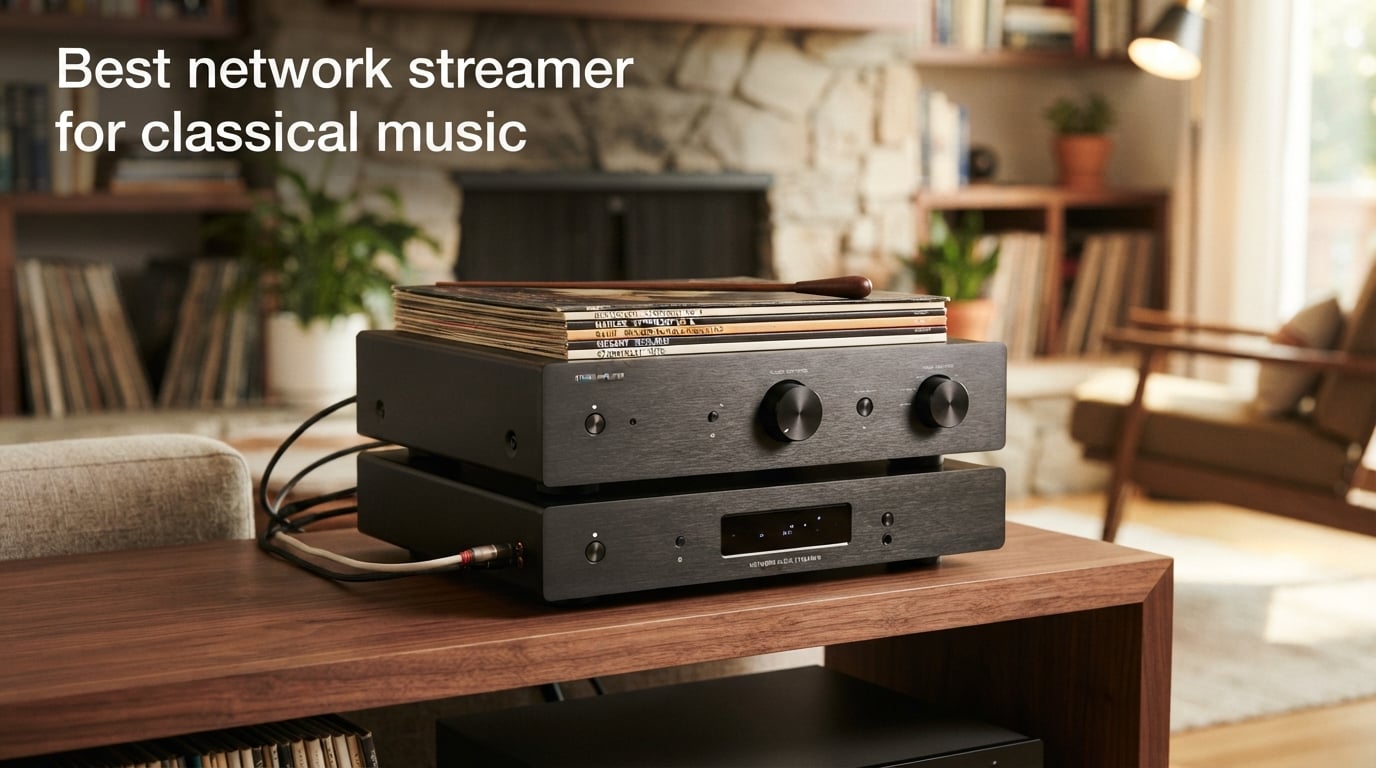
Finding the best network streamer for classical music changes everything about how a Mahler symphony or a Bach cello suite sounds in your living room. I learned this the hard way after years of blaming my speakers for thin string tone and muddy low brass, only to discover the real problem was the little box feeding the signal.
Classical recordings are unforgiving. They carry huge dynamic swings, layer dozens of instruments at once, and rely on subtle acoustic cues — the bloom of a concert hall, the bite of a bow change — that get stripped away by a weak digital-to-analog converter or a streaming service that butchers the metadata.
A phone plugged into a receiver simply cannot do this repertoire justice.
In this guide, our team walks through what actually matters when you stream classical at home: which DAC architectures sound best with orchestral music, why composer and work metadata makes or breaks the listening experience, and how the right combination of hardware and streaming service can give you a seat in the virtual concert hall.
We have spent months comparing streamers from Cambridge Audio, Bluesound, WiiM, Eversolo, NAD, and Denon, and tested every major classical-focused streaming service on the market.
By the end, you will know exactly how to pick the best network streamer for classical music for your budget, your speakers, and your favorite repertoire — without overspending on features you will never use.
Table of Contents
What Is a Network Streamer?
A network streamer is a dedicated device that pulls digital music from the internet or your local network and converts it into an analog signal your amplifier and speakers can play. Think of it as the modern replacement for a CD player, except your library is now effectively infinite and the source quality can be far higher than any disc ever offered.
Inside, every streamer has two main parts working together. First, the network side fetches audio using protocols like Spotify Connect, Tidal Connect, Qobuz Connect, AirPlay 2, Chromecast, or Roon Ready.
Second, the digital-to-analog converter (DAC) translates that stream into the electrical signal sent to your amp. The quality of both stages determines what you actually hear.
The reason a dedicated streamer beats streaming from a phone or laptop comes down to electrical isolation and clock precision. Phones are full of noisy components — cellular radios, bright screens, vibrating motors — all of which leak interference into the audio path.
A purpose-built network streamer keeps the digital audio circuit clean, with its own power supply, its own clock, and a DAC designed for one job.
For classical music, this matters more than for any other genre. Orchestral recordings routinely cover a dynamic range of 60 decibels or more, from a single pizzicato violin to a full tutti brass section.
If the streamer introduces noise into the quietest passages, you hear hiss instead of silence. If the clock is unstable, sustained piano chords shimmer unnaturally. The streamer is where the recording either survives intact or gets quietly damaged.
Why Classical Music Demands a Different Approach
General-purpose streaming was built around three-minute pop songs. Classical music was not, and that mismatch causes most of the frustration classical listeners run into online.
The first problem is metadata. A pop track has one artist and one title; a classical recording has a composer, a work, a catalogue number, a movement, a key, an ensemble, a conductor, a soloist, and a recording date.
On Spotify or YouTube Music, this information gets crammed into a single “artist” field, with movements of the same sonata scattered as separate tracks with no clear grouping. Navigating a Beethoven symphony cycle becomes a chore.
The second problem is dynamic range. Streaming services that apply loudness normalization can crush the soft-to-loud contrasts that define classical interpretation.
A conductor’s carefully shaped crescendo gets flattened, and a delicate pianissimo gets boosted to compete with everything else in your queue. Classical-specific platforms avoid this or give you the option to disable it.
The third problem is gapless playback. Symphonies, concertos, and song cycles are single works split across multiple tracks. If your streamer inserts even a quarter-second of silence between movements, the dramatic flow is broken.
Gapless support is not universal — verify it before you buy.
Key Features to Look for in a Network Streamer for Classical Music
The best network streamer for classical music nails five things that other genres can more easily forgive. Here is what to scrutinize when you compare models.
1. DAC Quality and Architecture
The DAC is the heart of any streamer, and for classical it determines how cleanly the most demanding recordings are rendered. Look for premium DAC chips from ESS Technology (the Sabre range, such as the ES9039PRO) or AKM (the Velvet Sound line, such as the AK4499EX).
Both deliver the low noise floor and fine detail retrieval that orchestral music needs.
Pay attention to bit depth and sample rate support. A streamer rated for 32-bit / 384kHz PCM and DSD256 covers every lossless format any classical streaming service currently offers, with room to spare.
Avoid anything that tops out at 24-bit / 96kHz if you ever plan to explore hi-res Qobuz or local FLAC rips.
The circuit around the chip matters just as much as the chip itself. Premium streamers like the Cambridge Audio EXN100 pair their DAC with a dedicated power supply, balanced output stages, and careful PCB layout to keep noise out of the signal path.
Budget streamers often use the same chip but cut corners elsewhere, which is why two boxes with the same DAC can sound noticeably different.
2. Lossless and Hi-Res Format Support
Lossless audio is non-negotiable for classical listening. At minimum, your streamer should decode FLAC, ALAC, and uncompressed WAV with zero quality loss.
Hi-res support up to at least 24-bit / 192kHz lets you tap into the highest-quality streams from Qobuz and the best local rips.
DSD support is a bonus rather than a deal-breaker for streaming, since most services deliver PCM. But if you have a SACD collection ripped to DSF files, a streamer that handles DSD64 and DSD128 natively is worth seeking out.
MQA used to matter for Tidal HiFi Plus subscribers, but with Tidal moving away from MQA toward FLAC hi-res in 2026, I would not weight it heavily. Bit-perfect playback — where the streamer passes the digital signal to the DAC untouched — is far more important than any single format on a spec sheet.
3. Streaming Protocol Support
The protocols your streamer supports decide which services you can use natively. The more, the better, because native streaming almost always sounds cleaner than Bluetooth re-streaming.
For classical, the must-haves are Spotify Connect, Tidal Connect, Qobuz built in, and AirPlay 2. Roon Ready certification is a major plus if you want to build a serious music server around a large classical library, since Roon is widely regarded as the smartest platform for handling composer and work metadata correctly.
Chromecast built in is useful for catching services that lack a dedicated Connect protocol. Tidal Connect plus Qobuz Connect give you bit-perfect paths from the two services classical audiophiles care about most.
The WiiM Pro Plus and Bluesound Node range cover most of these at accessible prices.
4. App Quality and Composer Navigation
The control app is what you will touch every single day, and a clumsy app can ruin an otherwise excellent streamer. For classical listeners, the app needs to handle three things the genre throws at it: long work titles, multi-movement groupings, and deep composer hierarchies.
BluOS (used by Bluesound and NAD) is the gold standard for app polish and multi-room control. Cambridge Audio’s StreamMagic app has improved steadily and handles Roon-style metadata cleanly.
Eversolo’s app on the DMP-A6 and DMP-A8 is excellent for browsing by composer and work. WiiM’s app is the simplest of the bunch, which some listeners love and others find limiting.
Test the app before committing. Look for whether it shows movement titles, whether gapless playback works in practice, and whether you can browse by composer rather than only by artist.
These details separate a streamer built for classical from one built for playlists.
5. Multi-Room and Integration Features
If you want Mahler in the study and Mozart in the kitchen, multi-room support is what makes it happen without running extra cables. BluOS is the strongest multi-room platform, letting you group Bluesound, NAD, and other BluOS devices with sample-accurate sync across rooms.
Roon Ready streamers can also form multi-zone systems with Roon handling the routing. AirPlay 2 gives you basic multi-room with Apple devices, useful if you already have HomePods in the mix.
HDMI eARC is worth having if the streamer sits near a TV, since it lets the same box handle movie soundtracks without a separate input.
Room correction, offered by some Cambridge Audio, NAD, and WiiM models (often through Dirac Live), is a quiet win for classical. It tames bass boom and smoothes out midrange colorations so the timbres of acoustic instruments land more honestly.
Not essential, but a noticeable upgrade if your listening room is acoustically tricky.
Best Classical Music Streaming Services in 2026
The best network streamer for classical music is only as good as what you feed it. The streaming service you choose shapes everything from sound quality to how easily you can find the Karajan Beethoven cycle versus the Kleiber one.
Here is how the major options stack up for classical listeners in 2026.
Idagio
Idagio is built from the ground up for classical music, and it shows. The interface lets you search by composer, work, conductor, soloist, ensemble, period, and instrument — exactly how classical fans actually think about repertoire.
It handles multi-movement works gracefully, groups complete cycles together, and presents recording comparisons clearly.
Audio quality reaches CD-resolution lossless FLAC on the premium tier, which is excellent but not the very highest available. For metadata handling and discovery, Idagio is the platform the classical world has wanted for years.
Reddit users consistently call it out alongside Presto Music as the best purpose-built option.
Qobuz
Qobuz is the audiophile’s choice, and the streaming service our community most often recommends for pure sound quality. Hi-res FLAC streams up to 24-bit / 192kHz are available on a huge classical catalogue, and the Qobuz Connect protocol built into modern streamers delivers bit-perfect playback without compromise.
The metadata is solid rather than best-in-class, and you do not get the same composer-first navigation as Idagio or Presto. But pairing Qobuz with Roon fixes that completely.
Roon organises the Qobuz catalogue (and your local files) by composer and work, with rich editorial data. The Roon-plus-Qobuz combination is what serious classical audiophiles on Reddit repeatedly call the sweet spot.
Apple Music Classical
Apple Music Classical is the most accessible high-quality option, included at no extra cost with any Apple Music subscription. The dedicated classical app offers lossless and hi-res ALAC up to 24-bit / 192kHz, has invested heavily in proper composer and work metadata, and works seamlessly across iPhone, iPad, and Apple TV.
The catch is hardware compatibility outside the Apple ecosystem. AirPlay 2 will get the signal to most streamers, but the cleanest path is to an Apple TV or an AirPlay 2-certified device.
Still, for listeners who already live in Apple’s world, Apple Music Classical is hard to beat on value.
Presto Music
Presto Music launched its streaming service after years as a leading classical retailer, and the result is one of the most thoughtfully designed classical platforms available. Composer and work navigation is excellent, complete recordings are grouped sensibly, and the editorial coverage is genuinely useful for discovery.
Audio quality is CD-resolution lossless FLAC. Presto does not yet match Qobuz on hi-res, but for many classical listeners the superior interface and curated catalogue more than compensate.
The classical community on Reddit and Talk Classical frequently ranks Presto alongside Idagio as the best experience-first option.
Tidal
Tidal in 2026 is in transition. The service is moving from MQA-based hi-res to FLAC-based hi-res, which is broadly good news for classical listeners since FLAC is more universally supported and bit-perfect friendly.
Max settings on Tidal deliver strong sound quality through Tidal Connect on compatible streamers.
The classical catalogue is large but the metadata is generalist. Movements are sometimes grouped awkwardly, and browsing by composer is not as fluid as on the dedicated classical platforms.
For listeners who want one service for everything — classical, jazz, rock — Tidal is workable. For classical-first listeners, it is a step below Idagio, Presto, and Qobuz for usability.
How to Choose the Best Network Streamer for Classical Music
Choosing the best network streamer for classical music comes down to three questions: what is your budget, what services do you already pay for, and how serious is your system on either side of it? Work through these and the field narrows quickly.
Step 1: Set Your Budget Tier
Under roughly $250, the WiiM Pro Plus is the standout choice. It offers a genuinely good AKM DAC, a clean app, and broad protocol support that covers Spotify Connect, Tidal Connect, Qobuz, AirPlay 2, and Chromecast.
For a first serious streamer feeding a modest amp and speakers, it punches well above its price.
In the $500 to $1,500 midrange, the Bluesound Node family (Node X, Node Icon) and Cambridge Audio streamers are the heart of the market. You get BluOS or StreamMagic, stronger DAC stages, balanced outputs on some models, and the kind of build quality that lasts a decade.
Above $1,500, you move into Eversolo DMP-A6 and DMP-A8 territory, the Cambridge Audio EXN100, NAD’s higher-end streamers, and dedicated separates like a streamer paired with an external DAC.
The gains are real but diminishing — most listeners will hear more improvement spending the same money on speakers or room treatment.
Step 2: Match the Streamer to Your Services
Make a list of every service you actually use. If Qobuz is your classical home, prioritise Qobuz Connect or Roon Ready.
If Apple Music Classical is your main library, an AirPlay 2-certified streamer or an Apple TV is the cleanest path. If you run Roon, Roon Ready certification is the single most important feature — without it, you are streaming through AirPlay or a workaround that costs you quality.
Do not buy a streamer that locks you out of your preferred service. Cross-reference the manufacturer’s supported services list before pulling the trigger.
Remember that protocol-level integration (Tidal Connect, Qobuz Connect, Roon Ready) always beats generic UPnP or Bluetooth.
Step 3: Match the Streamer to Your System
A streamer should sit at the same level of quality as your amplifier and speakers. Pairing a $3,000 Eversolo DMP-A8 with entry-level bookshelf speakers will reveal nothing the speakers can reproduce, while pairing a $150 streamer with a $10,000 power amp will leave obvious quality on the table.
Look at the outputs. Balanced XLR outputs matter if your amplifier has balanced inputs and you want maximum noise rejection over long cable runs.
Single-ended RCA is fine for most home setups. A dedicated headphone output is a plus if you listen late at night without waking the household.
Step 4: Future-Proof Sensibly
A good streamer should last five to ten years. To future-proof without overspending, prioritise: a capable DAC with 32-bit / 384kHz PCM and DSD support, Roon Readiness (even if you do not use Roon today), and a manufacturer with a track record of firmware updates.
Bluesound, Cambridge Audio, and WiiM all have strong histories of supporting older hardware with new features.
Do not over-index on features you cannot use. Room correction only matters if your room needs it. Multi-room only matters if you have (or plan to have) a second zone. HDMI eARC only matters if the streamer lives near a TV.
Buy the features your listening life actually calls for.
Setting Up Your Classical Streaming System
A few setup choices make a bigger difference than any single component upgrade. Get these right and even a modest streamer will sing.
Use wired Ethernet whenever possible. Wi-Fi is convenient, but a wired connection eliminates dropouts, reduces jitter at the network interface, and gives streaming services the stable bandwidth needed for hi-res FLAC.
A $15 Cat 6 cable often outperforms a $200 Wi-Fi upgrade.
If you build a local library of hi-res classical rips, consider a small music server or network-attached storage running Roon Core, Plexamp, or a UPnP server. A local server gives you instant access to your complete recordings and supports bit-perfect playback to any Roon Ready or UPnP streamer.
Finally, disable loudness normalisation on any service that offers the option. For classical music, normalisation flattens dynamic range and undermines the expressive contrasts that make a great performance great.
The quieter passages should be quiet — that is the point.
Frequently Asked Questions
What streamer has the best DAC?
For classical music, streamers built around ESS Sabre (ES9039PRO) or AKM Velvet Sound (AK4499EX) DAC chips deliver the low noise floor and fine detail retrieval that orchestral recordings demand. The Cambridge Audio EXN100, Eversolo DMP-A8, and high-end NAD models are widely regarded as having the best DAC stages available in network streamers, with the WiiM Pro Plus offering excellent AKM-based performance at a fraction of the cost.
What is the best music streaming platform for audiophiles?
For audiophile classical listening, Qobuz is the most recommended service thanks to its hi-res FLAC catalogue up to 24-bit / 192kHz and bit-perfect Qobuz Connect integration. Pairing Qobuz with Roon adds the composer-aware metadata handling serious classical listeners want. Idagio and Presto Music offer superior classical-specific interfaces at CD-resolution, while Apple Music Classical delivers hi-res lossless included with a standard Apple Music subscription.
Where can I stream classical music?
You can stream classical music on dedicated classical platforms like Idagio, Presto Music, and Apple Music Classical, as well as general audiophile services like Qobuz and Tidal. Free options include BBC Radio 3’s online stream, YouTube’s classical channels, and the free tiers of Spotify and Apple Music, though metadata handling and audio quality are noticeably weaker on the generalist free options.
Is Tidal any good for classical music?
Tidal offers a large classical catalogue and good sound quality through Tidal Connect, and its shift in 2026 from MQA to FLAC hi-res makes it more bit-perfect friendly for classical listeners. However, its composer and work metadata is generalist, multi-movement works are sometimes grouped awkwardly, and browsing by composer is less fluid than on Idagio, Presto Music, or Apple Music Classical. It works well as an all-genre service but is a step below dedicated classical platforms for usability.
Conclusion
The best network streamer for classical music is the one that pairs a quiet, capable DAC with the streaming services you actually use and an app that respects how classical listeners browse — by composer, by work, by movement. Get the DAC right, the protocols right, and the metadata right, and the music does the rest.
Start from your budget tier and your preferred service, match the streamer to the rest of your system, and prioritise wired Ethernet and gapless playback. Do that and you will hear more of what the conductor, the engineers, and the performers put into the recording than you ever have before.