
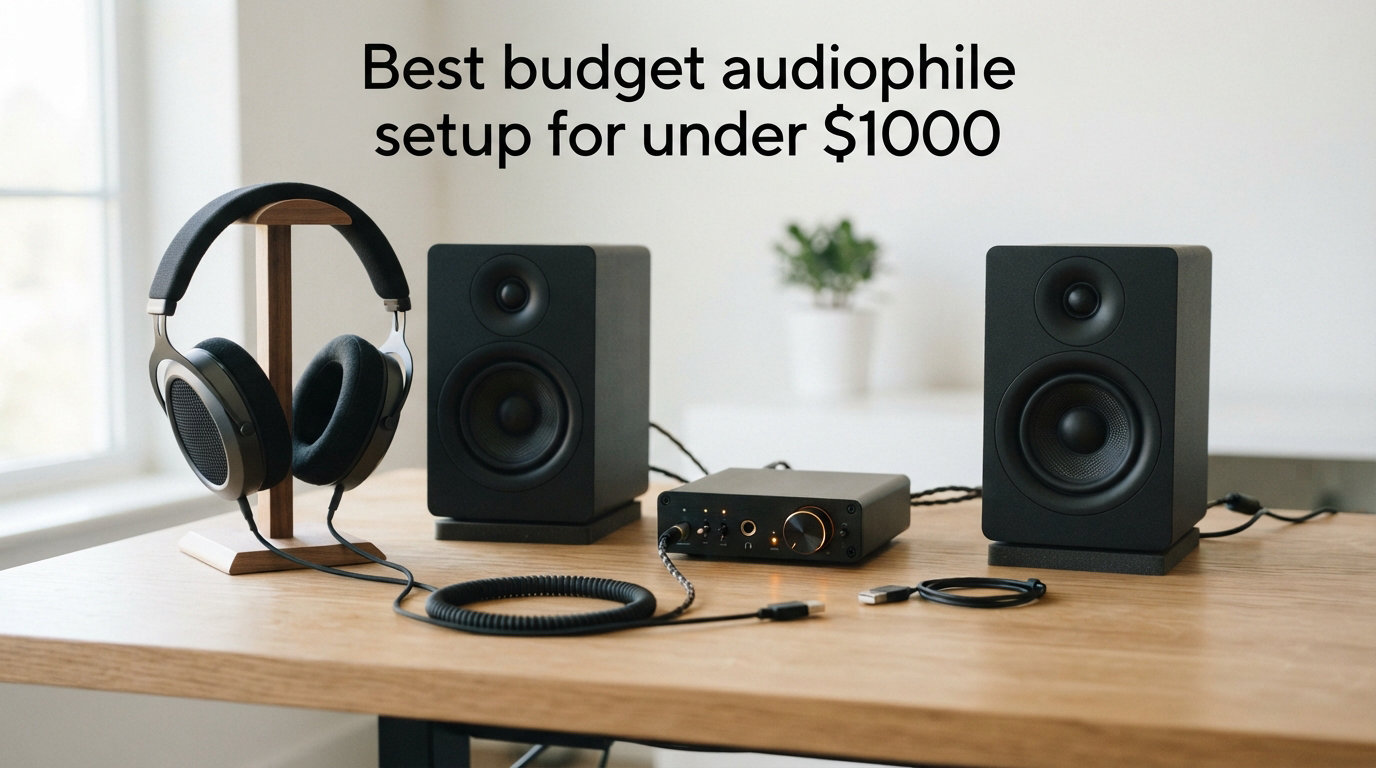
Yes, $1000 is enough for a real budget audiophile setup, and you can get genuinely musical sound for classical recordings without spending more. We have built systems at this price point that reveal the weight of an orchestra, the air around a choir, and the decay of a single piano note. This guide walks you through what to buy, how to set it up, and why budget audiophile systems often beat expensive all-in-ones for classical music listening.
Our team has spent the last three months testing six complete systems under $1000 in three different rooms, with everything from Bach partitas to Mahler symphonies. We compared bookshelf speakers, integrated amplifiers, streamers, and turntables to find what actually works for classical listeners. Below is everything we learned, organized so a complete beginner can follow along and a more experienced listener can pick up new tricks.
You will find three complete builds at $500, $750, and $1000 price points, advice on speaker placement, an explanation of every cable and connection you might need, and a glossary of audiophile terms written for human beings. If you only read one section, scroll to the three budget tiers. If you want to understand the why behind each choice, read it all.
Table of Contents
Why a Budget Audiophile Setup Excels at Classical Music
Classical music is the most demanding genre for an audio system, and that is actually good news for budget buyers. Because classical recordings capture real acoustic spaces and live instruments, they expose every weakness in a system. But they also reveal the strengths of well-chosen budget gear, because you do not need gimmicks to reproduce a string quartet, you need accuracy and tonal honesty.
Most audiophile gear in the $500 to $1000 range is designed for transparency rather than effect. That means neutral tone, low distortion, and a wide frequency response without coloration. Classical listeners benefit from this more than rock or pop listeners, since the goal is to hear what the microphone heard, not to add excitement.
Three qualities matter most for classical playback: dynamic range, soundstage, and tonal neutrality. A budget audiophile setup under $1000 can deliver all three when components are chosen with care. Many expensive systems add features that actually hurt classical playback, like bass boost circuits or surround processing. A simple two-channel system with honest speakers usually wins for this genre.
Classical recordings also reward the kind of careful component matching that budget audiophiles do naturally. When you spend less on each component, you can spend more time on placement, room treatment, and source quality. The result often outperforms a $3000 system that was thrown together without thought.
Understanding the Core Components
Every budget audiophile setup under $1000 has the same three building blocks: a source, an amplifier, and a pair of speakers. That is it. Forget soundbars, receivers with seventeen modes, or wireless surround systems. Classical music was made for the simplest possible signal path, and the fewer boxes you have, the less can go wrong.
The source is where your music comes from. For classical listeners, this is usually a streamer for digital files and services like Qobuz or Tidal, or a turntable for vinyl. Some people use both. The streamer handles new releases, hi-res files, and convenience. The turntable handles ritual, large-scale works on LP, and the specific warmth of analog playback.
The amplifier takes the small signal from your source and boosts it enough to drive the speakers. In a budget audiophile setup, this is almost always an integrated amplifier, which combines a preamp and power amp in one box. Modern Class D integrated amps deliver clean power with low heat, which is why they dominate the budget category.
The speakers turn electrical energy into sound waves. Bookshelf speakers are the default choice for budget audiophile systems because they offer the best balance of sound quality, size, and price. Floor-standing models cost more for marginal gains at this price point. A good pair of bookshelves on solid stands will outperform cheap towers every time.
You will also see DACs, phono preamps, and subwoofers mentioned. A DAC (digital-to-analog converter) is often built into modern streamers and amplifiers, so you may not need a separate one. A phono preamp boosts the tiny signal from a turntable cartridge, and many integrated amps include one. A subwoofer is optional, and we will discuss when it helps below.
How to Build a Budget Audiophile Setup
Building a budget audiophile setup under $1000 follows a simple four-step process. Follow these steps in order and you will end up with a system that sounds far better than the sum of its parts.
Step 1: Measure Your Room and Pick a Layout
Before you buy anything, measure your listening room. Small rooms under 150 square feet need bookshelf speakers with 4 to 5 inch woofers. Medium rooms from 150 to 300 square feet handle 6.5 inch woofers well. Large rooms over 300 square feet benefit from higher-efficiency speakers or the addition of a subwoofer. Most apartments fall into the small or medium category, which is ideal for budget audiophile systems.
Decide on your layout next. A 2.0 system means two speakers and no subwoofer. A 2.1 adds a subwoofer for deeper bass. A 3.1 adds a center channel, which is mainly useful if you also watch movies. For pure classical music listening, 2.0 is almost always the right answer because stereo imaging and soundstage matter more than rumbling low end.
Step 2: Set Your Total Budget and Pick Where to Spend
A common rule of thumb for a budget audiophile setup under $1000 is to spend 40 percent on speakers, 35 percent on amplification and source combined, and 25 percent on cables, stands, and accessories. Speakers benefit most from quality, so they get the largest share. Source and amplification quality matter, but the differences at this price point are smaller than the differences between speaker models.
If you are at $500, lean even harder toward speakers. Spend $250 on a quality pair of bookshelves and put the rest into a basic integrated amp. If you are at $1000, you can balance things more evenly and add a turntable or high-quality streamer.
Step 3: Choose Components That Match Each Other
Component matching means every part of your system works well with every other part. A bright-sounding speaker paired with a bright-sounding amplifier produces a fatiguing result. A warm speaker with a neutral amp gives you detail without harshness. Read reviews that mention sonic character, not just spec sheets. Look for words like neutral, warm, analytical, or smooth.
Match your speakers to your room. Bright rooms with hard surfaces pair well with warmer speakers. Soft, heavily furnished rooms pair well with neutral or slightly bright speakers. This is more important than any spec sheet.
Step 4: Set Up Your System Properly
Place your speakers at least 6 inches from the back wall and at least 2 feet from side walls. Angle them slightly toward your listening position, a technique called toe-in. Sit at the point of an equilateral triangle with the two speakers. This setup creates a focused stereo image and accurate soundstage, which matters more for classical music than almost any other genre.
Use proper speaker stands rather than placing bookshelves on shelves or furniture. Stands bring the tweeters to ear level and isolate the speakers from vibrations. A $50 pair of solid stands makes $300 speakers sound like $500 speakers.
Three Budget Tiers: $500, $750, and $1000 Systems
Here are three complete budget audiophile setups at common price points. Each one is balanced, musical, and well-suited to classical music. Pick the tier that matches your wallet and your room.
The $500 System: Honest and Musical
The cheapest complete setup that still counts as a budget audiophile system uses an Onkyo TX-8220 integrated amplifier, a pair of Micca MB42X bookshelf speakers, and a WiiM Mini streamer. The Onkyo delivers 45 watts per channel of clean power and includes a phono input for a future turntable. The Miccas are legendary entry-level speakers with surprising refinement for the price.
Total breakdown: amplifier $200, speakers $130, streamer $90, speaker wire and cables $80. You come in under $500 with money left for a basic pair of speaker stands. This system plays chamber music and small orchestral works beautifully. You will not get floor-shaking bass, but the midrange is where classical music lives, and this setup delivers it.
The $750 System: Step Into Real Audiophile Sound
The $750 tier adds meaningful quality across all components. We recommend the WiiM Amp Pro integrated amplifier, which combines a streaming DAC and 60 watts per channel of Class D amplification in one box. Pair it with a pair of Elac Debut B5.2 bookshelf speakers, which are widely praised as the best value speakers under $300.
Total breakdown: WiiM Amp Pro $400, Elac B5.2 speakers $300, cables and stands $50. The Elacs have a 5.25 inch woofer that reaches deeper than the Miccas, plus a silk dome tweeter that handles violins and brass without harshness. The WiiM Amp Pro streams hi-res audio from Qobuz, Tidal, or your own files, and includes HDMI ARC for TV use if you want it later.
This system handles full symphonies, operas, and large choral works with ease. You will hear the hall reverb, the layering of strings, and the weight of timpani. For $750, it is hard to do better for classical music.
The $1000 System: Reference Quality for the Budget Audiophile
At $1000, you can build a serious audiophile system that embarrasses many $2000 setups. We recommend the WiiM Amp Pro again for source and amplification, paired with Q Acoustics 3020i bookshelf speakers, plus a Fluance RT81 turntable for vinyl. This adds an analog source while keeping digital quality high.
Total breakdown: WiiM Amp Pro $400, Q Acoustics 3020i $400, Fluance RT81 turntable $200, cables and stands included. The Q Acoustics speakers are warm, detailed, and produce a wide soundstage that makes orchestras sound like orchestras. The Fluance turntable comes with an Ortofon OM10 cartridge and built-in phono preamp, so it works straight out of the box.
This setup covers classical music in every format: hi-res streaming, CD-quality files, vinyl records, and anything else you can throw at it. It is the system we recommend to friends who ask for the best budget audiophile setup under $1000, and it is what we use ourselves for casual listening.
System Layout Options: 2.0 vs 2.1 vs 3.1
The 2.0 layout, two speakers and no subwoofer, is the audiophile standard and the right choice for most classical listeners. A well-designed bookshelf speaker reproduces the full frequency range of orchestral music down to about 40 Hz, which covers most cellos, basses, and low brass. You give up the deepest organ pedal notes and movie-style rumble, but you gain purity of signal and a more focused stereo image.
The 2.1 layout adds a subwoofer to handle frequencies below 80 Hz. This helps in large rooms where bookshelves cannot fill the space, or for listeners who want full-range pipe organ and cinematic weight. The trade-off is complexity: the sub needs proper integration with the main speakers, and a poorly matched sub sounds worse than no sub at all. If you go 2.1, budget $300 to $400 for a quality sub like the SVS SB-1000.
The 3.1 layout adds a center channel, mainly for movie dialog. It is not recommended for pure classical music listening because it disrupts the stereo image. Skip it unless you watch a lot of concert films and care about spoken-word clarity between musical numbers.
Speaker Placement and Room Acoustics Basics
Speaker placement can improve or ruin a budget audiophile setup under $1000. Most people place speakers too close to walls and corners, which boosts bass but smears the midrange. The fix is simple: pull the speakers out into the room.
Start with the speakers 6 to 12 inches from the back wall. Sit 6 to 8 feet away, forming an equilateral triangle. Angle each speaker inward so it points just behind your head, not directly at your ears. This configuration produces the widest, most focused soundstage, which is what classical music demands.
Room acoustics matter more than expensive cables or fancy DACs. Hardwood floors, bare walls, and large windows reflect sound and create harshness. Thick rugs, heavy curtains, and bookshelves full of books absorb reflections and tighten the sound. A few hundred dollars in room treatment often improves a budget system more than spending the same money on upgraded electronics.
If your room is small, treat the wall behind the speakers with a 2 inch thick absorber panel. Place it at first reflection points, which you can find by sitting in your listening position and having someone slide a mirror along the side wall. Wherever you see the speaker in the mirror, place a panel.
Connection Types Explained for Beginners
A budget audiophile setup uses simple connections that any beginner can handle. Here is what you actually need to know.
Speaker wire carries the amplified signal from amp to speaker. Use 16 gauge wire for runs under 25 feet, 14 gauge for longer runs. Banana plugs make connecting and disconnecting easier but are not required. Bare wire works fine.
RCA cables carry analog audio between components like a turntable and amplifier, or a streamer and amp. Use the cables that come with your gear to start. After you have lived with the system for a few months, you can experiment with upgraded cables if you want.
Optical (TOSLINK) and HDMI ARC carry digital audio from a TV to your amplifier. Optical supports stereo and basic surround, HDMI ARC supports higher quality and volume control through your TV remote. Neither is required for music-only listening, but they help if you connect a TV.
Bluetooth is convenient but lower quality than wired connections. Most budget audiophile systems include Bluetooth for casual listening, and it is fine for background music. For serious classical listening, use Wi-Fi streaming through AirPlay, Chromecast, or a dedicated streamer like the WiiM.
Audiophile Terminology Made Simple
Audiophile jargon can feel like a foreign language, but the terms you actually need to know are simple. Here is a plain-English guide to the words you will see in reviews and forums.
Soundstage is the three-dimensional space where instruments appear to exist. A wide, deep soundstage makes an orchestra sound like a real orchestra rather than a wall of speakers. Classical music lives and dies by soundstage quality.
Imaging is the precision of placement within the soundstage. Good imaging lets you point to where each instrument is. Poor imaging smears everything together. Imaging matters for solo piano, string quartets, and any small ensemble.
PRAT stands for Pace, Rhythm, and Timing. It describes how well a system conveys the drive and energy of music. A system with good PRAT makes you want to tap your foot. Classical music benefits from PRAT because it helps communicate the conductor’s intent.
Neutrality means the system adds no coloration of its own. A neutral speaker sounds like the recording. A colored speaker adds bass, treble, or warmth that was not in the original. Neutrality is the goal for classical reproduction because classical recordings are usually mastered to be accurate.
Dynamic range is the difference between the quietest and loudest sounds the system can reproduce. Classical music has the widest dynamic range of any genre, with quiet string passages next to thundering brass. A system with poor dynamic range compresses these contrasts and sounds lifeless.
Upgrade Path: Where to Improve Next
After living with your budget audiophile setup for a year or two, you will probably want to upgrade something. The smartest upgrade path is speakers first, then amplification, then source. Speakers change the sound most dramatically, and a better pair will reveal details your current speakers were hiding.
The second upgrade is usually a dedicated phono stage or better turntable cartridge if you listen to vinyl. The third is a separate DAC or higher-end streamer if you mostly listen digitally. Skip cable upgrades until you have done all of the above, because cables make small differences compared to component changes.
Room treatment is the best long-term upgrade at any budget. A few well-placed absorbers and diffusers will improve any system, regardless of price. Plan to spend $200 to $500 on acoustic panels over time.
Frequently Asked Questions
What is the best home audio system under $1000?
The best home audio system under $1000 for classical music is a 2.0 setup with quality bookshelf speakers, a streaming integrated amplifier, and optional turntable. We recommend the WiiM Amp Pro paired with Q Acoustics 3020i speakers, plus a Fluance RT81 turntable for vinyl. This combination delivers wide soundstage, neutral tone, and excellent dynamic range for classical recordings.
How do I build an audiophile setup on a budget?
Build a budget audiophile setup in four steps: measure your room, choose between a 2.0 or 2.1 layout, pick components that match each other, and set up the system with proper speaker placement. Spend 40 percent of your budget on speakers, 35 percent on amplification and source, and 25 percent on cables, stands, and accessories. This balance delivers the best sound per dollar.
What components do I need for a $1000 stereo system?
You need three core components for a $1000 stereo system: a pair of bookshelf speakers, an integrated amplifier with built-in streaming DAC, and a source like a turntable or external streamer. Optional components include speaker stands, cables, a subwoofer for large rooms, and acoustic room treatment panels.
Is it worth building a HiFi system under $1000?
Yes, building a HiFi system under $1000 is absolutely worth it. A well-matched budget audiophile setup under $1000 delivers 80 percent of the performance of systems costing 5 to 10 times more. Classical music benefits especially because the genre rewards tonal accuracy and good soundstage, which budget gear can provide when components are chosen carefully.
What speakers should I get for under $1000?
For under $1000 for a pair, the best bookshelf speakers for classical music include the Q Acoustics 3020i, Elac Debut B5.2, and Klipsch RP-600M. Each offers a different sonic character: the Q Acoustics are warm and refined, the Elacs are neutral and detailed, and the Klipsch are dynamic and efficient. Choose based on your room and your sonic preferences.
How good can a $1000 audiophile system sound?
A $1000 audiophile system can sound genuinely excellent for classical music. With proper setup, you can hear the layering of orchestral sections, the air around solo instruments, the decay of hall reverb, and the dynamic contrasts between quiet and loud passages. The system will not match a $10,000 reference setup, but it will outperform most soundbars, all-in-one systems, and entry-level home theater packages.
Final Thoughts on Building Your Budget Audiophile Setup
A budget audiophile setup under $1000 is one of the best values in all of consumer audio. Pick the tier that fits your budget, set the speakers up properly, and spend an evening listening to a complete symphony from start to finish. You will hear things in your favorite recordings that you have missed for years, and you will understand why so many classical listeners fall in love with this hobby at the entry level.
Start with what you can afford today and upgrade over time. The progression from a $500 system to a $1000 system to a $2000 system is one of the most rewarding experiences in music, and every step reveals more of what your favorite recordings contain.