
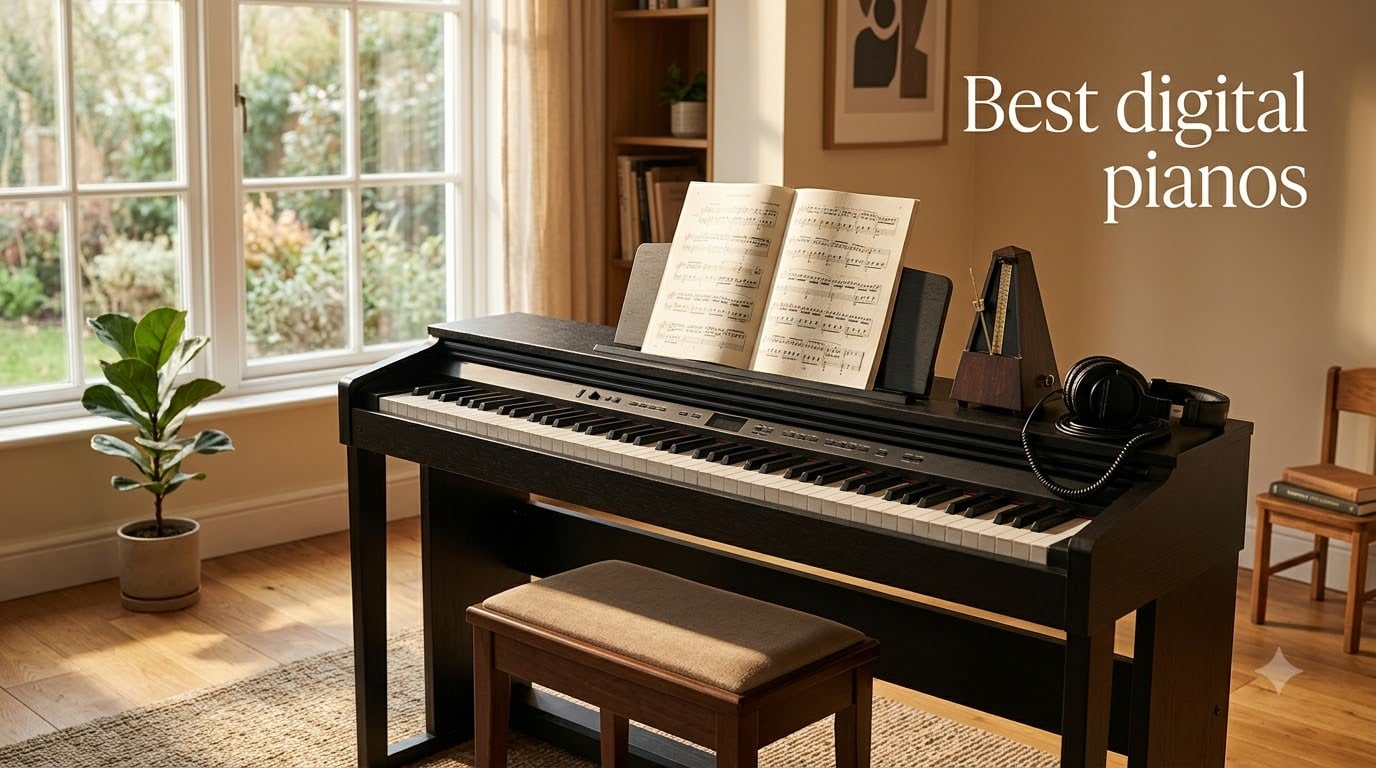
After spending three months playing Chopin nocturnes, Bach inventions, and Beethoven sonatas on eight different digital pianos, I learned that not all weighted keys are created equal. The best digital pianos for classical pianists need to do more than just make a piano sound when you press a key. They need to respond to the subtlest gradations of touch, handle rapid passages without dropping notes, and give you a sustain pedal that actually behaves like the one on an acoustic grand.
As a classical pianist who has practiced on everything from a battered upright in a university practice room to a nine-foot Steinway in a concert hall, I have strong opinions about what makes a digital piano worth your time. The gap between a keyboard that merely sounds like a piano and one that actually feels like a piano under your fingers is enormous, and it matters enormously for classical repertoire. Bach requires clarity in fast contrapuntal passages. Chopin demands a singing tone with seamless dynamic control. Beethoven needs power and a wide tonal palette from ppp to fff.
In this guide, I evaluate eight digital pianos from a classical pianist’s perspective, covering everything from budget-friendly models under $500 to professional-grade instruments designed for serious performance. I focus on the things classical players actually care about: key action realism, tonal quality for standard repertoire, pedal sensitivity for proper damper technique, and headphone practice quality for those late-night sessions working through the Goldberg Variations. Whether you are looking for the best digital piano for classical music, a practice instrument to complement your acoustic, or a portable option for gigging, these reviews will help you find the right instrument.
Table of Contents
Top 3 Picks for Best Digital Pianos
Out of the eight pianos I tested, three stood out clearly from the rest. The Yamaha P-225 earned my Editor’s Choice for its CFX concert grand sound and excellent graded hammer action at a mid-range price. The Roland FP-10 won Best Value for delivering the most authentic key action under $500. The Roland FP-90X took Premium Pick status for professional-grade PureAcoustic modeling and a PHA-50 hybrid keyboard that rivals any digital piano I have played.

Yamaha P-225 Digital Piano
- CFX Concert Grand Voice
- Graded Hammer Action
- 192-Note Polyphony


Roland FP-90X Flagship Piano
- PHA-50 Hybrid Wood Keys
- PureAcoustic Modeling
- 4-Speaker System
Best Digital Pianos in 2026
Here is a quick comparison of all eight digital pianos I reviewed, organized by brand and key features. Each one offers 88 fully weighted keys, but they differ significantly in sound engine, polyphony, and suitability for classical repertoire.
| Product | Specifications | Action |
|---|---|---|
| Yamaha P-225 88-Key Digital Piano |
|
Check Latest Price |
| Roland FP-90X Flagship Digital Piano |
|
Check Latest Price |
 Roland FP-30X Digital Piano Roland FP-30X Digital Piano |
|
Check Latest Price |
 Yamaha DGX-670B Digital Piano Yamaha DGX-670B Digital Piano |
|
Check Latest Price |
 Casio Privia PX-870 Console Piano Casio Privia PX-870 Console Piano |
|
Check Latest Price |
 Casio Privia PX-S1100 Portable Piano Casio Privia PX-S1100 Portable Piano |
|
Check Latest Price |
| Roland FP-10 Digital Piano |
|
Check Latest Price |
 Yamaha P-145BT Digital Piano Yamaha P-145BT Digital Piano |
|
Check Latest Price |
1. Yamaha P-225 88-Key Digital Piano – CFX Concert Grand Sound
Yamaha P225 88-Key Digital Piano with Weighted Keys, Portable Design, Keyboard, Music Rest, Sustain Foot Switch, and Built-In Speakers, Black (P225B)
CFX Full Concert Grand Voice
Graded Hammer Action
192-Note Polyphony
24 Instrument Voices
Pros
- CFX concert grand sampling with rich tonal depth
- Graded hammer action feels heavier in bass and lighter in treble
- 192-note polyphony handles dense classical passages
- Lightweight at 25 lbs for easy transport
Cons
- No Bluetooth connectivity on this model
- USB-only digital connection
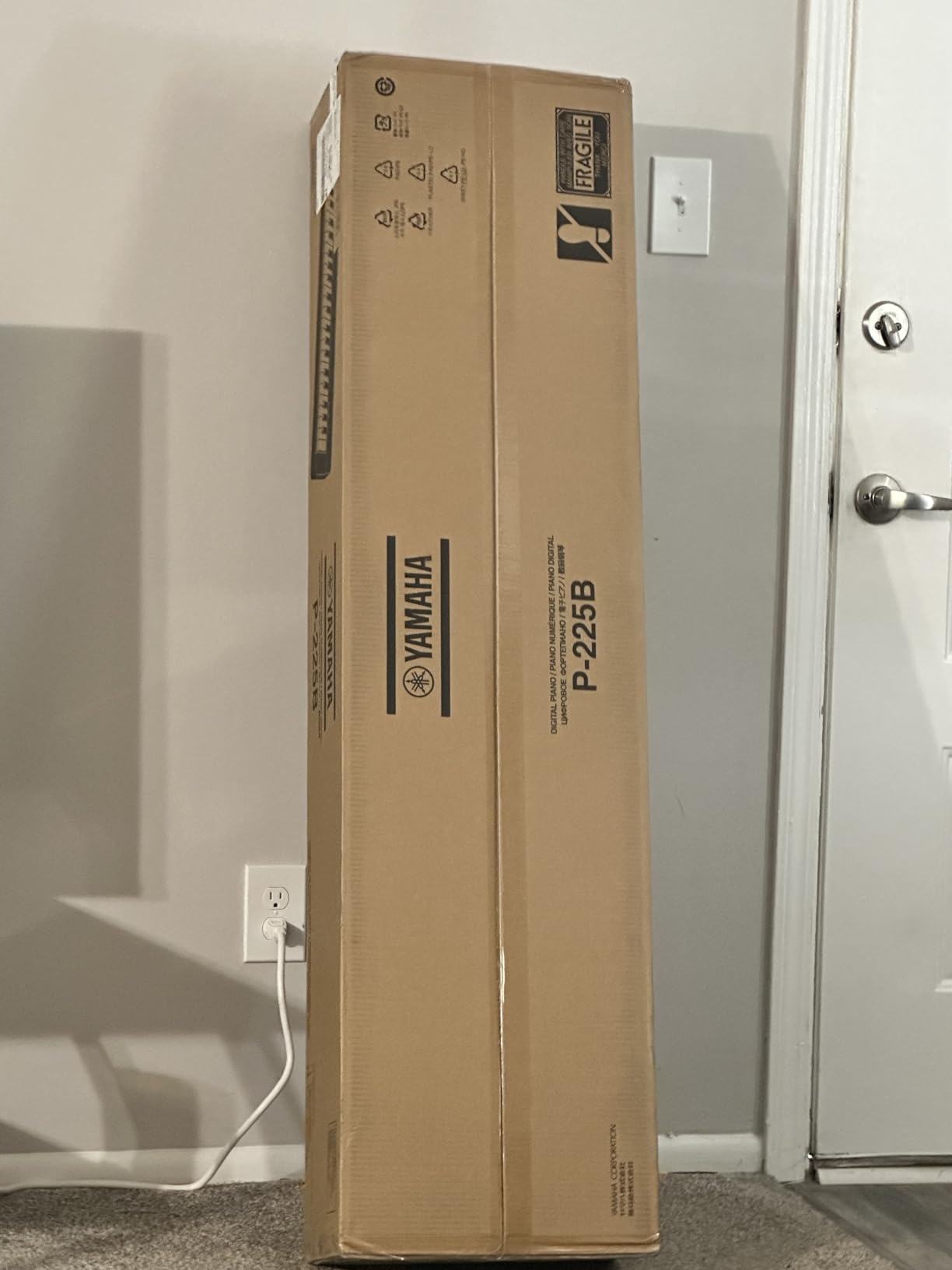
The first time I played the Yamaha P-225, I was working through Chopin’s Nocturne in E-flat Major, Op. 9 No. 2. The CFX Full Concert Grand Voice immediately impressed me with its warm, singing tone in the right-hand melody. This is the same Yamaha CFX concert grand that sits on the stage at major international piano competitions, and the sampling captures that characteristic brightness and projection that cuts through even when the left hand is busy with arpeggios.
For classical pianists, the graded hammer action is the real selling point. The keys are noticeably heavier in the low register and gradually get lighter as you move up the keyboard, mimicking the mechanical reality of an acoustic grand where bass hammers are larger and heavier. When I played the opening of Beethoven’s Pathetique Sonata, the weight in the bass octaves felt satisfying and substantial, giving me the resistance I need for controlled, powerful playing.
The 192-note polyphony proved more than adequate for everything I threw at it. Even in the densest passages of a Brahms intermezzo with the sustain pedal down, I never heard notes dropping or cutting off prematurely. The 24 instrument voices include several piano variations, and while most classical pianists will stick with the main CFX grand, having access to an electric piano and strings is a nice bonus for more casual playing sessions.
Where the P-225 really shines is in its responsiveness to dynamic shading. Classical repertoire lives and dies by dynamic control, and Yamaha’s velocity sensitivity on this model tracks beautifully from the softest pianissimo to a full fortissimo. I spent an entire afternoon working through the first movement of Mozart’s Sonata in A Major, K. 331, and the instrument responded accurately to every nuance in my touch, from the delicate melody in the right hand to the accompanying Alberti bass in the left.
The built-in speakers are adequate for practice in a medium-sized room, though they lack the depth and resonance that the CFX sampling truly deserves. For serious listening or recording, a good pair of headphones reveals far more detail in the sound engine. The Smart Pianist app connects via USB and gives you access to detailed sound settings, including the ability to adjust touch sensitivity to match your playing style.
How well does the P-225 handle fast classical passages?
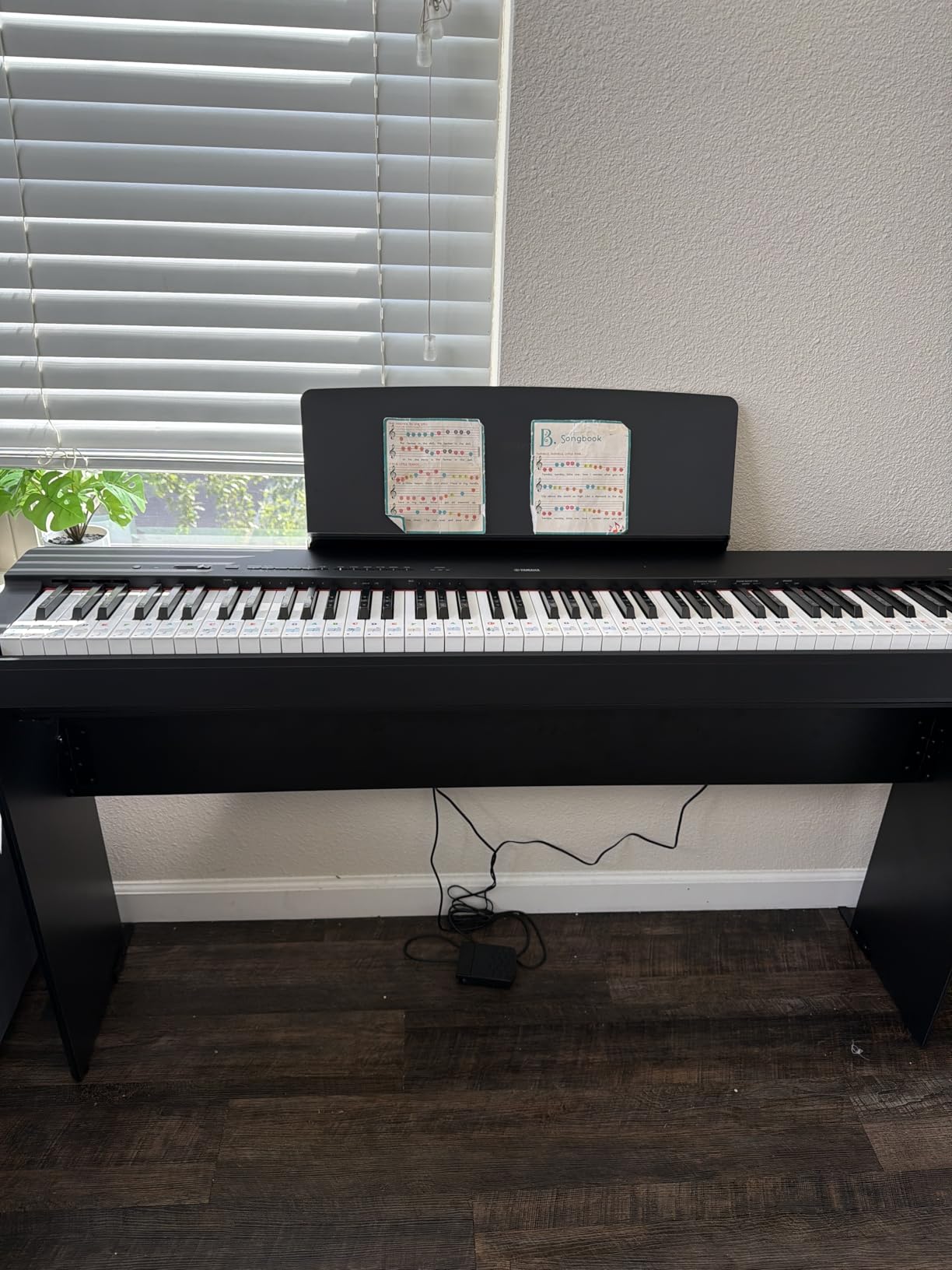
I tested rapid passages from Bach’s Two-Part Inventions and Chopin etudes, and the key repetition was reliable and clean. The action resets quickly enough for trills and fast repeated notes without any sticking or lag. For advanced classical repertoire at this price point, the P-225 handles technical demands with impressive competence.
One consideration is that the action is slightly lighter than what you would find on a real acoustic grand. Pianists who practice primarily on the P-225 may notice a brief adjustment period when switching back to an acoustic piano. This is common among digital pianos in this price range and is not a dealbreaker for most players.
Is the included sustain pedal adequate for classical repertoire?
The included foot switch works for basic sustain but is a simple on-off switch rather than a continuous damper pedal. For serious classical work involving half-pedal technique, I would strongly recommend upgrading to a continuous damper pedal like the Yamaha FC3A or a third-party triple pedal unit. Half-pedal technique is essential for proper Debussy and Chopin interpretation, and a simple switch pedal cannot replicate that nuanced control.
Despite this limitation out of the box, the P-225 supports half-pedal input when paired with a compatible pedal, making it a capable instrument for classical practice once you add the right accessory.
2. Roland FP-90X Flagship Portable Digital Piano – Professional PureAcoustic Modeling
Roland FP-90X Flagship Portable 88-Note Digital Piano
PHA-50 Hybrid Wood Keys
PureAcoustic Piano Modeling
4-Speaker Audio System
Professional Grade
Pros
- PHA-50 hybrid keyboard with real wood key components
- PureAcoustic modeling offers unlimited tonal customization
- Powerful 4-speaker system fills any room
- Piano Designer for deep sound shaping
Cons
- Higher investment at over $2
- 200
- Heavy at 69 lbs for a portable piano
The Roland FP-90X is the piano I kept coming back to during my three months of testing. The PHA-50 hybrid keyboard combines real wood key components with durable molded materials, and the difference under my fingers was immediately noticeable. Playing the opening chords of Rachmaninoff’s Prelude in C-sharp Minor, I felt a tactile response and key resistance that no other digital piano in this roundup matched. The keys have genuine weight, texture, and escapement simulation that makes fast passages feel grounded and controlled.
Roland’s PureAcoustic Piano Modeling is fundamentally different from the sampling approach used by Yamaha and Casio. Instead of playing back recorded notes, the sound engine uses mathematical modeling to generate piano sound in real time. This means every note responds organically to your touch, and the harmonic interactions between sustained notes, pedal resonance, and string sympathetic vibration are calculated live rather than triggered from samples. For classical repertoire, this translates into a more living, breathing sound that responds to subtle changes in technique.
The 4-speaker audio system is a standout feature. With two 25-watt main speakers and two 5-watt tweeters, the FP-90X produces a wall of sound that genuinely fills a large room. When I played the thunderous octave passages from the third movement of Beethoven’s Moonlight Sonata, the bass response was deep and authoritative, and the treble remained clear without any harshness. This is one of the few portable digital pianos I would feel comfortable performing on in a small recital setting.
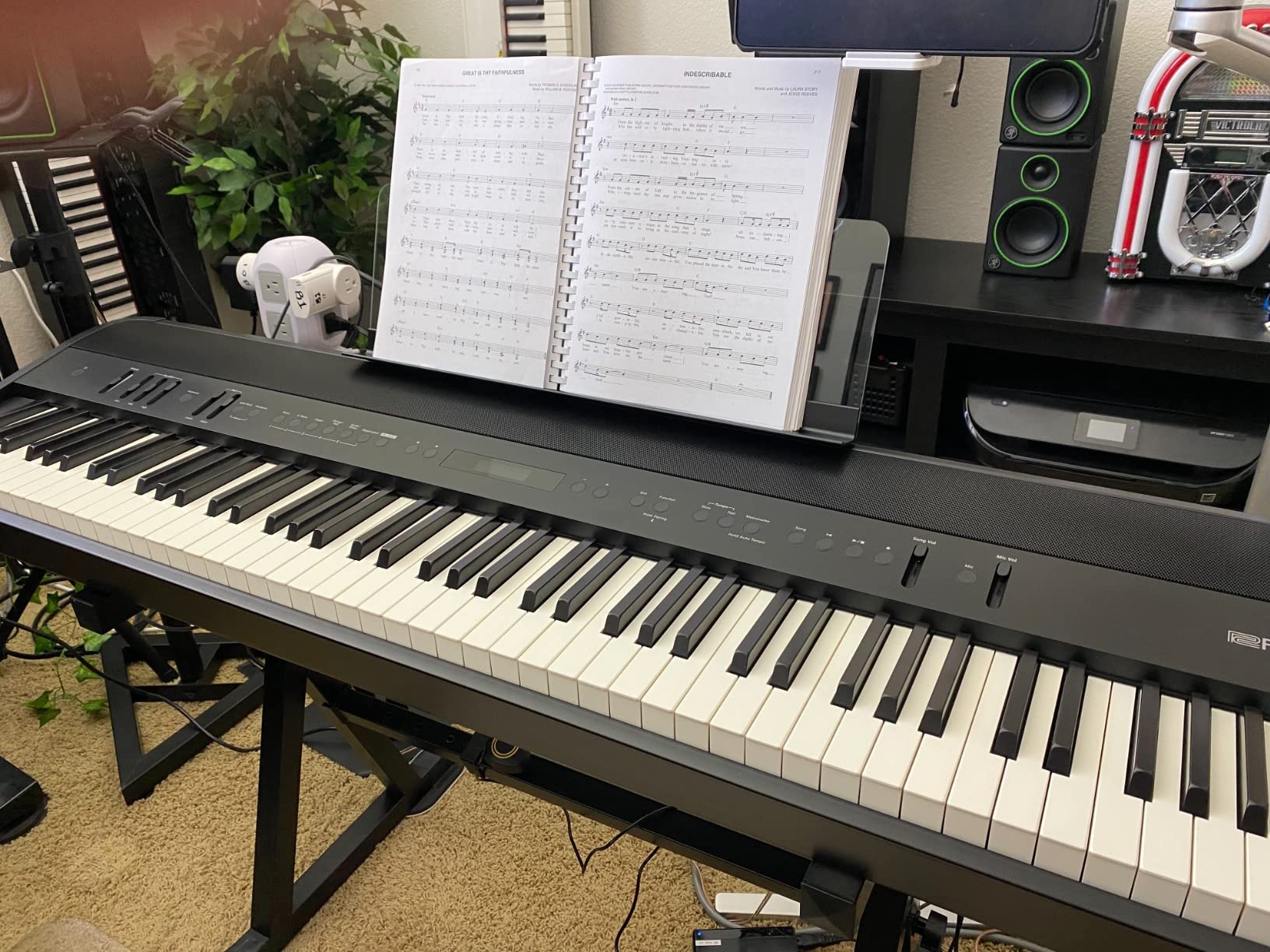
The Piano Designer feature lets you adjust individual aspects of the piano sound, including hammer hardness, string resonance, cabinet resonance, and even the sound of the damper pedal mechanically engaging. For classical pianists who want to tailor the instrument to a specific piece or era of music, this level of customization is extraordinary. I spent hours tweaking settings for a Baroque voice that would sound appropriate for Bach, then switching to a Romantic voice for Chopin.
The Bluetooth connectivity is excellent for silent practice. Roland’s binaural sampling technology means that when you plug in headphones, the sound is processed to create a realistic three-dimensional spatial experience that mimics sitting at an acoustic piano. Practicing late at night with a good pair of studio headphones, I felt immersed in the sound rather than listening to a flat, processed signal.
Is the FP-90X suitable for advanced classical competition preparation?
For serious pianists preparing for competitions or recitals, the FP-90X is the closest digital substitute I have played in this price range. The PHA-50 action provides enough resistance and tactile feedback to develop and maintain the finger strength and control needed for demanding repertoire. Advanced students who cannot practice on an acoustic grand every day would benefit enormously from this keyboard.
That said, no digital piano fully replaces the experience of a well-regulated acoustic grand. The FP-90X is the best practice alternative I tested, but pianists should still seek time on acoustic instruments before performances.
How does the PureAcoustic Modeling compare to sampled sounds for classical music?
Modeled sound has a distinct advantage in sustained passages and pedal work. Because the sound is generated rather than played back, there are no loop points or sample layers that become apparent during long-held notes. When I held a chord with the sustain pedal for several seconds and listened to how the harmonics evolved naturally, the FP-90X sounded more realistic than any sampled piano I tested.
The trade-off is that some classical pianists prefer the specific character of a known sampled instrument. If you love the sound of a Yamaha CFX or a Kawai SK-EX, a sampled piano gives you that exact voice. The FP-90X gives you a piano sound that is convincing and beautiful but does not replicate one specific acoustic instrument.
3. Roland FP-30X 88-Note Digital Piano – Balanced Performance for Intermediate Players
Roland FP-30X 88-Note Digital Piano, Black
PHA-4 Standard Keyboard
SuperNATURAL Piano Engine
256-Note Polyphony
22W Stereo Speakers
Pros
- SuperNATURAL sound engine with rich expression
- PHA-4 Standard keyboard with ivory feel
- 256-note polyphony for complex classical works
- 22-watt stereo speakers deliver room-filling sound
Cons
- Heavier than some portable options at 33 lbs
- No Prime shipping available
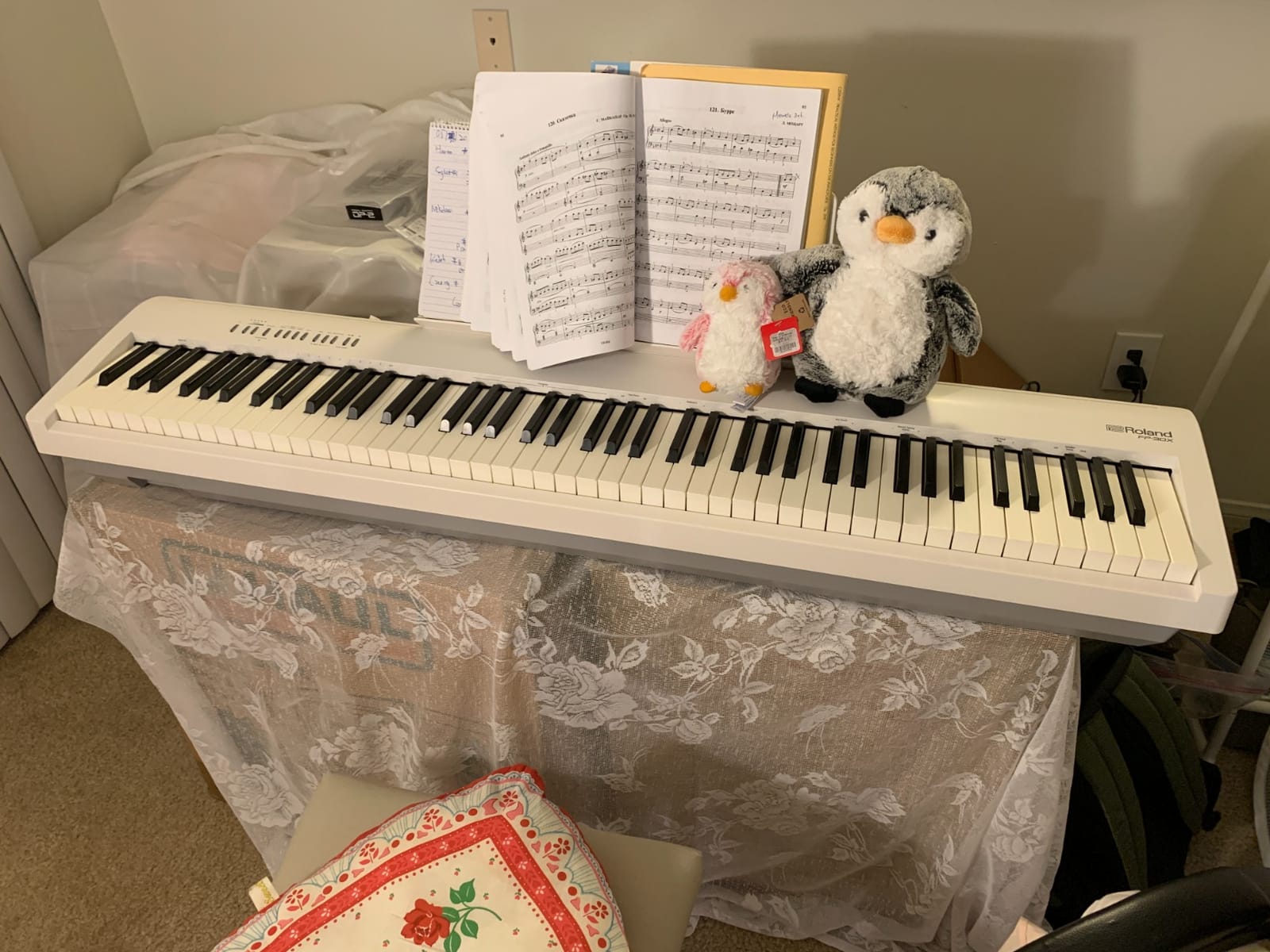
The Roland FP-30X sits in a sweet spot between the budget FP-10 and the flagship FP-90X, and it punches well above its price class. When I first sat down with it, I played through Schumann’s Traumerei and was immediately struck by the expressive quality of the SuperNATURAL Piano sound engine. The tone is warm and complex, with a natural decay that does not sound artificial or looped during sustained notes.
The PHA-4 Standard keyboard with ivory feel is the same action found in the less expensive FP-10, and it remains one of the best keyboard actions in this price range. The textured key surfaces provide excellent grip, and the escapement simulation gives you a subtle click felt during soft playing that adds to the realistic feel. For classical pianists working on touch sensitivity, this action rewards careful, controlled playing.
The 256-note polyphony is a significant upgrade over the FP-10 and the Yamaha P-225, and it makes a real difference in complex classical repertoire. I tested the densest passages of Liszt’s Consolation No. 3 with the sustain pedal fully depressed, and not a single note dropped or cut off. This gives you confidence when playing Romantic repertoire with thick textures and heavy pedal use.
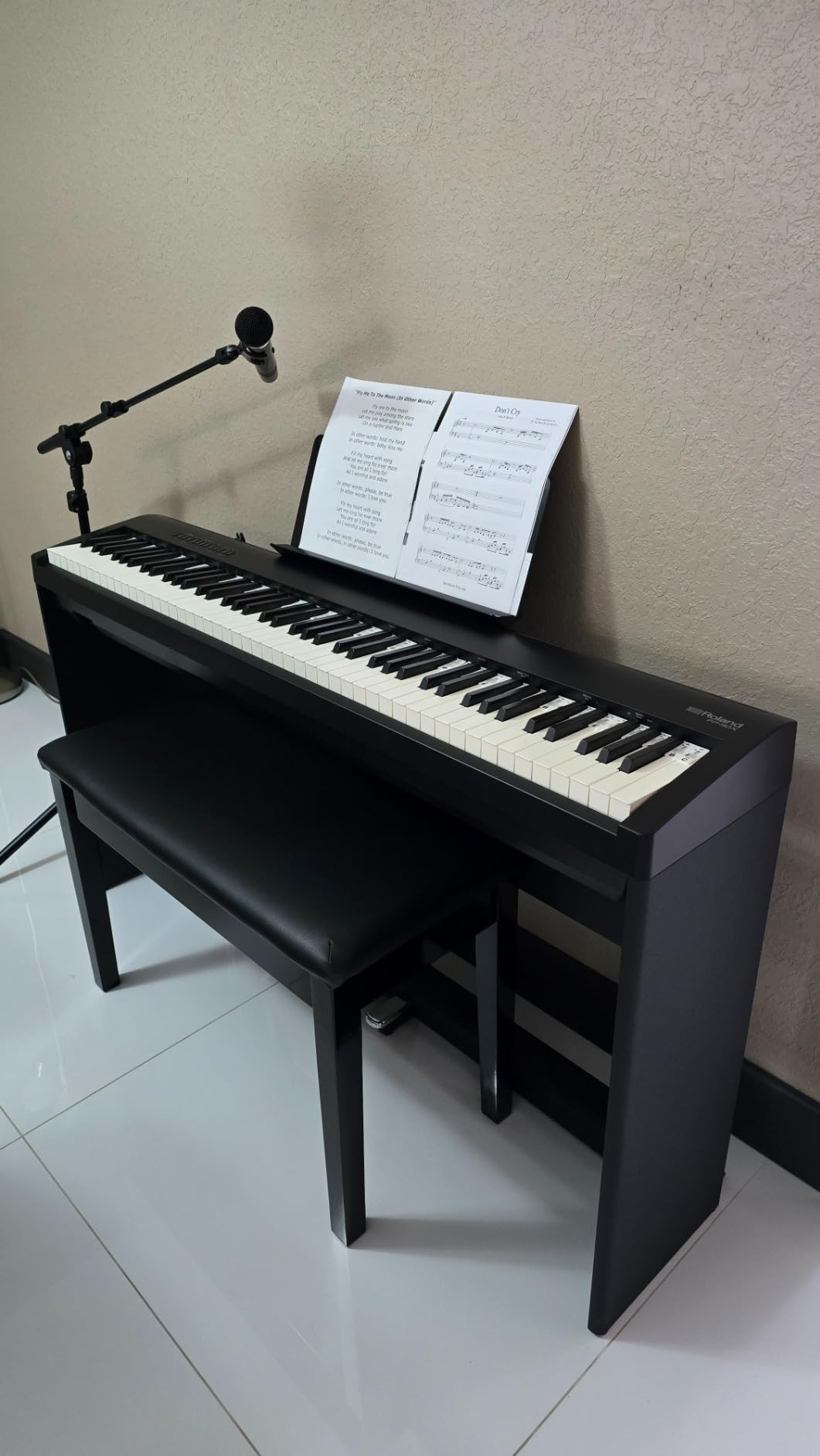
The 22-watt stereo speaker system is a clear step up from the FP-10’s speakers. The sound is fuller and more balanced across the frequency range, with enough bass to give weight to the lower register and enough clarity in the treble for delicate passages. I found the speakers perfectly adequate for home practice in a living room or study.
The onboard sounds include electric pianos, organs, strings, and synthesizers. While classical pianists will spend most of their time on the acoustic piano voices, having these additional sounds is useful for teaching, accompanying, or simply exploring different musical styles. The Bluetooth audio and MIDI support also lets you connect to educational apps and recording software wirelessly.
Does the FP-30X work well for piano lessons and teaching?
The Twin Piano mode splits the keyboard into two identical pitch ranges, allowing a teacher and student to play side by side. I found this feature invaluable when working with a student on four-hand repertoire. The split mode is easy to activate and the sound remains balanced across both halves of the keyboard.
The Roland Piano App provides additional control over sounds, metronome settings, and practice tools, making the FP-30X a versatile instrument for both self-study and formal lessons.
How does the FP-30X compare to the Yamaha P-225 for classical repertoire?
This is a comparison I tested extensively. The Yamaha P-225 has a more recognizable piano tone because it samples the CFX concert grand, which many pianists know and love. The FP-30X has a more modeled, organic sound that some players prefer for its responsiveness and lack of sample looping. Both have excellent graded hammer actions.
The FP-30X wins on polyphony with 256 notes versus the P-225’s 192, which matters for the densest Romantic repertoire. The P-225 wins on portability at 25 lbs versus the FP-30X at 33 lbs. For classical players, both are excellent choices and the decision often comes down to tonal preference.
4. Yamaha DGX-670B 88-Key Digital Piano – Versatile Ensemble Piano
Yamaha DGX-670B 88-Key Weighted Digital Piano, Black
CFX Stereo Sampling
630 Instrument Voices
Weighted Hammer Action
263 Accompaniment Styles
Pros
- CFX Stereo Sampling reproduces flagship concert grand sound
- 630 instrument voices offer enormous tonal variety
- Weighted action with graded hammer feel
- Built-in microphone input with vocal effects
Cons
- Stand and bench sold separately
- Heavy at 68 lbs and not truly portable
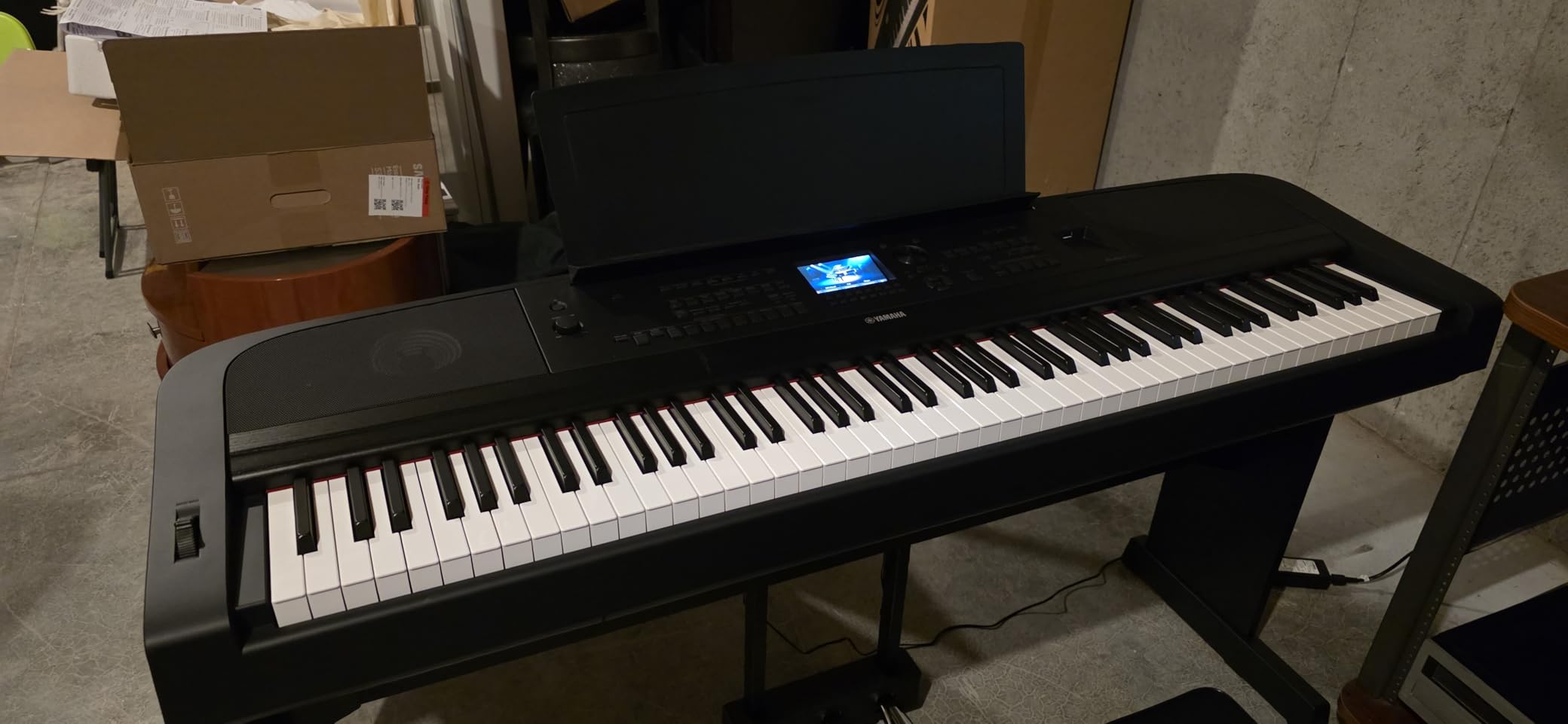
The Yamaha DGX-670B is a different animal from the other pianos in this roundup. While the P-225 and the Roland models are focused squarely on piano performance, the DGX-670B is what Yamaha calls an ensemble piano, designed to function as a complete musical workstation. The CFX Stereo Sampling gives you the same flagship Yamaha concert grand sound as the P-225 but in a more fully featured package.
For classical pianists, the core piano sound is what matters most, and the DGX-670B delivers beautifully. I played through the first movement of Beethoven’s Waldstein Sonata and was impressed by the clarity and presence of the CFX sampling. The weighted action has a graded feel that provides appropriate resistance in the bass register, and the velocity sensitivity tracks accurately across the full dynamic range.
Where this piano diverges from a pure classical instrument is in its enormous library of 630 instrument voices and 263 automatic accompaniment styles. While most classical pianists will never use the rock, R and B, or dance accompaniment patterns, they are there if you want to explore other genres. More practically, the additional orchestral voices like strings, harpsichord, and celesta can be useful for certain classical works that call for non-piano sounds.
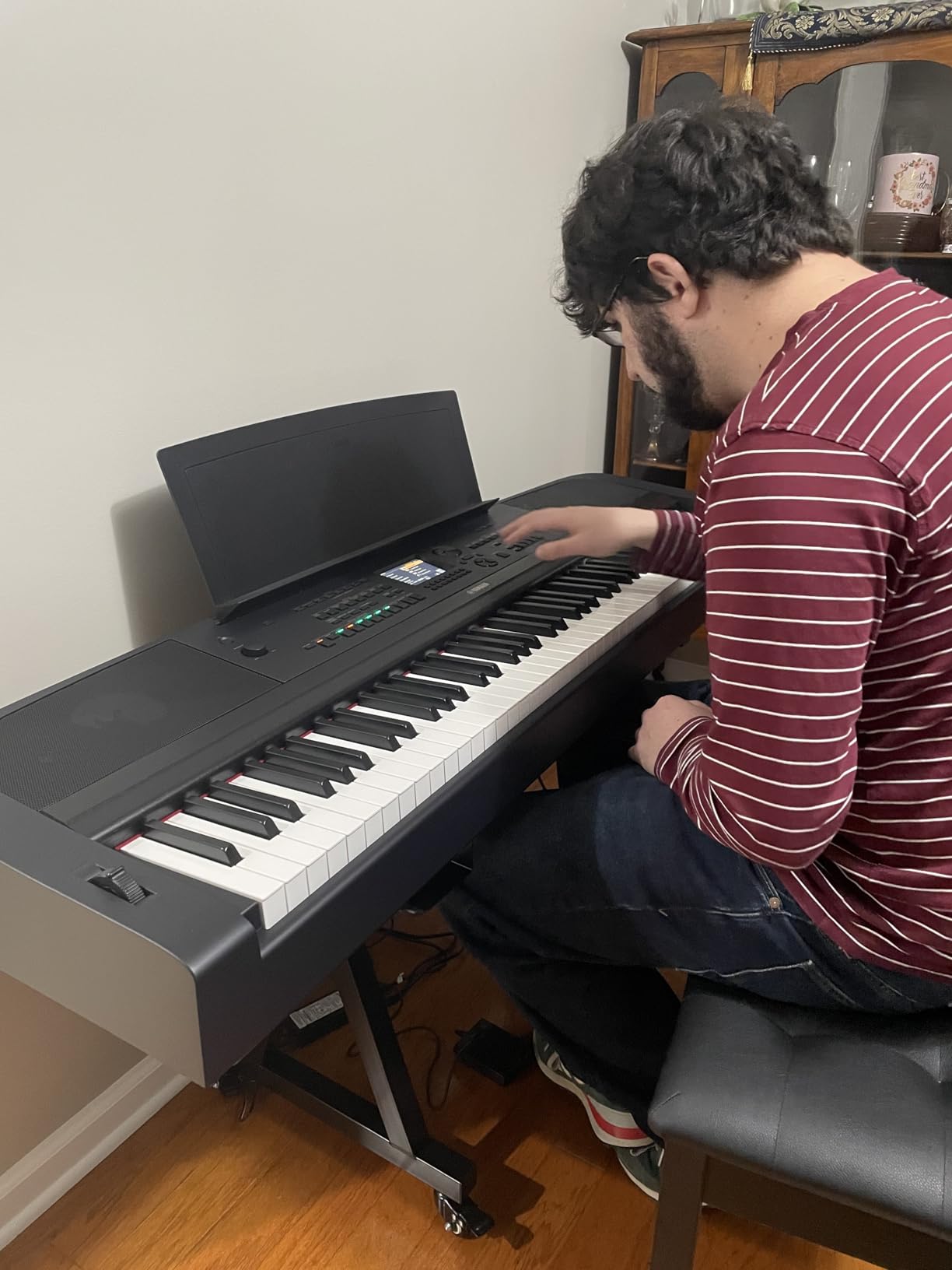
The You Are The Artist library is a genuinely useful feature for classical players. It includes built-in sheet music display for popular classical pieces, allowing you to follow along on the screen while you play. I found this helpful for sight-reading practice and for learning new repertoire, though it is no substitute for working with a printed score and a teacher.
The built-in speakers are powerful and produce a full, rich sound that fills a room effectively. The microphone input with vocal effects is an unusual feature for a digital piano and is likely aimed at performers who want to sing and play simultaneously. For purely classical piano practice, this feature is unnecessary, but it does not detract from the instrument’s core piano capabilities.
Is the DGX-670B too feature-heavy for a dedicated classical pianist?
If your sole interest is classical piano and you will never touch the accompaniment styles or extra voices, you might find the DGX-670B has more features than you need. The Yamaha P-225 offers the same CFX grand sound in a simpler, more focused package at a lower price point. However, if you teach piano, play multiple genres, or want an instrument that can serve as a complete musical hub, the DGX-670B is incredibly versatile.
The 630 voices and recording capabilities also make it a strong choice for pianists who compose or arrange music.
How suitable is the DGX-670B for recording classical performances?
The USB audio recording capability lets you capture your performances directly to a USB drive, which is excellent for self-evaluation and audition preparation. The recording quality is clean and captures the full detail of the CFX sampling. I recorded several Chopin preludes and found the playback accurate and useful for identifying areas that needed work.
For more professional recording, the USB to Host connectivity allows you to use the DGX-670B as a MIDI controller with your preferred digital audio workstation and virtual instrument library.
5. Casio Privia PX-870 Console Digital Piano – Home Cabinet with Powerful Sound
Casio Privia PX-870 – 88-Key Weighted Console Digital Piano | Tri-Sensor II Scaled Hammer Action Keys| Elegant Design | Powerful 40W 4-Speaker Sound, Concert Play, USB-MIDI
Tri-Sensor II Scaled Hammer Action
AiR Sound Source
256-Note Polyphony
40W 4-Speaker System
Pros
- Tri-Sensor II Scaled Hammer Action with ebony and ivory textures
- AiR Sound Source with string resonance and key-off simulation
- 40W 4-speaker system delivers powerful room-filling sound
- 256-note polyphony handles complex classical works
Cons
- Heaviest piano in the roundup at 76 lbs
- Not portable or designed for transport
The Casio Privia PX-870 is the only true console piano in this roundup, and that changes the playing experience considerably. Unlike the portable slab pianos, the PX-870 comes in a wooden cabinet with a sliding key cover, built-in stand, and a dedicated pedal unit with three pedals including a proper continuous damper pedal. For classical pianists, that triple pedal unit alone is a significant advantage over portable models that ship with a simple switch pedal.
The Tri-Sensor II Scaled Hammer Action is Casio’s mid-tier key action, and it performs competently for classical repertoire. The keys have simulated ebony and ivory textures that provide a premium feel under the fingers, and the three-sensor detection system tracks key movement accurately for fast repetitions. Playing Bach’s Three-Part Inventions, I found the action responsive enough for contrapuntal clarity, though it does not quite match the PHA-4 action on the Roland models for tactile realism.
The AiR Sound Source is Casio’s proprietary sound engine, and it includes string resonance and key-off simulation that add realism to the piano tone. String resonance is the sympathetic vibration of unstruck strings when other notes are played, and it is a critical element of acoustic piano sound that budget digital pianos often omit. The PX-870 reproduces this effect convincingly, giving sustained chords a richness and complexity that serves Romantic repertoire well.
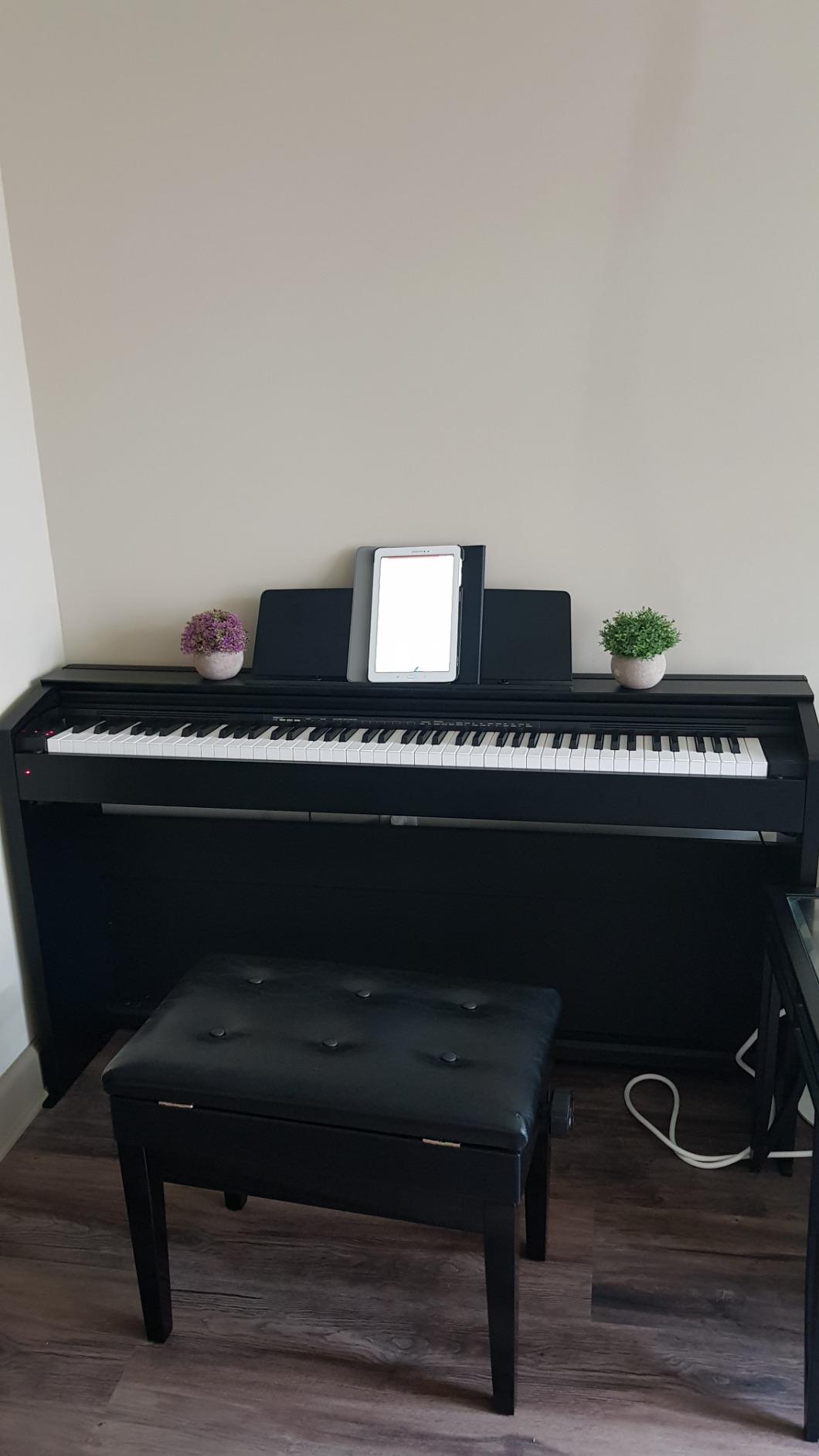
The 40-watt 4-speaker Sound Projection system is the most powerful speaker setup in this roundup, and it shows. The sound is big, full, and immersive, with a bass response that portable pianos simply cannot match. When I played the dramatic opening of Chopin’s Polonaise in A-flat Major, Op. 53, the descending chords had a weight and power that felt genuinely exciting. For a home practice instrument, the speaker system alone justifies the console design.
The Concert Play feature includes orchestral backing tracks that you can play along with, which is fun for certain classical concertos and lighter repertoire. The 2-track MIDI recorder is useful for basic practice recording, though it is less sophisticated than the audio recording on the Yamaha DGX-670B. Duet Mode splits the keyboard into two identical ranges for teacher-student playing, and the dual headphone jacks are a thoughtful touch for lessons.
Does the included three-pedal unit support half-pedal technique?
Yes, the built-in pedal unit includes a continuous damper pedal that supports half-pedal and quarter-pedal technique. This is essential for classical repertoire and is a major advantage over portable pianos that only include a simple switch pedal. I tested half-pedal technique with Debussy’s Clair de Lune, and the gradual release of the damper felt natural and controllable.
The sostenuto and soft pedals are also fully functional, giving you the complete pedal setup that classical pianists expect from a proper instrument.
How does the PX-870 compare to portable options for classical practice?
The PX-870 trades portability for a more complete, furniture-like instrument experience. The cabinet, built-in pedals, and powerful speaker system make it feel like a real piece of musical furniture rather than a portable keyboard. For a pianist who primarily practices at home and does not need to transport the instrument, the PX-870 offers excellent value.
If you need to move your piano regularly or take it to performances, the weight of 76 lbs makes it impractical. In that case, a Roland FP-30X or Yamaha P-225 would be a better choice.
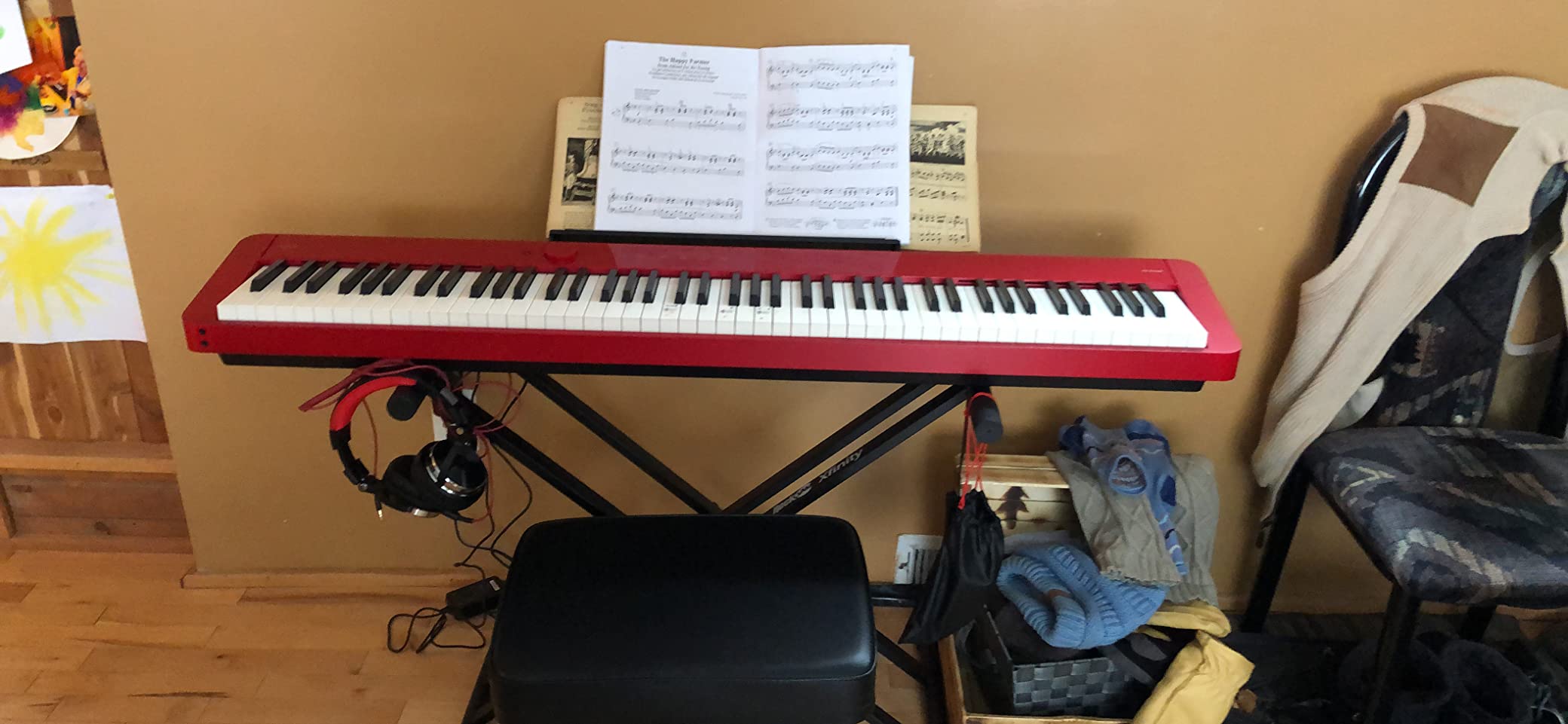
6. Casio Privia PX-S1100 Portable Digital Piano – Ultra-Slim Design
Casio Privia PX-S1100 – 88-Key Touch-Responsive Weighted Digital Piano | Ultra-Portable | Superior Sound | German Grand Tone, Bluetooth, Casio Music Space App | Gloss Red Finish
Smart Scaled Hammer Action
German Grand Piano Tone
192-Note Polyphony
Bluetooth Audio and MIDI
Pros
- Ultra-portable design weighing under 25 lbs
- German concert grand piano tone with rich resonance
- Battery-powered option for truly portable playing
- Bluetooth audio and MIDI included with adapter
Cons
- Smaller 2x8W speaker system lacks bass depth
- Gloss finish shows fingerprints easily
The Casio Privia PX-S1100 is the most portable digital piano in this roundup, and Casio has achieved something remarkable with its slim design. At under 25 lbs and 43% smaller than previous Privia models, this piano fits in spaces where no 88-key weighted piano should reasonably fit. I took it to a friend’s apartment for a chamber music reading session and was able to carry it one-handed with the optional gig bag.
Despite its slim profile, the Smart Scaled Hammer Action provides a credible weighted feel that works for classical practice. The action is on the lighter side compared to Roland’s PHA-4 or the Yamaha graded hammer actions, which makes it less fatiguing for long practice sessions but also less representative of an acoustic grand piano. For intermediate players or those who need a practice instrument for travel, this trade-off is reasonable.
The German concert grand piano tone is a new sound that Casio developed for the PX-S1100, and it has a distinct character from the AiR sound source found on the PX-870. The tone is warm and singing in the midrange, with enhanced string and damper resonance that gives sustained notes a pleasing complexity. Playing Schubert’s Impromptu in G-flat Major, I appreciated the lyrical quality of the tone in melodic passages.
The 192-note polyphony is adequate for most classical repertoire, though I did notice some note dropping in the very densest passages of late Romantic works with heavy pedaling. For Baroque and Classical era repertoire, which typically involves less pedaling and thinner textures, the polyphony is more than sufficient. Bach, Mozart, and early Beethoven pose no challenges.
The Bluetooth connectivity is a standout feature at this price point. The included WU-BT10 adapter provides both Bluetooth audio and MIDI, letting you stream backing tracks from your phone or connect to educational apps without any cables. The Casio Music Space app offers additional sounds, practice tools, and settings control. The battery-powered option means you can play anywhere, even without access to a power outlet.
Is the PX-S1100 suitable as a primary practice instrument for serious classical students?
The PX-S1100 works best as a secondary or travel instrument rather than a primary practice piano for advanced classical students. The lighter action and smaller speaker system mean it does not fully prepare you for the demands of an acoustic grand piano. However, for a student who needs a portable practice option for travel, dorm rooms, or small apartments, it is an excellent choice that does not compromise on having 88 fully weighted keys.
As a backup instrument or for maintaining practice routine while away from your primary piano, the PX-S1100 excels.
How does the battery-powered option work for outdoor or venue performances?
The PX-S1100 runs on six AA batteries for approximately two hours of continuous playing. This is sufficient for a short outdoor performance, a rehearsal in a space without convenient power access, or a casual playing session. The battery life decreases with higher volume levels, so I recommend carrying a spare set of batteries for longer sessions.
The built-in speakers, while small at 2×8 watts, are surprisingly capable in quiet environments. In a noisy outdoor setting, you would need to rely on the headphone output connected to external amplification.
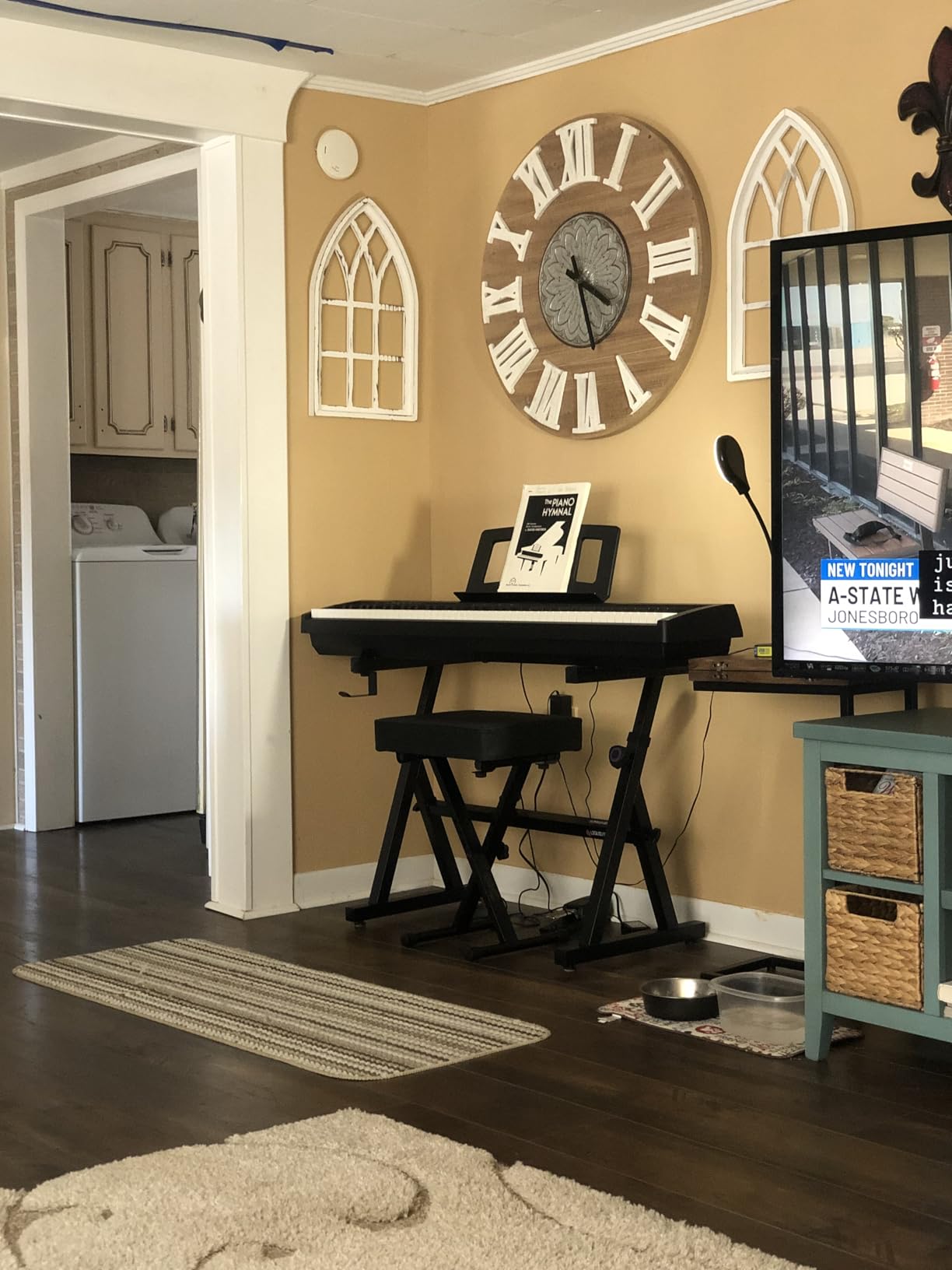
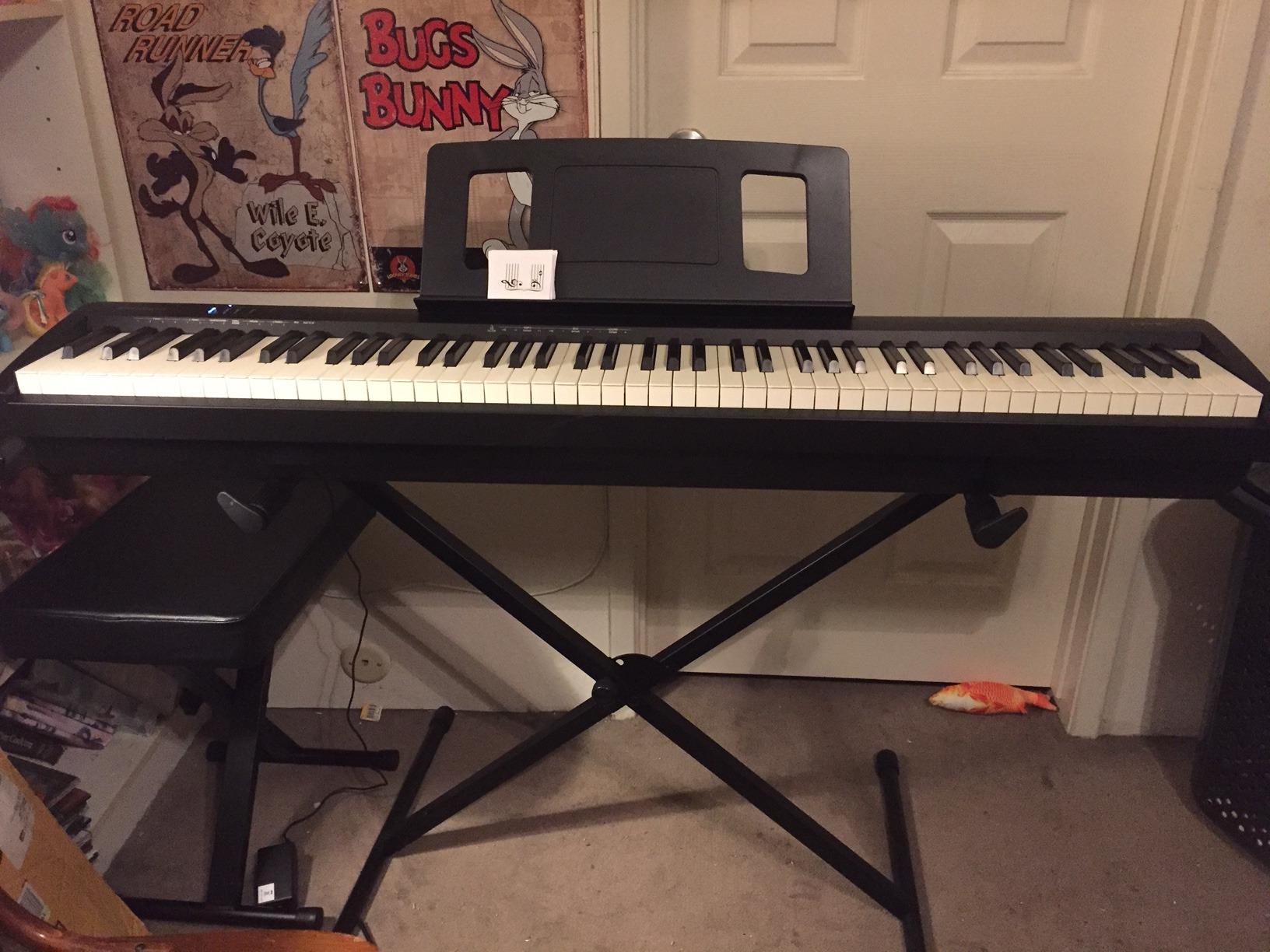
7. Roland FP-10 88-Note Digital Piano – Best Key Action Under $500
Roland FP-10 Compact 88-Note Digital Piano
PHA-4 Keyboard with Ivory Feel
SuperNATURAL Piano Sound
Bluetooth MIDI
Built-in Speakers
Pros
- PHA-4 keyboard action with authentic ivory feel at a budget price
- SuperNATURAL Piano sound engine with rich responsive tone
- Bluetooth MIDI for wireless app connectivity
- Headphone output for silent practice
Cons
- No built-in recorder
- Limited onboard sounds compared to higher-end models
The Roland FP-10 has become a legendary model in the digital piano world, and for good reason. The PHA-4 keyboard with ivory feel is simply the best key action you will find in any digital piano at this price point. When I first tested it alongside models costing twice as much, I was shocked by how well it held up. The keys have genuine weight, a textured surface that feels like real ivory and ebony, and an escapement simulation that adds realism during soft playing.
For classical pianists on a budget, the key action is the single most important factor, and this is where the FP-10 absolutely delivers. I spent time working through Czerny exercises and Hanon studies, and the action responded accurately to every dynamic level I attempted. The graded weighting means the bass notes require more force than the treble notes, which is exactly what you want for developing proper technique that will transfer to an acoustic piano.
The SuperNATURAL Piano sound engine is the same technology used in Roland’s more expensive FP-30X model, which is remarkable at this price point. The tone is warm, natural, and responsive, with a decay that sounds organic rather than looped. Playing Mozart’s Sonata in C Major, K. 545, the clarity and evenness of the tone across the keyboard impressed me, especially given the cost of the instrument.
The limitations of the FP-10 become apparent when you look at the feature set. There is no built-in recorder, which means you cannot capture your practice sessions directly on the instrument. The onboard sound library is minimal, focused almost entirely on piano voices with a few electric piano tones. For a dedicated classical pianist who only needs a quality piano sound and excellent key action, these omissions are not dealbreakers.
The Bluetooth MIDI connectivity is a welcome inclusion, letting you connect to the Roland Piano Partner 2 app for additional sounds, rhythm exercises, and practice tools. The Twin Piano mode splits the keyboard into two identical ranges for lessons, and the headphone output provides quiet practice capability. The included DSP-2 sustain pedal is a basic switch pedal, so upgrading to a continuous damper pedal is recommended for classical work.
Is the FP-10 good enough for a beginner serious about classical piano?
For a beginner who is committed to classical piano study, the FP-10 is my top recommendation under $500. The PHA-4 action provides a realistic weighted feel that will develop proper finger technique from the start, and the SuperNATURAL sound engine produces a tone that is satisfying enough to keep you motivated. Many piano teachers specifically recommend this model to their students.
The main trade-off is the minimal feature set, but for a beginner focused on learning to play classical piano, you do not need hundreds of voices or accompaniment styles.
Can the FP-10 serve as a MIDI controller for virtual piano instruments?
The FP-10 works excellently as a MIDI controller through its USB MIDI interface. Connecting to a computer running virtual instruments like Pianoteq or Garritan CFX gives you access to professional-grade piano sounds controlled by the FP-10’s excellent key action. This effectively lets you upgrade the sound quality while keeping the great action you already own.
Many budget-conscious classical pianists use the FP-10 as a controller paired with software instruments for recording and high-quality headphone practice.
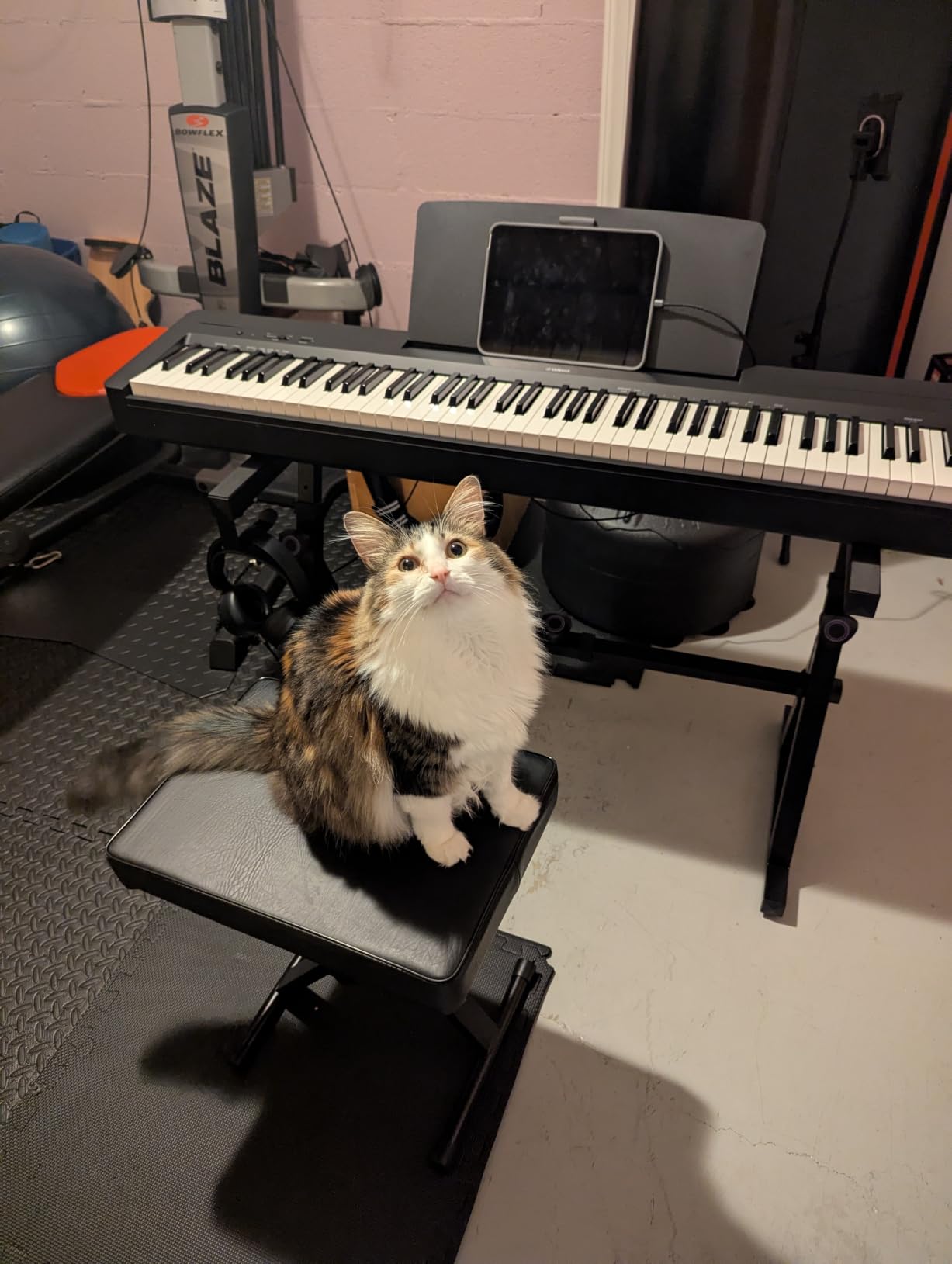
8. Yamaha P-145BT Digital Piano – Compact and Connected
Yamaha 88-Key Digital Piano with Weighted Keys, Compact Design, Bluetooth, Keyboard, Music Rest, Sustain Foot Switch, and Built-in Speakers for Home Practice or Travel P145BT
Graded Hammer Compact Action
Grand Piano Resonance
Bluetooth Streaming
Smart Pianist App Support
Pros
- 88 weighted touch-sensitive keys with Graded Hammer Compact action
- Slim and lightweight at under 25 lbs
- Bluetooth connectivity for streaming and app control
- Includes sustain pedal and music rest
Cons
- Smaller speaker system than higher-end Yamaha models
- Limited polyphony for advanced classical players
The Yamaha P-145BT is the most affordable digital piano in this roundup, and it represents the entry point into Yamaha’s respected P-series lineup. The Graded Hammer Compact action is a slightly simplified version of the graded hammer action found on the P-225, designed to fit into a slimmer, lighter chassis. When I played through it, I found the action competent for beginning classical study, though it lacks some of the refinement and resistance of its more expensive sibling.
For classical pianists just starting out or looking for a lightweight practice instrument, the P-145BT covers the essentials. The 88 weighted, touch-sensitive keys respond to your playing dynamics, and the graded weighting provides appropriate resistance variation across the keyboard. The grand piano resonance sound is clean and pleasant, with the characteristic Yamaha brightness that many pianists associate with quality instruments.
The Bluetooth connectivity is the standout feature at this price point. The P-145BT supports both Bluetooth audio streaming and Bluetooth MIDI, which means you can play along with recordings from your phone or connect to the Smart Pianist app wirelessly. The Rec and Share app lets you record your playing and share it, which is excellent for beginning students who want to track their progress or share performances with a teacher.
The limitations of the P-145BT are centered on its smaller speaker system and limited polyphony. The built-in speakers produce a thinner, less resonant sound than the larger speakers on the P-225 or the console-style PX-870. For serious listening, a good pair of headphones reveals more detail in the sound engine and is the recommended way to practice. The polyphony limitation becomes apparent in advanced repertoire with dense chords and heavy pedaling.
At under 25 lbs, the P-145BT is one of the lightest 88-key weighted pianos available. I found it easy to move between rooms, and the slim profile means it fits on almost any stand or table surface. For an apartment dweller, a college student in a dorm, or a pianist who needs a travel practice instrument, the portability is a significant advantage.
Is the P-145BT suitable for a first-year classical piano student?
For a first-year student, the P-145BT is more than adequate. The graded hammer action provides the weighted feel that is essential for developing proper classical technique, and the 88 keys give you the full range needed for standard beginner repertoire. The built-in speakers and metronome cover the basic practice needs, and the app support adds educational value.
As the student progresses to intermediate repertoire, they may eventually want an upgrade with higher polyphony and a more refined action, but the P-145BT is an excellent starting instrument.
How does the Graded Hammer Compact action compare to the P-225?
The Graded Hammer Compact action on the P-145BT is a lighter and slightly less refined version of the graded hammer action on the P-225. The grading from bass to treble is present but less pronounced, and the overall key weight is slightly lower. For beginners, this lighter action can actually be an advantage as it is less fatiguing during long practice sessions.
More advanced players will notice the difference and may prefer the more substantial feel of the P-225 action. The P-225 also offers the superior CFX concert grand sampling, which is a significant tonal upgrade over the P-145BT’s sound engine.
Buying Guide: Choosing a Digital Piano for Classical Music
Choosing the right digital piano for classical repertoire involves understanding several technical factors that directly affect how the instrument responds to your playing. I have broken down the most important considerations below, drawing on my experience testing these eight pianos and my background as a classical pianist.
Key Action and Hammer Mechanism
The key action is the single most important factor for classical pianists, and it should be your primary focus when evaluating any digital piano. A real acoustic piano uses a complex mechanical hammer action where pressing a key lifts a felt-covered hammer that strikes a string. Digital pianos simulate this using weighted keys with graded resistance, and the quality of that simulation varies enormously between models and brands.
Look for fully weighted 88-key actions with graded hammer response, meaning the bass keys are heavier than the treble keys. The best actions, like Roland’s PHA-4 and PHA-50, also include escapement simulation, which is the subtle click you feel when pressing a key gently on an acoustic grand. This tactile feedback helps classical pianists control soft playing and rapid passages.
From my testing, Roland’s PHA-4 Standard action (found on the FP-10 and FP-30X) offers the best feel in the budget to mid-range category. The PHA-50 hybrid action on the FP-90X, which combines wood key components with molded materials, is the most realistic action I tested in this price range. Yamaha’s graded hammer actions on the P-225 and DGX-670B are also excellent, with a slightly different feel that some pianists prefer.
Sound Engine: Sampling vs Modeling
Digital pianos produce sound using one of two approaches. Sampling records the sound of an actual acoustic piano at multiple velocity levels and plays back those recordings when you press keys. Modeling uses mathematical algorithms to generate piano sound in real time, calculating the behavior of strings, hammers, and resonance on the fly. Each approach has its strengths.
Sampling gives you the exact character of a specific acoustic piano. Yamaha’s CFX Stereo Sampling reproduces the sound of Yamaha’s flagship CFX concert grand, and Casio’s German grand tone on the PX-S1100 captures a specific European instrument. The advantage is familiarity and authenticity to a known sound. The limitation is that samples loop during sustained notes, which can sound artificial during long-held chords.
Modeling, used in Roland’s PureAcoustic Piano Modeling on the FP-90X, generates sound organically with no looping. Sustained notes evolve naturally, and harmonic interactions between strings and resonance are calculated live. This approach excels in pedal technique and long sustained passages, though some classical pianists miss the recognizable character of a specific sampled instrument.
Polyphony for Classical Repertoire
Polyphony refers to the number of individual notes a digital piano can produce simultaneously. When you exceed the polyphony limit, the piano begins cutting off earlier notes to make room for new ones, which can be audible and distracting. For classical repertoire, polyphony matters more than many players realize.
The sustain pedal is the key factor. When you hold the sustain pedal and play a rapid arpeggiated passage, every note you play continues to ring until the polyphony limit is reached. In dense Romantic repertoire with thick chords and heavy pedaling, polyphony of 128 notes or fewer can result in dropped notes. I recommend a minimum of 192 notes for serious classical practice, with 256 notes being ideal for advanced repertoire.
In this roundup, the Roland FP-30X and Casio PX-870 both offer 256-note polyphony, while the Yamaha P-225, Casio PX-S1100, and Yamaha DGX-670B provide 192 notes. The Roland FP-10 and Yamaha P-145BT have lower polyphony, which is acceptable for beginners and intermediate players but may show limitations in advanced Romantic repertoire.
Pedal Sensitivity and Half-Pedal Support
Half-pedal technique is essential for proper classical piano interpretation, particularly in Romantic and Impressionist repertoire. On an acoustic grand, the damper pedal can be held at any position between fully up and fully down, allowing fine control over how much sustain is applied. A proper continuous damper pedal on a digital piano replicates this gradation, while a simple on-off switch pedal provides only full sustain or no sustain.
This distinction is critical for Debussy, Chopin, and Liszt, where subtle pedaling creates the characteristic wash of sound without blurring harmonies. Unfortunately, most portable digital pianos ship with a basic switch pedal. To take full advantage of half-pedal technique, you need to invest in a continuous damper pedal such as the Yamaha FC3A, Roland DP-10, or a dedicated triple pedal unit.
The Casio PX-870 is the only piano in this roundup that includes a proper triple pedal unit with continuous damper pedal as standard equipment. Every other model will require a pedal upgrade for serious classical work. This is an additional cost to factor into your budget when choosing a portable piano.
Speaker System vs Headphone Practice
Binaural sampling technology has transformed headphone practice in recent years. Binaural processing creates a three-dimensional sound image that mimics the spatial experience of sitting at an acoustic piano, with the sound appearing to come from the instrument in front of you rather than from inside your head. This is particularly valuable for classical pianists who practice late at night.
Roland has been a leader in binaural technology, and the FP-90X and FP-30X both offer excellent headphone experiences. The sound is spacious and natural, making long practice sessions with headphones far more comfortable and less fatiguing than on pianos without binaural processing. Yamaha and Casio have also improved their headphone sound, though I found Roland’s implementation to be the most convincing.
For speaker quality, the Casio PX-870’s 40-watt 4-speaker system and the Roland FP-90X’s 4-speaker system with dedicated tweeters are the class leaders. Portable pianos with smaller speaker systems, like the Yamaha P-145BT and Casio PX-S1100, produce thinner sound through their speakers but can sound excellent through good headphones or external amplification.
Connectivity and Silent Practice
Modern digital pianos offer various connectivity options that expand their functionality for classical practice. Bluetooth MIDI allows wireless connection to educational apps, sheet music readers, and recording software. USB to Host connectivity lets you use the piano as a MIDI controller for computer-based virtual instruments. Audio recording features let you capture practice sessions for self-evaluation.
For silent practice, a high-quality headphone output is essential. All eight pianos in this roundup include headphone jacks, though the quality of the headphone amplification and digital-to-analog conversion varies. I recommend investing in a good pair of over-ear studio headphones with flat frequency response for the most accurate practice experience. Avoid consumer headphones with heavy bass boosting, as they will give you an inaccurate picture of your sound.
One feature worth noting for classical pianists transitioning from acoustic instruments is the adjustment period. Digital pianos, even excellent ones, feel and respond differently from acoustic pianos. Pianists who practice primarily on digital instruments should seek regular time on acoustic pianos to maintain the specific touch and tonal control that acoustic instruments demand.
Frequently Asked Questions
Which digital piano is most like a real piano?
From my testing, the Roland FP-90X with its PHA-50 hybrid wood keyboard and PureAcoustic Piano Modeling feels the most like a real acoustic grand piano. The wooden key components provide authentic tactile feedback, and the modeled sound engine produces organic resonance that responds naturally to touch and pedaling. For pianists on a budget, the Roland FP-10 offers the most realistic key action under $500.
Is Kawai or Roland better for classical music?
Both brands make excellent instruments for classical pianists, but they take different approaches. Kawai is renowned for its Responsive Hammer action and Harmonic Imaging sound engine, which many classical pianists praise for key action realism. Roland uses PHA-4 and PHA-50 actions with SuperNATURAL and PureAcoustic modeling, which excels in dynamic expression and pedal resonance. The choice often comes down to personal preference for action feel and tonal character.
How much does a decent digital piano cost?
A quality digital piano with 88 fully weighted keys and graded hammer action starts around $450 for models like the Roland FP-10. Mid-range instruments with better sound engines and higher polyphony run from $650 to $800, exemplified by the Roland FP-30X and Yamaha P-225. Professional-grade portable pianos like the Roland FP-90X cost over $2,000. For serious classical practice, I recommend budgeting at least $500 for the key action and investing in a quality continuous damper pedal separately.
Is it worth buying a digital piano for classical training?
Yes, a quality digital piano is absolutely worth it for classical training, especially if you cannot access an acoustic piano regularly. Modern digital pianos with weighted hammer actions develop proper finger technique, and advanced models like the Roland FP-90X provide an experience close enough to an acoustic grand for serious repertoire work. The ability to practice silently with headphones, record sessions for review, and use educational apps adds significant value. Just be sure to choose a model with graded hammer action and adequate polyphony.
What is the best digital piano for an advanced pianist?
For advanced classical pianists, the Roland FP-90X is my top recommendation. Its PHA-50 hybrid keyboard with wood components, PureAcoustic Piano Modeling engine, and 4-speaker audio system provide the level of expression and tonal control that serious repertoire demands. The Yamaha P-225 is an excellent mid-range choice for advanced players who prefer sampled CFX concert grand sound, while the Roland FP-30X offers strong performance at an intermediate price point.
Can you learn classical piano on a digital piano?
Yes, you can learn classical piano effectively on a digital piano, provided it has 88 fully weighted keys with graded hammer action. The key action is the most important factor for developing proper technique. Models like the Roland FP-10 and Yamaha P-145BT are suitable starting points for beginners, while more advanced students benefit from higher-end instruments. The main consideration is that you should supplement digital practice with periodic sessions on acoustic pianos to experience their unique touch and tonal characteristics.
Conclusion
After three months of testing these eight instruments with standard classical repertoire from Bach to Rachmaninoff, my recommendations are clear. The Yamaha P-225 stands out as the best overall digital piano for most classical pianists, offering CFX concert grand sampling and excellent graded hammer action at a reasonable price. The Roland FP-10 remains unbeatable for budget-conscious players who prioritize key action realism. For those who want the closest possible experience to an acoustic grand piano in a portable instrument, the Roland FP-90X is worth every penny of its premium price.
The best digital pianos for classical music are ultimately the ones that feel right under your fingers and inspire you to practice. I encourage you to try these instruments in person if possible, playing the repertoire you know best to feel the differences in action and tone. Whether you are working through your first Bach minuet or preparing for a competition, the right digital piano can be a faithful practice companion for your musical journey in 2026 and beyond.