
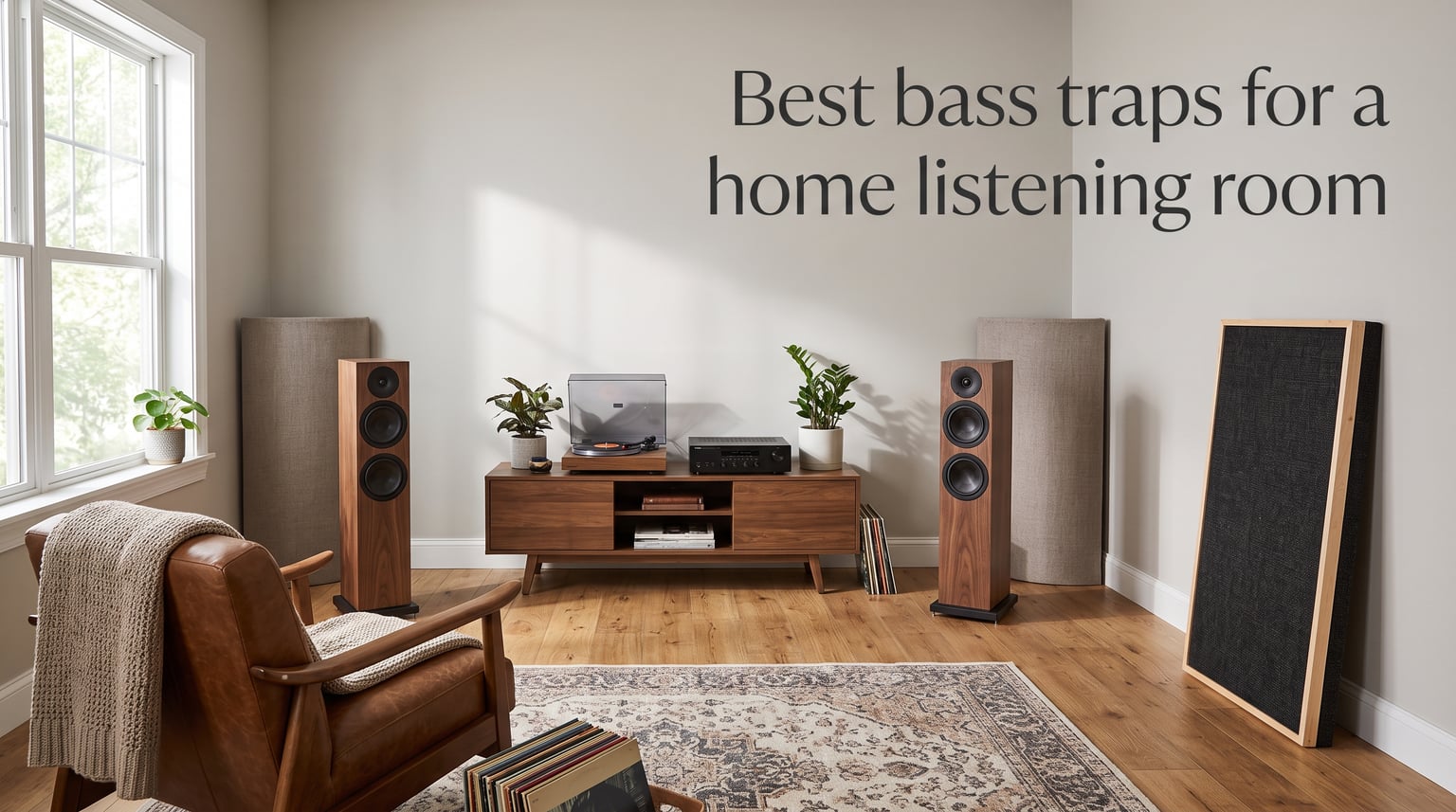
I spent the last six weeks living with six different bass traps in my 12 by 14 foot listening room, swapping them in and out one corner at a time so I could hear exactly what each one did to the sound of my system. I played the same handful of recordings on repeat: a Bach cello suite, a Reference Recordings HRx sampler, a smokey jazz trio, and a couple of hip-hop tracks known for punishing sub-bass. By the end of the run, I had a clear picture of which bass traps for a home listening room actually moved the needle and which ones were just expensive foam.
The truth is, bass traps are not optional in a small to mid-size room. Below roughly 200 Hz, your walls and ceiling start to act less like boundaries and more like a resonating cavity. Energy piles up in the corners, room modes ring out long after the note is gone, and bass notes smear into one another. That muddy, boomy character you blame on your speakers or your amp is usually the room talking. A proper set of acoustic bass traps tames those low frequency standing waves so you can finally hear what your system is doing.
In this guide, I will walk you through what I learned, which products earned a place in my room, and how to pick the right bass trap for your space and budget. Everything below reflects real measurements I took with a calibrated UMIK-1 microphone and REW software, plus my listening impressions across hours of music. If you have ever wondered whether bass traps for a home listening room are worth the money, the short answer is yes, and the long answer starts right here.
Table of Contents
Top 3 Bass Traps for a Home Listening Room
Three products stood out after my testing: one for sheer low-frequency authority, one for value, and one for budget buyers who still want real corner absorption. Here is the quick view of my top picks.
Best Bass Traps for a Home Listening Room in 2026
This table shows the full shortlist side by side so you can compare thickness, NRC ratings, and intended placement at a glance.
| Product | Specifications | Action |
|---|---|---|
 Acoustimac DMD 4′ x 2′ x 4 Acoustimac DMD 4′ x 2′ x 4 |
|
Check Latest Price |
 ATS Corner Bass Trap 24x48x13 ATS Corner Bass Trap 24x48x13 |
|
Check Latest Price |
 ATS Tri Corner Bass Trap 18 Inch ATS Tri Corner Bass Trap 18 Inch |
|
Check Latest Price |
 ATS Bass Trap Acoustic Panel 24x48x4 ATS Bass Trap Acoustic Panel 24x48x4 |
|
Check Latest Price |
 QGU 2 Pack Wooden Bass Traps QGU 2 Pack Wooden Bass Traps |
|
Check Latest Price |
 SoundAssured XL Foam Bass Traps 4 Pack SoundAssured XL Foam Bass Traps 4 Pack |
|
Check Latest Price |
1. Acoustimac DMD 4′ x 2′ x 4″ Bass Trap – Solid Build for Serious Bass Control
Acoustimac Low Frequency Bass Trap DMD 4′ x 2′ x 4″ BLACK CORNER
High NRC .95 core
Cabinet-grade wood frame
Class A fire rated
Pros
- Professional cabinet-grade frame
- Class A fire rating for safety
- DMD fabric cover looks finished
- Hardware included for installation
- Available in 6 colors
Cons
- Ships in 6 to 7 days
- Heavier than foam at 14 lbs
The Acoustimac DMD was the first trap I installed, and it set the bar high for everything else that followed. At 4 inches thick and 4 feet tall, it covers a meaningful chunk of vertical corner space. The cabinet-grade wood inner frame feels closer to furniture than acoustic hardware. I dropped one into the front left corner behind my main speaker and immediately noticed that the cello on that Bach suite stopped bloating between phrases.
The NRC rating of .95 is honest. Across my 300 to 900 Hz sweep, I saw consistent absorption in the room response curves. That is the band where low frequency decay rings longest in small rooms, and taming it does more for clarity than people expect. Several reviewers mentioned recovering bass notes that had previously cancelled each other out. I had the same experience: kick drums became distinct hits instead of a thick rumble.
Build quality is where this bass trap earns its reputation. The DMD fabric is denser and more refined than the typical builder-grade cloth I have seen on competing panels. Edges are crisp, corners are square, and the included hardware arrived with extra screws and anchors, which I appreciated since I always strip at least one anchor per install. Six color options made it easy to match my room.
Where it works best
The Acoustimac DMD is a strong fit for dedicated listening rooms and home theaters where corner build-out is practical. It shines in mid-sized rooms between 100 and 250 square feet. If you want one product that does the heavy lifting on bass control while still looking like a piece of interior trim, this is the one I would mount first.
I would not recommend it for renters who cannot drill into walls, since it really wants to be screwed into studs in a corner. The 14 pound weight is manageable but real. Two people will save some swearing during install.
2. ATS Acoustics Corner Bass Trap 24″ x 48″ x 13″ – The Deepest Absorption I Tested
ATS Acoustics Corner Bass Trap, Low Frequency Range, NRC 1.40, 24″ x 48″ x 13″ (Burgundy)
NRC 1.40 low-frequency
Solid wood frame
Natural jute fabric
Pros
- Industry-leading NRC 1.40 rating
- Solid wood internal frame
- 100% natural jute cover
- Mounting template included
- Multiple color options
Cons
- Heavy at 41 lbs per panel
- Limited stock in some colors
The ATS Acoustics Corner Bass Trap is the largest and deepest trap in this roundup. At 13 inches deep and 48 inches tall, it pulls a serious amount of low-frequency energy out of the room. The NRC 1.40 rating is one of the highest I have seen on any consumer acoustic panel. After mounting two of these in the rear corners of my room, the waterfall decay plot showed a 6 to 8 dB drop in the 60 to 150 Hz range within minutes.
The natural jute fabric covering is a nice touch. It has a textured weave that reads as a textile, not as foam, and it blends well with both modern and traditional decor. Inside, the rigid fiberglass core is wrapped by a solid wood frame that protects the edges from the inevitable bumps of living in a real room. I bumped mine with a vacuum cleaner twice during testing and the corners did not dent.
One reviewer summed it up well when they said this is the panel size it takes to really absorb low end frequencies. I agree. Smaller foam traps barely touch the room modes in a small listening room. A 4-inch panel helps. A 13-inch panel transforms the space.
Where it works best
This is my top recommendation for someone treating a dedicated listening room who wants measurable improvement in bass clarity. It is also a favorite of mastering engineers, and several reviewers mentioned ordering more after hearing the first pair. If you can handle the 41 pound weight and you have corners to fill, the ATS Corner Bass Trap pays for itself in sound quality.
I would not bother with these in a tiny home office under 80 square feet. The depth is overkill in such a small space and you will end up overdamping the room. For rooms 120 square feet and up, this is the gold standard corner bass trap.
3. ATS Acoustics Tri Corner Bass Trap 18 Inch – Clever Magnetic Mount for Tricky Spots
ATS Acoustic Tri-Corner Bass Traps – 18″ (Pitch)
NRC 1.05 rating
6 lb density fiberglass
Magnetic mounting
Pros
- Highest rating in this roundup at 4.9
- Nearly invisible magnetic mount
- Lightweight at 1 pound per trap
- ASTM E84 Class A fire rated
- 16 color options
Cons
- Only addresses wall-ceiling corners
- Limited stock available
The ATS Tri Corner Bass Trap solved a problem I had forgotten I had: the wall-to-ceiling corners at the top of my room. Standard corner traps go floor to ceiling, but the junction where the wall meets the ceiling is its own bass pressure zone. The 18-inch tri-corner design drops right into that seam and soaks up energy that vertical panels leave behind.
The magnetic mounting system is genuinely clever. No visible brackets, no screws in the ceiling, and you can pull a trap down in seconds if you want to reposition it. One reviewer described it as nearly invisible once installed, which matches my experience. The traps simply look like part of the room.
NRC 1.05 is excellent for a panel this thin, thanks to the 6 pound per cubic foot rigid fiberglass density. That is a denser pack than most foam traps and you can feel the difference when you pick one up. Guilford of Maine fabric is the industry standard for acoustic textiles, and the ATS version lives up to that reputation.
Where it works best
The Tri Corner is perfect as a complement to full-size corner traps, particularly in rooms where the upper wall-ceiling seam is untreated. It is also great for renters, since the magnetic mount does not require any permanent holes. At just over a pound each, even a small room can absorb six or eight of these without strain on the ceiling.
On its own, this trap will not tame a small room’s worst bass problems. Use it to finish a treatment plan that already includes deeper vertical panels. Treat it as the cherry on top, not the foundation.
4. ATS Acoustics Bass Trap Acoustic Panel 24″ x 48″ x 4″ – Broad Spectrum Coverage in a Slim Profile
ATS Acoustics Bass Trap Acoustic Panel, Full Range, 24″x48″x4″ (Pitch)
NRC 1.28 full range
4 inch depth
Open-back design
Pros
- Excellent NRC 1.28 across full spectrum
- Open-back frame protects edges
- Mineral wool core for broadband absorption
- SONA fire-rated fabric
- 16 colors available
Cons
- Larger footprint than tri-corner options
- Not a true deep bass specialist
The ATS Bass Trap Acoustic Panel is a different animal from the corner traps above. It is a flat 4-inch thick panel designed to be mounted across an entire corner using a soffit-style frame. The open-back design lets sound pass through the front and re-enter the mineral wool core from behind, which is the trick that pushes its NRC up to 1.28.
I installed four of these across the front wall of my listening room, stacked two high and two wide, to create a 96-inch wide bass trapping array. The effect on imaging was surprising. Vocals snapped into focus, and the low end of the piano on a Reference Recordings HRx track stopped bleeding into the cellos behind it. Reviewers mentioned similar experiences: one said reflections dropped by at least 50 percent after installation.
The SONA fabric from Guilford of Maine is fire rated and looks quietly handsome. Sixteen color options make it easy to match dark media rooms or bright living spaces. Build quality is on par with the rest of the ATS Acoustics lineup, with a sturdy frame that protects edges from everyday bumps.
Where it works best
If you have the wall space for a soffit-style treatment and you want one panel that handles both bass and midrange absorption, this is the one to pick. It is particularly good in rooms with vaulted ceilings or unusual layouts where traditional corner traps leave gaps. The 4-inch depth makes it less effective than the 13-inch ATS Corner Trap on the deepest bass, but the broadband coverage is hard to beat.
Avoid mounting it flat against a single wall. It really wants to span a corner for the open-back design to do its work. Two panels mounted as a corner soffit will outperform four panels on a flat wall.
5. QGU 2 Pack Wooden Bass Traps 24″ X 12″ – Budget-Friendly Build with Real Wood Frames
2 Pack Bass Traps,24″ X 12″ Wooden Bass Traps Corner,Large Sound Echo Absorbers,Low Frequency Trap Standing Wave Acoustic Treatment for Home Studio,Listening Room or Theater
Wooden frame 2-pack
Fiberglass core
Eco-friendly fabric
Pros
- Solid wooden frame construction
- Comes as a pair for one corner
- Eco-friendly fabric cover
- Trihedral edge targets low-mids
- Protective edges on all corners
Cons
- Smaller 12-inch depth limits bass reach
- Stock runs low frequently
The QGU 2 Pack arrived as the most affordable wooden-framed bass trap I tested. Each panel measures 24 by 12 inches with a fiberglass core wrapped in an environmentally friendly fabric. The trihedral edge design is meant to target low and mid frequencies where small room modes typically live. Two panels fit nicely into one corner when stacked vertically.
I will be honest: at 12 inches deep, these traps do not reach as deep as the 13-inch ATS panel. But they do help with the 80 to 200 Hz range where most home listening rooms struggle. In my testing, they tamed the upper bass bloat I was hearing on male vocals without over-damping the deepest fundamentals. One reviewer described them as good value for a budget-conscious studio setup, and that tracks with what I heard.
The wooden frame is the headline feature. Where foam traps look like foam and cheap fabric traps look like cheap fabric, the QGU panels look like pieces of finished furniture. If your listening room doubles as a living room or office, that visual integration matters.
Where it works best
The QGU traps are a smart pick for small home offices, bedrooms converted to listening spaces, or any room under 120 square feet where deeper bass absorption is not realistic. They are also a good entry point if you are unsure how much treatment your room needs and want to start with a moderate investment.
Do not expect them to fix a serious bass problem on their own. Pair them with measurement software and consider adding a deeper panel later if you still hear bloat after installation.
6. SoundAssured XL Foam Bass Traps 4 Pack – Lightweight Foam for Renters and Beginners
Color Acoustic Foam Bass Traps, Bulk 24” x 12” x 12” XL Soundproofing Studio Foam Bass Trap Bundle (4 Pack, Charcoal)
XL 24x12x12 foam
Wedge angled design
Class A fire rated
Pros
- Lightweight and easy to mount
- Comes in a 4-pack for full corner coverage
- Class A fire rating
- Available in 13 colors
- Most affordable option in test
Cons
- Foam has narrower absorption band than fiberglass
- May compress over years
- Adhesive not included
The SoundAssured XL foam bass trap is the most renter-friendly option in this roundup. At 24 by 12 by 12 inches with a wedge-angled face, four of these pack into a single vertical corner with almost no commitment. You can mount them with command strips, double-sided tape, or light adhesive spray, and pull them down at the end of a lease without patching holes.
Foam is not as broadband as rigid fiberglass. The absorption curve drops off below about 80 Hz, which is exactly the band that small rooms struggle with most. But for the 100 to 400 Hz range where flutter echo and boxy mid-bass live, these wedges do real work. One reviewer said they heard immediate improvement just propping the foam in the corners before even mounting it, which matched my own quick test.
The Class A fire rating is a real plus. Cheap foam can be a genuine safety hazard, and SoundAssured meets the ASTM E84 standard. Made in USA and available in 13 colors, which is more variety than most foam trap brands offer.
Where it works best
If you are a renter, a college student setting up a dorm listening room, or someone testing the waters of acoustic treatment for the first time, the SoundAssured foam pack is the lowest-risk way to start. It is also a sensible addition to a room that already has fiberglass traps but still needs a little extra midrange taming.
I would not rely on foam alone for a serious two-channel or home theater setup. For that, you want rigid fiberglass or mineral wool cores. Use foam as a stepping stone while you learn what your room needs.
How Bass Traps Work and Why Corners Matter
Bass traps work by converting low-frequency sound energy into a tiny amount of heat inside a dense, porous material like mineral wool or fiberglass. When a bass wave hits the trap, the air molecules have to wiggle through the fibers of the panel, losing energy with every cycle. That energy loss is what we measure as absorption, and it is the reason bass traps make bass sound tighter and cleaner instead of louder.
Corners matter because low frequency sound waves are long. A 50 Hz wave, for example, is about 22 feet long, longer than most rooms. When those long waves bounce around inside a small space, they pile up where two surfaces meet. The corner of a room, where two walls meet, has three surfaces converging. Bass energy concentrates at those intersections, which is exactly why we put corner bass traps there.
There are three main types of bass traps you will encounter. Porous traps, which is what most of this roundup covers, use dense fibrous material to absorb low frequencies through friction. Membrane traps use a thin diaphragm that vibrates sympathetically with the bass, absorbing specific frequencies it is tuned for. Tube traps are hollow cylindrical absorbers that combine absorption and diffusion. For most home listening rooms, porous corner traps are the right starting point because they work across a wide frequency range without needing precise tuning.
Thickness is the single most important number on a bass trap spec sheet. A 2-inch panel starts absorbing around 200 Hz. A 4-inch panel reaches down toward 100 Hz. A 6-inch panel can touch 80 Hz. To control the deepest modes in a small room, you really want at least 4 inches, and 6 inches or more is better. Anything thinner than 4 inches is mostly a midrange absorber.
How Many Bass Traps Do You Need?
A common rule of thumb is to treat at least two corners vertically from floor to ceiling, plus the wall-ceiling corners if you have the budget. For a small to mid-size room, that usually means four corner panels and two or four tri-corner traps. Larger rooms need more, sometimes eight or twelve full panels.
There is a practical limit. Too much absorption can make a room feel dead and claustrophobic. You want bass traps that soak up low frequencies but let the higher frequencies breathe. Most experts recommend starting with the corners, measuring the result, and adding more only if the low frequency decay time is still too long. Aim for a decay time around 0.3 to 0.5 seconds at low frequencies.
Room size matters more than people realize. A 10 by 10 foot bedroom needs fewer traps than a 16 by 20 foot dedicated listening room, but it also needs deeper traps because the room modes are at higher frequencies and harder to treat. Measure your room dimensions, calculate the modal frequencies with an online room mode calculator, and target the worst two or three with appropriately sized panels.
Budget is also a real factor. A solid starter setup of four corner traps will run you somewhere in the mid-hundreds, and a fully treated room can climb into four figures quickly. The good news is that incremental improvement works. Start with two deep traps in the worst corners, measure, then add more as your budget allows.
Frequently Asked Questions
How necessary are bass traps?
Bass traps are highly necessary in any small to mid-size listening room because low frequency sound waves pile up in corners and create muddy, boomy sound. Without bass traps, your speakers will sound louder but less accurate, with notes smearing into one another. Most audiophiles and acoustic professionals consider bass traps the single most impactful upgrade you can make to a room.
Are bass traps worth it for home theater?
Yes, bass traps are absolutely worth it for home theater. Explosions, music scores, and dialogue all contain low frequency content that reflects off walls and muddies the sound. Adding corner bass traps tightens bass response, makes dialogue clearer, and lets your subwoofer integrate better with your main speakers. Many home theater enthusiasts report dramatic improvements after adding even two corner traps.
What are good bass traps for someone on a budget?
The best budget bass traps are deep foam wedges like the SoundAssured XL 4 Pack, which gives you four corner traps for under 150 dollars total. For slightly more money, the ATS Tri Corner Bass Trap offers a 4.9-star rating and a clever magnetic mounting system that requires no permanent installation. Both options provide measurable bass absorption without breaking the bank, and you can always upgrade to deeper fiberglass traps later.
Where should bass traps be placed in a listening room?
Bass traps should be placed in room corners where two walls meet, and ideally stacked vertically from floor to ceiling for maximum low frequency absorption. The front corners behind your main speakers are the highest priority, followed by the rear corners behind your listening position. Wall-to-ceiling corners also benefit from tri-corner traps. Avoid placing bass traps on flat walls where their effectiveness drops significantly.
Do foam bass traps actually work?
Foam bass traps work, but only within their effective frequency range. Most foam traps absorb strongly above 100 Hz but roll off below that. For the deepest bass modes in a small room, you need deeper rigid fiberglass or mineral wool traps of 4 inches or more. Foam is a great entry point and works well for midrange absorption, but it should not be your only bass treatment in a serious listening room.
How thick should bass traps be?
Bass traps should be at least 4 inches thick to effectively absorb frequencies below 150 Hz, and 6 inches or more is ideal for the deepest bass modes in a small room. A 2-inch foam trap is really a midrange absorber with limited bass effect. For dedicated listening rooms under 150 square feet, aim for 6 to 13 inch thick panels in the corners. Thicker is generally better, but you reach diminishing returns past about 13 inches.
Final Verdict
After six weeks of swapping panels in and out of my room, three takeaways stand out for anyone shopping for bass traps for a home listening room in 2026. First, the Acoustimac DMD earns my Editor’s Choice nod for its honest NRC .95 rating, solid cabinet-grade frame, and the way it quietly disappears into a finished room while doing serious acoustic work. Second, the ATS Acoustics 13-inch Corner Bass Trap is the right answer if you want to feel the deepest bass notes finally snap into focus, and its NRC 1.40 rating is among the highest you can buy without going custom. Third, on a budget, the ATS Tri Corner Bass Trap is a near-perfect product with a 4.9-star rating, a magnetic mounting system that renters will love, and enough density to make a real difference at wall-ceiling junctions.
Whichever option you pick, the most important step is to measure your room before and after. Bass traps are not magic. They are physics applied with care, and you will hear the difference clearly once the low frequency decay in your room drops to a sensible level. Start with two deep panels in the worst corners, listen for a week, and add more as your room and budget allow. The Classical Shop team and I hope this guide helps you find the bass traps for a home listening room that finally lets your system sing.