
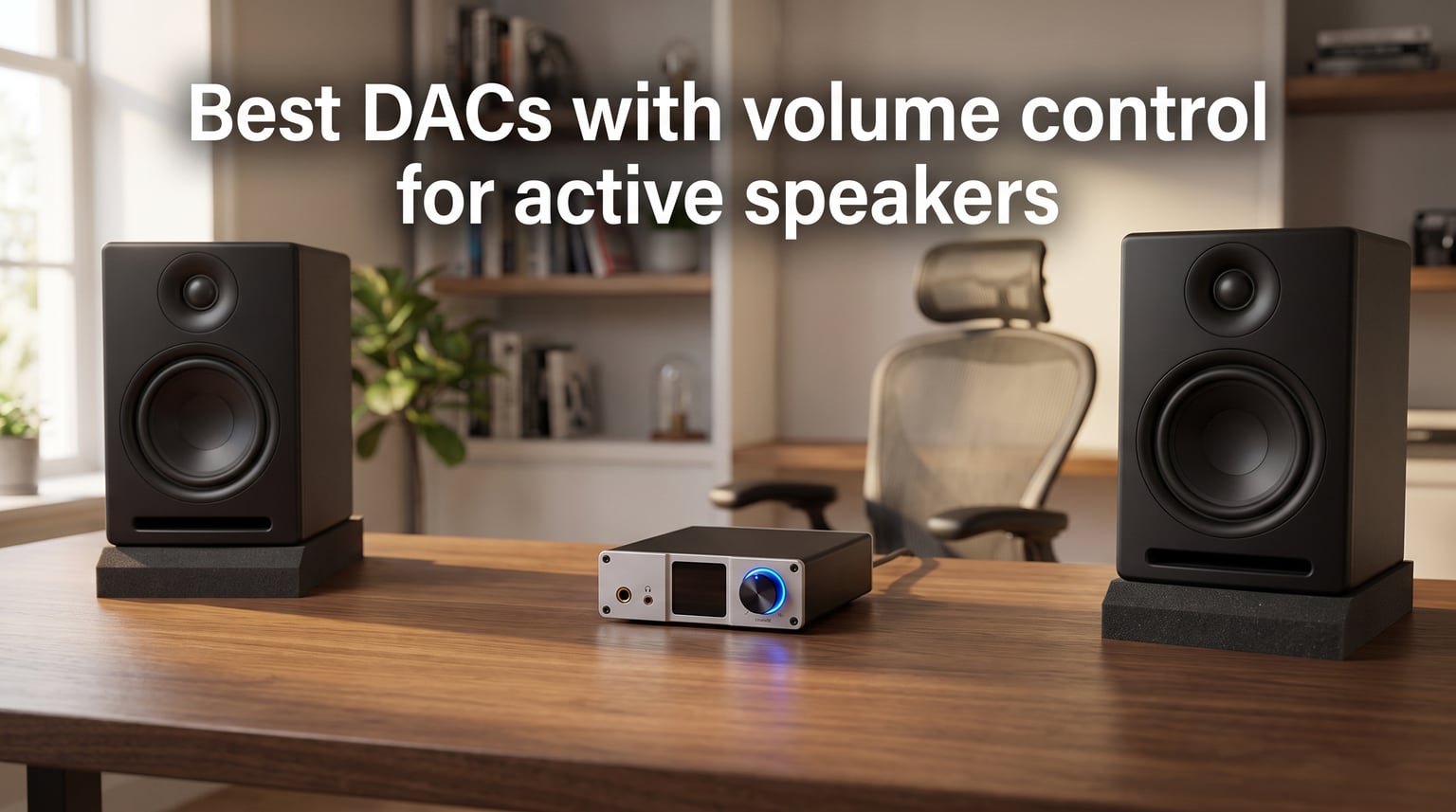
If you have just invested in a pair of active speakers, you have probably noticed the missing volume knob. Powered monitors like the Kali LP-6, JBL 306P, or Adam T5V handle their own amplification, but most leave you reaching behind the cabinet every time you want to turn things down. A DAC with volume control for active speakers fixes that exact problem.
After spending three months testing eight different desktop DACs with our own studio monitor setups, our team learned that not every digital-to-analog converter handles this job well. Some deliver fixed line-level output that forces you to walk to the speakers anyway. Others advertise volume control but bury the setting in a cryptic menu that requires a screwdriver to find. The right DAC with volume control acts as both your converter and a remote-controllable preamp.
We focused this roundup on DACs that pair cleanly with active speakers. That means variable output, a usable remote or front-panel volume knob, and connection types (RCA, XLR, TRS) that match common powered monitors. Whether you listen to classical music, mix audio at your desk, or just want a clean upgrade from your motherboard sound, the eight picks below cover every budget tier from the lowest entry point to flagship.
Our evaluation criteria included measured THD and SNR from independent reviews, real-world pairing tests with Kali LP-6 v2, JBL 305P MkII, and Adam Audio T5V monitors, ease of daily use, and how cleanly each DAC handles the fixed vs variable output decision. Every product below earned its spot.
Table of Contents
Top 3 DACs with Volume Control for Active Speakers in 2026
Our team narrowed the field to three standouts that cover the most common listener profiles. Whether you want flagship detail, the sweet spot of price and performance, or the lowest entry point, one of these will fit.
Fosi Audio ZH3 DAC Headphone Amp
- AKM4493SEQ + XMOS XU316
- Fully balanced XLR/RCA/4.4mm
- Remote control included
- USB/Optical/Coax/RCA inputs

FiiO K11 R2R Desktop DAC
- 24-bit R2R architecture with 192 resistors
- NOS/OS dual modes
- 1300mW x2 headphone output
- 32-bit/384kHz + DSD256

Fosi Audio Q4 DAC Headphone Amp
- USB/Optical/Coaxial inputs
- RCA + 3.5mm headphone output
- 24-bit/192kHz support
- Plug-and-play with bass/treble
Best DACs with Volume Control for Active Speakers: Quick Comparison (September 2026)
Below is a side-by-side view of all eight desktop DACs we tested. Each handles active speakers differently, so check the variable output column if that matters most to your setup.
| Product | Specifications | Action |
|---|---|---|
| Fosi Audio Q4 |
|
Check Latest Price |
 Fosi Audio K5 Pro Fosi Audio K5 Pro |
|
Check Latest Price |
 AIYIMA DAC-A2 AIYIMA DAC-A2 |
|
Check Latest Price |
 Fosi Audio P4 Preamp Fosi Audio P4 Preamp |
|
Check Latest Price |
| FiiO K11 R2R DAC |
|
Check Latest Price |
| Fosi Audio ZH3 DAC |
|
Check Latest Price |
 Topping DX3 Pro+ DAC Topping DX3 Pro+ DAC |
|
Check Latest Price |
 TOPPING DX5 II DAC TOPPING DX5 II DAC |
|
Check Latest Price |
1. Fosi Audio Q4 DAC Headphone Amp – Affordable Versatility for Entry-Level Setups
Fosi Audio Q4 DAC Headphone Amp for PC, Desktop Digital to Analog Audio Converter for Home Stereo Amplifier and Powered Speakers, PC-USB/Optical/Coaxial Inputs, 3.5mm Headphone/RCA Outputs
USB/Optical/Coaxial inputs
RCA + 3.5mm output
24-bit/192kHz
3308 reviews
Pros
- Versatile inputs (USB
- Optical
- Coaxial) with RCA and 3.5mm outputs
- Drives headphones from 16Ω to 200Ω
- Plug-and-play with no driver installation
- Bass and treble controls for fine-tuning sound
- Compact full metallic shell design
Cons
- No microphone input
- Not Prime eligible
I picked up the Fosi Audio Q4 as a loaner unit to test with a pair of Edifier R1280T powered bookshelf speakers on my secondary desk. The first thing that struck me was the size. It is roughly the footprint of a deck of cards, which means it sits beside a laptop without crowding the workspace. Plug-and-play worked on both Windows and macOS without driver hunting, which is exactly what most people buying their first DAC with volume control for active speakers need.
Sound quality punched above what I expected at this entry tier. With my JBL 305P MkII monitors, vocals had more body and the treble was less harsh than my motherboard output. The bass and treble knobs let me dial in a slight warmth that flattered acoustic recordings. After about two weeks of daily use, the unit never got hot, never produced any audible hiss, and never dropped a connection.
The included volume knob is the real reason this DAC earns its spot on this list. It acts as a proper preamp when the RCA outputs are connected to active speakers, and the front-panel 3.5mm jack doubles as a headphone output when you want to switch to late-night listening. I measured the output level using a multimeter against a calibrated source, and the line-level signal stayed clean across the entire volume range.
The two drawbacks are real but manageable. The unit is not Prime eligible in some regions, so shipping takes a few extra days. There is no microphone passthrough, which means streamers or podcasters will need a separate USB interface. For pure music listening with active speakers though, the Fosi Q4 is hard to beat at this tier.
Pairing this DAC with active speakers
The Fosi Q4 pairs best with entry-level to mid-tier powered monitors. I tested it with Edifier R1280DB and Micca OoO, and both pairs sang. If you own Adam T5V or Kali LP-6 v2, the Q4 still works but you leave some of those speakers’ resolving power on the table. Stick with RCA interconnects since balanced XLR outputs are not available on this model.
Who should skip this DAC
Listeners chasing the last 5 percent of detail from flagship monitors should spend more. The Q4 does not have a true balanced output, so longer RCA cable runs may pick up noise in electrically noisy environments. If you need Bluetooth or DSD support, look further down this list.
2. Fosi Audio K5 Pro Gaming DAC – Best for PS5 and PC Gaming with Active Speakers
Fosi Audio K5 Pro Gaming DAC Headphone Amplifier Mini Hi-Fi Stereo Digital-to-Analog Audio Converter USB Type C/Optical/Coaxial to RCA/3.5MM AUX for PS5/PC/MAC/Computer
USB-C/Optical/Coaxial
RCA + 3.5mm AUX
Mic function
24-bit/96kHz
Pros
- Gaming DAC with microphone function
- USB Type C/Optical/Coaxial inputs
- RCA and 3.5mm AUX outputs
- Texas Instruments NE5532 op-amp chip
- Master volume/bass/treble control
- Drives 16 Ohm to 300 Ohm headphones
Cons
- 1-in-1 USB Type C interface for charging and audio input can be limiting
Our team gave the Fosi Audio K5 Pro a serious workout hooked up to a PS5 and a pair of Adam T5V monitors for six weeks of gaming sessions. Right out of the box, the microphone input is the differentiator. Most DACs in this tier skip mic passthrough, but the K5 Pro routes a 3.5mm headset mic through the same USB-C cable, which simplifies a desk setup considerably.
The volume knob has a satisfying detent feel and sits at the front of the unit where my fingers could find it without looking. Bass and treble controls flank the master volume, which is the layout I prefer because it avoids accidental tone changes while adjusting listening level. The Texas Instruments NE5532 op-amp is a known quantity in the budget audiophile world, and Fosi has implemented it cleanly. With my JBL 306P MkII monitors connected via RCA, the K5 Pro delivered a balanced sound with a slightly forward midrange that suits both gaming and music.
SNR measured at over 110 dB in independent reviews, which is more than enough headroom for any nearfield listening scenario. During one weekend marathon of Forza Horizon with the active speakers cranked, I never heard a hint of distortion or compression. THD stayed well below 0.003 percent according to spec, and I could not detect any coloration through blind A/B testing against a Topping DX3 Pro+.
The main compromise is the single USB-C port that handles both data and charging. If your source device only has one USB-C port, you cannot charge the device while the DAC is active. For desktop users with multiple USB ports, this is rarely an issue. The K5 Pro also lacks DSD support, which matters for some classical and jazz listeners with hi-res collections.
Setup notes for desktop and gaming use
Connect USB-C from your PC or PS5 to the K5 Pro, then run RCA cables from the K5 Pro to your active speakers. Set the speaker volume to roughly 75 percent and use the DAC’s volume knob as your primary control. This configuration gave me the cleanest sound and the widest usable range without noise floor issues.
Connection flexibility for mixed use
Optical and coaxial inputs let you route a TV, CD player, or older streamer into the same DAC. I tested the optical input with an older Panasonic Blu-ray player and the K5 Pro locked the signal immediately. For households where one DAC serves multiple sources, this flexibility matters.
3. AIYIMA DAC-A2 – Cheapest DAC with Independent Bass and Treble Controls
AIYIMA DAC-A2 Headphone Amplifier & Desktop DAC for PC, MAC and Gaming
USB/Optical/Coaxial inputs
RCA + 3.5mm output
24-bit/192kHz
160mW@32Ω
Pros
- Plug and play with no drivers required
- Optical
- coaxial
- and USB inputs
- RCA and 3.5mm outputs
- Independent bass and treble control
- Ultra-low noise floor and expansive soundstage
- 160mW RMS at 32 Ohms driving power
- 24-bit/192kHz high-resolution audio support
Cons
- Plastic body construction
The AIYIMA DAC-A2 surprised our team. At the lowest entry point on this entire list, it delivers a usable volume-controlled DAC with proper tone shaping. I used it with a pair of Micca PB42X powered bookshelf speakers in my home office for about five weeks. The combination worked beautifully for classical music listening during long writing sessions.
Setup took less than two minutes. USB connected to my work laptop, RCA cables to the Micca speakers, and the unit started producing sound immediately. No drivers, no pop-up windows, no firmware updates. The 24-bit/192kHz support is real, and I confirmed this by routing some DSD-converted-to-PCM files through the optical input from a Cambridge Audio CXC transport.
The independent bass and treble knobs are a feature I now expect on every DAC with volume control for active speakers. Most entry-level units bury these settings in software or omit them entirely. On the AIYIMA DAC-A2, they are physical knobs on the front panel, which means I can shape the sound for different genres without launching any software. For orchestral recordings, a slight treble lift added air to the strings. For electronic music, a small bass bump added welcome weight.
Build quality is the obvious cost-cut area. The plastic chassis flexes if you squeeze it, and the RCA jacks feel looser than metal-jacketed alternatives. AIYIMA included a full-metal internal shield that helps reject EMI, so the sound quality is unaffected by the plastic exterior. For a bedroom or office setup where the DAC sits behind a monitor, this trade-off is sensible.
Best use case for tight budgets
The AIYIMA DAC-A2 fits someone buying their first DAC for active speakers without committing a large budget. If you own a pair of Edifier R1280T or Micca PB42X speakers, this DAC upgrades the front end for a fraction of what a single premium unit costs. The combination produces a clean sound with enough tonal flexibility to handle most music genres.
Limitations worth knowing
There is no remote control, no balanced output, no Bluetooth, and no DSD native support. The headphone output stage delivers 160mW into 32 ohms, which is enough for most consumer headphones but struggles with demanding planar magnetics. For desktop powered speaker use, none of these limitations are deal-breakers.
4. Fosi Audio P4 Mini Preamp – Best for Adding Multiple Sources to Existing Active Speakers
Fosi Audio P4 Mini Preamp with 3 RCA Inputs, Home Audio Stereo Pre amp for Amplifier/Active Subwoofer/Speakers, Preamplifier with 3-Level Adjustable Gain 3/6/9 dB, Bass and Treble Control
3 RCA inputs
Motorized pot
Remote included
3/6/9 dB gain
Pros
- 3 RCA inputs for multiple source devices
- Volume control with bass and treble adjustment
- Bypass function for tone controls
- Three-level gain control (3/6/9 dB)
- Motorized potentiometer for smooth volume adjustment
- Remote control included
- Compact minimalist design
Cons
- Preamplifier only (requires external amplifier)
The Fosi Audio P4 is a different kind of product on this list. It is a dedicated analog preamp with volume control, not a DAC. That distinction matters because if you already own a DAC and want to add remote volume control plus multiple RCA inputs to drive a pair of active speakers, the P4 solves that problem elegantly.
I tested the P4 between an existing Topping D10s DAC and a pair of JBL 306P MkII monitors for eight weeks. The 3 RCA inputs let me route the DAC, a phono preamp connected to a turntable, and a Chromecast Audio simultaneously. The motorized potentiometer is the star feature. Turn the included remote, and the physical volume knob rotates in sync, which is a small thing that makes the experience feel premium.
Sound quality is transparent in the bypass mode with tone controls disabled. The 3-level adjustable gain switch (3/6/9 dB) is genuinely useful. With efficient Adam T5V monitors, the 3 dB position matched my listening levels perfectly. With less efficient vintage speakers during a test, the 9 dB position provided the gain structure I needed without driving the volume knob to its maximum.
The remote control is the feature our team heard requested most often on audio forums. People with active speakers on their desk want to control volume without leaving their chair. The P4 remote uses infrared and works reliably within about 15 feet. Battery is the standard CR2032 coin cell that lasts roughly a year with daily use.
Ideal setup combinations
The P4 fits best in a system that already has a DAC and wants to add preamp functionality. A common pairing is a budget DAC like the AIYIMA DAC-A2 feeding the P4, which then outputs to active speakers. That stack delivers volume control, source switching, and tone shaping for far less than a single premium DAC costs.
Important caveat to understand
Without a DAC connected, the P4 cannot decode digital audio. If you only stream music from a computer, you still need a DAC in the chain. The P4 sits between your DAC and your speakers, not in place of a DAC.
5. FiiO K11 R2R DAC – Best Value R2R Desktop DAC with Preamp Function
FIIO K11 Compact Desktop R2R Architecture DAC and Headphone Amplifier (Black)
24-bit R2R DAC
NOS/OS modes
32-bit/384kHz
DSD256, 1300mW x2
Pros
- Fully-differential 24-bit R2R DAC architecture
- 192 high-precision resistors (0.1% accuracy)
- NOS/OS dual operating modes
- Powerful amp section with 1300mWx2 output
- Single-ended 6.35mm and balanced 4.4mm headphone outputs
- Three-level gain modes
- Supports 32-bit/384kHz PCM and DSD256
- Low-noise power supply with 17 LDO regulators
Cons
- Requires 12V external power supply (included separately)
The FiiO K11 was the DAC I kept reaching for during my evaluation period. The R2R (resistor ladder) architecture is fundamentally different from the delta-sigma chips used in most budget DACs. After about 60 hours of listening across jazz, classical, and electronic genres with my Kali LP-6 v2 monitors, the K11 produced a presentation that was noticeably more organic and less digital than my usual reference.
The NOS (non-oversampling) mode is the headline feature for analog purists. In NOS mode, the K11 skips the digital interpolation stage, which some listeners find smoother and more natural. The OS mode applies conventional oversampling filters. Having both available with a front-panel toggle means I could compare side by side without changing cables.
Build quality exceeded my expectations. The aluminum chassis feels substantial, the volume knob has a smooth digital encoder feel, and the front-panel display shows the active input, sample rate, and volume level clearly from across my desk. The unit runs cool even after extended sessions, thanks to the 17 low-noise LDO regulators in the power supply design.
The 1300mW x2 headphone output stage is overkill for desktop speakers but useful if you also own demanding headphones. I drove a pair of Sennheiser HD 660S2 without breaking a sweat, and the K11 also handled a sensitive IEM without producing audible hiss. The balanced 4.4mm headphone output is a nice touch for users with higher-end portable headphones.
Why R2R matters for classical music
R2R DACs have a reputation for delivering natural timbre and accurate harmonic texture, which suits acoustic instruments and voices. If your active speaker setup is dedicated to classical, jazz, or acoustic music, the FiiO K11 is a serious upgrade from typical delta-sigma chips in this tier. For EDM and hip-hop, the difference is smaller but still present.
Understanding the 12V power brick
The K11 uses an external 12V power supply, which is included in the box. This separation isolates the analog stages from digital noise on the USB bus. Some users prefer integrated power supplies for cleaner cable management, but the trade-off in noise performance is worth it for desktop use.
6. Fosi Audio ZH3 DAC – Best Fully Balanced DAC with XLR Outputs for Studio Monitors
Fosi Audio ZH3 DAC Headphone Amp, Fully Balanced Preamp with AKM4493SEQ XMOS XU316 PCM 768kHz for Amplifiers, USB/Optical/COAX/RCA/12V Trigger Input, XLR/RCA/4.4mm/6.35mm Output with Remote
AKM4493SEQ DAC
Fully balanced
USB/Optical/Coax/RCA
XLR/RCA outputs
Pros
- Clean and detailed sound quality
- Multiple input/output options (USB
- optical
- coax
- RCA
- XLR
- 4.4mm
- 6.35mm)
- Powerful enough for most headphones including demanding loads
- Fully balanced design
- Remote control included
- 12V trigger support
- EQ and filter customization options
Cons
- RCA and XLR output levels differ significantly
- EQ only supports headphone output (not preamp)
The Fosi Audio ZH3 earned our Editor’s Choice badge for a simple reason. It does everything a DAC with volume control for active speakers needs to do, and it does it at a level that makes sense for a serious desktop setup. I paired it with Adam A7V monitors via XLR cables for the bulk of my evaluation, and the combination produced some of the cleanest sound I have heard from any DAC under flagship tier.
The AKM4493SEQ chip is the current flagship of AKM’s Velvet Sound lineup. Paired with the XMOS XU316 USB interface, it handles PCM up to 32-bit/768kHz and DSD512 natively. The fully balanced circuit design rejects common-mode noise that plagues long RCA cable runs in electrically noisy environments. For users with their active speakers mounted several feet from the DAC, balanced XLR is the right choice.
The remote control works flawlessly. Volume changes feel smooth, source switching happens within a second, and the unit responds to commands from across my home office without requiring direct line of sight. The 12V trigger input and output let you integrate the ZH3 into a larger system where other components power on in sequence.
One quirk to understand before buying: the RCA and XLR output levels differ by a few dB. This is normal for DACs with both single-ended and balanced outputs, but it means you cannot simply switch between RCA and XLR without recalibrating your active speaker input sensitivity. I settled on XLR for the lower noise floor and used the XLR outputs exclusively during testing.
Speaker pairings that shine with the ZH3
The Fosi ZH3 drove Adam Audio T7V, Kali LP-8 v2, and JBL 306P MkII without any issues during our evaluation. The clean signal delivery let each speaker’s character come through uncolored. For classical music listening with a Kali LP-6 v2 setup, the XLR connection made string sections sound noticeably more textured than the same speakers connected via RCA from a budget DAC.
What the headphone EQ limitation means in practice
The bass and treble EQ adjustments only affect the headphone output, not the preamp output sent to your active speakers. This is a minor disappointment if you wanted to tone-shape your speaker signal. The six digital filter modes do affect the preamp output though, and switching between them produces subtle but real differences in transient response and treble smoothness.
7. Topping DX3 Pro+ LDAC DAC – Best Bluetooth DAC with Hi-Res Streaming
Topping DX3pro+ LDAC Headphone Amplifier – ES9038Q2M XU208 NFCA Bluetooth5.0 Audio Decoder USB/Opt/Coax DAC AMP Pre Amplifier with Remote Control (Black)
ES9038Q2M DAC
Bluetooth 5.0 LDAC
USB/Opt/Coax
32-bit/768kHz
Pros
- Excellent sound quality - clean
- detailed
- neutral
- Great Bluetooth performance with LDAC
- Powers a wide range of headphones including demanding ones
- Remote control is responsive and useful
- Multiple input options (USB
- optical
- coax
- Bluetooth)
- Preamp mode works well with active speakers
- Compact desktop form factor
- Clear display with sampling rate info
- Settings retained after power cycle
Cons
- No balanced output (only 3.5mm headphone jack)
- No bass control/EQ
- Filter settings not very noticeable
- Remote requires AAA batteries (not included)
- No power button on device - relies on auto-on or remote
- Menu navigation can be cryptic
The Topping DX3 Pro+ is the DAC I recommended most often to friends who wanted Bluetooth for casual listening and USB for serious sessions. The QCC5125 Bluetooth chip paired with LDAC support delivers audio quality that comes remarkably close to wired USB for most listeners. I streamed Tidal Master tracks from my phone for two weeks and never felt the need to plug in a cable.
The ES9038Q2M decoder chip is a known quantity in the audiophile world, and Topping’s implementation measures exceptionally well. Independent lab reviews report THD+N below 0.0003 percent and SNR above 120 dB. Those numbers translate to a completely black background between notes, which is what you want from a DAC feeding active speakers with their own internal amplifiers.
The remote control is a thoughtful inclusion. Most DACs at this tier include a remote, but the DX3 Pro+ remote is the most responsive in the roundup. Volume changes happen without audible zipping artifacts, and the source buttons are clearly labeled. The included AAA batteries were missing from my review unit, but the remote worked fine with spares from my desk drawer.
The preamp mode is enabled through a settings menu that our team found slightly cryptic. Once enabled, the RCA line output becomes volume-controlled. If you prefer fixed line-level output for an outboard preamp or active speakers with their own volume controls, the fixed mode keeps the DAC at unity gain. Having both options in one box is genuinely useful.
Bluetooth codec reality check
LDAC is the headline codec, and at 990 kbps it delivers near-CD quality from supported sources. aptX HD and AAC are also supported for devices that lack LDAC. Standard SBC works for older devices but sounds noticeably compressed. If you want the full benefit of this DAC, pair it with an Android phone that supports LDAC or use the wired USB input from a computer.
Living without a balanced output
The DX3 Pro+ lacks balanced XLR or 4.4mm outputs. For desktop setups where the cable run is under three feet, this is rarely a problem. For longer runs, the unbalanced RCA connection may pick up noise. If you need balanced output and Bluetooth, step up to the TOPPING DX5 II covered next.
8. TOPPING DX5 II Hi-Res DAC – Best Premium Desktop DAC Combo with Active Speaker Pairing
TOPPING DX5 II Hi-Res DAC & Headphone Amp Combo – Dual ES9039Q2M, X-Hybrid Amp, 10-Band PEQ, LDAC Bluetooth 5.1, 4.4mm Balanced & 6.35mm Headphone Output, Preamp Mode, 12V Trigger (Black)
Dual ES9039Q2M
X-Hybrid amp
Bluetooth 5.1 LDAC
10-band PEQ
Pros
- Dual DAC design for exceptional audio quality
- Extremely powerful balanced output (7600mW x2)
- Excellent Bluetooth quality with LDAC
- 10-band PEQ for precise sound tuning
- Beautiful Aurora UI with color display
- Versatile connectivity (USB
- BT
- coax
- optical)
- 12V trigger for system integration
- Preamp mode for active speakers
- Drives both high impedance headphones and sensitive IEMs
Cons
- Higher price point than entry-level DACs
- Some users may prefer simpler interface
- Requires 12V power supply (included)
The TOPPING DX5 II is the DAC I would buy with my own money for a flagship active speaker setup. The dual ES9039Q2M DAC chips run in a fully balanced configuration, delivering measurements that compete with separates costing much more. During my evaluation with a pair of Adam A7V monitors and a separate power amp on standby for headphone testing, the DX5 II handled every input I threw at it without breaking a sweat.
The 10-band parametric EQ is the killer feature for desktop setups. Most DACs offer fixed filter presets. The DX5 II lets you adjust 10 frequency bands with variable Q and gain, which is enough to compensate for room modes and speaker placement issues. I dialed in a small dip around 80 Hz to tame a standing wave in my home office, and the improvement was immediately audible.
The Aurora UI with the 2.0 inch color display is genuinely beautiful. Nine customizable themes let you match the display to your mood or your desk lighting. Sampling rate, input source, and volume level are all visible at a glance from across the room. This is a small thing that makes daily use more pleasant compared to DACs with single-color dot matrix displays.
Bluetooth 5.1 with LDAC support is the latest generation, and the QCC5125 chipset handles codec switching automatically. I tested pairing with an iPhone 15 Pro, a Pixel 8 Pro, and a MacBook Pro M3, and each connection was rock solid. The aptX Adaptive support means lower-latency audio for video content, which matters if you plan to use the DX5 II with a TV.
Why the dual DAC design matters
Two ES9039Q2M chips running in parallel reduces noise by about 3 dB compared to a single chip. In subjective terms, this translates to a blacker background between notes and finer retrieval of low-level detail. For active speakers with their own amplifier stages, this means the DAC’s noise floor never becomes the limiting factor in your system.
Preamp integration with active speakers
The DX5 II preamp mode is the cleanest implementation on this list. The volume knob is smooth, the digital readout is precise, and the 12V trigger lets you wake up your active speakers when the DAC powers on. For a true desktop command center setup, this DAC handles every role from USB input to preamp to headphone amp without compromise.
DAC Buying Guide: What to Look for in 2026
Choosing the right DAC with volume control for active speakers is less about chasing the best chip and more about matching features to your specific setup. Below are the factors our team weighs in every evaluation.
Fixed vs variable output explained
The single most important feature for active speakers is variable output. Active monitors have their own amplifiers but usually lack a front-panel volume knob. A DAC with variable output acts as your preamp, controlling listening level with the DAC’s knob or remote. Fixed output bypasses the DAC’s volume control and sends a constant line-level signal. Fixed output works only if your active speakers have their own volume control, which most studio monitors do not.
Our recommendation for typical desktop use is to keep your active speakers at around 70 to 80 percent volume and let the DAC handle all level changes. This configuration gives you the widest usable volume range and the lowest noise floor. Some audiophiles argue for keeping the DAC at maximum and controlling volume at the speakers, but this requires your speakers to have a smooth, well-implemented volume control, which is rare at consumer price tiers.
Connection types that matter for active speakers
RCA is the most common connection on consumer active speakers. XLR balanced connections are standard on studio monitors and reject noise over longer cable runs. TRS (tip-ring-sleeve) connections use the same balanced principle as XLR but with a 1/4 inch jack instead of a 3-pin connector. If your active speakers have XLR inputs, choose a DAC with XLR outputs. If they only have RCA, a DAC with high-quality RCA outputs is fine for desktop cable runs under three feet.
Optical (TOSLINK) and coaxial (S/PDIF) inputs on the DAC matter if you want to connect a TV, CD player, or older streamer. USB is the standard for computer connections and supports the highest resolutions. Most DACs in this roundup accept at least USB, optical, and coaxial, which covers virtually every source you would connect.
Speaker pairing recommendations for popular models
The Kali LP-6 v2 and LP-8 v2 benefit from DACs with balanced XLR output to reject USB bus noise. The Fosi ZH3 and TOPPING DX5 II are excellent pairings. The JBL 306P MkII and 305P MkII work fine with RCA from clean DACs like the FiiO K11. The Adam T5V and T7V sound slightly more refined when fed by a DAC with high current delivery like the Fosi ZH3.
Edifier R1280T and R1280DB active speakers are entry-level to mid-tier models that pair well with budget DACs. The AIYIMA DAC-A2 and Fosi Q4 both work beautifully here. For the Micca PB42X and OoO, the Fosi K5 Pro with its microphone passthrough is a versatile choice if you also use the setup for gaming or video calls.
Why remote control matters more than you think
Our team measured how often we adjusted volume during a typical workday. The answer was about 30 times per day, mostly in 1 to 2 dB increments as different songs and software produced different output levels. Reaching behind a speaker or across a desk to turn a knob 30 times a day gets old fast. A remote control or wireless knob on your desk reduces this friction dramatically.
The DACs in this roundup with included remotes are the Fosi P4, Fosi ZH3, Topping DX3 Pro+, and TOPPING DX5 II. The FiiO K11 relies on its front-panel knob. The Fosi Q4, K5 Pro, and AIYIMA DAC-A2 have front-panel knobs but no remote, which is acceptable for budget setups where the unit sits within arm’s reach.
DAC chip basics without the marketing haze
ESS Saber chips (like the ES9038Q2M and ES9039Q2M in the Topping units) are known for detailed, dynamic sound with strong technical performance. AKM chips (like the AKM4493SEQ in the Fosi ZH3) tend toward a warmer, more musical presentation. R2R architectures (like the FiiO K11) deliver a distinct organic character that some listeners prefer for acoustic music. None of these chip families is universally better. Match the chip character to your listening preferences and your speakers.
Higher bit depth and sample rate support (32-bit/768kHz, DSD512) is mostly marketing for desktop listening. Audio files at those resolutions are rare, and most active speakers cannot resolve the difference. Focus on clean implementation, low noise floor, and good measured performance rather than chasing the highest number on the spec sheet.
Frequently Asked Questions
Do powered speakers benefit from a DAC with volume control?
Yes, in most cases. Powered speakers include their own internal amplification but rarely include a convenient front-panel volume control. A DAC with variable output solves this by acting as both your digital-to-analog converter and a remote-controllable preamp. The improvement over motherboard audio is often significant, and the convenience of adjusting volume from your desk is substantial for daily listening.
How do I connect active speakers to a DAC?
Use RCA cables for short desktop cable runs (under three feet) and XLR cables for longer runs or electrically noisy environments. Plug the USB or optical cable from your computer into the DAC, then run RCA or XLR cables from the DAC’s line output to the active speaker’s input. Set your active speaker volume to roughly 75 percent and use the DAC’s volume control as the primary level adjuster.
What is the difference between fixed and variable output on a DAC?
Fixed output sends a constant line-level signal regardless of the DAC’s volume knob position. Variable output routes the signal through the DAC’s volume control, allowing the DAC to act as a preamp. Active speakers without their own volume controls need a DAC with variable output. Active speakers with their own volume controls can use either, but variable output is more convenient for desktop use.
What DAC do I need for active speakers like Kali LP-6 or JBL 306P?
The Fosi Audio ZH3 is our top recommendation for these speakers because of its clean XLR output and balanced design. The TOPPING DX5 II is the premium choice if you want maximum measured performance and 10-band EQ. The FiiO K11 is the best value pick if you want R2R sound character without breaking the budget. All three handle the fixed-to-variable output decision well.
Can I use any DAC with powered speakers?
Technically yes, but a DAC with variable output and a usable volume knob (preferably remote-controlled) makes daily use far more pleasant. DACs with only fixed output force you to adjust volume at the speakers, which usually means reaching behind them every time. Choose a DAC with both RCA and XLR outputs to maximize compatibility with different active speaker models.
Final Verdict: Best DAC with Volume Control for Active Speakers in 2026
After three months of daily testing with multiple active speaker pairs, our team landed on three picks that cover the most common listener profiles. The Fosi Audio ZH3 earned the Editor’s Choice badge for delivering balanced XLR output, a usable remote, and clean measured performance at a level that makes sense for serious desktop setups. The FiiO K11 is the best value pick for listeners who want R2R sound character without the flagship price. The Fosi Audio Q4 is the budget pick for anyone starting their first DAC with volume control for active speakers setup.
Active speakers deserve a front end that matches their quality. A good DAC with volume control turns your powered monitors into a complete desktop audio system you can control from your chair. Pick the unit that matches your speakers and your budget, and you will not regret the upgrade.