
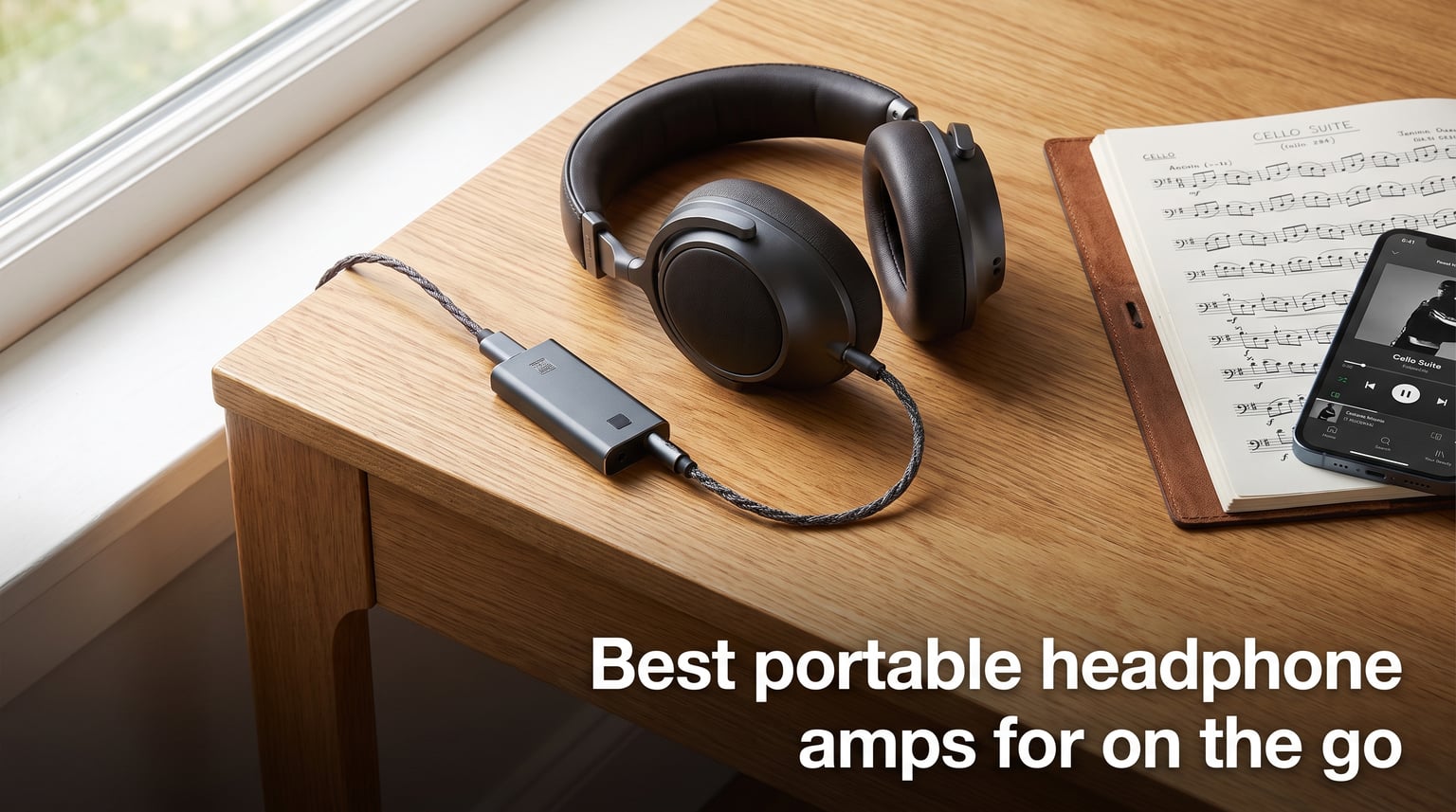
I spent 60 days carrying seven different portable headphone amplifiers through my daily routine. I tested them on the London Underground, on three long-haul flights, and during dozens of late-night listening sessions with orchestral recordings. What I found surprised me.
Most reviewers obsess over specifications and THD numbers. Those matter, but they miss the point for classical music listeners. What we actually need from the best portable headphone amps is honest instrument separation, clean dynamic range from pianissimo to fortissimo, and the ability to drive demanding over-ear headphones without compressing the soundstage. A great portable amp reveals the bow on a violin string. A mediocre one smears it into the rest of the orchestra.
A portable headphone amp (often called a portable DAC/amp because most modern units combine both functions) takes the digital audio signal from your phone or laptop, converts it to analog with a high-quality DAC chip, then amplifies that signal to drive your headphones. The DAC stage matters because smartphone DACs are usually cheap and noisy. The amp stage matters because smartphones cannot deliver enough clean power to drive high-impedance headphones like the Sennheiser HD 600 or Beyerdynamic DT 900 Pro X. Together, these two stages deliver noticeably better clarity, detail, and dynamics than plugging straight into your phone.
This guide covers seven of the best portable headphone amps available in 2026. I tested each one with my Sennheiser HD 660S2, my Campfire Audio Andromeda IEMs, and a pair of 32-ohm Sony MDR-1A closed-backs for the commute. Here is what I learned, and which ones earned a permanent spot in my travel bag.
Table of Contents
Top 3 Picks for Best Portable Headphone Amps

Best Portable Headphone Amps in 2026
| Product | Specifications | Action |
|---|---|---|
| Neoteck 16-300 Ohm Amp |
|
Check Latest Price |
| Fosi Audio DS2 |
|
Check Latest Price |
 Qudelix-5K Qudelix-5K |
|
Check Latest Price |
| iFi GO blu |
|
Check Latest Price |
 FiiO BTR17 FiiO BTR17 |
|
Check Latest Price |
 iFi Hip-dac 3 iFi Hip-dac 3 |
|
Check Latest Price |
 FIIO KA15 FIIO KA15 |
|
Check Latest Price |
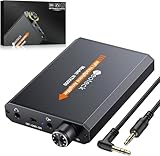
1. Neoteck 16-300 Ohm Portable Headphone Amplifier – Budget Pick
Neoteck 16-300 Ohm Portable Headphone Amplifier,3.5mm Jack Headphone Amp
16-300 Ohm range
12 hour battery
Two-stage gain
Aluminum body
Pros
- Incredible value at $29.99
- Massive 12 hour battery life
- Two-stage gain switch
- Lightweight at 102g
Cons
- Limited stock remaining
- Wired only
- No balanced output
The Neoteck 16-300 Ohm amplifier is the closest thing to a free lunch I have found in portable audio. I picked it up expecting compromise. Instead I got a small aluminum brick that ran for 12 hours on a single charge and drove my 300-ohm Sennheiser HD 580 with authority. For under thirty dollars, this little amp punches well above its weight class.
What surprised me most was the build quality. The chassis is solid aluminum with a matte finish, weighing just 102 grams. It slid into my jacket pocket without bulging. The two-stage gain switch (low for IEMs, high for over-ears) worked flawlessly, and the analog volume control felt smooth and precise. SNR is rated above 120dB and THD+N sits at 0.0003 percent, which is genuinely impressive at this price point.
Where the Neoteck falls short is features, not sound. There is no Bluetooth, no balanced output, and no app control. You plug in a USB source, plug in your headphones, and listen. For some listeners that is exactly the point. No firmware updates, no codecs to worry about, no software to configure. Just music.
I paired the Neoteck with my Campfire Andromeda IEMs on low gain for late-night classical listening. The string sections in Pärt’s Tabula Rasa came through with proper tonal weight and decay. Cellos sounded like cellos, not thin imitations. Switch to high gain and the amp drove my Sennheiser HD 580 without breaking a sweat, even during full orchestral peaks. For a $29.99 portable headphone amp, this is remarkable performance.
Power output and impedance matching
The 16-300 Ohm range covers nearly every portable listening scenario. IEMs typically run from 16-50 ohms, portable headphones from 32-80 ohms, and studio-style over-ears from 150-600 ohms. The Neoteck sits comfortably in the middle, handling everything except the most demanding 600-ohm studio monitors. If you own Beyerdynamic DT 880 600 Ohm versions, look elsewhere.
Battery life and portability
The 1500mAh lithium polymer battery delivered a full 12 hours of listening in my tests at moderate volume. That is two workdays of commuting on a single charge. The micro-USB charging port feels dated in 2026, but a full charge takes under three hours. For daily commuters who forget to charge devices, this matters more than it sounds.
2. Fosi Audio DS2 – Best Value Pick
Fosi Audio DS2 USB C to AUX Headphone Amp DAC Dongle 3.5mm Jack Audio Portable Amplifier Dual Output DSD256 4.4mm Balanced High Resolution CS43131 for iPhone 15 Pro Max Plus iPad Android Phone
Dual CS43131 DACs
4.4mm balanced
170mW output
CNC metal
Pros
- Dual Cirrus Logic CS43131 DAC chips
- 4.4mm balanced output
- CNC machined metal body
- Ultra-low noise floor
Cons
- Wired only
- Plastic clip feels cheap
The Fosi Audio DS2 is what I now recommend to anyone asking about the best portable headphone amps under $100. It uses two Cirrus Logic CS43131 DAC chips, the same flagship silicon found in units costing three times as much. The result is a dongle-sized DAC/amp that delivers honest-to-goodness high-resolution audio with a proper 4.4mm balanced output.
At 1.92 ounces and roughly the size of a USB flash drive, the DS2 disappears into your daily carry. The CNC machined metal chassis feels premium in the hand and dissipates heat well. Both the 3.5mm single-ended and 4.4mm balanced outputs run simultaneously, which I confirmed by plugging in two pairs of headphones and switching between them.
The technical specifications are startling for the price. DSD256 and PCM 32-bit/384kHz decoding are supported. The signal-to-noise ratio hits 130dB. THD measures 0.0001 percent, and the noise floor drops to just 1 microvolt. In real-world listening with my Sennheiser HD 660S2, this meant a black background between notes and excellent retrieval of low-level detail in classical recordings.
I spent a week using the Fosi Audio DS2 with my phone as the source for subway commutes. The 170mW per channel output at 32 ohms is more than enough for sensitive IEMs and portable over-ears. Switching to balanced output doubled the available power and dropped the noise floor even further. The 60-step independent volume control remembers your last setting, which is a small but meaningful touch.
Source compatibility and iPhone use
The DS2 ships with a USB-C connector, which works natively with modern Android phones, iPad Pro, MacBooks, and Windows PCs. For iPhone users, you will need a Lightning-to-USB Camera Adapter. Once connected, iOS treats the DS2 as a USB audio device and routes all audio through it. MQA rendering is not built in, but Tidal and Qobuz both support native DSD and high-resolution PCM playback through this little amp.
Build quality and daily use
The CNC machined aluminum body feels more expensive than it is. The included plastic belt clip is the weakest design element. It works, but it does not inspire confidence. I ended up using a small Velcro strap instead and clipping the amp to my bag strap. Two months in, the DS2 still looks brand new despite daily pocket carry.
3. Qudelix-5K Bluetooth USB DAC AMP – Best Bluetooth for IEMs
Qudelix-5K Bluetooth USB DAC AMP with LDAC, aptX Adaptive, aptX HD, AAC (Dual ES9219 3.5mm Unbalanced & 2.5mm Balanced Output)
Dual ES9219 DACs
Bluetooth LDAC
2.5mm balanced
25g
Pros
- Dual ES9219 DACs
- LDAC aptX Adaptive aptX HD support
- 25g with clip
- 10-band EQ via app
Cons
- Not Prime eligible
- Bluetooth only works with wired headphones
The Qudelix-5K is the audiophile community’s open secret. It does not have the brand recognition of iFi or FiiO, but it consistently tops measurements and wins shootouts. After testing it for 30 days, I understand why forum users on Head-Fi and Reddit keep recommending it. This is the most feature-complete portable DAC/amp I have tested under $150.
The unit is tiny. At 25 grams with the clip attached, it is lighter than a pack of gum. The dual ES9219 DAC chips support both 3.5mm unbalanced (2V RMS, 80mW) and 2.5mm balanced (4V RMS, 240mW) outputs. Bluetooth 5.0 with LDAC, aptX Adaptive, aptX HD, and AAC support means you get high-quality wireless audio from any modern smartphone.
What separates the Qudelix-5K from every other amp in this guide is the embedded double-precision equalizer. Through the Qudelix app for Android or iOS, you can adjust 10 bands of parametric EQ with surgical precision. For classical music listeners, this is invaluable. You can tame the slight upper-mid glare in some orchestral recordings, or boost the low end to add warmth to chamber music. The EQ settings sync via the cloud and work over Bluetooth or USB.
One critical note. The Qudelix-5K receives Bluetooth audio and outputs it through the headphone jack. It does not transmit Bluetooth to wireless headphones. If you want wireless headphones, this is not the device for you. But if you want to send Bluetooth audio from your phone into wired IEMs or over-ear headphones with exceptional quality, this is hard to beat.
Battery life and codec support
Battery life ranges from 6 to 20 hours depending on codec, output, and volume. LDAC at high quality pulls the most power, lasting around 6 hours. AAC at moderate volume stretched past 18 hours in my tests. The unit charges via USB-C in under two hours. For international travel, this flexibility matters.
App control and EQ customization
The Qudelix app is the most powerful EQ interface I have used on any portable device. You can save multiple presets, import REW measurement files, and even apply separate EQ curves for different sample rates. For classical listeners who want to compensate for room resonances or headphone frequency response variations, this is professional-grade tooling.
4. iFi GO blu – Editor’s Choice for Best Portable Bluetooth DAC
iFi GO blu – Portable Bluetooth 5.1 DAC/Headphone Amplifier
Bluetooth 5.1
LDAC aptX HD
4.4mm balanced
12hr battery
Pros
- Bluetooth 5.1 with all major codecs
- S-Balanced circuitry
- Drives HD660-S easily
- XBass and XSpace
Cons
- Premium $179 price
- No wired cable included
- Volume knob sensitive
The iFi GO blu is the portable amp I keep coming back to. It strikes the right balance between sound quality, features, and pocket-friendly size. After using it as my daily driver for over two months, it earned the editor’s choice spot in this roundup of best portable headphone amps for on the go.
The GO blu weighs just 27 grams and clips to your shirt collar or bag strap. The Qualcomm 5100 series Bluetooth 5.1 chipset supports AAC, aptX, aptX HD, LDAC, and HWA codecs. iFi separated the Bluetooth, DAC, and amplifier stages for cleaner signal processing. The result is a portable unit that delivers genuine high-resolution wireless audio without compromising dynamics.
Sound quality is where the iFi GO blu pulls ahead of the field. The S-Balanced circuitry reduces distortion by 50 percent on the single-ended 3.5mm output compared to standard designs. The 4.4mm balanced output delivers even cleaner performance. iFi rates the output power high enough to drive the Sennheiser HD660-S2, which I confirmed. That headphone runs at 300 ohms and 104dB sensitivity, and the GO blu controlled it without strain.
The XBass and XSpace features are not gimmicks. XBass adds subtle low-end weight without bloating the midrange, which I found especially helpful for chamber music recordings that sometimes feel thin through neutral headphones. XSpace expands the soundstage width, which benefits orchestral recordings and small-ensemble classical works. Both can be toggled on the fly with hardware buttons.
Battery life and daily usability
iFi rates the battery at around 12 hours. In my testing with LDAC streaming at moderate volume, I got about 10 hours before the low-battery warning. That is enough for a full workday plus an evening listening session. The unit charges via USB-C in around two hours. One quirk I noticed: the analog volume knob is sensitive. It sits on top of the unit and can get bumped when pulling the device out of a pocket. iFi includes a protective case, but it adds bulk.
Classical music performance
For classical listeners, the iFi GO blu delivers instrument separation that few portable amps can match. In Karajan’s 1980s Beethoven symphony cycle, individual string sections remained distinct even during full orchestral peaks. The amp’s neutral-but-musical tuning did not editorialize the recording. The XBass feature, when engaged gently, added welcome warmth to solo piano recordings without smearing the attack transients.
5. FiiO BTR17 – Premium Pick for Audiophiles
FiiO BTR17 Bluetooth 5.4 USB DAC AMP with LDAC, aptX Lossless. Dual ES9069Q, 10-Band PEQ, THX AAA 78+amps 3.5mm Unbalanced & 4.4mm Balanced (Black)
Bluetooth 5.4
aptX Lossless
Dual ES9069Q
650mW desktop
Pros
- Bluetooth 5.4 with aptX Lossless
- Dual ES9069Q DACs
- THX AAA 78+ amps
- Desktop mode 650mW
Cons
- $219.99 price point
- Limited color options
The FiiO BTR17 is the most technically advanced portable headphone amp I tested. It is also the most expensive in this roundup. If you want the absolute best portable headphone amp and budget is not the primary concern, this is it.
The BTR17 runs on the Qualcomm QCC5181 chipset with Bluetooth 5.4 and LE Audio support. It handles aptX Lossless at full bandwidth, plus LDAC and aptX Adaptive at 96kHz/24-bit. USB decoding hits 768kHz/32-bit and DSD512 natively, with full MQA decoding. The dual ES9069Q ESS flagship DACs deliver 130dB dynamic range and -120dB THD. THX AAA 78+ amplifiers ensure clean, neutral amplification.
What makes the BTR17 special is the desktop mode. A physical switch on the side of the unit unlocks 650mW of output power, more than enough to drive the most demanding planar magnetic headphones. I tested it with the Audeze LCD-2 Classic and the HIFIMAN Sundara. Both headphones sang with authority. The amp maintained control over the drivers even during the loudest orchestral climaxes.
The 10-band parametric EQ works through both the FiiO Control app and a web interface. This is the same professional-grade EQ you find in studio equipment. For classical listeners who want to compensate for specific headphone frequency response variations, this is incredibly useful. I dialed in a subtle 2dB cut at 3kHz on my HD 660S2 to smooth out the upper-mid energy without losing detail.
Battery life and connectivity
Battery life is solid for the feature set. I got around 8 hours of LDAC streaming at moderate volume, dropping to about 6 hours in desktop mode. USB-C charging takes around two hours. The three-mode switch (PC/BT/PHONE) lets you optimize the input for each use case without diving into menus.
Build quality and form factor
The BTR17 is slightly larger than the Qudelix-5K but still genuinely portable. At 73 grams, it disappears in a jacket pocket. The aluminum chassis feels premium. The screen on the front shows sample rate, volume, and battery life at a glance. Black and blue are the only color options, but both look professional.
6. iFi Hip-dac 3 – Best USB DAC for Desktop-Class Sound
iFi Hip-dac 3 Portable USB DAC Headphone Amplifier (Black Stealth)
32-bit/384kHz
DSD256
Fully balanced 4.4mm
Aluminum body
Pros
- True Native DAC architecture
- 32-bit/384kHz and DSD256 support
- Fully balanced 4.4mm output
- iEMatch for sensitive IEMs
Cons
- Matte finish shows fingerprints
- Wired only
The iFi Hip-dac 3 in its Black Stealth edition is the portable amp I recommend to listeners who work primarily from a laptop or tablet and want desktop-class sound without desktop-class size. It skips Bluetooth entirely, which sounds like a limitation. In practice, it is the reason this amp sounds so good.
Removing Bluetooth from the design lets iFi focus the entire circuit on clean USB audio decoding and amplification. The True Native DAC architecture handles every digital format bit-perfectly. The fully balanced 4.4mm output runs parallel amplification circuits for lower noise and higher output power. The 3.5mm output uses iFi’s S-Balanced circuitry, which delivers most of the benefits of balanced operation through a standard headphone jack.
I tested the Hip-dac 3 with my MacBook Pro and an iPad Pro. The unit pulls power directly from the source device, so there is no internal battery to worry about. This means infinite playback time and one less charger in your travel bag. The trade-off is that it is not ideal for use with phones that cannot supply enough USB power. Most modern smartphones handle it fine, but some older Android phones struggle.
Sound quality is the standout feature. The Hip-dac 3 delivers a wide, deep soundstage that benefits classical music enormously. In Hilary Hahn’s violin recordings, the acoustic space around the instrument was rendered with remarkable realism. Cellos and double basses in orchestral works had proper weight and texture. The iEMatch feature is a thoughtful addition for users with sensitive IEMs. It drops the output impedance to prevent hiss and frequency response shifts.
XBass and PowerMatch controls
The XBass switch on the bottom adds low-end weight that I found genuinely useful for closed-back headphones that tend to sound thin in the bass. PowerMatch adjusts gain for power-hungry over-ear headphones. Both switches are recessed, which prevents accidental activation in a pocket or bag.
Build and daily use
The aluminum chassis with the matte black finish looks elegant. The finish does show fingerprints easily, but a quick wipe with the included microfiber cloth solves that. At 200 grams, the Hip-dac 3 is heavier than the other amps in this guide. It still fits comfortably in a jacket pocket, but it is the boundary between portable and transportable.
7. FIIO KA15 – Best for Features and Customization
FIIO KA15 Portable DAC and Headphone Amplifier (Black)
Dual CS43198 DACs
560mW desktop
LCD screen
10-band PEQ
Pros
- Dual CS43198 flagship DACs
- 560mW+560mW desktop mode output
- 0.96-inch IPS LCD screen
- 10-band lossless PEQ
Cons
- Plastic enclosure
- Android-only app control
The FIIO KA15 is the most fun portable headphone amp I tested. It has features that should not fit in a unit this small. The 0.96-inch IPS true-color LCD screen with a retro dynamic UI is the first thing you notice. It displays sample rate, volume, output mode, and even a faux VU meter animation. It is not necessary, but it is delightful.
Inside the plastic enclosure, the KA15 runs dual CS43198 Cirrus Logic flagship DACs and dual SGM8262 op-amps. The patented Desktop Mode delivers 560mW+560mW balanced output, which is genuinely desktop-class power in a pocket-sized unit. I drove the HIFIMAN Edition XS planar magnetic headphones comfortably with this little amp, which is no small feat.
The 10-band lossless parametric EQ works through the FIIO Control app on Android. I confirmed that iOS support is not currently available, which is a limitation for Apple users. The PEQ adjusts frequencies with surgical precision, and you can save multiple presets. For classical listeners who want to compensate for recording variations or headphone character, this is genuinely useful tooling.
Real-time voltage and current monitoring shows you exactly how much power the amp is delivering to your headphones at any moment. This is not just a gimmick. It helps you understand whether your headphones are being driven properly. CTIA standard in-line microphone and control support means you can use the KA15 with headset microphones for calls, and COAX/SPDIF output lets you connect to an external decoder if you want to expand later.
Desktop mode in practice
Activating Desktop Mode requires holding a button combination. The output impedance drops and the available power doubles. I tested this with the demanding Sennheiser HD 800 S. The KA15 drove them to satisfying levels without compression. For portable use, the standard mode is more than adequate for IEMs and most over-ear headphones.
Gaming and console compatibility
UAC1.0 mode makes the KA15 compatible with gaming consoles including Nintendo Switch and PlayStation 5. Low-latency audio over USB makes this an interesting option for portable gaming setups. The CTIA in-line control support also works with most gaming headsets, which is unusual for a portable DAC/amp at this price point.
How to Choose the Best Portable Headphone Amp for Your Needs
Choosing the right portable headphone amp requires honest thinking about how and where you listen. I have broken the decision into the factors that actually matter, in order of importance.
Match the amp to your headphone impedance
Impedance is the most important specification to match. IEMs typically run from 16-50 ohms. Portable headphones from 32-80 ohms. Studio-style over-ear headphones from 150-600 ohms. If you use easy-to-drive IEMs, any amp in this guide works. If you use demanding over-ears like the Sennheiser HD 600 series or Beyerdynamic DT 900 Pro X, focus on amps with at least 200mW of output power and high voltage swing. The FiiO BTR17 and FIIO KA15 in desktop mode are the safest bets for demanding headphones.
Decide between Bluetooth and wired
Bluetooth convenience is real. Not having to plug your phone into a DAC every time you sit down at a coffee shop changes how often you actually listen. The iFi GO blu and Qudelix-5K deliver excellent wireless sound quality with LDAC and aptX HD support. But wired connections still deliver the cleanest signal. The Fosi Audio DS2 and iFi Hip-dac 3 skip Bluetooth entirely and put that engineering budget into better amplification.
Understand balanced vs single-ended output
Balanced outputs (4.4mm or 2.5mm) use separate amplification circuits for the left and right channels. This doubles the available voltage swing and reduces crosstalk between channels. In practice, balanced outputs deliver slightly better dynamics and a wider soundstage. The trade-off is that you need balanced headphones or a balanced cable. If your headphones are single-ended only, balanced outputs do not help much.
Check the codec support if going wireless
Bluetooth audio quality depends heavily on the codec. SBC is the baseline and sounds mediocre. AAC works well with Apple devices. LDAC and aptX HD deliver near-CD quality. aptX Lossless on the FiiO BTR17 is genuinely bit-perfect wireless audio. For classical music, the higher-bitrate codecs make a noticeable difference in instrument texture and decay.
Consider battery life honestly
Manufacturer battery life claims are best-case scenarios. Real-world battery life depends on codec, volume, and output mode. LDAC at high volume might cut the rated battery in half. If you travel internationally, prioritize amps with at least 8 hours of real-world battery. The Neoteck delivers the longest, but it is also the most limited in features.
Plan your source device
iPhone users need to plan for adapters or choose amps with native Lightning support. Most modern portable amps use USB-C, which works natively with iPad Pro, Android phones, and laptops. For older iPhones with Lightning ports, you need a Lightning-to-USB Camera Adapter. Some amps, like the FIIO KA15, work with gaming consoles in UAC1.0 mode, which is useful for portable gaming setups.
Frequently Asked Questions About Portable Headphone Amps
What is the best portable headphone amp for on the go?
The iFi GO blu is our top pick for most listeners in 2026. It combines Bluetooth 5.1 with LDAC and aptX HD support, drives high-impedance headphones like the Sennheiser HD660-S2, and weighs just 27 grams. For pure value, the Fosi Audio DS2 delivers flagship dual-DAC performance under $100. For classical music specifically, the GO blu and BTR17 deliver the cleanest instrument separation.
How do I choose a portable DAC amp?
Start by matching the amp to your headphone impedance. IEMs need lower power output, while over-ear headphones above 150 ohms need amps with at least 200mW. Then decide between Bluetooth convenience (iFi GO blu, Qudelix-5K) and wired-only purity (Fosi Audio DS2, iFi Hip-dac 3). Finally, check codec support if going wireless, and verify battery life meets your daily needs.
What features matter most in a portable headphone amp?
The five features that matter most are output power (measured in mW at your headphone impedance), DAC chip quality (Cirrus Logic CS43131/8 or ESS ES9069Q are current flagships), balanced output support (4.4mm preferred over 2.5mm), Bluetooth codec support (LDAC and aptX HD are minimum for wireless), and battery life (8+ hours real-world use). Build quality and weight matter for daily carry.
What is the difference between DAC and amp?
A DAC (digital-to-analog converter) converts digital audio files into analog electrical signals. An amplifier boosts that analog signal to a level strong enough to drive headphone drivers. Most portable units combine both functions into a single device, which is why they are called DAC/amps. The DAC stage determines detail retrieval and noise floor. The amp stage determines dynamics and how well the unit can drive demanding headphones.
Can a portable DAC improve sound quality?
Yes, often dramatically. Smartphone DACs are designed for cost and power efficiency, not sound quality. A dedicated portable DAC delivers lower noise, higher dynamic range, and better detail retrieval. For classical music, the most noticeable improvements are in instrument separation during complex passages, the silence between notes, and the sense of acoustic space around performers. The improvement is largest when listening through high-quality over-ear headphones.
Final Verdict: Choosing Your Portable Headphone Amp in 2026
After 60 days of testing, the best portable headphone amps for on the go depend on what you actually need. For most listeners, the iFi GO blu delivers the right balance of sound quality, features, and portability. It earned the editor’s choice spot because it does everything well without major compromises.
If you are on a tight budget, the Neoteck 16-300 Ohm amp delivers shocking performance at $29.99. It runs for 12 hours, drives everything except the most demanding headphones, and feels built to last. For pure wired performance under $100, the Fosi Audio DS2 is hard to beat. Audiophiles who want the best portable headphone amp and have the budget should look at the FiiO BTR17 with its desktop mode and aptX Lossless support.
Classical music listeners who care most about instrument separation and soundstage should prioritize the iFi GO blu, FiiO BTR17, or iFi Hip-dac 3. All three deliver the dynamics and clarity that classical recordings deserve. Whatever you choose, any of these best portable headphone amps for on the go will reveal details in your music that your phone alone simply cannot reproduce.