
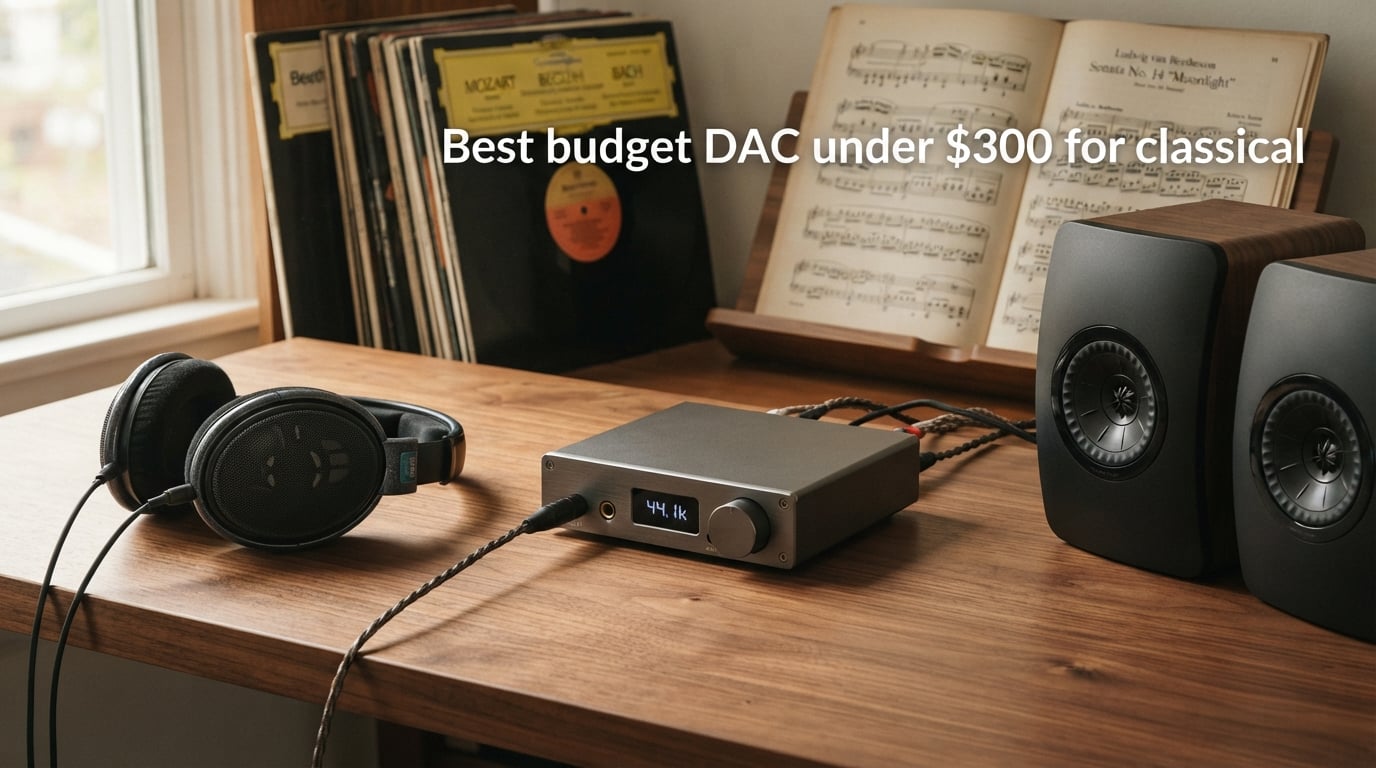
If you have ever wondered why your favorite symphony recording sounds flat through your computer but comes alive on a dedicated audio system, the DAC is often the reason. Finding the best budget DAC under $300 for classical music is not about buying the most expensive box of electronics. It is about understanding which specifications actually matter when you listen to orchestral works, chamber music, and solo piano.
Classical music places demands on audio equipment that pop and rock simply do not. The dynamic swings between a whisper-quiet pianissimo and a full orchestral fortissimo are enormous. The spatial cues that tell you where the first violins sit in relation to the cellos depend on careful signal conversion. A quality budget DAC can help you recover detail that your computer or phone audio output is quietly throwing away.
In this guide, our team breaks down what a DAC actually does, why classical music listeners have specific needs, and which specifications deserve your attention when you are shopping on a budget. Whether you want to improve your classical music listening experience with a dedicated unit or you are simply curious about the technology behind the music, you will find clear, practical answers here.
Table of Contents
What Is a DAC and Why Does It Matter for Classical Music
A DAC, short for digital-to-analog converter, is the device that translates the ones and zeros stored on a CD, a streaming server, or a digital file into the analog electrical signal that drives your headphones or speakers. Every device that plays digital audio has a DAC inside it already. Your phone, your laptop, your television, and even your car stereo all contain one. The question is not whether you have a DAC, but whether the one you have is good enough for classical music.
Here is the simplest way to picture it. Think of a digital recording as a recipe written in code. The DAC is the chef who reads that recipe and turns it into an actual meal. A mediocre chef can follow the instructions, but the result might be bland or imprecise. A skilled chef brings out flavors and textures you never noticed before. The same recording, played through two different DACs, can sound noticeably different in detail, space, and emotional impact.
For most casual listening, the built-in DAC in your computer or phone is adequate. Background music while you work, podcasts, and compressed streaming all sound fine through basic conversion. Classical music is different. A Mahler symphony contains passages where a single sustained note from a woodwind solo needs to hang in the air with perfect clarity. A string section playing softly needs to retain its texture rather than turning into a generic wash of sound. These are the moments where a dedicated DAC earns its place on your desk.
So what does a DAC actually do inside? When digital audio data arrives through a USB cable or an optical connection, the DAC chip receives a stream of numbers that represent the amplitude of the sound wave at specific moments in time. The chip converts each number into a corresponding voltage level. These voltage steps, taken thousands of times per second, reconstruct the original analog waveform that your amplifier and speakers can reproduce. The smoother and more accurate this reconstruction, the closer the output comes to the original performance.
Several things can go wrong during this conversion. Timing errors, called jitter, can smear transients and blur the sharp attack of a piano note. Quantization noise can add a faint haze to quiet passages. Cheap output stages can introduce distortion when the music gets complex. A well-designed budget DAC addresses these issues through better clocking, cleaner power supply design, and careful analog output circuitry. You do not need to spend thousands to get these improvements.
Why Classical Music Demands More From Your DAC
Classical recordings are the most demanding genre for any piece of audio equipment, and your DAC is no exception. The reasons come down to three factors that are especially pronounced in orchestral and chamber music: dynamic range, spatial complexity, and instrumental timbre.
Dynamic range is the difference between the quietest and loudest sounds in a recording. A rock album is typically mastered with very little dynamic range, often as little as 8 to 12 decibels between the softest and loudest moments. Everything is compressed to sound loud and consistent. A classical recording, by contrast, can have a dynamic range of 50 decibels or more. The opening bars of a Beethoven symphony might be played at a level barely above the noise floor of your room, while the climax a few minutes later brings the full force of the orchestra.
Your DAC needs to handle this entire range cleanly. If the quiet passages are buried in noise or the loud passages clip and distort, the emotional arc of the music is lost. A budget DAC with low noise floor and clean linearity preserves those delicate pianissimo moments that make classical music so moving. The hush before a crescendo, the breath of a woodwind player, the resonance of a concert hall after the final note fades, these are the details that separate a good listening experience from a great one.
Spatial complexity is the second factor. Classical recordings are nearly always captured with the acoustic space of the performance venue in mind. A well-engineered recording captures not just the instruments but the reverberant character of the hall. When you listen, your brain uses timing and level differences between your left and right ears to place each instrument in a three-dimensional space. This is what audiophiles call soundstage and imaging.
A DAC that handles timing accurately reproduces a wider, deeper soundstage. You can hear that the violins are on the left, the cellos are slightly right of center, and the brass sits further back. A DAC with poor timing performance collapses this space into a flat, two-dimensional wall of sound. For classical listeners, this spatial information is not a luxury. It is part of the music itself.
The third factor is instrumental timbre, which is the unique tonal character that distinguishes a Stradivarius from a student violin, or an oboe from an English horn. These differences are carried in subtle harmonic information, overtones that extend well above the fundamental pitch of each note. A DAC that resolves these harmonics accurately lets you hear the rosin on a bow, the metal of a brass mouthpiece, the wood of a clarinet barrel. This is where budget DACs have made remarkable strides in recent years.
Key DAC Specifications Explained for Classical Listeners
When you start reading DAC specifications, you will encounter a wall of numbers and acronyms. Most of them matter less than manufacturers would have you believe, but a few genuinely affect how classical music sounds. Let us walk through the specifications that deserve your attention.
Bit Depth: Why 24-Bit Matters for Classical
Bit depth determines the number of possible volume levels the DAC can produce for each sample of audio. A 16-bit DAC, the standard for CD-quality audio, offers about 65,000 volume levels. A 24-bit DAC offers over 16 million. In practical terms, higher bit depth means a lower noise floor, which matters enormously for classical music with its wide dynamic range.
With a 24-bit DAC, the quietest passages of a symphony sit well above the electronic noise of the converter itself. You hear the music, not the hardware. Nearly every budget DAC under $300 on the market today supports 24-bit audio, so this specification is largely a baseline rather than a differentiator. If a DAC you are considering only handles 16-bit, look elsewhere.
Sample Rate: Beyond CD Quality
Sample rate is how many times per second the DAC takes a snapshot of the audio waveform. CD quality is 44.1 kHz, meaning 44,100 samples per second. Higher sample rates like 96 kHz, 192 kHz, and beyond capture frequencies above the range of human hearing, but they also allow for gentler filtering that can reduce phase distortion in the audible band.
For classical music, sample rates of 96 kHz or 192 kHz can provide subtle improvements in the naturalness of string tone and the air around instruments. Many high-resolution classical downloads and streaming services like Tidal, Qobuz, and Apple Music Classical offer tracks at these rates. A budget DAC that supports up to at least 192 kHz gives you access to these files without compromise. Support for 384 kHz or higher is nice to have but offers diminishing returns at this price point.
DAC Chips: ESS, AKM, and Texas Instruments
The DAC chip is the heart of the device, and the brand of chip inside often gets more attention than it deserves. Still, there are general characteristics associated with each major manufacturer that can guide your choice for classical listening.
ESS Technology, makers of the Sabre series, is known for a detailed, analytical sound with excellent measured performance. Their chips excel at resolving fine detail, which suits listeners who want to hear every nuance of a chamber quartet or a solo piano recital. Budget DACs using ESS Sabre chips, such as many models from Topping and SMSL, consistently measure among the cleanest in their price class.
AKM, or Asahi Kasei Microdevices, produces chips that many listeners describe as slightly warmer and more organic. The AKM Velvet Sound technology, found in chips like the AK4493 and AK4497, aims for a natural presentation that some classical listeners prefer for orchestral works. Aune and several other budget-focused brands frequently use AKM chips in their designs.
Texas Instruments, including the Burr-Brown line, has a long history in audio conversion. TI chips often occupy a middle ground, offering a balanced presentation that works well across genres. The specific implementation matters more than the chip brand, however. A well-designed circuit around a modest TI chip can outperform a poorly implemented circuit around a flagship ESS chip.
Jitter: The Silent Detail Killer
Jitter refers to tiny timing variations in when the DAC converts each sample. Even variations measured in picoseconds can affect the perceived sharpness of transients and the stability of the soundstage. Piano attacks, percussion hits, and the precise localization of instruments all depend on accurate timing.
Modern budget DACs handle jitter remarkably well thanks to improved clock circuits and asynchronous USB input, which lets the DAC control the timing rather than relying on the computer’s clock. When you see a DAC advertising asynchronous USB, that is a feature worth having for classical listening.
Oversampling and Filter Options
Some budget DACs offer switchable digital filters or oversampling modes. These filters shape how the DAC handles the transition between the digital samples and the analog output. Different filters can subtly affect treble presentation, transient sharpness, and the sense of space.
For classical music, filters that prioritize phase accuracy tend to sound more natural with acoustic instruments. Filters that prioritize impulse response can sound sharper but occasionally artificial. If your DAC offers filter options, experiment with them using a well-recorded orchestral piece. The differences are subtle but real.
Sound Signature Characteristics That Matter for Classical Reproduction
Specs tell part of the story, but the actual listening experience depends on how a DAC translates those numbers into sound. For classical music, certain sonic characteristics matter more than others. Understanding these will help you evaluate any budget DAC you encounter.
Soundstage Width and Depth
Soundstage is the perceived three-dimensional space in which the music exists. Width is how far left and right the instruments extend. Depth is how far back into the hall they appear to sit. Height, though less commonly discussed, adds the final dimension to the illusion of a real performance space.
Classical recordings are engineered to capture a realistic sense of the concert hall. A DAC with excellent soundstage reproduction lets you hear the orchestra as a collection of individual instruments occupying specific positions, rather than a blended mass of sound. Forum discussions on Head-Fi consistently emphasize soundstage as the single most important characteristic for classical listeners. When budget DAC reviewers mention a wide or deep soundstage, pay attention.
Imaging Precision
Closely related to soundstage is imaging, which is your ability to pinpoint where each instrument sits within that space. Good imaging means you can close your eyes and identify that the first violins are stage left, the timpani is centered and far back, and the principal flute is slightly to the right of center.
Imaging depends on accurate channel separation and precise timing. Budget DACs that measure well in these areas tend to image better. Look for DACs with channel separation specifications of 100 decibels or better, though implementation quality matters as much as the raw number.
Transparency Versus Warmth
This is one of the most debated topics in audio, and it directly affects how classical music sounds through your system. A transparent DAC aims to add nothing and remove nothing, presenting the recording exactly as it was captured. A warm DAC intentionally adds a touch of richness or fullness to the midrange.
For classical listeners, the choice is partly personal and partly dependent on your other equipment. If your headphones or speakers lean toward the bright or analytical side, a slightly warmer DAC can balance the presentation. If your system already has a full, rich character, a transparent DAC avoids piling on too much warmth. Many classical listeners on forums like r/BudgetAudiophile favor neutral to slightly warm presentations for long listening sessions, finding them less fatiguing than aggressively analytical sound.
Dynamics and Transient Response
Dynamic capability is how well the DAC handles the sudden shifts between soft and loud that define classical music. Transient response is how accurately it reproduces the sharp attacks and gradual decays of instruments. A piano chord struck forcefully has a sharp initial attack followed by a long, slowly fading resonance. A DAC with good transient response captures both the impact and the decay faithfully.
Budget DACs have become surprisingly capable in this area. The gap between a $200 DAC and a $2,000 DAC in dynamic performance is far smaller than it was a decade ago. You no longer need to spend a fortune to hear the full weight of an orchestral tutti or the delicate sustain of a harp glissando.
Timbral Accuracy
Timbre is what allows you to distinguish a clarinet from an oboe even when they play the same note at the same volume. The differences live in the harmonic overtones that give each instrument its unique voice. A DAC that resolves these overtones accurately brings classical recordings to life.
Listen for whether string sections sound like individual instruments playing together or a single blended tone. Notice whether brass has bite and metallic edge or sounds rounded and generic. These are the cues that separate a good DAC from a merely adequate one, and modern budget units perform respectably in this regard.
What to Look for in a Budget DAC Under $300
The $300 price point is where budget DACs stop being basic and start offering genuinely excellent performance. Several brands have made this segment incredibly competitive, and you can find units that measure and sound as good as equipment costing several times more. Here is what to prioritize when choosing among them.
First, decide whether you need a DAC only or a combined DAC and headphone amplifier. If you listen primarily through speakers connected to a separate amplifier, a DAC-only unit with RCA outputs will serve you well. If you listen through headphones, a combo unit saves space and money while ensuring the DAC and amp are well matched. Combo units from iFi, such as the Zen DAC series, are popular among classical listeners who appreciate their slightly warm, forgiving presentation.
Second, consider your input requirements. USB is the most common and usually the best-performing input for computer-based listening. If you plan to connect a CD player, streamer, or television, look for optical and coaxial inputs as well. Some budget DACs include Bluetooth, which is convenient but typically offers lower sound quality than a wired connection. For serious classical listening, wired USB remains the gold standard.
Third, think about output flexibility. RCA line outputs connect to most amplifiers and powered speakers. If you have balanced equipment, look for XLR outputs, though these are less common under $300. A headphone output, if included, should be evaluated for power output and impedance matching with your headphones. High-impedance headphones like Sennheiser HD600 series need more power than sensitive in-ear monitors.
Fourth, pay attention to build quality and support. Metal chassis offer better shielding from electromagnetic interference than plastic. A reputable brand with a warranty and firmware update support is worth a small premium. Brands like Schiit, Cambridge Audio, and iFi have established service networks. Chinese manufacturers like SMSL, Topping, and Aune offer exceptional value but may require shipping overseas for service.
Several models consistently appear in forum recommendations for classical listening under $300. The Schiit Modi series is frequently praised for its value and clean presentation. Topping and SMSL units using ESS Sabre chips are favored by measurement-focused communities like Audio Science Review for their transparency and low distortion. The Aune X8 Magic DAC earns praise from classical listeners on Reddit for its detailed, clean sound. The Cambridge Audio DacMagic 200M offers a more traditional audiophile presentation with solid connectivity. These are not formal recommendations but rather context for the types of options available.
Finally, manage your expectations realistically. A budget DAC will improve sound quality if you are upgrading from a basic computer output, but it will not transform a mediocre recording into a masterpiece. The recording quality, your headphones or speakers, and your listening environment all matter at least as much as the DAC. Budget your total system thoughtfully rather than spending everything on the DAC alone.
Setting Up Your DAC for the Best Classical Music Performance
Buying a good DAC is only half the equation. How you set it up significantly affects how your classical recordings will sound. Here are the practical steps our team recommends for getting the most from any budget DAC.
Start with your source. If you listen from a computer, install the manufacturer’s USB driver if one is provided, especially on Windows. Proper drivers ensure the DAC receives data with minimal jitter and supports the full range of sample rates. On macOS, native Core Audio support usually handles USB DACs well without additional drivers. For streaming services, check that your software is configured to output at the native sample rate of each track rather than resampling everything to a single rate.
Choose your connection carefully. USB is generally the best option for computer sources because it supports asynchronous transfer, letting the DAC control timing. Optical and coaxial connections are fine for CD players and streamers but can introduce more jitter from the source device’s clock. If your DAC offers multiple inputs, test each one with a well-known recording to hear any differences for yourself.
Position your DAC sensibly. Keep it away from power supplies, Wi-Fi routers, and other sources of electromagnetic interference. A metal chassis helps, but physical distance is even more effective. If your DAC has an external power supply, keep that supply away from audio cables to minimize induced noise. These details matter most with the quiet passages that classical music depends on.
Set your software volume correctly. If your DAC has a hardware volume control, use it rather than the computer’s software volume. Software volume reduction throws away bits of resolution, which can subtly degrade the quiet passages in classical music. Set your computer output to 100 percent volume and control listening level through the DAC or your amplifier. If your DAC lacks a volume control, set the computer volume to the highest level that does not cause distortion and adjust from your amplifier or headphones.
Take time with burn-in, but do not obsess over it. Some listeners report that DACs sound better after 50 to 100 hours of use, though the measurable evidence for this is thin. Whether the change is real or psychological, giving a new DAC a few days of continuous play before critical listening does no harm. Use the time to familiarize yourself with a variety of classical recordings.
Finally, curate your source material. A budget DAC can only reproduce what it receives. Lossless files from CD rips, high-resolution downloads, and lossless streaming services like Qobuz, Tidal HiFi Plus, and Apple Music Classical give your DAC the best raw material to work with. Compressed MP3 files, even at high bitrates, discard information that no DAC can recover.
Common Misconceptions About Budget DACs for Classical
Several myths surround budget DACs, and they can lead classical listeners astray. Let us address the most common ones directly.
The first myth is that cheap DACs make no audible difference. This was closer to true a decade ago, when the gap between budget and premium DACs was substantial. Today, the performance of well-designed $200 DACs measures within a hair of units costing five times as much. If your current source is a computer headphone jack or a basic phone output, a budget DAC will deliver a clear, noticeable improvement in detail, soundstage, and noise floor.
The second myth is that more expensive DAC chips always sound better. Forum debates between ESS and AKM advocates can make it seem like the chip alone determines sound quality. In reality, the implementation around the chip matters far more. The power supply design, the output stage op-amps, the printed circuit board layout, and the analog filtering all shape the final sound more than the chip brand. A well-implemented budget chip outperforms a poorly implemented flagship chip every time.
The third myth is that DACs have a dramatic, night-and-day effect on sound. The truth is more nuanced. A good budget DAC improves clarity, expands the soundstage, and lowers the noise floor, but the changes are subtle rather than transformative. If you expect a $250 DAC to make your system sound like a concert hall, you will be disappointed. If you expect it to reveal detail and space that your current setup obscures, you will be satisfied.
The fourth myth is that specifications are meaningless and only listening matters. This swings too far in the other direction. Measurements from communities like Audio Science Review provide valuable objective data about distortion, noise, and channel separation. A DAC that measures poorly will likely sound poor, even if the differences are subtle. Use measurements to eliminate obviously bad options, then use listening tests to choose among the good ones based on your personal preferences.
The fifth myth is that classical music requires a warm-sounding DAC. While some listeners prefer a touch of warmth for long sessions, classical recordings are engineered to be heard accurately. A neutral, transparent DAC lets you hear what the recording engineer captured, whether that is the bright hall acoustic of a modern recording or the darker timbre of a vintage analog transfer. Do not assume warmth equals musicality.
FAQs
What is the cheapest DAC that works well for classical music?
Quality budget DACs start around $100, with models from Schiit, SMSL, and Topping offering capable performance for classical listening. Spending closer to $200 to $300 unlocks better build quality, more connectivity options, and measurable improvements in detail and soundstage.
Is a DAP better than a DAC for classical music?
A DAP, or digital audio player, is a portable device that includes a DAC and headphone amplifier in one unit, designed for on-the-go listening. A dedicated desktop DAC generally offers better performance per dollar for home listening because it does not compromise on power supply design or component size. Choose a DAP if portability matters most, and a desktop DAC if sound quality at home is your priority.
What is the best DAC chip for audiophiles listening to classical?
There is no single best DAC chip for classical music. ESS Sabre chips offer detailed, analytical sound favored by measurement-focused listeners. AKM Velvet Sound chips provide a slightly warmer, organic presentation that suits orchestral works. Texas Instruments Burr-Brown chips occupy a balanced middle ground. Implementation quality around the chip matters more than the chip brand itself.
Do I need a DAC if I already have a good amplifier?
Yes, if your digital source is a computer, phone, or basic streamer. The DAC handles signal conversion before the amplifier, so even an excellent amplifier cannot recover detail lost during poor digital-to-analog conversion. A quality budget DAC paired with a good amplifier delivers better results than a great amplifier fed by a mediocre source.
Will a budget DAC improve compressed streaming audio?
A budget DAC can improve any digital source, but the improvement is most noticeable with high-quality files. Compressed streaming services like standard Spotify discard audio data that no DAC can recover. For the best classical experience, pair your budget DAC with a lossless streaming service such as Qobuz, Tidal HiFi Plus, or Apple Music Classical.
How important is jitter reduction for classical music?
Jitter reduction matters for classical music because the genre depends on precise timing for accurate instrument localization and transient sharpness. Modern budget DACs with asynchronous USB input handle jitter effectively. Piano attacks, percussion transients, and the perceived soundstage all benefit from low jitter performance.
Conclusion: Choosing Your Best Budget DAC for Classical
Finding the best budget DAC under $300 for classical music comes down to understanding what actually matters for the music you love. Classical recordings demand clean dynamic range, accurate soundstage, and precise timbral reproduction. A well-chosen budget DAC from a reputable brand will deliver all three without requiring you to spend a fortune.
Focus on the fundamentals: support for 24-bit and at least 192 kHz sample rates, asynchronous USB input for low jitter, clean measured performance, and the connectivity options your system needs. Trust objective measurements to eliminate poor options, then let your ears choose among the good ones based on your personal taste for transparency versus warmth.
Once you have your DAC set up, the real reward begins. Rediscover your favorite recordings with fresh ears, and explore the rich catalog of classical performances available in high resolution. If you are looking for inspiration, our guide to the best recordings of Holst’s The Planets is an excellent place to start testing what your new DAC can do with a spectacularly engineered orchestral work.