
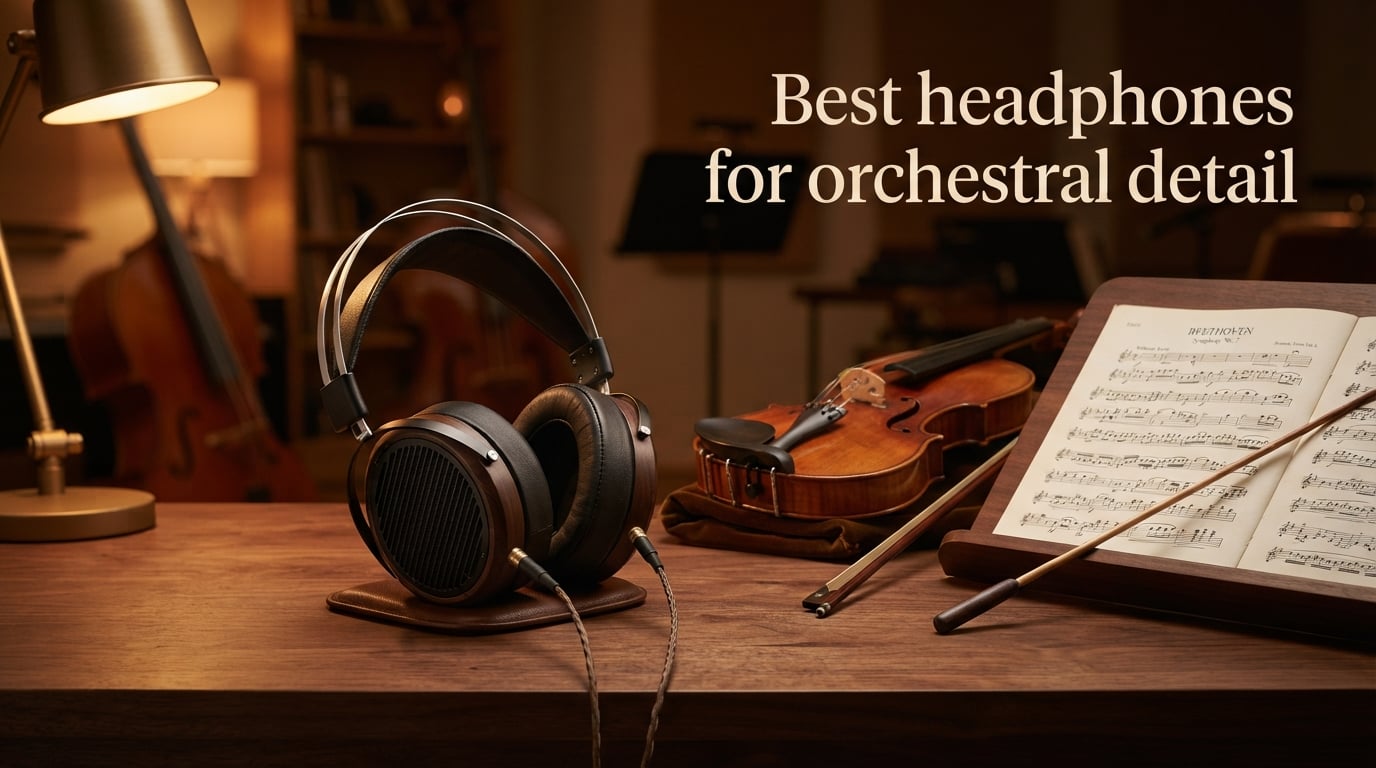
Finding the best headphones for orchestral detail means looking past the bass-heavy marketing that dominates most headphone reviews and focusing instead on three things: soundstage, imaging, and detail retrieval. Orchestral music stacks dozens of instruments into a single moment, and most consumer headphones smear that complexity into a wall of sound. The right pair separates the second violins from the violas, places the brass section where the recording engineer intended, and lets you hear the hall breathe between phrases.
I have spent years listening to classical recordings across headphones ranging from $80 open-backs to $4,000 reference flagships, and the gap between “good” and “great” for orchestral material is wider than for any other genre. A headphone that sounds fantastic on rock or electronic music can collapse completely when faced with the final movement of Mahler’s Second Symphony.
This guide covers what orchestral detail actually is, why classical music is the hardest genre to reproduce accurately, how to read the specifications that matter, which headphone models consistently deliver, and how to test any pair before you commit. Whether you are building a dedicated listening station or just want your morning commute to sound like Boston Symphony Hall, this guide will help you choose with confidence in 2026.
We will not be listing prices here, because pricing changes constantly and depends on sales, region, and condition. Instead, we focus on the sonic characteristics, technical capabilities, and real-world performance that actually determine whether a headphone reveals orchestral detail.
Table of Contents
What Is Orchestral Detail and Why It Matters
Orchestral detail is the ability of headphones to reproduce the layered complexity of a symphony orchestra with clarity, accuracy, and spatial realism. It is not about brightness or boosted treble, which many people mistake for “detail.” True detail retrieval means hearing the subtle brush of a bow on a string, the air around an oboe, the resonance of a timpani after the strike, and the acoustic signature of the concert hall itself.
Three technical characteristics work together to create orchestral detail. Soundstage is the perceived three-dimensional space in which the music exists, including width, depth, and height. Imaging is the precision with which you can locate individual instruments within that space. Detail retrieval, sometimes called resolution, is the headphone’s ability to resolve fine sonic information without smearing or blurring it together.
Orchestral music is uniquely demanding because it combines extreme dynamic range with extreme complexity. A symphony orchestra can have 80 to 100 players performing simultaneously, ranging from a whispering pianissimo to a thunderous fortissimo that hits over 110 decibels in the concert hall. The recording has to capture all of that, and your headphones have to reproduce it without falling apart at either end.
Forum discussions on r/HeadphoneAdvice and r/audiophile consistently highlight the same complaint: most online headphone recommendations are tuned for bass-heavy popular music and fall apart on complex classical passages. One common frustration is that consumer-oriented headphones handle the loud moments fine but turn the quiet interplay between woodwinds into a muddy blur. That is exactly the failure mode that distinguishes a true orchestral headphone from a general-purpose one.
The other factor that makes orchestral music special is the role of the hall itself. Great classical recordings are not just captures of the instruments; they are captures of the acoustic space. When you listen to a Berlin Philharmonic recording made in the Philharmonie, you are hearing that hall’s distinctive reverberant tail. Headphones with poor soundstage flatten that spatial information, turning a three-dimensional acoustic event into a flat, lifeless recording.
Understanding this distinction is the foundation of choosing the best headphones for orchestral detail. Once you know what you are listening for, every other decision becomes easier.
Soundstage: The Foundation of Classical Listening
Soundstage is the single most important characteristic for orchestral headphones, and it is also the most misunderstood. Many reviewers use the term loosely, but for classical music it has a precise meaning that directly affects your listening experience.
A headphone’s soundstage has three dimensions. Width is how far left and right the sound extends beyond your head. Depth is how far forward and back instruments appear, which lets you distinguish the front-row strings from the back-row brass. Height is the vertical placement, which matters less for orchestral music but still contributes to realism.
For orchestral recordings, width is king. A wide soundstage lets you mentally place each section of the orchestra in its proper location, exactly as a conductor or audience member would perceive it in a real concert hall. When the violins enter from the left and the cellos answer from the right, a headphone with strong width makes that dialogue feel physical rather than abstract.
Open-back headphones almost always produce a wider soundstage than closed-back models. This is physics, not marketing. Open-back designs allow air and sound pressure to escape from the back of the driver, which reduces reflections inside the ear cup and creates a more expansive, speaker-like presentation. Closed-back designs trap that energy, which can make the soundstage feel narrower and more “in your head.”
The connection between soundstage and concert hall acoustics is something almost no headphone guide explains. When an orchestra plays in a great hall like Vienna’s Musikverein or Boston’s Symphony Hall, the reverberation time is typically between 1.8 and 2.2 seconds. That reverberation is part of the music. A headphone with poor soundstage compresses that reverb, making a Carnegie Hall recording sound like it was tracked in a small studio. A headphone with excellent soundstage lets the hall speak.
This is why experienced classical listeners on forums consistently describe soundstage width as the make-or-break factor. If a headphone cannot reproduce the acoustic space of the recording, no amount of detail retrieval or frequency response accuracy will compensate.
Open-Back vs Closed-Back Headphones for Classical Music
For classical and orchestral music, open-back headphones are almost always the better choice. They produce a wider, more natural soundstage, they avoid the internal reflections that can muffle complex passages, and they generally present a more realistic sense of space. Closed-back headphones have legitimate uses, but they trade away the spatial qualities that make orchestral music come alive.
Open-back headphones work by venting the rear of the driver chamber to the outside air. This design reduces the trapped reflections and standing waves that build up inside a sealed ear cup, which in turn produces a cleaner, more open sound. For orchestral material, the result is a soundstage that extends well beyond your head, with instruments placed precisely across a wide arc.
The trade-offs are real, though. Open-back headphones leak sound in both directions, meaning people near you can hear what you are listening to, and you can hear ambient noise around you. They are useless on a noisy subway or in a shared office. They also tend to produce less bass impact, because the open design lets low frequencies dissipate rather than pressurizing against your ear.
Closed-back headphones seal the ear cup, which gives you isolation and bass impact in exchange for a narrower soundstage. Forum users on r/classicalmusic frequently describe closed-back classical listening as “muffled” or “claustrophobic,” even on expensive models. The trapped reflections inside the cup can smear the delicate interplay between sections that defines orchestral detail.
There are exceptions. High-end closed-back designs like the Sony MDR-Z1R use sophisticated acoustic treatments to approach open-back soundstage while maintaining isolation. If you absolutely need isolation for your listening environment, look at the upper end of the closed-back market, where manufacturers have invested heavily in overcoming the format’s limitations.
For most classical listeners, though, the recommendation from forums and professional reviewers alike is clear: get open-back headphones unless you have a specific reason not to. The consensus among experienced listeners on r/audiophile is that open-back design is essentially a prerequisite for serious orchestral listening, not a nice-to-have feature.
Wireless headphones add another layer of complexity. Most wireless models are closed-back by necessity, because the electronics and batteries require a sealed housing. They also process audio through codecs and digital signal processing that can compromise detail. If you want the best headphones for orchestral detail, wired open-back models remain the standard in 2026.
Key Features and Specs for Orchestral Headphones
Reading headphone specifications is useless if you do not know which ones matter for orchestral music. The spec sheet on most consumer headphones emphasizes frequency response and driver size, but for classical listening, the most important specifications are driver type, impedance, sensitivity, and the design decisions behind the sound signature.
Driver Type: Dynamic vs Planar Magnetic
The driver is the component that converts the electrical signal into sound, and its design fundamentally shapes the headphone’s character. Two driver types dominate the audiophile market: dynamic drivers and planar magnetic drivers.
Dynamic drivers use a cone attached to a voice coil that moves in a magnetic field. They are the most common type, found in everything from $20 earbuds to $3,000 flagships. Well-designed dynamic drivers, like those in the Sennheiser HD 800S, are prized for their natural timbre, dynamic punch, and coherent sound. They reproduce the timbral character of acoustic instruments with remarkable realism, which matters enormously for classical music.
Planar magnetic drivers use a flat diaphragm with an embedded circuit that sits between arrays of magnets. They are generally faster, with lower distortion, and they handle complex passages with less congestion. Models like the Hifiman Arya and Audeze LCD series use planar magnetic drivers to deliver exceptional detail retrieval and instrument separation. The trade-off is that planar headphones can sound slightly less natural on solo instruments, and they tend to be heavier.
For orchestral music, both designs can excel. Dynamic drivers often win on timbral realism, while planar magnetics often win on layering and detail in dense passages. The best choice depends on whether you prioritize natural sound or analytical resolution.
Impedance and Sensitivity
Impedance, measured in ohms, determines how much power a headphone needs to reach a given volume. Sensitivity, measured in decibels per milliwatt, indicates how efficiently the headphone converts power into sound. Together, these two specs determine whether you can drive a headphone directly from a phone or laptop, or whether you need a dedicated amplifier.
Low-impedance headphones, typically under 80 ohms, are easy to drive from portable devices. The Sennheiser HD 600, at 300 ohms, is a high-impedance design that benefits significantly from amplification. The Beyerdynamic DT 880 comes in multiple impedance versions, and the 250-ohm and 600-ohm versions require a capable amp to sound their best.
For orchestral listening, this matters more than most buyers realize. A high-impedance headphone that is under-driven will sound thin, lifeless, and dynamically compressed, with the bass disappearing and the soundstage collapsing. Many negative reviews of classical-oriented headphones come from users who never properly amplified them. If you are buying a headphone like the HD 800S or the Hifiman Arya, budget for a quality headphone amplifier.
Frequency Response and Neutrality
Frequency response describes how loudly a headphone reproduces different frequencies across the audible spectrum. For orchestral music, the ideal is a neutral or slightly warm response, not the V-shaped tuning that boosts bass and treble for popular genres. Boosted bass muddies the lower strings and overwhelms the midrange where most orchestral detail lives. Boosted treble can sound artificially detailed at first but becomes fatiguing over long listening sessions.
The midrange is where orchestral music lives. Violins, violas, cellos, woodwinds, and the human voice in vocal works all occupy the midrange frequencies. A headphone with recessed mids will push the orchestra into the background and rob the music of its emotional core. Look for headphones described as “mid-forward” or “neutral” rather than “fun” or “punchy.”
Comfort for Long Listening Sessions
Orchestral works are long. A Mahler symphony can run over 80 minutes. Wagner’s Ring Cycle spans 15 hours. If your headphones cause discomfort after 30 minutes, you will never actually use them for the music they are designed to reproduce.
The factors that affect comfort are weight, clamping force, ear pad material, and ear cup size. Planar magnetic headphones tend to be heavier, sometimes over 500 grams, which can cause neck fatigue over long sessions. Velour ear pads, found on many Sennheiser and Beyerdynamic models, breathe better than leather and reduce heat buildup. Large ear cups that fully enclose the ears distribute pressure more evenly than smaller on-ear designs.
DAC and Amplifier Pairing
A digital-to-analog converter (DAC) translates digital audio files into analog signals, and a headphone amplifier boosts that signal to drive your headphones. For serious orchestral listening, both matter, and the pairing can dramatically affect performance.
The DAC determines how cleanly your digital source is converted. Built-in DACs in phones and laptops are often adequate but not exceptional. A dedicated DAC, even an inexpensive one, can reduce noise and improve clarity in quiet classical passages where background artifacts are audible.
The amplifier is more important than the DAC for most classical headphones. High-impedance models like the Sennheiser HD 800S need an amp with sufficient voltage swing. Planar magnetic headphones like the Hifiman Arya need an amp with sufficient current. Mismatched amplification is one of the most common reasons a great headphone underperforms.
No competitor in our research thoroughly addresses DAC and amplifier pairing for classical listeners specifically, which is a significant gap. The short version: if your headphone costs more than $400 and has impedance above 150 ohms, plan to spend at least $200 on amplification. If you are driving a sensitive low-impedance headphone from a modern source, a DAC may be sufficient.
Headphones That Excel at Orchestral Detail
Rather than listing every headphone on the market, we have organized the strongest options into three tiers based on extensive forum consensus, professional reviewer agreement, and the technical characteristics that matter for orchestral music. These are the models that consistently appear in discussions among serious classical listeners.
Reference Tier: No Compromises
The Sennheiser HD 800S is the most frequently recommended headphone for orchestral music on r/HeadphoneAdvice, r/audiophile, and r/classicalmusic. Its soundstage width is legendary, often described as the widest of any dynamic driver headphone ever produced. Users consistently praise its ability to place individual instruments across a vast sonic space, which is exactly what orchestral music demands. The HD 800S is neutral and analytical, with exceptional treble extension that reveals fine detail without the harshness of the original HD 800. It requires a quality amplifier to perform at its best, given its 300-ohm impedance.
The Focal Utopia represents the other end of the reference spectrum. Where the HD 800S prioritizes soundstage width, the Utopia prioritizes dynamic impact and immediacy. Its beryllium dynamic driver produces explosive transients that capture the attack of timpani, brass, and percussion with startling realism. The soundstage is narrower than the HD 800S, but the imaging within that space is razor-sharp. Forum users who favor the Utopia for orchestral music often describe it as the closest thing to sitting in the front row of a concert hall.
Both of these headphones represent significant investments, and both require quality amplification. They are the choices for listeners who have already built a capable source chain and want the absolute best orchestral performance available.
Mid-Tier: The Sweet Spot
The Sennheiser HD 600 and HD 650 are considered classics for classical music, and they remain relevant in 2026 despite being decades old. Forum users consistently describe them as offering “very good detail and clarity” with a natural, mid-forward sound signature that suits orchestral material perfectly. The HD 600 is slightly more neutral, while the HD 650 is slightly warmer. Both have narrower soundstages than the HD 800S, but their tonal accuracy and timbral realism are exceptional for the price. At 300 ohms impedance, both benefit from amplification.
The Hifiman Arya brings planar magnetic technology to the mid-tier, and it is frequently praised for orchestral performance. The Arya’s planar driver delivers outstanding detail retrieval and instrument separation, which helps enormously with dense orchestral passages where dozens of instruments play simultaneously. Its soundstage is wide and tall, approaching the HD 800S in some dimensions. The Arya requires careful amplifier pairing, as planar magnetic drivers need current rather than voltage. When properly driven, it is one of the most resolving headphones available at any price.
The Beyerdynamic DT 880 is mentioned repeatedly in forum discussions as a favorite for classical music, with users specifically calling out its “very wide soundstage.” Available in multiple impedance versions, the DT 880 is semi-open, which gives it a soundstage that falls between fully open and closed designs. Its treble can be forward, which some listeners love for detail and others find fatiguing. It is one of the best values in classical listening.
Budget Tier: Getting Started
The AKG K702 is frequently mentioned as a budget alternative with good soundstage, which is the most critical characteristic for orchestral music. Its open-back design produces a wide, spacious presentation that belies its modest price. The K702 is not the most detailed headphone, and its bass is lean, but for listeners who want the orchestral soundstage experience without a major investment, it is a strong starting point.
The Beyerdynamic DT 900 PRO X is a newer option that has earned praise for its neutrality and ease of driving. Unlike many classical-oriented headphones, it has low impedance and high sensitivity, meaning it performs well directly from a phone or laptop without a dedicated amplifier. This makes it an excellent choice for listeners who want orchestral detail without investing in a separate amp. Its soundstage is good rather than class-leading, but its overall balance and timbral accuracy make it a compelling budget option.
For listeners who specifically want wireless convenience, the landscape is more limited. Most wireless headphones are closed-back and process audio through Bluetooth codecs that can compromise detail. The Focal Bathys and Apple AirPods Max are the most commonly recommended wireless options for classical music, with the AirPods Max earning praise for its performance across solo, chamber, and orchestral works. However, no wireless option in 2026 matches a comparably priced wired open-back headphone for pure orchestral detail.
Test Tracks for Evaluating Orchestral Detail
No competitor in our research provides specific test track recommendations for evaluating orchestral headphones, which is a significant gap. The recordings you use to evaluate a headphone matter enormously, because the wrong test material can mask a headphone’s strengths or exaggerate its weaknesses. Here are the categories and specific works that experienced listeners use.
The Congestion Test: Dense Tutti Passages
The final test for any orchestral headphone is how it handles a full orchestra playing at full volume. This is where lesser headphones turn into a wall of sound. The classic test piece, mentioned by audiophile reviewers, is Tchaikovsky’s 1812 Overture, specifically the final section where the orchestra, bells, and cannons all fire simultaneously. A headphone with poor detail retrieval will smear this into noise. A good one will let you pick out individual instruments even in the loudest moments.
Another excellent congestion test is the finale of Mahler’s Symphony No. 2 (“Resurrection”), where the full orchestra, chorus, and soloists converge. The best recordings of this piece, particularly those by Abbado and Klemperer, are notoriously demanding on playback equipment.
The Dynamic Range Test: Quiet to Loud
Orchestral music has the widest dynamic range of any genre. A recording that captures the whisper of a pianissimo string section and the roar of a fortissimo tutti is a serious test of a headphone’s dynamic capability. Beethoven’s Symphony No. 9, particularly the opening of the fourth movement, moves from near-silence to overwhelming force. Listen for whether the headphone can reproduce the quietest moments cleanly without background hiss or noise, then transition to the loud passages without compression or distortion.
The Detail Retrieval Test: Solo and Chamber Works
Counterintuitively, the best way to test detail retrieval is not with a full orchestra but with a single instrument or small ensemble. A solo violin recording, like Bach’s Sonatas and Partitas, reveals whether a headphone can reproduce the texture of bow hair on string, the resonance of the instrument body, and the acoustic of the recording space. If a headphone makes a solo violin sound sterile or synthetic, it will not serve orchestral music well either.
Chamber music, such as Mozart’s string quartets or Brahms’s clarinet quintet, tests the headphone’s ability to separate a small number of instruments with precision. You should be able to locate each instrument clearly in space and hear the interplay between them.
The Hall Acoustic Test: Spatial Realism
To evaluate soundstage and hall reproduction, listen to recordings made in acoustically distinctive venues. The Berlin Philharmonic’s recordings from the Philharmonie have a distinctive spatial signature. Wiener Philharmoniker recordings from the Musikverein capture one of the world’s most revered acoustic spaces. A headphone with excellent soundstage will let you hear the differences between these halls, not just the differences between the orchestras.
How to Choose Headphones for Orchestral Detail
Choosing the best headphones for orchestral detail comes down to a sequence of practical decisions about your listening environment, budget, and priorities. Here is the framework we recommend.
Step 1: Assess your listening environment. If you listen in a quiet room at home, open-back headphones are the clear choice for orchestral music. If you need isolation for commuting or shared spaces, you will need to accept the trade-offs of closed-back or wireless designs, and you should focus on the upper end of those categories where manufacturers have invested in overcoming the format limitations.
Step 2: Set your investment level across headphones and amplification. A $600 headphone paired with a $200 amplifier will almost always outperform a $1,000 headphone driven directly from a phone. Factor amplification into your budget from the start, especially if you are considering high-impedance models like the Sennheiser HD 600, HD 650, or HD 800S.
Step 3: Prioritize soundstage and neutrality over specifications. Frequency response graphs and driver specifications are useful, but they do not tell you how a headphone reproduces orchestral space. Read reviews from listeners who specifically discuss classical music, and pay attention to terms like “soundstage width,” “imaging precision,” “timbral accuracy,” and “layering.”
Step 4: Match your headphone to your source chain. If you do not plan to buy a dedicated amplifier, focus on low-impedance, high-sensitivity headphones like the Beyerdynamic DT 900 PRO X. If you already have or plan to invest in quality amplification, the world of high-impedance dynamic drivers and demanding planar magnetics opens up.
Step 5: Test with familiar recordings before committing. If possible, audition headphones with the test tracks described above. Listen specifically for whether you can separate instruments in dense passages, whether the soundstage extends beyond your head, and whether solo instruments sound natural rather than analytical. If you cannot audition in person, buy from a retailer with a generous return policy.
Frequently Asked Questions
What are the best headphones for listening to orchestral music?
The Sennheiser HD 800S is the most widely recommended headphone for orchestral music, praised for its exceptional soundstage width and instrument separation. Other top choices include the Focal Utopia for dynamic impact, the Hifiman Arya for planar magnetic detail retrieval, and the Sennheiser HD 600 and HD 650 for natural timbre at a mid-range price point.
Are open-back or closed-back headphones better for classical music?
Open-back headphones are almost always better for classical and orchestral music because they produce a wider, more natural soundstage and avoid the internal reflections that can muffle complex passages. Closed-back headphones are necessary if you need isolation, but they sacrifice the spatial qualities that make orchestral recordings come alive. For serious classical listening in a quiet environment, open-back is the standard recommendation.
What headphones do professionals use for orchestral recording?
Professional audio engineers working with orchestral recordings commonly use reference-grade open-back headphones like the Sennheiser HD 600, HD 650, and HD 800S, the Beyerdynamic DT 880 and DT 1990 Pro, and the AKG K701 and K702. These models are valued for their neutral frequency response, accurate imaging, and ability to reveal fine detail without coloration.
What is the best budget headphones for classical music under $500?
The best budget options for classical music include the Beyerdynamic DT 880 for its wide soundstage, the AKG K702 for its spacious presentation, and the Beyerdynamic DT 900 PRO X for its neutrality and easy amplification requirements. The Sennheiser HD 600, while at the upper end of this range, is considered one of the best values in all of audiophile audio for its timbral accuracy and midrange clarity.
Do expensive headphones make a difference for classical music?
Yes, expensive headphones make a more noticeable difference for classical music than for most other genres, because orchestral recordings contain more spatial and dynamic information to reveal. The jump from a $200 headphone to a $1,000 headphone is more dramatic for orchestral material than for pop or rock. However, the gains diminish above roughly $1,500, and proper amplification matters more than incremental price increases at the high end.
Final Thoughts
The best headphones for orchestral detail share a common set of characteristics: wide soundstage, precise imaging, neutral-to-warm frequency response, and the resolving power to separate dozens of instruments playing at once. Open-back designs dominate this category for good reason, because they reproduce the spatial information that gives orchestral recordings their life.
Whether you choose the reference-class Sennheiser HD 800S, the mid-tier Sennheiser HD 600, or a budget-friendly AKG K702, the principles in this guide apply equally. Match your headphones to a capable source chain, test them with demanding orchestral recordings, and listen for the details that lesser headphones obscure. The reward is hearing classical music the way the composer, conductor, and recording engineer intended, with every section, every voice, and every acoustic detail in its proper place.
Your next step is simple: identify your listening environment, set your budget across headphones and amplification, and audition a pair with a recording you know intimately. Once you hear what proper orchestral detail sounds like, there is no going back.