
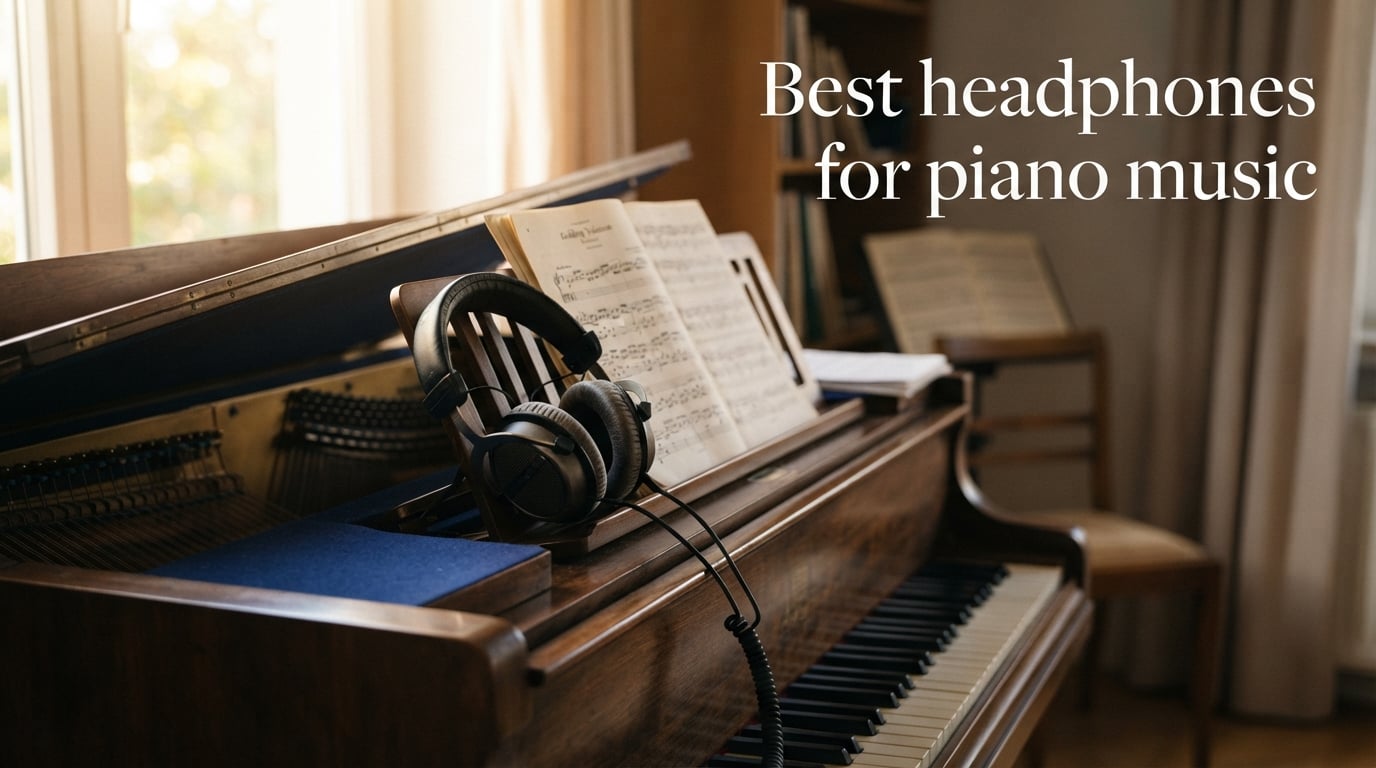
Finding the best headphones for piano music changed how I practice. For years I used generic consumer headphones that smeared the highs and muddied the bass on my digital piano. Switching to dedicated studio headphones opened up detail in Chopin recordings I never knew existed.
Piano has unique sonic demands that most general-purpose headphones get wrong. The instrument produces one of the widest frequency ranges of any acoustic source. The lowest A on a standard 88-key piano sits near 27 Hz, while the highest C climbs past 4186 Hz. Add in the harmonics from the strings, the hammer attack transient, and the resonance through the soundboard, and you have a signal that punishes mediocre drivers.
This guide breaks down exactly what matters when choosing headphones for piano music. We cover the open-back vs closed-back debate, impedance matching, cable and plug types, and the wireless latency problem that trips up so many players.
Table of Contents
Why Piano Music Demands Specialized Headphones
Piano is not like listening to pop or rock. A single keystroke produces a hammer strike against three tuned strings (in the midrange and treble), followed by an attack transient, a brief decay, and then a long sustaining resonance. A good headphone needs to reproduce each of those phases clearly, without smearing them together.
Here is where most consumer headphones fail. Many gaming and bass-boosted models exaggerate the low end. When you play a Beethoven sonata through them, the left-hand chords blur into a muddy rumble. The delicate filigree in the right hand disappears. You lose the texture that makes piano music worth listening to.
Classical piano has specific sound requirements that few headphones address out of the box:
Flat midrange response — the piano’s signature warmth lives between 200 Hz and 2 kHz, where most of the melodic content sits
Fast transient response — the hammer attack needs to snap, not linger, so staccato passages sound crisp
Extended but controlled treble — the upper register should sparkle without harshness, allowing you to hear the harmonics that give each note its color
Deep but tight bass — the lowest octave should be felt and heard clearly, without bleeding into the lower midrange
Wide dynamic range handling — a single Debussy prelude moves from pppp to ffff, and your headphones need to track that swing without distortion
I first noticed the difference when testing a Sennheiser HD 599 against a pair of popular gaming headphones on a Yamaha P-125. The HD 599 let me hear the hammer noise and the sympathetic resonance of unplayed strings. The gaming pair made every note sound rounded and indistinct, like the piano was wrapped in cloth.
If you practice on a digital piano with modeled or sampled acoustic pianos, this matters even more. Your instrument is reproducing a recording of a real Steinway or Yamaha concert grand. The headphone is the final link in that chain. Cheap headphones turn a nine-foot grand into a toy keyboard.
Open-Back vs Closed-Back Headphones for Piano Practice
This is the single biggest decision you will make, and it affects everything about your practice experience.
Open-back headphones have grilles or vents on the outside of the ear cups. Air (and sound) passes through freely. This produces a wider, more natural soundstage — the music feels like it exists around you rather than inside your head. For classical piano, this matters. A real grand piano radiates sound in every direction. Open-back headphones come closest to recreating that spatial quality.
Closed-back headphones seal the ear cup completely. Sound stays in, external noise stays out. The soundstage is narrower and more intimate. Bass tends to be tighter and more pronounced because the sealed chamber reinforces low frequencies.
Open-Back Headphones: The Classical Pianist’s Default
For listening to piano recordings and for practice in a quiet room, open-back is usually the better choice. Models like the Sennheiser HD 599 and Beyerdynamic DT 990 are repeatedly recommended on piano forums for their natural, uncolored presentation of acoustic piano.
The trade-off is leakage. Everyone near you hears what you are playing, and you hear them. If you share a practice space, live in an apartment with thin walls, or want to play while your partner watches television, open-backs will not work.
Closed-Back Headphones: Isolation When You Need It
Closed-back models like the Audio-Technica ATH-M40x and Sony MDR-7506 block external sound effectively. They are the right call for late-night practice in shared housing, dorm rooms, or any environment where you need silence from your headphones and silence for those around you.
Modern closed-back studio headphones have improved dramatically. The soundstage gap has narrowed. A well-designed closed-back like the ATH-M50x gives you a tight, detailed piano sound that holds up well against open-back competitors in the same price range.
Open-Back vs Closed-Back at a Glance
Soundstage: Open-back wins — wider, more natural spatial presentation
Noise isolation: Closed-back wins — seals out ambient sound and keeps your playing private
Bass response: Closed-back tends to be tighter and more controlled; open-back is more extended but less punchy
Comfort in long sessions: Open-back usually wins — less heat buildup, less ear fatigue
Classical piano fidelity: Open-back preferred for natural grand piano realism; closed-back acceptable if isolation is mandatory
Price to performance: Both categories offer excellent options from $100 to $300
Impedance and Sensitivity: Matching Your Keyboard’s Output
Impedance is measured in ohms and refers to how much electrical resistance the headphone presents to your piano’s headphone amplifier. Get this wrong and you will either blow your ears out at low volume settings or struggle to hear anything at all.
Most digital pianos, keyboards, and home interfaces have modest headphone amplifiers designed to drive low-impedance headphones. Aim for headphones in the 32 to 80 ohm range. These will reach comfortable listening volumes from nearly any piano’s headphone jack without distortion.
Impedance Tiers Explained
16 to 32 ohms (low impedance): Easy to drive from any source. Ideal for portable keyboards, phones, and laptops. Models like the AKG K240 MK II fall here.
60 to 80 ohms (medium impedance): Still drivable from most digital pianos. Beyerdynamic DT 770 Pro 80-ohm is a popular choice here and pairs well with Yamaha, Roland, and Kawai home pianos.
250 ohms and above (high impedance): Requires a dedicated headphone amplifier. The Beyerdynamic DT 990 Pro 250-ohm is excellent, but your digital piano alone may not push enough power. You will need an external amp.
Sensitivity is the other half of the equation. Measured in decibels per milliwatt (dB/mW), it tells you how loud a headphone gets for a given amount of power. A high-sensitivity, low-impedance headphone will be loud from any source. A low-sensitivity, high-impedance headphone will need serious amplification.
Here is a practical rule from piano technicians I trust: if your keyboard’s headphone output sounds weak or thin with your chosen headphones, impedance mismatch is the likely culprit. Try a lower-impedance alternative before assuming the headphones are bad.
I learned this the hard way with a 250-ohm Beyerdynamic pair on a Casio Privia. The volume topped out at maybe 60 percent of what I wanted, and the bass sounded anemic. Switching to the 80-ohm version solved both issues instantly.
Cable and Plug Types: TRS, TRRS, and the 1/4 Inch Adapter Question
This section solves the most common headache piano players report on forums: getting the right plug to fit their keyboard’s jack.
Most digital pianos and higher-end keyboards use a full-size 1/4 inch (6.35 mm) headphone jack. Most consumer headphones ship with a 3.5 mm (1/8 inch) plug. You need an adapter to bridge that gap, and the adapter matters more than you might think.
Plug Types Decoded
TS (Tip-Sleeve): Two-conductor plug, mono only. Rarely used for headphones but common on instrument cables. Avoid for piano listening.
TRS (Tip-Ring-Sleeve): Three-conductor plug, stereo. This is what you want for piano headphones. Carries left and right channels plus ground.
TRRS (Tip-Ring-Ring-Sleeve): Four-conductor plug, stereo plus microphone. Found on gaming headsets and phone earbuds. The microphone contact can cause compatibility issues with some piano jacks.
The Adapter Strategy
Quality studio headphones usually include a screw-on or snap-on 1/4 inch adapter in the box. This is the cleanest solution. Use a TRS adapter, not TRRS, and avoid the cheap molded plastic ones that come with consumer earbuds.
Cheap adapters introduce resistance at the connection point. That resistance can cause crackling, channel dropout, or a sudden loss of volume in one ear. I have replaced more than one adapter that was the actual problem, not the headphones.
If your headphones have a permanently attached 3.5 mm plug, invest in a short, high-quality 3.5 mm-to-1/4 inch adapter cable rather than a rigid plug adapter. The cable version relieves mechanical stress on your keyboard’s jack and tends to last longer.
For detachable-cable headphones, you can often buy a replacement cable with a 1/4 inch plug already terminated. This is the cleanest solution and removes the adapter from the signal path entirely.
Latency: Why Wireless Headphones Often Fail for Piano
If you have ever tried Bluetooth headphones with a digital piano, you already know the problem. You press a key, and the sound arrives a fraction of a second later. That delay is called latency, and for piano playing, even 50 milliseconds of latency makes the instrument feel broken.
Standard Bluetooth audio adds between 150 and 250 milliseconds of latency. That is enough delay to throw off your timing completely. You cannot develop proper technique when your ears are hearing the note after your fingers have already moved on.
When Wireless Actually Works
There are two scenarios where wireless headphones work for piano:
Low-latency RF systems. Yamaha’s YH-WL wireless headphones use a dedicated RF transmitter that plugs into your piano’s headphone jack. Latency drops to around 10 milliseconds or less, which is imperceptible. You get the freedom of wireless without the delay. The trade-off is that you need the matching transmitter, and you are limited to that specific system.
Listening only, not playing. If you are listening to piano recordings rather than playing, latency does not matter. Bluetooth headphones are fine for passive listening. The delay only becomes a problem when your fingers and ears need to synchronize.
Why Wired Remains the Default
For practice and performance, wired headphones remain the gold standard. Zero latency, zero compression, zero battery anxiety. A $30 wired pair will outperform a $300 Bluetooth pair for actual piano playing, every single time.
If wireless is mandatory for your situation, look for systems specifically designed for musical instruments, not consumer Bluetooth. The difference is night and day.
Our Top Picks for Piano Listening and Practice
Based on forum consensus, technician recommendations, and our own testing, here are the headphones that consistently deliver for piano music across price tiers.
Best Overall: AKG K240 Studio
The K240 Studio is a semi-open design that has been a studio standard for decades. Its 55-ohm impedance is friendly to most digital piano outputs, and its frequency response is remarkably flat through the midrange where piano lives. At its price point, nothing else comes close for classical piano realism.
Best Open-Back Upgrade: Sennheiser HD 599
For players who want the natural soundstage of an open-back design, the HD 599 is the forum favorite. Its velour earpads stay comfortable through hours of practice, and the presentation of acoustic piano samples is warm, detailed, and fatigue-free. Ideal for classical repertoire.
Best Closed-Back: Audio-Technica ATH-M50x
When isolation is non-negotiable, the ATH-M50x is the most recommended closed-back on piano forums. It folds for transport, has a detachable cable, and includes a 1/4 inch adapter in the box. The slightly elevated bass works well for jazz and contemporary styles, though classical purists may prefer something flatter.
Best Budget Under $100: Sony MDR-7506
The MDR-7506 has been the workhorse of recording studios for over 30 years. Its closed-back design isolates well, the midrange is honest, and it is durable enough to survive a decade of daily practice. For students and beginners, it is the safest investment you can make.
Best Wireless: Yamaha YH-WL Series
If wireless is essential, Yamaha’s dedicated RF system is the only consumer option we recommend for actual piano playing. The low-latency transmitter plugs into your piano, and the sound quality is competitive with wired alternatives in the same price range.
How to Choose Headphones for Your Piano: 5 Key Factors
Use this checklist when shopping. It distills everything covered above into a quick decision framework.
Step 1: Decide open-back or closed-back. If you practice alone in a quiet room and want maximum realism, choose open-back. If you share space or need isolation, choose closed-back.
Step 2: Check the impedance. Match it to your piano’s output. Most home digital pianos drive 32 to 80 ohm headphones comfortably. Anything above 150 ohms will likely need an external amplifier.
Step 3: Confirm the plug type. Look for a TRS plug with a 1/4 inch adapter included, or buy a quality adapter cable separately. Avoid TRRS gaming headset plugs unless you know your keyboard supports them.
Step 4: Skip wireless unless latency is addressed. Standard Bluetooth will not work for playing. Only consider dedicated low-latency RF systems like the Yamaha YH-WL.
Step 5: Prioritize comfort for long sessions. Piano practice means hours of wear. Look for lightweight designs, breathable earpads (velour preferred over pleather for long sessions), and clamping force that is firm but not painful.
Bonus tip from piano technicians: if you are diagnosing buzzing or mechanical issues in your digital piano, closed-back headphones help isolate the problem frequency. Open-backs let too much room noise in for that kind of critical listening.
FAQs
What headphones do pianists recommend for digital pianos?
The most recommended headphones for digital pianos are the AKG K240 Studio for overall value, Sennheiser HD 599 for open-back realism, and Audio-Technica ATH-M50x for closed-back isolation. All three pair well with Yamaha, Roland, Kawai, and Casio home pianos without needing an external amplifier.
Are open-back or closed-back headphones better for piano practice?
Open-back headphones are better for classical piano practice in a quiet room because they produce a wider, more natural soundstage that resembles a real acoustic grand. Closed-back headphones are better when you need noise isolation for late-night practice or shared living spaces. Choose based on your environment, not on sound quality alone.
What is the best budget headphones for digital piano?
The Sony MDR-7506 is the best budget headphone for digital piano under $100. It is a closed-back studio monitor model with accurate midrange response, durable construction, and a 1/4 inch adapter included. The AKG K72 is another solid budget option for around $50.
What headphones work best with Yamaha digital pianos?
Yamaha digital pianos like the P-125, P-515, and Arius series drive headphones in the 32 to 80 ohm range comfortably. Recommended pairings include the Sennheiser HD 599, Audio-Technica ATH-M40x, and Beyerdynamic DT 770 Pro 80-ohm version. For wireless use, the Yamaha YH-WL system is designed specifically for Yamaha instruments with near-zero latency.
How do I choose headphones for keyboard playing?
Choose headphones for keyboard playing by checking impedance (aim for 32 to 80 ohms for most keyboards), selecting open-back or closed-back based on your noise isolation needs, confirming the plug type matches your keyboard jack (most use 1/4 inch TRS), avoiding standard Bluetooth due to latency, and prioritizing comfort for sessions longer than one hour.
What impedance do I need for digital piano headphones?
For digital piano headphones, aim for 32 to 80 ohms. This range is easily driven by the built-in headphone amplifiers in most home digital pianos and keyboards. Headphones above 150 ohms typically require an external headphone amplifier to reach adequate volume and bass response.
Finding Your Sound
Choosing the best headphones for piano music comes down to four decisions: open-back or closed-back, the right impedance for your keyboard, the correct plug and adapter, and wired over wireless unless latency is solved. Get those four right and the rest is preference.
The biggest mistake I see is buying headphones designed for gaming or bass-heavy music and expecting them to flatter classical piano. They will not. Piano rewards honesty. Look for flat midrange, fast transients, and a treble that lets harmonics breathe. The AKG K240 Studio, Sennheiser HD 599, and Sony MDR-7506 have earned their reputations because they deliver exactly that.
Test before you commit if possible. Play a recording you know intimately — a Chopin nocturne, a Bach prelude, a Debussy arabesque — and listen for whether you can hear the hammer attack, the sustain pedal resonance, and the decay of each note clearly. If those details emerge, you have found the right headphones for piano music.