
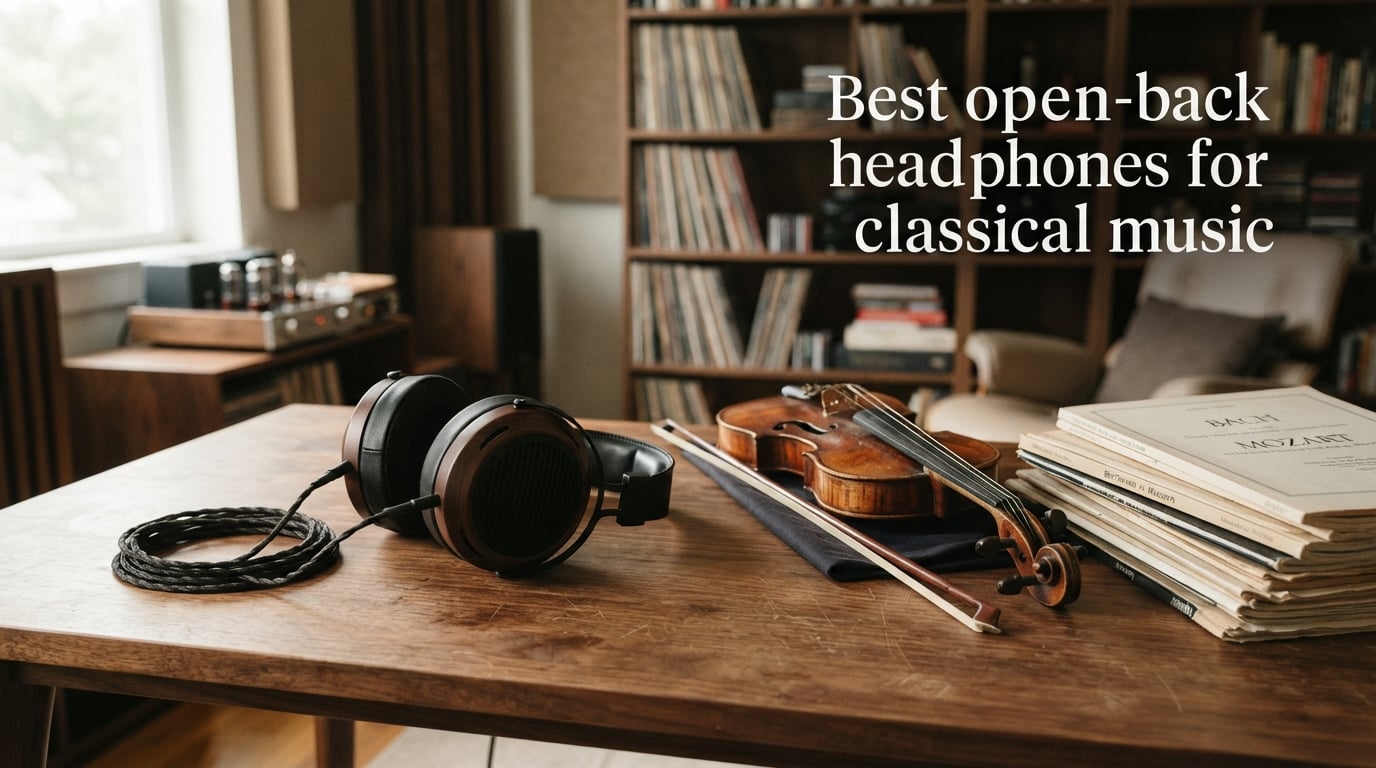
Classical music lives or dies by space. When a Mahler symphony swells from a whisper to a thunderous orchestral tutti, you want to hear exactly where each string section sits, how the woodwinds breathe between phrases, and how the concert hall itself shapes the sound. The wrong pair of headphones collapses all of that into a flat, congested wall of audio. That is exactly why so many classical listeners, myself included, end up at the same destination: open-back headphones for classical music.
This guide is not another list of product picks. Instead, our team put together a deep educational resource explaining why open-back designs suit orchestral and chamber music so well, what technical characteristics actually matter, and how to evaluate a pair before you commit. We mined community discussions from Head-Fi, r/classicalmusic, and r/HeadphoneAdvice to surface the real listener concerns that spec sheets never address.
By the end, you will understand soundstage, imaging, frequency response tradeoffs, driver technology, amplification needs, and how all of these interact with the kind of classical recordings you love most. Whether you are upgrading from a basic pair of closed-backs or buying your first audiophile headphone, this is the foundation you need to make a confident choice in 2026.
Table of Contents
What Are Open-Back Headphones?
Open-back headphones use earcups with vents, grilles, or perforations that let air and sound pass freely between the driver and the outside world. The back of the driver is not sealed inside a closed chamber the way it is in closed-back designs. That single design choice changes almost everything about how the headphone sounds.
Because air moves through the earcup, internal reflections and pressure buildup are dramatically reduced. The result is a sound that feels less confined to your head and more like it exists in the room around you. Listeners often describe the experience as closer to sitting in front of a pair of speakers than wearing headphones.
The trade-off is obvious and worth stating upfront. Sound leaks out, so people nearby can hear what you are playing. Outside noise also leaks in, so a noisy environment will compete with your music. Open-back headphones are best for quiet, dedicated listening spaces where their strengths can actually shine.
Why Open-Back Headphones Are Ideal for Classical Music
Classical recordings are not mixed the way pop albums are. Engineers typically capture a real ensemble in a real acoustic space, using microphone placement to preserve the natural reverberation and the spatial relationship between instruments. Open-back headphones honor that recording philosophy better than almost any other type of headphone.
The vented design produces a wider, deeper, and more spacious presentation. Strings do not sound trapped inside your skull. Brass swells feel like they come from a real distance. The decay of a piano note in a concert hall fades naturally instead of being cut off by sealed-earcup reflections. For music that was conceived acoustically, this natural presentation matters more than any other single factor.
There is a second benefit that audiophiles in the Head-Fi community bring up again and again: long-session comfort and reduced listening fatigue. Closed-back designs trap heat and create pressure against the eardrum, which contributes to that tired, headachy feeling after a long symphony. Open-backs breathe, both physically and sonically, letting you listen through a full Wagner opera without fatigue.
Finally, open-back headphones for classical music tend to be tuned with a more neutral, transparent signature. Manufacturers know their audience values accuracy over artificial bass boost, so the best models in this category preserve timbre honestly. That means violins sound like violins, cellos sound like cellos, and a solo oboe retains the reedy character that gives it away in a blind test.
Soundstage and Imaging: The Classical Listener’s Two Most Important Specs
Soundstage and imaging are the two concepts that separate casual headphone listening from the experience classical listeners actually want. They are related but distinct, and understanding the difference is the single biggest upgrade you can make to how you evaluate gear.
What Is Soundstage?
Soundstage describes the perceived size and shape of the sonic space a headphone creates. A wide soundstage places instruments outside the boundaries of your head, often well beyond your ears. A deep soundstage adds front-to-back dimension, so you can sense how far away the timpani sits relative to the first violins. Together, width and depth recreate the geometry of a real performance hall.
Open-back headphones generally produce the largest soundstage of any headphone type because the vented earcups let sound radiate outward instead of bouncing back at you. This is why listeners on r/classicalmusic so often recommend models like the Sennheiser HD 800 S and AKG K702 for orchestral music. The sense of space those headphones deliver is simply unmatched in sealed designs.
What Is Imaging?
Imaging is the precision with which a headphone places individual instruments within that soundstage. If soundstage is the size of the stage, imaging is the resolution of the map drawn on it. Good imaging lets you point to exactly where the first-chair violin sits, follow a woodwind line as it moves between players, and track the antiphonal dialogue between two brass choirs.
For chamber music and small ensemble work, imaging matters even more than raw soundstage width. A string quartet recorded in a small studio has no need for a stadium-sized presentation, but the listener should still be able to locate each player with precision. That kind of pinpoint placement is what separates a good classical headphone from a merely loud one.
The pairing matters. A huge soundstage with poor imaging sounds diffuse and vague, like hearing an orchestra through a bathroom door. Precise imaging inside a tiny soundstage sounds claustrophobic. The best open-back headphones for classical music deliver both, and that combination is exactly what reproduces the experience of sitting in a good seat at a real concert.
Frequency Response: Treble, Midrange, and Bass for Classical
The way a headphone balances treble, midrange, and bass shapes how every note sounds. Classical music makes specific demands on each part of the frequency spectrum, and a signature that flatters electronic music can actively damage the listening experience.
Treble Clarity Without Harshness
High frequencies carry the overtones, the bow noise on strings, the breath in woodwinds, and the shimmer of cymbals. Treble clarity is what lets you hear the rosin on a violin bow and the air around a flute. Without it, classical recordings sound muffled and lifeless.
The danger is treble that peaks too aggressively. A boosted upper treble can make violins sound strident and massed strings turn harsh and fatiguing. Listeners in the audiophile forums consistently praise models like the HiFiMan Sundara and Sennheiser HD 600 series for delivering detail without that piercing edge. The goal is presence, not brightness.
Midrange Accuracy: The Heart of Classical Music
The midrange is where almost all classical music actually lives. Violins, violas, cellos, woodwinds, piano, and the human voice all have their fundamental frequencies and most important harmonics in the midrange. A headphone that gets the mids right will sound correct on everything from a Bach cello suite to a Verdi opera.
Midrange accuracy means neutrality, not flatness. The best open-back headphones reproduce the timbre of each instrument honestly, with the right body, warmth, and texture. The HiFiMan Arya Stealth gets consistent praise for an engaging midrange that pulls detail forward without sounding analytical, and the Sennheiser HD 600 line has been the reference standard for lifelike string tone for over two decades.
Bass Extension, Not Bass Boost
Classical music does not need the elevated bass that pop and hip-hop demand. What it needs is clean, extended low-frequency response that reproduces the actual fundamentals of cellos, double basses, bass drums, and timpani accurately. Boosted bass muddies the lower midrange and ruins the clarity of orchestral textures.
Listen for articulation rather than impact. A good open-back headphone lets you hear the pitch and texture of a double bass line, not just feel a thump. Planar magnetic drivers, which we cover in the next section, tend to excel here with their fast, controlled low-end response.
Open-Back vs Closed-Back Headphones for Classical Music
The choice between open-back and closed-back is not about which is objectively better. It is about which trade-offs fit your listening situation and the kind of classical music you play most.
Open-back wins on soundstage, imaging, natural timbre, and long-session comfort. Closed-back wins on noise isolation, bass impact, privacy, and portability. For a listener in a quiet dedicated room focused on orchestral and chamber music, open-back is almost always the right answer.
Closed-back becomes the better choice in specific scenarios. If you listen in a shared household, on commutes, or in any noisy environment, the isolation of a sealed design lets you actually hear the quiet passages that classical recordings depend on. A pianissimo string section is pointless if a refrigerator or traffic drowns it out.
Some listeners keep both. An open-back pair for serious home listening, and a closed-back or noise-cancelling pair for travel and shared spaces. The best closed-back headphones for classical music are the ones that minimize the typical closed-back flaws of congestion and boominess while still providing isolation. That usually means a well-engineered sealed design from a manufacturer that takes acoustic treatment seriously.
Driver Technology: Dynamic vs Planar Magnetic for Classical
Most open-back headphones use one of two driver technologies. Both can sound superb on classical music, but they have different strengths worth understanding before you buy.
Dynamic drivers are the traditional cone-and-magnet design used in most headphones and speakers. They tend to deliver a more natural, organic timbre, with a sense of physical weight and warmth that many listeners find addictive. The Sennheiser HD 800 S, Grado SR325x, and Beyerdynamic DT 1990 Pro all use dynamic drivers, and all are beloved by classical listeners.
Planar magnetic drivers use a flat, thin membrane with a printed circuit trace suspended between magnets. They are typically faster, with lower distortion and excellent bass control. Models like the HiFiMan Sundara, Arya Stealth, and Audeze LCD series are planar designs praised for detail retrieval and effortless handling of complex orchestral passages.
There is no universal winner. Dynamic drivers often win on timbral realism and that hard-to-define sense of musicality. Planar magnetic drivers often win on speed, detail, and bass articulation. The best choice depends on whether you prioritize the soul of the music or the precision of its reproduction. Many serious classical listeners end up owning one of each.
Genre-Specific Considerations: Baroque, Classical, Romantic, Contemporary
Classical music spans centuries and enormous stylistic range, and the right headphone emphasis shifts with the repertoire. Here is how the major periods map onto the technical priorities covered above.
Baroque music, with its clarity of counterpoint and prevalence of small ensembles, rewards imaging and midrange accuracy above all. You want to follow each voice in a Bach fugue without strain. Classical-era repertoire, from Haydn and Mozart, balances elegance and clarity, so a neutral signature with good treble presence serves it well.
Romantic music is where soundstage and dynamic range become critical. A Brahms symphony or a Wagner opera demands a headphone that can resolve huge forces without congestion and recreate the depth of a large hall. Planar magnetic designs often shine here. Contemporary and 20th-century repertoire, with its extended techniques and extreme dynamic contrasts, rewards speed, detail retrieval, and clean treble.
How to Choose the Best Open-Back Headphones for Classical Music
Choosing well means matching the headphone’s technical character to your listening situation, your source equipment, and the kind of music you play most. Here is how our team breaks down the decision.
Impedance and Amplification Requirements
Impedance, measured in ohms, describes how much electrical resistance the headphone presents to your amplifier. Higher impedance generally means the headphone needs more voltage to reach a given volume, which usually means a dedicated headphone amplifier. This is the single most overlooked factor by buyers new to open-back headphones.
Low-impedance models, typically under 80 ohms, can be driven acceptably by a phone, laptop, or modest USB DAC. The Beyerdynamic DT 900 PRO X and most Grado models fall into this category and are friendly starting points. They will not reach their full potential from a weak source, but they will sound good.
High-impedance models, often 150 to 600 ohms, demand a proper amplifier. The Sennheiser HD 600, HD 650, and Beyerdynamic DT 880 (600-ohm version) are famous examples. Plug them directly into a phone and they sound thin and lifeless. Pair them with even a modest dedicated amp and they transform, gaining body, dynamics, and headroom that completely change the listening experience.
Sensitivity also matters. A highly sensitive, low-impedance headphone may get loud from a weak source but still sound better with cleaner power. As a working rule, if your headphone costs more than your source, you have probably mismatched the system.
Comfort for Long Listening Sessions
Classical music rewards long sessions. A Wagner opera runs over four hours. A complete Beethoven symphony cycle takes an entire afternoon. If a headphone is uncomfortable at minute thirty, it does not matter how good it sounds.
Weight is the first factor. Lighter headphones, under 350 grams, generally cause less fatigue over time. The Sennheiser HD 600 line and Grado models are notably light. Heavier planar magnetic designs can still be comfortable if the weight is well distributed across a wide headband.
Earpad material matters as much as weight. Velour and porous fabric pads breathe better than leather or pleather, which is one reason the open-back community favors them. Clamp force should be firm enough to keep the headphone stable but gentle enough that you forget you are wearing it. Replaceable earpads are a major long-term plus, since pads compress and wear out long before the drivers do.
Build Quality and Durability
A good open-back headphone can last decades if it is built well. Look for metal in the headband and yokes, user-replaceable cables, and replaceable earpads. The Beyerdynamic DT series is famous for being serviceable, with every part available as a spare, and the Sennheiser HD 600 line has been on the market since 1997 in part because owners can keep them alive indefinitely.
Avoid designs that rely on glued-together plastic at stress points. The hinge where the headband meets the earcup is the most common failure point on cheaply built headphones, and a broken hinge turns a great-sounding headphone into a paperweight.
Cabling, Earpads, and Maintenance
Detachable cables are not a luxury feature on a serious headphone. They are the difference between a ten-dollar fix and a total loss when a cable fails. Look for standard connectors, since proprietary locking designs limit your upgrade and replacement options.
Earpads change the sound as well as the comfort. Swapping stock pads for thicker velour or perforated leather can shift the tonal balance, sometimes subtly and sometimes dramatically. Treat pad choice as part of the tuning, not just a wear item.
Price-to-Performance Guidance
Open-back headphones deliver genuinely transformative improvements up to a certain price point, after which returns diminish sharply. The biggest jump almost every listener reports is moving from a basic closed-back consumer headphone to a serious open-back in the 150 to 500 dollar range. Models in this tier, like the HiFiMan Sundara, Sennheiser HD 600 series, and Beyerdynamic DT 1990 Pro, deliver most of what classical listeners actually need.
The next tier, roughly 500 to 1500 dollars, adds refinement in soundstage, imaging, and detail. The HiFiMan Arya Stealth and Focal Clear are popular here. Beyond 1500 dollars, you are paying for diminishing increments of performance and exotic build materials. Those flagship models are wonderful, but they are not required to experience classical music the way the engineers and conductors intended.
Budget should also account for source equipment. A 300 dollar headphone paired with a 200 dollar DAC and amplifier will almost always outperform a 600 dollar headphone plugged directly into a laptop. Plan the whole system, not just the headphone.
FAQs
Do open-back headphones sound better for music?
Open-back headphones sound better for music that depends on space, natural timbre, and accurate instrument placement, which includes most classical, jazz, acoustic, and orchestral recordings. The vented earcups produce a wider soundstage and reduce internal reflections that closed-back designs trap inside the earcup. The trade-off is that open-backs leak sound in both directions and provide no noise isolation, so they suit quiet listening rooms rather than commutes or shared spaces.
What are the best headphones for listening to classical music?
The best headphones for listening to classical music are open-back designs with a wide soundstage, precise imaging, neutral midrange, and clean treble that avoids harshness. Frequently recommended models among classical listeners include the Sennheiser HD 600, HD 650, and HD 800 S for natural timbre, the HiFiMan Sundara and Arya Stealth for detail retrieval, the Beyerdynamic DT 1990 Pro for analytical clarity, and the AKG K702 for value and spacious presentation. The right choice depends on your budget, source equipment, and which subgenre you listen to most.
What are the best closed-back headphones for classical music?
The best closed-back headphones for classical music are sealed designs that minimize the typical closed-back flaws of congestion and boominess while still providing isolation. They are the right choice when you listen in noisy environments, on commutes, or in shared spaces where sound leakage is a problem. Look for closed-back models with neutral tuning, controlled bass, and treated earcups designed to reduce internal resonance, since those design choices come closest to preserving the clarity and space that classical recordings depend on.
What are the best noise cancelling headphones for classical music?
The best noise cancelling headphones for classical music are active noise cancelling (ANC) models that combine effective isolation with a neutral, detailed sound signature. ANC is especially valuable when you want to hear the quiet pianissimo passages that classical recordings rely on but cannot control the noise around you, such as on flights or in busy offices. Prioritize models with low inherent noise floor, since ANC circuitry that introduces hiss will sabotage the very detail classical listening demands, and look for a transparent or neutral EQ mode rather than a bass-boosted default.
Conclusion
Finding the best open-back headphones for classical music is less about chasing a single perfect model and more about understanding how soundstage, imaging, frequency response, and driver technology combine to recreate the experience of a live performance. Open-back designs win for classical because they preserve the space, timbre, and clarity that orchestral and chamber recordings are built around.
Match the headphone to your listening environment, your source equipment, and the repertoire you love most. A 300 dollar open-back paired with a modest amplifier will reveal more of a Beethoven symphony than any flagship headphone plugged into a phone. Start with the foundation in this guide, listen before you buy whenever possible, and let your own ears make the final call.