
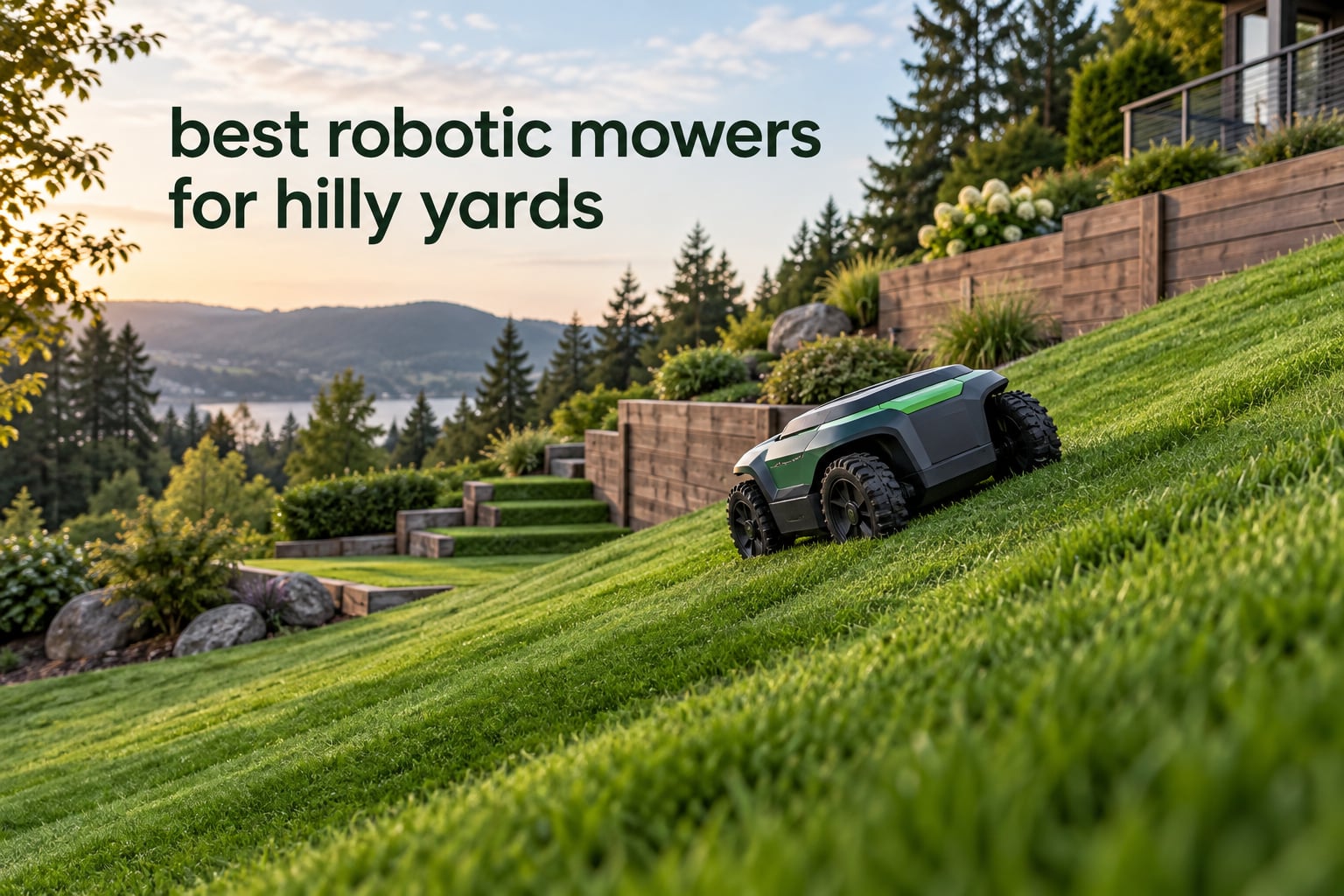
Most robot lawn mowers are sold for flat lawns, and most of them fail badly on hills. The short answer for 2026: the best robotic mowers for hilly yards are all-wheel-drive machines rated at 60 to 84 percent slope, and 80 percent equals 38.6 degrees. Below that tier, a two-wheel-drive mower will skid sideways, chew a rut, or stall halfway up a moderate incline.
That ceiling matters because slope rating is the one spec that decides whether you will actually enjoy the machine. A mower rated 45 percent handles a gentle rise. A mower rated 80 percent handles the kind of backyard slope that stops a walk-behind mower dead. We sorted all ten models in this guide on published slope rating first, then drive system, then coverage for the acreage you actually have.
This is a specification-and-owner-data roundup rather than a hands-on slope test. Every slope figure below comes from the manufacturer’s published rating, and every owner detail comes from aggregated customer reviews. We tell you where the ratings are generous and where reviewers report a different experience in real yards. If you want ear protection for the sessions when you still mow by hand, we covered that separately in our noise cancelling headphones for lawn mowing and yard work guide.
Table of Contents
Top 3 Picks for Hilly Yards (October 2026)

Mammotion LUBA mini 2 AWD 1500H
- 80 percent slope rating
- Two independent 88W motors
- Adaptive suspension
- 0.37 acre

Mammotion LUBA 3 AWD 3000
- 80 percent (38.6 degree) slope
- 15.7 inch dual discs
- 500 sqm per hour
- 12Ah battery
The LUBA mini 2 AWD 1500H takes the top slot because it pairs an 80 percent published slope rating with the deepest owner-review base in our set at 263 reviews and a 4.4 average. The LUBA 3 AWD 3000 covers far more ground per hour, which matters when your hill sits on a half-acre-plus property. The Navimow i215 LiDAR is the pick when satellite signal is a problem, because solid-state LiDAR and vision fuse together and never depend on sky view.
All 10 Best Robotic Mowers for Hilly Yards in 2026
| Product | Specifications | Action |
|---|---|---|
| Mammotion LUBA mini 2 AWD 1500H |
|
Check Latest Price |
| Mammotion LUBA 3 AWD 3000 |
|
Check Latest Price |
 Navimow i215 LiDAR Navimow i215 LiDAR |
|
Check Latest Price |
 ANTHBOT M5 ANTHBOT M5 |
|
Check Latest Price |
 Navimow i206 AWD Navimow i206 AWD |
|
Check Latest Price |
 Sunseeker X5 AWD Sunseeker X5 AWD |
|
Check Latest Price |
 Mammotion LUBA 2 AWD 3000HX Mammotion LUBA 2 AWD 3000HX |
|
Check Latest Price |
 WORX WR342 4WD WORX WR342 4WD |
|
Check Latest Price |
 Dreame A3 AWD 2000 Dreame A3 AWD 2000 |
|
Check Latest Price |
 Roborock RockNeo Q110H Roborock RockNeo Q110H |
|
Check Latest Price |
Read the slope column as a floor, not a promise. Ratings are measured on clean, dry, engineered test inclines, and reviewers regularly report that wet grass, thick coarse blades and mowing transitions cost a mower a meaningful slice of its rated grade. Size your mower one tier above your steepest measured section rather than matching it exactly.
1. Mammotion LUBA mini 2 AWD 1500H – Best Overall for Steep Hills
(2026 NEW) Mammotion LUBA mini 2 AWD 1500H Robot Lawn Mower with Garage, for 0.37 Acres, 360° LiDAR+Dual-Camera AI Vision, 80% Slope, DropMow, 20 Multi-Zone Management
80 percent slope
0.37 acre
7.9 inch deck
2.2-4.0 inch height
Pros
- Owners report success on 80 percent grade terrain
- Two independent 88W motors with adaptive suspension
- Accurate RTK mapping with virtual walls and no-go zones
- Quiet running with a rain sensor
- Detailed app control of patterns and schedules
Cons
- 0.37 acre mapping ceiling cannot be expanded
- 7.9 inch deck makes mow times long
- Charging takes two to three hours from low
- Map editing in the app is awkward
This is the machine I keep coming back to for genuine hills. The LUBA mini 2 AWD 1500H runs two independent 88W motors with an adaptive suspension system, which is the mechanical reason it can hold a climb where lighter two-wheel-drive machines spin out. Owners with multiple seasons of experience report consistent slope reliability, and the 4.4 average across 263 reviews is the largest feedback base among the steep-rated machines here.
The navigation stack is 360 degree LiDAR plus dual-camera AI vision, so it keeps working under tree cover where a pure satellite mower gives up. Obstacle handling combines physical bumpers, LiDAR and vision, and the mower manages up to 20 independent mowing zones. If you want a hilly yard handled quietly and without digging rut lines into the hill, this is the safest pick on the list.
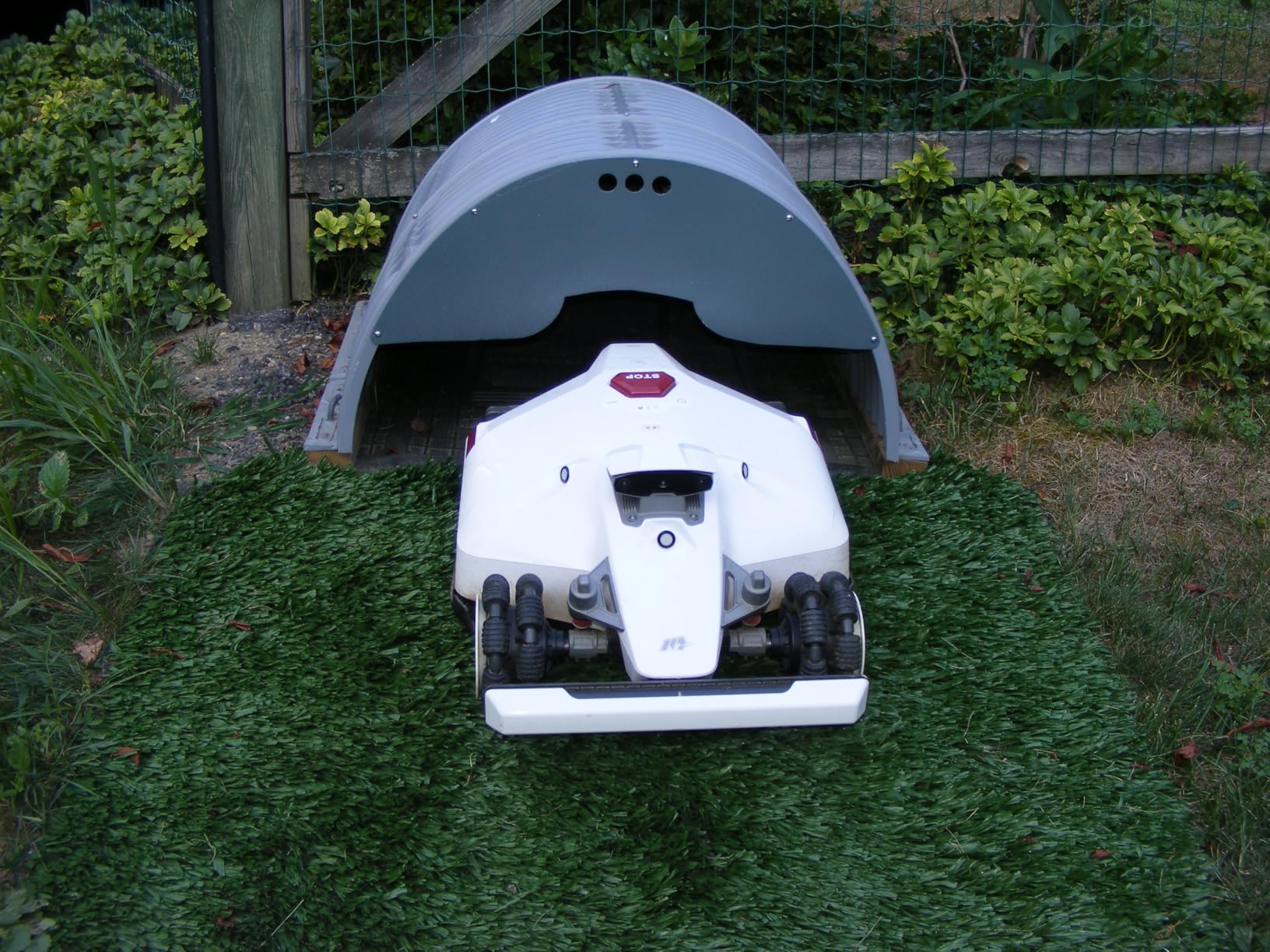
The compromises are real and worth naming. The 0.37 acre mapping ceiling is a hard limit that cannot be expanded, which rules it out for anything larger regardless of how good the slope performance is. The 7.9 inch cutting width is narrow, so mow times stretch out compared with the 15.7 inch decks on the larger models. Charging from a low battery takes two to three hours, which shapes how you schedule it.
One more thing owners mention: editing mapped boundaries in the software is awkward and sometimes forces a full re-map. The cut-height range of 2.2 to 4.0 inches is unusually wide, which matters in summer when you want to leave the grass taller.
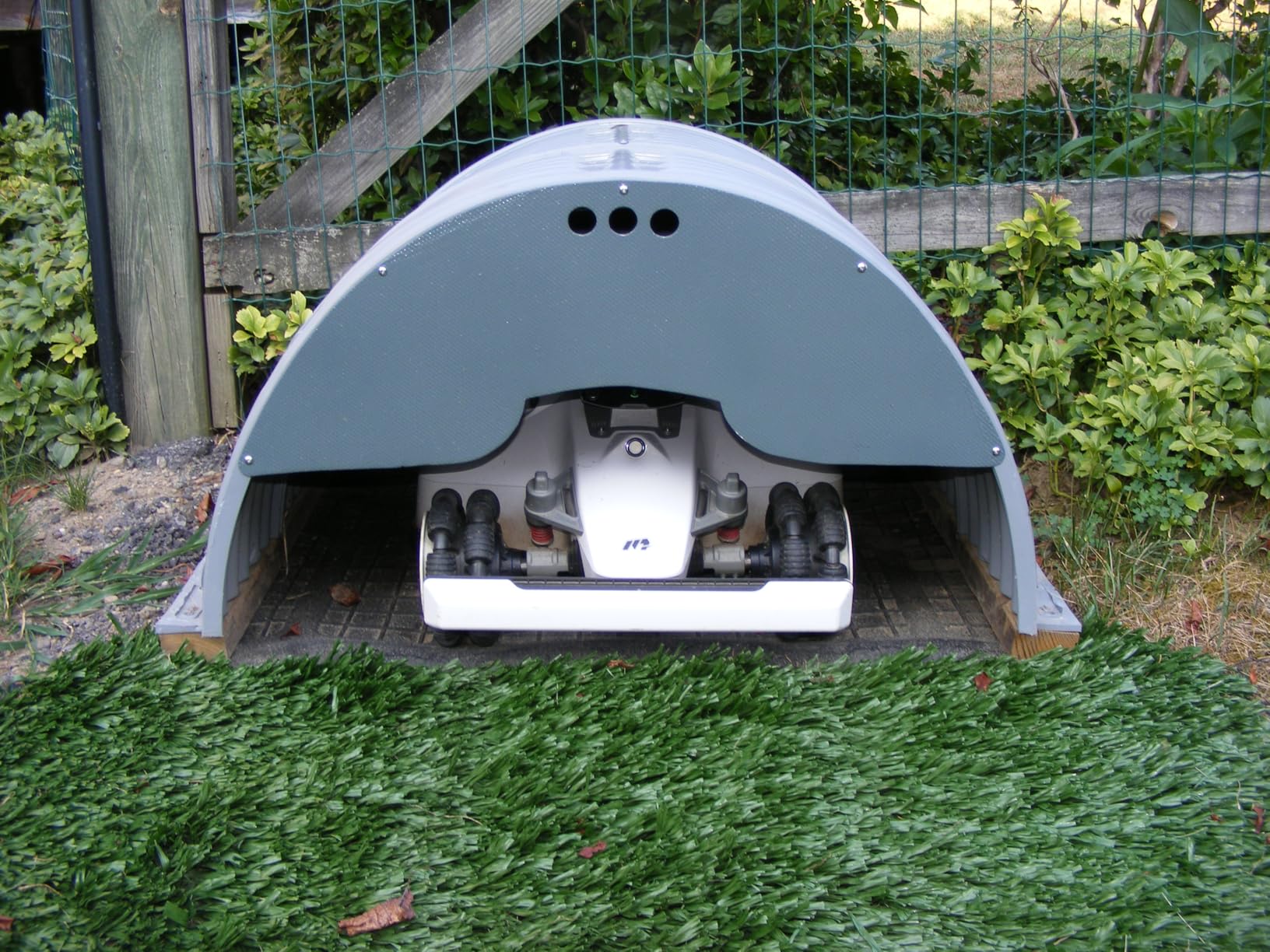
What it handles that smaller mowers cannot
Grades up to 80 percent published, plus roots and uneven ground, thanks to suspension travel that steps over curbs and thresholds. It also holds its line across uneven sidehill traverses rather than sliding. On a yard where the hill is the whole problem, that difference is what the purchase is actually buying you.
It also has an edge cutting disc alongside the main disc, so the uncut strip against fences and beds is narrower than on single-deck machines. That is not a full solution, but it cuts down the string trimming you would otherwise do every week.
Where it falls short
The 0.37 acre cap is the deal-breaker for larger properties, and the narrow deck means long sessions. If your hilly yard is small and steep, this is the right fit. If it is large as well as steep, step up to the LUBA 3 AWD 3000 for speed.
Support chat experiences are often unhelpful according to some owners, so factor in your own tolerance for remote troubleshooting. The mower itself is well liked; the service around it is the weak spot.
2. Mammotion LUBA 3 AWD 3000 – Best for Large Hilly Properties
Mammotion LUBA 3 AWD 3000 Robot Lawn Mower with Cleaning Stand (Ship Separately), 360° LiDAR+NetRTK+AI Vision, AWD for 80% Slopes, 5400 sq.ft/h, Cutting Height 1.0″-2.7″
80 percent (38.6 degree) slope
15.7 inch dual discs
12Ah and 175 min
1.0-2.7 inch height
Pros
- Four independent motors climb 80 percent slopes and clear 50 mm obstacles
- 360 degree LiDAR to 230 ft plus AI vision for 300 plus obstacle types
- Up to 500 sqm per hour with 15.7 inch dual discs
- Quiet enough for night mowing with lighting and rain sensor
- No RTK antenna needed in day-to-day use
Cons
- Online manual is not very helpful
- App mapping is difficult in bright sunlight
- Battery pack is not user replaceable
- Default settings will not finish a quarter acre on one charge
Coverage rate is what separates this from the mini. Two 165W cutting motors drive 6-blade discs across a 15.7 inch cutting width, and the 12Ah battery runs up to 175 minutes for up to 500 square metres per hour. On a big property with a hill on it, finishing the slope before the neighbours are up is the difference between loving the machine and resenting it.
Tri-Fusion navigation combines 360 degree LiDAR, NetRTK and dual-camera AI vision. The LiDAR sweeps 360 degrees horizontally and 59 degrees vertically with a range up to 230 feet, and the upgraded AI processor identifies more than 300 obstacle types. Four independent motors handle the 80 percent grade, and adaptive suspension steps over 50 mm obstacles without getting stuck.
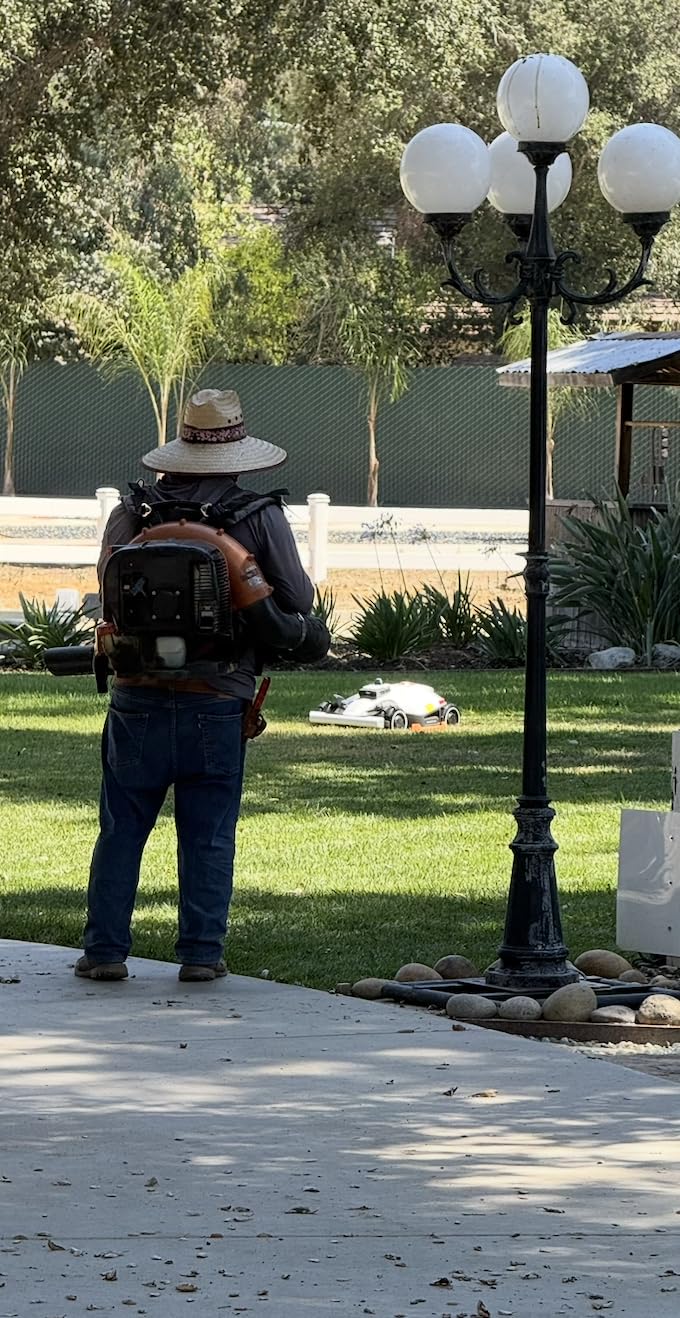
The friction points are practical rather than dramatic. The online manual is not very helpful, so owners lean on community videos for setup, and the phone app is hard to use in bright sunlight. The battery pack is not user replaceable, which matters if you plan to keep the machine a decade. With default pattern settings it will not finish a quarter acre on a single charge, so plan on one recharge cycle per session.
Because it cuts without lifting grass, appearance can look uneven when the lawn has grown long. Run it more frequently at a higher cut height than you would with a lifted-blade machine.
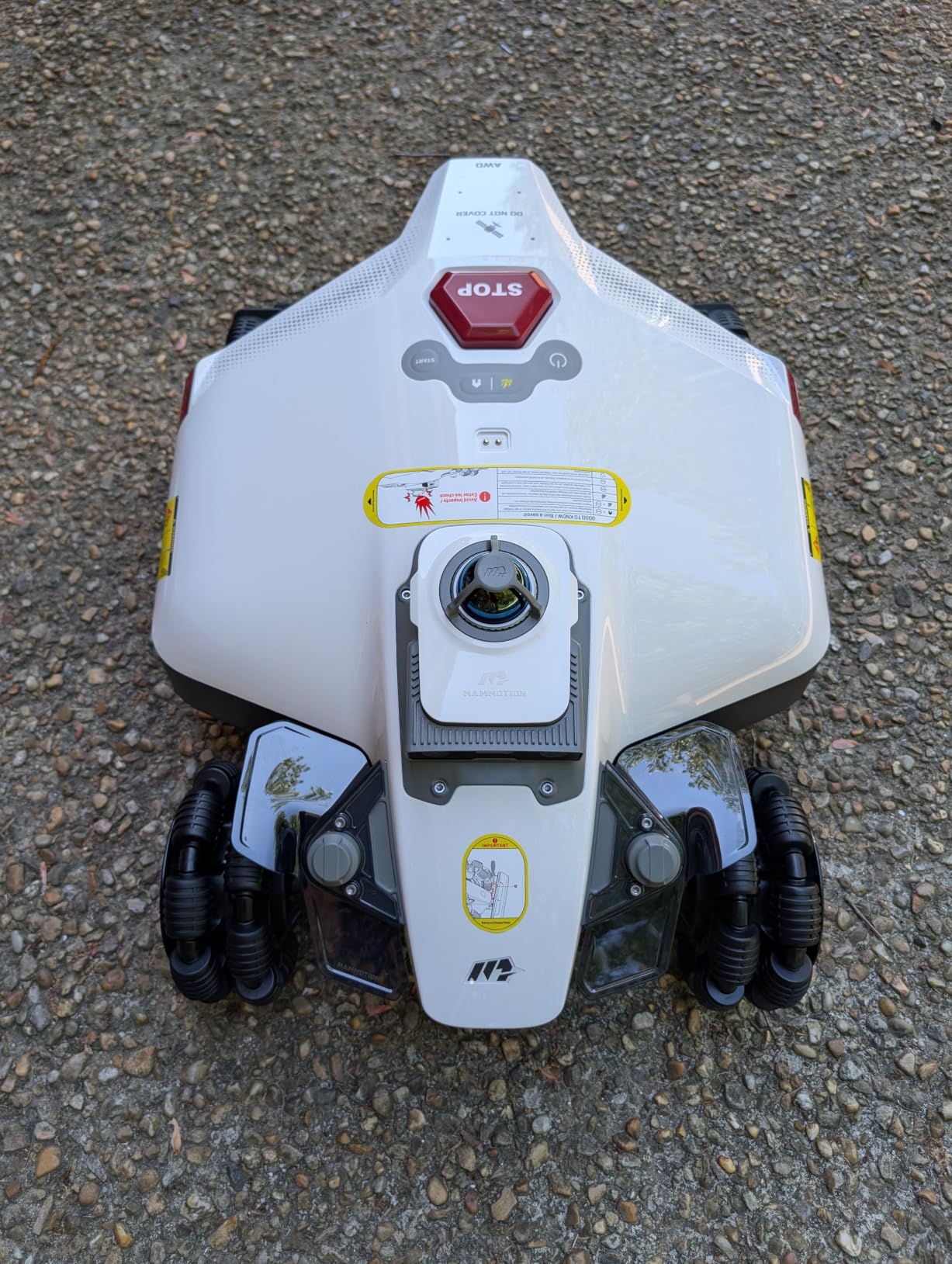
When the acreage and the grade both argue for the bigger machine
Rough or sloped lawns above a quarter acre, especially anywhere you would otherwise spend a full Saturday. The wide deck and high hourly coverage cut session length dramatically compared with the 7.9 inch and 8.66 inch decks in this list.
Integrated lighting and a rain sensor let you run it at night or after a shower, which is a big scheduling win on a large yard. The absence of a required RTK antenna in daily use also removes a visible trip hazard from the lawn.
Trade-offs worth weighing
Cut height tops out at 2.7 inches, which is lower than some owners want in summer heat. The learning curve on app mapping is real, and setup leans on community support rather than documentation.
Some units have stopped working after a few weeks, and support responses can be slow, so keep expectations realistic on long-term support. The mower is strong; the aftercare is uneven.
3. Navimow i215 LiDAR – Best Satellite-Free Hill Climbing
Segway Navimow i215 LiDAR Robot Lawn Mower, Wire Free Robotic Lawn Mower for 0.37 Acre, LiDAR & Vision Dual Fusion, Auto Mapping, Off-Road Wheels for 45% Slopes, Quiet 59 dB(A) Mowing
45 percent slope
0.37 acre
Solid-state LiDAR plus vision
2-4 inch height
59 dB(A)
Pros
- Off-road wheels and stability control for 45 percent slopes
- Satellite-free LiDAR and vision navigation day or night
- Very quiet at 59 dB(A)
- One-tap auto mapping with an editable 20-zone map
- GPS geo-fence with lift detection and Find My alerts
Cons
- Setup and mapping required before use
- 0.37 acre coverage means multiple sessions
- 8.66 inch cut width adds run time
- Edges along fences still need manual trimming
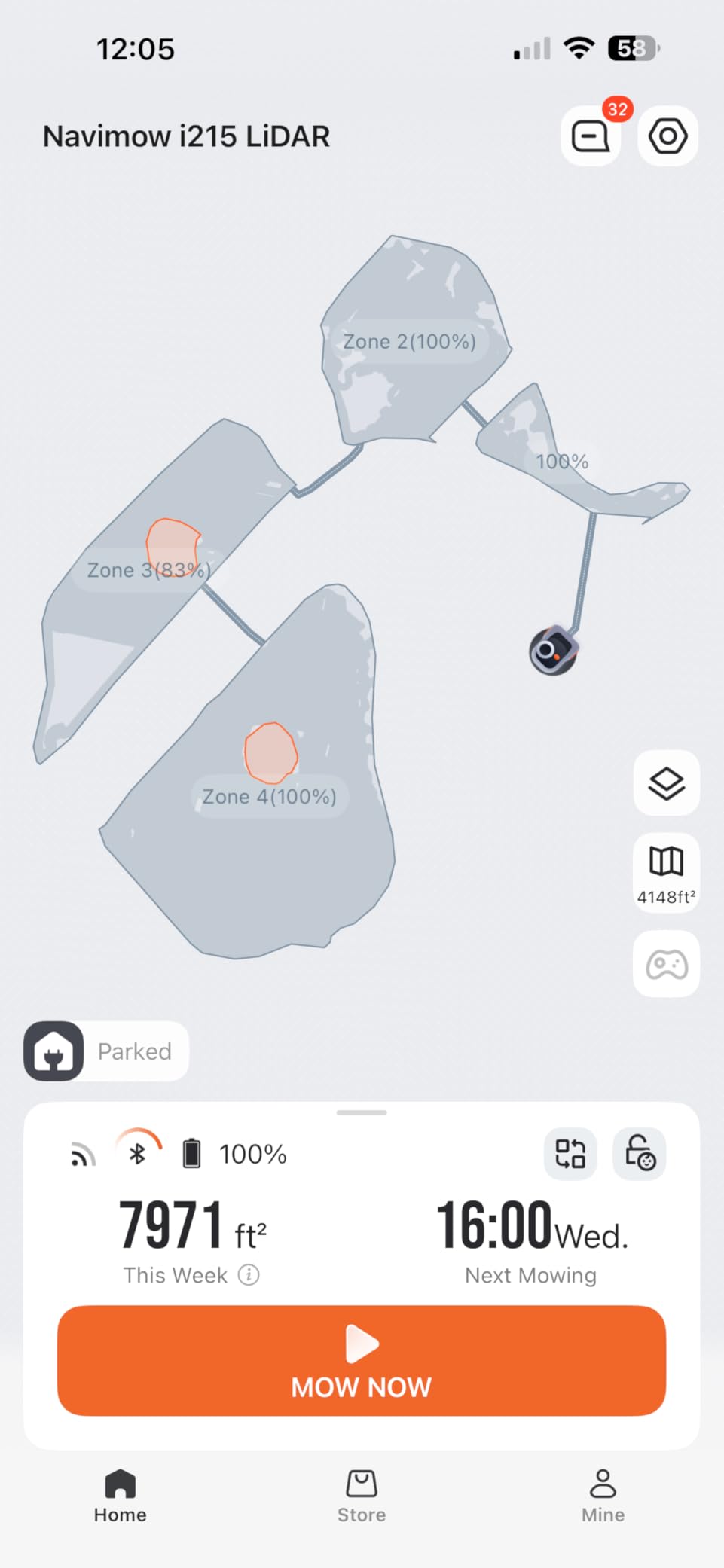
Hills create satellite shadow zones, and that is the exact problem this machine is built to remove. A high-resolution solid-state LiDAR pairs with onboard vision sensors for stable, satellite-free navigation that works day or night with 3D awareness. No antenna to mount, no base station to bury, and no aborted cycle because the mower drifted behind a ridge line.
For the 45 percent grade, off-road wheels and Electronic Stability Control do the work. Owners highlight strong slope performance alongside the quiet 59 dB(A) running and a capable app with editable zones and patterns. AI VisionFence and GeoSketch detect more than 200 obstacle types at 0.4 inch accuracy, and you can edit up to 20 mowing zones on an interactive map.
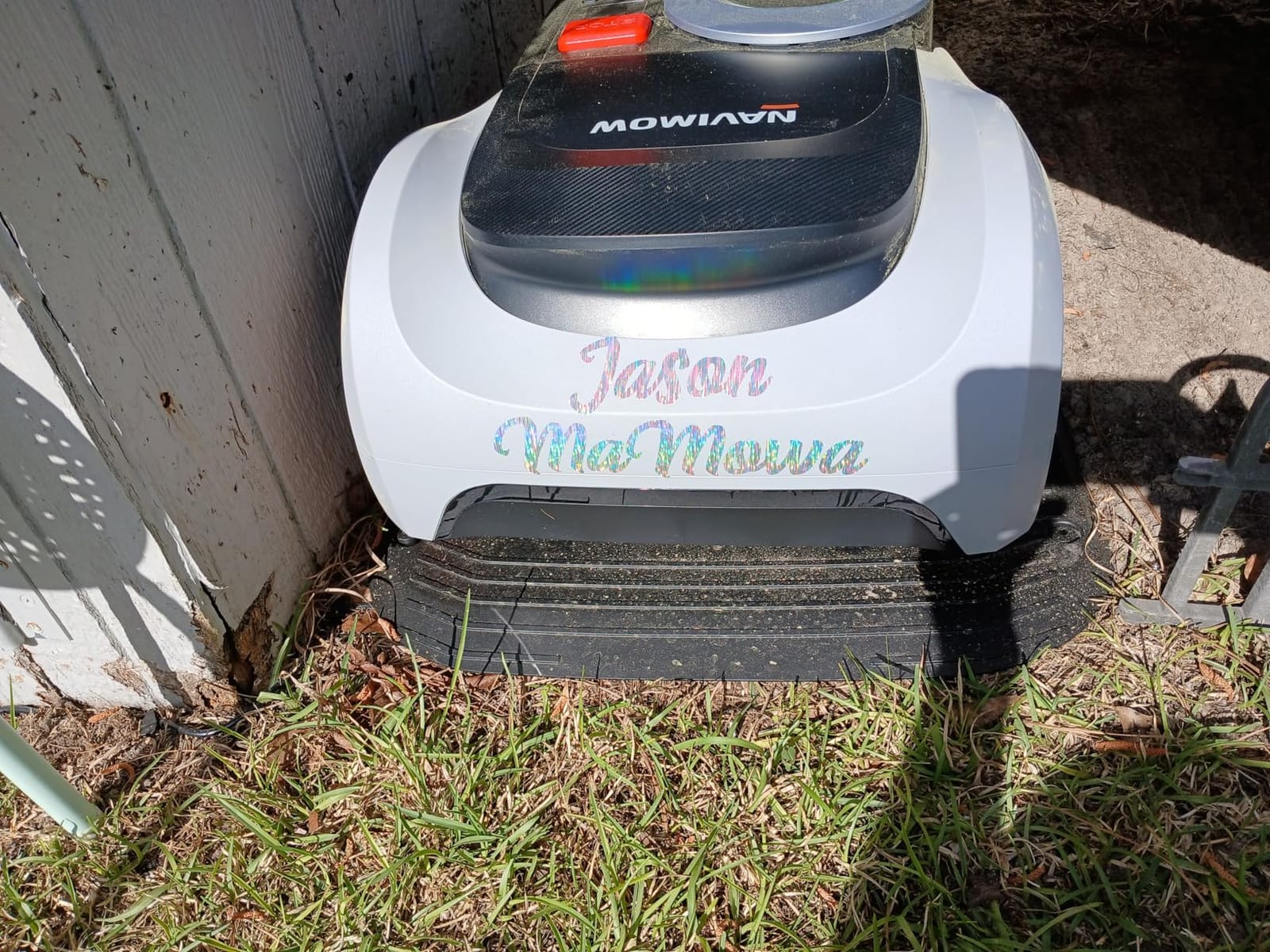
The honest limit is the coverage figure and the run time that follows from it. At 0.37 acre with an 8.66 inch cut width, a larger yard needs several sessions, and edges along fences and fixed borders still take some manual trimming. Mapping is a planning exercise rather than a one-tap job on every yard, so allow time for it before the first mow.
Security features are unusually thorough for the class, with GPS, geo-fence, lift detection and Apple Find My alerts, plus automatic docking during extreme weather. If theft is a concern in your area, that is a genuine advantage over simpler models.
Why satellite-free matters more on hills than on flat lawns
Flat ground gives the sky. A yard with a berm, a retaining wall or tall trees along one edge does not, and that is where position drifts and mowers park mid-lawn. Solid-state LiDAR plus vision sidesteps the issue entirely rather than working around it.
It also means no wiring or antenna installation, which on a hilly property is often the hardest part of the whole job. If your yard is wooded or walled, this navigation approach is the safest bet here.
Where the 45 percent rating becomes the constraint
If your steepest section is steeper than a 45 percent grade, this mower will not be the machine that gets you through the season. Pair it with a steeper-rated AWD model, or accept a walk-behind for the worst section.
The 2 to 4 inch cut height range is generous, which is a plus if you prefer taller summer grass. Just budget for edge trimming and multiple sessions on bigger properties.
4. ANTHBOT M5 – Best Value for Small Sloped Yards
ANTHBOT M5 Robot Lawn Mower 1/8 Acre, Dual Vision+Full-Band RTK Robotic Lawnmower, No Perimeter Wire, App Control Obstacle Avoidance, 45% Slope, Cutting Height, Multi-Zone Mapping
45 percent slope
0.15 acre
7.9 inch deck
1.2-2.7 inch height
58 dB or below
Pros
- Wire-free RTK plus dual cameras self-maps in about 10 minutes
- Holds slopes up to a 45 percent gradient reliably
- Quiet at 58 dB or below
- App multi-zone and no-go control with automatic recharge
- Recognizes over 1000 common garden objects
Cons
- Narrow 7.9 inch deck means slow coverage
- Several software updates needed after setup
- Leaves uncut strips along edges
- Arrives in multiple boxes
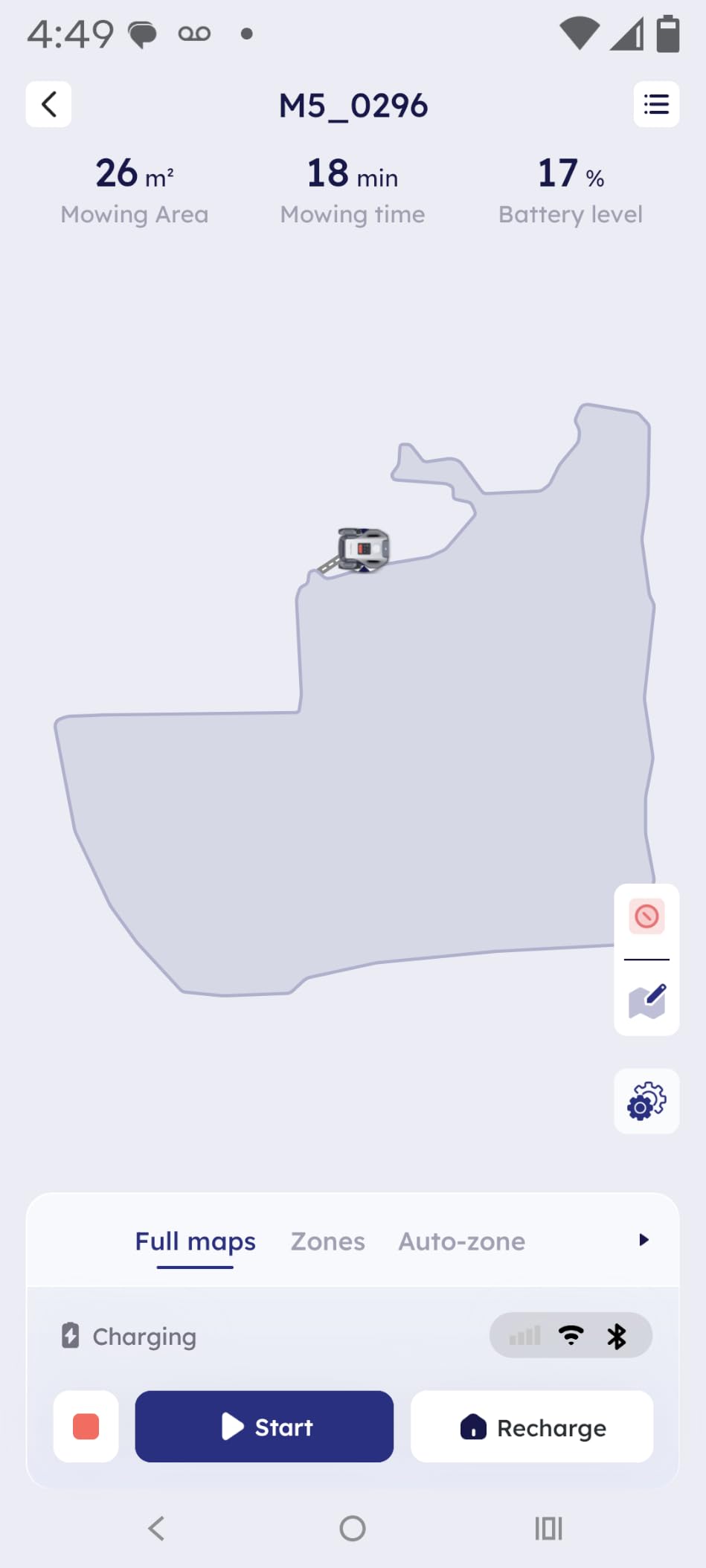
With 370 reviews at a 4.2 average, this is the most-reviewed machine in the roundup, and that volume of owner feedback is itself useful. The M5 handles slopes up to a 45 percent gradient, which covers a great many residential side yards. Dual 150-degree HDR cameras plus an RTK positioning system give centimetre-level precision, and the app builds a virtual map in roughly 10 minutes.
It is genuinely quiet at 58 dB or below, which makes early or late sessions neighbour-friendly. The package includes the mower, charging base station, a five-blade set and an RTK reference station, and it manages up to 20 work zones with customisable no-go areas through the app.
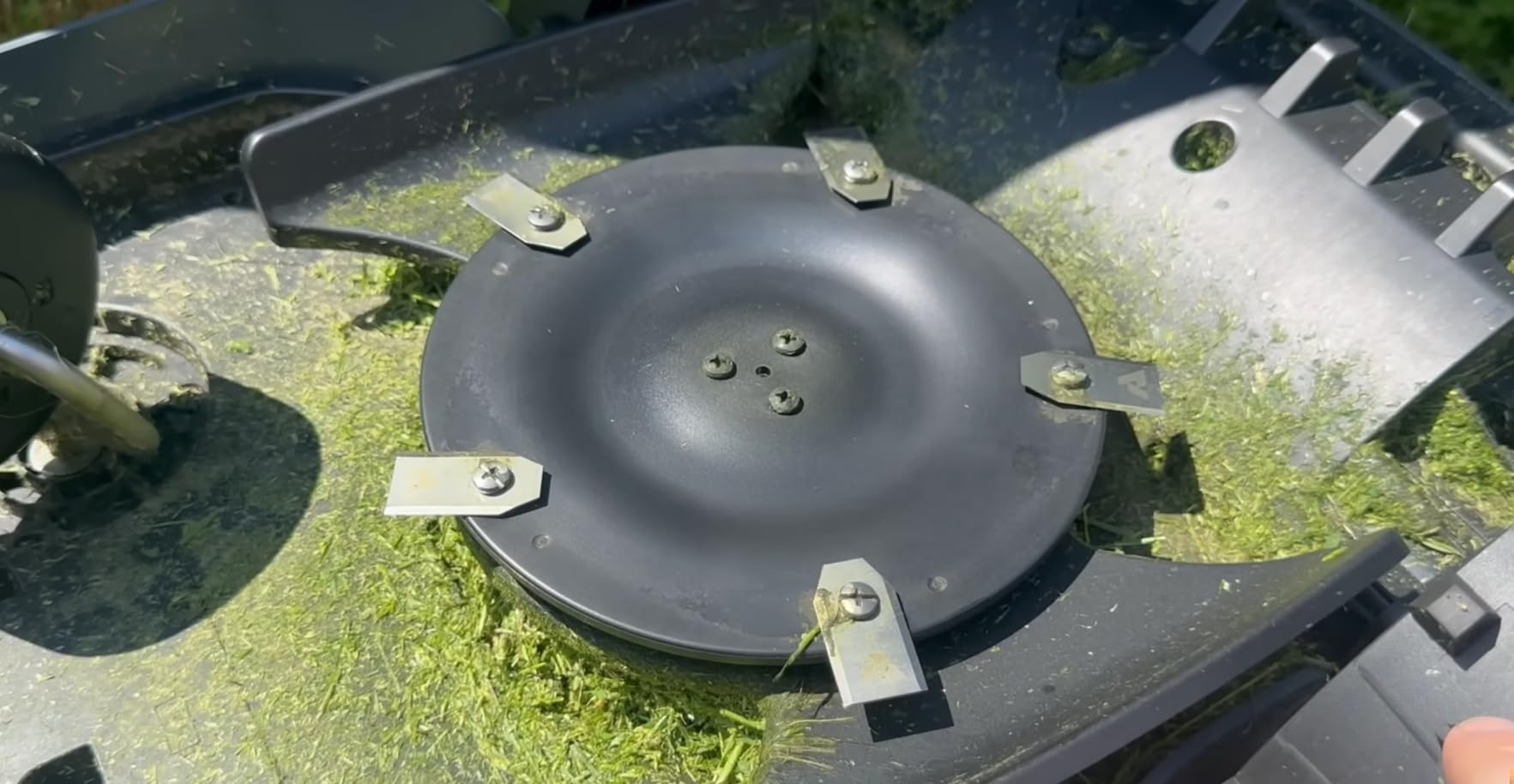
Where it loses ground is deck width and patience. A 7.9 inch cutting width means slower coverage and multiple passes, and charging takes several hours between cycles. Reviewers also note that several software updates after setup are normal, that some uncut strips remain along edges, and that overlapping cuts can be inconsistent. The package arriving across multiple boxes is a recurring complaint, and the advertised garage is not always included.
An even cut still takes a few passes to settle in. Plan for the first week as a learning period rather than a finished lawn.
The right size of hill for this machine
Up to 0.15 acre of mowable area with a 45 percent grade, which is a very common suburban side-lot or small back garden shape. If your hilly section is that size, the M5 does the job at a modest outlay.
For very small or obstacle-filled gardens, the 1000-plus object recognition and 20 zone support are more useful than they would be on an open lawn.
Where it will disappoint
Anything larger. The 0.15 acre ceiling is firm, and the narrow deck plus long charge cycles make a bigger property a multi-day affair rather than an overnight one.
If your hill is steeper than 45 percent, or your grass is coarse and wet, look up to a steep-rated AWD chassis instead. The M5 is a value pick, not a terrain machine.
5. Navimow i206 AWD – Best for Compact Hilly Lots
Segway Navimow i206 AWD Robot Lawn Mower, New i105N, 0.15 Acre, 45% Slopes
45 percent slope
0.15 acre
All-wheel drive
2-3.6 inch height
Zero-turn steering
Pros
- All-wheel drive with automotive-grade stability control for 45 percent slopes
- Zero-turn steering pivots without tearing the turf
- Very quiet and often inaudible to neighbours
- Adjusts its angle for an even cut on uneven ground
- Support provided replacement parts at no charge
Cons
- Auto mapping is unreliable on some yards
- 2.5Ah battery covers only about 1350 sq ft per charge
- Leaves an unmowed swath against fences
- Can get stuck on uneven ground or small rises
Two details make this one distinctive. First, zero-turn steering means it pivots in place rather than skidding through a turn, so it does not scrape or tear turf the way some machines do on hills. Second, the all-wheel drive system with automotive-grade stability control is the part that actually carries the 45 percent slope rating. It also adjusts its angle automatically for an even cut across uneven ground.
Running noise is low enough that owners report it being inaudible to neighbours and pets. The cutting height adjusts from 2 to 3.6 inches, and EFLS Network RTK with vision handles mapping without buried wire. You get up to 20 mowing zones with optimised routes and auto-resume charging, plus real-time GPS lift alerts.
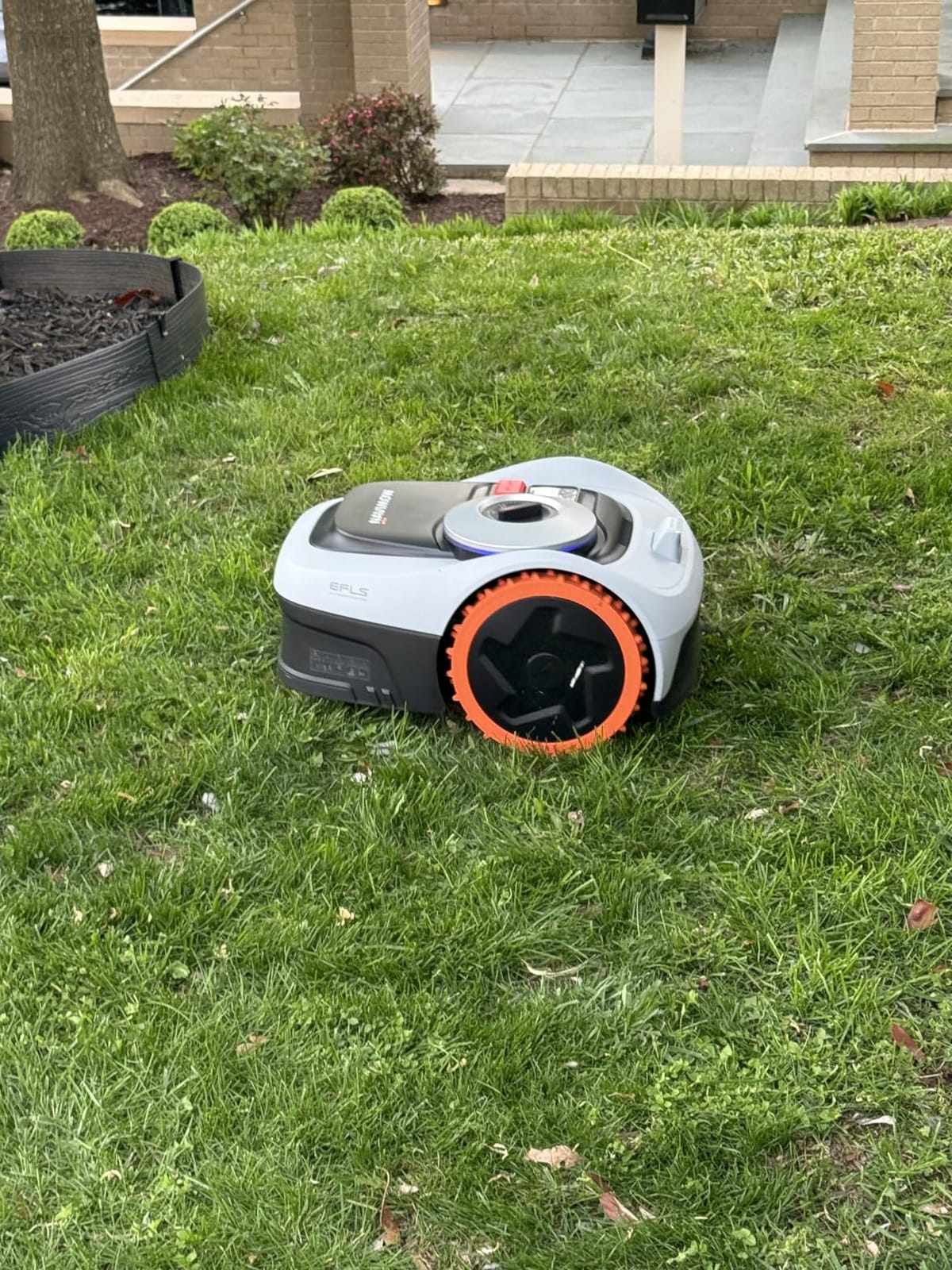
The weak spot is software reliability rather than mechanics. Auto mapping does not work on every yard and often needs manual boundary walks, and lifting the mower briefly wipes the saved map and forces a full re-map. It can wander into mulch beds outside the mapped area, and it leaves an unmowed swath between the machine and fences. On very uneven ground or small rises it can still get stuck.
Battery size is modest. At 2.5Ah it covers up to about 1350 square feet per charge, so a 0.15 acre yard with any slope to it will need more than one cycle.
Where zero-turn steering earns its keep
On sidehill traverses, where a skid-steer turn is exactly where grass gets torn out. Owners who have run other mowers on the same slope tend to notice the difference quickly. It is also kinder to lawns with thin, stressed grass in summer.
The stability control keeps the chassis composed on uneven ground, which is the same benefit that helps on a hill with a berm or a shallow drainage swale.
When to choose something else
If your yard has large trees or a wall that blocks satellite signal, the mapping reliability will frustrate you. Choose a LiDAR-and-vision model instead.
If your property is above 0.15 acre, or has rough rises the mower can catch on, the coverage and obstacle limits will show. Pick a wider-deck AWD with a higher slope rating.
6. Sunseeker X5 AWD – Best for Wooded and Shaded Hills
Sunseeker X5 AWD Robot Lawn Mower, RTK, Vision AI, 0.5 Acre, Wire-Free
60 percent (30 degree) slope
0.5 acre
8.7 inch floating deck
1.6-3.2 inch height
Pros
- All-wheel drive with independent front suspension for 60 percent slopes
- Keeps signal and coverage under trees and in shade
- Produces straight crisp stripes with pattern and symbol mowing
- Very quiet at 60 dB
- Two year warranty with US-based support
Cons
- Gets stuck on small humps and grass-to-sidewalk transitions
- Firmware and app programming criticized by some owners
- Tall grass can be treated as an obstacle
- Perimeter still needs manual weed eating
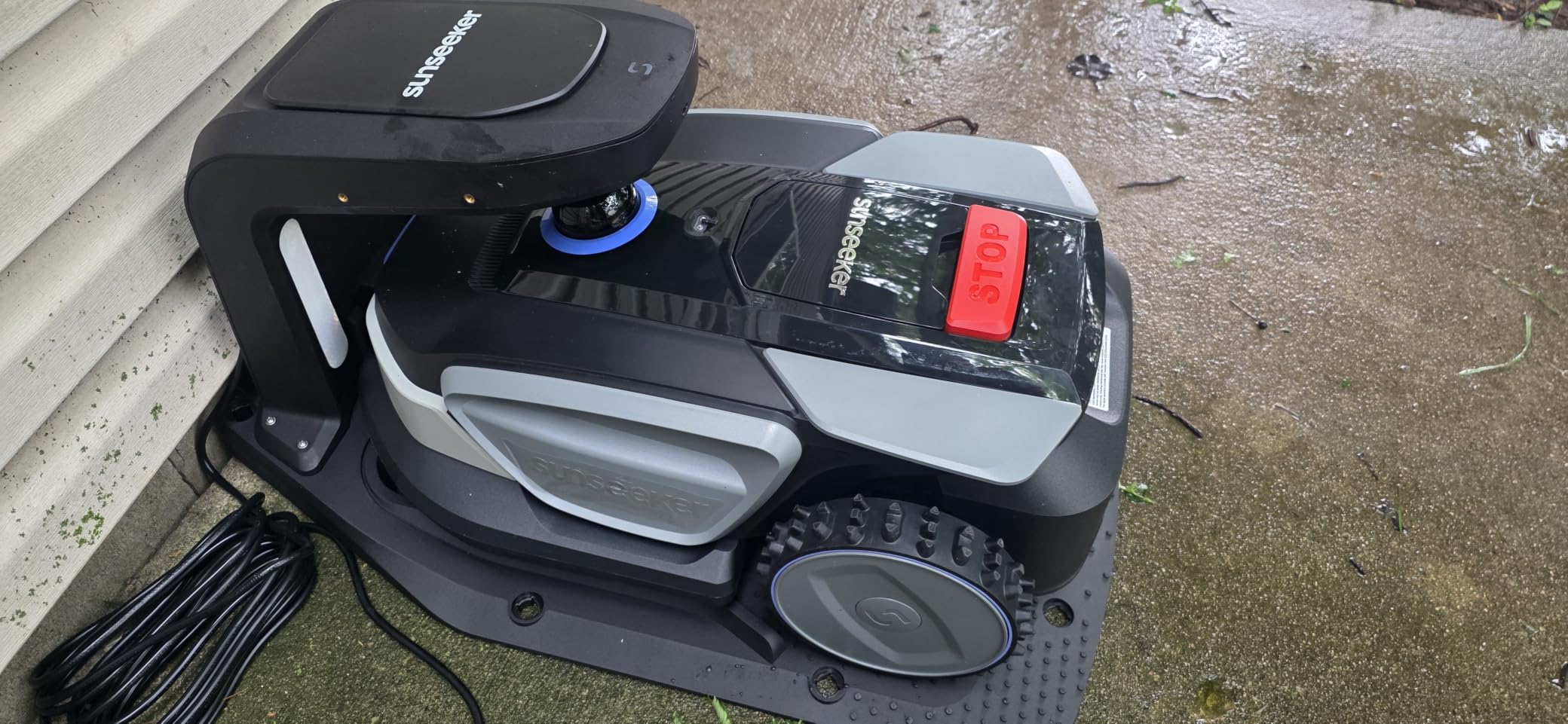
A 60 percent slope rating is 30 degrees, and that puts the X5 above every 45 percent machine here. Rugged tires and independent front suspension deliver the stability, and owners report that it performs better on sloped ground than the two-wheel-drive models they replaced. The all-terrain chassis is built for roots, thicker turf and changing backyard conditions.
Navigation is RTK plus VSLAM plus Vision AI, which is why it keeps mowing cleanly under trees and in shaded areas without losing signal. It handles up to 21,780 square feet, creates virtual boundaries with up to 5 maps, and works through passages as narrow as 31.5 inches. The floating 8.7 inch deck adjusts from 1.6 to 3.2 inches and follows contours for repeatable coverage.
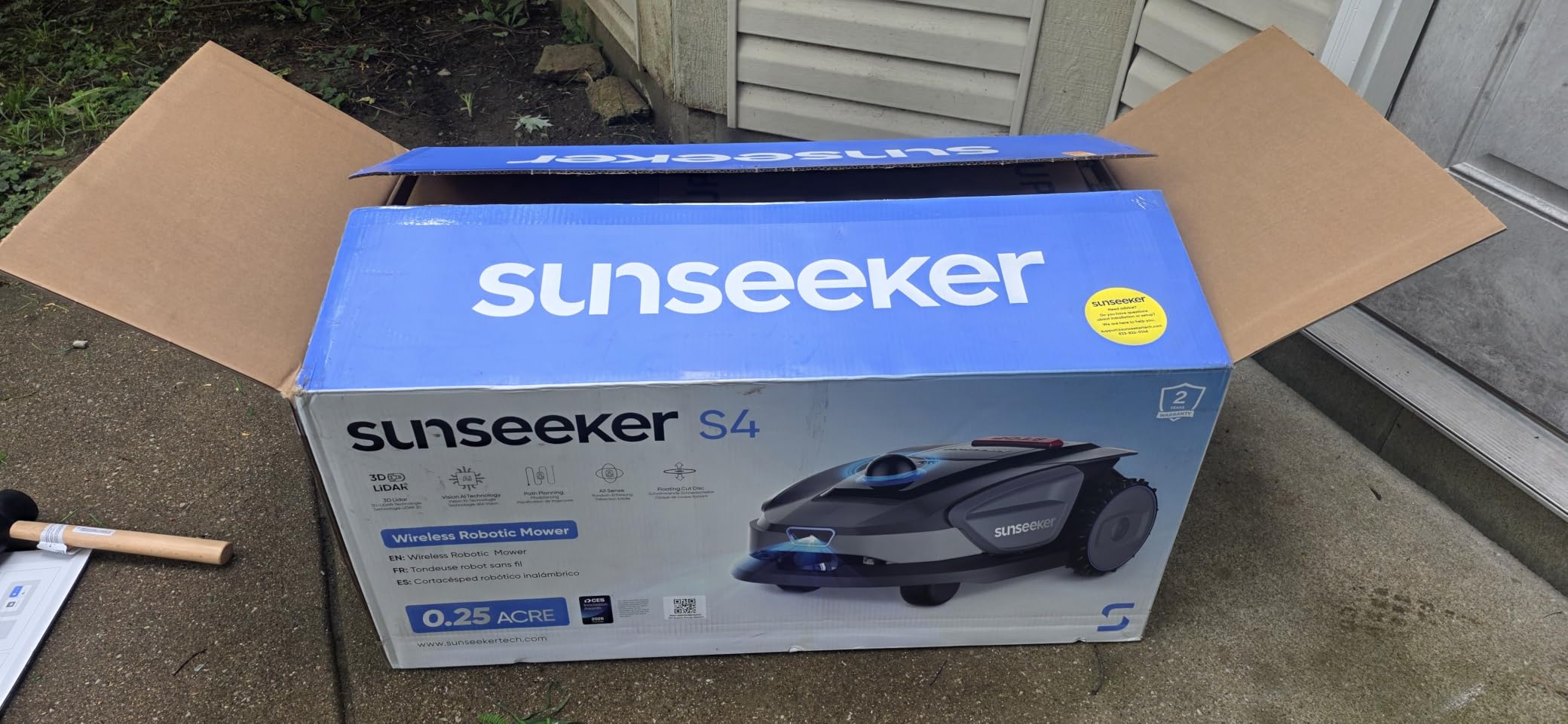
The recurring complaint is transitions rather than slopes. Owners report it getting stuck on small humps, dips and edges where grass meets a sidewalk. Vision AI can also treat tall grass like an obstacle, so it needs frequent cutting schedules to stay ahead of the grass. A wide 8.7 inch deck still leaves manual weed eating around the perimeter, and some owners criticise firmware and app programming quality.
Larger yards may also need Wi-Fi extenders to keep the connection solid.
Why the wooded-yard case is different
Under a tree canopy, satellite positioning degrades and pure RTK machines start aborting cycles. VSLAM sensor fusion with vision takes over in shaded or partially covered areas, so the mower keeps cutting instead of parking in a corner.
Owners also highlight the cut quality, with straight crisp stripes and the option to mow patterns, numbers and symbols. It runs at 60 dB and is quiet enough that only the plastic body creaks.
Where it falls short
The 60 percent rating sits below the 80 percent machines, so a genuinely severe hill is out of range. Watch the small humps and grass-to-sidewalk transitions that owners flag as sticking points, and keep the schedule frequent.
App programming is the weak spot in owner reviews. If software control matters to you, a model with a more mature app may serve better.
7. Mammotion LUBA 2 AWD 3000HX – Best for Multi-Zone Yards
Mammotion LUBA 2 AWD 3000HX Robot Lawn Mower with 4G, All-Wheel-Drive for 80% Slope, Perimeter Wire Free for 0.75 Acre, UltraSense AI Vision & RTK Auto-Mapping, 2.2″-4.0″ Adjustable Cutting Height
80 percent slope
15.7 inch dual-blade disc
2.2-4.0 inch height
Up to 30 mowing areas
Pros
- 165W four-wheel motor system for 80 percent grade climbing
- Zero-distance edge cutting with vision positioning
- Manages up to 30 mowing areas including no-go zones
- Recognizes 200 plus objects and chooses avoidance strategies
- 4G Wi-Fi and Bluetooth with GPS anti-theft tracking
Cons
- Setup takes patience with RTK antenna and mapping
- Turn algorithm can tear grass in tight pivots
- Stalls on short driveway ramps and small bumps
- 4G service needed after the first free year
This is the zone specialist. It manages up to 30 mowing areas, including front and back yards, roadside strips and no-go zones around pools and flower beds, and it resumes where it stopped after recharging. The 165W four-wheel motor system is rated for an 80 percent grade, and the dual-blade disk design gives a cutting width of about 15.8 inches.
UltraSense AI vision combined with RTK navigation is what makes wire-free work under trees, and the visual positioning recognises lawn and non-lawn boundaries for riding-style edge cutting. Connectivity covers 4G, Wi-Fi and Bluetooth, with GPS tracking and a lost mode that prevents unauthorised use. It supports parallel, checkerboard and diamond grid mowing patterns.
Owners like the results and grumble about setup. Mounting the RTK antenna, mapping in the app and running firmware updates all take patience, and the turn algorithm can tear grass during tight pivots. It also occasionally stalls on short driveway ramps and small bumps, which is worth noting on a property with a sloped entrance.
The mower does not mulch or collect leaves, blades still need occasional manual replacement, and mow times run long on larger properties. A 4G subscription applies after the first free year.
When 30 mowing zones changes the decision
Properties split into several distinct lawn areas, roadside verges, or gardens with pools and beds to protect. Very few machines in this roundup manage that many zones, and the auto-resume behaviour means you are not re-sending it out each time.
The 2.2 to 4.0 inch cutting height range is among the widest here, which suits owners who mow high in summer to protect the lawn.
Where it will disappoint
If your yard is simple, most of that zone capability goes unused. The 42-review base is thinner than several rivals here, so long-term reliability data is thinner too.
Ramp transitions and small bumps are the reported trouble spots, and 4G service is a recurring cost after year one. If you have neither zones nor an 80 percent hill, a simpler machine may serve you better.
8. WORX WR342 4WD – Best for the Steepest Grades
WORX Robot Lawn Mower 4WD for 1/2 Acre, No Perimeter Wire, WR342
84 percent (about 40 degree) slope
0.5 acre
4WD
1.57-3.54 inch height
3 year warranty
Pros
- 4WD traction reported by owners on 20 to 30 degree hills
- Terrain-adaptive chassis keeps all four wheels planted
- Front-wheel steering avoids tearing turf
- Handles thick St Augustine grass where 2WD machines stall
- Very quiet with Find My Landroid GPS tracking
Cons
- No headlight in the box so it stops in low light
- App cannot edit maps or per-zone patterns
- Vision AI circles tall weeds and leaves rings of uncut grass
- Setup and firmware updates can be frustrating
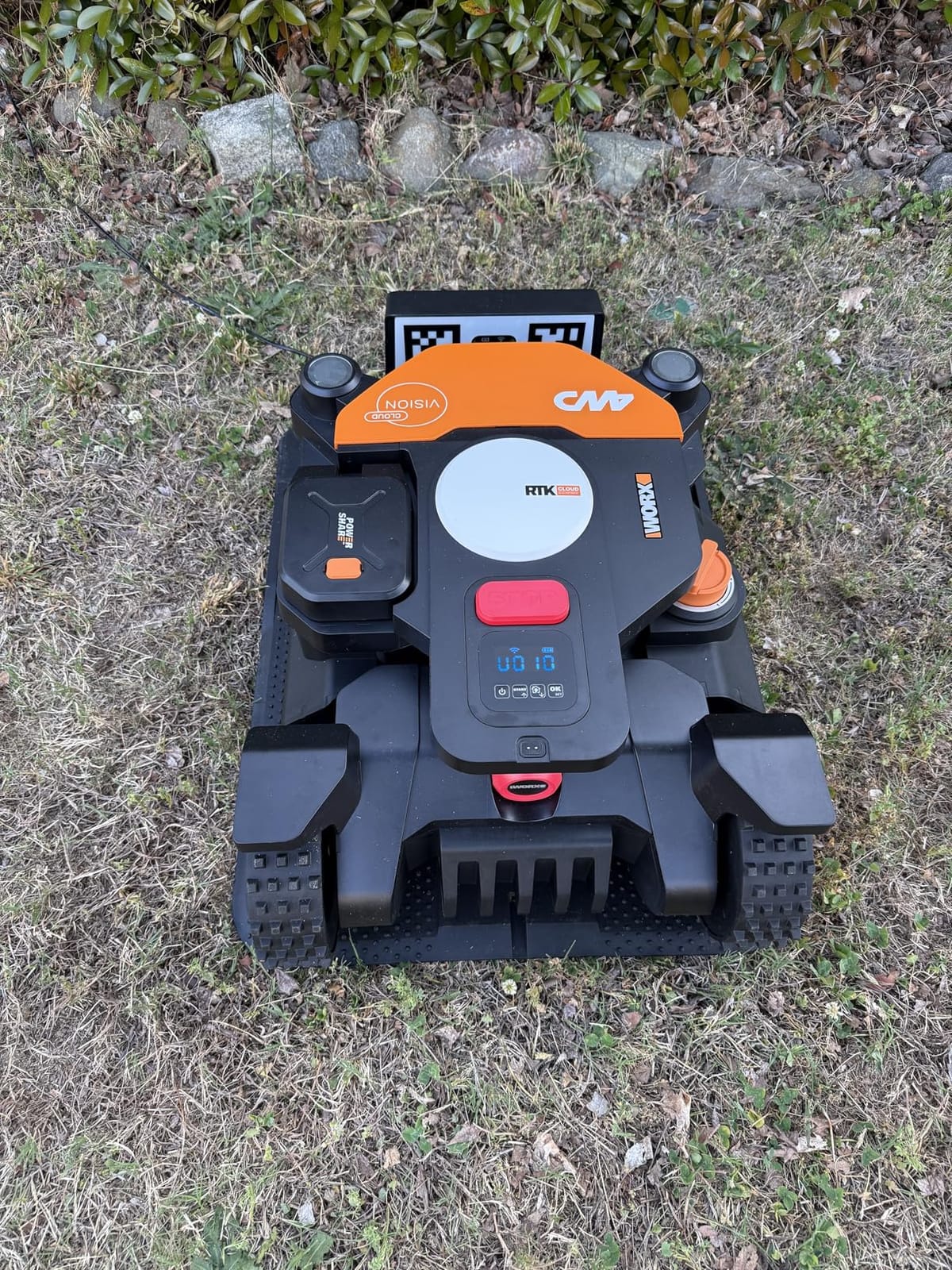
This carries the highest published slope rating in our set at 84 percent, roughly 40 degrees. RTK Cloud delivers centimetre-level accuracy without a local antenna and without additional cloud costs, and the terrain-adaptive chassis keeps all four wheels planted over uneven ground, raised borders and transitions. True front-wheel steering gives smooth turns without tearing the turf.
Owners credit it with handling thick St Augustine grass where two-wheel-drive machines stall, and with a near hands-off experience that is a clear step up. The cutting height adjusts from 1.57 to 3.54 inches, and Cut-to-Zero border cutting with an offset blade reduces the string trimming you need along edges. A three year manufacturer warranty is listed, and Find My Landroid adds GPS tracking and remote lockout.
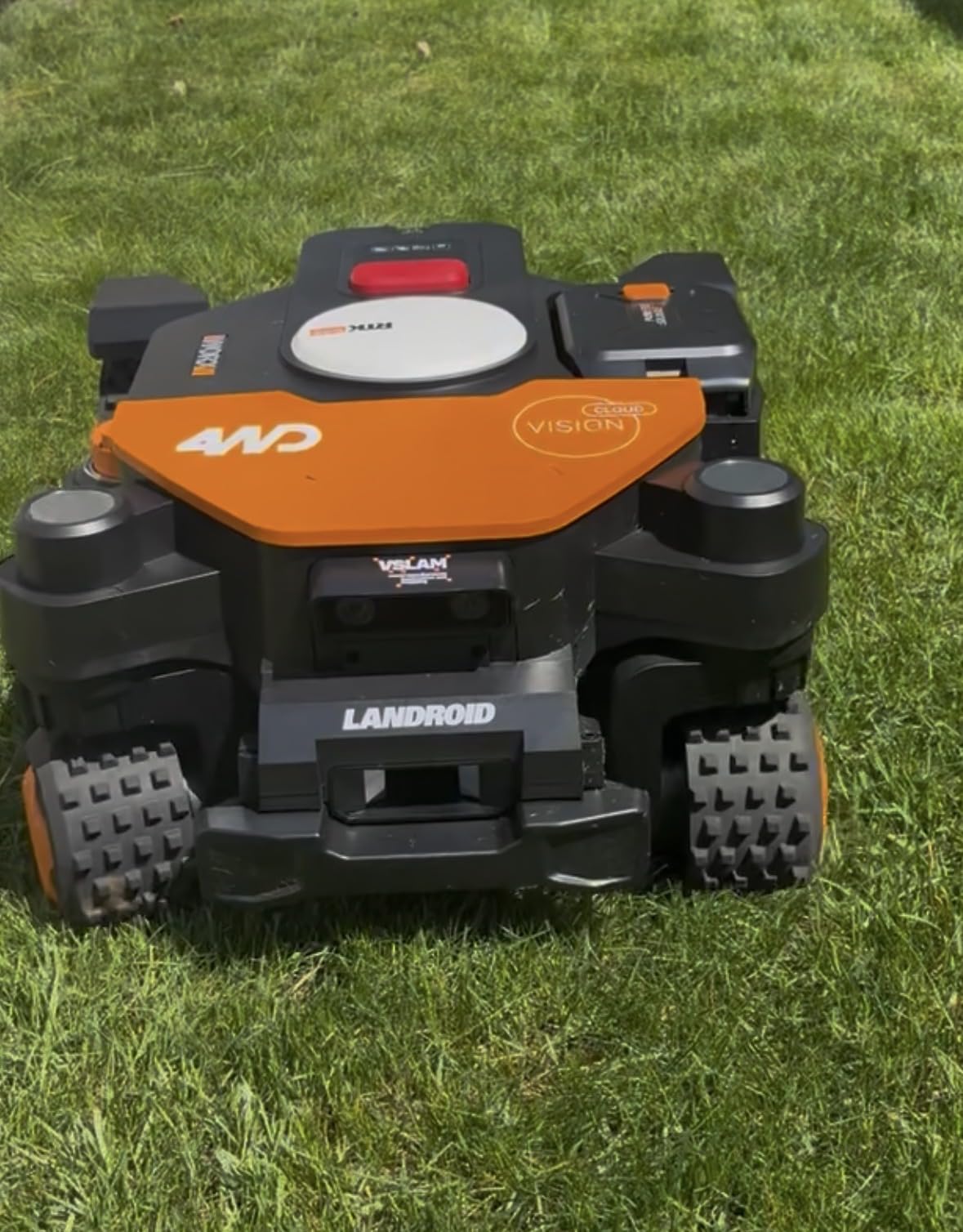
The complaints cluster around lighting and software. No headlight is included in the box, so it cannot mow at night and stops early in low light. The app cannot edit maps or change mowing patterns per zone, and Vision AI treats tall dandelions and weeds as obstacles, circling them and leaving rings of uncut grass. Wi-Fi and Bluetooth connection plus firmware updates can be frustrating during setup, and some owners report programming bugs and unsupportive tech help.
The 41 minute average battery life is short, so a larger yard means frequent charging stops.
What 84 percent actually unlocks
Grades most walk-behind mowers refuse. At roughly 40 degrees, this is the machine for a lot where the entire back slope is the problem, and owners report success on 20 to 30 degree hills in practice. The terrain-adaptive chassis is the reason it keeps contact on bumpy, uneven ground.
Thick coarse turf is another area where four-wheel drive and the raised chassis keep it moving where lighter machines dig in.
Where it falls short
Software and lighting, mostly. Without a headlight you lose night mowing, and an app that cannot edit maps limits how finely you can shape zones around beds and paths.
The review base is small at 17 ratings, so treat long-term durability claims cautiously. If your yard is not genuinely steep, the 45 percent machines here are better value.
9. Dreame A3 AWD 2000 – Best for Fast Overnight Recharging
(Upgraded) DREAME A3 AWD 2000 LiDAR Robot Lawn Mower, 45-Min Fast Charge
80 percent (38.7 degree) slope
0.25-0.50 acre
45 minute charge
1-4 inch height
Pros
- AWD hub motors hold 80 percent inclines and 2.17 inch obstacles
- 360 degree LiDAR with binocular vision maps quickly under tree cover
- 45 minute recharge with the 5A adapter which is 22 percent faster than standard
- Built-in 4G and HDR camera for monitoring and theft protection
- Whisper quiet enough for night mowing
Cons
- Only one customer rating on record
- Covers 0.25-0.50 acre so larger yards need frequent recharging
- Edge precision of 1.97 inch without the optional trimmer module
The headline spec here is charging speed. A 5A adapter refills the battery in 45 minutes, which the manufacturer puts at 22 percent faster than the industry standard, and that changes how a hilly yard gets scheduled. The mower can be back out on the slope the same evening instead of sitting on the dock overnight.
Traction comes from heavy-duty AWD hub motors rated for 80 percent, or 38.7 degrees, and for 2.17 inch obstacles that stall ordinary robots. OmniSense 3.0 navigation pairs 360 degree LiDAR with binocular AI vision, staying precise under heavy tree cover or next to tall walls, and it dodges more than 300 obstacle types. A three year warranty and a year of included 4G service are listed.
Be clear-eyed about the evidence here. There is a single customer rating on record, so long-term reliability is genuinely unknown rather than good. That rating does report easy setup, reliable LiDAR mapping and obstacle avoidance, and good all-wheel-drive performance on sloped and uneven ground.
Coverage is 0.25 to 0.50 acre, so larger properties need frequent recharging, and edge precision of 1.97 inches still wants the separately sold trimmer module to get below about 1.18 inches.
Why recharge speed matters more on a hill than on flat ground
Slopes drain battery faster than flat terrain, so a mower that spends half a day on the dock leaves less usable mowing time. Cutting recharge to 45 minutes keeps a hilly schedule workable rather than theoretical.
The 1 to 4 inch cutting height range here is among the widest in this group, and quiet running makes scheduled night mowing practical.
Who should buy and who should wait
Buy it if you are comfortable being an early adopter on a well-specified machine with a three year warranty and fast charging. The 80 percent rating and LiDAR navigation stack are exactly what a steep, wooded yard needs.
Wait if you want a long public owner history before committing. With one rating, there is not yet the review depth to judge battery life over seasons or support quality under load.
10. Roborock RockNeo Q110H – Budget Pick for Gentle Hills
Roborock RockNeo Q110H Robot Lawn Mower, Wire-Free Robotic Lawn Mower with Full-Band RTK + VSLAM Navigation, Auto Mapping, AI Vision Obstacle Avoidance, App Control, 45% Slope, Covers Up to 1/4 Acre
45 percent slope
0.25 acre
Full-band RTK plus VSLAM
1.6-3.1 inch height
27 pounds
Pros
- Handles 45 percent slopes and 1.57 inch obstacles
- Floating cutting deck follows contours for straight even lines
- Very quiet with headlights for night mowing
- Passages as narrow as 2.3 ft
- Roborock app with PIN lockout and alarm
Cons
- Boundaries usually have to be driven manually
- Conservative avoidance leaves 1 to 1.5 foot strips at edges and fences
- Maps cannot be edited and there is no partial zone mowing
- Traction struggles in thick coarse grass
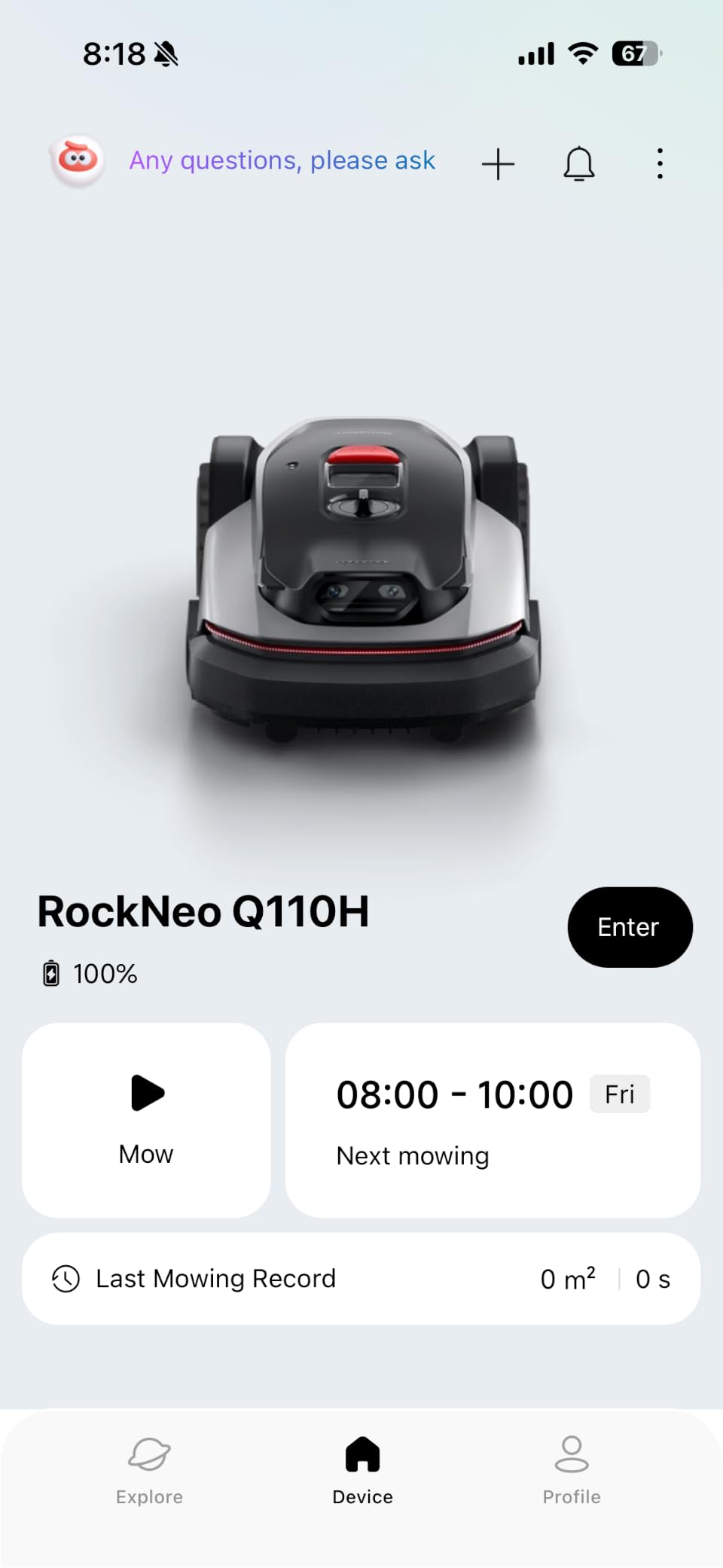
This is the entry point, and for a modest rise it does the job without drama. It handles 45 percent slopes and 1.57 inch obstacles, and a floating cutting deck adapts to ground contours so the lines come out straight. Full-band RTK plus VSLAM holds navigation under tree canopies and near fences, with an average battery life of 130 minutes.
It is quiet and includes headlights, so night mowing is on the table, which several rivals in this price range cannot offer. At 27 pounds it is also one of the easier machines to lift, and passages as narrow as 2.3 feet are within reach if your route to the lawn is tight.
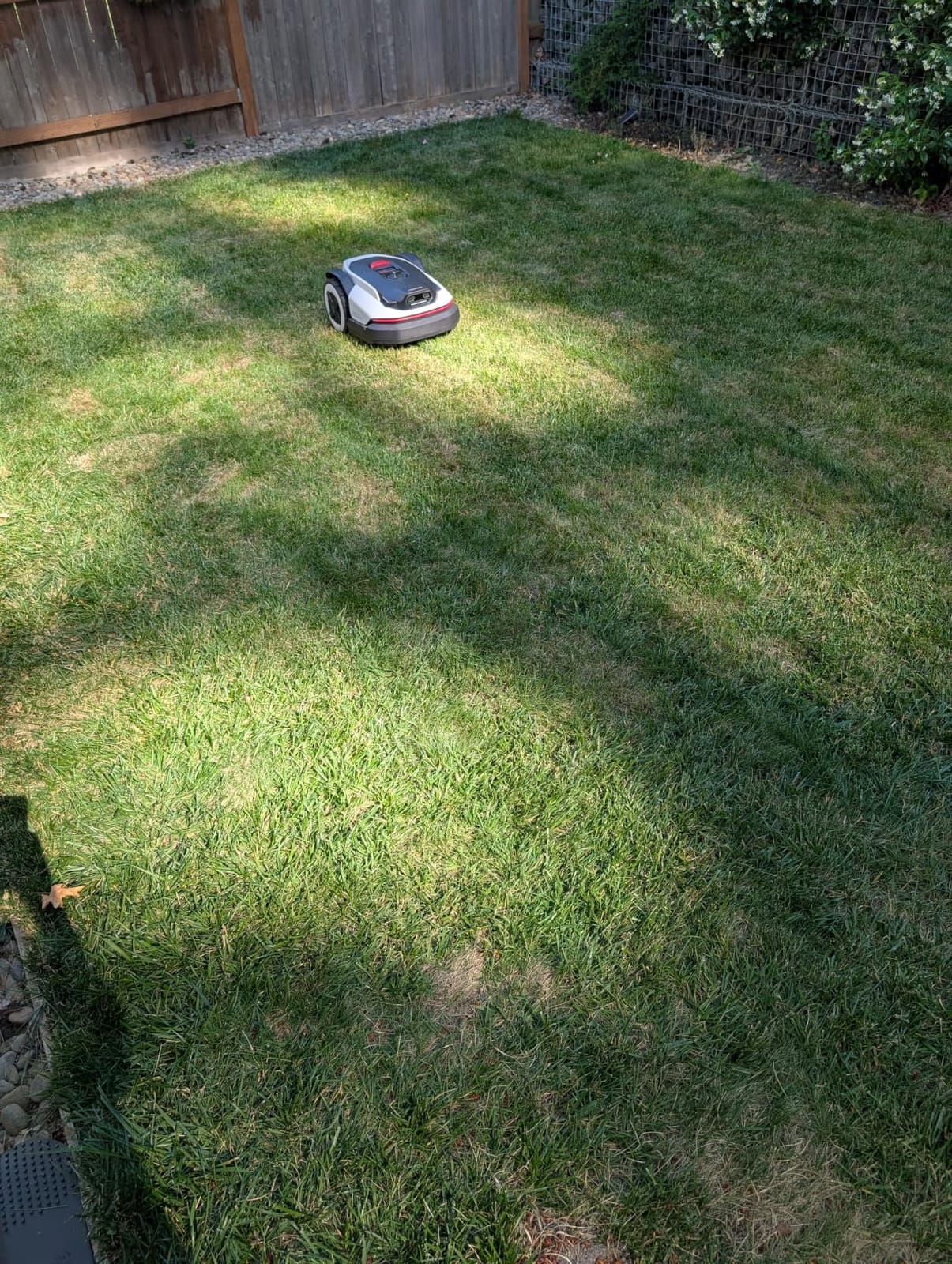
The 3.8 average is the lowest here, and the reasons are consistent. Auto-mapping is limited in practice, so boundaries usually must be driven manually, and maps cannot be edited in the app with no partial zone mowing available. Overly conservative obstacle avoidance leaves strips 1 to 1.5 feet wide along edges and fences, and it refuses to pass through narrow openings even when the clearance looks sufficient. Traction struggles in thick coarse grass and small bumps can trigger false lifted-unit alerts.
The edge-mowing module is sold separately and is not available in the US, which pushes edge work back to you.
What you get for the lowest outlay in the group
Solid slope performance on 30 to 45 percent grades, straight-line cutting, and a genuinely quiet machine with lighting. The floating deck is a smart inclusion because uneven hilly ground is exactly where fixed-deck machines leave stripes.
The familiar app with PIN lockout and a high-decibel alarm is a nice touch for anti-theft peace of mind.
When to spend more instead
If your hill is steeper than 45 percent, this is the wrong chassis. If you want automatic mapping and editable zones, they are simply not there. And if coarse wet grass is your situation, spend up for all-wheel drive.
Best treated as a gentle-hill machine with manual setup, not an automation product. If you dislike driving the boundary yourself, the ANTHBOT M5 or a LiDAR model is a better use of money.
What Slope Can a Robot Mower Handle? Percent vs Degrees
Published slope ratings are stated in percent grade, and 100 percent grade equals 45 degrees. The conversion is percent grade equals the tangent of the angle in degrees, so a yard that feels like a hill is often a much steeper number than buyers expect.
Here are the working conversions that matter when you are matching a mower to a yard:
30 percent grade is about 16.7 degrees, and 45 percent is about 24.2 degrees
50 percent is about 26.6 degrees, and 60 percent is about 31 degrees
70 percent is about 35 degrees, and 80 percent is about 38.6 degrees
84 percent, the highest rating in this roundup, is about 40 degrees
The practical takeaway: anything at or above a 50 percent published rating is a genuinely hilly machine, and 80 percent is the current ceiling we see in this category. Never size a mower equal to your steepest section. Pick one tier above it, because wet grass, tall coarse blades and mowing transitions all reduce real-world grip below the published figure.
2WD vs AWD vs 4WD vs Tracked: Why Drive Type Decides Everything
Two-wheel-drive mowers put torque through one driven axle, which works fine on flat ground and fails on traverses. When the machine crosses a hill sideways, gravity pulls it down the fall line while the drive wheels try to push it along the contour. The drive wheels lose grip first, and the free wheels provide almost no resistance, so the mower slides.
That sideways slide is the rut-maker. Owners describe mowers that skid, grind away, and dig a channel through soft grass on a modest incline. Once the deck is buried, traction is gone entirely, which is why a two-wheel-drive machine can get stuck on a hill that looks walkable.
All-wheel drive puts motors on both axles with independently distributed torque, so at least three wheels keep contact in any traverse direction. Adaptive suspension and terrain-adaptive chassis add wheel travel, so the machine stays planted over bumps instead of tipping onto two wheels. That is the class behind every 80 percent and 84 percent rating in this roundup.
Four-wheel drive pushes the same principle harder, with rugged tires and suspension on every corner. The published numbers back it up: the only 4WD machine here, the WORX WR342, carries the highest slope rating at 84 percent. Tracked chassis spread weight over a larger contact patch and are the emerging answer for extreme grades, though none of the models we selected this round uses them.
The rule of thumb for a hilly yard: two-wheel drive for flat ground, all-wheel drive for anything above about 45 percent, four-wheel drive or tracks for the steepest sections. If the majority of your lawn is flat and only one corner is steep, all-wheel drive is the minimum that works.
How to Measure the Slope of Your Own Yard
Before you buy anything, measure the steepest part of your lawn. It takes ten minutes with either method below, and it converts an abstract spec comparison into a concrete match.
Phone clinometer method:
Open a level or clinometer app on your smartphone
Calibrate it on a flat indoor surface first
Set your phone on the paving or driveway and read the angle there as your zero reference
Move the phone onto the grass at the base of the hill and read the tilt in degrees
Repeat at several points, including the steepest traverse line, and note the highest reading
Convert the angle to a percent grade with the figures in the section above, then add a margin of 15 to 20 grade points when you pick a model
Eight-foot board method, useful if you have no phone or want a second reading:
Lay an eight-foot straight board or a length of timber across the slope
Rest one end on the ground and prop the other up
Measure the rise in inches at the propped end
Convert with this rule: percent grade equals rise in inches divided by 96 inches, multiplied by 100
Repeat at the top, middle and bottom of the hill so you catch the steepest section rather than the average
Then apply the matching rule. If your steepest measured section is 30 percent, choose a mower rated 45 percent or higher. If it is 50 percent, choose 60 to 80 percent. Setting a mower exactly equal to your measured grade leaves no margin for wet grass or long turf, and that margin is where stuck machines come from.
Navigation on Hills: RTK, NetRTK, LiDAR and AI Vision
Positioning is the second-biggest failure mode on hilly yards, and the cause is geometric. A ridge or a row of tall trees creates a satellite shadow zone, so a mower relying on satellite signals alone can lose its fix and abort a cycle or park mid-lawn.
RTK gives centimetre-level accuracy from a base station or antenna, and it is the most precise option, but it needs sky view. NetRTK and RTK Cloud deliver the same correction over a cellular network with no local antenna, which removes the installation burden but depends on coverage. LiDAR sweeps the surroundings with laser and builds a map of the yard, so it does not care about the sky at all. AI vision reads the scene through cameras and adds object detection.
For a wooded or walled property, LiDAR plus vision is the safest pairing, which is why the Navimow i215 LiDAR and the Sunseeker X5 rate well on shaded hills. For open terrain with clean sky view, RTK or RTK Cloud is the most accurate and usually the cheapest. The strongest stacks fuse all three, as the Mammotion LUBA 3 AWD 3000 does with LiDAR, NetRTK and dual-camera vision.
One practical point: models sold with an RTK reference station still need a clear placement for it. On a steep property, put the station on the highest point with an open view, not beside the house.
Terraced Yards and Retaining Walls
Terraced yards are the case owners ask about most and roundups almost never address. A retaining wall creates a hard vertical step, a narrow grass ledge between levels, and a slope that usually runs along the wall rather than away from it.
The first rule is that a mower will not climb a vertical face. A retaining wall taller than the machine’s obstacle clearance is a permanent divider, so each terrace becomes a separate mapping job. Check the stated obstacle clearance against your wall height before you buy: the Dreame A3 AWD 2000 clears 2.17 inch obstacles, the LUBA 3 AWD 3000 handles 50 mm, and the Roborock Q110H manages 1.57 inch. Anything much higher than that means the terrace is out of reach.
Second, terraces need wide enough transitions. A ledge narrower than the machine’s body will not be mowed, and owners of narrow-ledge yards report a permanent uncut strip. Look for stated minimum passage widths: the Sunseeker X5 handles 31.5 inch passages and the Roborock Q110H manages passages as narrow as 2.3 feet.
Third, most apps let you define separate zones and no-go areas, so you can keep the mower off the wall face and the beds behind it. On terraces, set separate no-go zones per level rather than one map. If your terraces are steep between the walls, treat each as its own terrain and size the mower against the steepest one.
Hilly-Yard Maintenance Schedule
Hills wear machines faster than flat lawns because the chassis works continuously against gravity and the deck is more often airborne. A steeper service cadence than the manual suggests is worth it.
Check and clear wheels and tires monthly, especially in wet conditions where mud builds on the tread and quietly destroys traction. Rinse the underbody weekly after mowing to stop packed grass from matting against the blade housing, which is a common cause of stall on a slope.
Replace blades every two to three months on a hilly yard, faster than the usual interval, because blade imbalance shows up as bounce on uneven ground. Inspect the cut-height linkage at the same time, since a bent linkage is a very common cause of a mower that struggles on a rise.
Check battery health each season. Slope work draws more charge per cycle, and battery packs typically last four to six years under heavy slope use compared with seven to ten years on flat ground. Store the machine below 50 degrees over winter, and clean the charging contacts before the first spring cycle.
Finally, if a mower does get stuck, drive it out along the contour rather than straight up, and press any formed rut with your boot and water it back in. A rut left alone becomes a permanent trip hazard that also traps the mower next time.
Buying Guide for Robot Mowers on Hills
Drive system first. Above a 45 percent grade, do not consider a two-wheel-drive chassis, whatever its slope claim. All-wheel drive is the minimum, four-wheel drive for the steepest grades.
Coverage next, and remember that the rated acreage is a flat-yard number. Slope work drains far more charge per cycle, so size up rather than sizing to the number on the box. A small steep yard of a quarter acre or less can justify a mower rated for half an acre, because the slope penalty eats the difference.
Cut height range matters more than most buyers expect. Premium slope machines often top out lower than general-purpose models, and if you plan to mow high through summer heat, check the maximum before you commit. The LUBA mini 2 AWD 1500H, LUBA 2 AWD 3000HX, Navimow i215 and Dreame A3 AWD all reach four inches, while the LUBA 3 AWD 3000 caps at 2.7 inches.
Service and warranty are a real criterion, not a footnote. Brands with a local dealer network give you in-person diagnosis and faster parts. Shipping-based brands handle service by mail, so a failure means boxing up a machine that can weigh over 30 pounds. Warranty lengths here range from a two year warranty on the Sunseeker X5 to a three year manufacturer warranty on the WORX WR342 and a three year warranty on the Dreame A3 AWD 2000.
Edge cutting deserves an honest look before purchase. Every robot mower leaves an uncut strip at fences and fixed borders, typically one to three inches, and slopes amplify it because the machine leans away from the edge. Models with a dedicated edge cutting disc, such as the LUBA mini 2 AWD 1500H and the LUBA 2 AWD 3000HX, narrow the gap. Budget for a string trimmer regardless.
Connectivity cost is easy to miss. Some models include 4G service for a period and then require a subscription, as the LUBA 2 AWD 3000HX does after its first free year. Others list a year of service included, as the Dreame A3 AWD 2000 does.
Finally, who should not buy one. If your steepest section is a cliff-like bank that mowers visibly cannot hold, or if the terrain is mostly retaining walls and narrow ledges with no continuous grass, a robot mower will not deliver the automation you are paying for. Buy a slope-rated walk-behind or a small tractor for those sections.
Frequently Asked Questions
Which robotic mower is best for mowing steep slopes?
For steep slopes, choose an all-wheel-drive or four-wheel-drive machine rated at 80 percent or higher. In this roundup the Mammotion LUBA mini 2 AWD 1500H leads for small steep yards with an 80 percent rating and 263 owner reviews, the Mammotion LUBA 3 AWD 3000 covers large hilly properties at the same rating, and the WORX WR342 4WD carries the highest published rating at 84 percent, roughly 40 degrees.
Do I need AWD or 4WD for a hilly yard?
Above roughly a 45 percent grade you do need all-wheel drive or better. A two-wheel-drive mower can only push along one axle, so on a sideways traverse gravity wins and the machine skids, digs a rut and stalls. All-wheel drive with independently driven wheels keeps at least three wheels planted in any direction, and four-wheel drive adds the highest published slope ratings.
Which robot mower can handle a 45-degree slope?
None of the mowers we reviewed is rated for a full 45 degrees, because 100 percent grade equals 45 degrees and no current production robot mower claims that. The highest published ratings are 84 percent, about 40 degrees, for the WORX WR342, and 80 percent, about 38.6 to 38.7 degrees, for the Mammotion LUBA mini 2 AWD 1500H, LUBA 3 AWD 3000, LUBA 2 AWD 3000HX and Dreame A3 AWD 2000.
How do I know how steep my yard is?
Use a phone clinometer app calibrated on flat ground, then read the tilt at the base, middle and top of the hill, and again along the steepest sideways traverse. Or lay an eight-foot board on the slope, measure the rise in inches, divide by 96 and multiply by 100 for a percent grade. Then pick a mower rated 15 to 20 grade points above your highest reading.
Why does my robot mower get stuck on hills?
Most often it is a traction failure rather than a power failure. Two-wheel-drive mowers lose grip on sidehill traverses and sink the deck into soft grass, which removes the little traction that is left. Other causes include wet or overgrown grass reducing grip below the published rating, a bent cut-height linkage, mud packed into wheel treads, and sharp transitions such as grass meeting a sidewalk.
Can robot mowers handle retaining walls and terraces?
Only up to their obstacle clearance, so measure your wall height first. The Dreame A3 AWD 2000 clears 2.17 inch obstacles and the Mammotion LUBA 3 AWD 3000 handles 50 mm, so taller retaining walls permanently divide the lawn. Each terrace needs its own mapped zone and no-go area, and ledges narrower than the mower body stay permanently uncut, so check stated minimum passage widths too.
Conclusion
The best robotic mowers for hilly yards in 2026 are the all-wheel-drive machines rated at 80 percent or better, and the choice inside that group comes down to acreage and signal conditions. For a small steep yard, take the Mammotion LUBA mini 2 AWD 1500H, which combines an 80 percent rating with the deepest review base here. For a large hilly property, the Mammotion LUBA 3 AWD 3000 covers ground far faster on its 15.7 inch discs.
For the steepest grades, the WORX WR342 4WD has the highest published rating at 84 percent. Where trees block the sky, the Navimow i215 LiDAR maps and drives without satellites at all. Measure your steepest section first, then pick one tier above it.
If your hill is gentle, the value picks here do the job well. If it is genuinely extreme, no robot mower will save you, and that is worth knowing before you spend anything.