
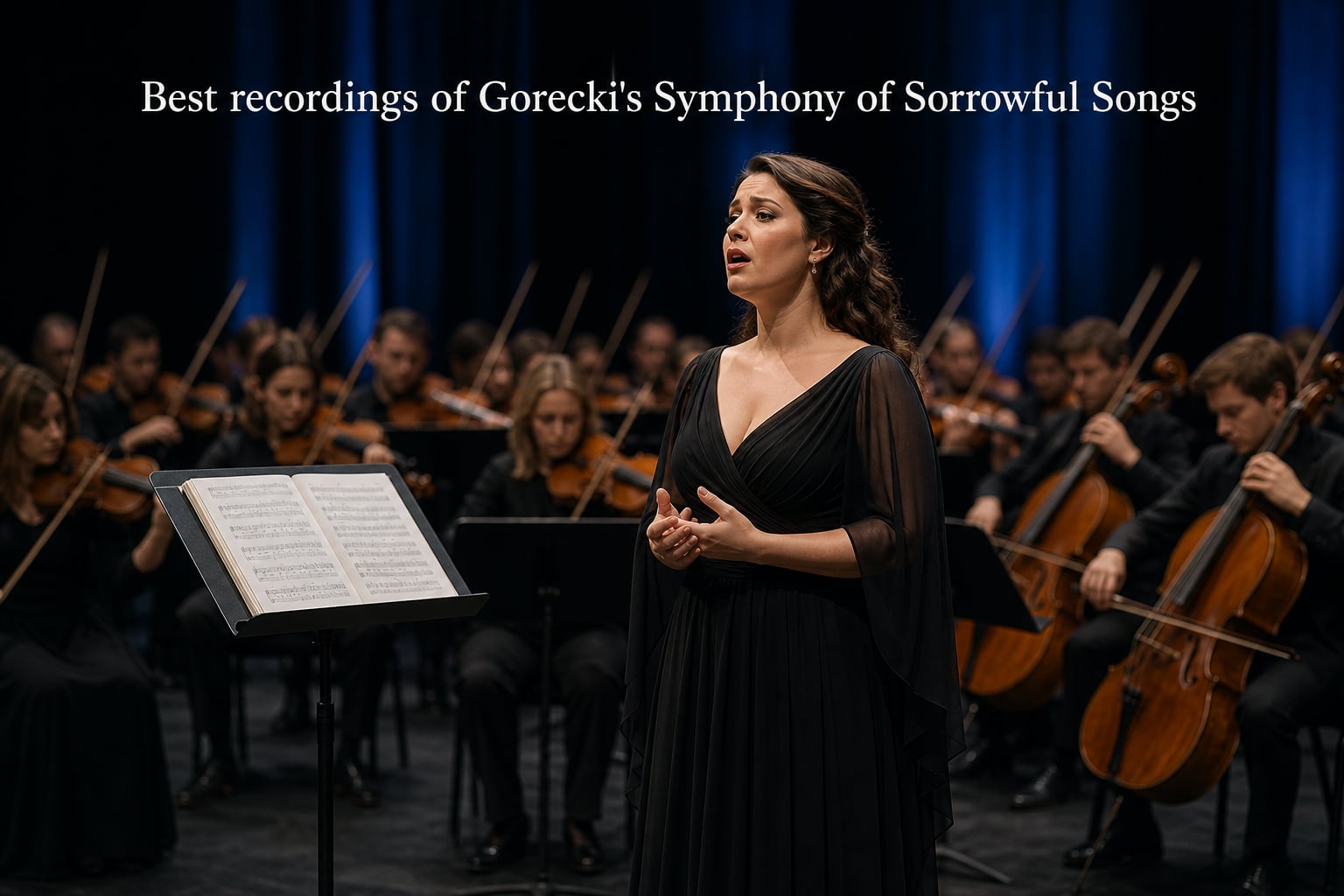
For most listeners, the best place to begin with Górecki Symphony of Sorrowful Songs recordings is the Dawn Upshaw and David Zinman performance with the London Sinfonietta. It is the version that brought Henryk Górecki’s Symphony No. 3 to a huge audience, and it remains the clearest entry point into a work that can feel both simple and overwhelming.
That answer is useful, but it is not the whole story. A listener who wants a darker, richer soprano sound may prefer Zofia Kilanowicz, while a listener putting recorded sound first may want to seek out Alain Altinoglu’s 2004 Naïve performance.
This guide explains why those choices differ, what happens in the symphony’s three movements, and how to choose a version that fits the way you listen. I also separate what is well established from claims that are often repeated without enough context, especially around the work’s subject matter and film use.
Górecki’s music asks for time rather than background attention. The recurring string patterns, slow growth, and lone soprano make this a recording where the conductor, soloist, ensemble, and recorded acoustic all shape the experience.
Table of Contents
The best Górecki Symphony of Sorrowful Songs recording to start with is Upshaw and Zinman
Dawn Upshaw, David Zinman, and the London Sinfonietta made the essential first recording for many listeners. The 1992 release on Nonesuch turned Symphony No. 3 from a comparatively little-known contemporary classical work into a mainstream phenomenon, selling more than a million copies according to the research behind this guide.
Choose it first if you want to understand the performance against which later Górecki Symphony of Sorrowful Songs recordings are usually measured. Its place in the story matters as much as its sound: many people first encountered the work through this recording, and forum discussions still treat it as the benchmark.
Choose Zofia Kilanowicz’s Naxos version next if the Upshaw voice leaves you wanting more weight and shadow. Listeners frequently describe Kilanowicz’s tone as darker and richer, while Polish recordings also carry a special appeal for people looking for a closer cultural connection to the texts.
Choose Alain Altinoglu’s 2004 Naïve recording if you are comparing sound as closely as interpretation. An audiophile discussion specifically singled it out as the best-sounding CD that contributor had heard, which makes it a sensible third stop rather than an automatic replacement for the classic.
Górecki wrote a three-movement lament rather than a conventional dramatic symphony
Henryk Górecki was a Polish composer, and his Symphony No. 3, also called the Symphony of Sorrowful Songs, is a work for soprano and orchestra composed in 1976. It lasts about 54 minutes and unfolds across three movements, each setting a different Polish text centered on a mother’s grief, loss, and consolation.
The sound world is often grouped with holy minimalism because of its slow pace, simple harmonies, repeated figures, and devotional atmosphere. That label can be helpful, but it should not make the music sound passive: the strings build large spans of tension, and the soprano enters as a human voice within an immense orchestral frame.
The work’s materials link a 15th-century lament, a message from a Second World War prison, and a Silesian folk song. Those sources explain its broad emotional reach better than the vague idea that the symphony is simply “sad” or simply a memorial to one historical event.
The 1992 breakthrough was exceptional because a slow, serious contemporary classical recording crossed far beyond the usual classical audience. The combination of an immediately audible emotional core, a distinctive soprano line, and an accessible recording presentation helped the music meet listeners who may not otherwise have sought out a Polish composer or modern symphony.
That popularity also created a small problem for new listeners. They can mistake the famous recording for the only valid reading, even though the forum record shows real disagreement about vocal color, pacing, and the amount of warmth or detail people hear in the sound.
The three movements explain why recordings can feel so different
Before comparing singers and conductors, it helps to hear the design of the piece. The same performance can feel spacious to one listener and slow to another because Górecki makes time, repetition, and sustained string sound part of the meaning.
Listen for three things in every version: whether the strings hold a stable pulse without becoming mechanical, whether the soprano projects words as well as tone, and whether the long pauses and crescendos feel connected. Those questions tell you more than a blanket claim that one account is “more emotional.”
The first movement begins with a 15th-century lament
The first movement sets a 15th-century Polish lament. Its emotional center is maternal grief, and the music introduces the symphony’s characteristic manner: strings begin a long, patient ascent before the soprano becomes the focus.
This is where a conductor’s handling of the Lento pace becomes obvious. The opening needs enough patience for the cumulative rise to register, but it also needs an inner line so the repeated patterns feel like a gathering act of mourning rather than a static surface.
The soprano’s entry tests balance as much as beauty. A voice that floats clearly above the orchestra can make the movement feel remote and otherworldly; a fuller, darker voice can make the same text feel closer and more bodily present.
When comparing Górecki Symphony of Sorrowful Songs recordings, do not judge the first movement after only a minute. Give the opening enough time to establish its scale, then notice whether the performance makes the eventual vocal line feel prepared by the orchestra.
The second movement centers on a wartime prison message
The second movement sets a message from a Second World War prison. This source is why the symphony is often linked to the Holocaust and wartime suffering, but the full work does not use only one type of text or one historical moment.
A more accurate way to hear the movement is as one part of a wider sequence of mothers and children speaking across time. The prison text brings a particular historical wound into the symphony, while the surrounding movements widen the work’s focus to grief, protection, separation, and faith.
This movement puts special pressure on diction and vocal character. Even listeners who do not understand Polish can hear whether the soprano seems to shape phrases like speech, prayer, or an extended instrumental line; none of those choices is automatically wrong, but they produce different emotional distances.
The orchestral writing here can sound spare, which makes recorded balance especially important. If the voice seems detached from the strings, the movement may feel isolated; if the recording lets the strings and voice breathe in one shared space, the music’s quiet intensity can feel much more immediate.
The third movement answers with a Silesian folk song
The final movement sets a Silesian folk song. It returns to the mother-and-child theme in a more folk-inflected frame, giving the symphony an ending that seeks consolation without pretending that sorrow has disappeared.
Its marking, cantabile-semplice, points toward a singing, simple character. “Simple” should not mean blank or sentimental: the strongest performances hold the line plainly and let the repeated harmonies do their work without exaggerated gesture.
Because the third movement follows the wartime prison text, it can be tempting to hear it only as release. I hear it more usefully as an answer that stays vulnerable, with the folk-song element bringing intimacy rather than a triumphant ending.
This is also a practical comparison point for recordings. If one version moves you in the first two movements but makes the last feel merely slow, try another: the closing pages should retain a sense of direction, even at a very measured pace.
The strongest recording choices serve different listening priorities
“Best” is not a neutral word in this repertory. One listener wants a transparent, prayer-like soprano; another wants a grief-struck voice with more darkness; a third hears the orchestra and recording acoustic first.
The profiles below are not a sales ranking. They are a way to make the choice behind the best recordings of Górecki’s Symphony of Sorrowful Songs more specific and less dependent on a single famous name.
Dawn Upshaw and David Zinman are the benchmark for a first encounter
The Upshaw/Zinman/London Sinfonietta recording is the reference point because it made the work widely known in 1992. Its Nonesuch release is the account most often named when listeners ask which version put the symphony on the map.
Start here if you have never heard Symphony No. 3 or if you want the historical recording before exploring alternatives. The performance gives you a shared reference for later discussion, which is useful when people disagree about whether another account is slower, warmer, darker, or more authentic.
Its commercial success should not be confused with proof that every listener will prefer its sound. Forum participants have raised concerns about clarity and warmth, so a listener who finds the recorded perspective less satisfying has a real reason to compare rather than assume the problem is with the work itself.
My practical advice is to hear the whole recording once without stopping, then revisit the second movement with the text source in mind. That approach lets you take in the famous performance on its own terms before turning the listening session into a technical comparison.
Zofia Kilanowicz is the first alternative for a darker, richer vocal tone
The Naxos recording with Zofia Kilanowicz is the alternative most often praised in the supplied forum research for a darker, richer tone. It is also the name to try if the cultural and linguistic roots of this Polish work matter strongly in your choice.
Community comments value Polish recordings for authenticity, though “authentic” needs care. A performer’s nationality does not settle every interpretive question, but a Polish-language work does make attention to text, vowel color, and speech-like phrasing an especially reasonable part of the conversation.
Some listeners also report that Polish performances can feel too slow. Treat that as a preference, not a flaw: in this score, extra breadth can deepen the sense of ritual for one person and weaken forward motion for another.
Try Kilanowicz after the Upshaw/Zinman version if you want to isolate the effect of vocal color. Listen to the second movement first, then the final folk-song movement, and ask whether the darker sound brings you closer to the words or makes the larger orchestral arch harder to hear.
Alain Altinoglu is the sound-focused alternative worth hearing
Alain Altinoglu’s 2004 recording on Naïve enters this guide because a Steve Hoffman forum contributor identified it as the best-sounding CD they had heard of the piece. That is an individual audiophile judgment, not a universal measurement, but it directly addresses a recurring listener concern.
Seek it out after you know the music well enough to notice the recorded space around the strings and soprano. If the classic Nonesuch account seems to lack the clarity or warmth you want, this is the comparison that speaks most directly to that concern in the available research.
Do not use one sound-quality comment to turn listening into a laboratory exercise. The better question is whether the recording helps you follow the orchestral growth and hear the soprano as part of that growth, rather than as a spotlighted soloist pasted over it.
For headphone listeners, the quietest passages are often the most revealing. Notice the sustained strings before the voice enters, the space between phrases, and whether the performance keeps detail without losing the music’s plain, devotional concentration.
Wit, Kord, and Yuasa offer further routes beyond the three main reference points
Comparative sources also identify Wit with Kilanowicz, Kord with Kozłowska, and Yuasa with Kenny as alternative recordings worth exploring. Their presence matters because it shows that the catalog is deeper than the famous Nonesuch disc and one Naxos option.
The supplied research does not give reliable, detailed tempo, engineering, or vocal-character data for each of those pairings. I would not invent a fine-grained ranking from names alone, and neither should a guide claim a version is fastest, slowest, most natural, or best recorded without evidence.
Instead, use them as productive next listens once you know your preference. If the benchmark feels too polished, if Kilanowicz’s darker approach is close but not quite right, or if you want to hear how another soprano-conductor partnership handles the same long arcs, these accounts widen the search.
This is one advantage of choosing recordings as performances rather than collecting them as trophies. Each additional version can teach you which feature moves you most: the soprano’s directness, the string orchestration, the pace of the slow build, or the feeling of space around the ensemble.
You can compare recordings with four focused listening steps
Górecki Symphony of Sorrowful Songs recordings reward comparison, but only when the comparison has a clear purpose. Playing five versions of the opening back to back can blur the differences instead of revealing them.
Step 1 is to decide whether the soprano or the orchestra leads your attention
In one performance, you may be drawn first to the soprano’s purity, diction, and emotional distance. In another, the strings may create the main emotional pressure and the voice may feel woven into a much larger sound mass.
Neither response is more sophisticated. Write down which one holds your attention after a complete movement, because that answer will steer you toward a voice-centered or orchestra-centered account.
Step 2 is to compare pace by musical direction, not by a stopwatch
The score’s Lento character makes listeners sensitive to speed, and forum comments show that some people find Polish readings too slow. Rather than timing every movement, ask whether the repeated patterns keep accumulating force and whether the vocal phrases have room to speak.
If a version feels slow but never slack, its breadth may suit you. If it feels like it stops moving between important moments, try another conductor before deciding that the symphony itself is too static.
Step 3 is to hear one movement twice before making a sound-quality judgment
First, listen normally and take in the music. Then replay the same passage and attend to the relationship between the soprano and strings: can you hear the line of each, and do they share an acoustic world?
This method is more useful than assuming that a bright sound is clearer or a warm sound is better. Forum listeners flag clarity and warmth as concerns, but their priorities differ, so your own listening goal has to lead the decision.
Step 4 is to keep the text source in view without demanding a literal story
The medieval lament, prison message, and Silesian folk song give the three movements a shared family of grief and consolation. They do not turn the symphony into a plot-driven work with one fixed emotional response.
Read a translation from a reliable text source before or after listening if the words are new to you. Then return to the recording and notice how the singer’s phrase shape changes what you thought you heard, even when you do not follow every Polish word in real time.
The symphony’s film association is real, but specific film claims need verification
Search interest around Symphony No. 3 often asks which movies use the Symphony of Sorrowful Songs. The research for this article confirms that film soundtrack use is part of the work’s cultural story, yet it does not supply verified film titles.
I will not add a list of titles from memory and risk attaching the music to the wrong scene or production. If a particular film matters to you, check its official soundtrack or credits, then return to the full movement rather than assuming that a brief excerpt represents the complete symphony.
The film connection makes sense because the music has an unusually direct emotional profile: slow string orchestration, a solo soprano, grief, silence, and a long-building climax. Those traits also explain why people seek it for contemplation, spiritual comfort, or grief processing, though its intensity makes it much more than ambient devotional music.
The answers below settle the most common questions about Symphony No. 3
What is the best work of Górecki?
Górecki’s best-known work is Symphony No. 3, the Symphony of Sorrowful Songs. Its 1992 Dawn Upshaw and David Zinman recording sold more than a million copies and brought the Polish composer’s music to a broad audience, although listeners may have personal favorites among his other works.
How many movements does Górecki’s Symphony of Sorrowful Songs have?
Górecki’s Symphony No. 3 has three movements. They set a 15th-century Polish lament, a message from a Second World War prison, and a Silesian folk song, linking maternal grief and consolation across different sources.
Why did Górecki’s Symphony No. 3 become so popular?
The 1992 Upshaw/Zinman recording gave listeners an accessible way into a slow, emotionally direct contemporary classical work. Its soprano line, repeated string patterns, devotional atmosphere, and clear themes of loss helped it reach well beyond the usual classical audience.
What movies is the Symphony of Sorrowful Songs in?
The research for this guide confirms that the symphony has film-soundtrack associations but does not verify individual film titles. Check official film credits or soundtrack information for a specific title rather than relying on unverified lists, since excerpts and complete movements are often confused.
Which Górecki Symphony No. 3 recording should I hear first?
Start with Dawn Upshaw, David Zinman, and the London Sinfonietta. It is the landmark 1992 Nonesuch recording and the community benchmark; try Zofia Kilanowicz next for a darker, richer vocal tone, or Alain Altinoglu if recorded sound is your main priority.
The best recordings of Górecki’s Symphony of Sorrowful Songs begin with a benchmark and invite a second listen
Start with Dawn Upshaw and David Zinman if you want the recording that explains the work’s extraordinary public afterlife. It remains the most useful first choice because it gives every later discussion of Górecki Symphony of Sorrowful Songs recordings a common point of reference.
Then choose your next version according to what you heard: Kilanowicz for a darker, richer soprano presence, Altinoglu for a sound-focused comparison, or one of the further pairings for another view of the same three movements. The point is not to crown a winner forever, but to find the performance that lets the lament, prison message, and folk song speak most directly to you.