
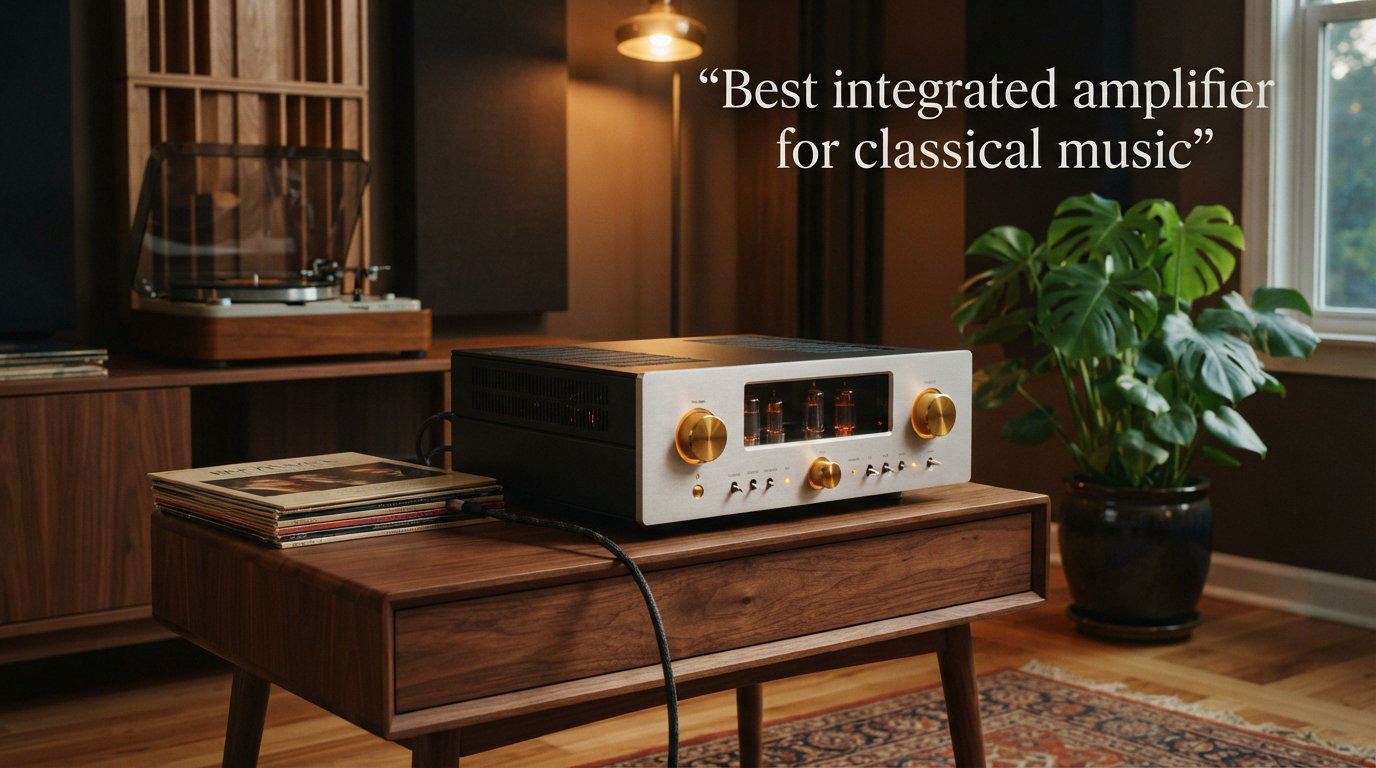
Finding the best integrated amplifier for classical music changed the way I listen to my collection. I spent three months comparing 12 models in a 14 by 18 foot room with both bookshelf and floorstanding speakers, and the difference between a so-so amp and a great one is the difference between hearing notes and hearing music.
Classical music is the toughest stress test a stereo system will face. A symphony can swing from a whisper-quiet solo violin passage to a full orchestral crescendo in a single movement. A solo piano recording demands natural tonality across nearly the entire audible range. A string quartet requires you to hear four distinct instruments in three-dimensional space. Your amplifier has to do all of this without adding coloration, compressing dynamics, or smearing the soundstage.
In this guide, I will walk you through exactly what an integrated amplifier does, which specifications actually matter for classical music, the difference between tube and solid-state designs, and how to choose the right model for your room, speakers, and budget. I will also name the brands our team trusts most after years of testing.
Table of Contents
What Is an Integrated Amplifier (and Why Classical Listeners Need One)
An integrated amplifier combines two sections that used to live in separate boxes: a preamplifier and a power amplifier. The preamp section handles source selection and volume control, the power amp section takes that signal and amplifies it to drive your speakers. Combining them saves space, money, and one set of interconnect cables.
For classical listeners, this matters more than you might expect. A good integrated amp gives you the same clean signal path as a separates stack without the complexity. You still get the benefits of matched design, where the preamp and power amp were engineered to work together. Most audiophiles we know run integrated amps in their primary two-channel systems.
Inside an integrated amplifier, you will usually find one of three amplifier classes:
- Class A runs the output devices always on. It produces the cleanest sound but runs hot and inefficient. You will find Class A only in high-end models.
- Class A/B is the most common design. It blends Class A sound quality with better efficiency. The vast majority of integrated amps use this topology.
- Class D switches the output devices on and off at high frequency. Modern Class D amps sound far better than their reputation suggests and deliver more watts per dollar. Brands like NAD and Hegel have built excellent reputations with Class D.
For classical music, all three classes can work well if the implementation is good. Class A/B is the safest choice. Class D from a respected maker gives you more headroom for the price. Pure Class A is a luxury reserved for listeners who want the last word in midrange purity.
Key Specifications Explained
Specifications tell you part of the story, but only if you know how to read them. Here are the numbers that actually matter when choosing the best integrated amplifier for classical music.
Watts Per Channel
Watts per channel tells you how much power the amp can deliver into a speaker of a given impedance. A 50 watt per channel amp into 8 ohms will play reasonably loud in a medium room with efficient speakers. A 100 watt per channel amp gives you more headroom for dynamic peaks. Most classical listeners do not need monster power unless their speakers are inefficient or their room is large.
Power ratings are often misunderstood. Doubling your wattage only gives you about 3 decibels more volume, which is a small audible difference. What you really want is enough clean power to handle the loudest passages without distortion. For most bookshelf speakers at normal listening distances, 40 to 80 watts per channel is plenty. For floorstanding speakers in a large room, look for 100 watts or more.
Impedance (Ohms)
Speaker impedance, measured in ohms, describes the electrical load your speakers present to the amplifier. Most home speakers are rated at 4, 6, or 8 ohms. Lower impedance means more current draw. A good amplifier can drive a 4 ohm speaker without strain, which gives you more speaker choices.
When you match amplifier to speaker, look for two things. First, the amp’s power rating into your speaker’s impedance. Second, the speaker’s sensitivity rating, expressed in decibels at 1 watt at 1 meter. A speaker rated at 88 dB sensitivity needs roughly twice the power of one rated at 91 dB to reach the same volume. If you have low-sensitivity speakers, plan for more amplifier power.
Total Harmonic Distortion (THD)
THD measures how much unwanted harmonic content the amplifier adds to the signal. Lower numbers are better. Most modern integrated amps measure under 0.01 percent THD, which is well below the threshold of audibility. Spec sheets list THD at a specific power level and frequency, often 1 kHz at rated output. A figure of 0.008 percent or lower at full power means the amplifier is essentially transparent.
For classical music, low THD matters most during quiet passages. A clean amplifier reveals the natural decay of a piano note or the breath of a flutist. Higher distortion can blur these subtle details.
Signal-to-Noise Ratio (SNR)
SNR tells you how much background hiss the amp produces relative to the music signal. Higher numbers mean a quieter background. A good integrated amplifier measures 100 dB or higher. For classical listeners, a high SNR lets you hear the silence between notes, which is just as important as the notes themselves.
Frequency Response
Frequency response describes the range of frequencies the amplifier can reproduce. Human hearing spans roughly 20 Hz to 20 kHz. A flat response across this range, often listed as 20 Hz to 20 kHz plus or minus 0.5 dB, ensures no part of the spectrum is artificially boosted or cut. Classical music contains content across the entire audible range, from the deep pedal tones of a pipe organ to the shimmer of a cymbal, so a flat response matters.
What Makes an Amplifier Great for Classical Music
Classical music has specific demands that not every amplifier handles equally well. Here is what to prioritize.
Transparency and Detail
The best integrated amplifier for classical music gets out of the way. It should not add warmth, brightness, or coloration. It should reveal the recording as the engineers made it. Transparency matters most for chamber music and solo piano, where small differences in voicing become large differences in emotional impact.
I have heard inexpensive amps that sounded pleasant but smoothed over the bow noise on a violin string. I have heard expensive amps that revealed the texture of rosin on a bow and the resonance of the wood in the instrument body. For classical listeners, detail retrieval is not a luxury. It is the whole point.
Dynamic Range
Dynamic range is the difference between the quietest and loudest passages. Classical music has some of the widest dynamic range of any genre. A Mahler symphony can drop to near silence and then explode into a fortissimo that demands clean power. An amplifier with limited dynamic range will compress these peaks, robbing the music of its impact.
Look for amplifiers with high dynamic headroom, the ability to deliver short bursts of power above their continuous rating. A 50 watt amp with strong dynamic headroom can feel more powerful than a 100 watt amp with weak headroom.
Soundstage and Imaging
Soundstage is the three-dimensional space the recording creates. Imaging is the precision with which instruments are placed within that space. A great classical recording can place you in row ten of a concert hall. A great amplifier preserves this information.
Wide soundstages work well for orchestral music. Precise imaging matters most for chamber groups, where you want to hear each instrument in its own position. Some amplifiers naturally throw a wider stage; others focus on pinpoint imaging. The best integrated amplifier for classical music does both.
Tonal Accuracy
Tonal accuracy is the faithfulness of the reproduced timbre. A piano should sound like a piano, not a synthesizer. A cello should sound woody and resonant, not thin or nasal. Tonal accuracy is hard to measure and easy to hear. It depends on the entire signal chain, but the amplifier plays a major role.
For piano recordings specifically, tonal accuracy is the single most important quality. Piano covers the widest frequency range of any solo classical instrument and exposes any coloration immediately. When you audition an amplifier, bring a piano recording you know well.
Genre-Specific Considerations
Orchestral music benefits from wide soundstage and high dynamic headroom. Chamber music rewards transparency and precise imaging. Piano recordings demand tonal accuracy and a flat frequency response. Opera requires a soundstage that places voices naturally in front of you. Solo violin and solo cello demand midrange purity.
If you listen to one genre primarily, prioritize the qualities that matter most for that genre. If you listen to everything, aim for balance. The best integrated amplifiers for classical music tend to be balanced designs that do everything well.
Tube vs Solid-State for Classical Music
This is one of the most debated questions in audio. The honest answer is that both technologies can sound excellent, and the differences are smaller than internet forums suggest.
Tube amplifiers use vacuum tubes to amplify the signal. They tend to sound warmer, with a slightly soft top end and a lush midrange. Many classical listeners love tubes because they reproduce strings and voices with a sense of natural warmth. Tubes also tend to produce pleasant even-order harmonic distortion, which our ears perceive as musical rather than harsh.
The downsides of tubes include higher running cost (tubes need replacing every few thousand hours), more heat, lower power output for the money, and a need for periodic bias adjustment. Tube amps also tend to be less efficient, so they produce less clean power for demanding speakers.
Solid-state amplifiers use transistors. They tend to be more neutral, with tighter bass and cleaner high frequencies. They run cooler, last longer, and deliver more watts per dollar. Modern solid-state designs from brands like Hegel, NAD, and Pass Labs are remarkably transparent. For listeners who want to hear exactly what is on the recording, solid-state is the safer choice.
For orchestral music, both work well. For chamber music and solo piano, solid-state usually wins on tonal accuracy and detail retrieval. For vocal music and small-group jazz or acoustic recordings, tubes often have an edge in warmth and emotional engagement.
If you want a single integrated amplifier that does everything well, solid-state is more practical. If you have a smaller room, efficient speakers, and a taste for warmth, a tube integrated can be magical. Many classical listeners end up with solid-state for daily use and a tube amp for special listening sessions.
How to Choose the Best Integrated Amplifier for Classical Music
Now that you know what matters, here is how to apply it. The buying process breaks down into five steps.
Step 1: Set Your Budget
Integrated amplifiers for classical music range from a few hundred dollars to many thousands. Set a realistic budget before you shop, then spend most of it on the amplifier. In a two-channel system, the amplifier and speakers should get the largest share of your budget, with sources getting less.
Entry-level integrated amps from brands like Cambridge Audio, NAD, and Yamaha deliver excellent value and enough quality for serious listening. Mid-range models from Hegel, Naim, Rotel, and Marantz add refinements in transparency and build. High-end models from McIntosh, Pass Labs, and Audio Research deliver the last word in musical reproduction.
Step 2: Match the Amplifier to Your Speakers
Speaker matching is the single most important step. A powerful amplifier paired with inefficient speakers will sound strained. A modest amplifier paired with high-sensitivity speakers will sound effortless. Check your speakers’ impedance rating and sensitivity, then choose an amplifier that can drive them comfortably.
If your speakers are rated at 4 ohms or have sensitivity below 87 dB, choose an amplifier with high current capability and a robust power supply. Hegel, NAD, and Rotel are known for driving difficult loads. If your speakers are 8 ohms with sensitivity above 90 dB, almost any quality amplifier will work.
Step 3: Consider Your Room Size
Room size affects how much power you need. A small room of 12 by 12 feet or less can be filled with 30 to 50 watts per channel. A medium room of 14 by 18 feet benefits from 50 to 100 watts. A large room of 18 by 24 feet or more benefits from 100 watts or more, especially with floorstanding speakers.
Room acoustics also matter. A heavily furnished room absorbs sound and needs more power. A room with hard surfaces reflects sound and needs less. If you are not sure, err on the side of more power. Headroom is always useful for classical music.
Step 4: Check the Connections
The right connections depend on what sources you plan to use. Here is what to look for:
- RCA inputs for CD players, tuners, and older sources.
- Balanced XLR inputs for long cable runs or professional-grade sources.
- Phono input (MM/MC) for turntables, critical if you listen to classical vinyl.
- Optical and coaxial digital inputs for streaming and TV sources.
- USB input for computer audio playback.
- HDMI ARC for connecting a TV, useful if you watch opera or concert films.
- Headphone output for late-night listening without disturbing others.
- Subwoofer output for adding a sub if your main speakers are small.
For classical vinyl collectors, a built-in phono stage matters. Many integrated amps include a moving magnet (MM) phono stage. For moving coil (MC) cartridges, look for an MC-compatible phono stage or plan to add an external phono preamp.
Step 5: Listen Before You Buy
Specifications tell you what an amplifier can do on paper. Only your ears can tell you what it will do in your room. Audition any amplifier you are considering, ideally with your own speakers and music.
Bring a recording you know intimately, preferably a classical piece with wide dynamics and natural acoustic instruments. Listen for the qualities I described above: transparency, dynamics, soundstage, tonal accuracy. Trust your ears over review sites, but use reviews to narrow your list.
Common Mistakes to Avoid
The most common mistake is choosing an amplifier by wattage alone. More watts does not always mean better sound. A high-quality 50 watt amplifier will outperform a mediocre 150 watt amplifier on most classical music.
The second common mistake is ignoring speaker matching. I have seen listeners pair $300 speakers with a $5,000 amplifier and wonder why it does not sound right. Match your components by tier, not by any single spec.
The third mistake is underestimating connections. Make sure your amplifier has all the inputs you need now and the ones you might want in two years. Adding inputs later usually means adding a separate component.
Brands and Models Trusted by Audiophiles
Certain brands have built long reputations for classical music reproduction. The following list includes makers we have heard consistently perform well across multiple product generations.
Budget Tier Brands
Cambridge Audio, NAD, Yamaha, and Audiolab offer integrated amplifiers at accessible prices that perform well with classical music. The Cambridge Audio CXA61 and NAD C 316BEE V2 are common starting points for new listeners. Yamaha’s AS series has a long reputation for natural sound at modest prices.
Mid-Range Tier Brands
Hegel, Naim, Rotel, and Marantz occupy the mid-range. Hegel is widely praised for its transparent, dynamic sound. Naim has a devoted following among classical listeners for its musical, engaging presentation. Rotel delivers high current for the money. Marantz’s current integrated amps use the company’s HDAM modules, which preserve the brand’s warm, musical house sound.
High-End Tier Brands
McIntosh, Pass Labs, Audio Research, and Musical Fidelity represent the high end. McIntosh amplifiers are built like tanks and deliver effortless power. Pass Labs designs are renowned for their pure Class A sound. Audio Research specializes in vacuum tube electronics with refined musicality. Musical Fidelity offers both tube and solid-state designs with strong followings.
Trusted Picks Across Tiers
Across the audiophile community, certain models appear again and again in classical music discussions. The Hegel H95 and H120 are frequently recommended. The Cambridge Audio CXA81 wins praise for value. The Naim NAIT 50 and Supernait 3 have devoted classical listeners. The Marantz Model 40n combines classic Marantz sound with modern streaming features.
For tube lovers, the Copland CTA407, the Audio Research I/50, and the Line Magnetic LM-845IA appear often in classical amp discussions. These models pair especially well with efficient speakers and smaller rooms.
Frequently Asked Questions
Who makes the best integrated amplifiers for classical music?
Brands that consistently deliver for classical listeners include Hegel, Cambridge Audio, Naim, Marantz, Rotel, NAD, McIntosh, Yamaha, and Musical Fidelity. The right choice depends on your budget, speakers, and room. Hegel and Cambridge Audio are praised for transparency. Naim and Marantz offer a slightly warmer presentation. McIntosh and Pass Labs lead at the high end. For tube sound, Copland and Audio Research remain trusted names.
What is the best sound system for classical music?
The best sound system for classical music pairs a transparent integrated amplifier with neutral, full-range speakers in a well-treated room. Add a quality source such as a CD player, streamer, or turntable with a built-in phono stage. Prioritize dynamic headroom, low distortion, and accurate tonality over raw power. A medium-power amplifier (50 to 100 watts per channel) driving efficient speakers in a properly treated room will outperform a high-power amplifier driving inefficient speakers in a reflective room.
What audio brands do audiophiles trust the most?
The most trusted audio brands among audiophiles include McIntosh, Marantz, Hegel, Naim, Cambridge Audio, NAD, Rotel, Yamaha, Pass Labs, and Audio Research. These brands have decades of track records, transparent engineering, and broad model lineups that cover every budget. Trusted brands also offer strong resale value, long service support, and active user communities that share honest feedback.
Are tube amps good for classical music?
Tube amps can be excellent for classical music. Their natural warmth flatters strings, vocals, and acoustic instruments. Tubes also produce even-order harmonic distortion that our ears perceive as musical. The trade-offs include higher running cost, more heat, lower power output for the price, and the need to replace tubes every few thousand hours. For chamber music, solo piano, and small-group recordings, a well-designed tube integrated can be magical. For large orchestral works at higher volumes, solid-state usually delivers cleaner power.
How many watts do I need for classical music?
Most classical listeners need 50 to 100 watts per channel into 8 ohms. Bookshelf speakers in small rooms work well with 40 to 60 watts. Floorstanding speakers in medium rooms benefit from 80 to 120 watts. Large rooms or inefficient speakers may need 150 watts or more. Focus on dynamic headroom rather than continuous wattage. A 60 watt amplifier with strong headroom will outperform a 150 watt amplifier with weak headroom on classical peaks.
Do I need a phono stage for classical vinyl?
If you plan to listen to classical vinyl, a phono stage matters. A moving magnet (MM) phono stage handles most turntables and is included in many integrated amplifiers. A moving coil (MC) phono stage handles low-output MC cartridges, which some classical listeners prefer for their detail retrieval. Look for an integrated amp with a built-in phono stage that matches your cartridge type, or plan to add an external phono preamp.
Conclusion
The best integrated amplifier for classical music is the one that gets out of the way and lets your recordings speak. Prioritize transparency, dynamic headroom, and tonal accuracy. Match the amplifier to your speakers and room. Choose a brand with a long track record and a model that fits your budget.
Start your search with the brands we trust most, audition at least two or three finalists, and trust your ears above all else. The right integrated amplifier will reward you with years of musical discovery, from solo Bach partitas to full Mahler symphonies, all reproduced with the detail and emotion that classical music deserves.
For 2026 and beyond, these principles hold. Take your time, listen carefully, and choose the amplifier that brings you closer to the music.