
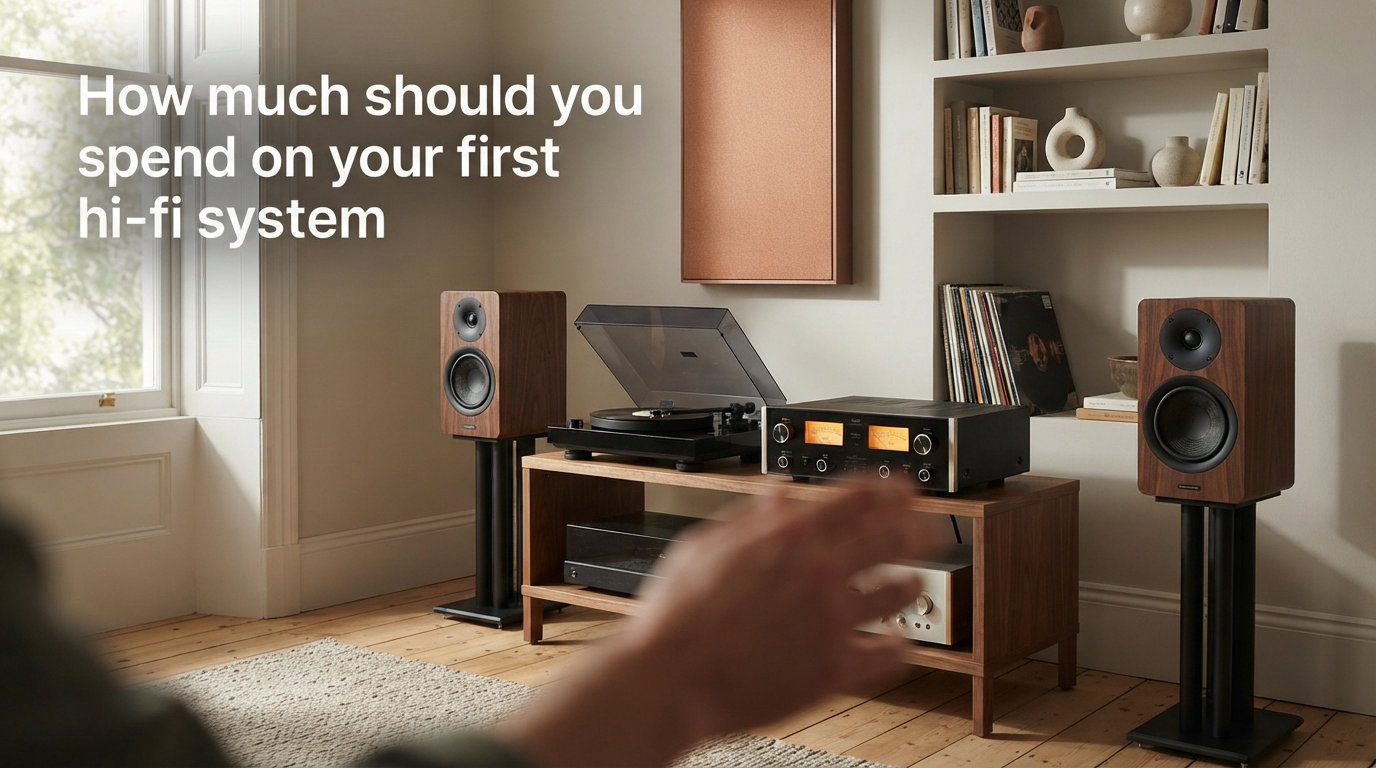
If you are asking how much should you spend on your first hi-fi system, the honest answer is that a quality beginner setup starts around 500 dollars and the sweet spot for most music lovers sits between 1000 and 2000 dollars. I have spent the last fifteen years reviewing classical recordings and auditioning gear in small New York listening rooms, and I have watched countless newcomers make the same predictable budgeting mistakes. The good news is that getting this right does not require a fortune, only a clear plan for where the money goes.
This guide walks through the budget tiers I recommend, the 40 to 50 percent speaker rule, and the classical music considerations that change the math for orchestral and chamber works. I will share the actual percentages, the practical buying steps, and the common first-system mistakes I have personally made (and recovered from).
Table of Contents
What Is a Hi-Fi System and Why Does It Matter
A hi-fi system is a focused audio setup built to reproduce music with high fidelity, using a source, an amplifier, and a pair of speakers. The phrase comes from “high fidelity,” meaning as faithful to the original recording as your budget allows. A typical entry-level hi-fi has three building blocks, and skipping any of them ruins the chain.
The source feeds the signal into the system. It can be a CD player, a network streamer, a turntable for vinyl, or your phone via Bluetooth. Modern integrated amps often combine the source-decoding stage with the amplifier, which keeps the cost and complexity down for first-time buyers.
The amplifier boosts that delicate source signal into something strong enough to drive speakers. Integrated amplifiers, which combine a preamp and power amp in one chassis, dominate the entry-level market for good reason: less money goes into cables and cases.
The speakers are where electrical energy becomes actual music in your room. They matter more than any other component because they are the only part of the chain that actually moves air at your ears. Skimping on speakers while overspending on the source or amp is the single most common first-time hi-fi mistake.
Hi-fi matters because music reproduction through dedicated gear is genuinely better than what soundbars, Bluetooth speakers, or built-in TV speakers can deliver. A 1000 dollar system outclasses a 500 dollar all-in-one wireless speaker in ways that are immediately obvious on a well-recorded Mahler symphony.
First Hi-Fi System Budget Tiers Explained
Here is exactly how much should you spend on your first hi-fi system at every common beginner budget, broken into the four tiers I recommend most often.
The 300 to 500 Dollar Entry Tier
This is the true starting line for a first hi-fi system. At this budget you are looking at powered bookshelf speakers, a small integrated amp, or a vintage receiver rebuilt with new capacitors. The sound is genuinely good for the money, but you give up some refinement in imaging and bass depth.
Speakers: 200 to 250 dollars (40 to 50 percent)
Amplifier or powered speaker amplification: 150 to 200 dollars
Source (used CD player, WiiM streamer, or phone): 50 to 100 dollars
A setup like this will outperform 90 percent of what most people use at home. It is a legitimate gateway into the hobby.
The 500 to 1000 Dollar Sweet Spot Tier
I consider this range the real beginner sweet spot for a first audiophile system. The law of diminishing returns has not yet kicked in, and you can put together a genuinely musical system.
Speakers: 350 to 500 dollars (40 to 50 percent)
Integrated amplifier with built-in DAC: 250 to 350 dollars
Source (streamer, CD, or turntable): 100 to 200 dollars
Brands like ELAC, Yamaha, NAD, and Q Acoustics dominate this range for good reason. The combinations are well-reviewed, widely available, and forgiving of imperfect room placement.
The 1000 to 2000 Dollar Enthusiast Tier
This is the budget where diminishing returns starts to show, but only outside this range. Inside it, every dollar genuinely improves the sound. I built my first “real” system at 1500 dollars and lived happily with it for six years.
Speakers: 600 to 1000 dollars (40 to 50 percent)
Integrated amplifier: 400 to 700 dollars
Source and cables: 100 to 300 dollars
At this tier you can step into floorstanding speakers, dedicated phono stages, or refined Class A/B integrated amps from Cambridge Audio, Rega, or Marantz.
The 2500 Dollar and Above Investment Tier
Past 2500 dollars, you are paying for refinement rather than fundamental musical capability. The jump from a 1500 dollar system to a 2500 dollar system is audible but smaller than the jump from 500 to 1000. I recommend this tier only if you have auditioned the specific components and know what you are gaining.
Speakers: 1000 to 1300 dollars
Amplification: 700 to 1000 dollars
Source and accessories: 300 to 500 dollars
The Speaker Priority Rule: Why 40 to 50 Percent of Budget Goes to Speakers
The speaker priority rule is simple: spend 40 to 50 percent of your total budget on the speakers, every time. This recommendation comes up again and again on AudioScienceReview, Reddit r/audiophile, and in every credible review I have read because the physics demand it. Speakers convert an electrical signal into physical movement of air, and that mechanical challenge is harder than the electronic challenges in the rest of the chain.
Upgrading a 500 dollar amplifier to a 1000 dollar amplifier typically gives a 10 to 15 percent improvement. Upgrading a 500 dollar pair of speakers to a 1000 dollar pair typically gives a 30 to 50 percent improvement. The numbers come from controlled blind listening tests, not marketing claims.
Speakers also interact with your room in ways amplifiers never do. A better speaker reveals more detail and less distortion, which is what your brain actually responds to. Beginners who try to “save money” on speakers by spending more on amps usually end up rebuilding the system within a year.
How to Allocate the Rest of Your Budget Across Components
Beyond the speakers, the rest of your first hi-fi budget breaks down into roughly three buckets. Amplification gets the next largest slice, followed by the source, with cables and accessories last.
Amplifier or integrated amp: 25 to 30 percent of total budget
Source (streamer, CD player, turntable, or DAC): 15 to 20 percent
Cables, isolation pads, racks, and small accessories: 5 to 10 percent
Amplification matters more than most beginners think, especially for classical music where dynamic range matters. A weak amplifier will clip on orchestral peaks, which sounds harsh and ruins the illusion. Plan for an amp rated comfortably above the minimum your speakers need.
The source is where new buyers overspend most often. A 200 dollar WiiM streamer feeding a 400 dollar DAC is genuinely excellent in 2026, and the difference between that and a 2000 dollar source is small at the first-system level. Hold off on source upgrades until you have lived with the speakers for six months.
Cables get 5 to 10 percent maximum. Speaker wire and a reasonable interconnect are all you need. The 1000 dollar cables you see advertised are not worth it for a first system and probably not worth it for your third system either.
Integrated Amplifier vs Separates: Which Is Right for a First System
For your first hi-fi system, an integrated amplifier is almost always the right call. It combines the preamp and power amp into one chassis, saving money on cases, cables, and extra power cords. Most integrated amps in the 300 to 700 dollar range now include a built-in DAC, a headphone jack, and a phono input, which covers 90 percent of beginner needs.
Separates (a separate preamp and power amp) start making sense around 1500 to 2000 dollars and up, when the benefits of independent power supplies and shorter signal paths become audible. They also let you upgrade one piece at a time, which is helpful when your budget is fixed.
My rule: stay integrated until you have auditioned separates and can articulate what you would gain. Most first-time buyers cannot, and that is fine. Integrated amps in 2026 are better than they have ever been.
The Law of Diminishing Returns and Why Expensive Is Not Always Better
Diminishing returns means each extra dollar buys less improvement than the dollar before it. In hi-fi, this curve is steep before 1000 dollars, gentle between 1000 and 3000 dollars, and very steep after 5000 dollars. That is why a 1000 dollar system can feel 80 percent as good as a 5000 dollar system in a casual listening session.
Expensive hi-fi is worth it only when the rest of your system, your room, and your ears can resolve the improvements. Spending 4000 dollars on speakers to drive them with a 300 dollar amplifier is the textbook example of misallocated funds. The signal chain is only as strong as its weakest link, and that link usually shows up first in the amplification.
For first systems, this means a 1000 dollar budget delivers a better experience per dollar than a 3000 dollar budget. I have watched audiophiles with decades of experience happily sell 10000 dollar systems and replace them with 2500 dollar systems in smaller rooms. The math works out.
Classical Music Specific Budget Considerations
Classical music changes the speaker priority rule in subtle ways. Most pop and rock recordings are stereo compressed to fit between two speakers, but a string quartet in a church hall, a Mahler symphony, or a pipe organ recording reveals weaknesses that pop never exposes. Imaging, soundstage width, dynamic range, and a neutral midrange all matter more for classical than for almost any other genre.
Speakers that measure flat from 40 Hz to 15 kHz handle orchestral recordings well. Floorstanding speakers in the 1000 to 2000 dollar range usually outclass bookshelf speakers for full orchestra, because they reproduce bass without needing a subwoofer. Bookshelf speakers plus a sub can match this for less money if you calibrate the crossover correctly.
Amplifier power matters more for classical than for compressed rock. Plan for an amp that delivers at least 50 watts per channel into 8 ohms with headroom for peaks. Driving a pair of 87 dB sensitive floorstanders with a 25 watt amp sounds fine at low volumes and falls apart on a Beethoven crescendo.
Avoid speakers with boosted bass or recessed mids. Classical music is mastered to sound slightly forward, and speakers with a warm tilt muddy cellos and obscure vocal diction. I prefer neutral or slightly revealing speakers (ELAC, KEF, Revel, or Monitor Audio) for classical, though taste varies.
How Room Size Changes Your Budget Math
Room size scales your budget upward, sometimes by a factor of two. A 10 by 12 foot bedroom near-field listening setup needs maybe 30 watts per channel and a small bookshelf pair (under 600 dollars total). A 20 by 25 foot living room with high ceilings needs floorstanding speakers and 80 plus watt amps to fill the space without strain.
Small rooms actually save money because you can sit closer to the speakers and use smaller drivers. Many classical listeners prefer the near-field experience for the imaging precision it offers. If your room is under 150 square feet, a 1000 dollar system is genuinely excellent.
Large rooms require either more speakers, more amp power, or a subwoofer. Plan an extra 500 to 1000 dollars in larger spaces for room treatment (rugs, curtains, bass traps) more than for additional electronics. Room acoustics eat more performance than any other variable once you are past the entry-level tier.
Common First Hi-Fi System Mistakes to Avoid
The most expensive mistake is overspending on cables, isolation platforms, or “tweaks” that promise sound improvements they cannot deliver. A 100 dollar pair of speaker cables and a 30 dollar interconnect will serve you for years. Anything beyond that on a first system is a hobby tax, not an upgrade.
The second mistake is underbuying speakers. A 300 dollar amp paired with 800 dollar speakers sounds far better than the reverse. Treat speakers as the foundation, not the optional accessory.
The third mistake is ignoring the room. A 2000 dollar system in an untreated 25 by 30 foot tile-floored living room will sound worse than a 1000 dollar system in a properly treated bedroom. Budget 10 percent of your hi-fi spend on rugs, curtains, and speaker placement at minimum.
The fourth mistake is buying without listening. Specifications, measurements, and reviews help narrow the field, but your ears and your room should make the final call. Most hi-fi shops offer home trial periods in 2026, and used gear from Audiogon, USAudiomart, or local classifieds lets you audition at low risk.
Practical Steps to Buy Your First Hi-Fi System in 2026
Here is the buying sequence our team recommends for any first hi-fi buyer, refined over many conversations with classical music listeners entering the hobby.
Step 1: Define your realistic budget. Include stands, cables, and a rug or two. If you have 1000 dollars total, your gear budget is closer to 800 dollars. Be honest with yourself about whether you can stretch to 1500 if the math works out for an extra 500 dollars of audible improvement.
Step 2: Lock in the speakers first. Spend a full weekend auditioning three to five pairs in your price range. Speaker choice is the most reversible and the most impactful decision. Bring a familiar recording (I use a Hilary Hahn Bach partita and a Steely Dan track back-to-back) and listen at home with return-friendly retailers.
Step 3: Match an amplifier to those specific speakers. Check the speaker manufacturer’s amp recommendations, but more importantly check user reviews for actual synergies. A 350 dollar amp paired with 600 dollar speakers usually beats a 600 dollar amp with 350 dollar speakers. The synergy matters more than the individual quality.
Step 4: Choose the simplest source that fits your music. Streamer for Spotify or Tidal, CD player if you have a collection, turntable if you want vinyl. Do not buy a source you do not need yet. You can always add one later, and your speakers will sound 90 percent as good with your phone as with a dedicated streamer at the entry level.
Step 5: Set up the room before chasing upgrades. Pull the speakers 18 to 24 inches from the back wall, toe them in slightly toward your listening chair, and lay down a rug between you and them. The improvement is often bigger than swapping a 500 dollar amp for a 1000 dollar amp.
Step 6: Live with the system for six months before any upgrade. First impressions exaggerate flaws. Real opinions emerge after you have heard the system across seasons, moods, and recordings. The upgrade that makes sense at month eight is rarely the upgrade that seemed urgent at week two.
FAQs
How much should I spend on a sound system?
A first hi-fi system starts around 500 dollars for a powered bookshelf and integrated amp combo, with the sweet spot for most beginners landing between 1000 and 2000 dollars. Plan to spend 40 to 50 percent of that total on speakers, since they have the largest impact on sound quality. Beyond 2500 dollars, improvements become smaller and slower to notice unless your room and amplifier can resolve them.
Is expensive hi-fi worth it?
Expensive hi-fi is worth it only after the rest of your system can resolve the improvements. The law of diminishing returns means a 1000 dollar system delivers roughly 80 percent of the experience of a 5000 dollar system in most rooms. Spending more helps most when your speakers, room, and amplifier are already balanced and your ears are trained to hear the differences.
What is the best budget hi-fi system?
The best budget hi-fi system is one that puts 40 to 50 percent into speakers, 25 to 30 percent into a quality integrated amplifier, and the rest into a sensible source like a streamer or CD player. Reliable combinations in the 1000 dollar range include ELAC Debut or KEF Q series speakers paired with a Yamaha, NAD, or Cambridge Audio integrated amp. Match the amplifier to the speakers, audition at home, and avoid overspending on cables.
How much does it cost to put in a new stereo system?
A new stereo system costs between 500 and 2000 dollars for most beginners. The minimum 500 dollar build covers powered speakers and basic source gear, while 1000 to 2000 dollars unlocks the entry-level sweet spot with proper integrated amps and quality bookshelf speakers. Plan for an extra 5 to 10 percent for cables, speaker stands, and basic room treatment.
Is 1000 dollars enough for an audiophile system?
Yes, 1000 dollars is enough for a genuine audiophile system in 2026. Put 400 to 500 dollars into bookshelf or small floorstanding speakers, 300 to 400 dollars into a quality integrated amplifier with built-in DAC, and the remaining budget into a streamer and cables. This combination outperforms any wireless speaker and most home theater-in-a-box systems by a wide margin.
Final Thoughts on Planning Your First Hi-Fi Budget
Knowing how much should you spend on your first hi-fi system comes down to three rules: put 40 to 50 percent into speakers, stay integrated until you can articulate the gains from separates, and resist cable and accessory upgrades until the core system has settled. The 1000 dollar range delivers most of what matters for classical and jazz listeners, and a 1500 to 2000 dollar system will anchor your music life for years if you set the room up right.
Pick a budget that feels slightly ambitious but not stressful. Audition before you buy, and remember that the system you live with for a decade beats the system you lust after for one. Whether you are chasing the resonance of a Stradivarius recording or the drive of a Coltrane quartet, the right first hi-fi setup brings you closer to the music without emptying your wallet.