
If you have ever tried to find a specific Mahler symphony recording on Spotify, you already know the problem. The conductor’s name is buried in a track title, the movements are split across random albums, and half the results are playlist compilations with wrong cover art. That is exactly why dedicated classical streaming services exist.
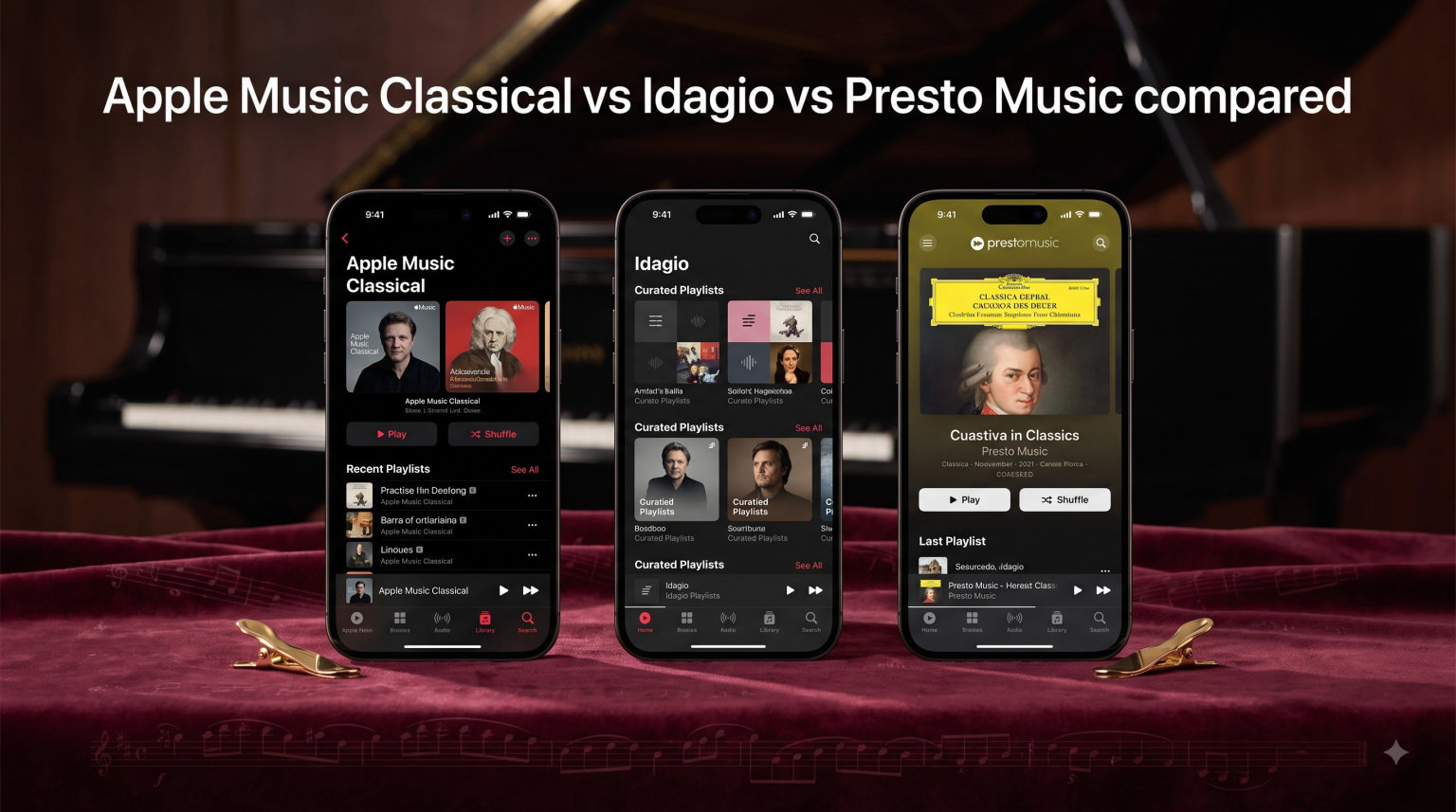
Our Apple Music Classical vs Idagio vs Presto Music compared guide breaks down the three services serious listeners actually debate in 2026. Each one tackles the same headache from a different angle: better metadata, higher audio quality, or a bigger all-genre catalog bundled in.
One service is built into an Apple Music subscription, giving you every genre alongside a classical-focused interface. Another is a classical-only specialist with arguably the best search and curation in the business. The third is a hi-res audiophile platform that throws in detailed liner notes and digital downloads.
I have spent months switching between all three on the same reference headphones, the same living-room speakers, and the same phone. This guide covers pricing, sound quality, catalog depth, search functionality, platform availability, and the small details, like liner notes, that competitors skip. By the end you will know exactly which one fits your listening habits and your budget.
Table of Contents
Quick Summary: Which Service Wins?
Here is the short version for readers who want a fast answer. The right pick depends on what kind of listener you are.
Apple Music Classical is the best choice if you want classical features without paying for a separate subscription. Since it is included with any Apple Music plan starting at $10.99 per month, you also get the full 100-million-song pop, rock, and jazz catalog. You get lossless audio up to 24-bit/192kHz and Spatial Audio support, but no detailed liner notes.
Idagio wins for anyone who lives and breathes classical music. Its metadata search is unmatched, letting you filter by conductor, period, label, and even specific work numbers. The Premium tier at $12.99 per month adds lossless FLAC streaming. The trade-off is that it is classical-only, so you still need Spotify or Apple Music for everything else.
Presto Music is the audiophile and collector pick. It offers hi-res streaming up to 24-bit/192kHz, includes actual liner notes and booklets, and lets you buy permanent downloads alongside your subscription. It is ideal if you treat recordings as something to own and study, not just stream.
None of the three is objectively best for everyone. The rest of this comparison explains exactly how they differ so you can choose with confidence.
Apple Music Classical: The All-Access Option
Apple Music Classical launched in March 2023, built on technology Apple acquired when it bought the classical streaming service Primephonic in 2021. The app exists as a separate download from the main Apple Music app, but it shares the same subscription and the same library. You do not pay twice.
The reason for the split app is simple. Classical music metadata is fundamentally different from pop music. A single Beethoven symphony has a composer, a conductor, an orchestra, a soloist, a record label, a catalog number, and four movements. Apple built a dedicated interface to handle that complexity instead of forcing it into a pop-oriented app.
Pricing and Plans
Apple Music Classical is included with every Apple Music subscription tier. The individual plan costs $10.99 per month. The Family plan runs $16.99 per month and covers up to six people. A student plan is available for $5.99 per month. If you already subscribe to Apple One, Apple Music is bundled in, so Classical comes along at no extra cost.
This pricing model is Apple’s biggest advantage. You are not paying a classical-only premium on top of a general music subscription. Everything, from Taylor Swift to the complete Bach cantatas, lives under one monthly fee.
Sound Quality
Apple Music Classical streams in Lossless audio using ALAC format at up to 24-bit/192kHz. For context, CD quality is 16-bit/44.1kHz, so Apple exceeds CD resolution on supported recordings. The service also supports Spatial Audio with Dolby Atmos on select albums, which some listeners love for orchestral and opera recordings.
One important detail: hi-res lossless requires a wired connection. Bluetooth codecs compress the signal, so you will not hear the full 24-bit/192kHz resolution over AirPods or standard Bluetooth headphones. For the best quality, you need a wired DAC and high-impedance headphones or powered speakers.
Catalog Size
Apple Music Classical draws from the full Apple Music catalog, which exceeds 100 million songs. The Classical app surfaces over 5 million classical tracks specifically, organized by composer, period, and work. In practice, this means you get an enormous library that also covers mainstream and niche genres outside classical.
The downside is that the classical metadata layer is applied on top of an existing pop-oriented database. Some recordings have incomplete metadata, and a few niche early-music or historical-label recordings may be harder to find than on a specialist service.
Search and Discovery
Search is where the dedicated app earns its keep. You can search by composer, work, opus number, conductor, orchestra, soloist, and catalog number. Type in “Beethoven 9 Karajan” and you get exactly the Karajan recording of the Ninth Symphony, not a random mix of playlists.
The app also offers curated playlists organized by mood, period, composer, and instrument. The “Composer Pages” feature collects everything by a single composer in one place, including biographies and recommended recordings. For discovery, the Listen Now tab pushes new releases and editor picks daily.
Platform Availability
Apple Music Classical is available on iPhone, iPad, and Android. There is no dedicated Mac or Windows desktop app, though you can stream through the main Apple Music app or Apple Music web player with less classical-specific organization. AirPlay 2 and CarPlay are supported, and it works with HomePod and other Apple ecosystem devices.
The lack of a true desktop app is a real limitation for listeners who do serious sitting-down listening at a computer. You can work around it, but the experience is not as polished as on mobile.
Idagio: The Classical Specialist
Idagio was founded in Berlin in 2014 with a single mission: build the best possible streaming experience for classical music and nothing else. That narrow focus shows in every corner of the app. The search engine, the curation, and the metadata are all designed by people who understand that “Mahler 5” means something very specific.
If Apple Music Classical is a generalist app with a classical layer on top, Idagio is classical from the ground up. Every album, every playlist, and every editorial piece is built around how classical listeners actually think about music.
Pricing and Plans
Idagio offers two main tiers. The Standard plan costs $9.99 per month and streams at 320kbps AAC, which is solid quality but not lossless. The Premium plan costs $12.99 per month and adds lossless CD-quality FLAC streaming at 16-bit/44.1kHz. A Premium Family plan covers up to five accounts for $19.99 per month.
Annual billing saves roughly two months on any plan. Idagio also offers a free tier with limited functionality and ads in some regions, which is useful for testing the interface before committing. Student pricing is available in select markets.
Sound Quality
On the Premium tier, Idagio streams lossless FLAC at CD quality, meaning 16-bit/44.1kHz. This is genuine uncompressed audio that matches or beats what you hear on a CD. It does not offer hi-res audio above CD quality, so if you specifically want 24-bit/96kHz or higher, Idagio is not the platform for that.
For most listeners and most playback systems, CD-quality FLAC is indistinguishable from hi-res. The benefit over compressed streaming is real and audible, especially on quiet passages, sustained strings, and vocal music where compression artifacts creep in on lower-bitrate services.
Catalog Size
Idagio’s catalog includes over 2 million tracks across more than 100,000 albums. That is smaller than Apple Music’s total classical catalog, but Idagio’s advantage is not raw size. It is depth of metadata and organization. Every track is tagged with conductor, ensemble, soloist, label, recording date, and work number.
The catalog leans heavily into core classical repertoire: orchestral, chamber, opera, choral, and solo instrumental. It also covers early music, contemporary classical, and some film score and crossover material. Jazz and non-classical genres are essentially absent, which matters if you want one app for everything.
Search and Discovery
This is Idagio’s crown jewel. The search engine lets you filter by composer, work, conductor, orchestra, soloist, period, instrument, and record label, often in combination. You can search “Mozart Piano Concerto 23 Barenboim” and land on the exact recording instantly. Forum users consistently rank Idagio’s search as the best of any classical service.
Discovery is driven by human curation rather than algorithms. Editorial playlists are organized by mood, period, composer, and theme. Idagio also produces exclusive recordings and partners with labels for early releases. The “Mood” feature groups music by emotional character rather than composer, which is handy for casual listening.
Platform Availability
Idagio is available on iPhone, iPad, Android, and through a web player accessible from any desktop browser. There is also a dedicated desktop app for Windows and Mac in some regions. It supports AirPlay, Chromecast, and Bluetooth output. Offline listening is included on paid plans.
The broad platform support is a real plus. Unlike Apple Music Classical, you get a proper desktop experience, and Android support is fully functional rather than a secondary consideration. Third-party integration with devices like Sonos and Bluesound is also available.
Presto Music: The Hi-Res Audiophile Choice
Presto Music launched its streaming service in early 2023, but the company itself has been a major classical retailer since 2001. Originally a UK-based online store selling CDs and later digital downloads, Presto expanded into streaming to compete directly with Idagio and Apple Music Classical. Its heritage as a retailer shapes everything about the service.
What makes Presto different is that it treats streaming, downloading, and physical media as connected parts of one ecosystem. You can stream a recording, read its liner notes, buy the high-res download to keep permanently, and order the CD, all from the same platform.
Pricing and Plans
Presto Music’s streaming subscription costs approximately £9.99 per month or £99.99 per year, which translates to roughly $12 to $13 per month depending on exchange rates. There is a single tier rather than a split between standard and premium audio quality. A family plan is available for an additional fee.
Because Presto also sells downloads and physical media, the subscription is just one piece of the model. You can sample recordings through streaming and then purchase the ones you want to own in higher resolution. This appeals to collectors who want flexibility rather than a pure rental model.
Sound Quality
Presto Music streams in hi-res audio up to 24-bit/192kHz where the source recording supports it. This matches or exceeds Apple Music Classical’s maximum resolution and goes well beyond Idagio’s CD-quality ceiling. For listeners with a capable DAC and high-end headphones or speakers, the difference on well-recorded orchestral and chamber music is noticeable.
Not every album is available in hi-res. Many recordings max out at CD quality, and older catalog transfers may be lower. Presto clearly labels the resolution of each album, so you always know what you are getting before you press play.
Catalog Size
Presto Music’s streaming catalog includes over 200,000 albums and is growing steadily. While this is smaller than both Apple Music Classical and Idagio in raw numbers, Presto’s catalog is highly curated and includes deep representation from independent classical labels. Jazz is also represented alongside classical.
The focus on label partnerships means you get serious depth from audiophile labels like Hyperion, Chandos, BIS, and Harmonia Mundi. If your taste leans toward historically informed performance, contemporary classical, or niche instrumental repertoire, Presto may actually have better coverage than the bigger services.
Search and Discovery
Presto’s search is strong on classical metadata, supporting searches by composer, work, artist, label, and catalog number. It is not quite as granular as Idagio’s filtering system, but it is more than sufficient for most listeners. The interface also surfaces editorial reviews, which Presto has been producing for years as part of its retail business.
The standout feature is liner notes. Presto includes digital booklets and liner notes for a large percentage of its catalog, something neither Apple Music Classical nor Idagio offers consistently. For listeners who care about understanding a recording, its performers, and its historical context, this is a meaningful advantage.
Platform Availability
Presto Music is available on iPhone, iPad, Android, and through a full web player for desktop use. It supports AirPlay, Chromecast, and Bluetooth streaming. Offline listening is included with the subscription. Because Presto started as a web retailer, the desktop experience is mature and well-designed.
The platform does not yet have the deep smart-speaker integration that Apple enjoys through HomePod and Siri. If you rely heavily on voice control or whole-home audio through Apple devices, that is worth weighing before switching.
Apple Music Classical vs Idagio vs Presto Music: Sound Quality Compared
Sound quality is where these three services separate most clearly. Here is the direct technical comparison.
Apple Music Classical streams lossless ALAC up to 24-bit/192kHz and supports Spatial Audio with Dolby Atmos. Idagio Premium streams lossless FLAC at CD quality, meaning 16-bit/44.1kHz, with no hi-res option above that. Presto Music streams hi-res FLAC up to 24-bit/192kHz where source recordings allow.
On paper, Apple Music Classical and Presto Music tie at the top for maximum resolution. In practice, both depend on whether the specific album was recorded and mastered in hi-res. Many albums cap at CD quality regardless of the platform’s theoretical maximum.
Idagio is the outlier here. It tops out at CD quality, which for most listeners and most playback systems is more than enough. But if you have invested in a high-end DAC, balanced headphones, and reference monitors, you may hear a difference with hi-res material on Apple or Presto that Idagio cannot deliver.
One thing worth noting from my own testing: the audible difference between CD quality and 24-bit/96kHz is subtle on most recordings and most gear. The bigger jump is from compressed streaming, like Spotify’s 320kbps Ogg Vorbis, to any lossless format. If you are coming from Spotify, all three of these services will sound noticeably better.
Search and Metadata: Where Classical Services Shine
If there is one reason to leave mainstream streaming for a classical service, it is search. All three platforms understand that classical music needs different metadata than pop.
Idagio leads this category. Its filtering system is the most granular, allowing combinations of conductor, period, label, and work number that no other service matches. Apple Music Classical is a strong second, with excellent work-based search and the best composer pages of the three. Presto Music is solid and improving, with good metadata support and the bonus of editorial reviews.
The practical difference matters most when you are hunting for a specific recording. On Spotify, searching “Brahms 4 Kleiber” might return a dozen unrelated results. On Idagio or Apple Music Classical, you land on Carlos Kleiber’s legendary Vienna Philharmonic recording within seconds. That alone is worth the switch for serious listeners.
Pricing and Value: Which Gives You the Most?
Pricing comparison comes down to whether you need one app or two. Apple Music Classical gives you classical and everything else for $10.99 per month individual or $16.99 per month for a six-person Family plan. That is hard to beat on raw value.
Idagio’s Premium tier at $12.99 per month gets you lossless classical but nothing else. If you also want pop or jazz streaming, you are paying for two subscriptions. The Idagio Family plan at $19.99 per month is the most expensive family option of the three.
Presto Music lands in the middle at roughly $12 to $13 per month, with the added flexibility of buying downloads and physical media through the same account. For collectors who already spend money on recordings, that integration adds real value beyond the subscription itself.
For most households, the Apple Music Family plan is the most cost-effective if you want a single subscription that covers classical and mainstream music. Idagio and Presto are worth the extra cost only if classical is your primary or exclusive listening focus.
FAQs
Is IDAGIO better than Apple Classical?
IDAGIO is better than Apple Classical for listeners who want the deepest classical search and curation, with filtering by conductor, period, label, and work number that Apple does not fully match. Apple Classical is better if you want lossless and hi-res audio up to 24-bit/192kHz, Spatial Audio, and the full Apple Music catalog including pop and rock for one subscription price. IDAGIO tops out at CD-quality FLAC and is classical-only.
Which is the best streaming service for classical music?
The best streaming service for classical music depends on your priorities. IDAGIO is best for search organization and curation. Apple Music Classical is best for value and all-genre coverage with hi-res lossless. Presto Music is best for audiophiles who want hi-res streaming, liner notes, and the option to buy permanent downloads. All three handle classical metadata far better than Spotify or mainstream services.
Is Apple Music better for classical?
Apple Music is better for classical than mainstream services like Spotify because the dedicated Apple Music Classical app adds work-based search, composer pages, and curated classical playlists. It streams lossless audio up to 24-bit/192kHz and includes Spatial Audio. The trade-off is that its metadata is less granular than IDAGIO’s and it lacks consistent liner notes.
Is IDAGIO any good?
IDAGIO is excellent for serious classical listeners. Its search and filtering system is widely considered the best of any classical streaming service, and its human-curated playlists and editorial content add real value. The main limitations are that it tops out at CD-quality FLAC rather than hi-res, and it is classical-only, so you need a separate subscription for other genres.
What is the best source for streaming classical music?
The best source for streaming classical music in 2026 is one of the three dedicated services: Apple Music Classical, IDAGIO, or Presto Music. Apple Music Classical offers the best overall value and hi-res audio. IDAGIO offers the best search and curation. Presto Music offers hi-res audio plus liner notes and download purchasing. Avoid Spotify for serious classical listening because its metadata and search are not built for classical repertoire.
Why does Apple have a separate app for classical music?
Apple has a separate app for classical music because classical metadata is fundamentally different from pop music. A classical recording has a composer, conductor, orchestra, soloist, label, catalog number, and multiple movements that mainstream music apps are not designed to organize. The separate Apple Music Classical app handles work-based search, composer pages, and period organization that the main Apple Music app cannot do well.
Conclusion
Our Apple Music Classical vs Idagio vs Presto Music compared breakdown comes down to three listener profiles. Apple Music Classical wins on overall value, bundling hi-res lossless classical with a full all-genre catalog for one subscription. Idagio wins on search and curation if classical is your primary passion and you want the best metadata experience available. Presto Music wins for audiophiles and collectors who want hi-res streaming, liner notes, and the ability to own recordings permanently.
If you want one app for everything and already use Apple devices, start with Apple Music Classical. If you are a dedicated classical listener who values finding the right recording instantly, try Idagio’s free tier first. If sound quality and liner notes matter more than anything else, Presto Music is worth the switch.
The good news is that all three offer free trials or free tiers. Test them with the recordings you know best, on the gear you actually use, and trust your own ears over any spec sheet.