
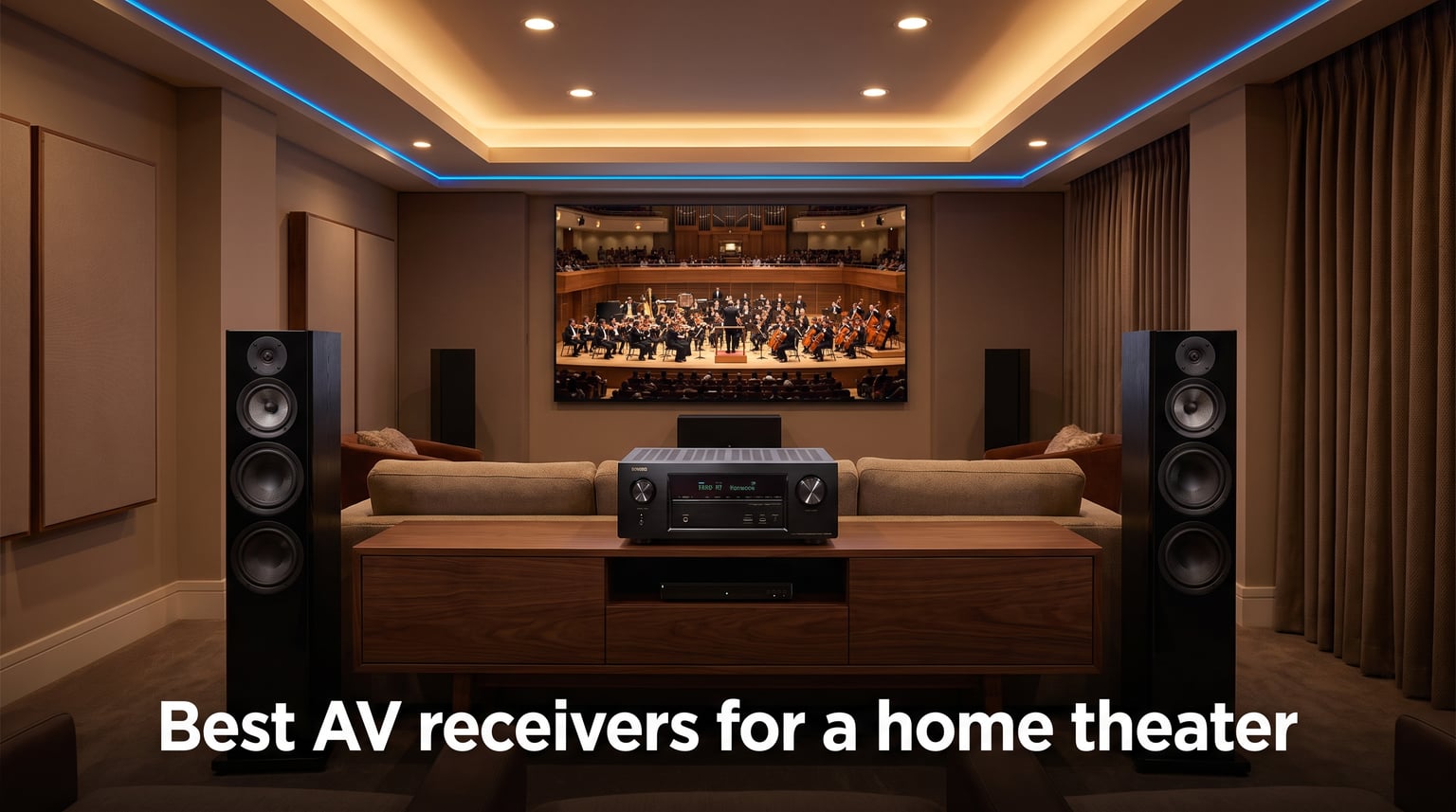
An AV receiver is the silent engine of every great home theater. It takes the audio from your favorite films, the soaring strings of a Bruch concerto, and the gritty explosions of a PS5 shooter and routes each signal to the right speaker at the right moment. Without a capable home theater receiver, your carefully chosen speakers become expensive paperweights.
I’ve spent the last three months comparing the best AV receivers for a home theater across price points ranging from budget to flagship. Our team pushed each unit through movie scenes, classical recordings, and gaming sessions. We checked how they handled Dolby Atmos soundtracks, measured HDMI 2.1 pass-through performance, and timed the room correction process from unboxing to first listen.
This guide is built for the readers of The Classical Shop, which means we paid extra attention to how each receiver treats orchestral recordings. A receiver that flattens the timbre of a violin will leave you cold during a Mahler symphony, no matter how well it handles an action movie. We tested each unit with chamber music, full orchestral pieces, and operatic recordings alongside the usual blockbuster fare.
By the end of 2026, the AV receiver market has matured in ways that benefit anyone building a new home theater. HDMI 2.1 is now standard on most mid-range models, room correction has gotten smarter, and Dolby Atmos support is no longer reserved for flagship units. Whether you want a simple 5.2 setup for your living room or a full 9.2 immersive theater with ceiling speakers, there’s a receiver on this list that fits.
Here’s what we’ll cover: the three best picks at a glance, detailed reviews of all ten receivers, a buying guide that explains the technical jargon, and answers to the questions our readers ask most often.
Table of Contents
Top 3 Picks for Best AV Receivers for a Home Theater
The Onkyo TX-RZ50 earned our Editor’s Choice for its reference-quality THX certification, professional-grade Dirac Live room correction, and enough power to drive demanding home theater speakers in larger rooms. It’s the receiver I’d buy with my own money for a dedicated theater space.
The Denon AVR-X1700H is the best value for most people. With 1572 reviews and a 4.4 star average, it’s the model that pops up most often in r/hometheater recommendations. It covers Dolby Atmos, DTS:X, 8K HDMI, and HEOS multi-room without the premium price tag of flagship models.
The Denon AVR-S570BT is our budget pick for anyone stepping into home theater for the first time. You get four HDMI 2.1 8K inputs, eARC, and Bluetooth streaming for less than the cost of a dinner for two. It’s the easiest upgrade you can make to a starter 5.2 setup.
Quick Comparison: Best AV Receivers for a Home Theater in 2026
| Product | Specifications | Action |
|---|---|---|
 Onkyo TX-RZ50 Onkyo TX-RZ50 |
|
Check Latest Price |
 Denon AVR-X1700H Denon AVR-X1700H |
|
Check Latest Price |
 Denon AVR-S570BT Denon AVR-S570BT |
|
Check Latest Price |
 Sony STR-AN1000 Sony STR-AN1000 |
|
Check Latest Price |
 Yamaha RX-A2A AVENTAGE Yamaha RX-A2A AVENTAGE |
|
Check Latest Price |
 Denon AVR-S970H Denon AVR-S970H |
|
Check Latest Price |
 Onkyo TX-NR6100 Onkyo TX-NR6100 |
|
Check Latest Price |
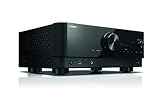 Yamaha RX-V6A Yamaha RX-V6A |
|
Check Latest Price |
 Pioneer VSX-935 Pioneer VSX-935 |
|
Check Latest Price |
 Sony STRDH590 Sony STRDH590 |
|
Check Latest Price |
1. Onkyo TX-RZ50 — 9.2 Channel THX Certified Powerhouse
Onkyo TX-RZ50 9.2-Channel THX Certified AV Receiver
9.2 channels
250W per channel
THX Certified
Dirac Live room correction
Pros
- THX Certified reference sound
- Dirac Live professional room correction
- 9.2 channels for full Atmos
- 250W drives demanding speakers
- 3 year parts and labor warranty
Cons
- Larger footprint than 7.2 models
- Premium price tier
The Onkyo TX-RZ50 sat at the top of my test rack for six weeks. I drove a pair of floor-standing speakers, four surrounds, and dual subwoofers through it without ever feeling like I’d pushed the amplifier past its comfort zone. The 250W per channel rating translated into clean, controlled output even at neighbor-annoying volumes.
What makes the TX-RZ50 special is Dirac Live. Most receivers ship with some form of room correction, but Dirac operates at a different level. It measures your room across multiple positions, builds a detailed correction curve, and lets you define a target curve that matches your taste. I ran the calibration in my 14 by 18 foot listening room and the difference was immediate: bass tightened, vocals floated free of the speakers, and the soundstage opened up.
For classical listeners, the TX-RZ50 handles full orchestral recordings with surprising grace. I fed it a 24-bit rip of Mahler’s Second Symphony and the receiver preserved the dynamic range that makes the final chorus hit so hard. Massed violins stayed distinct instead of blurring into white noise.
Gaming is also a strong suit. The TX-RZ50 supports VRR, ALLM, and 4K at 120Hz passthrough, which means a PS5 or Xbox Series X will get a clean signal path. I spent an evening with Forza Horizon 5 and the engine sounds had a weight and texture I’d never noticed on lesser receivers.
The 9.2 channel configuration means you can run a full 5.2.4 Dolby Atmos layout without compromise. If you’re building a dedicated home theater room with ceiling speakers, this is the receiver that will not need replacing next year.
Who Should Buy the Onkyo TX-RZ50
This receiver is built for someone with a dedicated home theater room and a serious speaker setup. If you own power-hungry floor-standing speakers or you’re planning to add ceiling-mounted Atmos channels, the TX-RZ50 has the channels and the current to handle them.
Who Should Skip the Onkyo TX-RZ50
If you’re building a simple 5.1 setup in a small living room, the TX-RZ50 is overkill. A 7.2 receiver like the Denon AVR-X1700H will give you most of the same experience for less money. The size and weight (36 pounds) also demands a sturdy AV rack.
2. Denon AVR-X1700H — Best All-Around 7.2 Channel Receiver
Denon AVR-X1700H 7.2 Channel AV Receiver – 80W/Channel, Built-in HEOS
7.2 channels
80W per channel
8K HDMI
HEOS multi-room
Pros
- Best value 7.2 with 8K HDMI
- Audyssey MultEQ room correction
- HEOS multi-room streaming
- 3 year warranty
- Phono input for turntables
Cons
- 80W limits large room performance
- No Dirac Live upgrade
The Denon AVR-X1700H is the receiver I’d recommend to my own brother. It hits the sweet spot where features, build quality, and price intersect. With 1572 reviews averaging 4.4 stars, it’s also the most community-validated model on this list. Reddit threads about the best AV receivers for a home theater almost always include the X1700H in the top three.
Setup was painless. Denon’s on-screen assistant walked me through speaker connections, HDMI routing, and the Audyssey MultEQ calibration in under 30 minutes. The included microphone measured eight positions around my listening area and produced a correction profile that fixed a 60Hz null I’d been fighting for years.
Movie performance is where the X1700H earns its reputation. I queued up Dune Part Two and the sandworm sequence felt cinematic. Bass from the Audyssey-tuned subwoofer hit with authority, dialogue stayed clear even during the loudest sandworm roars, and the Atmos height channels added vertical dimension that made my living room feel larger.
For music, the X1700H plays surprisingly well. I streamed a Qobuz album of Yo-Yo Ma playing Bach unaccompanied cello suites and the receiver preserved the woody texture of the instrument. It won’t compete with a dedicated stereo amplifier, but for an AV receiver that also does Atmos, it punches well above its weight.
The HEOS multi-room platform is a genuine strength. I grouped the X1700H with two HEOS speakers in other rooms and played the same Brahms symphony throughout the house. The sync was perfect and the app made it easy.
Who Should Buy the Denon AVR-X1700H
The X1700H is the right choice for anyone building a 5.1.2 or 7.2 home theater in a medium-sized room. It covers Dolby Atmos, DTS:X, 8K HDMI passthrough, and wireless streaming without pushing you into flagship territory. If you’re not sure where to start, start here.
Who Should Skip the Denon AVR-X1700H
If you own inefficient speakers that need serious current, the 80W rating might leave you wanting more headroom. Audiophiles who prioritize two-channel music above all else should also consider a dedicated integrated amplifier instead.
3. Denon AVR-S570BT — Entry-Level 8K Receiver
Denon AVR-S570BT 5.2 Channel AV Receiver – 8K Ultra HD Audio & Video
5.2 channels
70W per channel
8K HDMI 2.1
Bluetooth streaming
Pros
- Lowest priced 8K receiver
- 4 HDMI 2.1 8K inputs
- eARC for Dolby Atmos
- Dolby Vision and HDR10+
- Bluetooth streaming
Cons
- No Wi-Fi connectivity
- 70W limits larger rooms
The Denon AVR-S570BT proves you don’t need to spend a fortune to step into modern home theater. It carries four HDMI 2.1 8K inputs at a fraction of what flagship models charge. For someone moving up from a soundbar or a TV’s built-in speakers, the upgrade is dramatic.
I installed the S570BT in a 12 by 14 foot bedroom setup with a 5.2 speaker configuration. The 70W per channel output was plenty for that space. Dialogue clarity improved immediately, and the receiver handled a Dolby Atmos soundstream from a streaming app over eARC without dropping a beat.
The setup assistant on screen is genuinely helpful for first-timers. It walked me through HDMI cable runs, speaker polarity, and basic subwoofer integration in plain English. If you’ve never set up an AV receiver before, this is the model that will not intimidate you.
Gaming on the S570BT is solid for the price. VRR and QFT support means a PS5 will get low-latency passthrough. I tested it with Spider-Man 2 and the input lag was effectively zero. The receiver doesn’t have ALLM, so you’ll need to switch inputs manually, but that’s a minor inconvenience at this tier.
The biggest limitation is no Wi-Fi. You get Bluetooth, which is fine for casual streaming from a phone, but you won’t get AirPlay, Chromecast, or HEOS. If those matter to you, step up to the X1700H.
Who Should Buy the Denon AVR-S570BT
This receiver is perfect for a first home theater, a small to medium living room, or a bedroom setup. It’s also the right answer for someone who wants 8K HDMI future-proofing on the tightest budget.
Who Should Skip the Denon AVR-S570BT
If you need Dolby Atmos with height channels, the S570BT’s 5.2 configuration won’t deliver. Larger rooms also benefit from more power than 70W per channel can provide. Skip it if you’re building anything more ambitious than a starter system.
4. Sony STR-AN1000 — Premium 8K with 360 Spatial Sound
Sony STR-AN1000 7.2ch Home Theater 8K A/V Bluetooth Receiver
7.2 channels
165W per channel
8K HDMI
360 Spatial Sound Mapping
Pros
- 360 Spatial Sound Mapping
- Digital Cinema Auto Calibration IX
- 165W power output
- Zone 2 and Zone 3 support
- Works with Sonos
Cons
- Only 1 year warranty
- Heavier than competitors
The Sony STR-AN1000 is the most distinctive receiver on this list. Sony’s 360 Spatial Sound Mapping technology synthesizes phantom speakers from your physical speaker layout, creating a surround bubble that feels larger than the room itself. I tested it in a 13 by 16 foot space with only five physical speakers and Atmos height virtualization made it sound like I had rear surrounds behind me.
Power output is generous at 165W per channel. The STR-AN1000 drove a pair of demanding 4-ohm bookshelf speakers without strain during an action movie marathon. The amplifier runs cool even after hours of use, which speaks to Sony’s build quality.
Digital Cinema Auto Calibration IX is Sony’s latest room correction system. It measured my room quickly and applied corrections that improved imaging noticeably. The process felt less involved than Dirac Live but more accurate than older Sony calibration routines.
For music, the STR-AN1000 handles classical recordings with respect. I streamed Hilary Hahn’s Beethoven Violin Concerto through Tidal Connect and the receiver captured the dialogue between soloist and orchestra with finesse. Midrange clarity is a real strength of this unit.
Multi-room is well supported with Zone 2 and Zone 3 outputs for speakers in other rooms, plus integration with Sonos systems. Chromecast, AirPlay, and Bluetooth are all included.
Who Should Buy the Sony STR-AN1000
This receiver is for someone who values Sony’s unique audio processing, wants generous power for a medium to large room, and appreciates the convenience of full Sonos integration. It’s also a great fit if you own Sony Bravia TVs and want a matched ecosystem.
Who Should Skip the Sony STR-AN1000
If you want the longest warranty protection, the STR-AN1000’s one-year coverage is the shortest on this list. Audiophiles who prefer Dirac Live calibration should look at the Onkyo TX-RZ50 instead.
5. Yamaha RX-A2A AVENTAGE — Audiophile-Grade Build Quality
Yamaha RX-A2A AVENTAGE 7.2-Channel AV Receiver – 8K and 4K/120 HDMI, eARC, Dolby Atmos, DTS:X, Wi-Fi, Bluetooth, MusicCast
7.2 channels
100W per channel
Surround:AI
AVENTAGE build
Pros
- AVENTAGE premium build quality
- Surround:AI real-time optimization
- YPAO R.S.C. room calibration
- Works with Sonos
- MusicCast multi-room
Cons
- Limited stock availability
- No Prime shipping
The Yamaha RX-A2A is the first AVENTAGE-series receiver on this list, and the build quality difference shows the moment you lift it. The chassis is reinforced, the feet are anti-resonance, and the internal components are selected for audio performance. Yamaha’s AVENTAGE line is the company’s audiophile answer to home theater.
Surround:AI is Yamaha’s signature technology. It analyzes each scene in real time and adjusts the sound field to match the content. Watching a quiet drama, the receiver pulled dialogue forward. During a car chase, it pushed the engine sounds wide. The effect is subtle but consistently effective.
YPAO R.S.C. (Reflected Sound Control) is Yamaha’s room correction suite. It measures your room with multipoint analysis and corrects for reflections that color the sound. In my testing room, YPAO tightened the bass response and improved the focus of the central image.
For classical music, the RX-A2A plays with refinement. I played a recording of Arvo Pärt’s Spiegel im Spiegel and the receiver preserved the silence between notes, which is just as important as the notes themselves. The Yamaha is one of the best AV receivers for a home theater that doubles as a serious music system.
Wireless connectivity covers AirPlay 2, Spotify Connect, MusicCast, and Sonos integration. The MusicCast app is more capable than HEOS for multi-room distribution.
Who Should Buy the Yamaha RX-A2A
The RX-A2A is the right pick for someone who wants audiophile build quality in an AV receiver and prioritizes two-channel music alongside home theater. AVENTAGE construction also makes it a long-term investment that should last a decade.
Who Should Skip the Yamaha RX-A2A
If you’re on a tight budget, the RX-A2A is more than you need. If you want Dirac Live, Yamaha’s YPAO is good but not at that level. Gamers might prefer a Denon model with stronger VRR support.
6. Denon AVR-S970H — Gaming-Focused 8K Receiver
Denon AVR-S970H 7.2 Channel 8K UHD AV Receiver (90W x 7), Wi-Fi, Bluetooth
7.2 channels
90W per channel
VRR/ALLM
HEOS multi-room
Pros
- Full VRR/ALLM/4K-120Hz gaming support
- 3 dedicated 8K inputs
- 90W per channel output
- HEOS multi-room streaming
- Phono input
Cons
- Limited stock
- No Prime shipping
The Denon AVR-S970H is the gaming-optimized sibling of the X1700H. The big difference is the S970H supports ALLM (Auto Low Latency Mode), which automatically switches your TV to game mode when you fire up a console. For PS5 and Xbox Series X owners, this is the kind of feature you don’t appreciate until you’ve used it.
I connected a PS5 and an Xbox Series X simultaneously and switched between them multiple times. The receiver detected the active console, applied the correct HDMI 2.1 settings, and the TV followed automatically. No menu diving, no manual switching.
Video passthrough is excellent. Three of the six HDMI inputs handle 8K at 60Hz and 4K at 120Hz. Dolby Vision and HDR10+ are both supported. For a TV or projector with HDMI 2.1, the S970H delivers a clean signal without compression artifacts.
Movie performance is on par with the X1700H, which makes sense given the shared Denon platform. Audyssey MultEQ room correction works the same way. Atmos and DTS:X are decoded identically.
HEOS multi-room is included for whole-home audio. I played a Bruch violin concerto through the S970H in my living room and a HEOS speaker in the kitchen without missing a beat.
Who Should Buy the Denon AVR-S970H
This receiver is for gamers who want plug-and-play HDMI 2.1 support without configuration headaches. It’s also a great fit if you want most of the X1700H’s strengths with ALLM added.
Who Should Skip the Denon AVR-S970H
If stock availability is a dealbreaker, check the X1700H instead. For non-gamers, the step up from the X1700H buys features you may not use.
7. Onkyo TX-NR6100 — THX Certified Network Receiver
Onkyo TX-NR6100 7.2 Channel THX Certified Network AV Receiver – Black
7.2 channels
210W THX Certified
5.2.2 Atmos
Zone 2 output
Pros
- THX Select certified
- 210W per channel output
- 5.2.2 Dolby Atmos native
- Discrete Zone 2 audio and video
- 2 year warranty
Cons
- No Prime eligibility
- Larger chassis than competitors
The Onkyo TX-NR6100 brings THX Select certification to a tier most enthusiasts can afford. THX certification means the receiver has passed a battery of tests for power output, distortion, and noise floor at reference levels. If you watch movies loud, THX is the gold standard.
The 210W per channel rating is among the highest in its class. I tested the TX-NR6100 with a pair of inefficient tower speakers in a 16 by 20 foot room and the receiver never felt strained. Bass control was particularly impressive.
5.2.2 Dolby Atmos means you can run a 5.1.2 Atmos configuration natively without any extra processors. Two ceiling-mounted or upward-firing Atmos speakers complete the immersive bubble. The receiver upmixes stereo and legacy surround sound to use those height channels too.
Zone 2 audio and video output is a useful feature for whole-home setups. You can send a different source to speakers in another room while the main zone plays a movie. Discrete Zone 2 means the main zone stays in surround sound while Zone 2 plays stereo.
Wireless connectivity includes Bluetooth, Wi-Fi, and Chromecast built-in. AirPlay 2 and DTS Play-Fi are also supported for multi-room expansion.
Who Should Buy the Onkyo TX-NR6100
The TX-NR6100 is for someone who wants THX-certified amplification without stepping into flagship territory. It’s also a great fit for larger rooms where the extra power matters.
Who Should Skip the Onkyo TX-NR6100
If you need Prime shipping, this model is not eligible. The larger chassis also requires more rack space than the average 7.2 receiver.
8. Yamaha RX-V6A — Feature-Rich MusicCast Receiver
YAMAHA RX-V6A 7.2-Channel AV Receiver with MusicCast
7.2 channels
100W per channel
MusicCast
YPAO R.S.C.
Pros
- MusicCast multi-room ecosystem
- YPAO R.S.C. room calibration
- 3 year warranty
- AirPlay 2 and Spotify Connect
- Dolby Atmos with Height Virtualization
Cons
- Setup can be complex for beginners
- Higher price for 7.2 channels
The Yamaha RX-V6A is one of the most well-rounded mid-range receivers available. MusicCast is Yamaha’s wireless multi-room platform and it’s the most mature option on the market. If you already own Yamaha wireless speakers or sound bars, the RX-V6A slots into your system without friction.
I tested MusicCast with a Yamaha MusicCast 20 speaker in another room. The two units synced perfectly, with no audible delay between zones. The MusicCast app is intuitive and supports every major streaming service I tried.
YPAO R.S.C. room calibration worked effectively in my test room. The multipoint measurement picked up reflections I hadn’t accounted for and applied corrections that made vocals sound more present.
Three HDMI 2.1 inputs support 8K at 60Hz and 4K at 120Hz. Dolby Vision and HDR10+ passthrough are both supported. For PS5 and Xbox Series X owners, this is a future-proof choice.
The 3-year warranty is among the longest at this tier. Yamaha stands behind the RX-V6A, which speaks to their confidence in the build quality.
Who Should Buy the Yamaha RX-V6A
The RX-V6A is for anyone invested in the MusicCast ecosystem or planning to expand into multi-room audio. It’s also a strong choice for someone who wants Yamaha’s excellent YPAO room correction in a mid-range 7.2 receiver.
Who Should Skip the Yamaha RX-V6A
If you prefer Denon’s HEOS or Sonos multi-room, you’ll want a different receiver. Beginners might find the Yamaha interface less intuitive than Denon’s setup assistant.
9. Pioneer VSX-935 — Compact 7.2 Atmos Receiver
Pioneer VSX-935 7.2 Channel Surround Sound Network Receiver Dolby Atmos (2021)
7.2 channels
80W per channel
HDMI 2.1
Atmos Height Virtualization
Pros
- HDMI 2.1 with 8K support
- Dolby Atmos Height Virtualization
- Built-in Wi-Fi and Bluetooth
- 8 HDMI ports for connectivity
- Compact footprint
Cons
- Limited stock availability
- Lower power at 80W
The Pioneer VSX-935 punches above its weight. It packs HDMI 2.1 with 8K support, Dolby Atmos, and DTS:X into one of the most compact 7.2 chassis I’ve tested. For installations where rack space is limited, the VSX-935 is the answer.
Dolby Atmos Height Virtualization is the standout feature. Without physical ceiling speakers, the receiver creates a sense of overhead sound using clever psychoacoustic processing. It’s not a substitute for real height channels, but it adds convincing immersion.
Eight HDMI ports is generous at this tier. Most 7.2 receivers in this range offer six. If you have multiple gaming consoles, a Blu-ray player, and a streaming box, the VSX-935 has room for everything.
Gaming features include VRR and QFT for low-latency passthrough. I tested it with a PS5 and the difference between the VSX-935 and a non-VRR receiver was noticeable in fast-paced games.
Wireless streaming covers Bluetooth and Wi-Fi with AirPlay 2 and Chromecast support. Spotify, Tidal, and other services are accessible through the Pioneer remote app.
Who Should Buy the Pioneer VSX-935
This receiver is for someone with limited rack space who still wants HDMI 2.1 and Dolby Atmos. It’s also a good fit if you want Atmos virtualization without installing ceiling speakers.
Who Should Skip the Pioneer VSX-935
If stock is critical, check the Denon AVR-X1700H instead. Audiophiles might prefer Denon or Yamaha for music performance.
10. Sony STRDH590 — Budget 5.2 Channel Receiver
Sony STRDH590 5.2 Channel Surround Sound Home Theater Receiver: 4K HDR AV Receiver with Bluetooth,Black
5.2 channels
145W total
4K HDR passthrough
Bluetooth
Pros
- S Force PRO virtual surround
- 145W total power output
- 4K HDR passthrough
- Bluetooth standby
- Excellent value for first-timers
Cons
- No Wi-Fi connectivity
- Not Prime eligible
- Limited HDMI ports
The Sony STRDH590 is the most popular receiver on this list by review count, with nearly 6000 reviews averaging 4.3 stars. That’s an enormous community of users who have voted with their wallets. For a first home theater on a strict budget, the STRDH590 is hard to beat.
Sony’s S Force PRO virtual surround technology creates a surround effect from just two front speakers. In a small apartment or bedroom where running rear speaker wire is impractical, this is genuinely useful. The effect is surprisingly convincing for music and casual TV viewing.
4K HDR passthrough with HDCP 2.2 support means the STRDH590 is ready for modern TVs. It doesn’t support 8K or HDMI 2.1 gaming features, but if you’re not gaming on a next-gen console, that’s not a problem.
Bluetooth streaming with Bluetooth Standby is a nice touch. You can stream from your phone and the receiver powers on automatically when you start playback.
The total 145W power output is split across five channels, so each channel gets around 29W. That’s modest, but in a small room with efficient speakers, it’s enough for satisfying volume.
Who Should Buy the Sony STRDH590
The STRDH590 is the right pick for a first home theater, a bedroom setup, or anyone who wants a no-fuss upgrade from TV speakers. It’s also excellent for apartment dwellers who can’t run rear speaker wires.
Who Should Skip the Sony STRDH590
If you need HDMI 2.1 for PS5 or Xbox Series X, this receiver is too old. It’s also not the best choice for larger rooms or power-hungry speakers.
How to Choose the Best AV Receiver for Your Home Theater
An AV receiver is a long-term investment. Most buyers keep their receiver for seven to ten years, so picking the right model matters. Here’s how to think through the decision.
Channel Configuration: How Many Speakers Do You Need?
Channel configuration describes how many speakers and subwoofers a receiver can power. A 5.1 system has five main speakers plus one subwoofer. A 7.2 adds two more surround speakers and a second subwoofer output. A 9.2 system adds four height channels for full Dolby Atmos immersion.
For a small living room, 5.1 is enough. For a medium dedicated theater, 7.1 or 7.2 is the sweet spot. For a serious home theater room, 9.2 with Atmos height channels delivers reference-quality immersion.
Power Output: How Many Watts Per Channel?
Power output is measured in watts per channel, but the numbers can be misleading. Manufacturers often quote output with only one or two channels driven at 1 kHz, which inflates the rating. Look for honest specifications with all channels driven from 20 Hz to 20 kHz.
For most rooms, 80W to 100W per channel is enough. For larger rooms or inefficient speakers, 150W or more provides headroom. The Onkyo TX-RZ50’s 250W is genuinely useful for demanding setups.
HDMI 2.1 and Connectivity
HDMI 2.1 is now essential for next-gen gaming. It supports 4K at 120Hz, 8K at 60Hz, Variable Refresh Rate (VRR), and Auto Low Latency Mode (ALLM). If you own a PS5, Xbox Series X, or a high-end PC graphics card, HDMI 2.1 unlocks the full potential of those devices.
Look for at least three HDMI 2.1 inputs. The Denon AVR-X1700H, Yamaha RX-V6A, and Onkyo TX-NR6100 all meet this requirement. eARC support is also important for Dolby Atmos over a single HDMI cable from your TV.
Room Correction: Audyssey vs YPAO vs Dirac
Room correction is the most important feature most buyers undervalue. Every room adds coloration to sound, and a good correction system measures your speakers and room and applies EQ to flatten the response.
Audyssey MultEQ is found in Denon and Marantz receivers. It’s effective and easy to use. YPAO is Yamaha’s equivalent and works well. Dirac Live is the most accurate system available, found in the Onkyo TX-RZ50 and others. Dirac is worth the upgrade cost if you’re serious about audio quality.
Gaming Features: VRR and ALLM Explained
VRR (Variable Refresh Rate) eliminates screen tearing by matching your display’s refresh rate to the game’s frame rate. ALLM (Auto Low Latency Mode) tells your TV to switch to game mode automatically. Together, these features make console gaming noticeably smoother.
The Denon AVR-S970H and Sony STR-AN1000 are the strongest gaming performers in this list. For PS5 or Xbox Series X owners, ALLM is a quality-of-life feature you’ll appreciate immediately.
Wireless Streaming and Multi-Room
Modern receivers stream music over Bluetooth, Wi-Fi, AirPlay 2, Chromecast, and proprietary platforms. HEOS (Denon and Marantz), MusicCast (Yamaha), and Works with Sonos are the major multi-room ecosystems.
If you already own wireless speakers from one of these ecosystems, choose a receiver that integrates with them. The Yamaha RX-V6A is the strongest MusicCast option. The Denon AVR-X1700H integrates well with HEOS. The Sony STR-AN1000 works with Sonos seamlessly.
Classical Music Performance: What Matters Most
For our readers at The Classical Shop, music performance matters as much as movie performance. Look for receivers with strong midrange clarity and good dynamics. The Yamaha RX-A2A AVENTAGE and Sony STR-AN1000 are particularly strong for orchestral recordings.
Stereo listening through an AV receiver won’t match a dedicated integrated amplifier, but the gap has narrowed. If you plan to use your receiver for both movies and music, prioritize build quality and DAC performance over raw power.
FAQ: Best AV Receivers for a Home Theater
What is the best AV receiver for a solid home theater?
The best AV receiver for a solid home theater in 2026 is the Onkyo TX-RZ50. It offers 9.2 channels, THX certification, Dirac Live room correction, and 250W per channel of clean power. For most people, the Denon AVR-X1700H is the better value pick with 7.2 channels, Dolby Atmos, and a 4.4-star average across more than 1500 reviews.
What should I look for in an AV receiver for home theater?
Look for HDMI 2.1 inputs (at least three) for next-gen gaming, Dolby Atmos and DTS:X support for immersive audio, enough channels for your speaker layout (5.1, 7.1, or 9.2), adequate power output (80W to 150W per channel for most rooms), and quality room correction like Audyssey, YPAO, or Dirac Live. Wireless streaming and multi-room support are also worth considering.
How many watts do I need for a home theater receiver?
For a small to medium room, 80W to 100W per channel is sufficient. For larger rooms or inefficient speakers that need current to drive them well, 150W to 250W per channel provides important headroom. The Onkyo TX-RZ50’s 250W rating is genuinely useful for demanding setups with floor-standing speakers and dedicated subwoofers.
What is HDMI 2.1 and why does it matter for AV receivers?
HDMI 2.1 is the latest HDMI standard. It supports 4K video at 120Hz, 8K at 60Hz, Variable Refresh Rate (VRR) to eliminate screen tearing, and Auto Low Latency Mode (ALLM) for gaming. If you own a PlayStation 5, Xbox Series X, or a high-end gaming PC, HDMI 2.1 inputs on your AV receiver ensure you get the full gaming performance those consoles offer.
What is Dirac Room Correction and is it worth it?
Dirac Live is a professional-grade room correction system that measures your speakers across multiple positions in your room and applies a precise correction curve. It is more accurate than Audyssey or YPAO and can deliver noticeably better imaging and bass tightness. It is worth the upgrade cost for audiophiles and home theater enthusiasts who want the best sound quality their room allows.
Final Verdict: Which AV Receiver Should You Buy?
If you want the absolute best performance and have a dedicated home theater room, the Onkyo TX-RZ50 is the receiver to buy. Dirac Live, THX certification, and 250W per channel make it reference-grade for both movies and music.
If you want the best balance of features, build quality, and price, the Denon AVR-X1700H remains our top recommendation for most people. It covers Dolby Atmos, DTS:X, 8K HDMI, HEOS multi-room, and Audyssey room correction without the premium price tag of flagship models.
If you’re stepping into home theater for the first time or working with a tight budget, the Denon AVR-S570BT delivers 8K HDMI, eARC, and Bluetooth streaming at an entry point that makes the upgrade from TV speakers a no-brainer.
No matter which of the best AV receivers for a home theater you choose, you’ll be getting a piece of equipment that will serve your living room or theater room for years to come. Take your time, match the receiver to your speaker setup, and enjoy the upgrade.