

A camper van roof vent fan is a powered 12V DC unit bolted through a hole in the van roof that pulls hot, stale air out of the living space and draws cooler air back in, cutting humidity, condensation and cooking smells for a fraction of the power an air conditioner needs. Searchers usually land on RV pages, but a van is a tighter, lower, solar-crowded space, and the best camper van roof vent fans for one are not always the best ones for a motorhome.
We spent weeks reading owner feedback on ten widely reviewed 12V roof vent assemblies, comparing airflow figures, wattage, motor type, roof opening requirements and closed-lid height. What follows is a van-first ranking that answers the questions RV pages usually skip: will the cut-out physically fit your roof, does the lid add height you cannot afford, and does the fan fight your solar panels for space.
One honest note before the list. Several of the strongest-reviewed products here are complete vent-and-fan assemblies in the 14×14 inch class, which is the standard opening on almost every high-roof van. If your van has a narrow ribbed roof where a 14×14 hole will not cut cleanly, check the fitment section further down before you buy anything.
Table of Contents
Top 3 Best Camper Van Roof Vent Fan Picks (October 2026)

MaxxAir FanMate Vent Cover
- Clip-on rain cover
- No-tool EZClip mount
- Blocks rain with under 5% airflow loss


The MaxxAir FanMate is the highest-rated and most-reviewed product in this roundup, and it is the piece that decides whether a MaxxAir-equipped roof can run in rain. The Maxxfan Deluxe is the fan to pair with it, and the Maxxfan Plus adds an automatic rain sensor. Details on all three run below.
All 10 Best Camper Van Roof Vent Fans at a Glance in 2026
| Product | Specifications | Action |
|---|---|---|
| MaxxAir FanMate Vent Cover |
|
Check Latest Price |
| MaxxAir Maxxfan Deluxe |
|
Check Latest Price |
| MaxxAir Maxxfan Plus |
|
Check Latest Price |
 RVLOVENT 14 Inch Manual 10-Speed RVLOVENT 14 Inch Manual 10-Speed |
|
Check Latest Price |
 caqeg 14 Inch Vent and Fan Assembly caqeg 14 Inch Vent and Fan Assembly |
|
Check Latest Price |
 HENG’S 14 Inch Wedge-Lid Vent Fan HENG’S 14 Inch Wedge-Lid Vent Fan |
|
Check Latest Price |
 F36AR 14 Inch LED Brushless Fan F36AR 14 Inch LED Brushless Fan |
|
Check Latest Price |
 Heavy Duty 14 Inch Voice Control Fan Heavy Duty 14 Inch Voice Control Fan |
|
Check Latest Price |
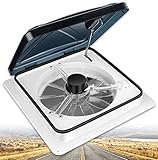 Starvent 6-Speed Reversible Starvent 6-Speed Reversible |
|
Check Latest Price |
 Kohree 14 Inch Brushless Fan Kohree 14 Inch Brushless Fan |
|
Check Latest Price |
Every entry above fits a standard 14×14 inch roof opening except the HENG’S, which uses a 14 1/2 inch rough cutout. That single dimension is the first thing to check against your van.
Why a Camper Van Roof Vent Is Worth the Roof Cut
Heat rises, and a van is a small sealed metal box. Water vapour from breathing, cooking and showering has nowhere to go, so it condenses on cold metal ribs and inside wall cavities. That moisture is what drives damp patches, mould and musty bedding, not the heat itself.
A roof vent fan addresses the vapour problem directly. Hot, wet air leaves at the highest point of the vehicle, and replacement air enters through a cracked window, a door gap or a second low vent. In practice that single change does more for sleep quality and interior smell than any other piece of hardware on a conversion.
Here is what a roof vent fan does not do. It is not air conditioning, and in a desert it will pull in more heat than it removes unless you leave a shaded opening at the opposite end. It also does not make a faulty cooking gas installation safe on its own. A roof fan is a ventilation tool, and pairing it with a working gas detector is a separate and non-negotiable safety step.
Owners on van life forums consistently describe the same pattern: one fan changes the air, but two fans with a planned path between them change how the van feels. The crossflow section further down explains where the second vent belongs.
1. MaxxAir FanMate Vent Cover – Best All-Weather Setup for a MaxxAir Roof
MAXXAIR FANMATE 00-955002 RV Fan and Vent Cover, Black
Clip-on rain cover for MaxxAir fans
EZClip no-tool mounting
Helps block rain
Pros
- Highest reviewed product in this roundup
- Clip-on fitting takes about 15 minutes on a roof with existing MaxxAir tabs
- Restricts less than 5% of airflow
- Smoke tint softens glare while letting in light
Cons
- Bug screen sold separately under part 955202
- Some clip holes arrive undrilled
- Instructions do not show which way the clips face
Be clear about what this is. The MaxxAir FanMate 00-955002 is not a fan. It is the moulded polyethylene rain cover that clips over an existing MaxxAir MaxxFan or MaxxFan Plus and turns a dry-weather-only roof vent into something you can leave running through a shower.
That distinction matters more than it sounds. Most of the fan options in this roundup can already run in rain if their lid stays open, and reviewers repeatedly single out the ability to leave a vent open in wet weather as the feature they would not give up. The FanMate is the simplest way to protect that feature on a MaxxAir roof without a permanent lid motor.
In our reading of 2637 reviews, the installation experience is the strongest part of the story. Owners on roofs with existing MaxxAir mounting tabs describe a genuine no-tool job that takes roughly a quarter of an hour, and the cover does not rattle or foul the fan once the clips are fully engaged.
The complaint that recurs is about the accessories rather than the cover itself. The bug screen is not included and has to be ordered separately as part 955202, which surprises a lot of first-time buyers who assume the package is complete. A handful of owners also report arriving with partially drilled clip holes that need a drill bit opened before the cover will seat.
Should you add this to your vent plan
If you are buying a MaxxAir Maxxfan Deluxe or Maxxfan Plus, this cover is the companion piece that lets the lid stay up when you are parked in the rain. It is the highest-reviewed product in this guide for a reason, and 2637 reviews is a large sample to judge a plastic cover by.
It is worth pairing with the Deluxe rather than the Plus if you already have a Plus, because the Maxxfan Plus has its own rain sensor and a powered lid, which makes an external cover more about long-term protection than about rain management.
Where it is the wrong buy
Skip it if your roof carries a non-MaxxAir vent. The EZClip system is designed around the moulded waterproof tabs on MaxxAir and MaxxFan Plus housings, and while hardware for adapting to other fan models is included, the fit on a foreign housing is not the clean no-tool experience the product is built around.
Also skip it if you want a bug screen. That part is a separate purchase, and a van with an open vent in a wooded campsite will need it.
2. MaxxAir Maxxfan Deluxe – The Best All-in-One Roof Vent Fan
MAXXAIR Maxxfan Deluxe Vent, Fan and Vent Cover All in One – Powerful 10-Speed Reversible Fan with Thermostat, Built-in Rain Cover, Remote Control, Intake & Exhaust Fan, Smoke (00-07500K)
12V, 60W, 10-speed reversible
Blower with 14 inch blades
Remote, thermostat and powered lid
Pros
- Vent
- fan and rain cover in one housing
- Quiet across roughly the lower 60% of the speed range
- Strong exhaust performance
- Remote plus thermostat auto mode
- Removable tool-free insect screen
Cons
- Noticeably loud above about speed 4 to 5
- No mounting template supplied
- Remote is infrared and needs line of sight
The Maxxfan Deluxe 00-07500K is the unit most van owners mean when they say the default roof vent fan. It combines the vent, the blower and a powered rain cover in a single housing, measures roughly 5.2 inches tall when closed, and runs on 12 volts at a listed 60 watts.
Everything in the box is meant to stay in the box. A 10-speed reversible controller, a remote, thermostat auto mode, onboard backup controls and a tool-free removable interior insect screen all come as standard, and the whole assembly drops into a standard 14×14 roof opening so swapping an existing vent is straightforward.
Reviewers describe the low end of the speed range as the reason this fan keeps its reputation. Across the lower 60% of the ten speeds it is quiet enough to run overnight above a bed, and in exhaust mode with a window cracked it cools a closed-up van faster than reviewers expected from a unit that draws 60 watts.
The honest downside is the top of the range. Owners are consistent about the jump in noise above roughly speed 4 or 5, and a fan that intrusive directly over a sleeping platform is a common complaint even from people who would recommend the unit again.
What you gain over a bare vent and a separate cover
The integrated powered lid is the practical win. A separate rain cover needs clipping on and off and can be left off entirely by a distracted owner, while a powered lid is opened and closed by the controller as part of normal operation. For someone who boondocks in unpredictable weather, that difference is worth the higher spec sheet.
Coverage is also part of the case. The unit carries a two-year limited warranty with a lifetime limited warranty on the lid, and replacement parts for a platform this widely sold are easier to source than for an unfamiliar brand.
What you give up for it
Two things. There is no mounting template in the box, so the roof cut-out is your measurement problem, and the remote is infrared only, which means it must be pointed at the fan to work. Neither is a deal breaker, but both should be understood before the roof is cut.
Water can also collect in the lip between the housing and the upper skirt. Reviewers who had no problems recommend sealing that joint with silicone as part of the install, which is a five-minute job that prevents a slow drip months later.
3. MaxxAir Maxxfan Plus – Best for Rain Sensor Automation
MAXXAIR Maxxfan Plus High Powered 10-Speed RV Intake and Exhaust Fan – Manual or Remote Control Electric Opening, Easy Ceiling Controls, Rain Sensor with Automatic Lid Closure, Smoke (00-04500K)
12V, 28W, 10-speed reversible
Automatic rain sensor lid
14 inch blades
Pros
- Rain sensor closes the lid without your involvement
- Runs as a ceiling fan with the lid shut
- Steady reversible airflow
- Interior ceiling controls within reach
- Two-year limited warranty
Cons
- FanMate rain cover is a separate purchase
- Smoke tint reduces daylight compared with a clear lid
- Remote and 10-speed setup adds complexity
The Maxxfan Plus 00-04500K is the Deluxe with one specific addition and one specific saving. The addition is the built-in rain sensor, which closes the lid automatically when it detects moisture. The saving is the rain cover, which is not included and is sold separately as the FanMate.
On paper the Plus is the more efficient of the two. It runs on 12 volts at a listed 28 watts against the Deluxe 60 watts, weighs 5.2 pounds, and still carries a 14 inch blade on a 10-speed reversible controller with interior ceiling controls.
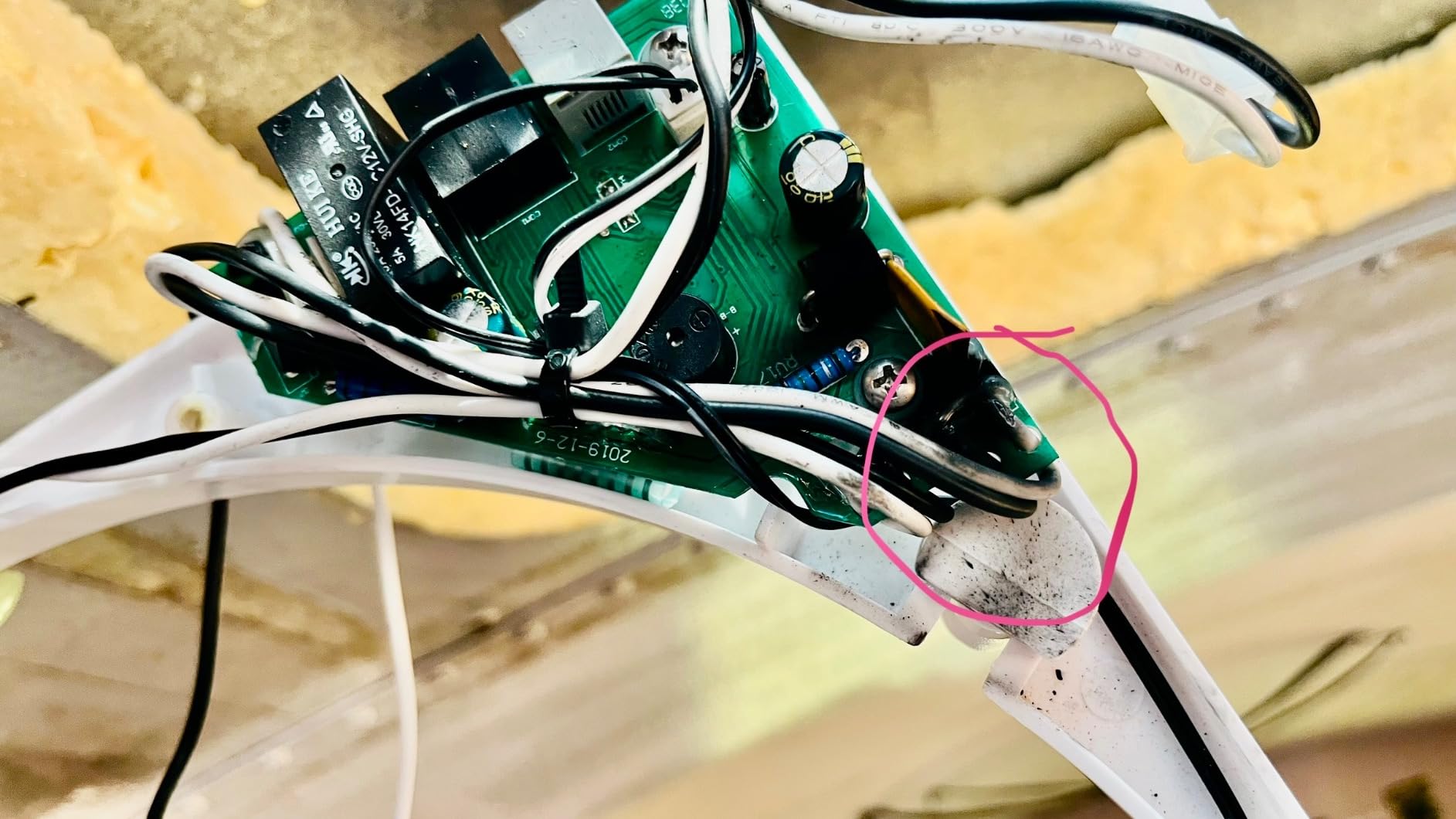
That 28 watt figure is the number to think about on a solar-only build. Running a 28 watt fan for eight hours works out to about 19 amp-hours, which is a very different day from a 60 watt fan at the same duration. On a van with limited panel area, that difference can decide between a fan and no fan.
The rain sensor is the feature owners single out most. Closing the lid without a human being present is exactly what a parked van needs, and it is the piece of automation that justifies the higher electrical draw over a simple manual-crank model.
Why pick the Plus over the Deluxe
Choose the Plus when the van is regularly parked in rain while you are inside, cooked, or asleep somewhere else. The sensor handles the weather without anyone remembering to pull a lever, and the ceiling-fan mode keeps air moving with the lid shut.
Choose it also if roof power is tight. At 28 watts it is the most efficient full-featured fan in this roundup, which matters when the same roof has to carry panels.
What you trade away
The complete rain-protection setup costs a second purchase. If your plan already includes the FanMate cover from the first pick in this guide, that is money you have budgeted twice, so compare the two costs before committing.
The smoke-tint lid also cuts daylight compared with a clear lid, and the remote plus ten-speed layout is more to learn than a manual crank. Neither is serious if you are comfortable with a remote, but the Plus is not the simple option.
4. RVLOVENT 14 Inch Manual 10-Speed – Best Airflow for the Money
RVLOVENT 12V RV Roof Fan Vent 14” 10 Speed Reversible Manual Lift (NO REMOTE)
12V, 18W, 14 inch blades,45 dB,Manual crank lid
Pros
- Owners rate airflow in the 1000 CFM class for this money
- Reversible intake and exhaust
- Quiet on the lower speeds
- Spare screen and spare 5A slow fuses included
- Drops into a standard 14x14 opening
Cons
- Louder than advertised in wind
- Interior garnish usually needs trimming
- Manual crank means no automatic rain closing
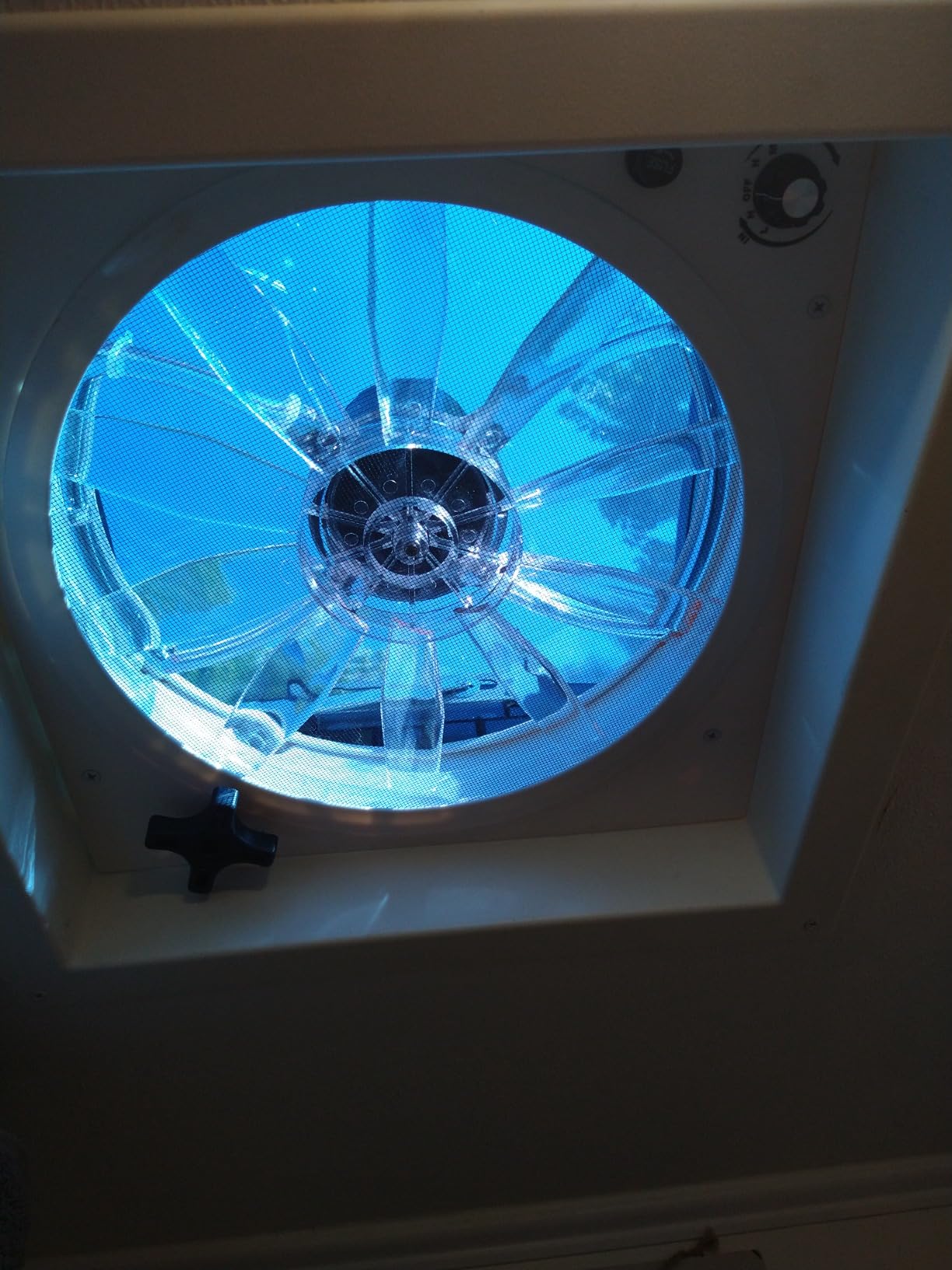
The RVLOVENT MANUAL-FSN-SMOKE is the value case in this category, and 1068 reviews at 4.6 stars is a strong endorsement for hardware at this level. It is a 12V reversible roof vent fan with a 14 inch blade, a manual crank lid, a 45 dB listed noise figure and an 18 watt draw.
It fits a standard 14×14 roof opening, which means it replaces an existing camper vent as easily as it fills a new cut-out. The UV-resistant polycarbonate cover comes in smoke or white, and the box includes a spare screen frame plus spare 5A slow-blow fuses.
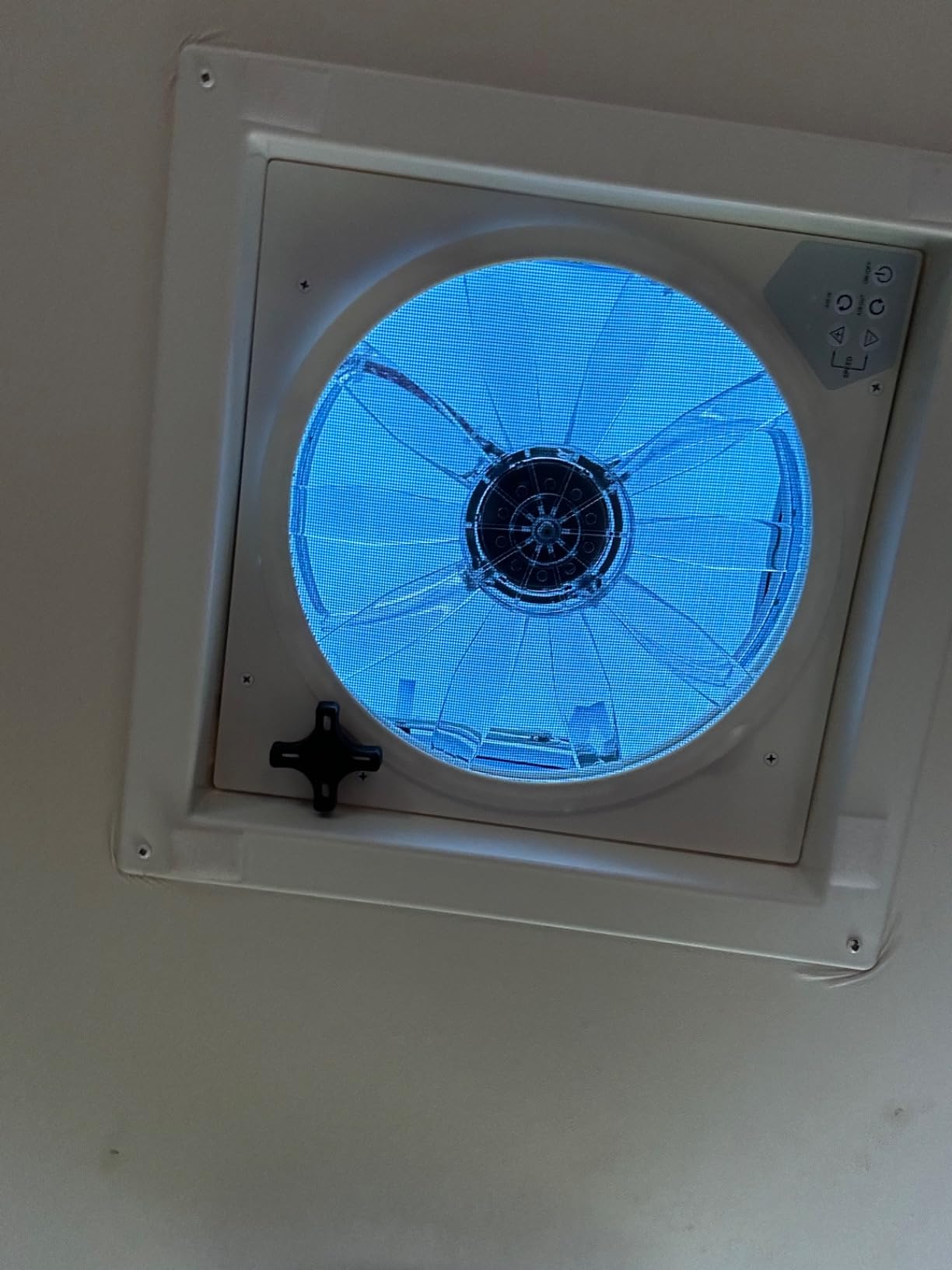
What buyers keep pointing at is the airflow-to-cost relationship. Owners describe roughly 1000 CFM class performance from a fan that costs a fraction of the premium models, and several say directly that it outperforms hardware they had already bought for more.
The low-speed noise is the other repeated positive. Compared with cheap factory vents, the quietness on the lower settings is the reason a number of owners rated it as a step up rather than a like-for-like swap.
Where this fan makes the most sense
This is the right pick for a builder who wants real extraction from a 12V fan without spending on a powered lid, a remote and a rain sensor. The manual crank is honest mechanical hardware, and the spare fuses in the box suggest a manufacturer that expects the fan to be serviced rather than discarded.
It also suits anyone replacing a failed factory vent on an existing camper roof, because the 14×14 fit is the standard and the install reduces to removing the old assembly and cleaning off the old sealant.
What you have to live with
Manual means manual. Nobody closes this lid for you in a downpour, so it is a poor choice for a van that sits parked in rain while you are inside, and it needs checking before every forecast.
Two install realities are worth planning around. The interior garnish box usually needs trimming to clear the ceiling, and owners replacing a factory vent report that scraping off old sealant consumes more of the job than the fan swap itself. Budget an afternoon, not an hour.
5. caqeg 14 Inch Vent and Fan Assembly – Best Budget Starter
14″ RV Roof Vent for Camper Trailer Universal White Lid Roof Vent with 12V RV Vent Fan 6″ Blades White lid Inner for Garnish Ring
Complete 14x14 vent with 12V fan,6 inch plastic blades,24W,Single speed
Pros
- Complete vent and fan in one low-cost package
- Two-wire hookup with garnish and screws
- Can run while driving
- in rain
- or as a ceiling fan
- Good fit in existing camper roofs
Cons
- Thin plastic that some owners report cracking during install
- Only suits roofs roughly 1-1/4 to 2-1/4 inches thick
- Lid material is thin and flexes if forced
- Single speed offers no airflow control
The caqeg AA1286111585 is a complete 14×14 roof vent with a 12V fan built in, a white lid, six inch plastic blades and a 24 watt draw. At 904 reviews and 4.4 stars it is one of the most reviewed budget assemblies on the market, and reviewers consistently treat it as a value replacement rather than a premium purchase.
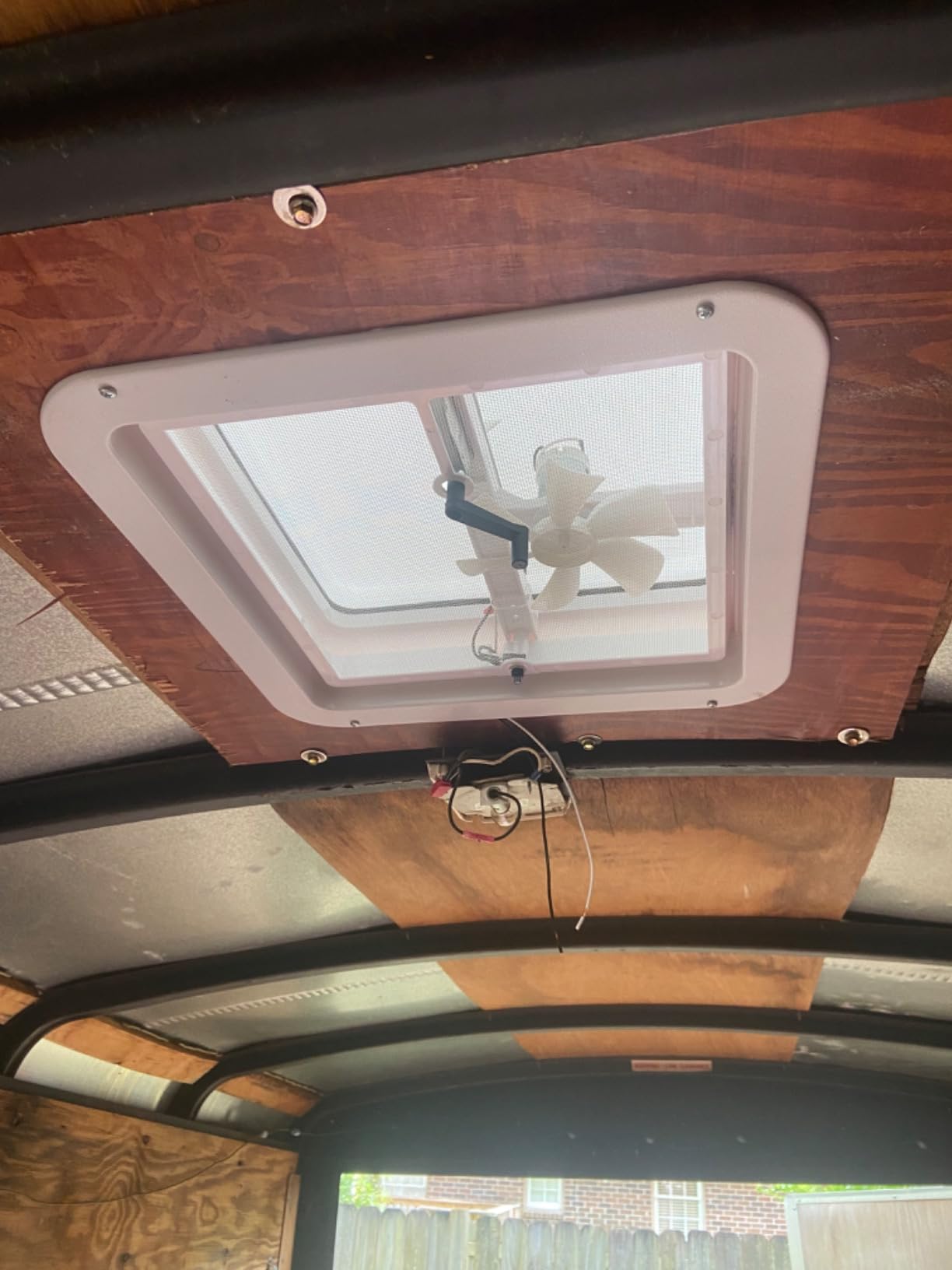
The two-wire connection is the easiest part of the install story in this roundup. The white interior garnish and screws come in the box, and the fan can run while driving, in rain, or as a ceiling fan with the lid closed.
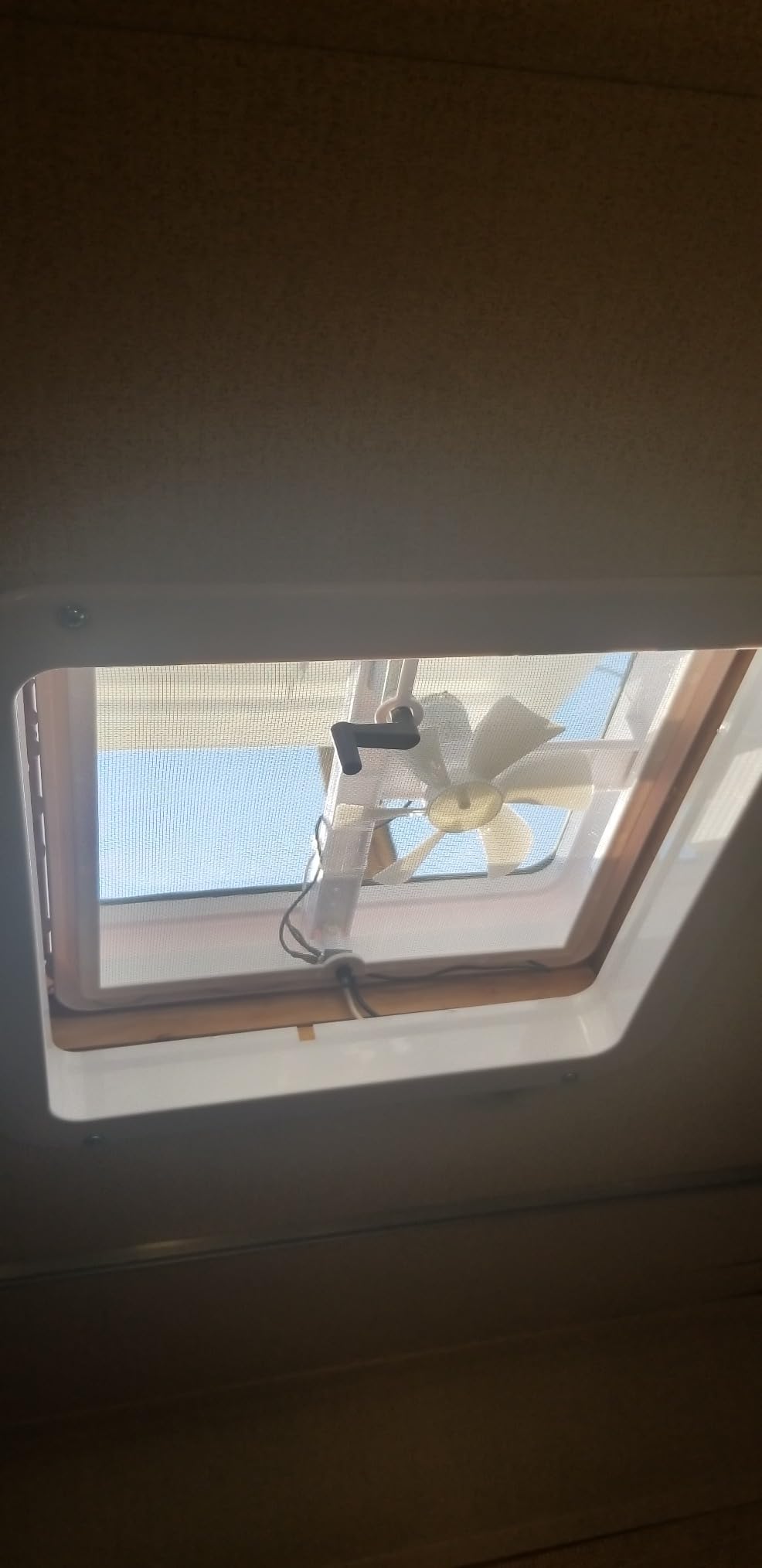
Where the caqeg earns its place is the second-hand or budget conversion. Owners replacing a failed factory vent report a clean finished look and a straightforward fit into an existing 14×14 hole, which makes it a sensible first vent on a build that will get a better one later.
Note the roof thickness limit before you plan around it. The unit suits roofs of roughly 1-1/4 to 2-1/4 inches, so a van with a deep structural rib or extra insulation above the skin may not accept it without modification.
Who should buy the budget assembly
Buy it if the priority is getting air moving at the lowest possible entry point, or if the van is a weekend rig that will not see heavy use. The single-speed motor is predictable and there is less to learn, which suits a first build.
It is also a reasonable second fan. A pair of budget assemblies gives you a genuine intake and exhaust path for crossflow, which owners on van life forums consistently rate as a bigger comfort gain than upgrading one fan.
What you give up for the lower cost
Handling. The plastic is thin enough that some owners report cracking it while fitting, and the lid material flexes if forced. Whoever does the install should support the frame and take the screws slowly.
You also give up airflow control entirely. A single-speed fan gives you the choice between on and off, which on a warm night means choosing between noise and a warm sleeping area rather than running it quietly on low.
6. HENG’S 14 Inch Wedge-Lid Vent Fan – Best for Thin and Awkward Roofs
HENG’S INDUSTRIES 14″ RV Roof Vent 12 Volt Powered Fan with WHITE Wedge Style Lid – 1” Garnish Ring | 71112A
12V, 4W, 3 blades,Single speed
Manual crank lid and screen
14 1/2 inch rough cutout
Pros
- Very low 4 watt draw
- Complete vent
- fan and lid package
- Integrated mesh insect screen
- 1 inch inner garnish ring included
Cons
- No mounting hardware included
- Metal flanges are sharp during install
- Modest airflow for a large space
- Not electric open so it cannot be left open in rain
The HENG’S 71112A is a 14 inch roof vent with a 12V powered fan, a white wedge-style lid and a 1 inch inner garnish ring. It uses a manual crank handle to open the lid, so there is no wiring for the cover, and the fan itself draws a listed 4 watts.
That 4 watt figure is the distinguishing spec. On a van with a small panel array or a house bank that has to cover lighting, water pump and charging, a fan that barely registers on the electrical budget is a genuinely useful design choice.
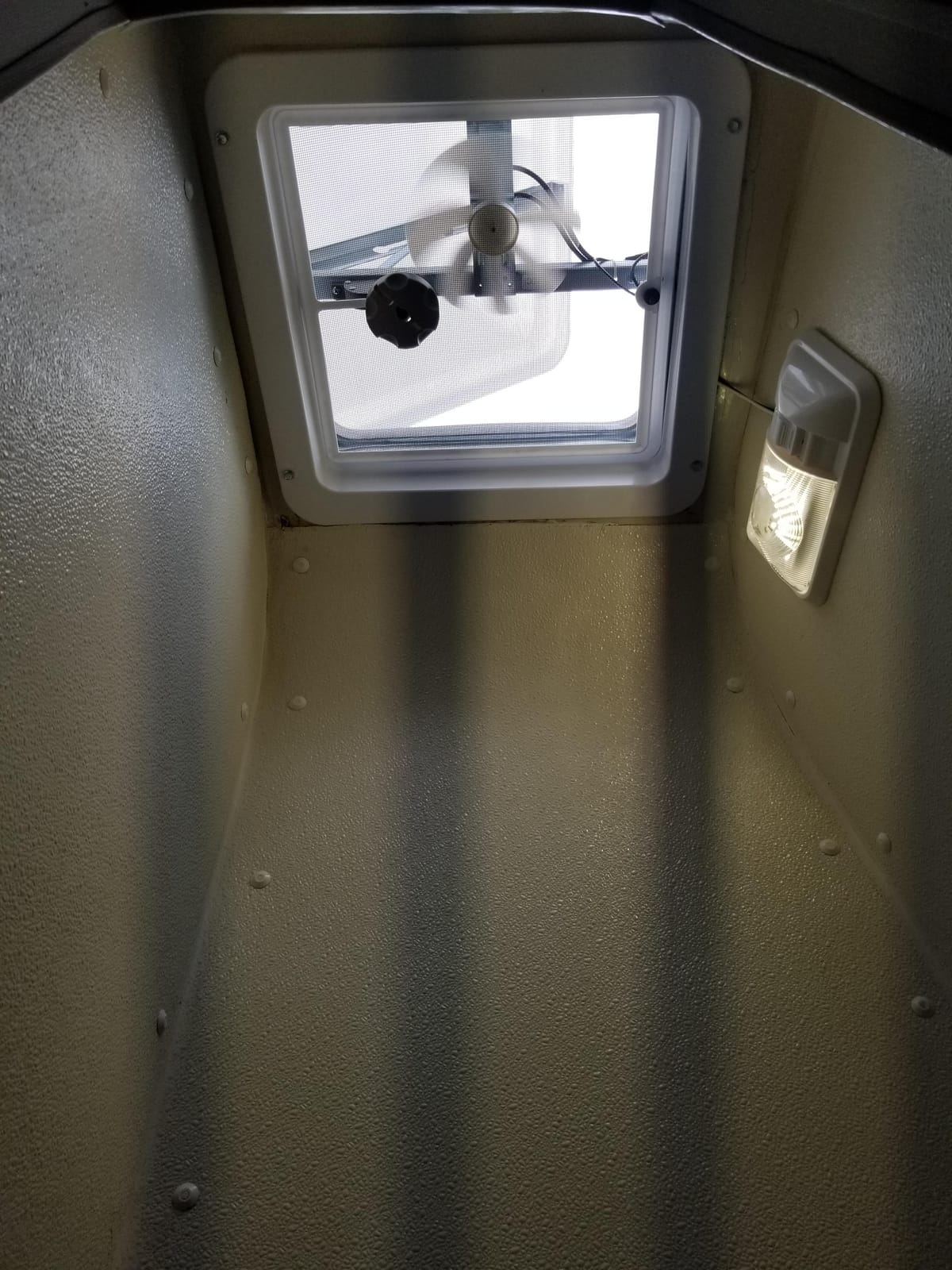
Builders with awkward roofs are the group this fits best. The rough cutout is 14 1/2 inches with a 16 1/2 inch exterior flange, which is a different requirement from the 14×14 standard, and the metal flanges add durability on a unit that otherwise feels inexpensive.
Reviewers also like the finished result. The white wedge lid and garnish ring give what several owners describe as a factory-like appearance, which matters on a van where the vent is visible from the ground.

Why this one rather than a bigger fan
Choose it when electrical headroom is the binding constraint, or when the roof is a candidate for a cut-out that a full-size assembly will not suit. The integrated mesh screen also removes one more item from the shopping list.
It is a sensible pairing with a roof air conditioner if you are running one. The 4 watt fan can run continuously for circulation while the cooling unit does the heavy lifting only when needed.
What to watch during install
No mounting hardware is included. You need to supply caulk or putty and screws, and the sharp metal flanges need gloves and careful handling at the cut-out stage. That is the single most repeated warning from owners.
The airflow is modest and the lid is manual, so it will not clear a large living space quickly and it cannot be left open in rain unattended. Treat it as a circulation fan rather than a primary extractor.
7. F36AR 14 Inch LED Brushless Fan – Best for Quiet Nights
RV Roof Vent Fan 14×14 with 4 Color LED Ambiance Light, Reversible Airflow, Ultra-Quiet 12V (24V Max) Vent Fan with Remote & Rain Sensor
40W with a brushless motor,674 CFM,25 dB,4 speeds
Pros
- Brushless motor rated for 5x the lifespan of brushed
- Very quiet on the lower settings
- Four-color LED lighting built in
- Four-speed reversible airflow with a rain sensor
- Roof thickness from 1.5 to 3.3 inches
Cons
- Rain sensor closes the lid but does not stop the fan
- Actual opening can be smaller than advertised
- Interior flange is a short 3 inch piece
The F36AR is a 14 inch roof vent fan built around a brushless motor, four reversible speeds, a 674 CFM airflow figure and a listed 25 dB noise level. It also carries built-in four-color LED ambience lighting in yellow, rose pink, blue and white, which is the feature that separates it from every other fan in this roundup.
The four speed settings draw 3, 10, 20 and 40 watts, so there is a genuine low-draw setting. The 3 watt mode works out to roughly 2 amp-hours across eight hours, which makes the low setting realistic on a modest solar setup.
Owners describe the brushless motor as inaudible on the lower settings against ordinary campground noise, and support has been responsive, including sending extended skirt inserts for thicker roofs. The three-year free parts replacement and lifetime repair support are stronger written terms than most rivals in this list offer.
The lid is adjustable to any angle up to about 50 degrees, and the bug screen twists out for cleaning from inside the van, which is a small detail that matters more than it sounds once insects are involved.
Who this fan suits
It fits roofs between 1.5 and 3.3 inches thick, which covers a wider range of van builds than most assemblies here, and it accepts both 14×14 inch and 400x400mm European openings. That makes it a reasonable choice on an imported van with a European aperture already cut.
The lighting is the draw for anyone whose van doubles as evening living space. Four ambient colors with a remote and local controls turn a functional vent into part of the interior finish.
What to check before you commit
The rain sensor closes the lid but does not cut power to the fan. That means the motor keeps running against a closed lid after a trigger, which owners mention often enough to be worth knowing before the fan sits above a bed.
Some buyers also report that the actual opening is smaller than the advertised 14×14, and the interior flange that comes in the box is a short 3 inch piece with a longer one sold separately. Measure your ceiling thickness and your existing opening before ordering.
8. Heavy Duty 14 Inch Voice Control Fan – Best for Voice-Controlled Setups
Heavy Duty 14″ RV Roof Vent Fan, Whisper-Quiet Voice Control, Colorful LED
25W brushless DC motor,4 speeds,12 pounds,Timed auto-off
Pros
- Brushless motor moves strong airflow quietly
- Voice control in addition to remote and buttons
- Four-color LED with red night-vision setting
- Timed auto-off from 1 to 8 hours
- Thicker housing reduces road rattle
Cons
- Heaviest option here at 12 pounds
- Voice control needs smart assistant pairing first
- Initial 14x14 swap means removing the old vent
The Heavy Duty 14 inch voice control fan is the thicker, heavier sibling of the F36AR. It runs a brushless DC motor on 25 watts, offers four speeds, a rain sensor that closes the lid automatically, and control by voice as well as the included remote and local buttons.
Its four-color LED system includes a red night-vision setting alongside warm white, amber and cool blue. The lid opens to any angle within 50 degrees, airflow is reversible for intake and exhaust, and a timer lets you set an automatic shutoff anywhere from 1 to 8 hours.
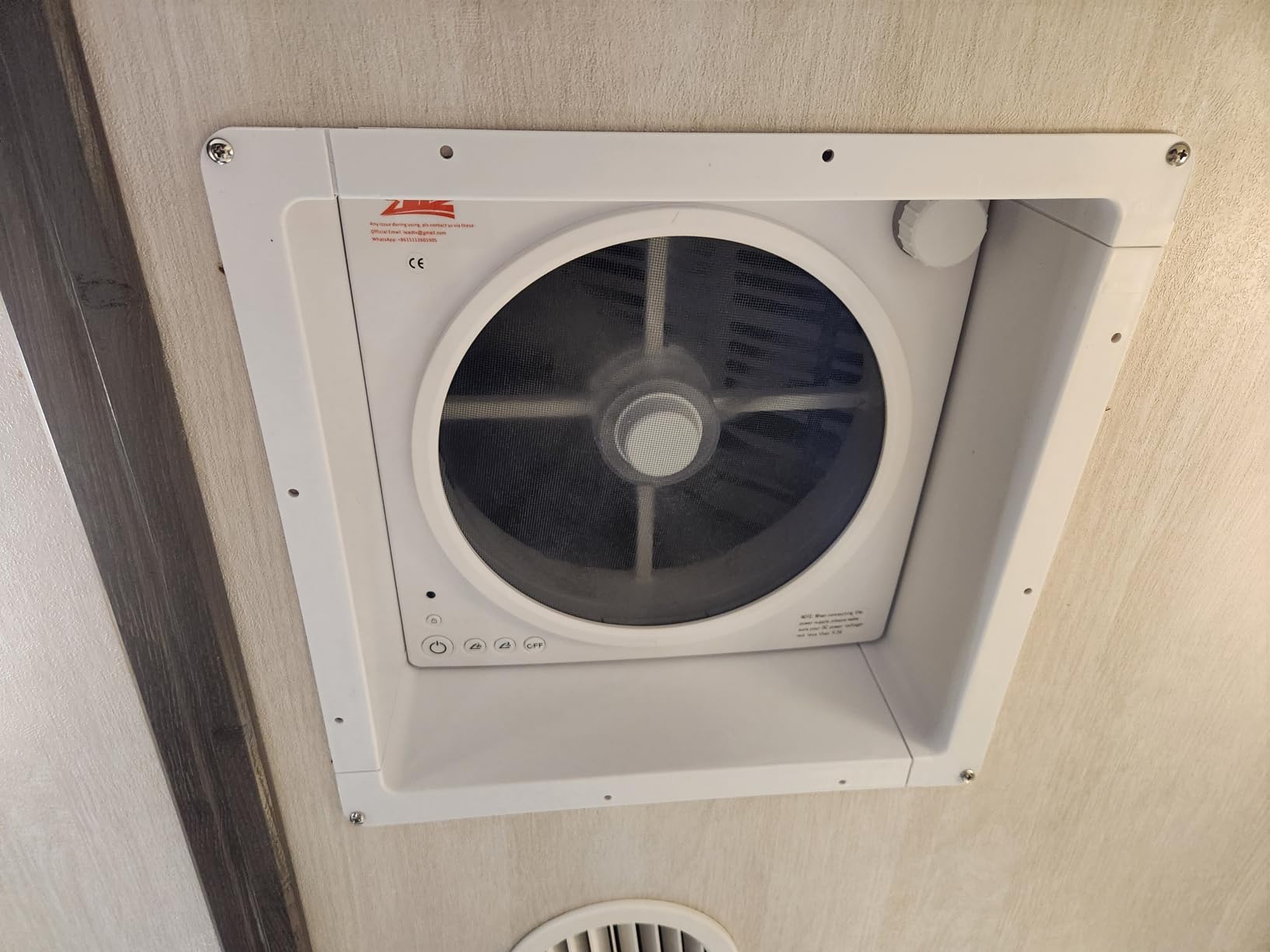
Buyers point to the construction as much as the features. The housing and lid are thicker than typical ABS or polycarbonate parts, which reviewers say reduces road rattle, and the brushless motor is the reason it stays quiet at higher speeds than its lighter sibling.
The timer is the sleeper-friendly feature. An automatic shutoff stops the drain question entirely for anyone who forgets a fan running overnight, and it costs nothing to set.
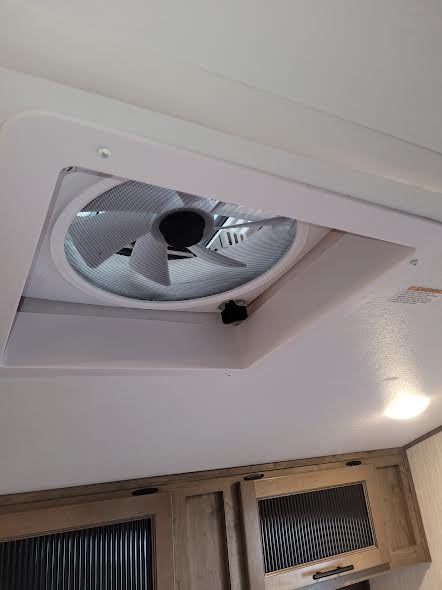
Where the voice control earns its place
If the van already has a smart assistant setup, controlling ventilation by voice from a bed is a real convenience rather than a gimmick. If it does not, the remote and local buttons handle everything and you simply never pair the voice function.
The four-speed ramp and the thicker shell make this the better choice of the two LED fans for a van driven on rough roads, where rattle is a real complaint on lighter housings.
What to plan around
At 12 pounds it is the heaviest item in this roundup, and that is felt when you are on the roof holding it in position while starting screws. Two people and a stable platform make this an easy install instead of a difficult one.
Voice control does nothing until it is paired with a smart assistant, so treat it as a bonus rather than a reason to buy. The two-year full warranty is solid but shorter than the three-year parts coverage on the F36AR.
9. Starvent 6-Speed Reversible – Best Reversible Speed Range
Starvent RV Roof Vent Fan 6-Speed-Reversible
22.2 Wh,6 reversible speeds,1100 CFM,17 blades
Pros
- Six reversible speeds for intake or exhaust
- Near-silent on the first two or three speeds
- Runs as a ceiling fan with the lid closed
- Screen removable from inside
- Roof thickness from 1.16 to 5.5 inches
Cons
- Push-button speed controls can stick
- Corner lid crank is awkward to turn
- Lid rattles when closed
- No third-party rain cover fits without modification
The Starvent Starfan Basic A021C is a 14×14 12V vent and fan with 17 five-inch plastic blades, six reversible speeds, a 1100 CFM airflow figure and a listed 59.5 dB noise level at full output. It runs at 1350 rpm on a 22.2 watt-hour rated motor.
The roof thickness range is the standout specification. At 1.16 to 5.5 inches it accepts a far deeper roof build than the 1-1/4 to 2-1/4 inch limits of cheaper assemblies, which matters on an insulated van where the roof cavity is substantial.
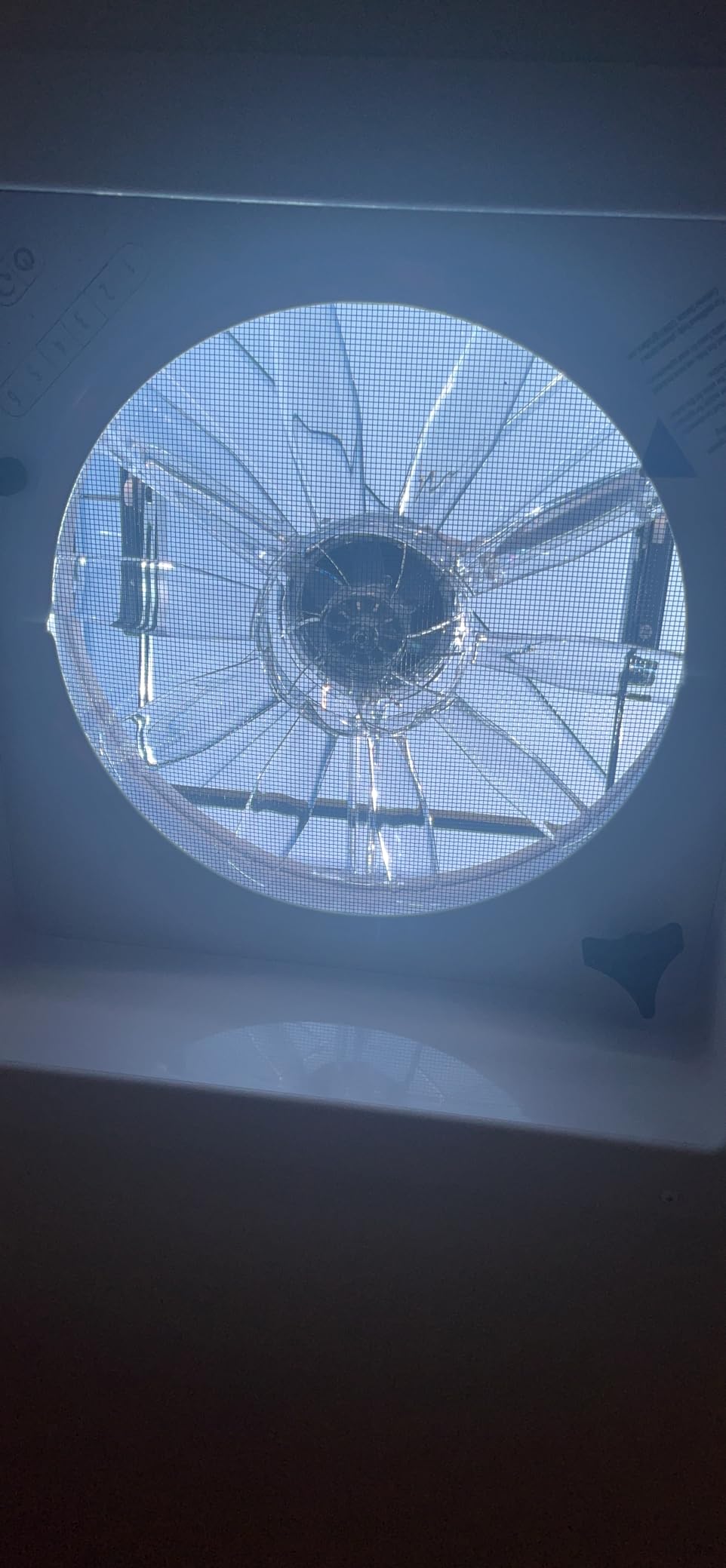
Owners frequently note that the low speeds are near-silent while still moving useful air, and that it performs above what the specification sheet suggests. The screen can be removed for cleaning from inside the van, and the smoke dome filters sunlight while the transparent blades still pass light.
It also runs as a ceiling fan with the lid closed, so it keeps working when the weather closes in, and the two-wire installation comes with interior trim and screws in the box.
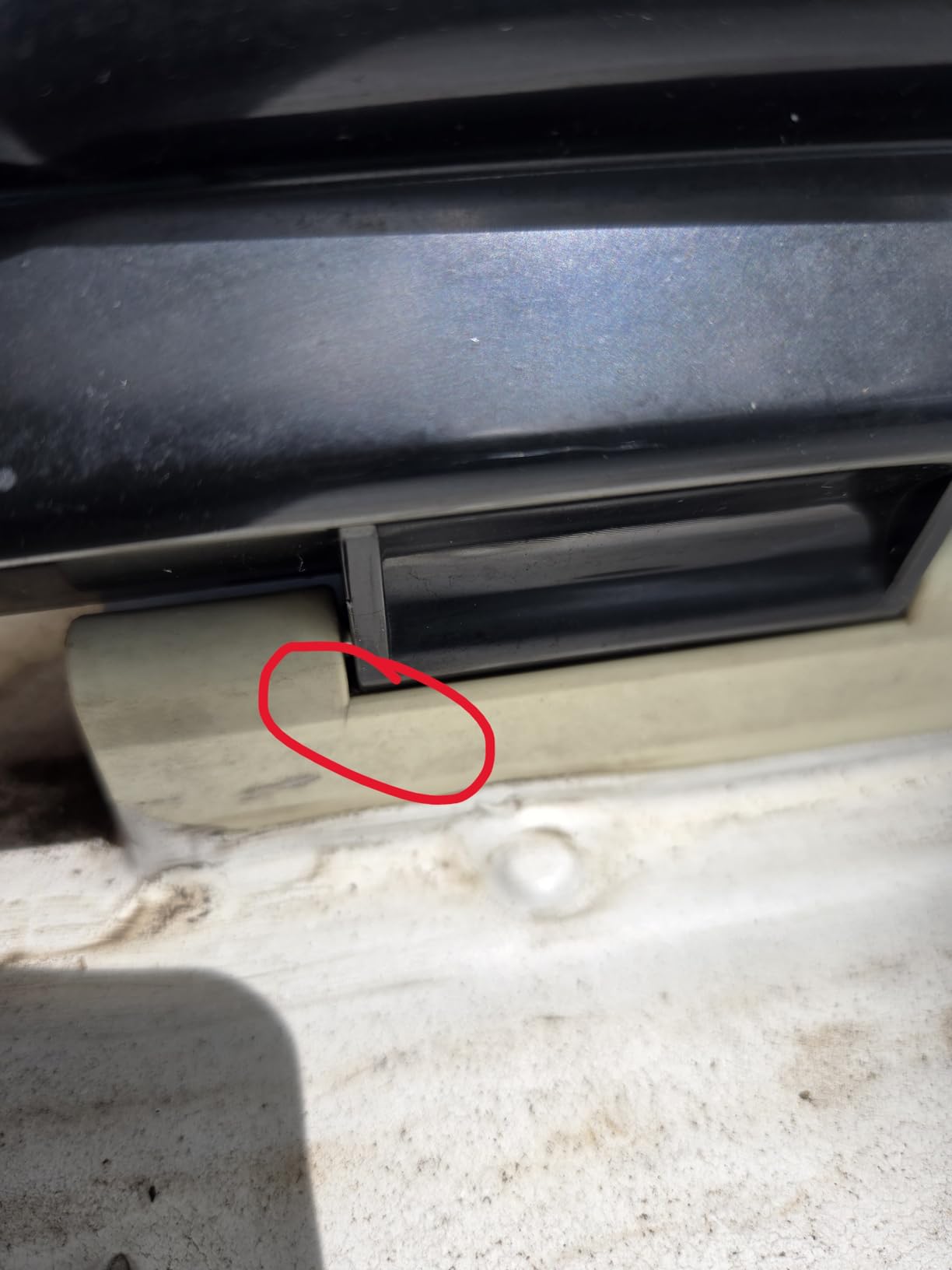
When the six-speed range helps
Six settings spread from near-silent to genuinely powerful, and the reversible blade direction lets you set one fan as extract and the other as intake. That flexibility is what makes a pair of these a workable crossflow setup on a single electrical budget.
Pick it if your roof is thick or heavily insulated, where thinner assemblies will not seat properly, and pick it if you want one fan that covers a quiet sleeping setting and a serious daytime extraction setting.
What the review data flags
The controls are the weak point. Owners report push-button speed controls sticking or misbehaving, and a speed sequence that cannot be interrupted, so a mis-pressed button delays the off command until the ramp finishes.
The lid crank sits in a corner where it is awkward to turn, the closed lid rattles noticeably, and the screen mesh can lift into the blades if it is not reseated carefully. No third-party vent cover fits without modifying the brackets, so rain protection has to come from a different solution.
10. Kohree 14 Inch Brushless – Best for Temperature-Triggered Automation
Kohree 14″ RV Vent Fan, 12V for Camper Vent, Green
25W brushless DC motor,934 CFM,10 speeds,Temperature auto mode
Pros
- Built-in temperature sensor triggers the fan near 78.8F
- Motorized lid with adjustable opening height
- Rain sensor closes the lid automatically
- Ten speeds with a brushless motor at 934 CFM
- Quiet enough to replace louder Dometic units
Cons
- Confirmation beep on every setting change
- Lid can bounce in strong wind
- Lid actuator is a single metal bar
- Heavier at 11 pounds
The Kohree KR5312 is a 14 inch flush-mount vent fan with a brushless DC motor, 934 CFM of airflow, ten adjustable speeds and a 25 watt draw at 50 dB. It ships with screws and extra sealing tape, and it fits standard 14×14 roof openings.
The feature no other fan in this roundup combines is the built-in temperature sensor. It switches the fan on above roughly 78.8F and off below it, which means the van begins ventilating on its own once the interior crosses a threshold, without a phone, a schedule or a person.
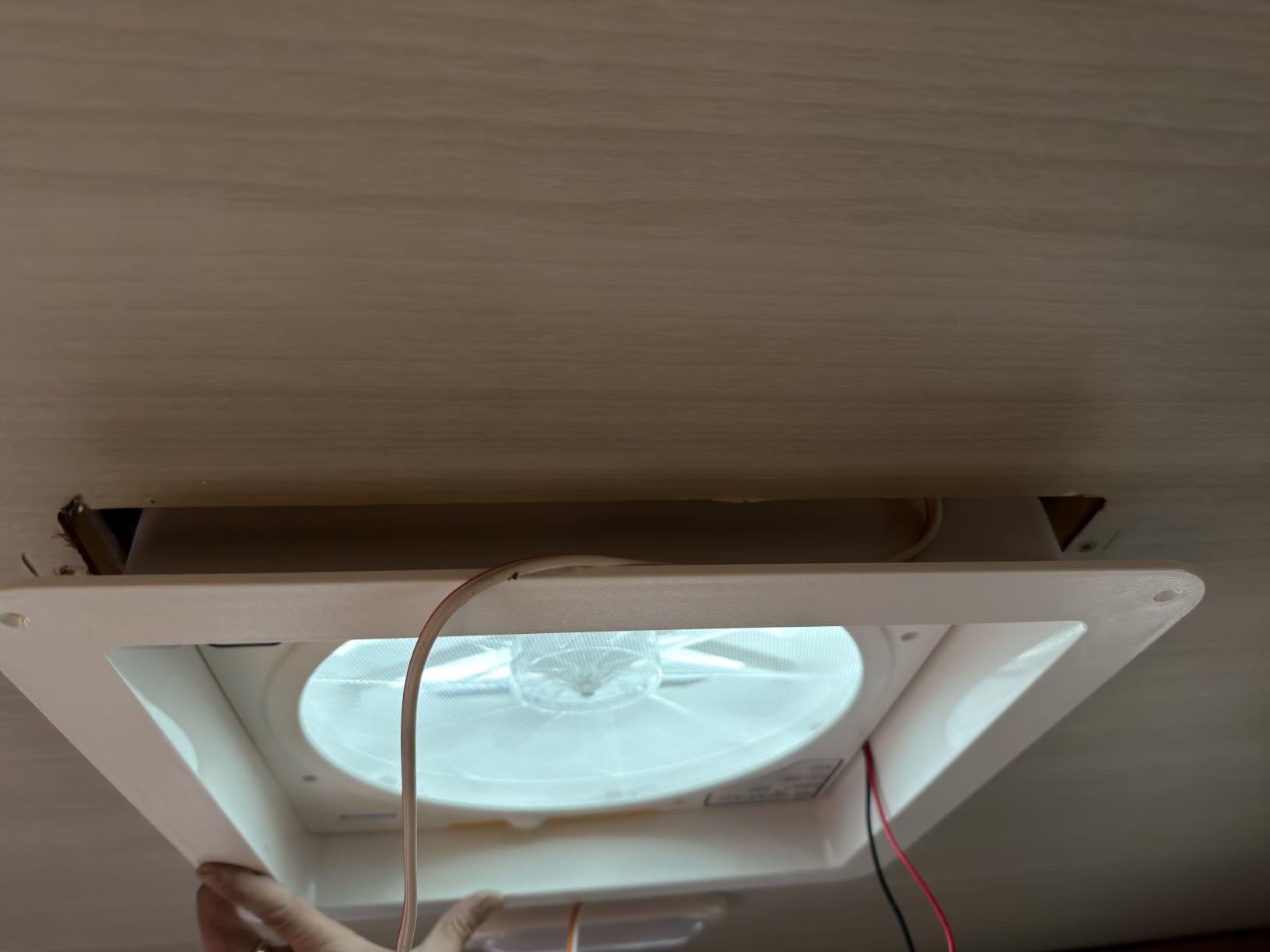
Owners like the motorized lid with adjustable opening height, the rain sensor that closes it at the first sign of moisture, and the LCD remote that shows direction and speed at a glance. Several report the motor is quieter than the louder Dometic units they replaced.
Reversible intake and exhaust airflow is standard, and the removable mosquito screen is a sensible inclusion for a van with an open aperture in summer.
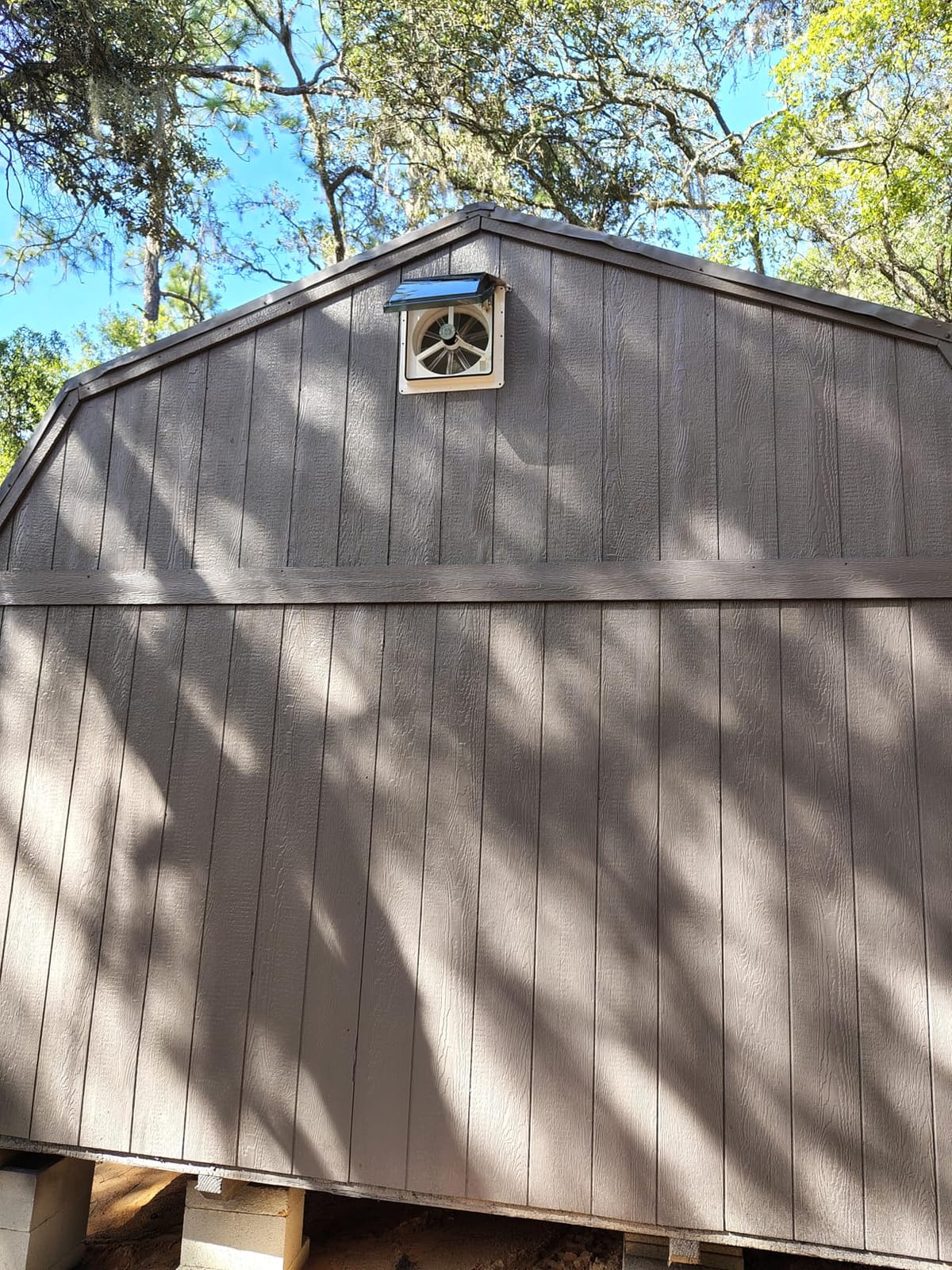
Why the auto temperature mode matters
A fixed threshold is genuinely useful in a parked van. Leave the heater or a battery bank alone overnight, let the sensor start the fan when the interior gets hot, and the condensation problem gets handled without a thermostat, an app or a schedule to maintain.
It also pairs well with a roof air conditioner, where the fan handles circulation around the clock and the cooling hardware runs only when the temperature sensor calls for it.
What to know before it goes on the roof
The confirmation beep on every setting change is the most reported irritation, and it wakes a sleeping partner. If the vent sits over a bed, check that before you commit.
Wind is a real consideration. Owners report the lid bouncing or vibrating in strong gusts, and the manufacturer advises closing it in those conditions, which means the motorized lid is not a set-and-forget feature in exposed locations. The lid actuator is a single metal bar fastened into plastic, and at 11 pounds this is a heavy unit to hold in position on the roof.
Why the MaxxAir Fans Command More
The most common question in van communities is why MaxxAir hardware is treated as the default when cheaper fans move comparable air. Five things explain the gap, and none of them is airflow alone.
Brushless motors. The brushless units in this roundup are rated for roughly five times the lifespan of brushed equivalents, which is the real technical reason for a higher spec sheet.
Rain handling as standard. A powered lid that closes on a sensor, or a clip-on cover that blocks water for under 5% of airflow loss, is what separates a fan you can leave running from one you cannot.
Quietness for the air moved. Owners judge fans on decibels per CFM rather than raw output. The MaxxAir units are repeatedly described as quiet across the lower part of their range, which is where a fan actually runs overnight.
Warranty and parts. Written cover of two to three years with replacement parts still available years later is worth real money on a vehicle you may own for a decade.
Installation history. A widely installed platform is easier to research before you cut a hole, and easier to find advice for afterwards.
None of that makes the cheaper fans wrong. It explains why the same question comes up every time someone builds a van.
Will It Fit Your Van? Roof Openings and Clearance
Fitment is the step that turns a good purchase into a return. Measure three things before you order anything: the roof thickness, the available flat area between structural ribs, and your garage or car park height limit.
Most vans in this class use a 14×14 inch opening, and the majority of the fans above fit that directly. The HENG’S is the exception with a 14 1/2 inch rough cutout, and the caqeg has a 1-1/4 to 2-1/4 inch roof thickness limit that will not suit a deeply insulated build.
Where fits get difficult is the ribbed or D-riveted roof. Owners on van build forums repeatedly report high-roof vans where the support bars sit too close together to accept a clean 14×14 hole without weakening a structural member. If your roof has ribs closer than 16 inches apart, take a template and confirm the aperture in person before cutting.
Closed-lid height is the second constraint and the one almost nobody ranks. The Maxxfan Deluxe sits at roughly 5.2 inches, the heavier LED and Starvent assemblies run closer to 7 to 8.3 inches, and the Kohree is around 9.5 inches. That spread decides whether the vent is invisible under a car park or obvious in a mirror.
Solar panels take the third bite. A 14×14 vent plus its flange needs a real patch of roof, and on a van with a full panel array the vent is usually placed forward of the panels over the galley rather than behind them over the bed, so the panels can still catch full sun without shading.
Two-Fan Crossflow: Getting a Real Airflow Path
One fan with a cracked window works. Two fans with a planned path between them work much better, and owners across several large van communities describe the second vent as the biggest single comfort change on a finished build.
Crossflow is simple physics. Set one fan to extract high in the van and the other to intake low near the floor, and air is pulled in a long loop across the whole living space instead of short-circuiting straight out of the same hole it came in.
The layout that works most often puts the extract vent over the bed or high in the roof near the rear, and the intake vent forward and low near the galley. Both are reversible, so you can flip the direction for winter, when you want to push warm air down rather than pull it out.
Watch the solar conflict. Two 14×14 vents plus flanges use a meaningful share of a high-roof van, and running a crossflow pair with a full panel array means deciding deliberately which gets roof space. A powered intake paired with a manual-crank extract is a common way to get the airflow path without doubling the electrical draw.
What a Roof Vent Fan Does Not Solve
It is not air conditioning. In a hot dry climate, exhausting roof air while drawing in daytime heat from a low opening can raise the interior temperature rather than lower it. The correct pattern is shade the intake and run the fan at a low speed, or run it after sunset when the outside air is cooler than the inside.
It does not make a failed gas installation safe. A roof fan moves air, and moving air over a leaking fitting does not remove the leak. A working gas detector remains the control that matters.
And it does not fix an uninsulated van. Ventilation moves the moisture that insulation would have trapped, but heat still comes through the metal. Owners who install a fan before insulating often find themselves replacing a vent position later to make room for thicker roof build-up.
There is also a cheaper alternative worth naming honestly. A 12V box fan or an evaporative cooler can move a surprising amount of air for a fraction of the cost, and several owners argue it is the smarter first purchase for a van used only in mild weather. The roof vent earns its place when you want the air removed rather than moved.
How to Choose a Camper Van Roof Vent Fan
Start with the roof opening, not the fan. Measure the hole you have or the flat area you have to cut. A 14×14 inch aperture is the standard on almost every high-roof van, and anything that does not fit it is a specialist part.
Check the closed height against your clearance. If the van sleeps in a car park with a low ceiling, or passes under a gate you use daily, the difference between a 5 inch and a 9.5 inch lid decides the purchase.
Decide exhaust-only or reversible. Reversible units pull in fresh air as well as push it out, which is what makes a two-fan crossflow setup possible. Exhaust-only units are simpler and often cheaper.
Budget the power draw honestly. The wattage figures range from 4W to 60W across this roundup. A 40W fan running eight hours is roughly 27 amp-hours; a 3W fan at the same setting is about 2 amp-hours. That is the difference between a fan your solar can support and one it cannot.
Judge noise per CFM, not noise in isolation. A fan quoted at 50 dB moving 934 CFM is a different proposition from one quoted at 59.5 dB moving 1100 CFM. The lower speeds are what you run at night.
Decide who closes the lid in rain. A rain sensor or a powered cover means nobody has to think about it. A manual crank means checking before every storm, which is fine if you are always there and a problem if you are not.
Match the roof thickness. Assemblies here accept anywhere from 1.16 inches to 5.5 inches. Measure the total build-up including insulation, not just the metal skin.
Look at the motor type. Brushless motors last longer and run quieter, and that is the strongest technical argument for a higher spec sheet.
Plan the interior flange. A short 3 inch flange may not reach a thick ceiling, and a garnish box that needs trimming is a common surprise. Check what is included before the roof is opened.
Count the roof real estate first. Decide the vent position before the panel layout, or accept that the vent and the panels are competing for the same 16 inches of roof.
Plan for two, buy one. Owners widely report that a second vent changes more than a better single fan. Choose a reversible model now so the second one can be added later without replacing the first.
What to Expect During Installation
Cutting a hole in a van roof is a one-way decision, so the sequence matters. Measure twice, mark the centre of the aperture, and check underneath for wiring, roof lining and any structural member before the jigsaw touches metal.
Sealing is where most water problems start. Clean every trace of old sealant off the flange, bed the new unit on proper roof sealant rather than a bead of general caulk, and silicone the joint between the housing and the upper skirt on units that have one. Reviewers who skipped this step are the ones who later reported a slow drip.
Wiring is straightforward 12V DC. Run the supply through an appropriately sized inline fuse close to the battery, keep the run away from the alternator cable to avoid noise on the fan, and use the spare fuses supplied with the fan as a guide to the rating the manufacturer expects.
Plan the headliner before the cut-out, not after. On a van with factory trim, removing the headliner panel is often longer than the vent swap itself, and the interior garnish ring will need trimming on some models. Removing the old vent and scraping off decades of sealant is likewise most of a replacement job.
Finally, decide where the panels go before you seal anything. Once a 14×14 flange is bonded down, moving it later means starting the sealant job again.
If you are also upgrading other cabin hardware while the van is apart, our picks for the best soundbars for an RV or camper TV cover the same install-over planning, and our guides to the best gifts for opera fans and the best gifts for guitar players cover downtime between longer trips.
Frequently Asked Questions
What is the best roof vent fan for a van?
The MaxxAir Maxxfan Deluxe is the most complete roof vent fan for a van, combining the vent, a 10-speed reversible 14 inch blower and a powered rain cover in one 12V housing that fits a standard 14×14 opening. If you want automatic rain protection, the Maxxfan Plus adds a rain sensor and runs at a lower 28 watt draw.
What is the best fan for a camper van?
For a van specifically, airflow per watt and roof clearance matter more than raw output. The MaxxAir Maxxfan Plus at 28 watts and the HENG’S 14 inch wedge-lid fan at 4 watts are the most efficient options here, while the Maxxfan Deluxe is the strongest all-in-one package for a van with a standard 14×14 roof opening.
What are the best roof vent fans for RVs and campers?
For larger RVs and campers, airflow figure dominates, and the Kohree at 934 CFM and the Starvent at 1100 CFM move the most air in this roundup. The MaxxAir Maxxfan Deluxe remains the strongest all-round choice with 10 speeds, a thermostat and a powered rain cover, and the F36AR and Heavy Duty 14 inch brushless fans suit those who want quiet operation and built-in lighting.
What is the best 12v fan for a van?
The MaxxAir Maxxfan Plus is the strongest 12V fan here on efficiency, drawing a listed 28 watts while offering 10 reversible speeds, a rain sensor and ceiling fan mode. The HENG’S 14 inch wedge-lid fan draws only 4 watts if you need something that barely registers on a small solar budget, and the Kohree adds automatic temperature-triggered operation at 934 CFM.
What are some good alternatives to Maxxair fans for van roofs?
The strongest alternatives here are the RVLOVENT 14 inch manual model for airflow value, the Kohree 14 inch brushless fan for temperature auto mode, the Starvent 6-speed reversible for a deep roof build, and the F36AR or Heavy Duty 14 inch brushless fans for quiet brushless running with LED lighting. All of them fit a standard 14×14 inch roof opening.
Do you need two roof vents in a van?
One fan with a window cracked makes a real difference, but owners widely report that a second reversible vent changes more than upgrading a single fan. Set one to extract high in the van and the other to intake low near the galley so air crosses the whole living space. Both vents have to be reversible for that layout to work.
Can a roof vent fan replace air conditioning?
No. A roof vent fan moves air, it does not cool it, and in a hot dry climate it can raise the interior temperature if the intake air is warmer than the air inside. Run it at low speed with a shaded opening, or run it after sunset when the outside air is cooler. For genuine cooling in heat you still need a roof air conditioner.
Will a roof vent fan drain my van battery?
It depends entirely on the setting. The HENG’S 14 inch fan draws a listed 4 watts, the F36AR has a 3 watt low setting, the Maxxfan Plus draws 28 watts and the Maxxfan Deluxe 60 watts. A 40 watt fan running eight hours uses roughly 27 amp-hours, so sizing solar or alternator charging around the setting you actually run matters more than the headline wattage.
The Best Camper Van Roof Vent Fans in 2026
Our editor’s choice is the MaxxAir FanMate vent cover, the highest-rated and most-reviewed product in this roundup at 4.6 stars across 2637 reviews, because it is the piece that decides whether a MaxxAir roof can run in rain at all. Pair it with the MaxxAir Maxxfan Deluxe for the strongest complete package, or add the Maxxfan Plus if you want a rain sensor and a lower 28 watt draw.
For value, the RVLOVENT 14 inch manual model delivers roughly 1000 CFM class airflow with no powered lid to pay for. For quiet nights, the brushless F36AR and Heavy Duty 14 inch fans are the only options here with LED lighting and multi-year parts coverage, and the Kohree is the one with automatic temperature-triggered operation.
Before any of them goes on your roof, measure the opening and the closed height, and decide which patch of roof belongs to the vent rather than the solar panels. That single decision outlasts the model you choose.
This roundup was reviewed and updated in 2026. Product specifications, ratings and review counts are taken from the manufacturer listings and owner reviews published at the time of writing.