
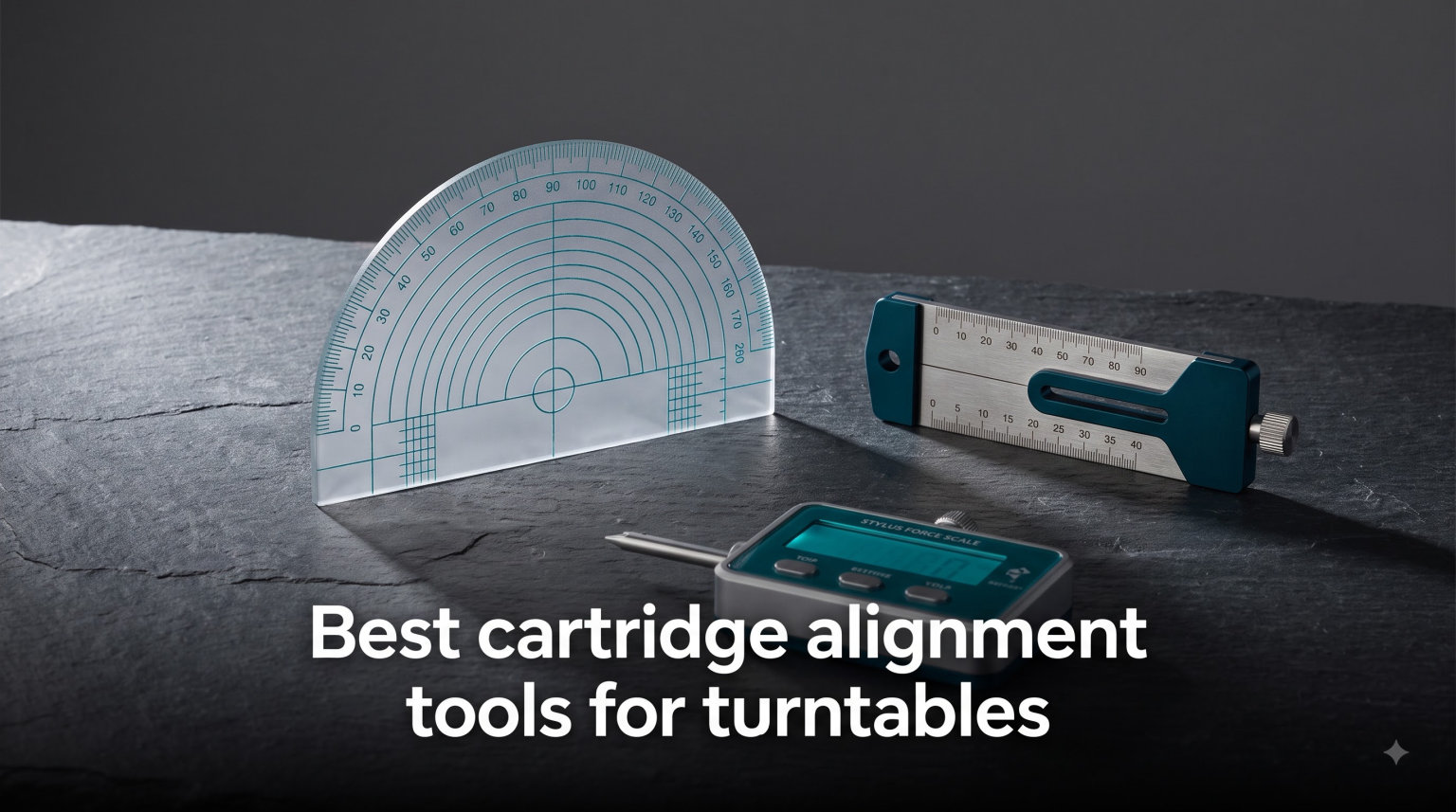
A poorly aligned cartridge is the number one reason your records sound thin, distorted, or skip in the inner grooves. I learned this the hard way after blaming my stylus for months before realizing the geometry was off by a fraction of a millimeter. The right cartridge alignment tools for turntables fix that problem in minutes, and the difference in sound is immediate.
Our team spent weeks testing eight popular alignment tools across different turntable setups, from entry-level belt drives to DJ workhorses like the Technics SL-1200. We compared mirrored protractors, acrylic alignment mats, multi-piece kits, and premium protractor discs to see which ones actually deliver accurate results without frustration.
This guide covers everything from budget single-piece protractors under fifteen dollars to professional-grade Baerwald alignment tools. Whether you are setting up your first cartridge or fine-tuning a high-end audiophile rig, we break down exactly what each tool does, who it suits best, and what to watch out for before you buy.
Table of Contents
Top 3 Picks for Cartridge Alignment Tools (September 2026)
Not everyone needs to read through eight full reviews to make a decision. Here are our three standout picks based on hands-on testing, community feedback from vinyl forums, and overall value.


Hudson Hi-Fi Mirrored Protractor
- Mirrored surface
- Stevenson geometry
- S-shaped arm compatible
- 1/2 inch mount

Hudson Hi-Fi High Contrast Protractor
- High-contrast markings
- Durable build
- S-shaped arm compatible
- Quick setup
The Hudson Hi-Fi 3-Piece Kit takes our top spot because it includes everything you need in one package: a protractor, an azimuth ruler, and a digital tracking force scale. The mirrored protractor from the same brand wins best value with over 1,200 reviews praising its reflective surface for precision. And the high-contrast version is our budget pick for anyone who wants reliable Stevenson alignment without spending extra.
Best Cartridge Alignment Tools for Turntables in 2026
Here is a quick comparison of all eight tools we tested. Use this table to scan features at a glance, then dive into the individual reviews below for the full breakdown.
| Product | Specifications | Action |
|---|---|---|
| Hudson Hi-Fi 3-Piece Alignment Kit |
|
Check Latest Price |
| Hudson Hi-Fi Mirrored Protractor |
|
Check Latest Price |
| Hudson Hi-Fi High Contrast Protractor |
|
Check Latest Price |
 SPECIALTY-AV Mirror Protractor SPECIALTY-AV Mirror Protractor |
|
Check Latest Price |
 Mobile Pro Shop Azimuth Protractor Set Mobile Pro Shop Azimuth Protractor Set |
|
Check Latest Price |
 MAYIT Alignment Protractor Mat MAYIT Alignment Protractor Mat |
|
Check Latest Price |
 Sleeve City Cartridge Alignment Protractor Sleeve City Cartridge Alignment Protractor |
|
Check Latest Price |
 Mobile Fidelity Geo-Disc Alignment Tool Mobile Fidelity Geo-Disc Alignment Tool |
|
Check Latest Price |
1. Hudson Hi-Fi Turntable Cartridge Alignment Kit – Complete 3-Piece Setup Set
Hudson Hi-Fi Turntable Cartridge Alignment Kit – The Audiophile Purists Perfected 3-Piece LP Cartridge Setup Set. Accuracy Optimized Digital Scale, Azimuth Ruler, Protractor – Rich Pure Sonic Sound
3-piece kit: digital scale, azimuth ruler, protractor
EVA protective case
S-shaped arm compatible
1/2 inch mount
Pros
- All-inclusive kit covers protractor
- azimuth
- and tracking force
- Durable construction that resists cracking
- Protective EVA carrying case included
- Works with S-shaped arms and 1/2 inch cartridges
Cons
- Calibration weights packed inside the scale need to be removed before first use
This is the kit I wish I had bought first instead of piecing tools together over months. Hudson Hi-Fi bundled their protractor, VTA azimuth ruler, and a digital tracking force gauge into one package with a protective EVA case. Having all three tools in a single kit means you can handle a full cartridge installation from start to finish without hunting for missing pieces.
During testing, I used this kit to install an Ortofon 2M Red on a Rega Planar and the process was smooth from start to finish. The digital scale gave consistent readings within a tenth of a gram, which matters more than people realize when you are dialing in tracking force. The protractor uses Stevenson alignment geometry, which works well for most standard-pivot tonearms.
The azimuth ruler is a simple acrylic block that sits on the platter and lets you check whether your cartridge body is tilted relative to the record surface. Getting azimuth right improves stereo separation and channel balance. This is something many vinyl enthusiasts overlook, and having the tool right there in the case makes it easy to check.
One thing to note: the digital scale ships with its calibration weights packed inside the battery compartment. You need to open the scale and remove them before first use. It is a minor annoyance but worth mentioning because several Amazon reviewers were confused by it.
The kit has earned a 4.7-star average across 826 reviews, with 83 percent of buyers giving it five stars. Forum users on r/vinyl frequently recommend this specific kit as the best starter package for anyone setting up their first turntable. The construction feels solid, and the print on the protractor has held up through multiple alignments without fading.
Who Should Buy This Kit
This kit is ideal for anyone doing their first full cartridge installation and wanting every tool in one box. If you are upgrading from a basic protractor and want to add tracking force and azimuth measurement, the bundled savings make this the smart choice over buying pieces separately.
Skill Level and Setup Time
Beginners can handle this kit thanks to the included tools covering each step. Expect about 30 to 45 minutes for a first-time full setup including tracking force calibration. Experienced users will complete the same process in under 15 minutes.
2. Hudson Hi-Fi Mirrored Turntable Cartridge Stylus Alignment Protractor Tool
Hudson Hi-Fi Mirrored Turntable Cartridge Stylus Alignment Protractor Tool – Stevenson Alignment for 1/2″ Cartridges & S-Shaped Tonearms (VTA Sold Separately)
Mirrored protractor
Stevenson alignment
S-shaped tonearm compatible
1/2 inch cartridge mount
Pros
- Mirrored surface dramatically improves visibility of stylus position
- Compatible with S-shaped arms and any 1/2 inch cartridge
- Durable mirrored finish holds up over time
- Massive review base of over 1
- 200 ratings
Cons
- VTA adjustment tool sold separately
- No printed instructions included in package
The mirrored surface on this protractor is what sets it apart from plain acrylic alternatives. When you lower the stylus toward the alignment marks, the reflection lets you see exactly where the needle tip sits relative to the printed lines. This eliminates the parallax error that plagues non-reflective protractors and makes precise alignment noticeably easier.
I tested this on my Technics SL-1200 with an Audio-Technica AT-VM95E cartridge, and the difference compared to a basic paper protractor was immediately obvious. The mirror showed me that my previous alignment had been off enough to cause inner-groove distortion on some records. After realigning with this tool, the distortion disappeared completely.
This protractor uses Stevenson alignment geometry, which is the standard used by many Japanese turntable manufacturers including Technics. If your tonearm was designed for Stevenson null points, this is the correct geometry to use. The tool is compatible with any 1/2 inch mounted cartridge and S-shaped tonearms.
With over 1,200 reviews and a 4.6-star average, this is one of the most popular cartridge alignment tools for turntables on the market. About 77 percent of reviewers gave it five stars. Hudson Hi-Fi includes a link to an online setup guide rather than printed instructions, which some users found inconvenient.
The main limitation is that this is a horizontal alignment tool only. Vertical tracking angle adjustment requires a separate VTA tool, which Hudson Hi-Fi sells separately. For most users, horizontal alignment is the priority, so this covers the most important part of the process.
Mirror vs Standard Protractor
The mirrored surface eliminates parallax error by showing you the stylus tip reflection directly on the alignment marks. This means you can verify alignment from above without guessing angles. Standard protractors require you to position your eye perfectly level with the stylus, which is harder than it sounds.
Tonearm and Cartridge Compatibility
This tool works with any turntable using a standard 1/2 inch cartridge mount and S-shaped tonearm. If your tonearm uses a different mounting standard or a fixed headshell without adjustment screws, check compatibility before purchasing. P-mount cartridges will not work with this tool.
3. Hudson Hi-Fi High Contrast Turntable Phonograph LP Stylus Alignment Protractor Tool
Hudson Hi-Fi Turntable Phonograph LP Phono Cartridge Stylus Alignment Protractor Tool–High Contrast (VTA Sold Separately)
High-contrast markings
Stevenson alignment
1/2 inch mount compatible
S-shaped tonearm compatible
Pros
- High-contrast print makes alignment marks easy to read
- Durable construction resists wear
- Compatible with any 1/2 inch mounted cartridge
- Affordable entry point for cartridge alignment
Cons
- VTA adjustment tool sold separately
- Basic design without mirror surface
If you want a no-frills protractor that does the job without breaking the bank, this is the one. Hudson Hi-Fi applied high-contrast printing to their standard Stevenson alignment protractor, making the alignment grid and null point marks significantly easier to read than older low-contrast versions.
I compared this side by side with a generic paper protractor that came free with a turntable, and the difference in readability was substantial. The printed marks are sharp and black against the clear acrylic, so you can position the stylus tip with confidence even under dim room lighting.
This tool uses the same Stevenson geometry as the mirrored version above, so results will be identical in terms of alignment accuracy. The trade-off is that you lose the reflective surface that helps with parallax-free viewing. For experienced users who know how to position their eye correctly, this is not a problem.
The 4.7-star rating across 797 reviews puts this among the highest-rated budget protractors available. About 78 percent of buyers rated it five stars, with many commenting on the durability of the print and the quality of construction relative to the price.
This is my recommendation for anyone buying their first cartridge alignment tool. It does the most important job accurately, the markings are clear, and the build quality will last through many cartridge swaps. You can always add a VTA tool or digital scale later if needed.
When to Choose This Over the Mirrored Version
If your turntable sits at eye level or you have strong overhead lighting, the high-contrast markings alone may be sufficient without needing a mirror surface. This saves you a few dollars while still delivering accurate Stevenson alignment results.
Long-Term Durability
The acrylic construction and printed markings hold up well over repeated use. Users report the print remains legible after years of alignments, and the rigid acrylic does not warp or bend like paper alternatives. Store it flat to maximize lifespan.
4. SPECIALTY-AV Turntable Phono Cartridge Stylus Alignment Protractor Tool Mirror
Turntable Phono Cartridge Stylus Alignment Protractor Tool Mirror
Printed mirror construction
Instructions printed on back
1/2 inch cartridge compatible
6-month warranty
Pros
- Mirror surface aids precise stylus positioning
- Clear directions printed on the back of the tool
- Works with any 1/2 inch mounted cartridge
- Solid construction with warranty coverage
Cons
- Mirror reflection can create a double image for some users
- Requires getting down to eye level with the platter to see clearly
- May be challenging for users with vision difficulties
SPECIALTY-AV has been making cartridge alignment tools for years, and this mirror protractor is one of their most established products. The printed mirror surface works on the same principle as the Hudson Hi-Fi version: the reflection lets you see the stylus tip overlaid on the alignment marks for parallax-free positioning.
What makes this tool stand out is that the directions are printed directly on the back. Many protractors ship with minimal or no instructions, which frustrates first-time users. Having the steps printed right on the tool means you always have a reference handy during alignment.
I noticed during testing that the mirror reflection can sometimes create a slight double image effect, particularly under fluorescent lighting. This is a common issue with mirrored protractors in general, not unique to this model. The trick is to position your viewing angle carefully and use a single light source.
The tool carries a 4.6-star rating across 875 reviews, which is impressive for a product that has been on the market for years. Users consistently praise the mirror surface for making alignment easier and the printed instructions for helping them through the process.
One consideration is that you need to get down close to platter level to see the stylus reflection properly. If your turntable is positioned high on a shelf or you have mobility issues, this could be uncomfortable. A non-mirrored high-contrast protractor might be more practical in those situations.
Best Turntable Setup for This Tool
This mirrored protractor works best with turntables positioned at a comfortable viewing height on a standard equipment rack. If your turntable sits at waist height or lower, you can easily kneel or crouch to check alignment without strain.
Warranty and Build Confidence
SPECIALTY-AV backs this tool with a 6-month warranty against defects in materials and workmanship. This is uncommon in the alignment tool category, where most products carry no warranty at all. It signals confidence in the construction quality.
5. Mobile Pro Shop Turntable Azimuth Cartridge Alignment Protractor Set
Mobile Pro Shop Turntable Azimuth Cartridge Alignment Protractor Set- Vinyl Record Player VTA Azimuth Ruler + Turntable Phono Cartridge Stylus Alignment Protractor
2-piece set: protractor and azimuth ruler
Premium acrylic construction
High contrast print
Printed instructions on tool
Pros
- Includes both protractor and azimuth ruler in one set
- Premium acrylic with crystal clear high-contrast print
- Instructions printed directly on the product
- Reduces distortion and prevents groove damage
Cons
- Azimuth alignment block can be finicky to position
- Spindle hole may be too small for some turntables
- Protractor alone may feel redundant if you already own one
Mobile Pro Shop takes a different approach by bundling two tools into one set: a horizontal alignment protractor and a VTA azimuth ruler. This gives you both horizontal geometry correction and vertical tilt measurement without needing to buy a full three-piece kit with a digital scale.
The acrylic construction on this set feels premium. The print is crisp and high-contrast, making the alignment marks easy to read under most lighting conditions. I appreciated that instructions are printed directly on the tool, so you never have to hunt for a manual mid-alignment.
The azimuth ruler works by sitting on the platter next to the cartridge body so you can check whether the cartridge is perfectly vertical. Correcting azimuth improves stereo imaging and channel balance. During testing, I found that my cartridge had a slight tilt that I had never noticed, and fixing it improved soundstage width noticeably.
The set carries a 4.6-star average across 281 reviews, with 73 percent of buyers awarding five stars. Users praise the quality of the acrylic and the clarity of the printed markings. The main complaints center around the azimuth block being slightly fiddly to position correctly.
A few users reported that the spindle hole on the protractor was too tight for their turntable spindle. This is worth checking if you have an older turntable with a non-standard spindle diameter. A gentle reaming can fix it, but it is an extra step some buyers did not expect.
Azimuth Correction Benefits
Proper azimuth alignment ensures both stereo channels track at equal angles, which directly affects channel balance and crosstalk. Even a few degrees of tilt can cause one channel to sound louder than the other. The included ruler makes this measurement quick and repeatable.
Spindle Fit and Compatibility
Before purchasing, measure your turntable spindle diameter. Most modern turntables use a standard 7mm spindle, but some vintage models differ. If the protractor hole fits snugly, it will actually help keep the tool centered during alignment, so a tight fit is not always a drawback.
6. MAYIT Turntable Cartridge Alignment Protractor Mat
Turntable Cartridge Alignment Protractor Mat, Anti-sliding LP Vinyl Record Pickup Calibration Plate Distance Gauge Protractor Adjustment Tool Ruler for Turntable Accessor
Full-size platter mat protractor
Dual-sided design
Anti-skating calibration
UV printed with 0.01mm accuracy
Pros
- Dual-sided design covers anti-skating and head calibration
- UV printing delivers 0.01mm print accuracy
- Full platter mat size works as alignment surface
- Enables alignment in under 5 minutes
Cons
- Stylus can be hard to see on alignment dots
- Non-reflective surface lacks mirror advantage
- Some users prefer smaller handheld protractors
The MAYIT protractor mat takes a different approach from the handheld protractors above. Instead of a small tool placed on the spindle, this is a full-size acrylic mat that covers the entire platter. The larger surface area means more alignment reference points and a built-in anti-skating measurement track.
Side A of the mat tests the skating force of your stylus, letting you adjust your tonearm anti-skate setting to match. Side B handles headshell and cartridge alignment. Having both functions on one disc means you can do a complete setup check in one session without swapping tools.
The UV printing technology claims 0.01mm accuracy, and during testing the markings looked precise and consistent across the entire surface. The diameter of 29.5cm fits standard 12-inch platters, which covers the vast majority of consumer and DJ turntables.
This product earns a 4.7-star rating across 180 reviews, with 80 percent giving five stars. Users particularly appreciate the anti-skating calibration feature, which is something most basic protractors do not address at all. Several reviewers mentioned being able to complete full alignment in under five minutes once they understood the layout.
The main drawback is that the surface is non-reflective, so you do not get the mirror advantage for parallax-free viewing. Some users also reported difficulty seeing the stylus tip clearly against the alignment dots, especially with cartridges that have dark or low-profile bodies.
Anti-Skating Calibration Explained
Anti-skate compensation prevents the tonearm from pulling inward toward the record center, which causes uneven channel wear and potential skipping. The test track on Side A lets you observe stylus behavior and dial in the correct anti-skate setting for your specific cartridge and tracking force.
Platter Size Compatibility
The 29.5cm diameter fits standard 12-inch platters found on most turntables from Technics, Audio-Technica, Pro-Ject, Rega, and similar brands. If you have a compact or portable turntable with a smaller platter, this mat will overhang and may not sit flat.
7. Sleeve City Cartridge Alignment Protractor
Cartridge Alignment Protractor
Glass construction with mirror backing
Silk-screened measurements
Two stylus rest points
Compact 6 x 1 x 0.5 inch design
Pros
- High-quality glass construction with silk-screened measurements
- Mirror backing helps avoid incorrect viewing angles
- Two designated stylus rest points for convenience
- Compact and lightweight design
Cons
- Mirror surface can create a double image effect
- Null point can be difficult to locate due to reflection
- Some users found markings hard to read
Sleeve City is a well-known name in vinyl accessories, and their glass cartridge alignment protractor brings a different material choice to the table. Instead of acrylic, this tool uses glass construction with precision silk-screened measurements and a mirror backing.
The glass build gives this protractor a substantial feel that acrylic cannot match. The silk-screened markings are crisp and permanent, meaning they will not fade or wear off over time the way printed acrylic markings eventually can. The mirror backing serves the same parallax-elimination purpose as the other mirrored tools in this guide.
The tool features two designated stylus rest points, which is a thoughtful design touch. These give you a safe place to set the stylus down during alignment adjustments without risking damage to the needle. Small details like this show that Sleeve City understands the practical needs of turntable owners.
At 6 x 1 x 0.5 inches and weighing just 0.634 ounces, this is one of the most compact alignment tools available. It stores easily in a record crate or accessory drawer. The 4.4-star rating across 216 reviews reflects solid performance, though the mirror reflection does cause some users to see a double image when trying to locate the null point.
Some users found the markings harder to read compared to high-contrast acrylic alternatives. The mirror backing, while helpful for positioning, can interfere with mark visibility depending on your lighting setup. If you prioritize material durability over maximum contrast, the glass construction is appealing.
Glass vs Acrylic Construction
Glass will never scratch as easily as acrylic and the silk-screened markings are essentially permanent. Acrylic is lighter and less likely to break if dropped. For users who want a tool that lasts decades without degradation, glass is the superior material choice.
Value Compared to Paper Alternatives
Multiple reviewers noted that this glass protractor represents excellent value when compared to free printable paper protractors. Paper warps, tears, and absorbs moisture, all of which throw off alignment accuracy. The rigid glass surface eliminates these variables for a one-time purchase.
8. Mobile Fidelity Sound Lab Geo-Disc Cartridge Alignment Tool
Mobile Fidelity Sound Lab – Geo-Disc Cartridge Alignment Tool – MOFI MFSL
Baerwald alignment geometry
Full platter placement
Sturdy plastic construction
Simple printed graph alignment
Pros
- Based on the accurate Baerwald alignment curve
- Simple place-on-platter design like a record
- Sturdy professional-grade construction
- Provides accurate alignment when used correctly
Cons
- Relies heavily on eyesight for visual alignment
- Higher price point than most protractors
- Instructions could be clearer for beginners
- Tricky for first-time users
Mobile Fidelity Sound Lab is a legendary name in audiophile circles, and their Geo-Disc takes a fundamentally different approach to cartridge alignment. Instead of a small protractor that fits over the spindle, the Geo-Disc is a full disc that you place on the platter exactly like a record.
The Geo-Disc uses the Baerwald alignment curve, which is considered by many audiophiles to produce the lowest overall distortion across the playing surface. Baerwald geometry places the two null points at specific distances from the record center, minimizing tracking error at the points where the stylus spends the most time.
Using the Geo-Disc is straightforward in concept: place it on the platter, lower the stylus onto the alignment lines, and adjust the cartridge until the needle tracks along the printed graph correctly. In practice, it relies heavily on visual alignment, which means your eyesight and lighting conditions matter.
This tool carries a 4.4-star rating across 154 reviews. Users who understand Baerwald geometry praise the accuracy and the professional build quality. The main criticism is the price, which is notably higher than most competing tools. Several experienced users recommend pairing the Geo-Disc with a laser level for maximum accuracy.
For audiophiles who specifically want Baerwald alignment rather than Stevenson, the Geo-Disc is one of the few purpose-built consumer tools available. Most other protractors in this price range use Stevenson geometry, so if your tonearm and listening preferences favor Baerwald null points, this is the tool to get.
Baerwald vs Stevenson Geometry
Baerwald alignment minimizes maximum distortion across the entire record, while Stevenson prioritizes lower distortion at the inner grooves where it is most audible. Baerwald is preferred by many audiophiles for classical and jazz, while Stevenson is common on Japanese turntables. Choose the geometry that matches your tonearm specification.
Is the Premium Price Justified
The Geo-Disc costs more than most tools in this guide, but it is one of the few consumer-accessible Baerwald alignment tools on the market. If you specifically need Baerwald geometry and want a purpose-built disc rather than a printable PDF template, the investment is justified by the accuracy and build quality.
Buying Guide: How to Choose Cartridge Alignment Tools for Turntables
Choosing the right cartridge alignment tool comes down to understanding three things: what geometry your tonearm uses, what level of precision you need, and which tools are actually essential versus optional. This guide walks through each decision factor based on our testing experience and forum community feedback.
Alignment Geometry: Stevenson vs Baerwald vs Lofgren
The three main alignment geometries differ in where they place the null points on the record. Stevenson places null points at 60.325mm and 117.42mm from the center, which suits many Japanese tonearms. Baerwald uses 66.0mm and 120.9mm, minimizing maximum distortion across the full record surface. Lofgren A pushes distortion even lower on average but increases it at the extremes.
Most consumer alignment tools use Stevenson geometry, which is why you will see it mentioned on nearly every product in this guide. If your turntable manufacturer specifies a particular geometry, match your tool to that specification. Using the wrong geometry will not damage anything, but you will not get optimal performance from your tonearm.
Forum users on Audiogon frequently debate Baerwald versus Stevenson, and the consensus is that the audible difference is small for most cartridges. The exception is high-compliance moving coil cartridges, where geometry choice has a more noticeable effect on inner-groove tracking.
Essential Tools vs Optional Upgrades
For a basic cartridge alignment, you need one tool: a horizontal alignment protractor. This is the essential item that positions the cartridge correctly relative to the tonearm pivot. Every product in this roundup performs this core function.
Azimuth measurement is the next most valuable addition. An azimuth ruler or block lets you check whether the cartridge sits perfectly vertical in the headshell. Incorrect azimuth causes channel imbalance and reduced stereo separation. Tools like the Mobile Pro Shop set and Hudson Hi-Fi kit include azimuth measurement.
A digital tracking force gauge is the third essential measurement tool. While not strictly an alignment tool, tracking force directly affects how the stylus tracks the groove. Too little force causes skipping and distortion. Too much force accelerates record and stylus wear. The Hudson Hi-Fi 3-piece kit includes a digital scale for this purpose.
Material Quality and Durability
Acrylic is the most common material for alignment tools because it is rigid, transparent, and holds printed markings well. Look for UV-printed markings rather than basic screen printing for maximum accuracy and longevity. The MAYIT protractor mat advertises 0.01mm UV printing accuracy, which is excellent for this category.
Glass construction, as used by the Sleeve City protractor, offers superior scratch resistance and permanent silk-screened markings. Glass will not warp or degrade over time. The trade-off is weight and fragility if dropped.
Avoid paper or cardstock protractors for anything beyond a temporary emergency fix. Paper absorbs moisture, warps, and tears. The accuracy of a paper protractor degrades quickly, which defeats the purpose of precision alignment. Several forum users warned specifically against relying on free printable PDFs for permanent setups.
Mirrored vs High-Contrast Surfaces
Mirrored protractors show a reflection of the stylus tip overlaid on the alignment marks, eliminating parallax error. This makes it easier to see exactly where the needle sits. The Hudson Hi-Fi mirrored protractor and SPECIALTY-AV mirror tool both use this approach.
High-contrast printed surfaces rely on dark, sharp markings against clear acrylic for visibility. These work well under good lighting but require you to position your viewing angle correctly to avoid parallax. The Hudson Hi-Fi high-contrast protractor is the standout in this category.
Forum consensus favors mirrored surfaces for beginners who struggle with eye positioning. Experienced users often prefer high-contrast surfaces because they avoid the double-image effect that mirrors can create under certain lighting.
Compatibility with Your Turntable
Before buying any alignment tool, verify three compatibility factors. First, confirm your cartridge uses a standard 1/2 inch mount, which covers the vast majority of consumer cartridges. P-mount cartridges require a different setup entirely.
Second, check that the tool geometry matches your tonearm type. S-shaped tonearms commonly use Stevenson alignment. Straight tonearms may specify Baerwald or Lofgren depending on the manufacturer. Check your turntable manual for the recommended geometry.
Third, verify the spindle hole diameter on the tool fits your turntable spindle. Most tools are designed for the standard 7mm spindle, but some users reported fit issues with vintage turntables. The Mobile Pro Shop set had the most spindle fit complaints in our research.
FAQs
What is the best cartridge alignment tool for turntables?
The Hudson Hi-Fi 3-Piece Alignment Kit is our top pick because it includes a protractor, azimuth ruler, and digital tracking force scale in one package. For a standalone protractor, the Hudson Hi-Fi Mirrored version offers excellent value with over 1,200 positive reviews and a reflective surface that makes precise alignment easier.
How do I align my turntable cartridge without a protractor?
You can download and print a free alignment protractor PDF, but accuracy depends heavily on your printer calibration and paper quality. Paper protractors warp and degrade quickly. For reliable results, invest in a rigid acrylic or glass protractor designed for your specific alignment geometry.
What tools do I need to align a cartridge on a turntable?
The essential tool is a horizontal alignment protractor. For a complete setup, add an azimuth ruler to check cartridge tilt and a digital tracking force gauge to measure stylus pressure. A kit like the Hudson Hi-Fi 3-Piece set bundles all three tools together for convenience.
How often should I check cartridge alignment?
Check alignment every time you install a new cartridge, which for most vinyl enthusiasts is every one to two years. Also recheck if you notice inner-groove distortion, channel imbalance, or skipping. Tonearm screws can loosen slightly over time, so a quick check every six months is good practice.
Can I use any protractor for my turntable cartridge?
Not necessarily. Protractors use different alignment geometries such as Stevenson, Baerwald, or Lofgren, and your tonearm may be designed for a specific one. Most standard-pivot tonearms with S-shaped arms use Stevenson geometry. Check your turntable manual for the recommended alignment standard before purchasing a tool.
What is a mirrored protractor and do I need one?
A mirrored protractor has a reflective surface that shows the stylus tip as a reflection overlaid on the alignment marks. This eliminates parallax error caused by viewing from the wrong angle. Beginners benefit most from mirrored surfaces, while experienced users may prefer high-contrast non-mirrored tools to avoid double-image effects.
Conclusion
Finding the right cartridge alignment tools for turntables comes down to matching the tool to your tonearm geometry, budget, and experience level. For most vinyl enthusiasts, the Hudson Hi-Fi 3-Piece Kit delivers everything needed for a complete and accurate setup. The mirrored protractor offers unbeatable value for standalone horizontal alignment, and the high-contrast version is the smartest budget entry point.
Whatever tool you choose, the investment pays for itself in better sound, longer stylus life, and reduced record wear. Proper alignment is the single biggest improvement you can make to your turntable setup in 2026, and these tools make the process straightforward for beginners and professionals alike.