
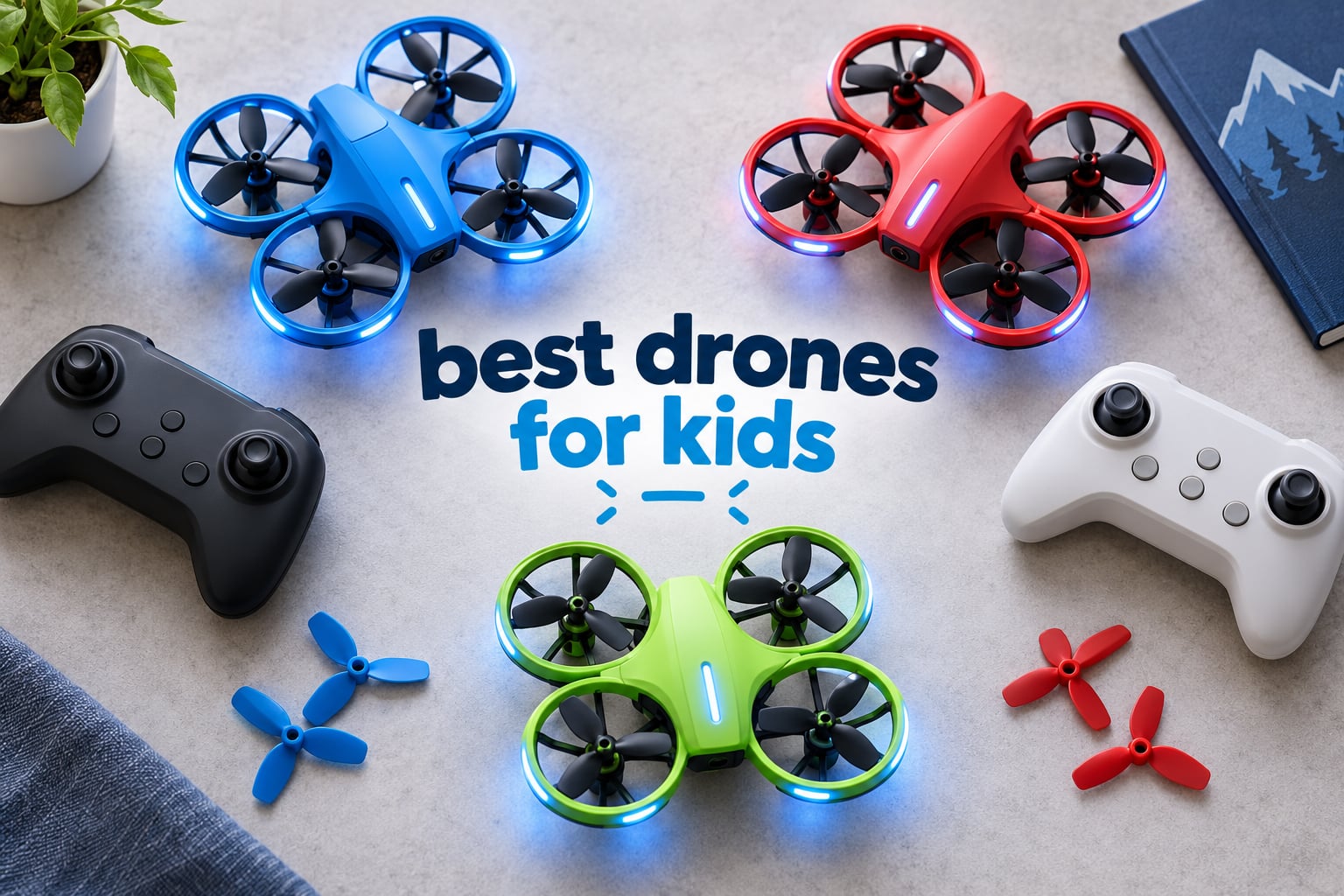
Short answer: the DEERC D20 is the best drone for kids overall in 2026, because it is the only sub-100g guarded drone in this guide that pairs a 720p live-view camera with two batteries and altitude hold. For the youngest pilots, the Force1 Scoot needs no controller at all, and for a ready-made gift the Loolinn U61 ships with two batteries, four spare propellers and a screwdriver in the box.
That is the whole argument, and the rest of this guide is the detail behind it. We looked at eight kid-focused drones and compared them on the things that actually decide whether a child keeps flying a drone or hands it back after two crashes: propeller guard coverage, the number of batteries in the box, whether assisted modes such as altitude hold and headless mode are present, how much the thing weighs, and whether spare parts are actually included.
One thing to clear up before we start. Almost every drone in this category is a first trainer, not a hobby. Kids and parents on flying forums consistently describe a guarded toy drone as a coordination tool you grow out of in a few months, which is exactly how we have treated these eight. The difference between the picks below is how gracefully they survive the months before a child moves up.
If you are also assembling a kid’s kit, our guides to the best kids headphones and the best kids earbuds cover the audio side of long family trips.
Table of Contents
Top 3 Picks for the Best Drones for Kids (October 2026)
Best Drones for Kids at a Glance in 2026
The table below is the fast version. Weight matters for more than portability: it decides whether the aircraft sits under the 250 g line that separates an unregistered hobby flight from a registered one in the United States.
| Product | Specifications | Action |
|---|---|---|
 DEERC D20 DEERC D20 |
|
Check Latest Price |
 Holy Stone HS210 Holy Stone HS210 |
|
Check Latest Price |
 Force1 Scoot Force1 Scoot |
|
Check Latest Price |
 Holy Stone HS190 Holy Stone HS190 |
|
Check Latest Price |
 HASAKEE Q9s HASAKEE Q9s |
|
Check Latest Price |
 AVIALOGIC Mini Drone AVIALOGIC Mini Drone |
|
Check Latest Price |
 Hiturbo S20 Hiturbo S20 |
|
Check Latest Price |
 Loolinn U61 Loolinn U61 |
|
Check Latest Price |
How We Picked These Drones
Every drone here is a consumer toy-grade quadcopter, so speed, range and camera quality were not useful ways to separate them. A fast drone with no guards is a bad toy for a seven-year-old, and a guarded drone with a stabilised gimbal is not what a five-year-old needs either. We scored each aircraft against the same five checks instead.
Guard coverage. A full propeller guard that encloses all four rotors is the single feature that changes how forgiving a drone is. It reduces damage in a light collision and it stops a child’s fingers reaching a spinning blade. It does not make a drone safe, and we treat claims that it does as a warning sign rather than a feature.
Assisted flight modes. Altitude hold fixes the drone at a height so the child only has to manage turning and travel. Headless mode makes the controls behave as though the drone’s nose always points the same way, which removes the mental flip that confuses most beginners. Drones with both are far easier to learn on.
Battery count and battery size. Small drones run 5 to 8 minutes per pack. A box with two or three packs roughly doubles or triples the usable flying time in a session, which is the single biggest fix for the tears-and-arguments complaint we see repeated across parent forums.
Spare parts in the box. Propellers snap, guards pop off, and arms crack. A screwdriver, a spanner and a set of spare propellers in the box decide whether a crash costs you a coffee break or a new drone. We counted the contents of the included components field for every aircraft.
Weight and the 250 g line. Almost everything here is a toy. One aircraft is heavier than 250 g, and we flag that clearly because it changes the registration picture for US families.
Ratings and review counts came from the product listings, and we use them as a rough reliability signal rather than a scoreboard. A 4.0 average across 19420 reviews tells you a great deal about whether a cheap drone falls apart; a 4.4 average across 271 reviews tells you almost nothing about the same thing.
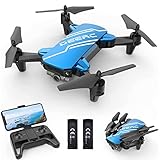
1. DEERC D20 Mini Drone: Best Drone for Kids Overall
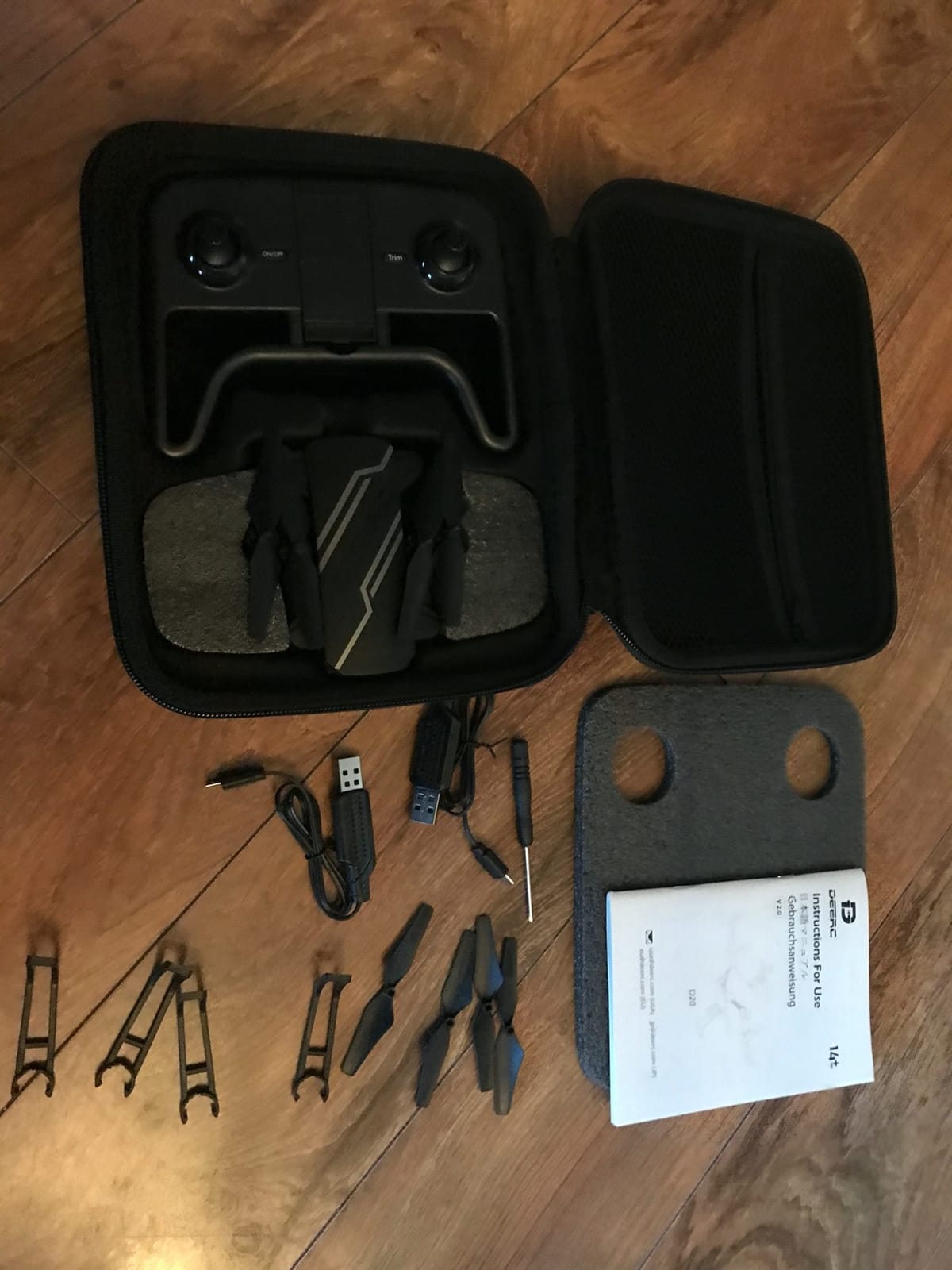
DEERC D20 Mini Drone for Kids with 720P HD FPV Camera Remote Control Toys Gifts for Boys Girls with Altitude Hold, Headless Mode, One Key Start Speed Adjustment, 3D Flips 2 Batteries, Blue
720p FPV camera
2 modular batteries
69 g
Altitude hold and headless mode
Pros
- Two batteries give roughly 20 minutes of total flight
- Live 720p view to a phone keeps kids engaged
- Altitude hold and one-key takeoff shorten the learning curve
- Propeller guards hold up to repeated indoor and grass crashes
- 69 g sits well under the 250 g registration threshold
Cons
- Very light build drifts badly in any breeze outdoors
- Control range is short at roughly 40 to 90 feet
- Prop guards and foam landing pads pop off after hard crashes
This is the drone we would put in a child’s hands first, and the reason is not the camera. It is that the DEERC D20 combines the three things that make a first drone stick: assisted flight that a child can beat within ten minutes, two batteries in the box, and a frame that shrugs off ordinary crashes. Owners of this aircraft describe it as the drone their child actually learned on, and the volume of reviews behind that claim is substantial.
Weight matters more here than it first appears. At 69 g with the guards on, this is one of the lighter aircraft in the guide, which is exactly what you want indoors and on a calm day outside. It is a genuine indoor-and-garden drone rather than a garden-only one, and that flexibility is what separates it from the pocket-sized nano models further down this list.
The FPV camera is the part parents underestimate. It streams 720p live video to a phone app, and even with noticeable latency that live view is what converts a toy into something a child finds exciting. Owners also point to voice control, gesture selfie and smartphone-drawn flight courses as small features that keep a seven-year-old interested past the novelty of the first ten flights.
Battery life and what 20 minutes really means
Two modular batteries give roughly 20 minutes of total flight time, which sounds generous until you break it down. That is closer to two ten-minute flights than one continuous twenty-minute flight, and the recharge time sits in between. The honest version for a parent planning a Saturday: expect about half an hour of flying spread across an hour, not twenty uninterrupted minutes.
That is still far better than the single-pack norm, and it is the reason we rate this above lighter options. If a child has two packs, the disappointment of the battery dying is offset by the promise of another pack, and that is most of the battle with a young pilot.
Where the D20 struggles outdoors
Wind. At this weight, a modest gust turns the D20 into an argument rather than a drone, and reviewers are consistent about drift being the main flaw. Control range is also short, closer to 40 to 90 feet in real use, so this is a garden and large-room aircraft, not something to send down a field.
For a child aged roughly 6 to 10 with an adult in the garden, that limitation is fine. For a family wanting long open-field flights, move up in this list. One more thing to know before a first flight: the propeller guards and foam landing pads can pop off after a hard crash, and replacements are the part most likely to be missing from the box.
2. Holy Stone HS210: Best Value Nano Drone for Indoor Learning
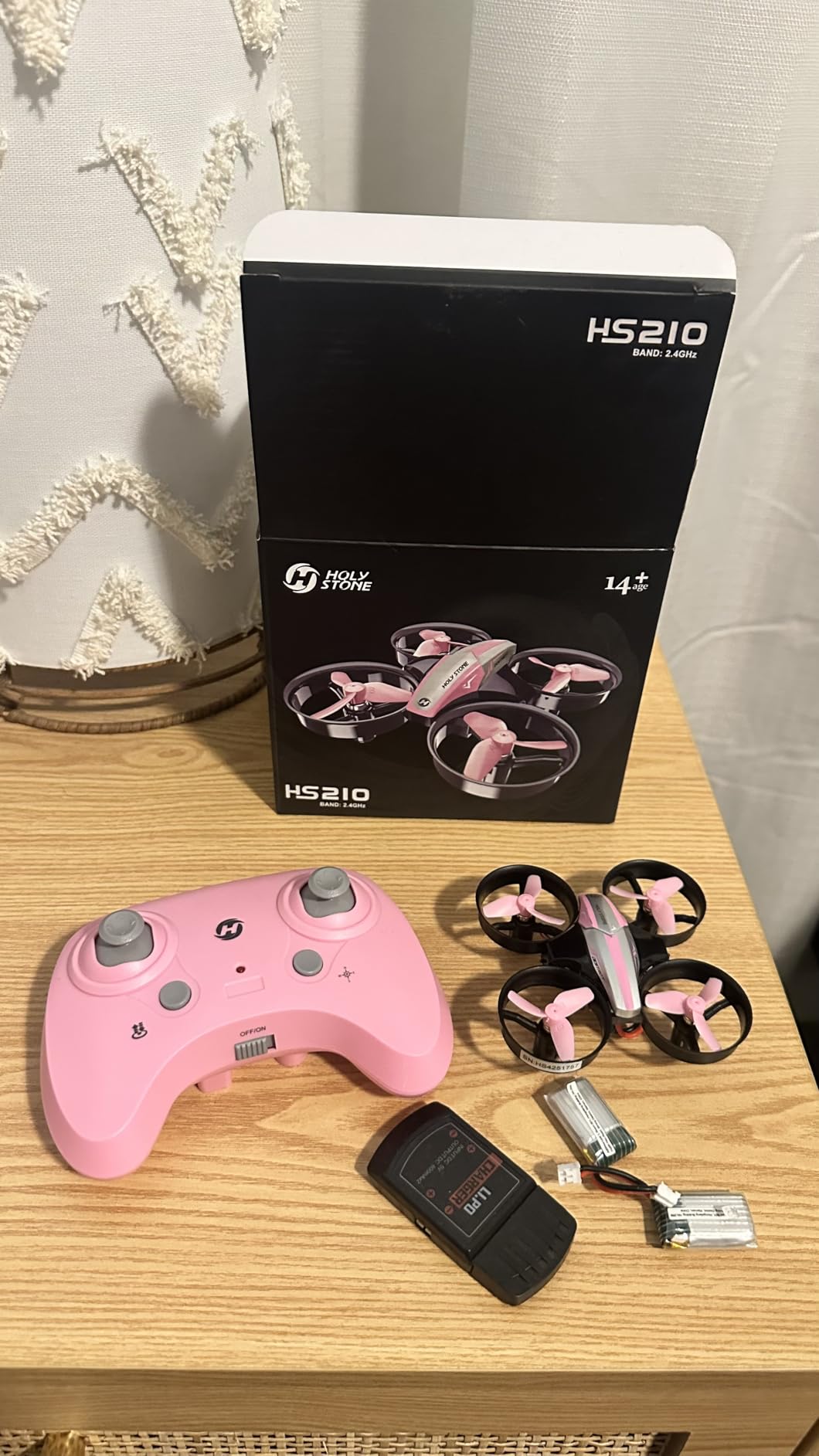
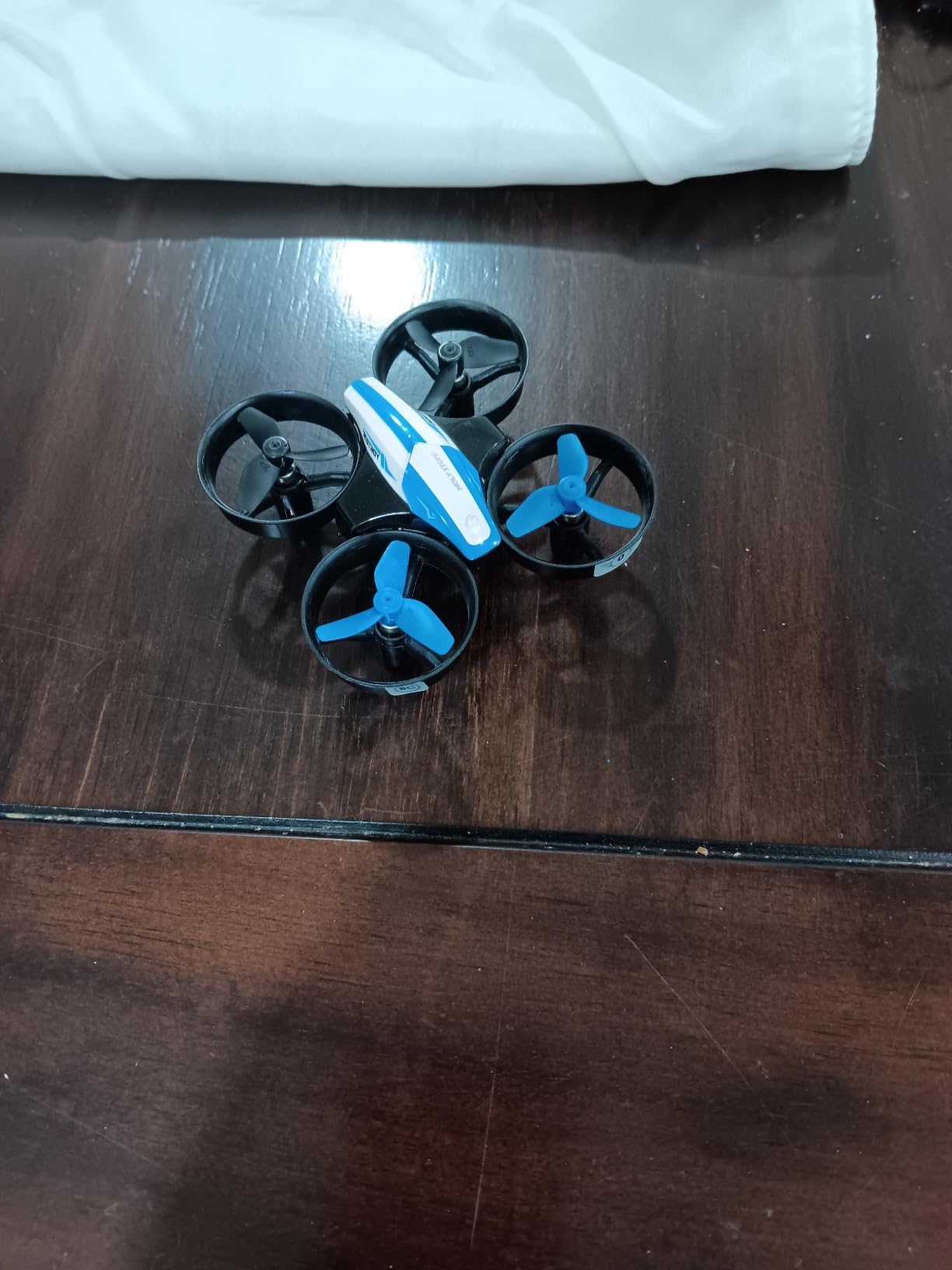
Holy Stone Mini Drone for Kids and Beginners RC Nano Quadcopter Indoor Small Helicopter Plane with Auto Hovering, 3D Flips, Headless Mode and 3 Batteries, Great Gift Toy for Boys and Girls, HS210 Blue
50 g palm-sized quadcopter
3 batteries
Altitude hold and headless mode
Full propeller guard
Pros
- Three batteries extend playtime to around 20 minutes
- Altitude hold and headless mode make hovering stable
- Full propeller guard absorbs indoor crashes
- Palm-sized and quiet enough to fly around furniture
- Three speed modes let a child progress
Cons
- Each pack runs only about 5 to 7 minutes and recharges slowly
- Sunlight outdoors jams the control link and causes drift
- Spare propellers are not colour-coded by rotation direction
The HS210 is the aircraft most parents end up buying twice: once for a child who was not quite ready, and once for a sibling who was. It is the most thoroughly reviewed drone in this guide and the reference point against which the other nano models are judged. At 50 g and fully guarded, it is among the safest things here for a small child, and it is designed to be flown in a living room rather than a field.
What makes it so good as a trainer is the combination of toss-to-launch, circle flight, 3D flips and auto rotation. A child can get the aircraft airborne by tossing it, then discover that pushing a stick makes it spin. That is a much better introduction to cause and effect than an eight-step pre-flight sequence, and reviewers consistently describe children picking it up on their own within minutes.
Three batteries, and the charging gap nobody mentions
The listing calls it 3 batteries for up to 21 minutes of flight. Read that as three short flights, not one long one. Each 250mAh pack runs about 5 to 7 minutes, and the USB charger is a single cable, so packs charge in sequence.
Two practical consequences for parents. First, buy a second USB cable early, because a lost charger ends the hobby. Second, the replacement batteries are the most expensive running cost in this category, and the connector is genuinely fiddly to seat and remove. A few parents on flying forums have switched to third-party packs for this reason; others found the connector unreliable and gave up. Our advice is to buy the branded spare pack and treat it as a slow charger rather than a flight-time upgrade.
Keep it indoors, not in the garden
The HS210 uses an infrared-style control link, and direct sunlight interferes with it badly. Reviewers report drift and lost control outdoors, and the wind sensitivity of an aircraft this light makes it worse. There is also a well-known drift immediately after calibration that surprises first-time users.
One practical detail that catches families out: the spare propellers are not colour-coded by rotation direction, so a child swapping them can put one on backwards. Show them the correct orientation once, in the first ten minutes, and it becomes a habit. For indoor learning this remains the best drone in the guide.
3. Force1 Scoot: Best Budget Pick for the Youngest Pilots
Force1 Scoot Hand Operated Drone for Kids or Adults – Hands Free Motion Sensor Mini Drones, Easy LED Indoor Rechargeable UFO Toy Flying Orb Ball Drone Toys for Boys and Girls (Blue)
Hand operated motion-sensor orb
360 degree obstacle sensors
LED webbed shell
About 8 minutes per charge
Pros
- No controller to learn
- so even a four-year-old can play with it
- Obstacle sensors let the aircraft follow or avoid a hand
- LED shell lights a dark room
- Webbed shell keeps propellers away from hands and walls
- Force1 handles warranty replacements responsively
Cons
- Battery stops holding charge after a few weeks
- Finger-sized gaps in the webbing can pinch small fingers
- One strand of hair around a rotor can stop it entirely
- Tiny printed instructions need online help to follow
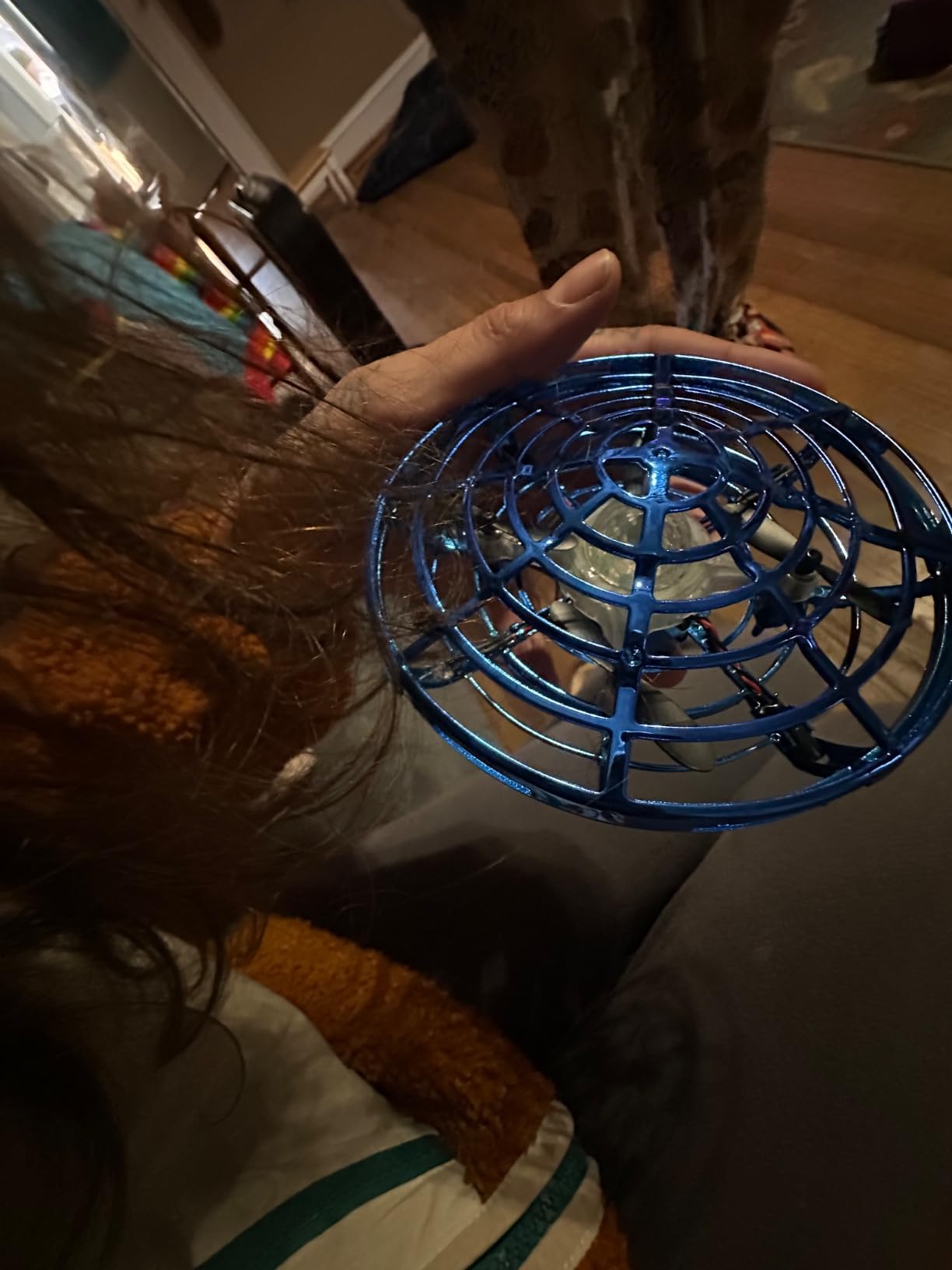
Everything else in this guide requires two thumbs and a controller. The Force1 Scoot requires a hand. It is a flying orb that reads motion from your palm, and that single design decision makes it the only drone here we would put in front of a four-year-old. It is also the cheapest aircraft we cover, and the only one that works as a genuine parent-child game rather than a solo flying toy.
There is a real learning argument here that gets missed. A very young child cannot coordinate a joystick, but can absolutely understand that moving a hand moves the drone. The Scoot turns that into a physical skill that carries straight across to a thumbstick later. The motion sensors with 360 degree obstacle avoidance also mean it will not crash into the sofa, which removes the usual first objection.
No controller to learn, and no skill to teach
It throws itself out of your hand, follows the motion of a palm, and lights up the ceiling in patterns. For a child aged 4 to 7 this is a genuinely good toy that survives being dropped, thrown and bumped by a smaller sibling, and the webbed shell design means furniture and hands are protected in a way bare rotors never would be.
What it does not teach is flying. There is no altitude hold, no headless mode, and no link between what the child does and where the aircraft goes. Treat it as a first taste of drones and a confidence-builder, not as a trainer. Its own listing describes it as a STEM toy recommended for ages 8 and up, which is a sensible floor even though younger children can clearly play with it.
The hair, fingers and battery problems
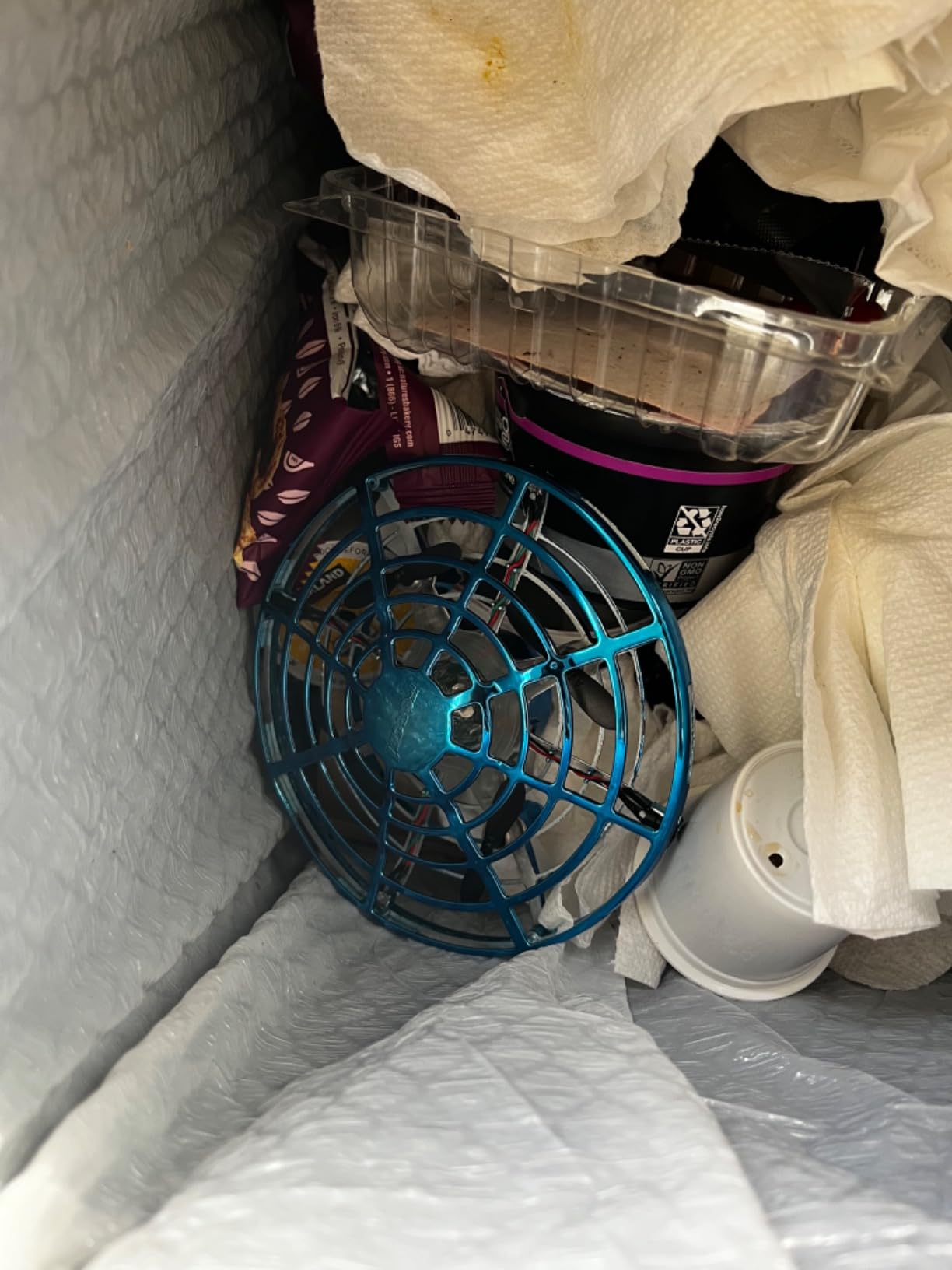
Three honest warnings. The battery degrades quickly and stops holding a charge after a few weeks, which is the most common complaint by a distance and the main reason this is a budget pick rather than a value pick. The webbed shell has finger-sized gaps that can catch and pinch small fingers, so supervise closely with a child under five. And a single strand of hair wrapped around a rotor can stop the aircraft entirely, which in a house with long-haired adults is not a rare event.
Shell legs also crack over time and calibration becomes less reliable. Force1’s warranty response is one of the better ones in this category, which softens the battery issue, but plan on replacing the unit within a term or two. As an introduction, it does its job better than anything else at this end of the market.
4. Holy Stone HS190: Best for Travel and Small Hands
Holy Stone HS190 Foldable Mini Nano RC Drone for Kids Gift Portable Pocket Quadcopter with Altitude Hold 3D Flips and Headless Mode Easy to Fly for Beginners
35 g foldable nano drone
Folds into the controller
Altitude hold and headless mode
3 speed modes
Pros
- Folds into the controller so it fits in a pocket or bag
- Only 35 g with guards fitted
- One-click takeoff and landing plus an emergency stop
- Three speed modes for a child progressing
- Box includes spare propellers
- a spanner and a screwdriver
Cons
- Very small 220mAh battery gives only a few minutes per charge
- No camera despite photo and video fields in the listing
- Control range is limited to about 96 feet
- Breeze easily blows the lightweight airframe off course
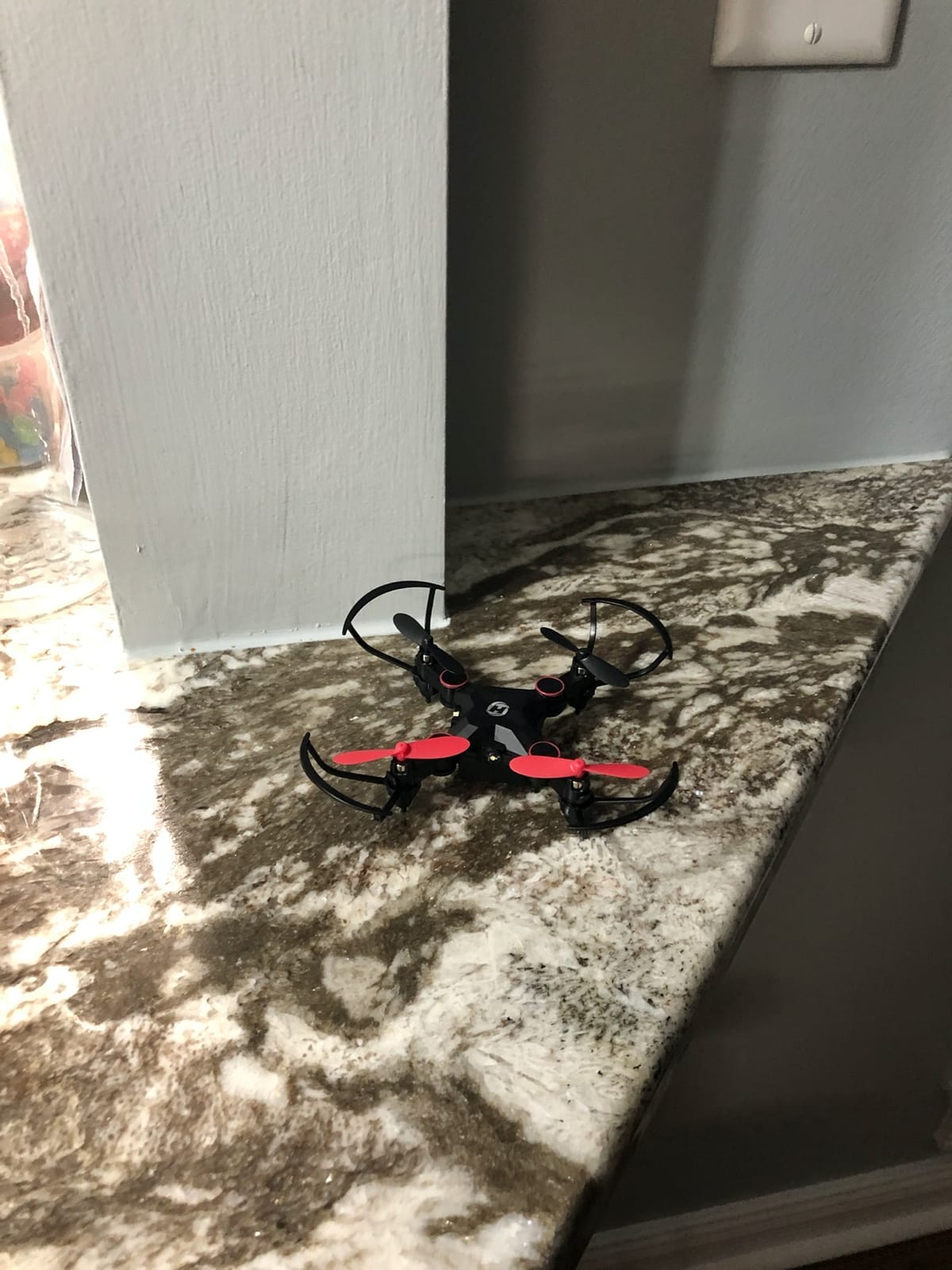
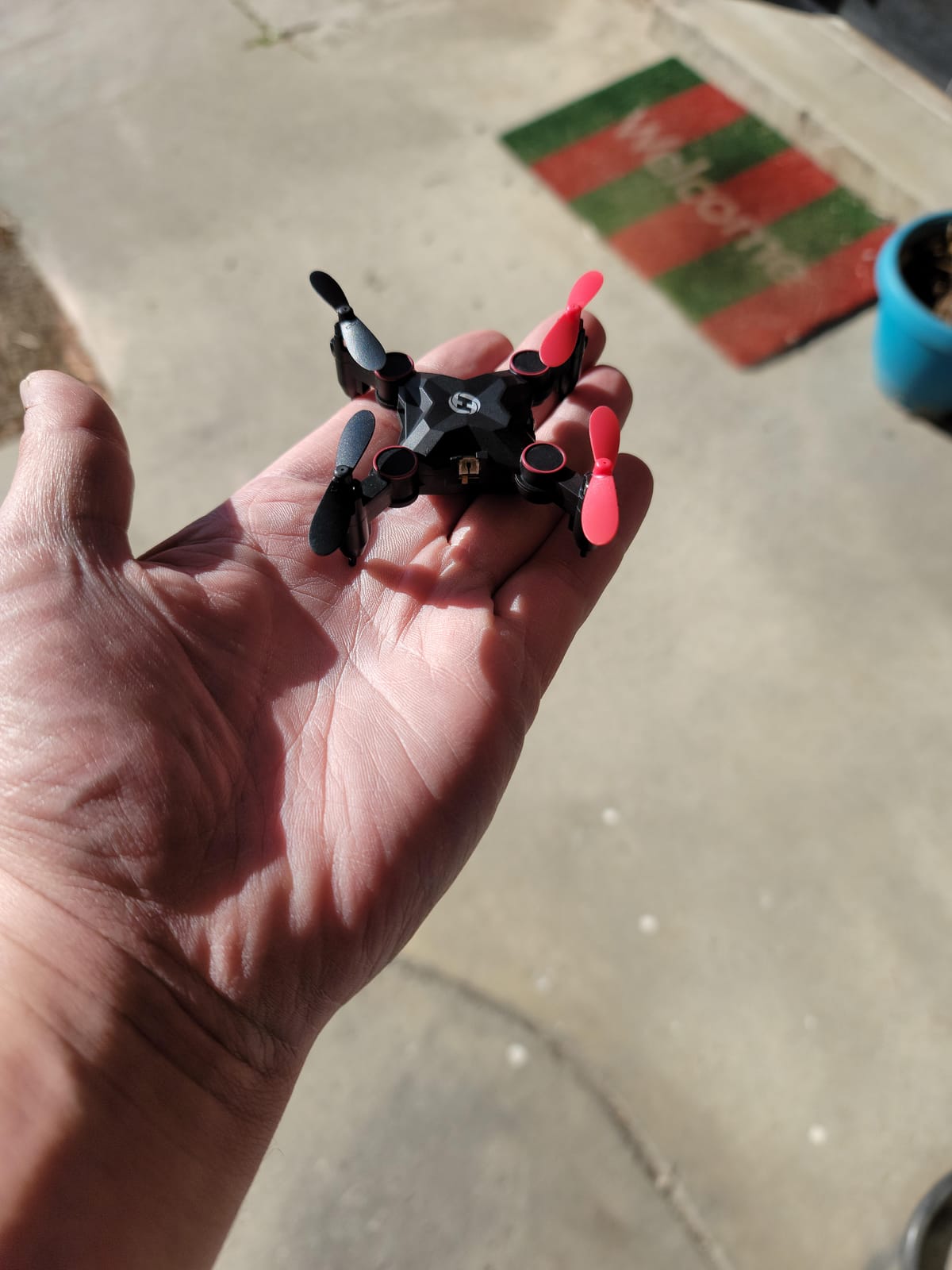
The HS190 solves a problem no other drone here addresses: what to do when the interesting place to fly is a two hours from home. It folds into its own controller, so the whole package is the size of a book, and at 35 g with the guards fitted it is the lightest aircraft we cover. If a child wants a drone in a rucksack for a hotel holiday rather than a garden at home, this is the one.
For the pilot, it is a well-behaved little aircraft. One-click takeoff and landing, altitude hold, headless mode and three speed modes cover everything a beginner needs, and the emergency stop function lands the aircraft immediately to limit damage. That last feature matters more than it sounds on something a child will fly into a lamp.
The 35 gram argument for a lighter drone
Lighter aircraft are safer indoors in a specific way: at low mass, the energy in a collision is low, and a small drone that bounces off a wall at walking pace is a very different proposition from a heavier camera drone at the same speed. Combined with full propeller protection and an emergency stop, this is one of the two safest picks in the guide for a child under seven.
It is also the one most likely to be lost. Reviewers are blunt about the airframe being blown off course by a breeze, and 96 feet of range is a small circle. Both facts push the same recommendation: this is an indoor and calm-day travel drone, and it should stay within arm’s reach of an adult.
What you give up with no camera
The listing carries photo and video fields in its specification table, but there is no working camera on this aircraft. If your child wants footage, this is the wrong pick and the DEERC D20 further up the list is the right one. Some parents have bought this expecting a camera and returned it, so treat that as a known confusion rather than a defect.
Against that, the box is unusually well organised for a nano drone: one battery, a USB cable, four propeller guards, spare propellers, a spanner, a screwdriver and a manual. The 30-day unit warranty and 90-day accessory warranty are also better than most at this end of the market. The single 220mAh battery is the real limitation, and it is a severe one.
5. HASAKEE Q9s: Top Rated Pick That Survives Crashes
Q9s Drones for Kids,RC Drone with Altitude Hold and Headless Mode,Quadcopter with Blue&Green Light,Propeller Full Protect,2 Batteries and Remote Control,Easy to fly Kids Gifts Toys for Boys and Girls
ABS frame with four full guards
2 x 500mAh batteries
Neon LED frame
720p camera
Pros
- Tough ABS frame with four guards survives repeated hard crashes
- Two 500mAh UL-certified batteries allow back-to-back flying
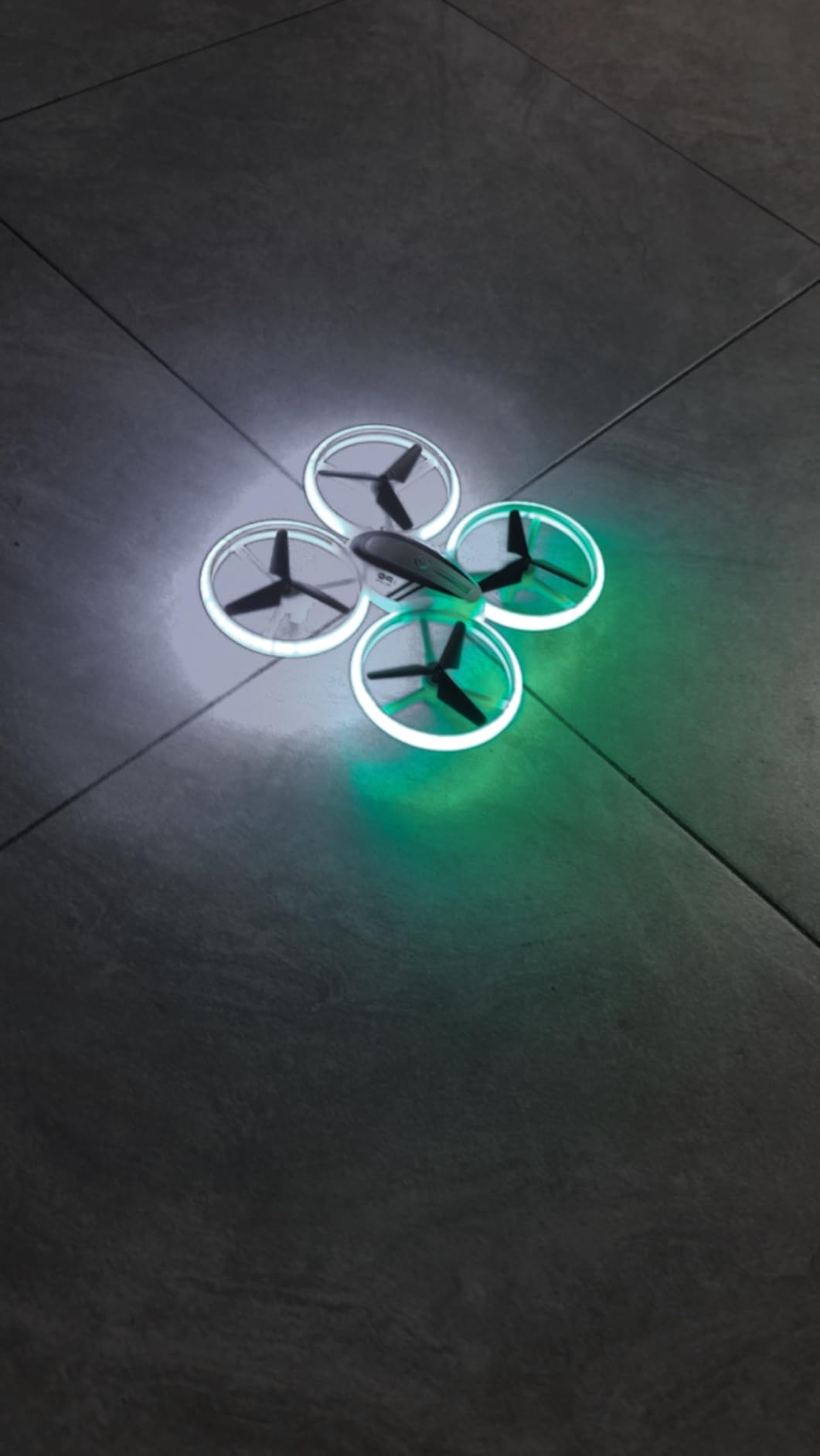
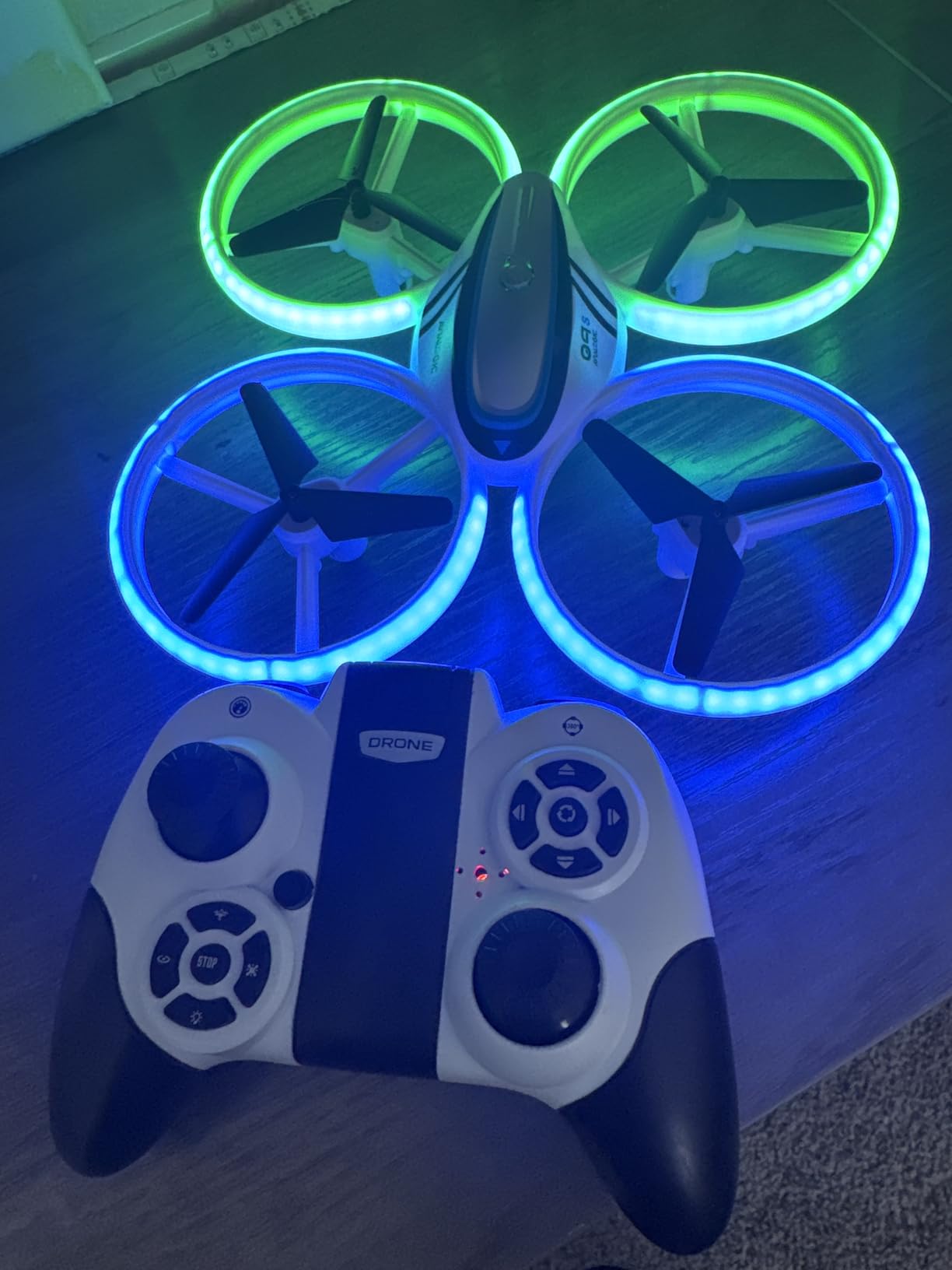
- Neon green and blue LEDs with three modes look great in a dark room
- Altitude hold
- headless mode and one-button takeoff
- Three speed settings and 360 degree flips
Cons
- Roughly 6 to 8 minutes per pack with about an hour of charging
- Very light
- so a gust outdoors can carry it away
- Open guards can snag long hair
- Some units fail to pair or stop flying after a few weeks
Durability is the reason this drone is on the list, and it is the thing competitors almost never address. Popular budget models in this category carry middling ratings precisely because they break, and parents describe the same failure repeatedly: a cracked frame or a snapped arm after an ordinary indoor crash. The Q9s is built from a structured ABS frame with four full propeller guards, and parents and hobby pilots alike rate it as one of the toughest kid drones at this level.
The second thing it does well is the 500mAh battery size. Two packs give back-to-back flying without the long gap you get with smaller nano batteries, and both are UL-certified, which is more than most of the field can say. Add altitude hold, headless mode and one-button takeoff, and you have a drone a child can operate without being talked through every flight.
Crash survivability and the ABS frame
We could not test crash counts, but the pattern across owner reviews is consistent: this aircraft absorbs hard indoor crashes without visible damage, where lighter neighbours crack. The structural frame is doing work that thin plastic shells on cheaper models do not, and the four guards sit close enough to the rotors to take the hit rather than passing it into the arm.
Two 500mAh packs is the practical headline. Roughly 6 to 8 minutes per charge with about an hour to refill is not a long session per pack, but two packs back to back is a usable evening, and the UL certification on both is a genuine quality signal for a lithium polymer pack.
Evening flights and the hair snag at the props
The LED frame is the feature parents mention most warmly, and it is not just decoration. Three lighting modes on a neon green and blue frame turn a dark living room into an indoor flying space, which extends the flying season considerably for a child in a winter climate. It is also, for many families, the reason the child keeps playing with it after the novelty fades.
The safety caveat is the open guard design. Those guards protect hands but they can catch long hair, and several reviews describe a child or adult losing hair into a rotor. Anyone with long hair in the household should tie it back before a session. Also expect the usual outdoor problem: this aircraft is very light, so a modest gust can carry it away entirely, and a minority of units fail to pair or die within weeks.
6. AVIALOGIC Mini Drone: Best 1080p Option, With a Registration Catch
AVIALOGIC Mini Drone with Camera for Kids, Remote Control Helicopter Toys Gifts for Boys Girls, FPV RC Quadcopter with 1080P HD Live Video Camera, Altitude Hold, Gravity Control, 2 Batteries, Black
1080p HD FPV camera with 90 degree tilt
2 x 550mAh batteries
Gravity control
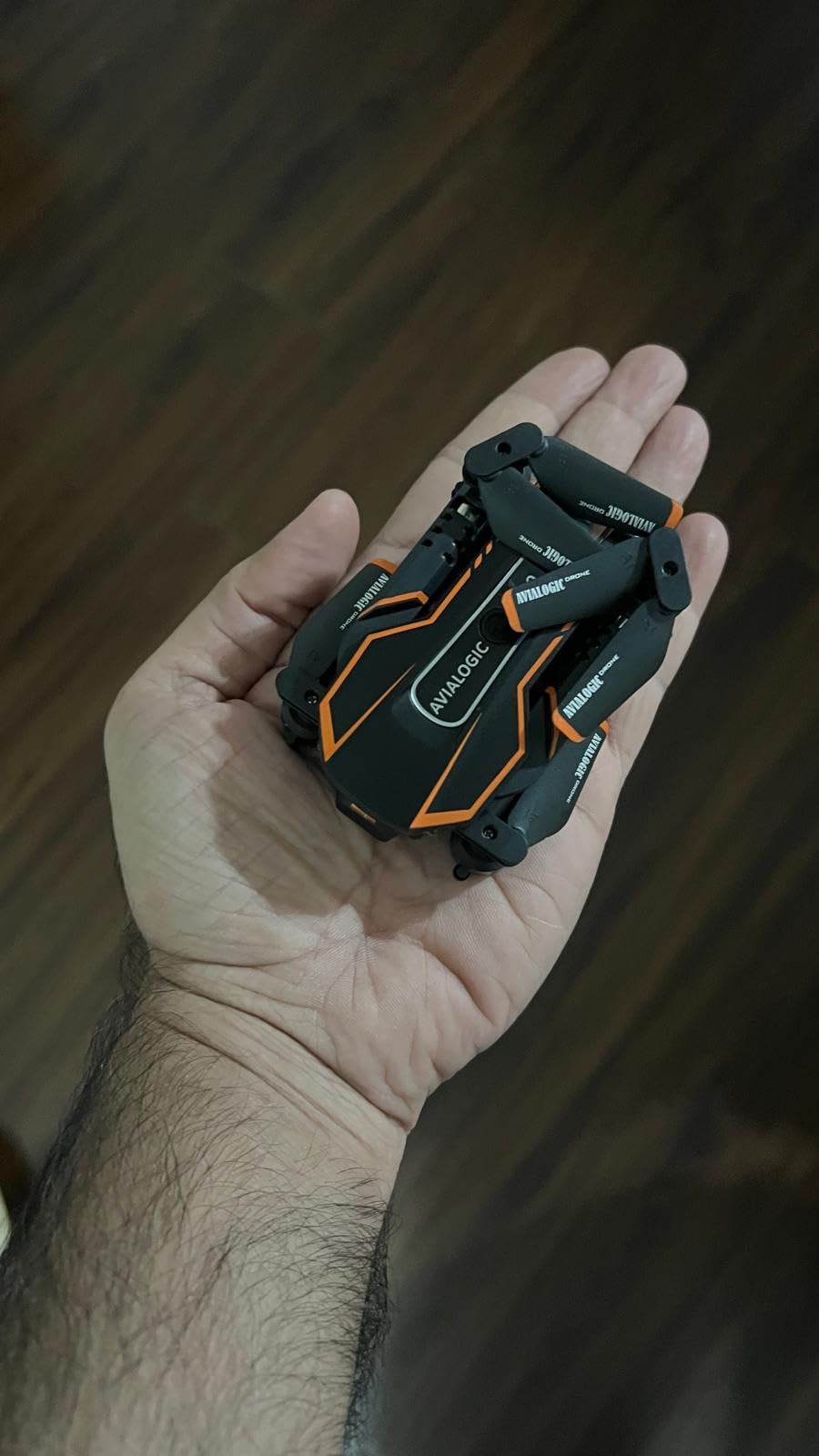
320 g
Pros
- 1080p camera with manual tilt and clear live FPV streaming
- Altitude hold
- gravity control and three speed modes for stability
- Two 550mAh UL-certified batteries give roughly 18 to 21 minutes
- Survives repeated crashes by children without visible damage
- Low power alarm
- emergency stop and four guards
Cons
- At 320 g it sits above the 250 g registration threshold in the US
- Propeller guards detach easily and replacements are hard to source
- Drifts with air currents indoors and is hard to control in wind
- A small share of units lose a motor arm after one flight
This is the only aircraft in the guide with a 1080p camera, and if a child is filming rather than flying, that resolution difference is the whole argument. The camera has a 90 degree manual tilt so the lens can be aimed straight down or forward, and it streams live FPV video to a phone. Reviewers like the pairing of a real camera with beginner-friendly stability modes.
Two 550mAh UL-certified batteries give roughly 18 to 21 minutes of flight, which is among the best totals in the guide, and the aircraft holds up to repeated crashes by children without visible damage. There is also a low power alarm, an emergency stop and four propeller guards.
Camera quality versus the weight rule
At 320 g, this aircraft is the one in the guide that sits above 250 g. That is a genuinely important difference for a US family, because the 250 g threshold is where recreational registration obligations begin. The rule applies to the aircraft as flown, and guards, propellers and batteries all count toward that number, so an aircraft near the line can cross it simply by being fitted properly.
The footage itself is a real step up from the 720p and 480p cameras in the rest of this list, and the adjustable tilt genuinely helps when a child wants to film something below them. But the live feed is a phone screen, not goggles, so this remains a line-of-sight aircraft rather than a first-person one.
Guards, drift and the day the guards pop off
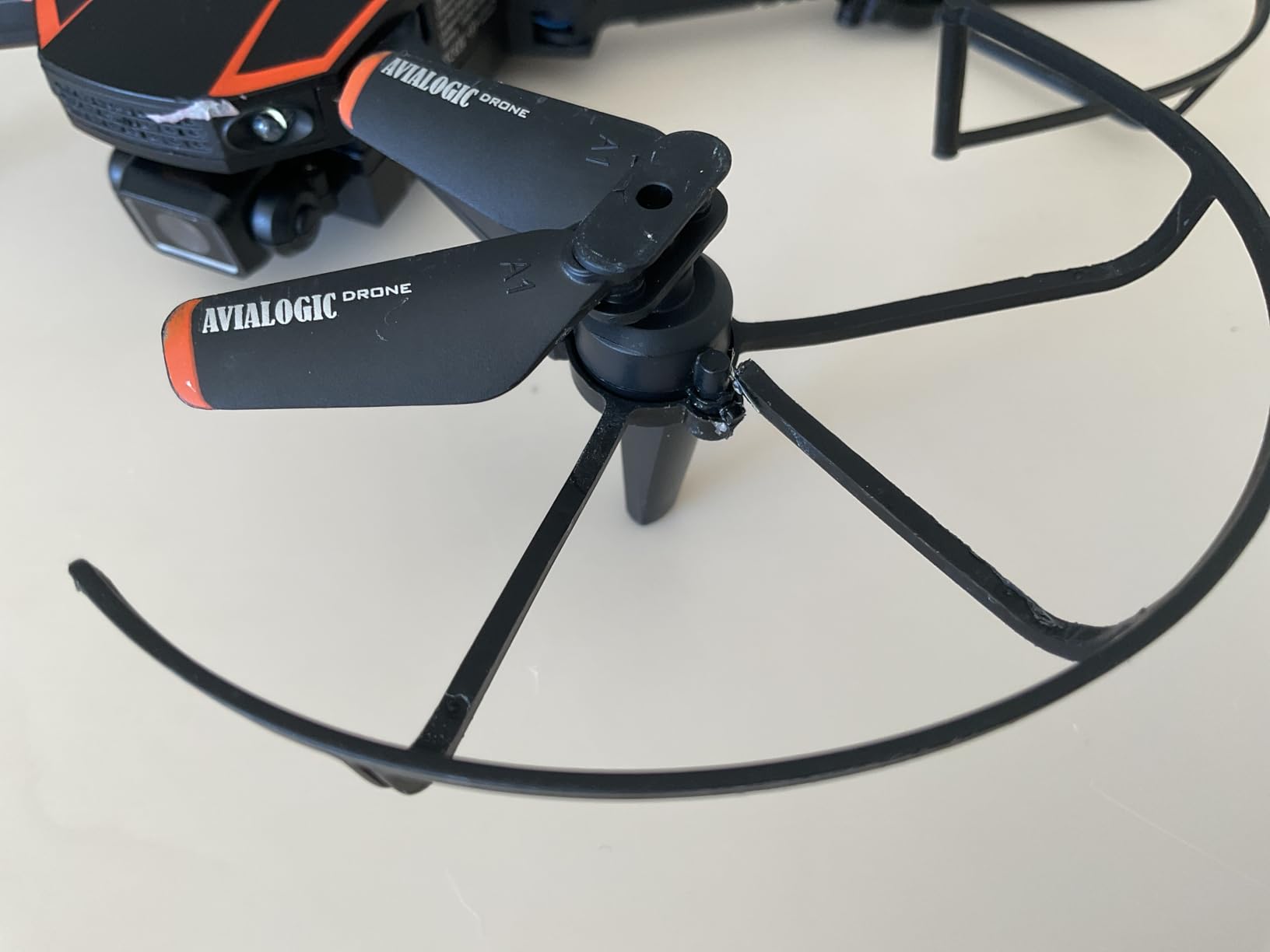
The most common complaint, and the one that matters most for a toy used by a child, is that the propeller guards detach easily. Replacement guards are hard to source separately, so a single hard landing can leave you with an aircraft you would rather not hand to a child. Check the guards before every session and treat any looseness as a stop signal.
Wind and drift are the other recurring issues, and at 320 g this aircraft handles indoor air currents better than the very light models but is still unpredictable in a breeze. A small share of owners report a motor arm detaching after a single flight, which is why we would not make this the first drone a six-year-old touches unsupervised.
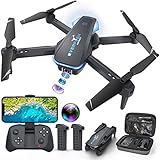
7. Hiturbo S20: Best for a First Drone With Almost No Setup
Drone with 1080P Camera for Beginners and Adults, Foldable Remote Control Quadcopter with Voice Control, Gestures Selfie, Altitude Hold, One Key Start, 3D Flips, 2 Batteries, Toy for Beginners
146 g foldable quadcopter
Adjustable 1080p camera
2 batteries
Runs about 12 minutes per pack
Pros
- No manual pairing
- so it is genuinely a first-drone experience
- Two batteries give about 12 minutes each
- roughly 24 minutes total
- Manually adjustable 1080p camera for forward and downward shots
- Altitude hold
- headless mode
- one-key takeoff and speed adjustment
- Foldable body stores easily
Cons
- Voice control
- trajectory flight and capture need the phone app instead of the remote
- Flips and high speeds noticeably shorten battery life
- Must be fully charged with the supplied cable before first use
- Lightweight frame is unsuited to windy conditions
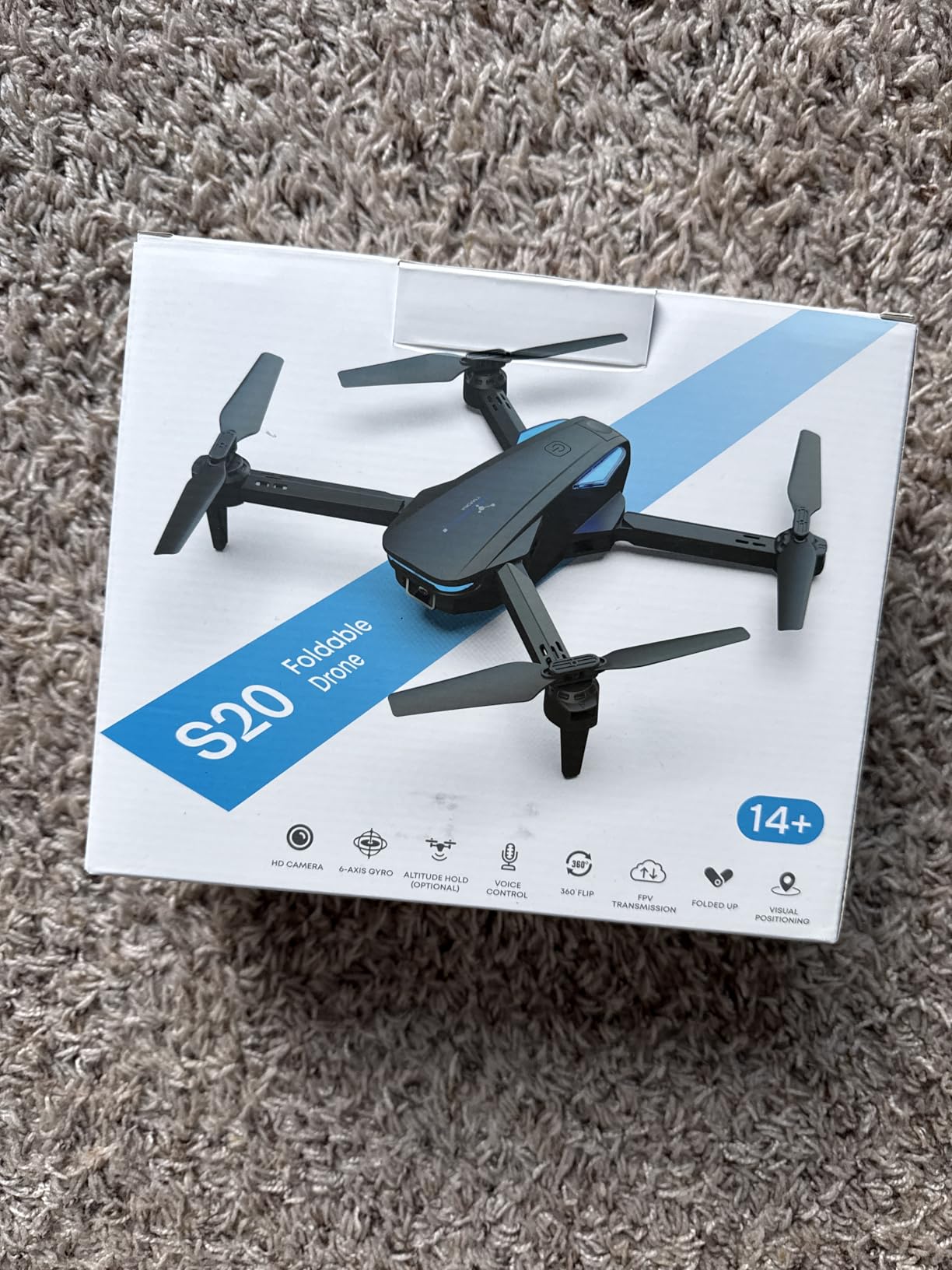
The S20’s entire pitch is that there is nothing to figure out. There is no pairing procedure, no account to create, no button combination to learn before the first flight. Reviewers describe it as a true first drone, and for a parent who does not want to spend an evening troubleshooting a Wi-Fi connection, that is worth more than a longer feature list.
The camera is a 1080p unit on a manual tilt, so it can shoot forward or straight down, which is more useful for a child than it sounds. Two rechargeable batteries give about 12 minutes each, up to 24 minutes total, and at 146 g the aircraft sits comfortably inside the sub-250 g category that keeps US family flying straightforward.
The easiest unboxing in this guide
Charge it with the supplied cable, switch it on, and fly. That is genuinely the whole setup, and it is why we recommend this aircraft for a child aged roughly 8 to 12 who has never touched a remote before. Altitude hold, headless mode, one-key takeoff and landing and speed adjustment cover the assisted features a beginner needs, and the foldable body means it lives in a drawer rather than on a shelf.
The two-battery arrangement also solves the most common frustration in the category. Roughly 12 minutes per pack is longer than most nano drones manage, and 24 minutes total across a session is enough to feel like a real flight rather than a demo.
Why the app-only features frustrate parents
Here is the catch, and it is worth understanding before you buy. Voice control, gesture selfie, trajectory flight and camera capture all require disconnecting from the remote and switching to the phone app. For an eight-year-old that means a phone handover mid-session, and parents report it breaks concentration more than they expect.
Two smaller things to know. Using flips and higher speeds drains each pack noticeably faster, so a stunt session ends sooner than a steady one. And the aircraft needs a full charge with the supplied cable before the first flight, which sounds trivial until a child tries it on a partly charged battery and concludes the drone is broken. It is a strong pick for a confident beginner who wants to film, and a poor choice for a windy garden or a child who will not share the phone.
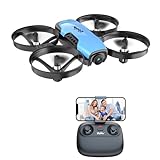
8. Loolinn U61: Best Ready-Made Gift Kit for Ages 8 and Up
Loolinn | Drone with Camera for Kids 8+ as Gift – Drone for Kids with Adjustable Camera, Photos and Videos, Safe for Kids to Play, Easy to Fly (Holiday Gift for Boys and Girls)
5.43 inch quadcopter
480p adjustable camera
2 batteries plus 4 spare props
24-month warranty
Pros
- Built specifically for children 8 and up with a guarded propeller design
- Very easy to fly for a child with no drone experience
- Two batteries
- four spare propellers
- a screwdriver and a phone holder in the box
- Manually adjustable camera for aiming shots
- 24-month warranty with refund or replacement
Cons
- Camera records at 480p
- the lowest resolution in this guide
- Infrared remote limits range and is affected by direct sunlight
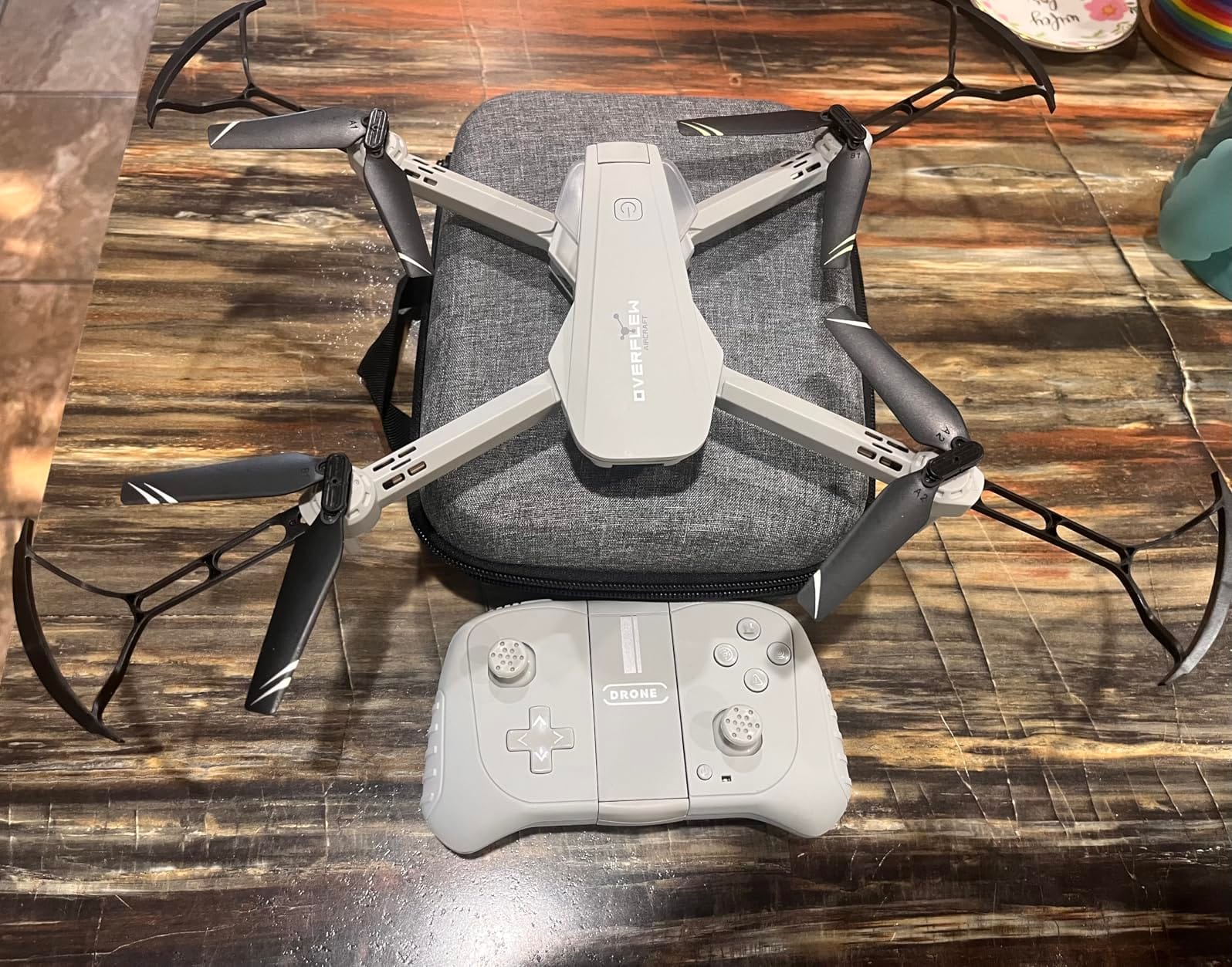
The Loolinn U61 is the one aircraft here sold explicitly as a children’s gift, and the packaging is built around that: a propeller safety guard, speed adjustment for different skill levels, and a boxed set of extras that would normally need buying separately. If you are buying a birthday or holiday present and you want the recipient to open one box and have everything working, this is the one.
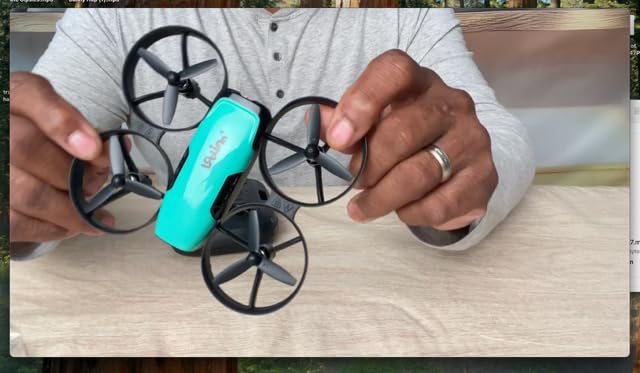
The box contents are the story. Two drone batteries, four extra propellers, a screwdriver, a smartphone holder, a USB charger and a remote control. That spare-parts bundle is genuinely the best in this guide, and it directly addresses the thing parents complain about most, which is a snapped propeller ending the hobby because the replacement was in a different cupboard.
The spare-parts box parents actually want
Propellers are consumables. They chip, snap and warp, and a warp is worse than a break because it throws the aircraft out of balance. A screwdriver and four spares in the box means a damaged propeller is a two-minute fix with a coin, not a lost drone, and on a toy that will be crashed regularly this is worth more than a better camera.
The 24-month warranty with refund or replacement is also the longest commitment in this guide, which matters for a present you are not going to supervise. Owners rate the aircraft as very easy for a child with no prior drone experience, and the manually adjustable camera is a nice touch for aiming at something specific rather than guessing.
480p video and infrared limits
Two limitations are worth being straight about. The camera records at 480p, which is the lowest resolution in this guide and low enough that a parent hoping for shareable family footage will be disappointed. If video quality matters, the AVIALOGIC or the Hiturbo S20 are the picks instead.
Second, the remote uses infrared control. That technology is affected by direct sunlight, so outdoors in bright sun the aircraft can be harder to control, and it will not compete with a radio-link drone in range. Combined with a metal-and-plastic build and a 5.43 inch frame, it is a solid indoor and shaded-outdoor toy for an 8-year-old, and a thoughtful gift, but it is not the aircraft we would buy for a child who wants to film seriously.
What Age Should a Child Fly a Drone?
Most four-year-olds should not fly a drone independently, and the honest answer to that question is that a four-year-old can handle a hand-guided toy with constant adult help, and nothing more. The switch from hand-guided to stick-controlled flying is the real dividing line, and it usually happens somewhere around seven, guided by the child’s coordination rather than their birthday.
Parents trust the manufacturer’s printed minimum age more than any article’s opinion, and that is the right instinct. But the printed age is a starting point, not a decision. Here is how the ages map to the aircraft types, including what supervision each one requires.
Ages 4 to 6: a hand-operated or nano drone flown in a large, clear indoor space with an adult within arm’s reach. A hand-guided orb is the right class here because a four-year-old cannot manage a thumbstick. No camera expectation, no outdoor use.
Ages 7 to 9: a guarded nano or mini drone with altitude hold, headless mode and one-button takeoff. This is where a real controller becomes realistic, and where indoor competence starts to matter. Stay indoors or in calm conditions only.
Ages 10 to 12: a guarded camera drone with a dedicated remote and two batteries. The child can now handle a phone app for live view, which unlocks the fun parts without removing the flying. Adult supervision, still within line of sight.
Ages 13 to 15: the same camera drone class, flown with less hovering help. This is the point where simulator practice starts to pay off, and where wind becomes a genuine skill rather than an excuse.
Ages 16 and up: anything above this guide, including FPV kits and stabilised camera drones. The rules and the hardware change completely, and so does the risk profile.
One honest note. There is a real school of thought among parents that children do not need drones at all, and that outdoor physical play and chores are the better use of the same money. We think that is a fair position and worth stating rather than hiding. Drones build coordination and cause-and-effect reasoning, but so does a football, and no roundup should pretend the case is settled.
Also worth knowing: a sub-250 g weight does not make a drone safe or automatically legal for a child. The weight threshold is a regulatory convenience, nothing more. The age of the pilot, the supervision and the environment are separate questions, and passing one does not pass the others.
How to Choose a Drone for Kids: Six Criteria That Matter
1. Propeller guards are not optional, and they are not free. A full guard around all four rotors is the feature that turns a hobby drone into a toy. Experienced pilots report consistently that guards reduce damage in light collisions but add weight, and that weight costs flight time. Parents who fit guards after buying, rather than choosing an aircraft that ships with them, get the worst of both. Choose guards that come fitted.
One warning that appears repeatedly in forums and is worth repeating here: third-party replacement guards vary widely in quality, and poorly fitted ones have been reported to cause motor overheating and early motor failure. If you need spares, buy the branded ones and check that they seat properly before a flight.
2. Controller type decides whether a child will keep going. A dedicated remote gives a child a real skill to develop, with tactile feedback and no screen. A phone-only controller creates setup friction and, for a young child, quietly turns a flying lesson into screen time. Phone control is fine as a supplement for live view, which is how the DEERC D20 and the Hiturbo S20 use it, but it should not be the only way to fly.
3. Assisted flight modes shorten the learning curve more than any other single feature. Altitude hold fixes the drone at a height, so a beginner only manages turning and travel. Headless mode means the controls respond as though the aircraft’s nose always points forward regardless of which way it is facing, which removes the mental flip that stops most children. Drones with both are dramatically easier to learn on, and they are the reason the first hour matters so much.
Altitude hold is not autopilot in the way a larger drone’s return-to-home is. It resists vertical movement; it does not stop a child flying into a tree. Both are worth explaining to a child before a first session.
4. Battery count matters more than battery capacity. Small drones run 5 to 8 minutes per pack, and a pack that dies mid-flight ends the session. Two packs is the practical minimum, three is better. Treat any advertised total as a sum of short flights, not a single session, and plan charging time into the afternoon. Our best kids microphones guide makes a similar point about session length versus advertised battery figures for a different kind of device.
5. Set camera expectations before you buy. A 480p or 720p camera produces footage that is fun for a child and disappointing to a parent expecting phone-quality video. The live FPV feed adds latency, so it is engaging rather than useful for flying by view. If a child wants to film rather than fly, tell them the resolution before you buy, and look at sample footage from the exact model rather than the brand’s other product.
6. Match the aircraft to the flying space, not the specification sheet. Nearly every drone in this guide is a light indoor aircraft. Outdoor flight in any breeze is a different discipline, and reviewers report the same wind frustration on almost all of them. Fly indoors until a child can control the aircraft in a calm room, then move outside on a still day in a clear field.
For a child who also uses a screen regularly, our picks for the best kids MP3 players and the best kids keyboards cover the same STEM-and-tinkering ground without the crash risk.
What It Costs to Keep a Kid’s Drone Flying
The purchase is the cheapest part. Over a year, the recurring costs are replacement batteries, replacement propellers, replacement guards and the occasional complete unit, and the families who get frustrated are usually the ones who budgeted only for the first one.
Batteries are the big one. Toy drone packs age whether or not they are flown, and a child who crashes regularly can flatten a pack in a term. The nano models with the smallest cells are also the most expensive relative to what you get, which is an unpleasant trade. Where a product lists spare propellers, a spanner and a screwdriver in the box, you can genuinely skip a first round of accessory buying, which is why we weighted the box contents so heavily above.
Guards are the hidden cost. If guards pop off in a crash and replacements are not included, the aircraft is either unusable or, worse, still flown without them. The DEERC D20 and the AVIALOGIC both lose guards more readily than the fully enclosed designs, and that is a running expense rather than a one-off.
Some families simply accept the two-tier approach: a cheap guarded toy for the first stage, and a better camera drone once the child has shown they can handle it without being asked to stop. That is a defensible way to spend across a year, and it is why we have split these picks by age rather than ranking them on a single scale.
Drone Safety and the Rules Families Need in 2026
Propeller guards reduce risk. They do not remove it. Any article that tells you a guarded drone is safe for a child to fly alone is overselling, and we have seen that claim used to sell aircraft to families who then fly them over a crowded park. The realistic position is that a guarded aircraft can be flown calmly indoors by a supervised child, and that guards turn a crash from an injury into a noise.
Our pre-flight routine, adapted from what experienced pilots recommend, is short. Fly in a large, open, obstacle-free space, indoors if you are learning. Check that guards are seated and not cracked. Check that propellers are undamaged and correctly oriented. Check the battery is charged. Keep the aircraft within line of sight and within reach. Fly away from people, pets, roads and water. Land rather than power off, so the aircraft settles where it is. And keep an eye on wind, because a light aircraft in a gust is a lost aircraft.
On rules, the practical detail for US families is weight. Recreational aircraft over 250 g need to be registered, and the threshold applies to the aircraft as flown, so guards, propellers and batteries count toward it. Registration is tied to the aircraft, not the pilot, which surprises parents who assume their child is the regulated party. TRUST, the free online safety course, is the sensible first step regardless of weight, and the FAA’s guidance on pre-flight checks is worth reading once before a child’s first flight. Other countries have their own schemes with similar weight thresholds and their own age limits.
One thing to flag honestly: a sub-250 g weight does not make an aircraft safe or legal for a child to fly unsupervised. The weight threshold is a regulatory convenience. Age, supervision and environment are separate questions.
Finally, motion sickness. Live-view flying through a phone screen or goggles, where the aircraft’s perspective fills the child’s whole field of view, causes nausea in younger children far more often than stick flying does. If a child reports feeling unwell after a first-person session, the fix is simply to go back to line-of-sight flying. If you are considering a proper FPV kit, practise in a simulator first, which is the near-universal advice from pilots who learned the hard way.
Can Kids Drones Fly in Rain or Wet Weather?
No. Almost no drone in this category is water resistant, and none of the eight here is.
Moisture corrodes motors and gimbals quietly, water in a battery connector causes failures that appear days later rather than immediately, and a wet compass will drift. Most of these aircraft also need a dry, stable surface for the compass and gyro to calibrate properly at power-on, so a wet launch means a badly behaved aircraft from the first second.
If a child is rained on mid-session, the right move is to power down, remove the battery, and let everything dry at room temperature for a day or more before flying again. A hair dryer or a heater will do more damage than the rain did. Waiting for a dry day is the entire weather strategy for this category.
Frequently Asked Questions
Can a 4 year old fly a drone?
Mostly not independently. A four-year-old does not have the coordination for a two-stick controller, so the right class at that age is a hand-guided or hand-launched drone flown indoors with an adult within arm’s reach. A dedicated controller with altitude hold and headless mode usually becomes realistic between six and eight, depending on the child rather than the birthday. Manufacturer minimum ages are a useful starting point, but supervision and coordination are the real test.
Are propeller guards really enough to make a drone safe for kids?
No, and any seller who says otherwise is overselling. Full guards around all four rotors turn most indoor crashes into noise rather than injury, and they let a child fly close to walls, furniture and hands. They do not stop a high-speed impact, they add weight that cuts flight time, and third-party replacement guards vary in quality enough to cause motor overheating. Use a guarded aircraft, keep an adult close, and stay within reach.
Do toy drones for kids need to be registered?
In the United States, recreational drones over 250 g need to be registered, and the weight is measured as the aircraft is flown, so guards, propellers and batteries count toward it. Registration attaches to the aircraft rather than the pilot, so it is the adult who handles it. Aircraft under 250 g are exempt from registration but not from the rules themselves. Other countries run their own schemes with similar weight thresholds.
What is the cheapest drone for kids?
Hand-operated motion-sensor drones are the cheapest class, and they are also the only ones a four-year-old can genuinely use because there is no controller to learn. What you give up is the skill development: no altitude hold, no headless mode and no link between the child’s hands and the aircraft’s movement. The best cheap models still last only about 8 minutes per charge and their batteries fade within weeks.
How long should a drone battery last?
Expect 5 to 8 minutes of flight per pack on most toy drones, and 12 to 18 minutes on the larger camera models in this guide. That is the real figure, not the advertised total, which is usually several packs added together with charging time in between. A battery that no longer holds a full charge after a few weeks of use has reached the end of its useful life and should be replaced rather than tolerated.
Are drone cameras good enough for a child?
For fun and for learning to frame a shot, yes. For phone-quality family footage, no. Cameras in this category range from 480p to 1080p, and the live FPV feed adds lag that makes it engaging rather than accurate. The best balance for a child who wants to film is the Hiturbo S20 or the AVIALOGIC Mini Drone, both of which pair a 1080p camera with an adjustable tilt. A 480p camera is worth avoiding if video matters.
Final Verdict: Which Drone for Which Age
For a child aged four to six, buy the Force1 Scoot and accept that it teaches confidence rather than flying. From seven to nine, the Holy Stone HS210 is the best drone for kids you can buy for indoor learning, because three batteries and a full propeller guard make the first month painless. From eight upward, the DEERC D20 is our pick overall: a 69 g guarded aircraft with a 720p live camera and two batteries, which covers indoor practice and calm outdoor flying in one machine.
Once a child wants to film, the Hiturbo S20 gives the best balance of camera quality and simple setup, and the AVIALOGIC Mini Drone goes higher on resolution while crossing the 250 g registration line. For a present, the Loolinn U61 arrives complete with spares and a two-year warranty. Whatever you choose, fly indoors first, keep an adult close, and remember that every one of these is a trainer meant to be outgrown.
We update this roundup each year, so check back for the 2026 lineup before your next purchase.