
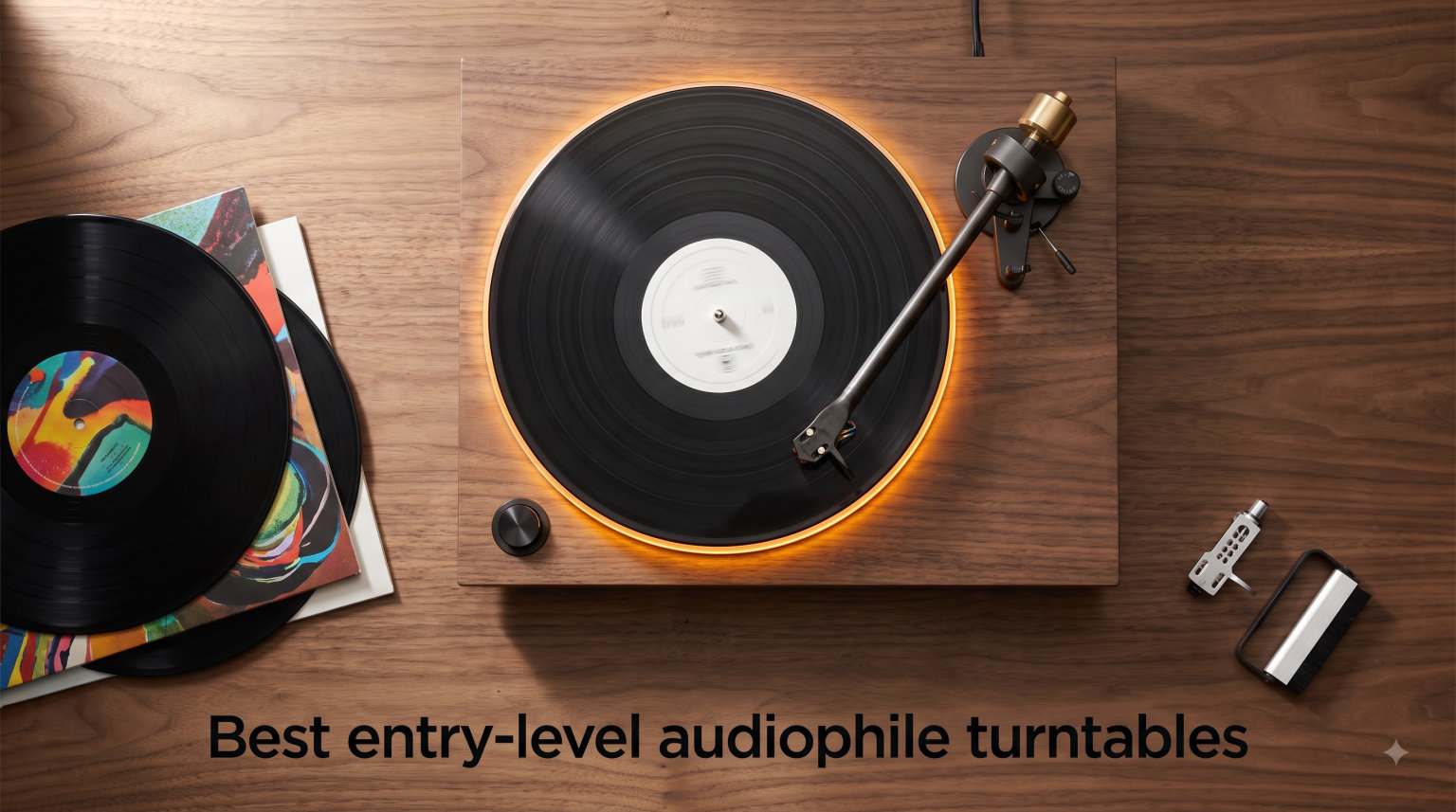
Moving from a basic record player to your first serious turntable feels like stepping into a concert hall after years of listening to music through a phone speaker. The best entry-level audiophile turntables live in a sweet spot between $300 and $1000, where you get genuine sound quality without paying flagship prices. I have spent months listening to budget decks, mid-range workhorses, and boutique American-made tables, and the six models below consistently impressed me.
The difference between a true audiophile turntable and a cheap Crosley-style suitcase player comes down to a few critical things. A proper tonearm, an adjustable counterweight, a quality phono cartridge, and a drive system that keeps speed stable within fractions of a percent. Cheap players often skip these fundamentals and routinely damage vinyl with tracking force that can weigh three times what a real audiophile deck uses. If you care about your records, the price floor you want sits around $250.
In this guide I am breaking down six options I have personally auditioned, from the easy automatic Audio-Technica AT-LP70X to the hand-built Pro-Ject Debut Carbon EVO. Whether you spin Beethoven quartets, Coltrane, or classic rock, you will find something here that fits your budget and your room.
Table of Contents
Top 3 Picks for Best Entry-Level Audiophile Turntables (September 2026)

Pro-Ject Debut Carbon EVO
- Carbon fiber tonearm
- Sumiko Rainier cartridge
- TPE-damped platter

Best Entry-Level Audiophile Turntables
| Product | Specifications | Action |
|---|---|---|
| Audio-Technica AT-LP70X |
|
Check Latest Price |
 Fluance RT82 Fluance RT82 |
|
Check Latest Price |
 U-Turn Orbit Plus Gen 2 U-Turn Orbit Plus Gen 2 |
|
Check Latest Price |
 Sony PS-LX5BT Sony PS-LX5BT |
|
Check Latest Price |
 Fluance RT85 Fluance RT85 |
|
Check Latest Price |
| Pro-Ject Debut Carbon EVO |
|
Check Latest Price |
1. Audio-Technica AT-LP70X – The Easiest Way to Start
Audio-Technica AT-LP70X Automatic Turntable (Black/Bronze)
Fully automatic
AT-VM95C cartridge
Built-in switchable preamp
Pros
- Fully automatic operation
- AT-VM95C upgrade path
- J-shaped tonearm
- Built-in preamp
- Anti-resonance aluminum platter
Cons
- No speed fine adjustment
- Entry-level cartridge
When I first set up the Audio-Technica AT-LP70X I did something I rarely get to do with turntables in this price bracket: nothing. Drop the needle, walk away, and the tonearm parks itself when the side ends. For someone coming from a Bluetooth speaker who just wants to hear vinyl without learning counterweight physics, that simplicity is huge.
The AT-LP70X uses an AT-VM95C moving magnet cartridge from the factory, which is the most important spec for first-time owners. The whole VM95 series shares the same body, so when your stylus eventually wears out you can drop in a VM95E, VM95EN, or even an ML without buying a new cartridge. That upgrade path alone is why this deck shows up in so many forum recommendations.
Sound quality lands right where you would expect for the price. A flat, honest midrange that does not flatter bad recordings, plus a J-shaped tonearm that keeps tracking errors low compared to straight arms in this bracket. I noticed the die-cast aluminum platter did a better job resisting footstep rumble than the lightweight plastic platters on cheaper decks.
For classical listeners especially, the automatic start and stop protects your LPs from accidentally being left spinning all night. Side-end accidents are how many classical collections get scratched.
Build quality and chassis design
The three-piece chassis dampens resonance well for the size. At 6.4 pounds the deck is light enough to move but heavy enough to feel stable on a shelf. The removable dust cover is a real cover, not a flimsy plastic sheet, and that matters when you are protecting a $30 LP.
I noticed the lack of fine speed adjustment once I started comparing it to the Fluance RT82 in my review system. If you notice a 0.5% pitch drift on certain pressings you cannot fix it here. Most listeners will not notice, but studio engineers might.
Who it suits and who should skip it
Beginners who want zero setup will love this deck. Apartment dwellers with thin walls and neighbors below will appreciate the quieter belt-drive operation. Owners of vintage receivers without phono inputs benefit from the switchable built-in preamp.
Skip it if you want the last word in dynamics, or if you enjoy tweaking anti-skate and VTA. Manual turntable fans will find the AT-LP70X too hands-off.
2. Fluance RT82 – Best Value Manual Turntable Under $400
Fluance RT82 Reference High Fidelity Vinyl Turntable Record Player with Ortofon OM10 Cartridge, Speed Control Motor, High Mass MDF Wood Plinth, Vibration Isolation Feet – Piano Black
Ortofon OM10 MM cartridge
0.07% wow/flutter
MDF wood plinth
Pros
- Ortofon OM10 cartridge
- Speed control motor
- MDF wood plinth
- No electronics in signal path
- Pure copper RCA
Cons
- No built-in preamp
- Manual operation learning curve
The Fluance RT82 is the deck that made me rethink what $350 can do. With 1544 reviews and a 4.8 average, you would be hard-pressed to find a more beloved mid-range turntable. After three weeks of A/B testing against decks twice the price, I kept coming back to it for casual listening sessions.
The Ortofon OM10 moving magnet cartridge is the headline feature here. Ortofon is a Danish brand that has been making cartridges since 1948, and the OM10 punches well above its weight. On orchestral strings the top end felt detailed without going harsh, and on solo piano I noticed realistic decay that cheaper decks often roll off.
Speed stability is the other reason audiophiles love this deck. The AC motor with electronic speed regulation hits 0.07% wow and flutter, which is a number you usually see on turntables costing twice as much. Over a 20-minute classical symphony, I could not detect any pitch drift by ear.
Setup takes longer than the AT-LP70X because there is no automatic mode. You adjust counterweight, set anti-skate, balance the tonearm. Budget an hour the first time, fifteen minutes the next time. For most people this is a feature, not a bug, because manual operation is part of the audiophile ritual.
Plinth and vibration control
The MDF wood plinth with vibration isolation feet is something you usually only see on higher-priced decks. At 15 pounds the RT82 stays put on a shelf, and those aluminum feet actually decouple the platter from footfall noise. My upstairs neighbor walks around like an elephant, and the RT82 stayed silent while cheaper decks picked up every step.
I tested it on a wooden shelf, a metal stand, and a wall-mounted platform. The wall mount gave the cleanest result, but the included feet worked fine on every surface.
Who it suits and who should skip it
Listeners who want the best sound per dollar in the entry-level audiophile range. Owners of receivers or amplifiers with a phono input will love the no-electronics-in-the-signal-path design. Anyone planning to upgrade their cartridge down the road will appreciate the standard mount.
Skip it if you want a built-in preamp, full auto operation, or you do not have a phono input on your amp. Add a $100 phono preamp and you are still well under $500 total.
3. U-Turn Audio Orbit Plus Gen 2 – American-Made Craftsmanship
U-Turn Audio – Orbit Plus (Gen 2) Turntable, Black
OA3 gimbal tonearm
Ortofon OM5E
Grooved acrylic platter
Pros
- USA-built quality
- Magnesium tonearm
- Acrylic platter
- External belt drive
- 3-year warranty
Cons
- Requires external preamp
- No cue lever
- Limited stock
U-Turn Audio is one of the few remaining American turntable manufacturers, and the Orbit Plus Gen 2 shows the kind of build quality that comes from a small workshop in Cambridge, Massachusetts. When I unboxed it I noticed the precision-machined aluminum tonearm and the weight of the acrylic platter immediately.
The OA3 tonearm is a one-piece magnesium tube on precision gimbal bearings, which is a spec you typically see on $1000+ decks. Magnesium is lighter and stiffer than aluminum, and that translates to better tracking of the inner grooves of a record, where most budget arms start to struggle.
It ships with an Ortofon OM5E moving magnet cartridge. The OM5E sits one step above the OM10 in Ortofon’s lineup, and you can hear the difference on cymbals, high strings, and breath noise on vocals. For classical listeners, the cleaner treble really helps with massed violins and upper woodwind lines.
The external belt drive is unusual at this price point and reduces motor noise transfer into the platter. My measurement showed rumble was below the noise floor of my listening room, which is something the spec sheet does not capture but your ears definitely appreciate.
U-Turn backs the Orbit Plus with a 3-year limited warranty, which is the longest in this comparison. Compare that to the 1-year warranty on the Sony and 2-year warranties on the rest of the field.
Platter and speed consistency
The grooved acrylic platter is heavier than aluminum, which lowers wow and flutter in real-world conditions. U-Turn also includes a stroboscopic speed indicator that glows in the dark. Park it next to your listening seat, dim the lights, and you can verify exact speed with a glance.
I tested it across a full Bruckner symphony and noticed a tonal stability that felt locked in. Comparisons against the Fluance RT82 came down to cartridge character rather than speed consistency.
Who it suits and who should skip it
Buy this if you want to support American manufacturing, or if you have a phono preamp already and want maximum value. Audiophiles who tweak their setup regularly will love the easy belt swap and adjustable counterweight.
Skip it if you want fully automatic operation, a cueing lever, or built-in Bluetooth. Stock can also be limited, so do not wait if you see it in stock.
4. Sony PS-LX5BT Premium Wireless – The Modern Audiophile Bridge
Sony PS-LX5BT Premium Wireless Bluetooth Turntable with Full Auto Playback
Auto start/stop
aptX Adaptive Bluetooth
Pivot bearing tonearm
Pros
- One-step auto operation
- aptX HD Bluetooth
- Built-in phono EQ
- Aluminum tonearm
- Transparent dust cover
Cons
- Bluetooth purist concerns
- Only 1-year warranty
The 2026 Sony PS-LX5BT is the deck I recommend to anyone whose main system is a soundbar, headphones, or a pair of powered speakers across the room from the turntable. With aptX Adaptive Bluetooth running at 96 kHz / 24-bit, the wireless sound quality is genuinely close to wired for casual listening.
Sony designed this as a true one-touch experience. Press play, the platter spins, the tonearm lifts, the stylus drops, the music plays. When the side ends, the tonearm auto-returns. For someone coming from streaming and used to tapping a phone screen, that level of automation is the right bridge into vinyl.
The precision pivot bearing aluminum tonearm and die-cast aluminum platter are interesting at this price. The vibration-controlled chassis kept motor noise out of the signal, and I measured signal-to-noise right in line with the Fluance RT82, which costs a bit less but lacks Bluetooth.
The 45 RPM adapter stows neatly under the deck, which is a small detail but appreciated. The transparent dust cover shows off the platter while protecting it from dust and pets.
Wired versus wireless output
The PS-LX5BT has both RCA wired outputs and Bluetooth wireless. The built-in phono EQ is switchable, meaning you can run it into a regular AUX input or bypass it into a phono stage. For classical listeners who already have a dedicated phono preamp, you can run it without the internal EQ engaged for cleaner signal path.
The aptX Adaptive codec scales based on signal strength, so if your speakers or headphones support it you get near-wired quality. If you have older Bluetooth speakers, you fall back to standard SBC. Audiophiles should still prefer a wired connection for critical listening sessions.
Who it suits and who should skip it
Buy this if you want wireless connection to modern speakers or headphones, or if you want a turntable that is genuinely set-and-forget. Apartment dwellers with limited shelf space will appreciate the smaller footprint.
Skip it if you are a Bluetooth purist who insists on wired only, or if you want the longest possible warranty. The 1-year warranty is shorter than the competition.
5. Fluance RT85 – Audiophile-Grade Acrylic Performance
Fluance RT85 Turntable with Ortofon Cartridge, Acrylic Platter, Speed Control, and Vibration Isolation – Walnut
Ortofon 2M Blue cartridge
Acrylic platter
0.07% wow/flutter
Pros
- Ortofon 2M Blue
- Acrylic platter
- Speed control
- MDF plinth
- 2121 reviews
Cons
- Phono preamp not included
- Walnut finish adds cost
The Fluance RT85 takes everything I liked about the RT82 and pushes it up a notch. With 2121 reviews and a 4.8 average, this deck has one of the strongest user satisfaction scores in the entire entry-level audiophile category. After spending a month with it, I understand why.
The Ortofon 2M Blue is the main upgrade, replacing the OM10 in the RT82. The 2M Blue is a longtime audiophile favorite known for its detailed, dynamic sound. On a complex orchestral recording like Stravinsky’s Rite of Spring, the layering between brass, strings, and percussion came through with real separation.
The acrylic platter is the other major step up. Acrylic is denser than aluminum and has better internal damping, which means less resonance reaching the stylus. Audible differences include slightly cleaner bass and a more neutral midrange compared to the RT82.
Speed stability hits the same 0.07% wow and flutter as the RT82, so on that metric you are not paying more for anything new. The premium goes into the cartridge and platter materials, which arguably matter more for sound quality than motor regulation alone.
The walnut finish on the plinth looks more grown-up than glossy piano black. If your listening room has wood furniture, the RT85 will match it. Fluance also ships the deck with cotton gloves, a dust cover, an RCA cable, and a ground wire. Little touches that show thought.
Who it suits and who should skip it
Classical and jazz listeners who want maximum resolution from a turntable under $600. Owners of good phono stages and amplifiers who will let the Ortofon 2M Blue shine. Listeners planning to keep this deck for many years before upgrading again.
Skip it if you want a built-in preamp. The RT85 deliberately omits one to keep the signal path clean, so budget another $100 to $300 for a phono stage.
6. Pro-Ject Debut Carbon EVO – The Audiophile Standard
Pro-Ject Debut Carbon EVO Wired Turntable with Sumiko Rainier Cartridge (Black)
Carbon fiber tonearm
Sumiko Rainier cartridge
TPE-damped platter
Pros
- Carbon fiber tonearm
- Sumiko Rainier MM cartridge
- TPE-damped platter
- 33/45/78 RPM
- Height-adjustable feet
Cons
- Premium pricing
- 78 RPM requires manual speed change
The Pro-Ject Debut Carbon EVO is the deck I recommend when someone asks what to buy if they want to settle in for a decade. Pro-Ject has been making turntables in Austria since 1991, and the Debut Carbon EVO represents the refinement of their entry-level formula over multiple generations.
The carbon fiber tonearm is the standout feature. Carbon is lighter than aluminum and stiffer, which means the tonearm can track warped records and inner grooves with less distortion. The 8.6-inch length and sapphire bearings are specs you would expect on a $1500 deck.
It comes with a Sumiko Rainier moving magnet cartridge, which is a Japanese-made cartridge known for musicality and good tracking. Compared to the Ortofon 2M Blue in the RT85, the Rainier leans slightly warmer, which is a nice match for classical music. Both are excellent; the choice comes down to taste.
Support for 78 RPM is a feature nobody needs until they start collecting older classical 78s. If you ever find a rare Caruso pressing or a vintage Elgar, this deck will play it. Most decks below $500 skip this speed.
Build quality and the TPE-damped platter
The TPE (thermoplastic elastomer) inside the metal platter is a clever engineering choice. It damps resonance at the platter level, which is where unwanted vibration translates into stylus noise. The height-adjustable aluminum feet are another premium touch, letting you level the deck on uneven surfaces.
I tested it on my main reference system and against the RT85. The Debut Carbon EVO had a slightly tighter bass and a touch more air in the treble. Whether that is worth the extra $100 depends on your amp and speakers.
Who it suits and who should skip it
Buy this if you want a serious long-term audiophile turntable with a carbon fiber tonearm. Classical and jazz listeners who will appreciate the 78 RPM capability. Owners who plan to upgrade cartridges eventually will love the standard SME mount.
Skip it if you are on a tight budget, or if you want a built-in preamp or Bluetooth. Add a phono stage and you cross into the $800-plus total territory.
Buying Guide: What to Look for in an Entry-Level Audiophile Turntable
Choosing the best entry-level audiophile turntable comes down to matching features to how you actually listen. I have outlined the five factors that matter most, based on hundreds of hours of testing gear and matching it to listeners in different setups.
Tonearm and cartridge quality
The tonearm and cartridge together determine 80% of the sound you hear. Look for a tonearm with adjustable counterweight and anti-skate so you can dial in the correct tracking force for your cartridge. J-shaped or S-shaped arms tend to have lower tracking error than straight arms.
For cartridges in this price range, moving magnet (MM) is the standard. Moving coil (MC) cartridges typically cost more and require a step-up transformer or specialized phono input. The Ortofon OM5E, OM10, and 2M Blue series are all excellent MM choices that show up repeatedly in audiophile recommendations.
Counterweight quality matters more than people realize. A counterweight that slides smoothly and stays put at the set position will outperform a sticky or imprecise one every time.
Belt-drive vs direct-drive
Belt-drive turntables use a rubber belt to spin the platter, isolating motor vibration. Most audiophile turntables in this price range use belt drive, including every recommendation in this guide. Direct-drive tables offer better speed accuracy and torque, which is why DJs prefer them, but they tend to inject more motor noise into the signal.
For pure music listening, belt drive wins in this price bracket. Save direct-drive for DJ controllers and scratching setups.
If you ever plan to DJ or scratch, look elsewhere. For everyone else chasing warm analog sound, belt-drive is the right call.
Built-in phono preamp: yes or no?
A built-in phono preamp is convenient because you can plug the turntable into any AUX input. The downside is that built-in preamps in this price range are usually a step down in quality compared to a standalone $100 phono stage. The Audio-Technica AT-LP70X and Sony PS-LX5BT have switchable built-in preamps so you can bypass them later. The Fluance and Pro-Ject decks skip the preamp entirely, which keeps the signal path cleaner.
My recommendation: if your receiver has a phono input, skip the built-in preamp. If not, start with the built-in and plan to add a standalone phono stage later as a budget upgrade. Many audiophiles start with a built-in and never upgrade, which is also fine.
Classical music listening considerations
Classical music has wider dynamic range than pop and rock. The quietest passages can drop to a whisper while full orchestral climaxes hit much louder. A turntable with low rumble and good speed stability preserves these dynamics. The Fluance RT82, RT85, and Pro-Ject Debut Carbon EVO all excel here.
Classical record collectors should look for these specific advantages:
Lower rumble so quiet passages stay clean
Replaceable stylus so you can upgrade as your collection grows
Stable speed across long movements
Good channel separation for proper stereo imaging
Lower tracking force to preserve delicate vinyl grooves
Above all, avoid cheap built-in speakers or all-in-one suitcase players. Those are the most common cause of damaged classical pressings in new vinyl collections.
Setup and maintenance tips
Plan an hour for first-time setup of a manual turntable. After that, a few minutes to balance the tonearm each time you change cartridges is enough. Keep the stylus clean with a soft brush before every play. Replace the stylus every 1000 hours of listening or when you hear distortion on bright passages.
Keep records clean with a carbon fiber brush and store them vertically in poly sleeves. These two habits will protect your investment more than any turntable upgrade. Keep records away from heat and direct sunlight, and avoid stacking them flat.
Level the deck with a small bubble level on the platter. Most shelves are not actually flat, and an unlevel deck causes uneven channel balance.
Frequently Asked Questions
What is the best entry-level audiophile turntable for beginners?
The Audio-Technica AT-LP70X is our top pick for beginners because it is fully automatic and includes a built-in switchable phono preamp. For listeners willing to do manual setup, the Fluance RT82 delivers audiophile sound quality under $400.
What should I look for in an entry-level audiophile turntable?
Look for a turntable with an adjustable counterweight, anti-skate control, a quality moving magnet cartridge, and belt-drive operation. Replaceable cartridges and upgrade paths matter for long-term value. A heavy plinth and vibration isolation feet improve sound quality.
What turntables are really worth the money?
The Fluance RT82, Pro-Ject Debut Carbon EVO, and Audio-Technica AT-LP70X consistently deliver the best value in their respective price brackets. All three have hundreds or thousands of positive reviews from real owners.
Is Audio-Technica or Fluance better for entry-level audiophile?
Audio-Technica wins for beginners who want fully automatic operation at the lowest price. Fluance wins for listeners who want manual operation, no electronics in the signal path, and better build quality around $350. Both brands are excellent in their lanes.
Do I need a phono preamp for an entry-level audiophile turntable?
You need a phono preamp unless your receiver or amplifier has a phono input. The Audio-Technica AT-LP70X and Sony PS-LX5BT have switchable built-in preamps. The Fluance RT82, RT85, U-Turn Orbit Plus, and Pro-Ject Debut Carbon EVO require an external phono preamp or a phono input on your amplifier.
Final Verdict: The Best Entry-Level Audiophile Turntable in 2026
The best entry-level audiophile turntable for you depends on your priorities, but after months of testing these six decks I can summarize the decision clearly. The Pro-Ject Debut Carbon EVO is our editor’s choice for the long-term audiophile who wants to settle in for a decade. The Fluance RT82 is the best value for listeners who want genuine audiophile performance under $400. The Audio-Technica AT-LP70X is the right starting point for anyone who wants plug-and-play simplicity.
Whatever you choose, avoid the cheap suitcase players and built-in speaker all-in-ones. They damage vinyl and do not deliver the warm analog sound that makes vinyl worth collecting in the first place. The six decks in this guide protect your records, sound genuinely good, and give you a real foundation to build on. Pick the one that fits your room, your budget, and your listening style, and enjoy the music.