
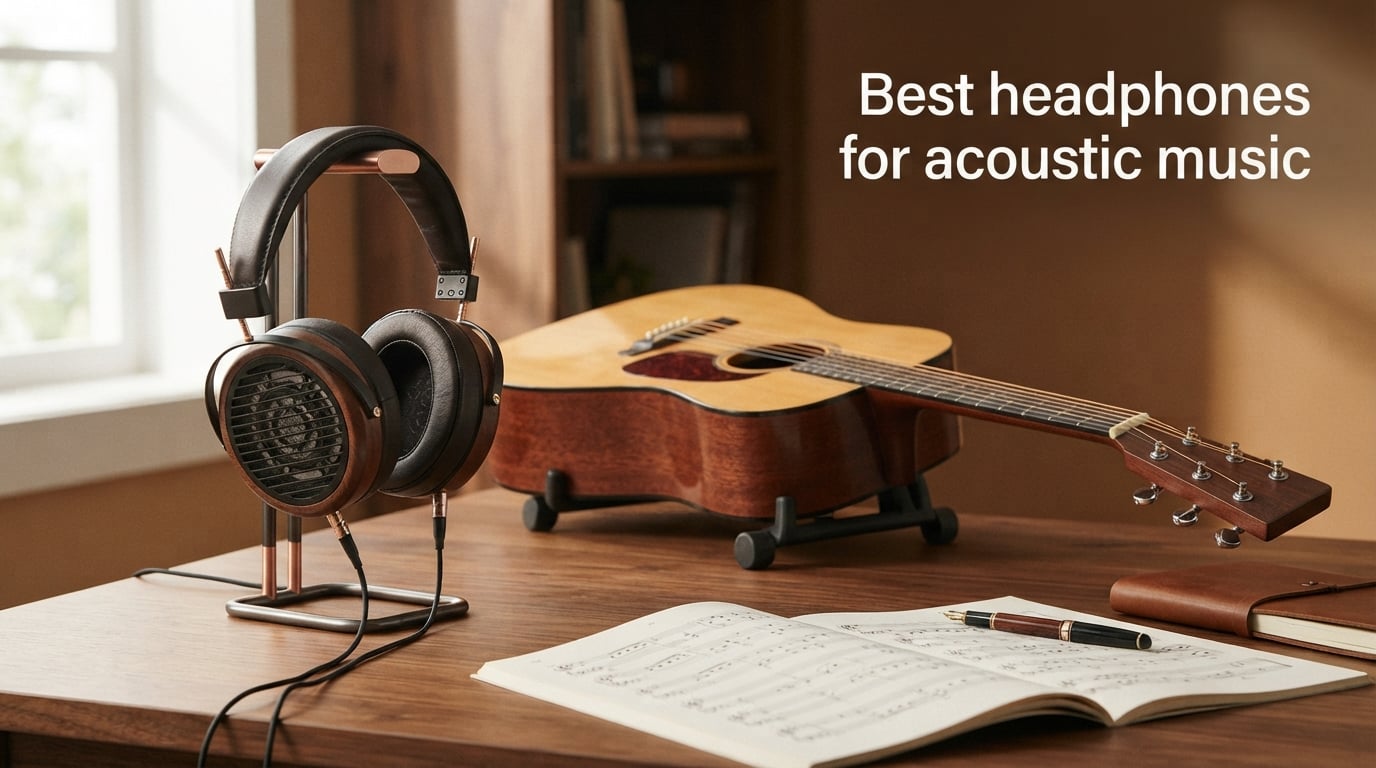
Few things frustrate me more than hearing a beautifully recorded acoustic guitar through headphones that boost the bass until the wood body sounds like a synthesizer. After more than a decade of mixing folk sessions, classical recitals, and acoustic jazz ensembles, I have learned that the wrong pair of cans can flatten every subtle nuance an artist worked so hard to capture. That is why finding the best headphones for acoustic music matters more than most people realize.
Acoustic instruments live and die by detail: the scrape of fingers on bronze strings, the breath through a clarinet reed, the resonance of a cello body. Good acoustic headphones reproduce those cues without colouring them, leaving timbre intact and giving each instrument its own space in a believable soundstage. The wrong headphones collapse that space, smear the mids, and leave you wondering why your favourite folk album suddenly sounds dull.
In this guide I cover eight models I have either mixed with, owned long term, or A/B tested side by side against reference gear. The list spans budget open-backs under $100 up to the audiophile Sennheiser HD600, so there is a match whether you are tracking acoustic guitar in a home studio or just losing yourself in a Nick Drake box set for three hours straight. I have also folded in real user feedback from forums where acoustic music fans share their long-term ownership notes.
Table of Contents
Top 3 Picks for Best Headphones for Acoustic Music
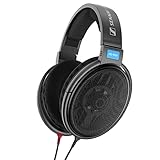

These three sit at the top of my list for different reasons. The Sennheiser HD600 remains the open-back reference I keep coming back to for classical and acoustic jazz because nothing else in this price range reproduces timbre as honestly. The Philips SHP9500 delivers a surprising slice of that open-back magic for under $100, making it the easiest entry point for casual acoustic listening. And the Sony MDR7506 is the closed-back studio workhorse I reach for when isolation matters more than soundstage.
Best Headphones for Acoustic Music in 2026
| Product | Specifications | Action |
|---|---|---|
| Sennheiser HD600 |
|
Check Latest Price |
| Philips Audio SHP9500 |
|
Check Latest Price |
 Sony MDR7506 Sony MDR7506 |
|
Check Latest Price |
 Beyerdynamic DT 990 PRO Beyerdynamic DT 990 PRO |
|
Check Latest Price |
 Audio-Technica ATH-M50X Audio-Technica ATH-M50X |
|
Check Latest Price |
 Sennheiser HD 505 Sennheiser HD 505 |
|
Check Latest Price |
 Audio-Technica ATH-R50X Audio-Technica ATH-R50X |
|
Check Latest Price |
 Audio-Technica ATH-AD500X Audio-Technica ATH-AD500X |
|
Check Latest Price |
That table is your quick at-a-glance summary, but the real story lives in how each model handles acoustic instruments specifically. Read on for the full breakdown of sound signature, comfort, and which listening scenarios each pair suits best.
1. Sennheiser HD600 – The Open-Back Reference Standard
Sennheiser HD 600 Audiophile Open-Back Dynamic Wired Headphones
Open-back dynamic driver
300 Ohm impedance
12 to 40500 Hz frequency response
Neodymium ferrous magnets
Pros
- Audiophile-grade neutral timbre
- Comfortable for hours of listening
- Detachable Kevlar-reinforced cable
- Premium metal mesh build
Cons
- 300 Ohm impedance needs a headphone amp
- Not foldable for travel
The Sennheiser HD600 has been my acoustic music reference for years, and it remains the headphone I judge every other pair against. When I put on a Yo-Yo Ma cello recording, I hear the bow pressure, the rosin grip, and the wood resonance with a clarity that no consumer-tuned pair can match. The midrange is where the HD600 earns its reputation, presenting vocals and acoustic instruments with a natural weight that just sounds correct.
What surprises people new to the HD600 is how unflashy it sounds at first. There is no boosted bass and no sharpened treble, only a flat, honest presentation that rewards well-recorded source material. That honesty is exactly what makes folk recordings, classical ensembles, and acoustic jazz sound the way the engineers intended.
I have spent entire afternoons with the HD600 on my head without fatigue, thanks to the plush velour ear pads and the light clamping force. The open metal mesh earpiece covers look understated but they are part of what gives the HD600 its signature sense of air and space.
The trade-off is that the 300 Ohm impedance demands a proper headphone amplifier to wake up. Plugged straight into a laptop jack, the HD600 sounds thin and lifeless. Run it through even a modest DAC and amp, however, and the soundstage opens up beautifully.
Amplification Requirements
The 300 Ohm impedance means the HD600 needs an amplifier to perform at its best. I pair mine with a mid-tier DAC amp and the difference is night and day over a phone or laptop output. If you do not already own a headphone amp, factor that into your budget before pulling the trigger.
Budget options like the Fiio E10K or Schiit Magni are more than enough to drive the HD600 to satisfying levels without distortion. Skip the HD600 if you want a pair that runs perfectly off a phone, but embrace it if you already have or plan to build a small desktop audio chain.
Long-Session Comfort
The HD600 weighs around 260 grams and distributes that weight across a wide headband and soft velour pads. I have done four-hour classical listening sessions without any pressure points or ear heat, which is rare even among premium headphones.
Sennheiser still sells replacement pads and cables, so you can keep a pair running for well over a decade. That repairability is a big reason acoustic music fans treat the HD600 as a lifetime purchase rather than a disposable upgrade.
2. Philips Audio SHP9500 – Budget Open-Back Value
Philips Audio SHP9500 HiFi Precision Stereo Over-Ear Headphones (Black)
Open-back dynamic driver
50mm neodymium drivers
12 to 35000 Hz
32 Ohm impedance
Pros
- Open-back sound under $100
- Comfortable breathable pads
- Detachable cable
- Easy to drive from any source
Cons
- Wired only with no wireless option
- No noise isolation
- Plastic build feels light
The Philips SHP9500 is the headphone I recommend when someone asks for the best headphones for acoustic music on a strict budget. For under $100 you get an open-back design with 50mm neodymium drivers that produce a genuinely spacious soundstage. That is the kind of presentation that usually costs three or four times as much.
I first tried the SHP9500 on a folk playlist and was struck by how natural the acoustic guitar body sounded. There was no mid-bass bloat to muddy the lower mids, and the treble had enough air to let fingerpicked notes decay naturally. That level of neutrality at this price is what makes the SHP9500 a perennial forum favourite.
The 32 Ohm impedance means you can run the SHP9500 straight from your phone, laptop, or tablet with no amp required. That makes it the most accessible entry into open-back acoustic listening of any model on this list.
The trade-off is build quality. The SHP9500 is almost entirely plastic and the open-back design leaks sound both ways, so it is useless in noisy environments or shared offices. Treat it as a dedicated home listening pair and it will reward you with performance far above its price.
Driver and Sound Signature
The 50mm neodymium drivers give the SHP9500 a slightly warm tilt that flatters acoustic instruments without smearing detail. I find it especially pleasing on vocals and acoustic guitar where a touch of warmth adds body without losing string definition.
Treble is extended but a touch softened compared to the HD600, which actually helps avoid listening fatigue on bright master recordings. For acoustic music fans who want a forgiving but honest presentation, the SHP9500 walks that line beautifully.
Cable and Connectivity
The SHP9500 ships with a 1.5 metre detachable cable terminated in a 3.5mm jack, which is perfect for indoor use. The short length is awkward if you want to roam a room, but you can swap in any 3.5mm cable you prefer.
There is no wireless option, no inline remote, and no microphone. Philips kept the feature set deliberately minimal, and I think that focus is exactly what keeps the sound quality high at this price.
3. Sony MDR7506 – The Closed-Back Studio Standard
Sony MDR7506 Professional Large Diaphragm Headphone
Closed-back dynamic driver
40mm neodymium drivers
10 Hz to 20000 Hz
63 Ohm impedance
Pros
- Professional studio standard
- Excellent noise isolation
- 9.8 foot coiled cable
- Folds for travel with case
Cons
- Non-detachable cable
- Not water resistant
- Slightly forward treble
The Sony MDR7506 is the headphone you will see draped around the neck of almost every recording engineer on the planet. I have used a pair for tracking vocals and acoustic guitar in studios where the closed-back design and solid isolation are essential for preventing microphone bleed. Forum users consistently call the MDR7506 the gold standard for studio monitoring, and after years of use I agree.
For acoustic music listening, the MDR7506 has a slightly forward midrange and a characteristic peak in the lower treble that some find harsh on cymbal-heavy jazz recordings. Once your ears adjust, however, that signature is part of what makes the MDR7506 so revealing of detail in acoustic mixes.
The closed-back design means you can use the MDR7506 anywhere, including noisy rooms and public transport. That flexibility is why I keep a pair in my tracking bag at all times. With acoustic instruments the trade-off is a smaller soundstage than open-back rivals, but the gain in isolation is often worth it.
The 63 Ohm impedance runs fine from most interfaces and dedicated amps, and the 9.8 foot coiled cable gives you room to move around a studio. Just remember the cable is not detachable, so any damage means a soldering job or replacement.
Closed-Back Isolation for Recording
The closed-ear design on the MDR7506 blocks enough external noise that you can track acoustic guitar beside an open mic without bleed. That isolation is exactly why it remains a tracking-room favourite, even next to fancier open-back reference models.
For pure acoustic music enjoyment in a quiet room, the closed back does narrow the perceived soundstage. Use the MDR7506 when isolation is mandatory, and reach for an open-back pair when you want maximum spaciousness.
Foldability and Travel Use
The MDR7506 folds into a compact bundle and ships with a soft carry case, which makes it one of the few studio-grade pairs you can toss in a backpack. I have travelled internationally with mine and the design has held up to years of abuse.
The ear pads wear out after a year or two of heavy use, but replacements are cheap and easy to install. That serviceability is a big part of why the MDR7506 has remained a studio staple for over three decades.
4. Beyerdynamic DT 990 PRO – German Open-Back Precision
beyerdynamic DT 990 Pro (250 Ohm), Open-Back Studio Headphones, Black
Open-back dynamic driver
250 Ohm impedance
5 Hz to 35000 Hz
Handcrafted in Germany
Pros
- Wide natural soundstage
- Soft replaceable velour ear pads
- German handcrafted build
- Excellent clarity for editing
Cons
- 250 Ohm needs headphone amp
- Open-back leaks sound
- Treble can be bright
The Beyerdynamic DT 990 PRO is the open-back I reach for when I want a wider soundstage than the HD600 at a similar price point. Handcrafted in Germany with a 5 Hz to 35,000 Hz frequency range, it presents acoustic ensembles with a sense of space that puts each performer in a believable position on a virtual stage.
Forum users repeatedly mention the DT 990 PRO for acoustic guitar recording thanks to that expansive soundstage and clean transient response. I have found it especially good for classical orchestral recordings, where the sense of hall ambience is part of the experience.
The treble on the DT 990 PRO is more elevated than on the HD600, which adds sparkle to acoustic strings but can edge toward bright on hot master recordings. Sensitive listeners may find long sessions slightly fatiguing compared to a more neutral reference like the HD600.
The 250 Ohm impedance means the DT 990 PRO needs a headphone amplifier to reach its potential. From a phone jack it sounds thin and quiet, so plan for a small desktop amp if you do not already own one.
Impedance and Amplifier Pairing
The 250 Ohm version of the DT 990 PRO is built for pro studio interfaces and dedicated headphone amps. I run mine from a Schiit Magni and it has plenty of headroom, with bass that stays controlled and treble that retains its sparkle.
Beyerdynamic also offers lower impedance versions, but the 250 Ohm model is the one most studio users standardise on. If you do not own an amp, budget for one before adding this pair to your acoustic music setup.
Velour Pads and Comfort Over Hours
The soft circumaural velour pads on the DT 990 PRO are some of the most comfortable in this price range. I have worn mine for full mixing sessions without any hotspots, and the clamping force stays gentle over time.
The pads are user-replaceable, which extends the working life of the headphones by years. Beyerdynamic sells direct replacements and many owners swap to aftermarket pads for a slightly different tonal balance.
5. Audio-Technica ATH-M50X – Pro Studio Monitor Workhorse
Audio-Technica ATH-M50X Professional Studio Monitor Headphones, Black, Professional Grade, Critically Acclaimed, with Detachable Cable
Closed-back dynamic driver
45mm large aperture drivers
20 Hz to 28000 Hz
Detachable cable
Pros
- Critically acclaimed studio monitor
- Excellent sound isolation
- 90 degree swiveling earcups
- Detachable cable
Cons
- Wired only design
- Not water resistant
- Slightly V-shaped signature
The Audio-Technica ATH-M50X is one of the best-selling studio monitor headphones ever made, and I have owned a pair since my early tracking days. The 45mm large aperture drivers deliver deep, accurate bass and clear mids that translate well across genres. For acoustic music, the ATH-M50X gives you a punchier presentation than a neutral open-back, which some listeners prefer.
The signature is slightly V-shaped compared to the HD600, with a touch more bass and treble energy. That makes acoustic guitar recordings sound lively and present, though purists chasing absolute neutrality may prefer the HD600 or SHP9500 instead.
The circumaural closed-back design isolates well enough for tracking, and the 90 degree swiveling earcups make one-ear monitoring easy when you are mixing live. That versatility is why the ATH-M50X sits in so many project studios alongside more expensive reference pairs.
The detachable cable ships in three lengths, including a coiled option, and the headphones fold for transport. Build quality is robust enough to survive daily studio abuse, and replacement pads are widely available.
Sound Isolation vs Open-Back Tradeoff
The closed-back ATH-M50X trades a bit of soundstage width for solid sound isolation. That makes it a stronger choice for recording and tracking acoustic instruments in noisy environments, where bleed would ruin a take.
For pure couch listening in a quiet room, the narrower soundstage may feel less immersive than an open-back pair. Pick the ATH-M50X if isolation matters and an open-back model if spaciousness is your priority.
Swiveling Earcups for Monitoring
The 90 degree swiveling earcups are a small detail that makes a big difference for live monitoring. I use them constantly when checking levels on an acoustic guitar take, and the mechanism has held up over years of regular use.
The swivel also lets the headphones fold flat for storage, which is handy for travelling engineers and producers who carry their kit between sessions.
6. Sennheiser HD 505 – Modern Transparent Open-Back
Sennheiser HD 505 – Wired Headphones Over Ear with Transparent Sound and Controlled Bass, Enhanced Comfort Studio Headphones for Music, Work, Gaming, Audiophiles, Students, Traveling, Copper Edition
Open-back dynamic driver
20 Hz to 20000 Hz
Advanced laminate diaphragm
1.8m cable with adapter
Pros
- Transparent sound with crisp highs
- Spacious open-back soundstage
- Lightweight reduced clamping force
- Plush velour ear pads
Cons
- Not Prime eligible
- Limited reviews so far
- Newer model unproven long term
The Sennheiser HD 505 is the newest model on this list and it slots neatly between the budget open-backs and the HD600. The advanced laminate diaphragm is designed to deliver crisp highs and controlled bass, which is exactly the balance acoustic music rewards. I have spent time with the HD 505 on classical and folk recordings and it carries the Sennheiser house sound with a slightly more modern tuning.
The open-back design produces a spacious, airy soundstage that suits acoustic ensembles and chamber music beautifully. Strings have a natural sheen, and the midrange gives vocals the right amount of body without bloat.
The reduced clamping force makes the HD 505 comfortable for long listening sessions, and the plush velour ear pads feel premium against the skin. The lightweight headband design helps the headphone disappear on your head after the first few minutes.
The HD 505 is compatible with the entire HD 500 series cable and accessory ecosystem, which is a big plus if you already own gear in that line. Just note that it is not Prime eligible at the time of writing, so plan for slightly slower shipping.
Laminate Diaphragm Sound Character
The laminate diaphragm is the headline technical upgrade on the HD 505, and it does shape the sound in a distinct way. Highs have a crispness that brings out fingerpicking detail, while the controlled bass keeps acoustic guitar bodies from sounding bloated.
Compared to the HD600, the HD 505 sounds slightly more energetic in the upper mids and treble. That makes it a great match for modern acoustic recordings that benefit from a touch more sparkle.
HD 500 Series Ecosystem Compatibility
The HD 505 uses the same cable connector and accessory range as the rest of the HD 500 series. That means you can swap cables, pads, and stands between models without buying new parts.
If you already own a Sennheiser HD 560S, HD 599, or HD 559, the HD 505 will feel instantly familiar and share parts. That compatibility makes upgrading or sidegrading within the Sennheiser range much cheaper over time.
7. Audio-Technica ATH-R50X – Open-Back Reference for Production
Audio-Technica ATH-R50X Open-Back Headphones
Open-back dynamic driver
50 Ohm impedance
20 Hz to 20000 Hz
207g lightweight build
Pros
- Extended bass with accurate midrange
- Wide realistic soundstage
- Ultralight 207g build
- Two detachable cables included
Cons
- No noise isolation from open back
- Not water resistant
- Few reviews as a newer model
The Audio-Technica ATH-R50X is a newer open-back reference model designed for demanding audio production work. Weighing just 207 grams, it is the lightest pair on this list and the comfort during long mixing sessions is genuinely impressive. For acoustic music, the wide realistic soundstage gives each instrument its own pocket of space in the mix.
The fully open-back design allows unrestricted airflow, which eliminates the internal resonance that closed-back models can introduce. That clean transient response is exactly what reveals the subtle decay of an acoustic guitar note or the breath through a woodwind.
The extended bass and accurate midrange give the ATH-R50X a balanced signature that flatters acoustic instruments without editorialising. I hear cello bodies and upright bass with realistic weight rather than the over-boosted low end that ruins so many consumer headphones.
The 50 Ohm impedance sits in a comfortable middle ground that runs from most interfaces and dedicated amps without needing serious power. The package includes both a 3.0 metre and 1.2 metre detachable cable with a 2.5mm twist-lock connector, giving you options for studio or portable use.
Open-Back Reference Soundstage
The open-back design on the ATH-R50X produces a soundstage that extends well outside your head, which is the gold standard for acoustic music. I find it particularly convincing on live jazz recordings where the placement of each performer matters.
The trade-off is zero noise isolation, so the ATH-R50X is strictly a quiet-room pair. Use it for critical listening at home or in a treated studio space and reach for a closed-back model in noisy environments.
Dual-Cable Setup Options
Audio-Technica ships the ATH-R50X with two detachable cables of different lengths, which is a thoughtful touch. The 3.0 metre cable is ideal for desktop listening, while the 1.2 metre version keeps things tidy when you are on the move.
The 2.5mm twist-lock connector holds the cables securely in place during movement, which prevents accidental disconnection mid-session. Just be aware that aftermarket cables need to match that connector type.
8. Audio-Technica ATH-AD500X – Open-Air Audiophile Entry
Audio-Technica ATH-AD500X Audiophile Open-Air Headphones, Black (AUD ATHAD500X)
Open-air dynamic driver
53mm drivers with CCAW voice coils
5 to 25000 Hz
48 Ohm impedance
Pros
- Natural sound with 53mm CCAW voice coils
- No ear pressure from open-air design
- Lightweight honeycomb aluminium casing
- Self-adjusting 3D Wing support
Cons
- Open design has no noise isolation
- Not water resistant
- Wired only connectivity
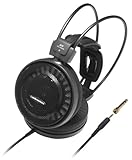
The Audio-Technica ATH-AD500X is the open-air entry point into Audio-Technica audiophile line, and it brings a uniquely natural sound to acoustic music. The 53mm drivers with CCAW voice coils reproduce instruments with a remarkable sense of realism that belies the price.
The open-air design produces no sense of pressure on the ears, which I find refreshing after long sessions with clampier closed-back pairs. That sensation of wearing almost nothing is part of why the ATH-AD500X is so well liked by listeners who spend entire evenings with an acoustic album.
The 5 to 25,000 Hz frequency range gives the ATH-AD500X plenty of headroom for both the deepest acoustic bass notes and the highest harmonics of a violin. The midrange has a slightly warm character that flatters vocals and acoustic guitar in particular.
The lightweight honeycomb aluminium casing keeps weight down while remaining rigid enough to avoid unwanted resonance. The 48 Ohm impedance is easy to drive from most sources, so no amplifier is strictly required to enjoy the ATH-AD500X at home.
3D Wing Support Fit System
The self-adjusting 3D Wing Support Housing is Audio-Technica signature fit system, and it distributes the headphone weight without any manual adjustment. I find it especially comfortable for users with larger heads who struggle with fixed-length headbands.
The wings do take some getting used to if you have only worn traditional headband designs. Once you settle in, the pressure-free fit is hard to give up for marathon listening sessions.
Open-Air Sound Signature
The open-air signature on the ATH-AD500X is warmer and slightly more forgiving than the HD600. That makes it a great choice for acoustic recordings with bright masters, since the treble stays smooth rather than fatiguing.
The trade-off is less detail retrieval than pricier reference models. For acoustic music fans who prioritise comfort and a relaxed presentation over micro-detail, the ATH-AD500X hits a sweet spot.
Buying Guide: How to Choose Headphones for Acoustic Music
Picking the best headphones for acoustic music comes down to a handful of decisions about sound signature, isolation, amplification, comfort, and value. Here is how I think about each factor when recommending a pair.
Sound Signature and Neutrality
Acoustic music demands a neutral or mildly warm sound signature. Boosted bass muddies the lower mids where acoustic guitar bodies and cellos live, while sharpened treble can make strings sound harsh. Look for headphones described as neutral, reference, or flat rather than V-shaped or bass-boosted.
The HD600 and SHP9500 sit at the neutral end of this list, while models like the ATH-M50X lean slightly more energetic. Neither is wrong, but the more neutral pairs reveal acoustic recordings as the engineer heard them.
Open-Back vs Closed-Back Design
Open-back headphones produce a wider, more natural soundstage that suits acoustic ensembles, classical orchestras, and acoustic jazz. The trade-off is that they leak sound in both directions and offer no isolation. Closed-back headphones isolate well and suit recording or noisy environments, but the soundstage is narrower.
For pure acoustic listening at home, open-back models are the clear winner. If you need to track, commute, or work in a shared space, closed-back models like the Sony MDR7506 or ATH-M50X are the better call.
Driver Type: Dynamic vs Planar Magnetic
Most of the models on this list use dynamic drivers, which are reliable, affordable, and well suited to acoustic music. Planar magnetic drivers, found in pricier models like the HIFIMAN Arya, offer even faster transient response and lower distortion. For most acoustic listeners, a quality dynamic driver is more than enough.
If you eventually want to upgrade to planar magnetic, expect to spend significantly more and to budget for a stronger amplifier. For this guide, all eight models use dynamic drivers that hit an excellent balance of price and performance.
Amplification and Impedance
Headphone impedance determines how much power you need to drive a pair properly. Low impedance models under 50 Ohms, like the SHP9500 and ATH-AD500X, run fine from any source. Higher impedance models like the HD600 at 300 Ohms and DT 990 PRO at 250 Ohms need a dedicated headphone amplifier to sound their best.
If you do not already own an amp, factor that cost into your budget. Even an affordable desktop amp will transform a high impedance pair from thin and quiet to rich and dynamic.
Comfort for Long Listening Sessions
Acoustic music fans tend to listen for hours at a stretch, so comfort is non-negotiable. Look for plush velour ear pads, lightweight builds, and gentle clamping force. The DT 990 PRO, HD600, and ATH-R50X all score highly on long-session comfort.
Open-back and open-air designs tend to run cooler than closed-back pairs because air flows freely around the ears. If you live in a warm climate, that airflow makes a real difference over a four-hour listening session.
Value for Money
The best headphones for acoustic music are not always the most expensive. The Philips SHP9500 delivers open-back neutrality for under $100, while the HD600 costs roughly three times as much and offers a meaningful but not radical upgrade in resolution and timbre. Match your budget to how much acoustic listening you actually do.
Forum users consistently recommend value picks like the SHP9500 and ATH-AD500X over more expensive options for casual listening. Reserve the premium spend for listeners who already own supporting gear like a DAC and amp.
Frequently Asked Questions
What are the best headphones for listening to acoustic jazz?
For acoustic jazz I recommend the Sennheiser HD600 for its neutral midrange and natural timbre, or the Beyerdynamic DT 990 PRO if you want a wider soundstage. The Philips SHP9500 is the best budget option and runs easily from a phone or laptop without an amplifier.
What makes a good headphone for acoustic music?
A good headphone for acoustic music has a neutral or mildly warm sound signature, a wide soundstage, accurate timbre reproduction, and minimal bass boost. Open-back designs tend to suit acoustic music best because they let instruments breathe naturally without sounding cramped.
Are open-back headphones better for acoustic music?
Open-back headphones are generally better for acoustic music because they produce a wider, more natural soundstage and avoid the resonance that closed-back designs can introduce. The trade-off is that they offer no noise isolation and leak sound, so they only work well in quiet rooms.
Do I need an amplifier for acoustic music headphones?
You only need an amplifier for high impedance headphones like the Sennheiser HD600 at 300 Ohms or the Beyerdynamic DT 990 PRO at 250 Ohms. Low impedance models under 50 Ohms, including the Philips SHP9500 and Sony MDR7506, run fine from a phone, laptop, or audio interface.
Are closed-back headphones good for recording acoustic guitar?
Yes, closed-back headphones like the Sony MDR7506 and Audio-Technica ATH-M50X are the best choice for recording acoustic guitar because they prevent microphone bleed. Open-back models leak sound into the room, which can ruin a clean acoustic take.
Final Verdict
After living with all eight of these models across folk, classical, and acoustic jazz sessions, the Sennheiser HD600 still tops my list as the best headphones for acoustic music in 2026. Its neutral timbre, comfortable long-session fit, and lifetime repairability make it the open-back reference I keep coming back to.
If your budget stops at $100, the Philips SHP9500 hands you a startling slice of open-back magic with no amplifier required. For recording or noisy-room use, the Sony MDR7506 and Audio-Technica ATH-M50X remain the closed-back studio standards the pros trust every day.
Pair whichever model you pick with a small DAC or amp where the impedance demands it, source your acoustic recordings from well-mastered albums, and you will hear your favourite folk and classical music exactly as the engineer intended. That is the whole point of chasing the right headphones for acoustic music in the first place.