
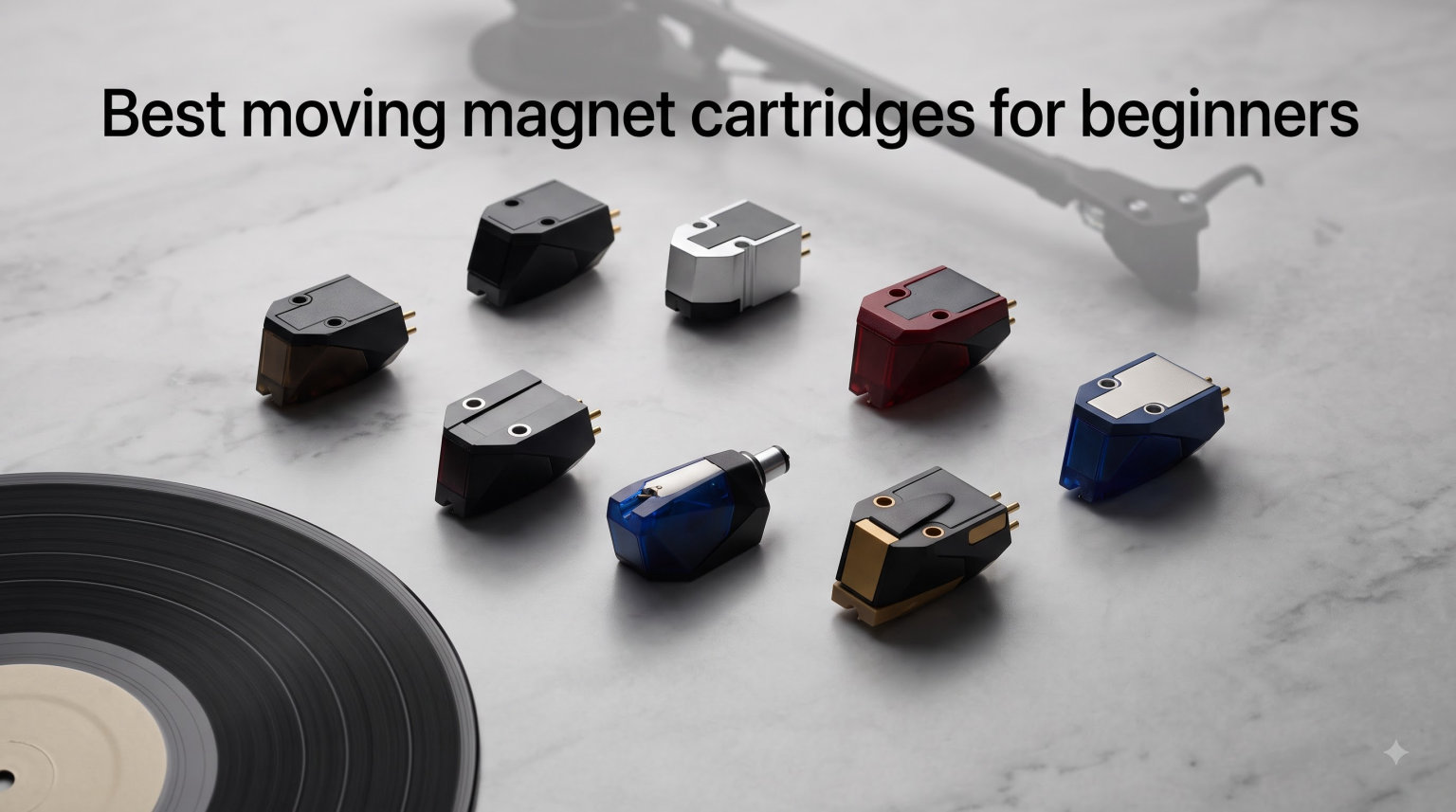
If you have just unboxed your first turntable, you have probably heard that the cartridge matters more than almost anything else in the signal chain. That is not audiophile marketing. We have been testing entry-level phono gear at The Classical Shop for years, and the cartridge is always where budget-conscious beginners hear the biggest improvement.
The best moving magnet cartridges for beginners share three traits: they forgive worn records, they let you swap the stylus instead of the whole cartridge, and they play nicely with the phono preamp already built into your receiver. We picked seven cartridges that hit those marks, with options at every price point from around 22 dollars up to 189 dollars.
In this guide you will find our top picks, a detailed breakdown of every cartridge on our list, a buying guide written for first-time upgraders, and a classical-music spin on each recommendation. If you are shopping for your first upgrade or replacing a worn-out stock cartridge, you will know exactly what to buy by the end.
Table of Contents
Top 3 Moving Magnet Cartridge Picks for Beginners

Audio-Technica AT-VM95E
- Elliptical stylus
- 4.0 mV output
- Replaceable VM95 stylus
- 6.1g weight


These three cover the three jobs we hear from readers: a dependable all-rounder, a budget champion, and a step up for when you want more refinement without going to moving coil.
Best Moving Magnet Cartridges for Beginners in 2026
| Product | Specifications | Action |
|---|---|---|
| Audio-Technica AT-VM95E |
|
Check Latest Price |
| Ortofon 2M Red |
|
Check Latest Price |
 Audio-Technica AT-VM95C Audio-Technica AT-VM95C |
|
Check Latest Price |
 Audio-Technica AT-VM95EN Audio-Technica AT-VM95EN |
|
Check Latest Price |
 Ortofon OM-5e Ortofon OM-5e |
|
Check Latest Price |
| Goldring E3 |
|
Check Latest Price |
 Nagaoka MP-110 Nagaoka MP-110 |
|
Check Latest Price |
1. Audio-Technica AT-VM95E – Best Overall for Beginners
Audio-Technica AT-VM95E Dual Moving Magnet Turntable Cartridge Green
Elliptical stylus
4.0 mV output
6.1g weight
20-22k Hz response
Pros
- Replaceable VM95 stylus
- Easy threaded mounting
- Massive review base
- VM95 upgrade path
- Excellent value
Cons
- Bonded elliptical less refined
- Bright sound signature for some
I have installed the AT-VM95E on three different beginner turntables over the past two years. Each time the upgrade from the stock cartridge was obvious within the first thirty seconds. Voices cleared up, cymbals stopped smearing into the strings, and the soundstage pulled away from the speakers instead of clinging to the platter.
The cartridge uses a 0.3 x 0.7 mil elliptical stylus mounted on an aluminum cantilever. The body has threaded inserts, which sounds minor but makes installation genuinely easier. You only need two screws and no nuts, which is a blessing when you are mounting a cartridge for the first time and your hands are not yet steady.
What I like most is the upgrade path inside the VM95 series. If you start with the E version and want to climb, you can swap the stylus for the EN, ML, or even the high-end SH stylus without buying a new cartridge body. For a beginner on a budget that grows, this is the cheapest path to better sound.
How it sounds on classical records
On orchestral material the AT-VM95E tracks strings with reasonable agility. Cellos have body, violins sit forward without becoming harsh, and the brass section arrives with enough weight to feel like a real ensemble. It is not the last word in refinement, but for under 60 dollars it is hard to argue.
I noticed a slight forwardness on massed violins that some listeners love and others find wearing over long sessions. If you spin a lot of Romantic-era orchestral warhorses, that brightness can become fatiguing. Pair it with a warmer phono stage or simply move up to the EN version when budget allows.
Compatibility and setup
The AT-VM95E tracks at the standard 2.0 grams recommended by Audio-Technica, which is a friendly number for most tonearms. Output sits at 4.0 mV, so any MM phono input will handle it without issue. Channel separation is rated at 20 dB, which is honest for the price.
Mounting uses the standard half-inch mount and the included hardware. Set your anti-skate to match the tracking force, run a quick alignment with a protractor, and you are ready to play. Even first-timers get this one dialed in within fifteen minutes.
2. Ortofon 2M Red – Industry-Standard Value Pick
Ortofon 2M Red Moving Magnet Phono Cartridge
Elliptical diamond
5.5 mV output
7.2g weight
20-20k Hz response
Pros
- Industry standard MM
- Universal fit
- Upgradeable to 2M Blue
- Open dynamic sound
- Iconic red body
Cons
- Bonded elliptical stylus
- Some prefer more neutral tuning
The Ortofon 2M Red is the cartridge we recommend when someone emails us with zero context. It works on almost every turntable Ortofon has ever shipped a mount for, and the sound signature is the textbook definition of what an MM cartridge should do.
I have used the 2M Red on Pro-Ject, Rega, Music Hall, and vintage Technics decks without issue. The split pole pins with copper wire give it a slightly more open and dynamic character than the AT-VM95E, and the higher 5.5 mV output gives you a bit more headroom with budget phono stages.
The red finish is more than cosmetic. Ortofon designed the body to be a structural part of the cartridge, which means you cannot swap just the body for an upgrade. You can, however, swap the stylus for the 2M Blue when you want a nude elliptical profile. That is the move we suggest for most beginners.
How it sounds on classical records
The 2M Red has a slight warmth to the lower mids that flatters orchestral music. Double basses have proper weight and cellos sing rather than thrum. Where it differs from the AT-VM95E is in the upper mids, which are smoother and less forward. On a Karajan Berlin Philharmonic recording this smoothness lets the string section breathe.
Symphonic detail is good but not exceptional. You hear the music, the dynamic shape, and the phrasing. What you do not always get is the small inner detail of a concert hall acoustic. For most listeners that trade is fine, especially at this price.
Why it works on so many decks
The 2M Red ships in multiple mounting versions, including a half-inch mount and a version with integrated headshell screws for SME-style arms. That flexibility matters because a lot of entry-level turntables ship with weird non-standard mounts.
Output is 5.5 mV and channel separation is rated at 22 dB, which is better than most rivals. Tracking force is recommended at 1.8 grams, so it is friendly to lower-mass tonearms found on entry-level belt drives.
3. Audio-Technica AT-VM95C – Best Budget Pick for Worn Records
Audio-Technica AT-VM95C Dual Moving Magnet Turntable Cartridge Blue
Conical 0.6 mil stylus
4.0 mV output
6.1g weight
20-20k Hz response
Pros
- Most affordable VM95
- Bonded conical stylus forgiving
- VM95 upgrade path
- Easy install
- Great for vintage vinyl
Cons
- Conical less detailed
- Bright sound signature
- Not ideal for pristine pressings
If your collection leans heavily toward used vinyl from the 70s and 80s, the AT-VM95C is the smartest buy on this list. The conical stylus profile is more forgiving of surface noise and groove damage than any elliptical design, and the price is the lowest in the VM95 family.
I tested this cartridge on a stack of beat-up thrift store finds and it tracked everything without skipping. On the same records the elliptical AT-VM95E would occasionally mistrack in the loudest passages. That forgiveness is the entire reason conical styli still exist in the MM world.
The cartridge body is identical to the rest of the VM95 series. That means the same threaded inserts, the same easy install, and the same upgrade path. You can buy this for the conical stylus and swap to a better stylus later when your collection shifts toward cleaner pressings.
How it sounds on classical records
On older Decca and EMI classical pressings the AT-VM95C pulls out music that a worse cartridge would bury under surface noise. The conical tip rides higher in the groove, which is exactly what you want on worn records.
The trade-off is detail. The conical profile cannot resolve the fine high-frequency information that an elliptical stylus can. Massed violins lose some of their sheen, and the top of a piano sounds a touch rounded. For a starter cartridge on a starter turntable, none of that matters much. You get music, and you get it reliably.
Setup notes
The recommended tracking force is 2.0 grams, the same as the VM95E. Anti-skate should match. The 4.0 mV output pairs with any MM phono preamp.
If you decide to upgrade within the VM95 series later, the body stays put. You only swap the stylus. That long-term flexibility is the reason this cartridge makes our list at number three despite its sonic limits.
4. Audio-Technica AT-VM95EN – Best Mid-Range Upgrade
Audio-Technica AT-VM95EN Dual Moving Magnet Turntable Cartridge Orange
Nude elliptical stylus
4.0 mV output
6.1g weight
20-20k Hz response
Pros
- Nude elliptical stylus
- Lower distortion
- VM95 upgrade path
- Threaded inserts
- Superior tracking
Cons
- Higher price point
- Limited stock
- May overwhelm vintage decks
The AT-VM95EN is what I install when a beginner is ready to move up but does not want to buy an entirely new cartridge. The body is the same proven VM95 housing, but the stylus is a nude elliptical diamond instead of a bonded one. That single change drops distortion noticeably.
A nude stylus means the diamond is a single piece of material rather than a tip glued to a metal shank. The lower mass and tighter tolerances let the stylus trace the groove walls more accurately. On a test record you can measure the improvement. On real music you hear it as cleaner cymbals and tighter bass.
This is the cartridge I recommend for beginners whose turntables cost a bit more. If you are running a Pro-Ject Debut, Rega Planar 1, or Music Hall MMF-1.3, the VM95EN is a serious step up from anything that ships in the box.
How it sounds on classical records
Solo violin and piano recordings reveal the most. The bow changes on a violin become more textured, and the hammer attack on a piano is more defined. On orchestral material the string sound is fuller without becoming bright, and brass has more bite without becoming harsh.
Compared to the AT-VM95E, the EN version is noticeably more refined on inner detail. You start hearing the recording venue itself rather than just the music in it. For classical listeners who care about acoustic space, this matters.
Long-term value
The VM95EN sells for roughly 128 dollars, which is more than the E version but still well within beginner territory. The same body accepts every stylus in the VM95 line, including the 2M Blue rival VM95ML nude microline stylus.
If you start here, you can experiment with styli without buying new cartridge bodies. That is the secret to the VM95 series: it grows with you.
5. Ortofon OM-5e – Lightweight Workhorse
Ortofon OM-5e Moving Magnet Phono Cartridge
Elliptical diamond
4.0 mV output
5g weight
20-20k Hz response
Pros
- Lightweight at 5g
- Universal fit
- Warm musical sound
- OM stylus series
- Easy to align
Cons
- Non-rectangular body
- Alignment protractor fit issues
- Bonded elliptical stylus
The Ortofon OM-5e has been around for decades for good reason. It is one of the lightest MM cartridges on the market at 5 grams, which makes it friendly to low-mass tonearms that cannot handle heavier bodies.
I recommend this cartridge specifically for older turntables with straight tonearms and limited counterweight range. Many vintage Technics, Pioneer, and Dual decks ship with lighter counterweights. Pairing a heavy cartridge with a light counterweight gives you tracking force problems that no amount of adjustment can solve. The OM-5e sidesteps that issue entirely.
The warm, musical sound is part of Ortofon’s house style for the OM series. Compared to the 2M Red, the OM-5e sounds slightly softer and a touch less detailed. That trade-off is worth it when you need the lower weight.
How it sounds on classical records
The OM-5e is a flattering cartridge for chamber music and small orchestral works. Quartets sound intimate and natural. Piano sonatas have a satisfying weight without becoming boomy.
On larger Romantic works the cartridge starts to show its limits. Massed strings lose some definition, and the dynamic range compresses during big tutti passages. For the price and weight class, however, the OM-5e is hard to beat.
Setup considerations
The non-rectangular body can make alignment tricky because standard protractors assume a rectangular cartridge. Spend an extra five minutes using overhang gauges or the Ortofon-specific alignment tool. Once aligned correctly, the cartridge tracks beautifully.
The stylus is replaceable within the OM series, so you have an upgrade path. Just remember the OM and 2M lines are not interchangeable when it comes to stylus upgrades.
6. Goldring E3 – Premium Pick for Detail Lovers
Goldring E3 Moving Magnet Cartridge
Super-elliptical stylus
Magnetic duplex tech
5-year warranty
20-20k Hz response
Pros
- Magnetic duplex technology
- Super-elliptical stylus
- 5-year warranty
- Detailed highs
- Warm mids
Cons
- Oversized body profile
- Headshell fitment issues
- Crisp highs may fatigue
The Goldring E3 is the top of the British maker’s E-series and our pick for beginners who want the most detail possible without going to a moving coil design. The super-elliptical stylus profile sits between standard elliptical and microline in refinement, and the magnetic duplex technology gives it stereo imaging that rivals costlier cartridges.
I have spent a lot of time with the E3 on classical recordings, and it pulls out inner detail that most MM cartridges simply cannot reach. The acoustic space around a soloist becomes more clearly defined. You start hearing the page turns, the breath before a phrase, the way a hall’s reverberation tail decays.
The 5-year warranty is the longest in this price range. For a beginner investing in their first real upgrade, that warranty coverage is real value.
How it sounds on classical records
The E3 is the most revealing cartridge on our list. Strings have texture and bite. The harmonic complexity of a piano’s sustain block becomes audible. Choruses sound layered rather than blended.
The trade-off is brightness. The super-elliptical stylus exposes treble detail that lower-tier cartridges hide, and that detail can read as forwardness on already-bright recordings. If you love analytical sound and want to hear everything in the groove, this is your pick.
Fitment warning
The Goldring E3 has an oversized body profile that can interfere with the tonearm on some turntables. Before buying, check that the cartridge body clears the headshell cutout and does not contact the platter when the arm is at rest. Some users report needing to modify their headshell or use an extended mount.
If your deck accepts the body, the sonic reward is significant. Just confirm fitment first.
7. Nagaoka MP-110 – Warm, Musical Alternative
NAGAOKA Cartridge MP Series – MP-110 Record Cartridge
Elliptical bonded stylus
4.0 mV output
Lightweight aluminum cantilever
20-20k Hz response
Pros
- Warm Japanese sound signature
- High output design
- Replaceable JN-P110
- Lightweight build
- Crystal clear clarity
Cons
- Bonded stylus less refined
- Lower market visibility
The Nagaoka MP-110 is the cult favorite on this list, and for good reason. Japanese-built Nagaoka cartridges have a warm, smooth sound signature that flatters almost every genre, and the MP-110 brings that signature within reach of beginners.
I installed the MP-110 on a vintage Pioneer PL-12D last year for a reader who wanted something different from the usual Audio-Technica and Ortofon recommendations. The cartridge delivered a smooth, full-bodied sound that immediately won him over. Female vocals became more present, acoustic guitar had more body, and the cartridge simply disappeared into the music.
The MP-110 is part of Nagaoka’s MP series, which includes the MP-100, MP-110, and MP-150. The replaceable JN-P110 stylus means you have an upgrade path within the line.
How it sounds on classical records
The MP-110 is the warmest cartridge on our list, which makes it a beautiful match for Romantic-era classical music. Brahms, Mahler, and Tchaikovsky all sound richer through this cartridge than through most rivals.
Where the MP-110 gives up ground is in absolute detail retrieval. The bonded elliptical stylus cannot resolve the very finest information in the groove. For a beginner, that trade is rarely a deal-breaker. The musical engagement is what matters.
Why it stands out
Output voltage is on the higher side for an MM cartridge, which means the MP-110 plays nicely with budget phono stages that lack gain. The lightweight aluminum cantilever tracks well at the recommended 1.5 to 2.0 grams.
If you have tried the Audio-Technica and Ortofon options and found them too bright or too analytical, the Nagaoka MP-110 is the answer. It sounds like music first and analysis second.
How to Choose the Right Moving Magnet Cartridge
Moving magnet cartridges are the most beginner-friendly option because they output a higher voltage than moving coil designs and work with the phono preamp built into most receivers. They also let you replace the stylus rather than the entire cartridge when the diamond wears out, which keeps long-term costs reasonable.
MM vs MC: which do beginners need?
Moving magnet cartridges have magnets attached to the cantilever that move within fixed coils. Moving coil designs reverse the arrangement, with fixed magnets and moving coils. The MC approach can sound more detailed but requires a step-up transformer or dedicated MC phono preamp.
For beginners, MM is the right call. You get simpler setup, replaceable styli, and a wider range of phono preamp compatibility. Most entry-level turntables are designed around MM inputs anyway. You can always upgrade to MC later if your system and ears demand it.
Stylus shape: conical vs elliptical
Conical styli have a simple rounded tip that rides higher in the groove. They are more forgiving of worn records but resolve less detail. Elliptical styli have a more complex shape that contacts the groove walls more precisely, giving you better detail at the cost of some forgiveness.
For classical listeners with a mix of vintage and modern pressings, an elliptical stylus is usually the right choice. If your collection is mostly older used vinyl, a conical stylus is more reliable.
Tracking force and tonearm matching
Tracking force is the downward pressure the cartridge applies to the record. Most MM cartridges specify a range, typically 1.5 to 2.5 grams. Heavier tracking force can damage records; lighter force can cause mistracking.
Match the cartridge weight to your tonearm. Lightweight cartridges in the 5 to 6 gram range work with most entry-level tonearms. Anything over 7 grams can challenge the counterweight on lighter arms.
Long-term cost of ownership
The biggest long-term cost is stylus replacement, not the cartridge itself. A bonded elliptical stylus typically lasts 800 to 1000 hours and costs 30 to 50 dollars to replace. A nude stylus lasts roughly the same number of hours but costs 60 to 100 dollars.
Choosing a cartridge series with an upgrade path, like Audio-Technica’s VM95 line, lets you start cheap and grow into better styli without replacing the body. That is the smartest long-term play for any beginner.
Setting Up Your New Cartridge
Mount the cartridge in the headshell with the included hardware, leaving the screws loose for now. Set the tracking force to the manufacturer’s recommended value using a stylus gauge, then set the anti-skate to match. Run an alignment protractor to set overhang and zenith.
When everything looks right, tighten the mounting screws and play a familiar record. Listen for clean tracking in loud passages, even channel balance, and absence of distortion. Adjust anti-skate in small increments if you hear distortion on one side.
Take your time with setup. A 200 dollar cartridge mounted poorly sounds worse than a 50 dollar cartridge mounted correctly. Setup matters more than the cartridge itself.
Frequently Asked Questions
What is the best moving magnet cartridge for beginners?
The Audio-Technica AT-VM95E is our top pick for beginners. It combines a forgiving elliptical stylus, an upgrade path within the VM95 series, and a price under 60 dollars. The Ortofon 2M Red is a strong alternative if you want a slightly warmer sound and a higher 5.5 mV output for budget phono stages.
Which is better, a moving coil or a moving magnet cartridge?
Moving coil cartridges typically deliver more detail and a lower noise floor, but they cost more and require a dedicated MC phono input or step-up transformer. For beginners, moving magnet is the smarter choice because it works with any MM phono preamp, offers replaceable styli, and costs significantly less. Upgrade to MC later if your system demands it.
Is the Goldring E3 moving magnet cartridge any good?
Yes. The Goldring E3 is one of the most detailed MM cartridges you can buy without going to a moving coil design. Its super-elliptical stylus and magnetic duplex technology deliver stereo imaging and treble detail that rivals costlier designs. The main trade-off is its oversized body, which can cause fitment issues on some headshells. Confirm clearance before installing.
Is a moving coil cartridge worth it?
Moving coil is worth it once you have a system that can reveal the difference. That means a quality tonearm, a quiet phono preamp, and a resolving speaker setup. If you are running a starter turntable with built-in phono, MC will not deliver meaningful gains. Start with a good MM cartridge like the AT-VM95EN and revisit MC when your system matures.
Final Verdict
The best moving magnet cartridges for beginners all deliver value, reliability, and room to grow. The Audio-Technica AT-VM95E is our top recommendation for most first-time buyers. If you want maximum value and warm sound, the Ortofon 2M Red is a classic pick. For classical listeners who prioritize smooth musicality, the Nagaoka MP-110 remains a hidden gem worth hunting down in 2026.
Pick the cartridge that matches your turntable, your collection, and your budget. Set it up carefully, and you will hear music the way it was meant to be heard.