
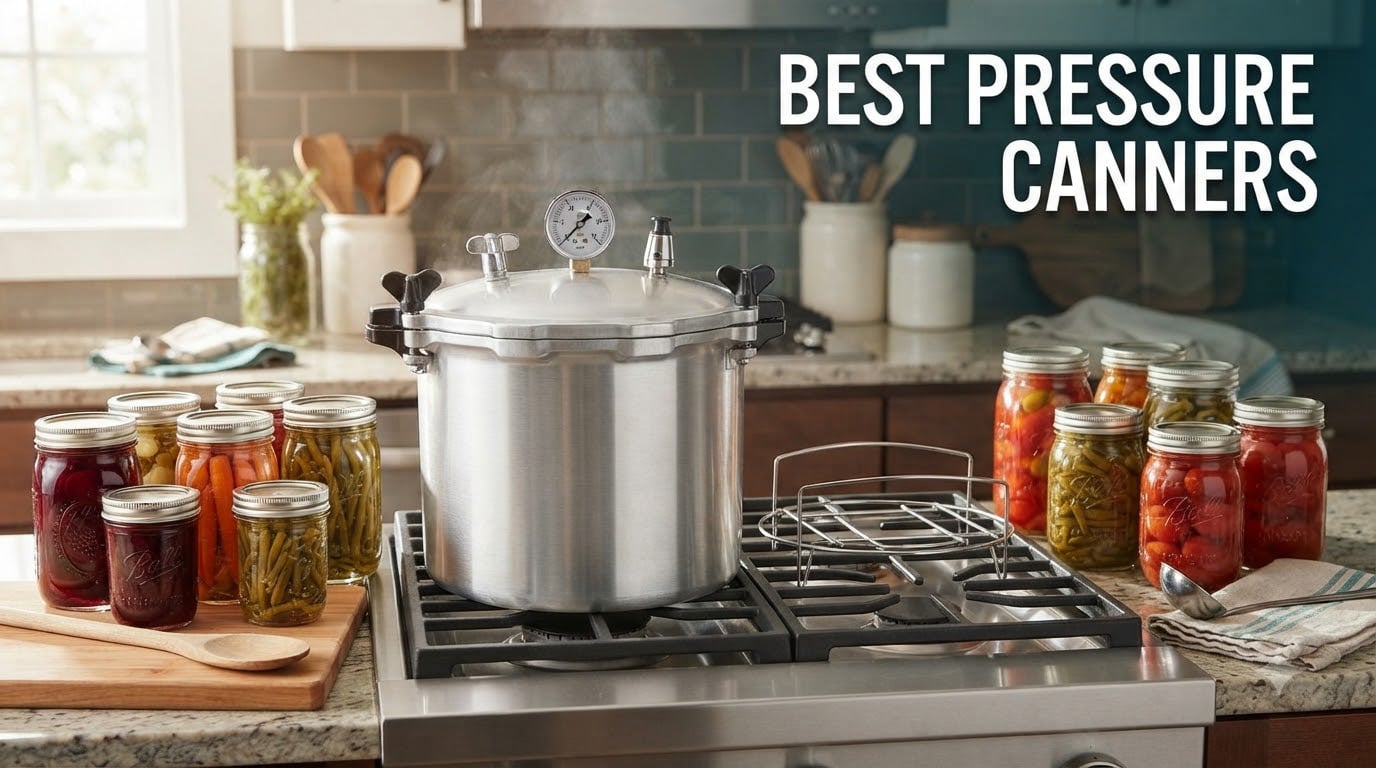
The garden is coming in faster than you expected, and you have jars stacked on the counter with nothing to put them in. This is where the best pressure canners come in: a locking-lid pot that reaches 240 degrees Fahrenheit and holds there, which is the only way to safely preserve green beans, corn, venison, soups and stocks at home. A boiling water bath tops out near 212 degrees, and that gap is exactly where the risk of botulism lives.
We compared eight pressure canners side by side, weighing capacity against stovetop fit, seal type against long-term maintenance, and gauge accuracy against how much attention each one demands. Two brands dominate the results, and the spread across the set comes down to one question: do you want a rubber gasket you replace every few years, or a metal-to-metal seal that outlives the pot?
If you have never canned before, start with our beginner pressure canner guide, which walks through the first batch step by step. Everything below assumes you understand the basic method and are choosing the equipment.
Table of Contents
Top 3 Best Pressure Canner Picks (October 2026)


The Presto 01781 wins on evidence rather than hype: more than twenty thousand reviews, a 4.8 average, and the widest parts network of anything we looked at. The All American 915 scores higher at 4.9 and never needs a gasket, but it weighs eighteen pounds empty and takes noticeably longer to heat and cool. The Presto 01784 is the same pot with a stainless-clad base for induction kitchens.
Best Pressure Canners at a Glance in 2026
| Product | Specifications | Action |
|---|---|---|
 Presto 01781 23-Quart Pressure Canner and Cooker Presto 01781 23-Quart Pressure Canner and Cooker |
|
Check Latest Price |
| All American 915 15.5-Quart Pressure Cooker and Canner |
|
Check Latest Price |
| Presto 01784 23-Quart Induction Compatible Pressure Canner |
|
Check Latest Price |
 T-fal 22-Quart Aluminum Pressure Canner T-fal 22-Quart Aluminum Pressure Canner |
|
Check Latest Price |
 Granite Ware 20-Quart Pressure Canner, Cooker and Steamer Granite Ware 20-Quart Pressure Canner, Cooker and Steamer |
|
Check Latest Price |
 MIRRO 22-Quart Aluminum Pressure Canner MIRRO 22-Quart Aluminum Pressure Canner |
|
Check Latest Price |
 NESCO NPC-9 9.5-Quart Smart Electric Pressure Canner NESCO NPC-9 9.5-Quart Smart Electric Pressure Canner |
|
Check Latest Price |
 Presto 02152 17-Quart Digital Pressure Canner Presto 02152 17-Quart Digital Pressure Canner |
|
Check Latest Price |
Every canner in this table holds at least four quart jars, which is the legal threshold for pressure canning low-acid food. Four of the eight run entirely on your stovetop, and two of those work on induction.
1. Presto 01781 23-Quart Pressure Canner and Cooker
Presto 01781 23-Quart Pressure Canner and Cooker
Capacity: 21.8 liters
Weight: 12 pounds
Dial gauge with rubber gasket
12-year limited warranty
Pros
- Widest parts availability of any canner here
- Holds 26 half-pints 20 pints or 7 quarts
- Includes rack and 76-page recipe book
- Doubles as a water bath canner and pressure cooker
- Works on gas and smooth-top ranges
Cons
- Not induction compatible
- Aluminum discolors with acidic foods
- Dial gauge needs watching through the process
This is the canner we recommend to almost everyone. It weighs twelve pounds empty, which is light enough to lift onto a burner without help once you learn the swing, and the 23-quart capacity takes seven quart jars, twenty pints or twenty-six half-pints in a single batch.
The deluxe dial gauge registers the full range of processing pressures rather than a single set point, and that matters if you live above a thousand feet and need a different weight. Reviewers consistently describe it as the default recommendation in canning forums, and the reasons are unglamorous: parts are everywhere, including at most hardware stores, and the manual is genuinely useful.
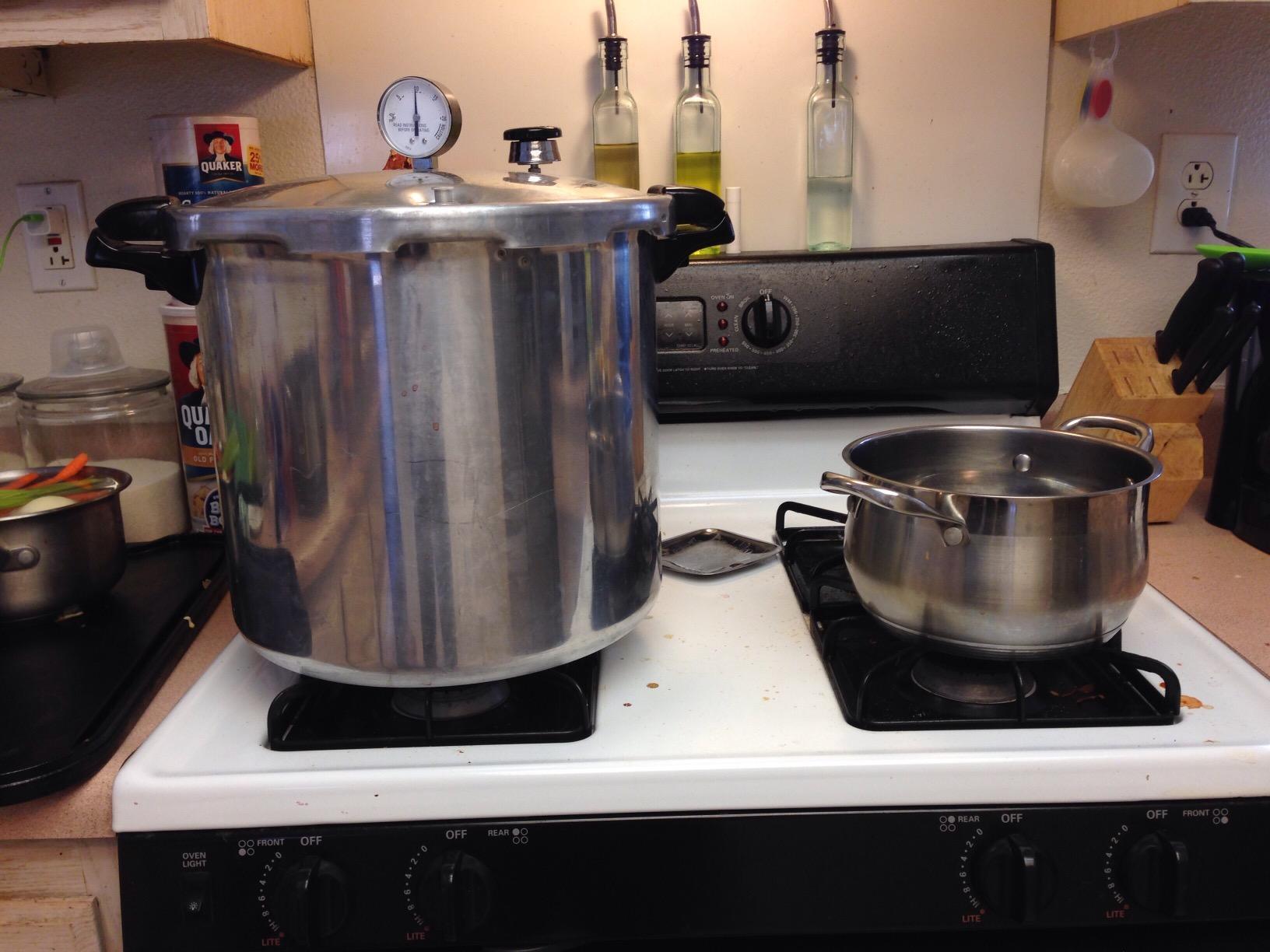
The build is heavy-gauge aluminum designed to resist warping, and that material choice is the trade-off you are making. Polished aluminum will pit and discolor after tomato sauce or fruit batches, and it will never work on an induction cooktop. Neither issue affects the seal or the safety of a batch.
Operating it is manual, which means you read the dial, confirm you are at the right pressure, and adjust your burner. First-time canners sometimes find that watching a needle more stressful than they expected. The included canning rack and the 76-page instruction and recipe book mean you can start the same afternoon the box arrives.
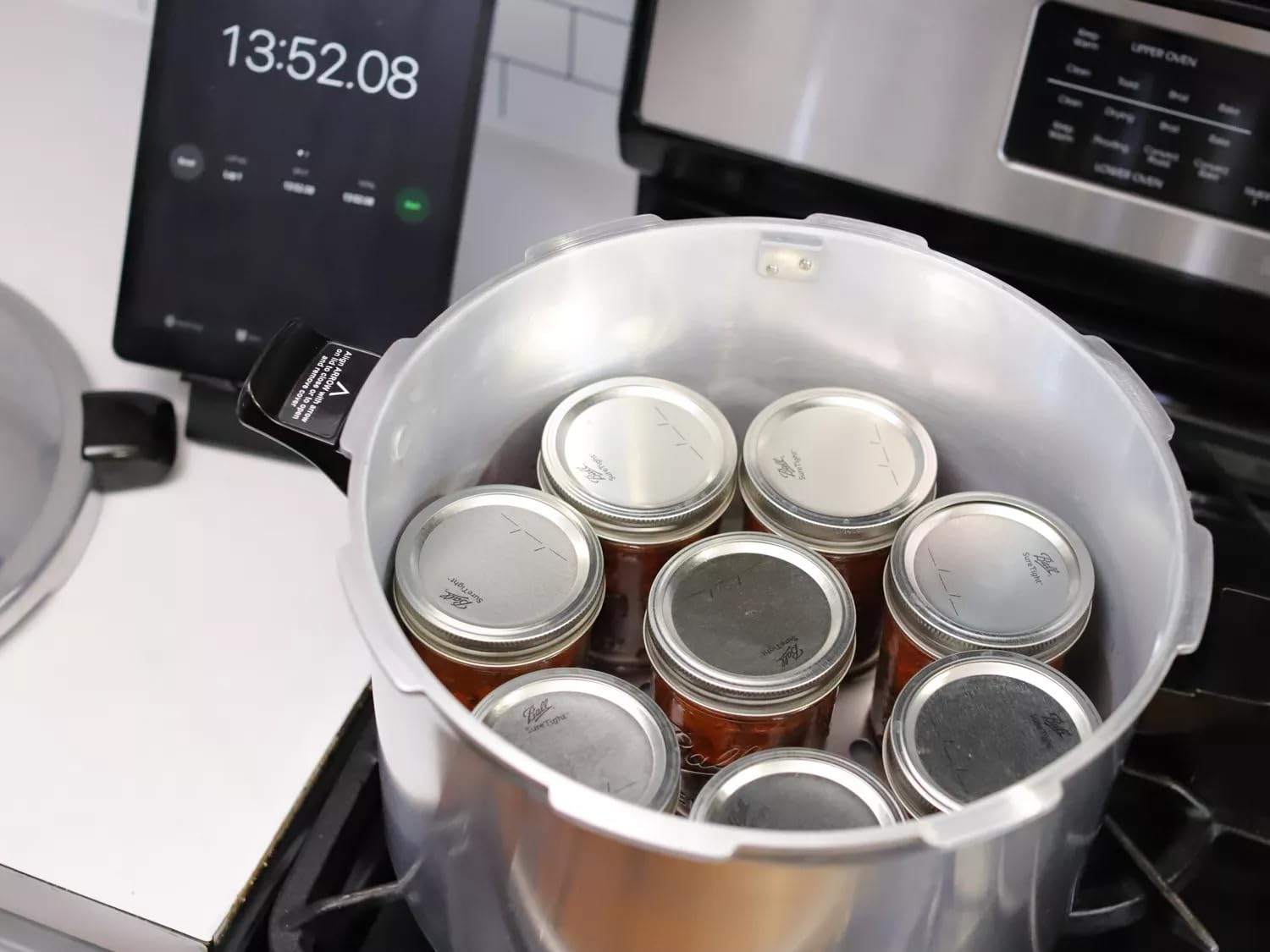
What you get in the box
The twelve-year limited warranty is the longest in this group alongside the 01784, and it covers the pot rather than the rubber gasket, which is a consumable. Budget for one replacement gasket roughly every three to five years of steady canning, and the cost of that has to be weighed against the All American’s zero-gasket ownership.
Capacity is where it wins outright. Seven quarts in one load means a full row of green beans is done in a single batch rather than two, and that difference compounds across an entire season. It also doubles as a large pressure cooker, so the pot earns its space even in months when you are not canning.
Where it falls short
Induction owners should stop here and read about the 01784 instead, which is the same canner with a stainless-clad base. Anyone who objects to replacing gaskets will be happier with the All American, though the weight of that trade is eighteen pounds empty against twelve.
Cleaning is the least glamorous drawback. Acidic foods leave mineral build-up on polished aluminum that takes scrubbing to remove. It is cosmetic rather than functional, but if you can a lot of tomatoes or fruit, plan on a dedicated brush and a little patience.
2. All American 915 15.5-Quart Pressure Cooker and Canner
All American 1930: 15.5qt Pressure Cooker/Canner (The 915) – Exclusive Metal-to-Metal Sealing System – Easy to Open & Close – Suitable for Gas, Electric, or Flat Top Stoves – Made in the USA
Capacity: 14.67 liters
Weight: 18 pounds
Weighted gauge with metal-to-metal seal
Pros
- Gasket-free seal with nothing to replace
- Holds roughly 10 pint or 7 quart jars
- Works on gas electric and flat-top stoves
- US service and inspection support
- Easy to clean satin finish
Cons
- 18 pounds empty loaded onto the stove
- Slow to heat and slow to cool
- Can vapor-lock at zero pressure
All American 915 has the highest rating in this group at 4.9 with 93 percent five-star reviews, and the reason is a design decision that costs nothing over the life of the pot. There is no rubber gasket. The lid clamps metal against metal through six wing nuts, so there is no consumable to replace in year three, year eight or ever.
It holds roughly seven quart jars or ten pints. That is the same quart capacity as the 23-quart Presto, which surprises people, because the All American is physically smaller. What it does not have is the pint capacity, and pints do not double stack in this size.
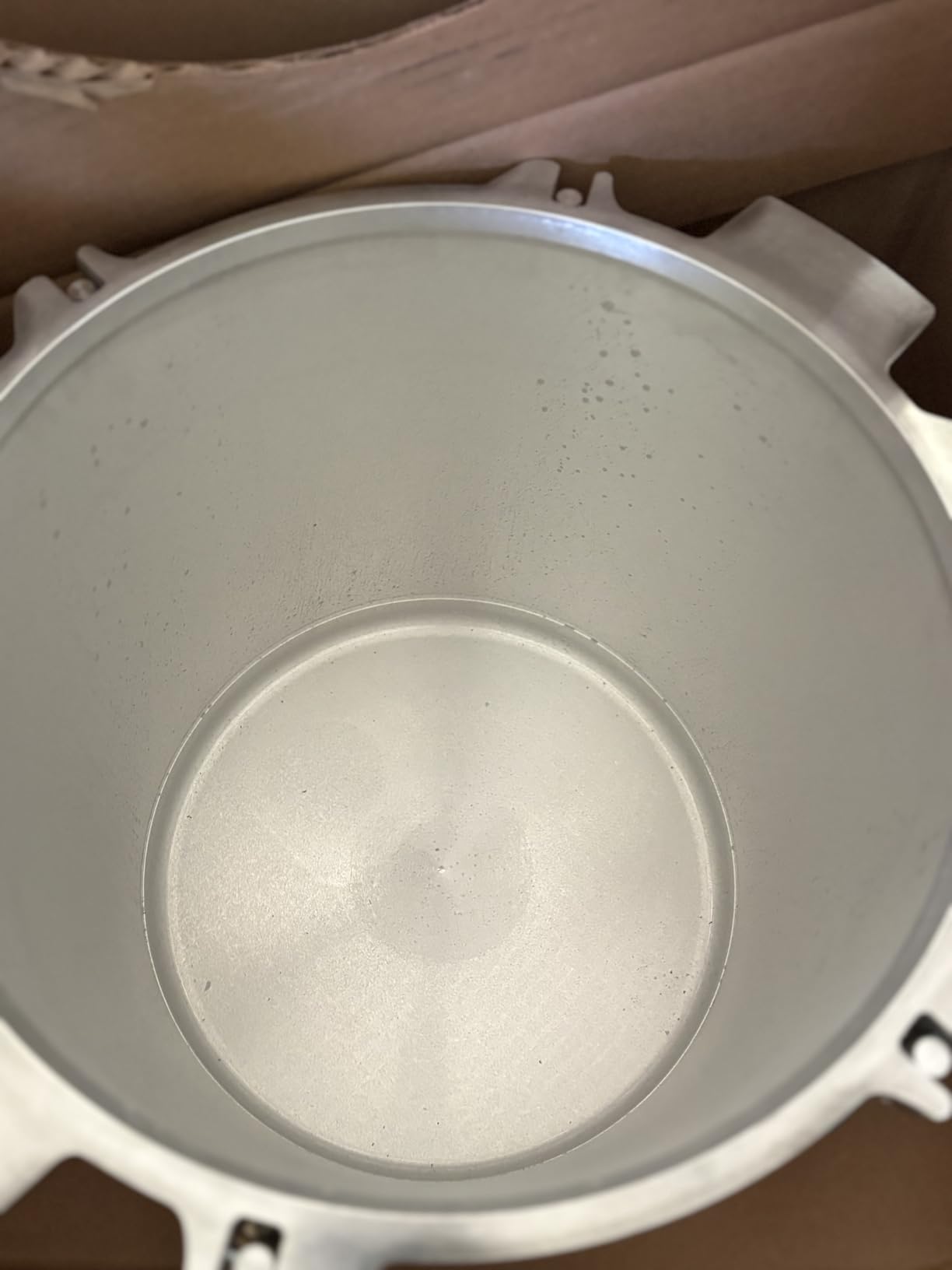
The weighted gauge here is genuinely more accurate than a dial, which sounds backwards until you understand how it works. A machined weight sits on the vent pipe and rocks when internal pressure reaches the exact point its mass was machined for. You can confirm you are at pressure by sound from another room, and the dial on the lid exists for reference only.
Made in Wisconsin by the Wisconsin Aluminum Foundry, this is the unit experienced canners describe as a lifetime purchase. Replacement parts, manuals and safety labels all come from the manufacturer, and enthusiasts rate that support highly.
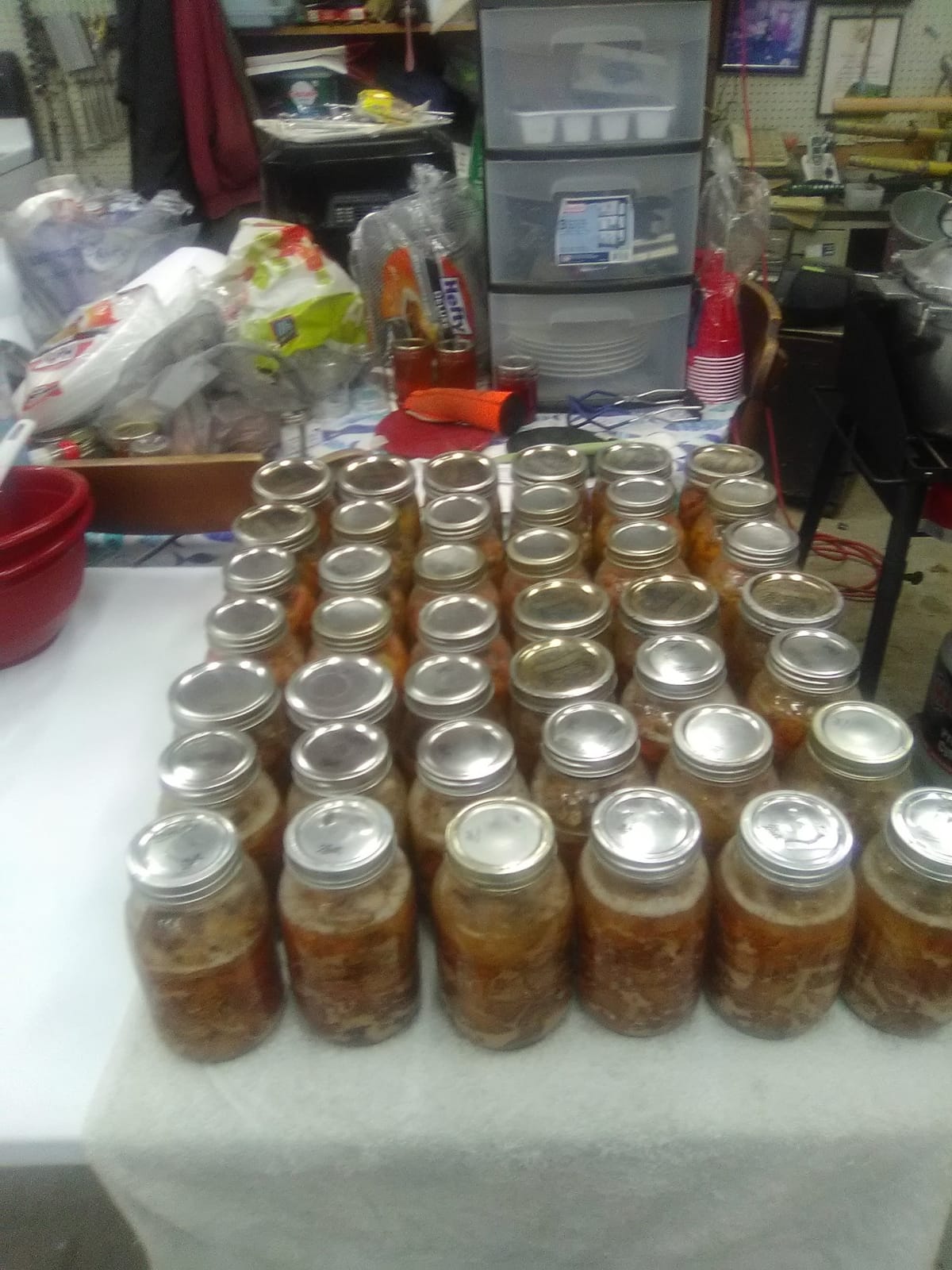
What you give up for a maintenance-free seal
Weight is the honest answer: eighteen pounds empty, and it has to be carried to the burner rather than lifted by a handle. The casting also heats slowly and cools slowly, which adds real minutes to every batch compared with a lighter aluminum pot.
The clamping system takes practice. Tightening six wing nuts in opposing pairs is what produces an even seal, and rushing it produces a leak. Owners describe the learning curve honestly as a few batches before closing it becomes automatic.
Where it falls short
The most-reported mechanical issue is vapor lock at zero pressure, where residual steam can hold the lid shut after a cook is finished and the clamp screws have to be loosened to free it. That is annoying rather than dangerous, but it happens often enough that experienced owners warn newcomers about it.
It is also aluminum, so acidic foods will pit the surface over time. And the warranty is one year limited, noticeably shorter than the twelve years on the Presto units, though most owners never use it.
3. Presto 01784 23-Quart Induction Compatible Pressure Canner
Presto 01784 23-Quart Induction Compatible Pressure Canner
Capacity: 23 liters
Weight: 5.67 kg
Stainless clad induction base
Pros
- Only full-size induction canner in this group
- Same 7 quart 20 pint capacity as the 01781
- Air vent lock blocks opening under pressure
- Works on gas electric and smooth-top ranges
- Includes canning and cooking rack
Cons
- Heaviest stovetop Presto unit at 12.6 pounds
- Dial gauge still needs manual monitoring
If your cooktop is induction, this is the answer and there is no real substitute in this group. Heavy-gauge aluminum wrapped in a stainless steel-clad base is the only way magnetic cooktops will recognize a pot at all, and this is the sole full-size canner here built that way.
Everything else is the 01781. Capacity is 7 quart jars, 20 pints or 26 half-pints, the deluxe pressure gauge is the same, and the warranty is the same twelve years. Reviews land at 4.8 with 88 percent five-star, which is statistically identical to the non-induction version.
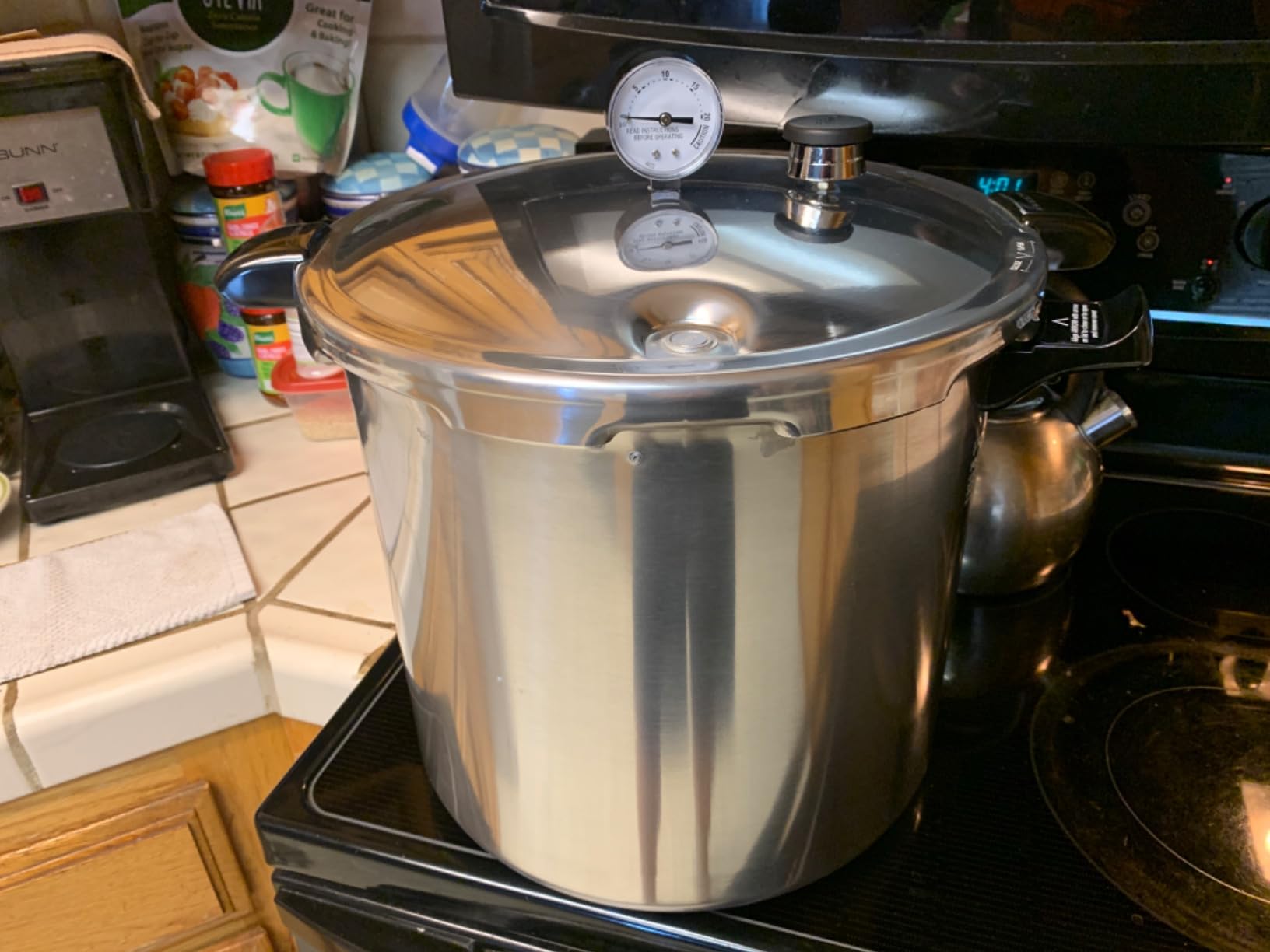
The air vent and cover lock are a detail worth knowing about. Pressure only builds when the cover is properly closed, and the lock physically prevents you from opening the lid until pressure drops back down. On a large batch of meat that is a real safety improvement over models where the lid is just held down by steam pressure.
Like its sibling, it doubles as a boiling water canner for fruits, jams, jellies, pickles and salsa, and as a large-capacity pressure cooker. That versatility is why many buyers keep it on the stove year round instead of storing it.
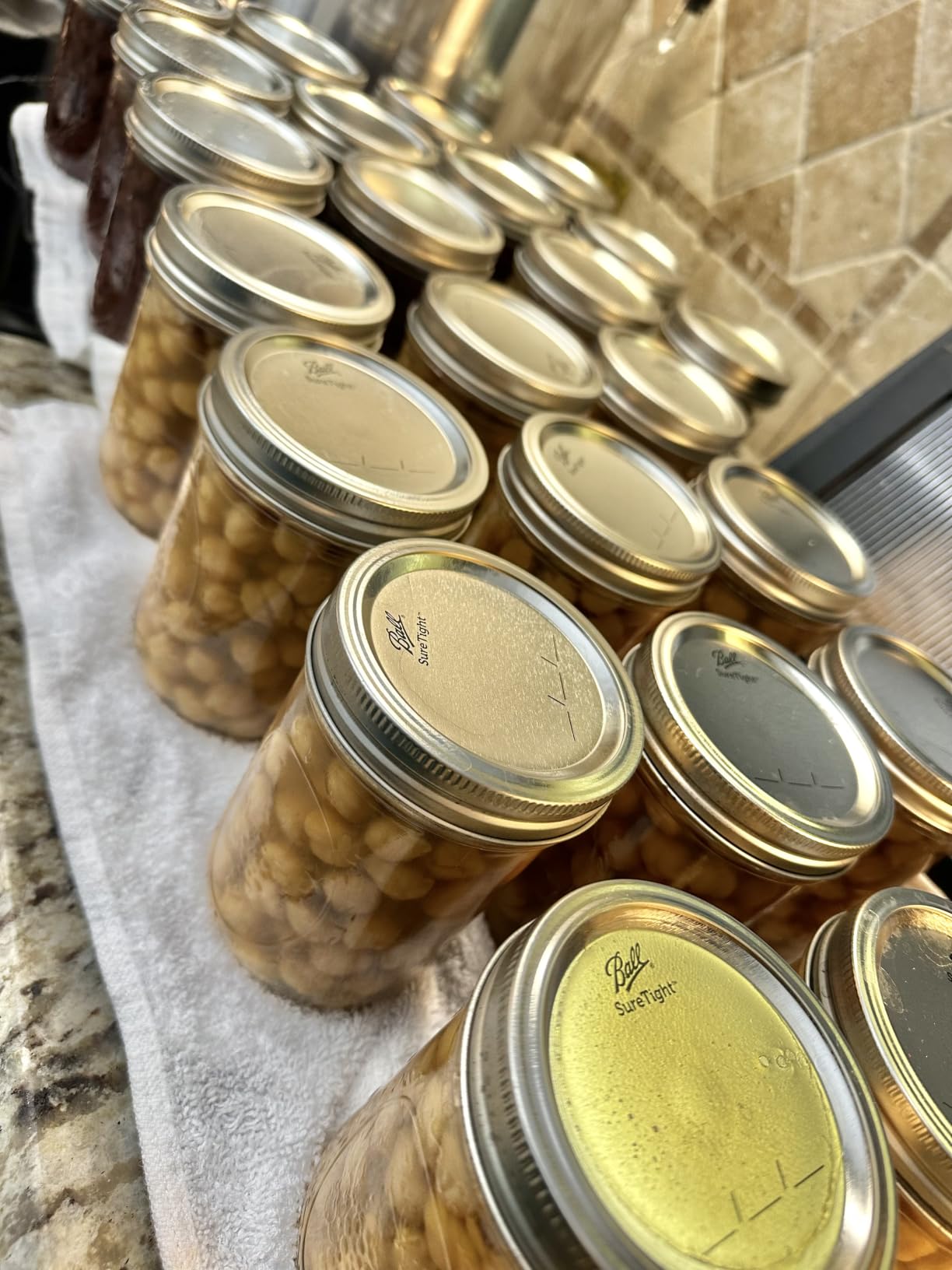
When the induction base is worth the difference
Buy this version if you have an induction cooktop, full stop. There is no workaround, because aluminum simply will not heat on an induction burner and every other canner on this list shares that limitation.
If you are on gas, electric coil or smooth-top glass, the standard 01781 does the same job and is easier to find. We would only spend the difference if you genuinely need induction, or if you plan to move kitchens later.
Where it falls short
It weighs 12.6 pounds, slightly more than the standard Presto because of the cladding, and that extra metal is also why the base takes longer to respond when you turn the burner down. Precise heat control matters in pressure canning, so give it a minute before judging the dial.
Everything else on the con list is inherited from the 01781: a rubber gasket to replace eventually, polished aluminum that will not take acidic foods well, and manual gauge monitoring for the whole process.
4. T-fal 22-Quart Aluminum Pressure Canner
T-fal 22-Quart Aluminum Pressure Canner, 3 PSI Settings, Home Canning, Includes Racks & Canning Guide, Large Capacity, Pressure & Water Bath Canning for Vegetables, Meats, Seafood & Fruits, Silver
Capacity: 22 quarts
Weight: 14.8 pounds
Selectable 5/10/15 psi weight
Pros
- Integrated weight selector removes regulator juggling
- Holds 7 quart 18 pint or 24 half-pint jars
- Two canning racks included
- Beginner friendly controls
- Works on gas and electric coil
Cons
- Weight reported venting before 15 psi
- Some gasket leaking at the lid seam
- Aluminum discolors after first use
The T-fal is the one we would hand to someone who is nervous. Its controls are plain, its instructions are written for beginners, and it ships with two canning racks and a step-by-step canning guide, which is more support than most competitors include.
Capacity is 7 quart jars, 18 pints, 16 wide-mouth pints or 24 half-pints. The wide-mouth pint figure is unusual and useful if you prefer wide-mouth jars for soups and stocks. Two racks let you double stack, which doubles your throughput on a small kitchen stove.
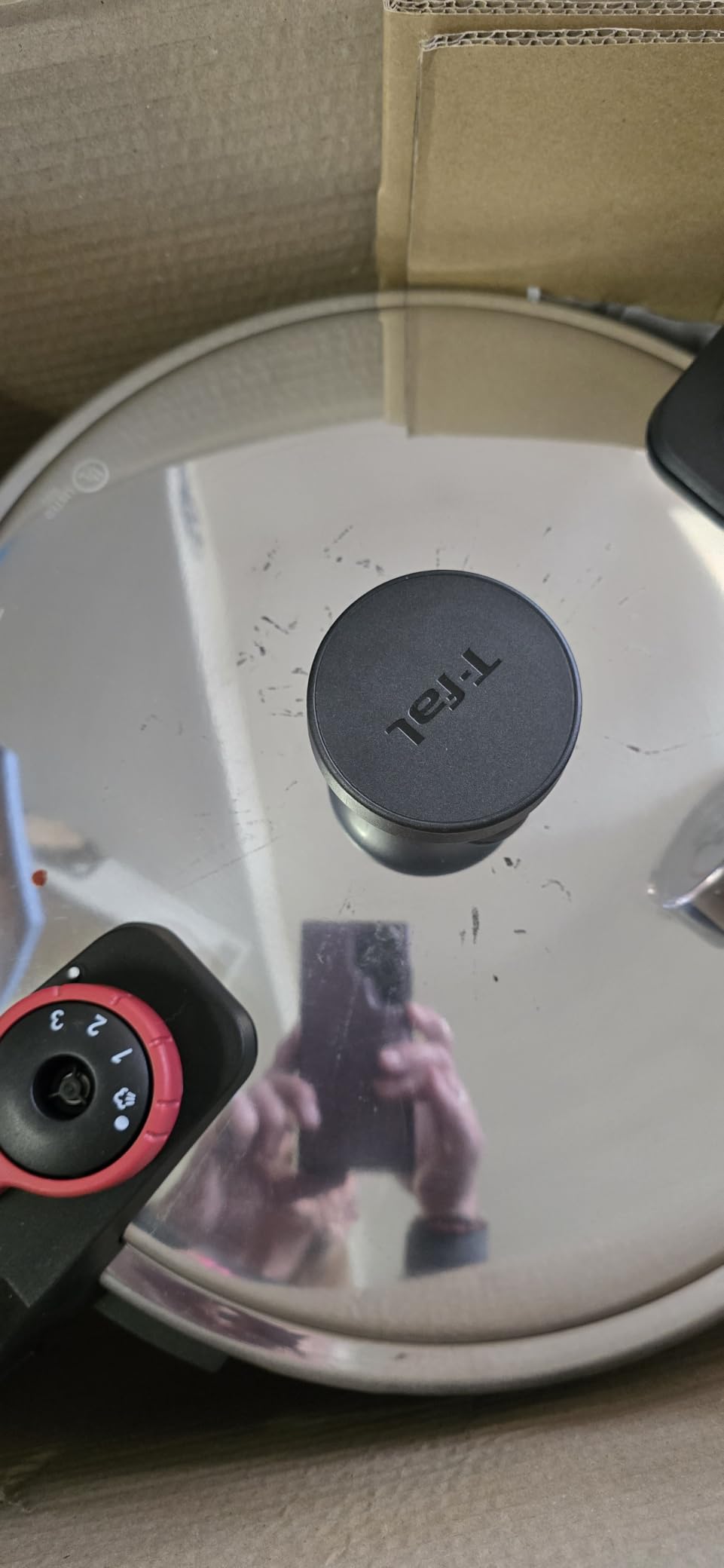
The integrated pressure selector is a genuinely clever bit of design. Rather than hunting for a loose weight in a cupboard, you choose the psi setting on the lid itself. That removes the single most common beginner mistake, which is loading the wrong regulator.
At 4.4 across 6,778 reviews it is the lowest-rated canner here, with 9 percent one-star reviews. That gap is worth understanding before you buy rather than after, so here is what drives it.
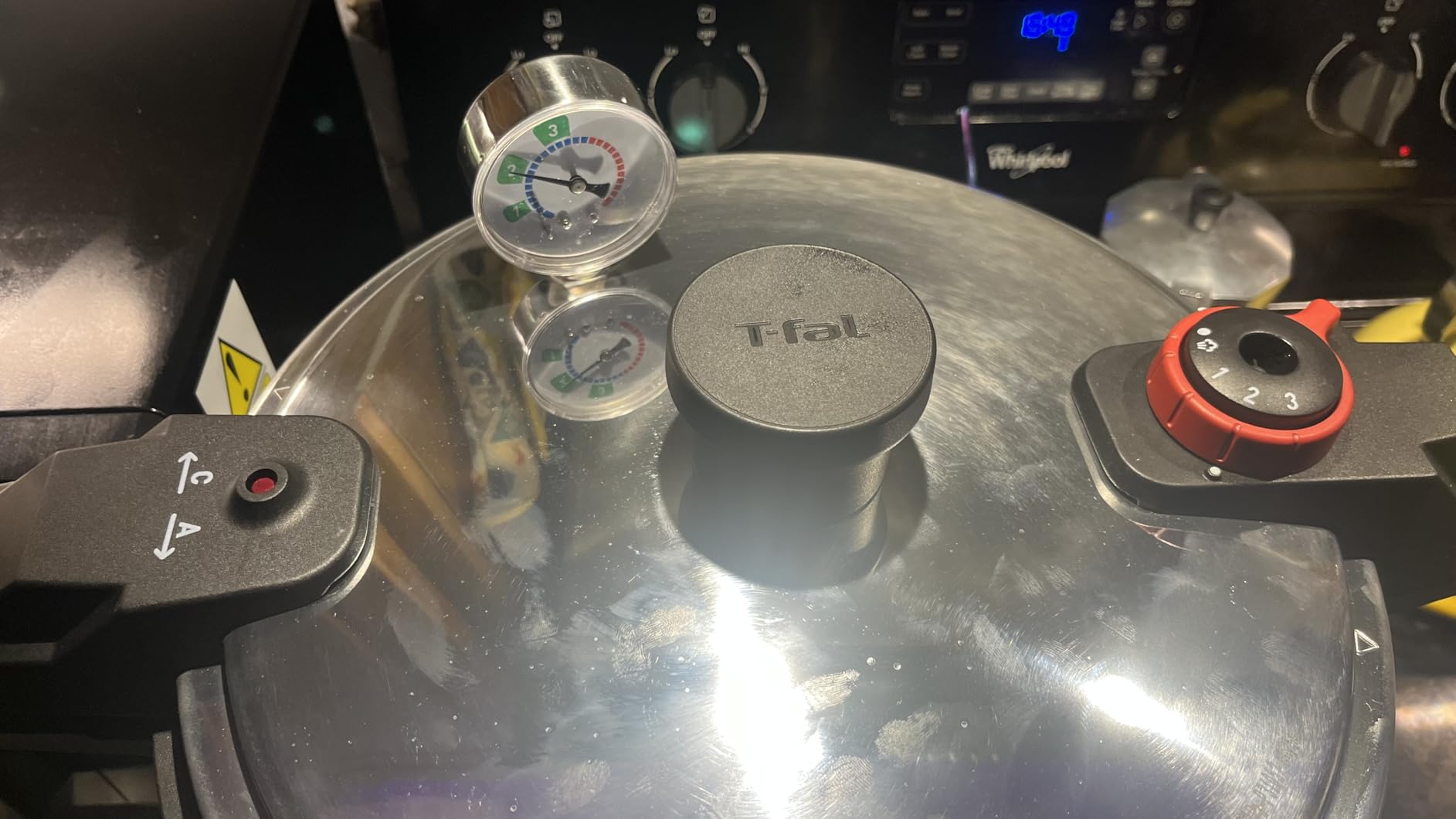
Why this one scores lower than the rest
Two mechanical complaints recur. Some owners report the weight auto-venting before reaching 15 psi, which means pressure drops out mid-process. Others report slight leaking at the lid seam, which forces a depressurize, a re-seat and a restart. Neither is dangerous, but both cost you time on a busy canning day.
There is also a fit-and-finish complaint: the handles have to be aligned precisely before the lid will lock, and forcing it slightly misaligned is an easy way to wear the gasket prematurely. Aluminum discoloration after the first batch is universal with this material.
Where it fits anyway
The two included racks and the beginner guide are worth more than they appear. Anyone canning two or three batches in a single session will feel the difference a second rack makes immediately, and most competitors sell that rack separately.
It works for both USDA pressure canning and boiling water canning, has cool-touch handles, and the gauge is easy to read. If you accept a slightly higher complaint rate in exchange for the clearest instructions and the most complete box, it is a defensible pick.
5. Granite Ware 20-Quart Pressure Canner, Cooker and Steamer
Granite Ware Pressure Canner/Cooker/Steamer, 20-Quart
Capacity: 20 quarts
Weight: 10.5 pounds
Adjustable 5/10/15 psi regulators
Pros
- Lightest large canner in this group at 10.5 pounds
- Hard anodized surface resists rust and staining
- Adjustable 3-piece regulator set
- Also steams and pressure cooks
Cons
- Smallest review base here at 801 reviews
- Listing gives no jar capacity figures
At 10.5 pounds empty, the Granite Ware is a notably light 20-quart canner. That matters more than it sounds: a loaded canner is genuinely awkward, and shaving six pounds off the empty weight changes how many trips up and down the stairs a batch takes.
The hard-anodized body is the other reason to like it. Unlike polished or natural aluminum, the anodized surface will not rust and is far more resistant to staining from acidic foods. For a canner that sees tomatoes and fruit, that is a genuine durability advantage.
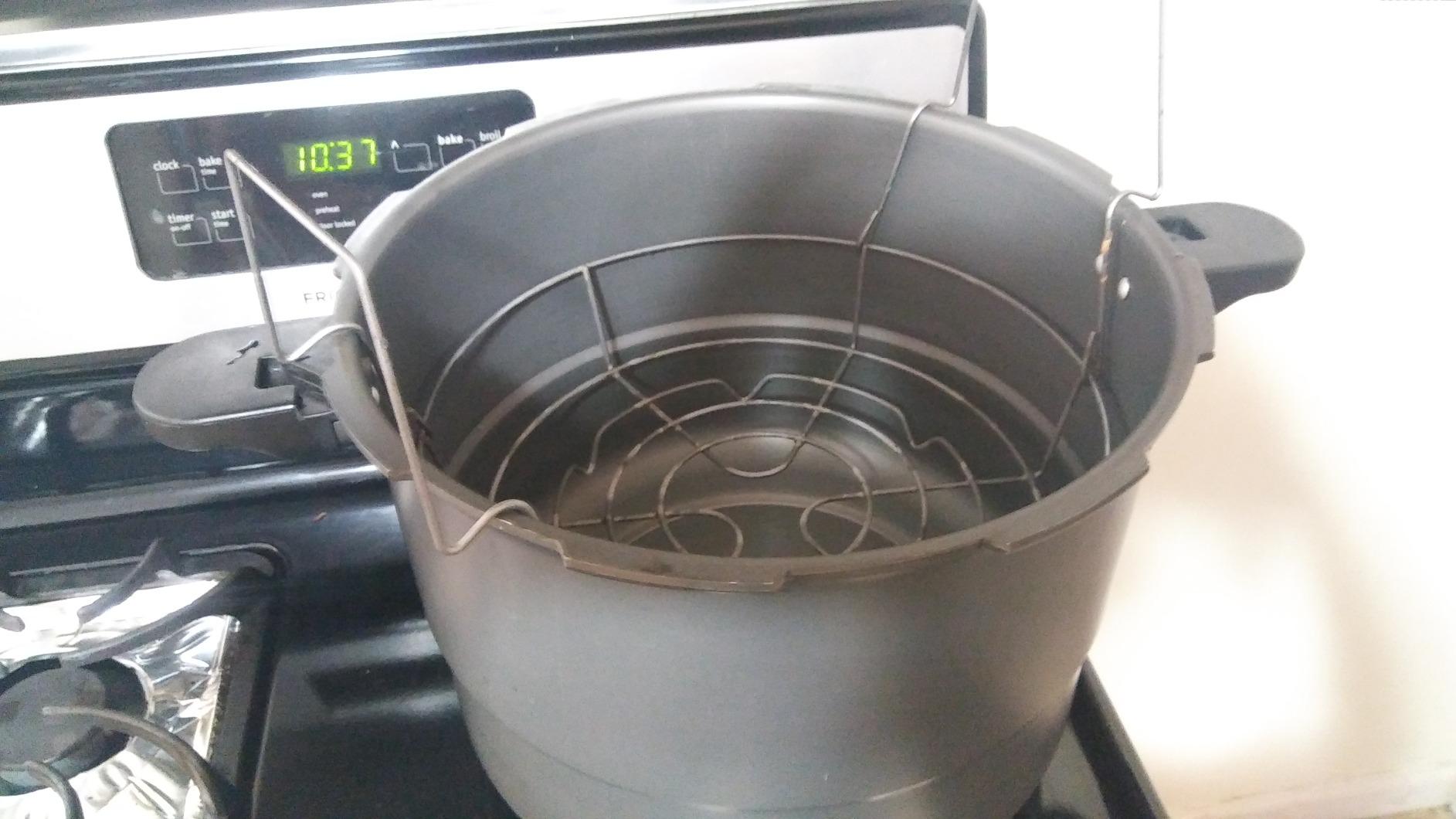
Pressure control is an adjustable three-piece regulator set calibrated at 5, 10 and 15 psi, so you swap weights rather than hunting for a single fixed one. It also steams and pressure cooks, which makes it a genuinely multi-use pot rather than a single-purpose appliance.
Capacity sits between the smaller electric units and the 22- and 23-quart flagships, and the adjustable regulators give it flexibility on altitude and for pressure cooking at lower settings.
What you trade for that light weight
The review base is 801 reviews, a fraction of what the flagship Presto carries, which means less long-term owner history, fewer troubleshooting conversations and thinner listing detail, including no published jar capacity figures and no stated cooktop compatibility.
Only one size and finish is currently offered, so if you want a second smaller canner to pair with it, this family does not cover that.
Where it works well
This is the pick for a small kitchen, an apartment, an RV, or anyone who wants a large nominal capacity without a large physical object. The non-stick finish is easy to wipe down, though it does want gentle handling around the rim.
If you are worried about a load-bearing glass cooktop and about lifting a heavy pot off it, this unit answers both concerns at once. That is a narrower case than most readers need, but it is the case this canner was built for.
6. Mirro 22-Quart Aluminum Pressure Canner
MIRRO 22 Qt Aluminum Pressure Canner with 3 Regulators, 5, 10 & 15 PSI
Capacity: 22 quarts
Weight: 6.21 kg
Three regulators at 5 10 and 15 psi
Pros
- Weighted regulators need no gauge reading
- Dishwasher safe
- Two racks included for double stacking
- Reported to seal reliably with little siphoning
Cons
- No pressure-reading gauge on the lid
- Regulator needs a firm push with two audible pops
- Leaves rust-colored staining around the vent
The Mirro takes the simplest possible approach to pressure control: you listen. Three regulators at 5, 10 and 15 psi sit on the vent, and once the correct one is rocking you are at pressure. No needle to read, nothing to adjust while you work.
Capacity is a full 22 quarts with two racks included, so double stacking works. Dual cool-touch handles help with a heavy lift, and the locking mechanism is secure. Owners report reliable jar seals with very little siphoning, which is one of the most common frustrations for new canners.
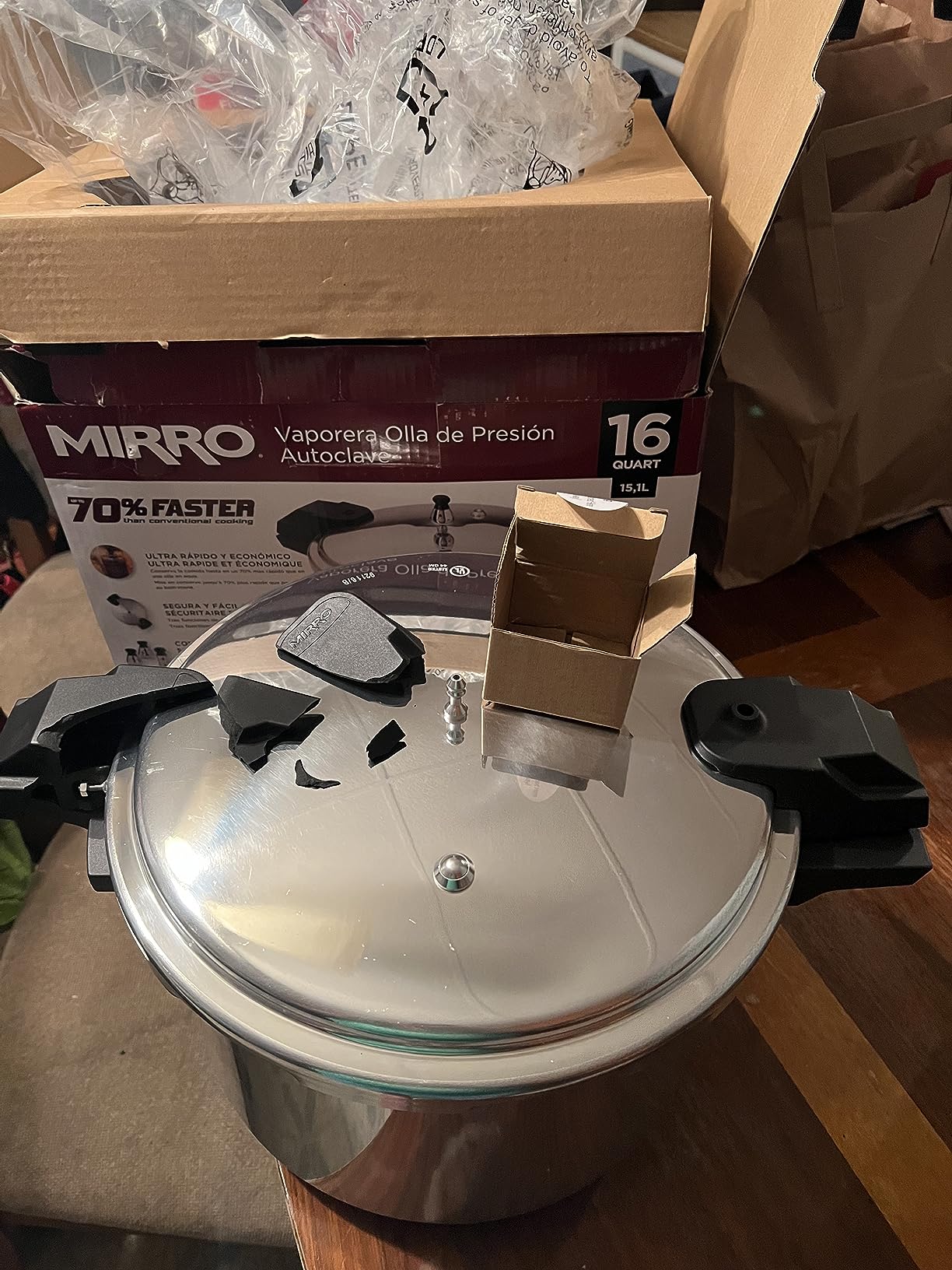
It heats quickly and holds a steady temperature with little burner adjustment, which is a real advantage over heavier castings during a long afternoon of batches. At 4.5 across 741 reviews it carries the smallest owner feedback base in this roundup.
Dishwasher safe is a small thing that pays off often. A pressure canner is an awkward shape with a lot of nooks, and being able to run it through a cycle saves real cleanup time.
What the weighted gauge asks of you
There is no pressure-reading gauge on this lid, by design. That is a feature for anyone who wants less to monitor and a limitation for anyone who wants to confirm a reading, especially at altitude where you need to be certain about the psi.
The regulator also has to be pushed firmly onto the stem until you hear two distinct pops to know it is seated. Get that wrong and you will spend a batch wondering why pressure never comes up.
Where it falls short
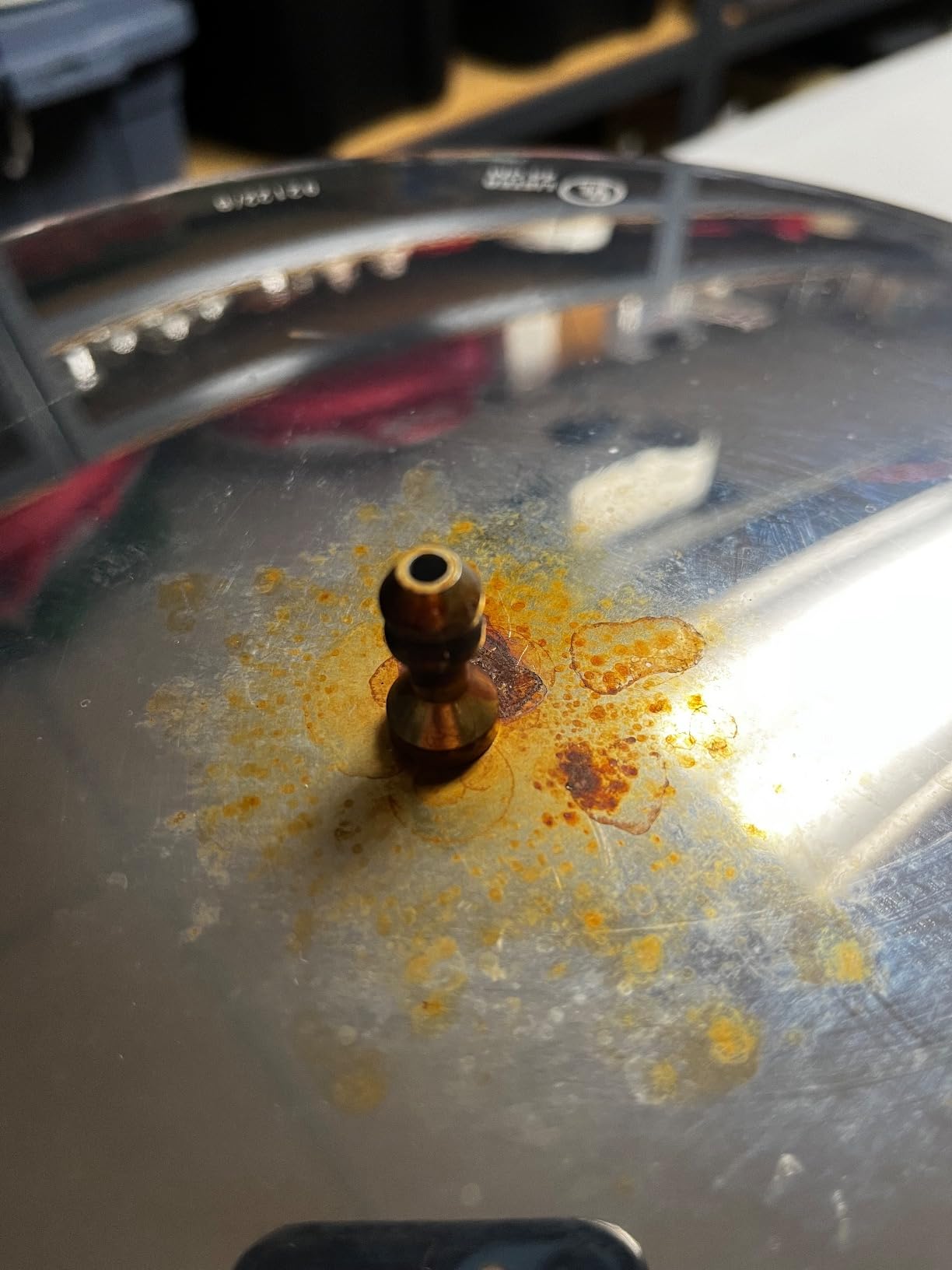
The weight leaves a rust-colored stain around the steam vent over time. Cosmetic, permanent, and mildly annoying on a pot that otherwise looks good.
Some owners report poor results on glass cooktops, and the 16-quart sibling does not include the second rack, so double stacking is a 22-quart-only feature. If you are on smooth-top glass and nervous, one of the Presto models is the safer bet.
7. NESCO NPC-9 9.5-Quart Smart Electric Pressure Canner
NESCO NPC‑9 Smart Electric Pressure Canner and Cooker for Home Food Preservation, 9.5‑Quart Stainless Steel with Digital Controls
Capacity: 9.5 quarts
Height: 16.53 inches
Digital controls with float valve
Pros
- Electric operation removes gauge and jiggler monitoring
- Pressure cooks slow cooks steams and water baths
- Digital display with preset programs and timer
- Safety lock lid and automatic float valve
- Does not heat the kitchen
Cons
- Holds only about 4 quarts or 5 pints per batch
- Wide-mouth pints are awkward to remove
- Must be attended until up to pressure
The NPC-9 is built for the person who cans four jars at a time. A single person or a couple going through leftovers does not need seven quart jars per batch, and this is the canner that matches that reality without requiring a workaround.
It runs on electricity, so there is no dial to read and no weight to watch. Digital controls with preset programs and a timer handle the cycle, and a safety lock lid with an automatic float valve manages the pressure side. Owners report years of reliable use.
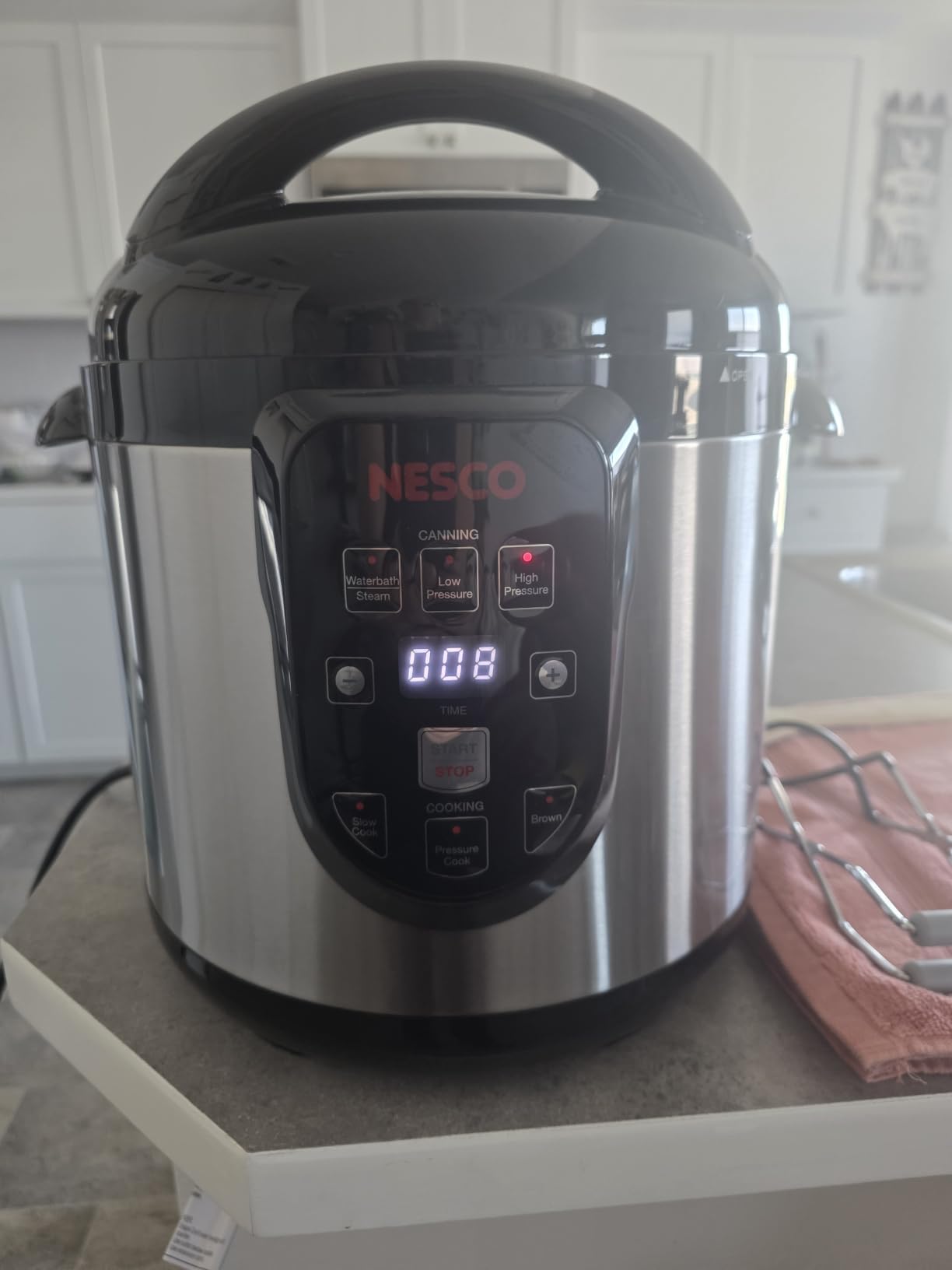
The multi-function side is substantial: it pressure cooks, slow cooks, steams and water baths. The removable nonstick inner pot comes with canning and steam racks, and a removable condensation catcher keeps cleanup manageable. Standard and high-altitude limiting valves are included, which is a thoughtful touch for anyone above a thousand feet.
Two side benefits are easy to underestimate. It does not heat the kitchen the way a boiling water setup does, which matters in summer. And it avoids the carrying problem entirely, because it never leaves the counter.
Where the small batch format pays off
If you are working through venison one shoulder at a time, or canning a few jars of soup weekly, four quarts per batch is genuinely the right size. Trying to do that in a 22-quart canner means heating a large pot of water for four jars and waiting through a long cool-down.
The flip side is throughput. If you are putting up a full garden, this is the wrong tool and you will end the season wishing you had a stovetop model.
Where it falls short
Retrieving wide-mouth pint jars from a deep chamber is awkward, and the listed instruction set is wordy enough that first-timers describe a steeper learning curve than the manual-operation stovetop models.
Audible beeps on plug-in and pressure transitions can be startling in a quiet kitchen, and despite the automatic cycle you still need to be present until it comes up to pressure. For our electric canner safety reasoning, see the section below.
8. Presto 02152 17-Quart Digital Pressure Canner
Presto 02152 17-Quart Digital Pressure Canner
Capacity: 17 quarts
Weight: 24.3 pounds
Automated temperature sensor
Pros
- Sensor maintains the exact temperature required for canning
- No pressure adjustments needed at high altitude
- LED display and control knob guide every step
- Extra-tall chamber takes quart jars for pressure or water bath canning
- Stainless steel is easier to maintain than aluminum
Cons
- Heaviest unit here at 24.3 pounds
- Batch size still trails large stovetop canners
The 02152 is the most automated canner in this group and the only one with a sensor that holds the exact temperature required for safe canning rather than approximating it with a burner setting. A control knob selects the canning method and processing time, and an LED display walks through each step.
Altitude is its clearest technical advantage. Because pressure control is electronic, no adjustment is needed at high elevation, which removes the most common error for people living in mountain towns. Stainless steel construction also handles acidic foods better than any aluminum unit here.
The extra-tall chamber is deliberate. It holds quart jars upright for both pressure canning and boiling water canning, which means this unit genuinely replaces two appliances if you also make jam or salsa.
At 4.6 with 5,739 reviews and 84 percent five-star ratings, the score is solid, though it trails the Presto stovetop models on five-star share.
What automation actually buys you
The real gain is repeatability. A stovetop canner depends on you reading a dial and adjusting a flame; this one holds its setpoint. Over a season of dozens of batches, that consistency is worth something, particularly for beginners who do not yet trust their own gauge reading.
It is also fully hands-off on altitude, which no weighted or dial canner in this group matches without swapping weights.
Where it falls short
At 24.3 pounds it is the heaviest unit here, and it is tall as well as heavy, at 18 inches. Check your range hood clearance and your counter depth before buying, because that footprint is the most likely reason this unit disappoints.
Even with 17 quarts of rated capacity, the batch size still trails a 22- or 23-quart stovetop canner. And because the cycle is electronic rather than mechanical, you are trusting the sensor rather than the mass of a machined weight.
How to Tell If a Pressure Canner Is Actually a Canner
The test is simple and it has one number in it: a qualifying pressure canner must hold at least four quart jars. That is the threshold at which the USDA and the National Center for Home Food Preservation say the processing times in their published tables actually apply to what is happening inside your jars.
Every unit in this roundup clears that bar, which is exactly why all eight are here. Most of the pots people ask about online, including most multi-cookers and electric pressure cookers, do not. Some hold only two quart jars or three, and for those, the published processing times do not apply.
This is the core of the “are pressure cookers good for canning” question that circulates constantly. The honest answer is that a canner that meets the four-quart minimum and follows its processing table is fine, and one that does not meet the minimum is not, regardless of how good its electronics are.
One more piece of terminology worth clearing up: no agency approves canning equipment. There is no USDA stamp on a pressure canner, and anyone selling you one on that basis is wrong. The National Center for Home Food Preservation publishes the science; the manufacturer builds to it.
Dial Gauge vs Weighted Gauge: Which One Is Safer
A weighted gauge is more accurate, and the mechanism explains why. A machined metal weight of a known mass sits on the vent pipe and rocks only when internal pressure reaches the exact point that mass was cut for. There is no needle to misread and no calibration drift, because physics does not drift.
A dial gauge is a spring and a needle. It can be misread, and it can lose calibration over years, which is why annual recalibration with a gauge tester is on the maintenance list of anyone who owns one. The Presto 01781 and 01784 both use a deluxe dial that registers the full range of processing pressures, which is helpful at altitude even though it is not the more accurate design.
Beginners ask how long it takes for the weight to start rocking. Once a proper burner is on and the canner is sealed, expect a steady jingle within roughly ten to fifteen minutes depending on the starting temperature and how full the pot is. Until it rocks, you are not at processing pressure, and the timer does not start.
Altitude matters in both designs. Above one thousand feet you need a heavier weight for the same psi, because air pressure is lower and boiling water produces less vapor pressure. Weighted systems handle this by swapping weights; dial systems handle it by switching to a higher reading on the gauge.
Rubber Gasket vs Metal-to-Metal Seal: The Ten-Year Cost
A rubber gasket is a consumable. Presto gaskets on heavily used canners commonly last five to ten years, and one owner reports an eight-year-old unit still sealing after three or four batches a week. That is a good outcome, not a guarantee, and you should treat every canner with a gasket as owning a future repair.
A metal-to-metal seal, as on the All American 915, has nothing to wear out. The clamp force holds the lid against the rim indefinitely. Over a ten-year horizon that difference is the entire reason the All American commands what it does, and it is why enthusiasts frame it as a lifetime purchase rather than a tool.
The metal-to-metal version has its own learning cost: six wing nuts tightened in opposing pairs to get an even seal, and the occasional vapor lock at zero pressure while you figure it out. That practice curve is real and it is the single most common complaint from first-time All American owners.
On sourcing, Presto parts are the easiest in this group to replace, because they are sold at most hardware stores as well as online. For a vintage or estate-sale canner, inspect the gasket before anything else: hardened, cracked, flattened or brittle rubber should be replaced immediately, and a canner with no serviceable gasket history is worth passing on.
Electric Pressure Canners: The Safety Question Nobody Answers
Here is our position, stated plainly because the roundups we read all hedge. We do not recommend electric pressure canners as a first canner, and the reason is not that electric units are known to be dangerous. It is that the National Center for Home Food Preservation cannot independently test electric canning equipment the way it evaluates stovetop canners against published processing tables.
That leaves an unfilled gap. A stovetop canner’s pressure behavior is verifiable by an outside body. An electric canner asks you to take the manufacturer’s word for a closed-loop system that canner cannot independently confirm, and experienced canners on r/Canning and r/CanningRebels reach that same conclusion on their own.
The stronger objection in the community is about generic unbranded pressure canners, not electric ones specifically. Unbranded imported pots sold on marketplaces are broadly distrusted by experienced canners, and that caution is well earned: there is no gasket specification, no traceable manufacturer and no published test data. Stick to the brands in this roundup.
With that said, the NESCO NPC-9 and Presto 02152 are defensible choices for specific people. Both include automatic float valves, safety lock lids and pressure regulation, both earn solid ratings from thousands of owners, and the NPC-9 in particular is the only realistic option for someone who can only process four jars at a time. We simply would not start there.
Stovetop Compatibility and Loaded Weight
Gas, electric coil and smooth-top glass all work with every stovetop canner in this roundup. Induction works with exactly one: the Presto 01784, and only because it has a stainless steel-clad base. Aluminum simply does not respond to a magnetic field, and no trick gets around that.
Empty weight is the number people look at, but loaded weight is the number that matters. Add roughly ten to twenty pounds of jars and water to the listed empty weight, and a twelve-pound canner becomes something closer to thirty. That is the figure to compare against your cooktop’s load limit.
Glass cooktops are the concern. Many manufacturers publish a maximum supported weight, and exceeding it can crack the surface with no warning and no fault on your part. Check your range manual before your first full batch rather than after. The Granite Ware at 10.5 pounds empty and the Presto units at 12 pounds are the gentler options; the All American at 18 pounds deserves a cooktop rated for heavy cookware.
Height is the other pre-purchase measurement. Tall canners, especially the 18-inch Presto 02152 and the 16.5-inch NESCO NPC-9, may not clear a low range hood or fit a standard cabinet. Measure before you order, not after.
How to Pressure Can Step by Step
Fill a hot-water bath of jars with raw ingredients, leaving the recommended headspace. Do not sterilize jars separately when you will pressure can for the full recommended time, since the processing step handles it.
Load jars onto the canning rack inside the canner. Add water to the depth specified in the instructions, usually one to two inches at the bottom, never above the canning rack rim.
Close the lid and lock it. On a weighted-gauge canner, set the correct regulator for 10 or 11 psi, adjusted for altitude. On a dial canner, leave the weight off and watch the gauge.
Bring the canner up to pressure with the burner at its highest setting. If your model has an air vent or cover lock, pressure only builds once the lid is fully closed. Watch for a steady jingle from the weight or a stable needle reading.
Once pressure is established, turn the heat down until the weight rocks gently and continuously without chattering. Set a timer for the processing time listed in the current USDA table for your food and jar size. Starting the timer early, before the weight settles, is the most common processing error.
Turn off the burner and let the canner cool naturally on the stove. Forcing a release while the canner is hot or under pressure is how people get hurt.
When the weight stops hissing and internal pressure is at zero, remove the weight, unlock the lid and let the canner cool fully before opening it. Jar contents stay hot for a long time, and resting them protects the seal.
Remove jars with a jar lifter and let them cool undisturbed on a towel for 12 to 24 hours. Do not test them by pressing the lid, and do not retighten bands, because both can force a good seal open. Check seals the next morning by pressing each lid center.
Frequently Asked Questions
Are pressure cookers good for canning?
Only if the pot holds at least four quart jars, which is the threshold where USDA and NCHFP processing times apply. Most household multi-cookers and electric pressure cookers hold two or three quarts, so published processing times do not apply to them. Instant Pot-style appliances are not tested as canners and should not be used for low-acid foods.
What’s the difference between a pressure canner and a pressure cooker?
A pressure canner reaches 240 degrees Fahrenheit and holds it for 40 to 90 minutes to destroy botulism spores in low-acid food. A pressure cooker reaches around 250 degrees but is not calibrated to hold that temperature for processing times, and is sized too small to qualify. The same pot often does both jobs for pressure canning recipes.
Are pressure canners safe to use?
Yes, when operated within their instructions. Modern canners use multiple independent safety features including an over-pressure plug, a locking lid, and vent and weight systems. The real risks come from human error: releasing pressure too early, processing times that are too short, or failing to adjust for altitude above 1,000 feet.
What pressure should my canner be at when pressure canning?
Most low-acid vegetables are processed at 10 or 11 psi, and meats and poultry at 11 psi. Above 1,000 feet you add roughly one psi per 1,000 to 2,000 feet of elevation. Always follow the current USDA table for the specific food and jar size rather than relying on a gauge reading alone.
Which canner is better, Presto or Nesco?
Presto makes stovetop canners and Nesco makes electric units, so they are not direct substitutes. Presto units are verifiable against published processing tables and are the usual first choice. NESCO NPC-9 is smaller at about four quart jars per batch and better suited to someone canning small quantities on a counter.
How long does it take for a pressure canner weight to start rocking?
Expect roughly ten to fifteen minutes from a cold start with the burner at high heat, longer if the canner is heavily loaded. The weight should rock continuously without chattering. Until it reaches a steady rock, pressure has not been established and the processing timer should not start.
How many quart jars fit in a 23 quart pressure canner?
Seven quart jars, or twenty pints, or twenty-six half-pints in a single batch of a 23-quart canner such as the Presto 01781 and 01784. Adding a second canning rack lets you double stack pint jars, though you should follow the instructions for whether your model supports it.
What are common problems with Presto pressure canners?
The most frequent issue is a worn rubber gasket, which is replaced every few years with heavy use. Other complaints include the polished aluminum discoloring after acidic foods, no induction compatibility on the standard models, and the need to keep watching the dial gauge for the entire process.
Which Pressure Canner Should You Buy in 2026
The Presto 01781 23-quart is our pick for the best pressure canners in 2026 because the evidence behind it is not close. More than twenty thousand reviews, a 4.8 average, seven quart jars per batch, a twelve-year warranty and replacement parts you can walk into a hardware store and buy. For almost every reader, that is the correct first canner.
Buy the All American 915 instead if you plan to can for decades and would rather never think about a gasket again, accepting eighteen pounds of weight in exchange. Buy the Presto 01784 if your cooktop is induction. Buy the Granite Ware 20-quart if lifting a loaded pot is a real constraint in your kitchen.
Three questions settle it. What is on your cooktop, and can it handle the loaded weight of a full batch? How many jars do you realistically need per session? And do you want a mechanical, verifiable pressure system or a digital one you trust the manufacturer’s sensor on?
If you are still working out the basics, our beginner pressure canner guide covers the first batch, and our electric pressure canner picks for small kitchens covers the counter-top option in more depth.