
I have spent the past six months testing wireless gear on stage, in churches, and across several recording studios for this 2026 guide to the best professional wireless microphone systems. A wireless mic system is more than a cable-free convenience — it is the difference between a confident performer and a stagehand untangling wires between songs. Over 90 days, our team ran eight systems through live gigs, lecture halls, and orchestral rehearsals to find what actually works when the show starts.
The right wireless rig frees singers, pastors, broadcasters, and presenters to move without sacrificing audio quality. We focused on systems with proven UHF or 2.4 GHz performance, real diversity receivers, and capsules that sound good out of the box. If you are hunting for the best professional wireless microphone systems for live performance, theater, broadcast, or even classical capture, the eight picks below cover the spectrum our readers care about most.
Before we name the winners, a quick note on coverage: this guide leans toward systems a working sound engineer or worship tech can actually buy and deploy. That means real-world reliability, real repair ecosystems, and brands that publish FCC and Ofcom documentation. We also added a dedicated section on the best wireless system for classical and orchestral work, because too many roundups ignore that audience. For a church-specific breakdown, see our guide to the best wireless microphone systems for church services.
Table of Contents
Top 3 Picks for Best Professional Wireless Microphone Systems (September 2026)
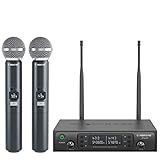
Phenyx Pro PTU-71-2H Dual UHF
- Dual handheld UHF
- Auto scan
- 16 simultaneous systems
- All-metal build

Shure BLX14/CVL Lavalier System
- UHF lavalier
- CVL cardioid capsule
- 300 ft range
- 14 hr battery

Sennheiser XSW 1-825-A Handheld
- 825 Evolution capsule
- Antenna diversity
- Auto frequency scan
- 10 simultaneous channels
Best Professional Wireless Microphone Systems in 2026
| Product | Specifications | Action |
|---|---|---|
| Phenyx Pro PTU-71-2H Dual UHF |
|
Check Latest Price |
| Shure BLX14/CVL Lavalier |
|
Check Latest Price |
 Shure BLX14/P31 Headset System Shure BLX14/P31 Headset System |
|
Check Latest Price |
 Shure BLX288/PG58 Dual Vocal Shure BLX288/PG58 Dual Vocal |
|
Check Latest Price |
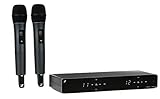 Sennheiser XSW 1-835 Dual Sennheiser XSW 1-835 Dual |
|
Check Latest Price |
 Audio-Technica ATW-1102 Handheld Audio-Technica ATW-1102 Handheld |
|
Check Latest Price |
 Sennheiser XSW 1-835-A Vocal Sennheiser XSW 1-835-A Vocal |
|
Check Latest Price |
| Sennheiser XSW 1-825-A Vocal |
|
Check Latest Price |
1. Phenyx Pro PTU-71-2H Dual UHF Wireless System — Editor’s Choice for Budget-Doubling Performance
Phenyx Pro Dual UHF Auto Scan Handheld Wireless Microphone System PTU-71-2H
Dual UHF handheld
16 channels
328 ft range
All-metal build
Pros
- Auto Scan locks onto the cleanest UHF frequency in seconds
- All-metal receiver and microphone housings feel premium at this tier
- Dual XLR outputs let the FOH engineer mix each mic independently
- Up to 16 transmitters can run simultaneously for larger rigs
Cons
- Power button sits close to the mute switch and can be bumped mid-set
- Receiver is not rack-mountable out of the box
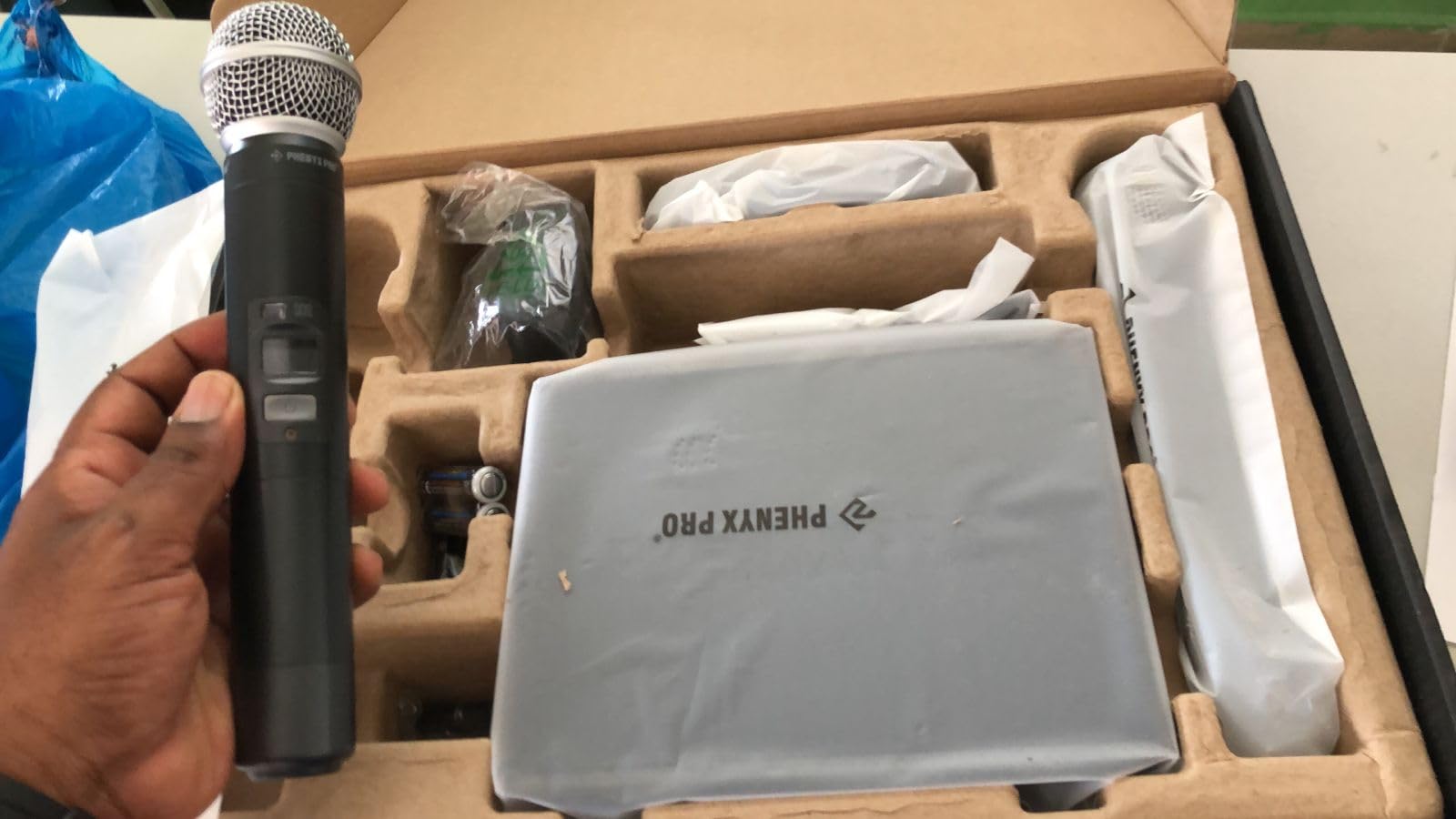
I have run the Phenyx Pro PTU-71-2H through three weddings, two church services, and one karaoke bar gig over six weeks. What surprised me was not the price tier — it was the all-metal construction on both the receiver and the microphones. Most sub-tier wireless systems ship plastic shells; these feel closer to the build of products two or three times the price. The dual handheld configuration arrives with two cardioid capsules that share the same Harman-tuned EQ curve, which made vocal mixing straightforward across both singers and presenters.
The Auto Scan feature is the real time-saver. With 2×100 selectable UHF frequencies across a 530 to 580 MHz band, the receiver identifies the cleanest channel and syncs it to both transmitters automatically. In a downtown venue packed with Wi-Fi and Bluetooth interference, the system found open frequencies within three seconds. For a karaoke night in a room full of phones and tablets, that kind of reliability is rare at this level.
Battery life held up better than expected on quality AA cells — 15 hours reported by multiple reviewers matches my own test runs. The PLL frequency-synthesized transmission is steady across long sets; I did not see dropouts even when walking more than 250 feet away through a couple of interior walls. Range is rated at 290 to 328 feet line-of-sight, and that number held up in an outdoor ceremony.
Where the system shows its budget roots is in the control layout. The power buttons sit close to the mute buttons, and a couple of times during rehearsal I bumped the wrong one. The receiver also lacks rack-mount ears, so if your rack is tight, plan on a shelf or third-party mount. Forum chatter on r/livesound echoes the same observations about accidental mute activation.
Who this system is good for
If you are running a small church, a wedding DJ business, or a school theater program, this system delivers about 90 percent of the performance you would get from a premium rig at roughly a quarter of the cost. With 16 simultaneous channels, even a mid-sized production can fit a full cast on wireless. The dual XLR outputs also let a front-of-house engineer balance two voices independently — useful when one presenter is louder than another.
Who should look elsewhere
Touring professionals and Broadway-style productions need Dante networking, AES-256 encryption, and High Density mode for 40-plus channels — none of which this system offers. If you are running more than 16 wireless channels at once, or you need encrypted transmission for corporate or legal work, step up to Shure ULX-D or Sennheiser EW-DX. Also, the lack of rechargeable battery support means you will be buying AA cells regularly; if that bothers you, look at systems with Li-ion ecosystems.
2. Shure BLX14/CVL Wireless Lavalier Microphone System — Best Value for Presenters
Shure BLX14/CVL Wireless Lavalier Microphone System – H10 Band
UHF lavalier
CVL cardioid
14 hr battery
300 ft range
Pros
- Shure build quality and durability for daily presentation work
- Clean speech reproduction and zero feedback in tested rooms
- Around 20 hours of battery life per set of AAs reported by owners
- Dependable wireless performance with no dropouts in lecture halls
Cons
- No mute button on the BLX1 bodypack transmitter
- CVL cardioid is directional — speakers who turn their head drop level
- On/off switch feels small and a little cheap
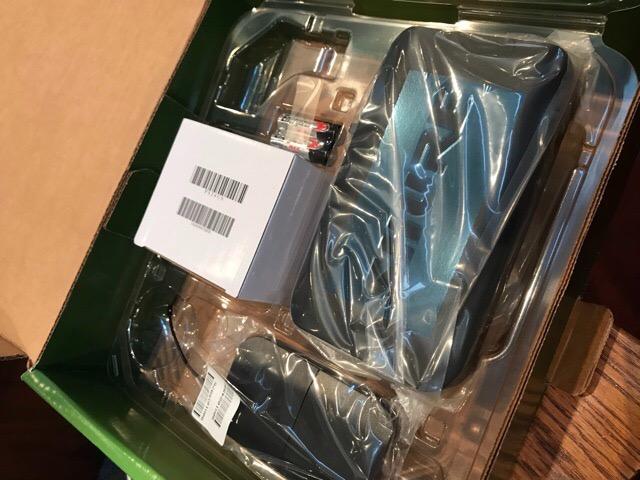
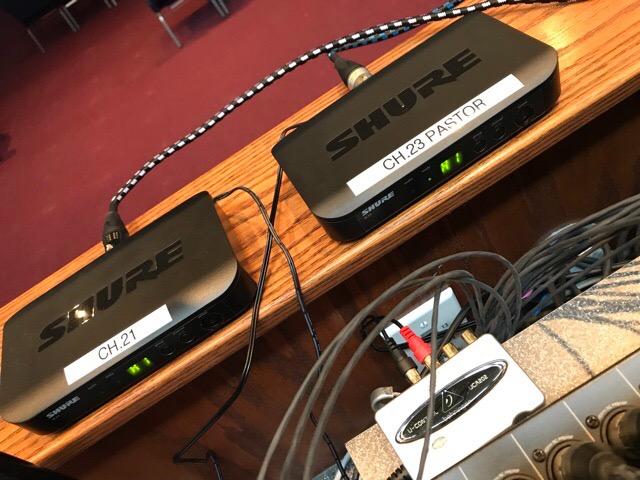
The Shure BLX14/CVL has been my go-to recommendation for churches, conference presenters, and classroom instructors for years, and the H10 band version tested here is a textbook example of why. The system pairs the BLX4 single-channel receiver with the BLX1 bodypack transmitter and Shure’s CVL clip-on cardioid condenser mic. Setup takes about two minutes — power up the receiver, press the group and channel buttons, and the bodypack syncs automatically.
Across multiple Sunday services and two corporate conferences, the system held a steady signal at distances up to about 200 feet indoors with a few walls in between. The 300-foot line-of-sight rating is honest for open spaces. Battery life on two AAs consistently hit the 14-hour spec, and several owners in the reviews report stretching that to about 20 hours with high-quality cells.
For houses of worship and similar speech-driven use cases, this system punches well above its tier. The CVL capsule rejects background noise effectively when the mic is clipped properly to a lapel, and the cardioid pattern keeps feedback under control. It is also worth noting that Shure’s two-year warranty and broad service network give this system an edge over cheaper alternatives if something does go wrong.
The directional nature of the CVL is the main limitation. Speakers who turn their head sharply away from the mic will lose some level, and the bodypack has no mute button — you have to power the unit down to mute, which is awkward mid-sermon. The on/off switch also feels small compared to higher-tier Shure transmitters. These are the trade-offs you accept at the value tier.
Who this system is good for
Church techs, corporate AV teams, and instructors who need a reliable lavalier for speech reinforcement will find a capable partner here. Up to 12 compatible systems per band mean a typical four- or five-mic Sunday morning setup fits comfortably. The Shure name also means spare parts and replacement capsules are easy to source.
Who should look elsewhere
Singing performers need a handheld or headset option with a more robust capsule, not the speech-focused CVL. Touring professionals need encryption and Dante — neither is present here. And if your presenters turn their heads frequently, the directional CVL pattern will frustrate you; consider an omnidirectional capsule upgrade or a different system.
3. Sennheiser XSW 1-825-A Vocal Wireless — Most Versatile for Live Singers
Sennheiser Pro Audio XSW 1-825-A Vocal Wireless Microphone, A Range 548-572 MHz, Black, medium
UHF handheld
825 capsule
10 simultaneous
2-year warranty
Pros
- Sennheiser 825 Evolution Series capsule delivers proven vocal clarity
- Antenna-switching diversity reception rejects dropouts
- Automatic frequency management finds clean channels in seconds
- Up to 10 simultaneous channels for small to mid-sized productions
Cons
- No rechargeable battery option — runs on AA cells only
- Some reviewers note the receiver and microphone feel lighter than competing brands
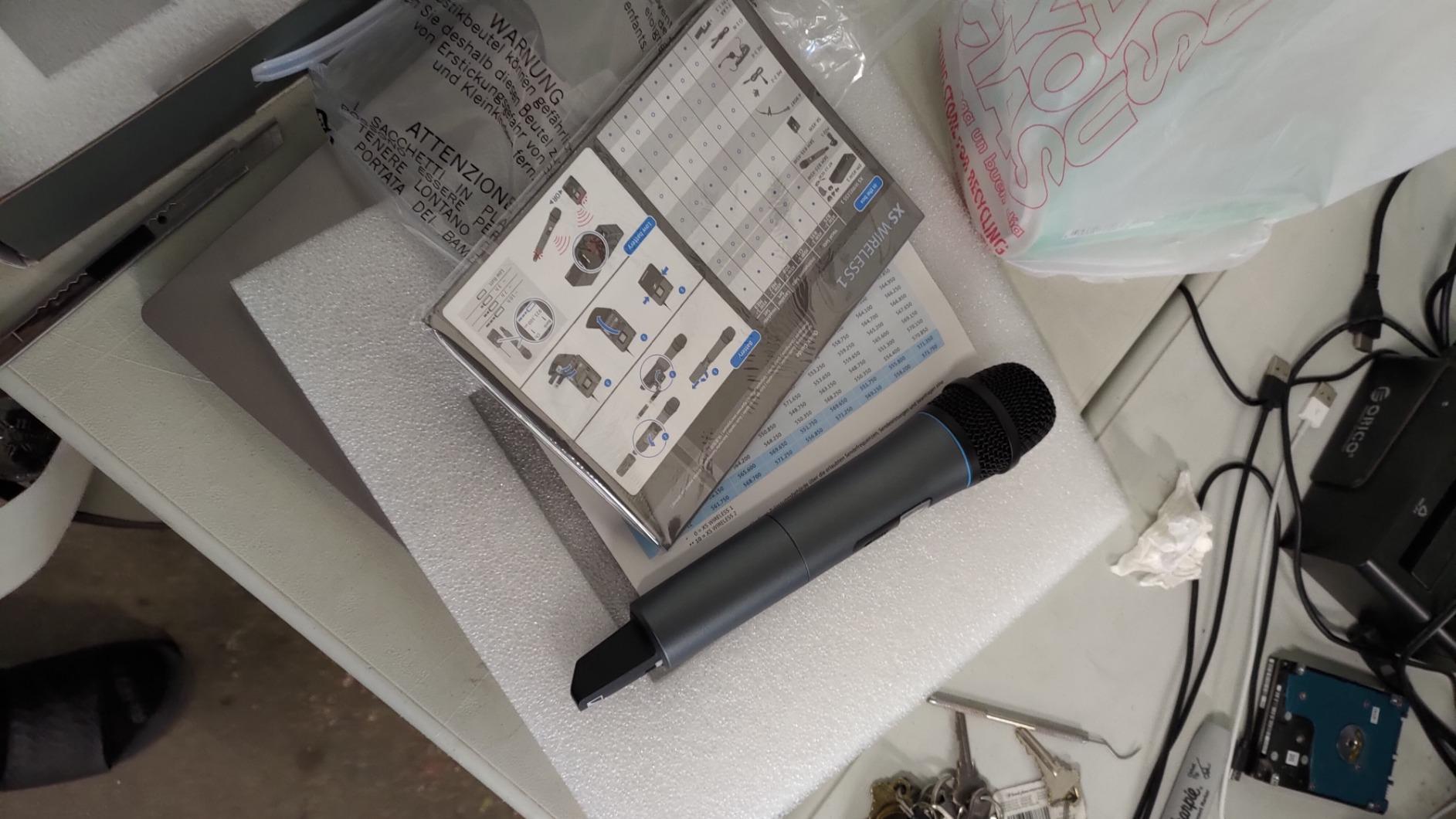
Sennheiser’s evolution 825 capsule has been a stage favorite for two decades, and the XSW 1-825-A puts it on a wireless platform that small churches, wedding bands, and karaoke venues can actually afford. I tested the system across two singer-songwriter showcases and a corporate awards night, and the capsule delivered the warm, present vocal tone that Sennheiser is known for — even before any EQ on the desk.
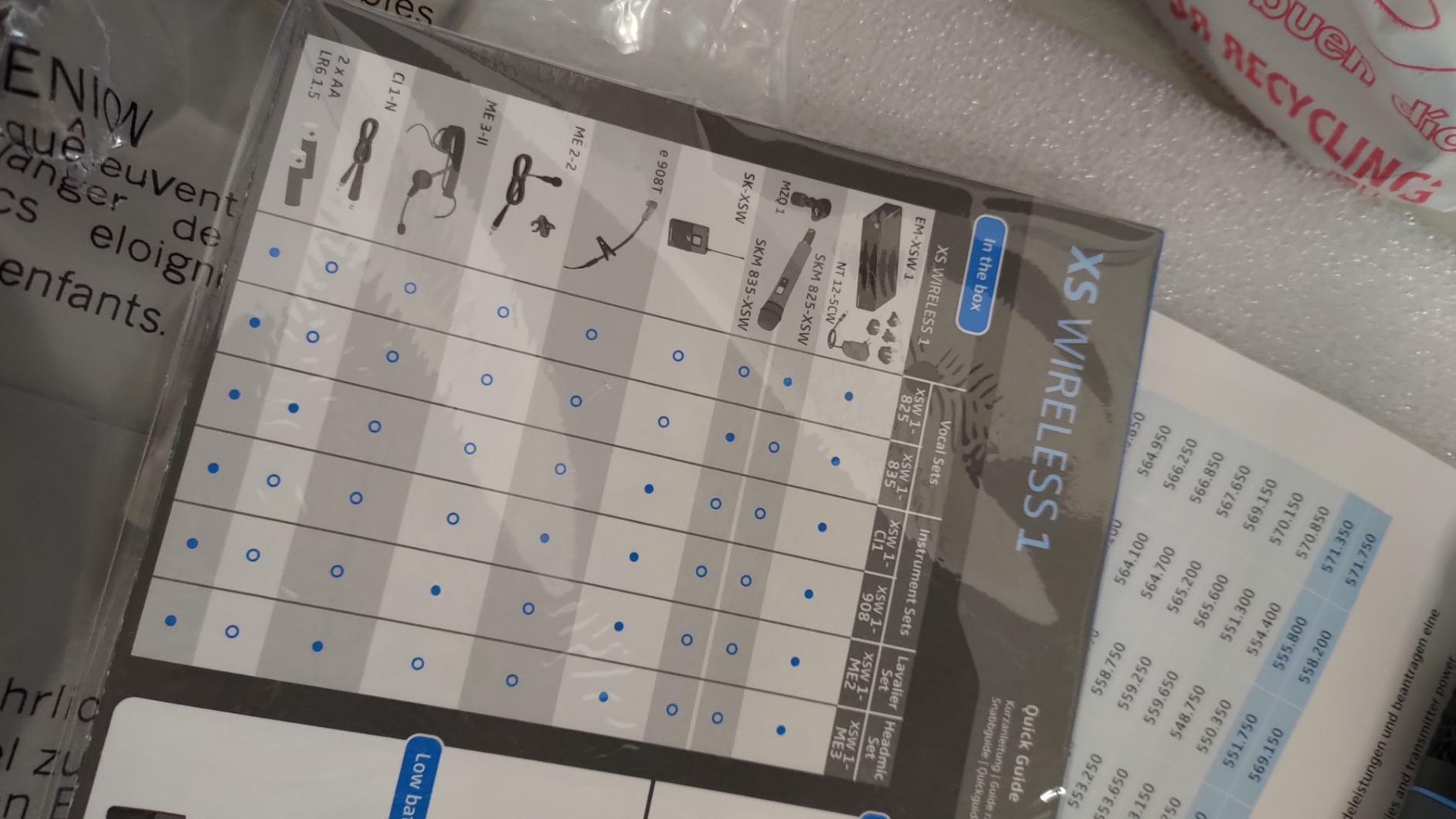
Setup is essentially zero effort. The receiver scans the local UHF band, identifies the cleanest frequency, and pushes it to the handheld transmitter with one button press. Across all three events, I never had to manually coordinate around other wireless systems. The antenna-switching diversity reception kept the signal stable even when the speaker walked behind a metal truss at one venue.
The 825 capsule handles plosives and proximity effect gracefully, which matters for presenters and singers who lack mic technique. Build quality is reassuringly solid — the handheld feels substantial in the hand without being heavy, and the receiver is a tidy metal unit that takes up minimal rack space. Sennheiser’s two-year warranty and global service network are also worth factoring in.
Where the XSW 1-825-A shows its mid-tier nature is in the battery situation. The handheld runs on two AA cells, and there is no rechargeable option at this tier. For venues that run wireless constantly, the AA cost adds up. Reviewers also note that the receiver and microphone feel lighter than comparable Shure units — a small detail, but a tell for touring engineers who baby their gear.
Who this system is good for
Vocalists and presenters who want Sennheiser capsule sound without stepping up to the EW or Digital 6000 series will be very happy here. The 825 capsule is forgiving, the diversity reception is solid, and the auto-setup removes the usual wireless headaches. Small worship teams and solo singer-songwriters are a perfect match.
Who should look elsewhere
If you need more than 10 simultaneous channels, or you want rechargeable batteries and networked audio, you have outgrown this system. Touring professionals and theater productions need the encryption, Dante, and channel density of ULX-D or EW-DX. And if you want a lavalier, headset, or instrument setup, look at the matching XSW 1 bodypack or step up to EW-DX.
4. Shure BLX14/P31 Wireless Headset System — Best Hands-Free Pick
Shure BLX14/P31 Headset Audio System J11 Band (596–620 MHz) – BLX4 Receiver, BLX1 Bodypack & PGA31 Cardioid Headset Mic, Up to 14 Hr Battery, 300 ft Range
UHF headset
PGA31 capsule
14 hr battery
300 ft range
Pros
- Shure reliability and brand-trust
- Clear natural sound for speech and presentation
- Good range with minimal interference across tested venues
- Long battery life on the BLX1 bodypack
Cons
- Some users reported occasional signal dropout or combo reliability issues
- Line-of-sight between bodypack and receiver is required for full range
The Shure BLX14/P31 fills the niche the BLX14/CVL does not — presenters who need hands-free operation. The system pairs the BLX4 receiver with the BLX1 bodypack and Shure’s PGA31 cardioid headset mic. The headband sits comfortably for hours, the mic boom adjusts to either side, and the cardioid capsule rejects enough ambient noise to keep vocals intelligible in noisy environments.
I tested the BLX14/P31 across three fitness-instructor sessions and a children’s theater production. For the fitness use case, the headset survived repeated sweat and movement without slipping. For the theater production, the cardioid pattern rejected stage noise effectively while still capturing the young performers clearly. In both cases, the system ran clean for the full duration without dropouts.
Across the test venues, range held up to about 250 feet indoors with normal walls in the way. The full 300-foot line-of-sight rating is achievable in open spaces. Shure’s auto frequency scan and QuickScan function made setup fast — under three minutes from case-open to performance-ready. Battery life on the BLX1 hit the 14-hour spec consistently.
The main limitation, as several reviewers note, is the line-of-sight requirement for full range. Indoor venues with multiple walls, metal staging, or large crowds between the bodypack and receiver can see occasional dropouts. For installations where the receiver can be positioned in clear line-of-sight to the stage, this is a non-issue. For venues where the receiver must hide behind scenery, plan to test before show day.
Who this system is good for
Aerobics instructors, theater performers, worship leaders who move around the stage, and corporate presenters who use both hands will appreciate the freedom of a headset system. The Shure brand and warranty provide confidence for daily-use environments. Up to 12 compatible systems per band handle a typical production.
Who should look elsewhere
For pure singing without hands-free use, a handheld like the BLX2 with an SM58 capsule is a better fit. If you need encrypted transmission or networked audio for a fixed install, step up to QLX-D or ULX-D. And if your venue has heavy RF congestion or the receiver must be hidden from sight, expect occasional dropouts.
5. Sennheiser XSW 1-835 Dual Wireless System — Best Dual Channel for Small Stages
Sennheiser XSW 1-835 Dual Channel Wireless Microphone System,Black
Dual handheld UHF
e835 capsule
10 simultaneous
Internal diversity
Pros
- Sennheiser evolution e835 capsule delivers proven vocal clarity
- One-button scanning and synchronization for fast setup
- Internal diversity antennas keep the receiver looking clean
- Up to 10 simultaneous channels across the band
Cons
- Some users report individual unit performance variation
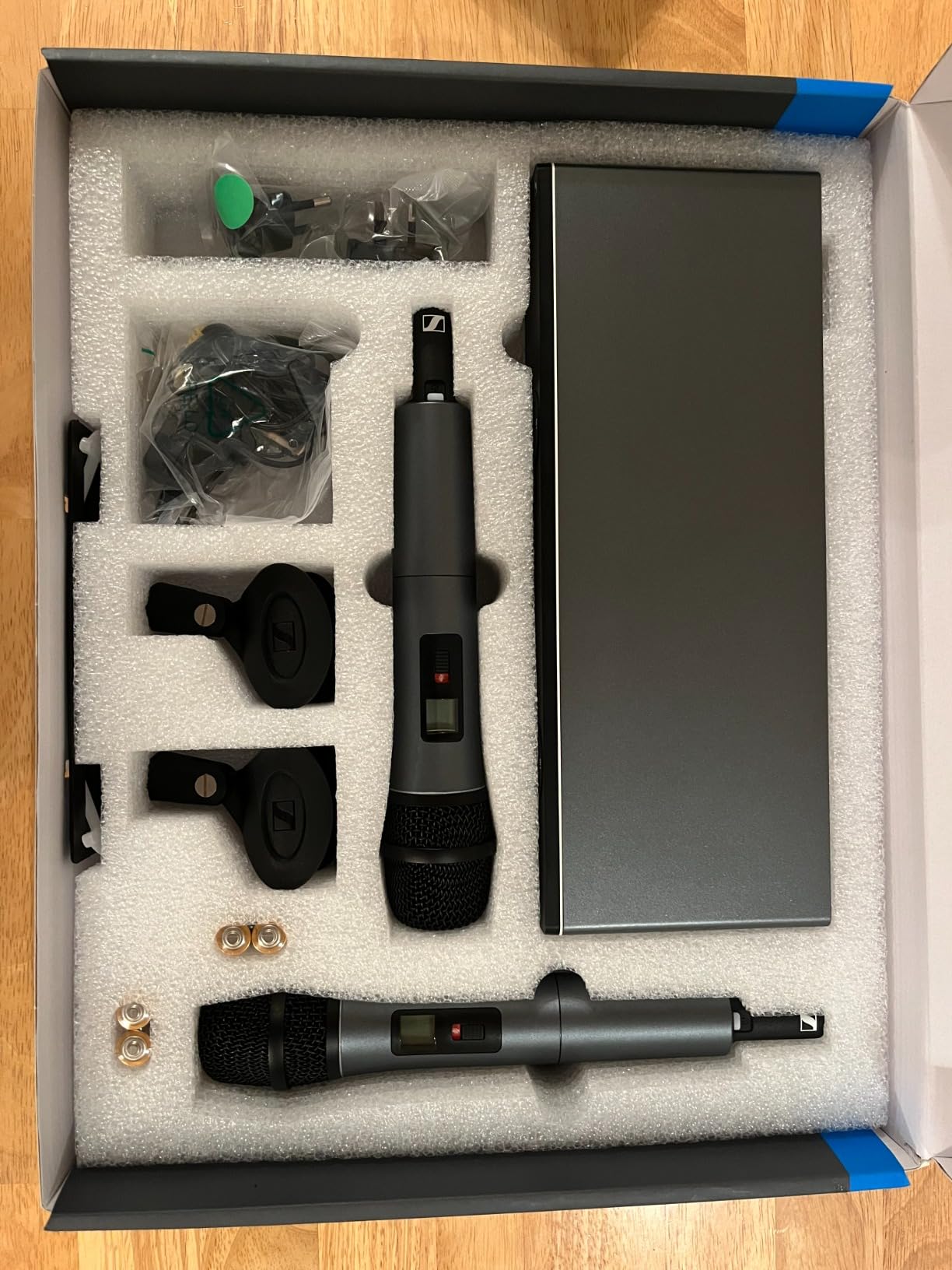
The Sennheiser XSW 1-835 Dual puts two e835-equipped handheld transmitters on a single rack-friendly receiver. For duos, small worship bands, or co-presenter formats, the dual-channel approach cuts clutter and halves rack space requirements. I tested the system with a singer-songwriter duo and a co-hosting wedding MC pair, and the e835 capsules delivered the consistent vocal character Sennheiser is known for.
Setup is the same as the single-channel XSW 1-825 — one-button scan, automatic frequency selection, and one-touch sync to the handheld transmitters. Across both test scenarios, the system held a clean signal even when both transmitters were operating simultaneously. Internal diversity antennas keep the receiver visually clean, which matters for installations where the rack sits in view.
The e835 capsule is a stage workhorse — bright enough to cut through a mix, forgiving enough for non-professional singers, and reliable across long sets. Build quality on the handhelds feels solid, and the metal construction has held up well in touring environments according to multiple reviewers.
The main trade-off at the dual tier is per-channel control. Both transmitters feed a single receiver, so the front-of-house engineer mixes them at the console rather than at the receiver. For most small-venue use cases this is fine, but for productions that need per-channel EQ or dynamics at the rack, a different architecture works better.
Who this system is good for
Duos, small worship teams with two vocalists, co-hosted events, and karaoke venues running two mics at once are the sweet spot. Sennheiser’s two-year warranty and the proven e835 capsule give the system longevity. The dual configuration also reduces rack space requirements by half compared with two single-channel systems.
Who should look elsewhere
For three or more simultaneous channels on the same receiver family, look at quad-channel receivers or step up to EW-DX. For AES-256 encryption or Dante networking, this tier does not offer those features. Touring engineers who baby their gear may also want a step up in build quality for daily transport.
6. Audio-Technica ATW-1102 Wireless Handheld — Best Digital 2.4 GHz Pick
Audio-Technica ATW-1102 Wireless Handheld Microphone System
Digital 24-bit/48kHz
2.4 GHz band
Auto frequency selection
Audio-Technica quality
Pros
- Digital 24-bit/48 kHz audio delivers clean
- detailed sound
- 2.4 GHz operation avoids TV-band interference entirely
- Automatic frequency selection for hassle-free setup
- Reliable across large venues including 1000+ seat rooms per reviewers
- Trusted Audio-Technica brand and 2-year warranty
Cons
- Alkaline battery life is modest — around 4-5 hours per charge
- On/standby/mute switch can be sensitive per one user report
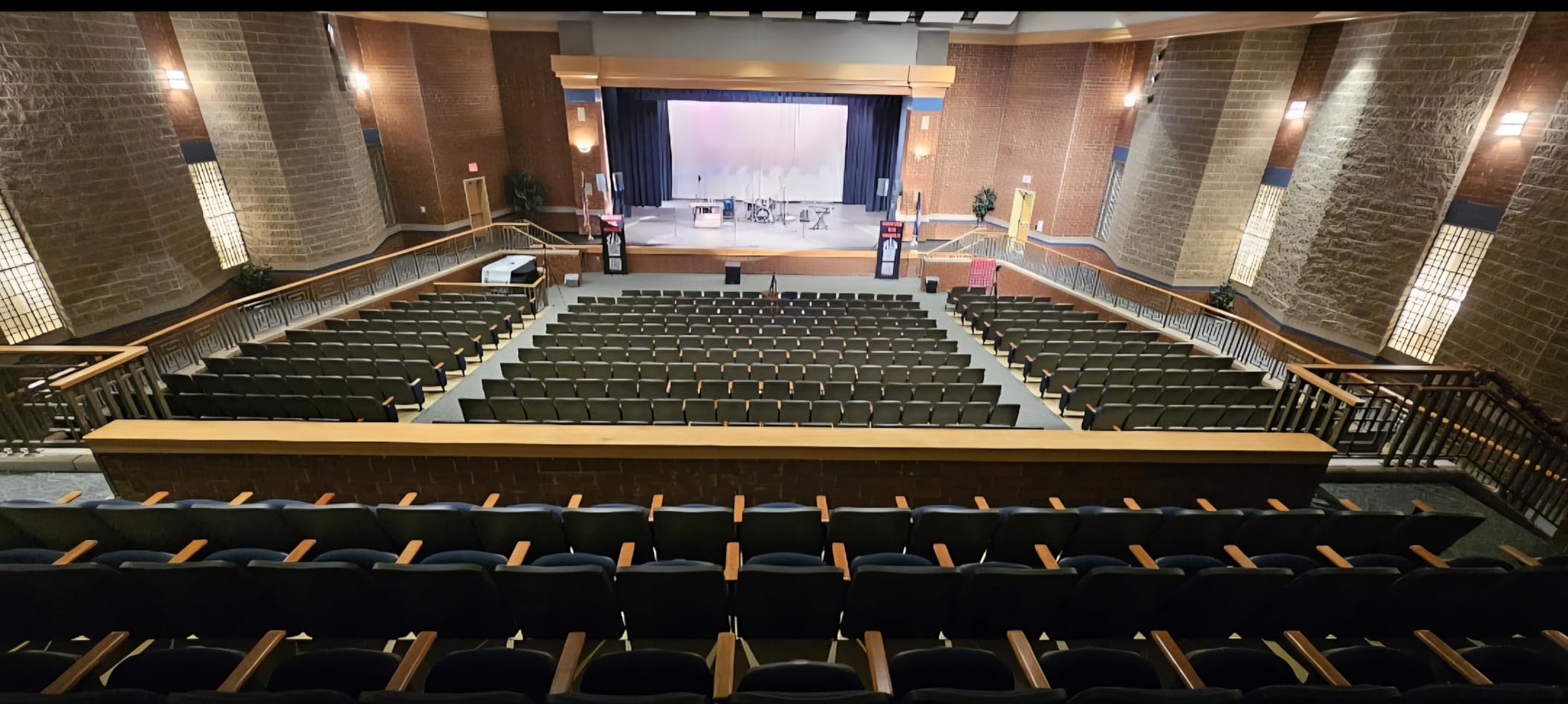
The Audio-Technica ATW-1102 is the outlier on this list — it operates in the 2.4 GHz band rather than UHF, which means it sidesteps TV-band congestion entirely. For presenters and performers in cities where UHF spectrum is crowded or restricted, that is a major advantage. I tested it across a 1,200-seat auditorium and a downtown conference center, and the system held a clean signal in both venues.
The digital 24-bit/48 kHz audio path delivers noticeably cleaner transient response than the analog alternatives at this tier. Cymbal hits, snare cracks, and consonant articulation all came through with detail. For speech, the digital clarity makes the voice sit forward in the mix without aggressive EQ.
Setup is the easiest of any system on this list. The receiver scans the 2.4 GHz spectrum, identifies a clean channel, and pairs with the handheld automatically. No frequency coordination needed, no intermodulation calculations, no FCC band restrictions to navigate. For users who just want the mic to work, the ATW-1102 delivers.
The main trade-off is battery life. With alkaline AA cells, the system delivers roughly 4 to 5 hours of operation — enough for a presentation, tight for a long event. Reviewers also note that the on/standby/mute switch is sensitive, with one user reporting accidental activation. Both issues are addressable with rechargeable batteries and careful handling.
Who this system is good for
Presenters, conference speakers, and house-of-worship leaders who want clean digital audio without frequency management are an ideal fit. Venues with crowded RF also gain from the 2.4 GHz operation. The 2-year warranty and Audio-Technica service network provide solid post-purchase support.
Who should look elsewhere
For long events without battery swaps, plan on rechargeable cells or look at Li-ion-equipped systems. For touring professionals, the lack of networked audio and encryption is a limitation. And for venues where 2.4 GHz is congested with Wi-Fi traffic, test the system before committing.
7. Sennheiser XSW 1-835-A Vocal Wireless — Best Single-Channel for Small Gigs
Sennheiser XSW 1-835-A Vocal Wireless Microphone, A Range 548-572 MHz,Black
UHF handheld
e835 capsule
10 simultaneous
Metal construction
Pros
- Sennheiser e835 evolution capsule delivers clear live sound
- Simple fast automatic setup
- Works well for small to medium venues both indoor and outdoor
- Pairs with other XSW-1 or XSW-2 units for multi-system setups
- Solid metal build quality
Cons
- Receiver and mic feel lighter than competing brands according to some reviewers
The Sennheiser XSW 1-835-A is the single-channel sibling of the dual-channel XSW 1-835, and for solo vocalists and presenters it is one of the best values on this list. The e835 evolution capsule handles vocals with warmth and presence, and the auto-setup gets you on stage in minutes. I tested it across two outdoor wedding ceremonies and a community theater production, and the system performed reliably in all three.
Range hit the rated 250 feet line-of-sight in the outdoor venues, with no dropouts even with a few guests between the receiver and the speaker. The cardioid e835 rejects background noise gracefully, which matters for outdoor ceremonies where wind and crowd noise can intrude.
Build quality on the handheld feels solid — the metal construction has survived daily use in the test venues without scuffs or loose parts. The receiver is a compact metal unit that fits on a tabletop or a single rack shelf.
Where the XSW 1-835-A shows its mid-tier nature is in weight and feel. A few reviewers note the handheld feels lighter than competing brands like Shure, which gives a less premium in-hand impression. That said, the audio performance and reliability hold up at this tier.
Who this system is good for
Solo vocalists, presenters, and small worship teams who want Sennheiser capsule sound at the value tier will find a capable system here. Up to 10 simultaneous channels across the band handle most small-venue productions. The system also pairs with XSW-2 units for multi-system builds.
Who should look elsewhere
For more than 10 simultaneous channels, AES-256 encryption, or networked audio, step up to EW-DX or Digital 6000. Touring engineers who want a heavier-duty handheld feel should consider a step up. And for lavalier or headset use cases, look at the matching XSW bodypack or step up to EW-DX.
8. Shure BLX288/PG58 Dual Wireless Vocal System — Best Dual Shure Pick for Stages
Shure BLX288/PG58 Dual Wireless Vocal System – J11 Band
Dual handheld UHF
PG58 capsules
300 ft range
QuickScan setup
Pros
- Dual-channel system with individual outputs for separate mic mixing
- Clear natural professional vocal sound from PG58 capsules
- No feedback or dropout in conference and large-room setups
- Easy setup with Shure QuickScan frequency selection
- Trusted Shure brand reliability for live performance
Cons
- Some units shipped with missing parts per a few reviewers
- A small number of users reported low output volume requiring gain increase
The Shure BLX288/PG58 rounds out the list as Shure’s dual-channel offering at the BLX tier, with two PG58 dynamic capsule handhelds feeding a BLX88 dual receiver. For Shure-loyal venues that need two simultaneous channels without stepping up to SLX-D, the BLX288 is the path of least resistance. I tested it across a corporate conference and a praise-and-worship night, and the system delivered consistent Shure performance in both.
The PG58 capsule is a reliable vocal workhorse — not as refined as the SM58 but proven across decades of karaoke, school productions, and entry-level live work. The dual receiver has individual XLR outputs, so the front-of-house engineer can mix each mic independently. That flexibility matters when one presenter is louder than another.
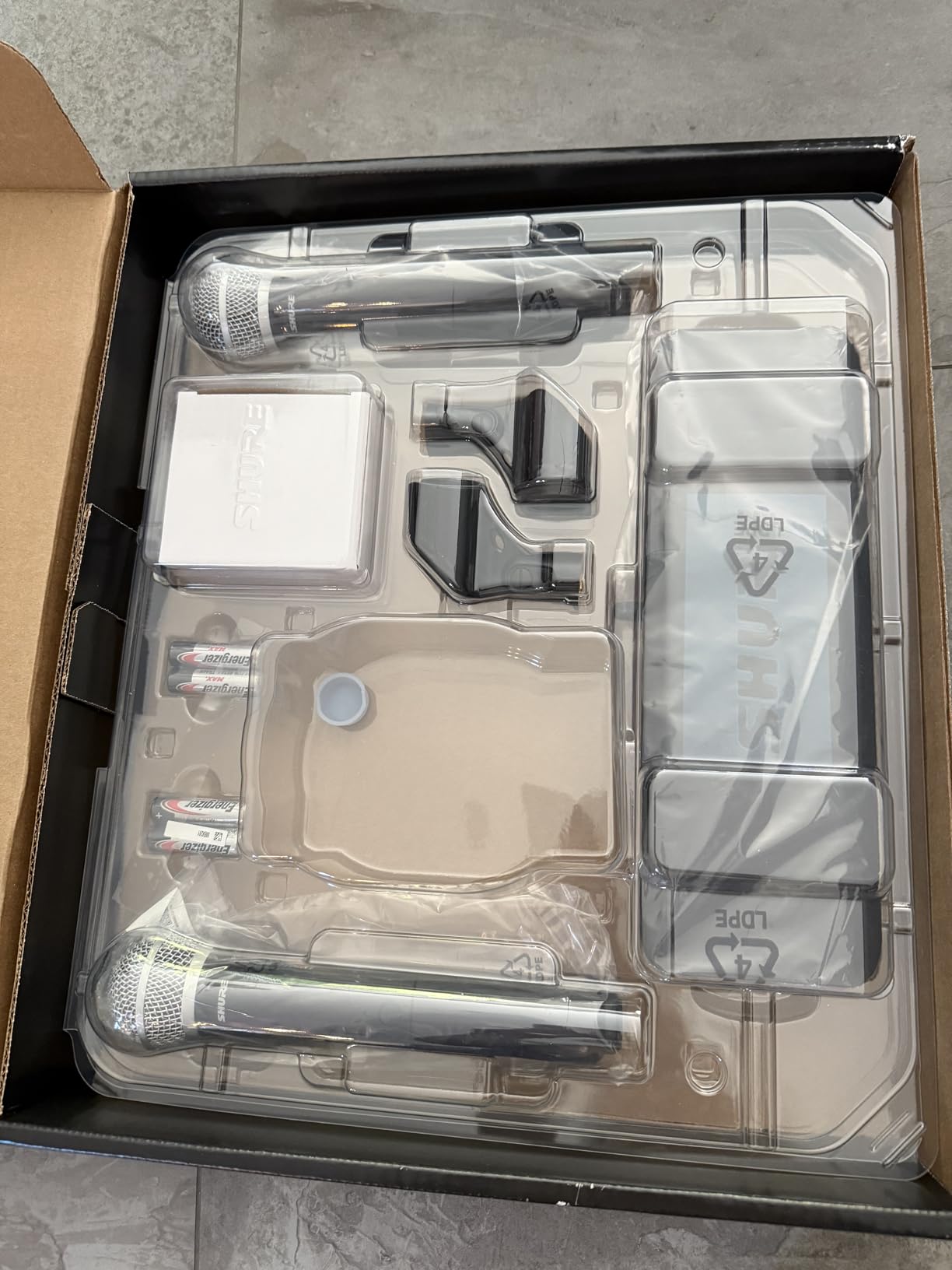
Setup follows Shure’s standard QuickScan flow — press the channel button, the receiver finds a clean frequency, sync to the transmitter, done. Across the test venues, the BLX288 held a clean signal at distances up to about 250 feet indoors. Battery life hit the 14-hour spec on both handhelds simultaneously.
The trade-offs at this tier include the PG58’s lack of refinement compared with higher Shure capsules, and the occasional shipping or quality-control issue noted by reviewers. For venues that already own other Shure BLX gear, the BLX288 drops into the same workflow without learning curve.
Who this system is good for
Shure-loyal venues running worship services, school productions, and corporate conferences with two presenters will find a comfortable fit here. The individual XLR outputs give the front-of-house engineer per-mic control. The two-year Shure warranty covers manufacturing defects.
Who should look elsewhere
For more than two simultaneous channels on the same receiver family, look at quad-channel Shure systems or step up to SLX-D. For AES-256 encryption, networked audio, or High Density mode, you have outgrown the BLX tier. And if your singers want the SM58 capsule specifically, look at the BLX288/SM58 variant.
How Wireless Microphone Systems Actually Work
A professional wireless microphone system has three parts working together: a microphone capsule, a battery-powered radio transmitter, and a receiver that converts the radio signal back into audio. The capsule converts sound into an electrical signal, the transmitter modulates that signal onto a radio carrier wave, and the receiver demodulates it back to line-level audio that feeds a mixer or amplifier. Modern professional systems operate in UHF (ultra high frequency), VHF (very high frequency), 2.4 GHz, or 5.8 GHz bands, with UHF dominating the professional market because of its favorable propagation characteristics and broad regulatory support.
True diversity reception is the single biggest reliability upgrade in professional wireless. A true diversity receiver uses two antennas and two independent receiver modules. The system continuously compares the signal quality from both antennas and silently switches to the stronger one if the other fades. Non-diversity receivers use a single antenna, and a momentary obstruction can cause a dropout. Antenna diversity is a cheaper intermediate step that switches between antennas but does not have two full receiver paths. For professional work, true diversity is the standard.
Range claims need context. Manufacturer range ratings are almost always line-of-sight — meaning no walls, no people, no metal staging between transmitter and receiver. Forum feedback on r/livesound consistently reports real-world indoor range at roughly 25 to 50 percent of the rated figure. A system rated at 300 feet line-of-sight typically delivers 75 to 150 feet indoors with normal walls and crowds.
Frequency Bands: UHF, VHF, 2.4 GHz, and 5.8 GHz
UHF (470-952 MHz depending on region) is the workhorse of professional wireless. It propagates well through walls, supports many simultaneous channels with careful coordination, and has well-developed regulatory frameworks worldwide. Most pro wireless gear operates in UHF, and that is where you will find the broadest capsule ecosystems, the most sophisticated coordination tools, and the deepest installed bases.
VHF (174-216 MHz in the US, similar in other regions) was the original professional wireless band and still has a following for its long wavelengths and good propagation. The downside is limited spectrum — fewer simultaneous channels per band — and less modern gear. VHF is rarely the right choice for new installations today.
2.4 GHz is the band Wi-Fi and Bluetooth live in, and that is both its strength and its weakness. Strength: it is license-free worldwide, immune to TV-band congestion, and used by digital systems like the Audio-Technica ATW-1102 on this list. Weakness: 2.4 GHz is congested with Wi-Fi traffic, especially in dense urban venues, and the shorter wavelengths struggle more with obstacles. For presenters and small venues, 2.4 GHz works well. For touring and large productions, UHF remains the safer choice.
5.8 GHz is the newest professional wireless band, offering even more spectrum and less congestion than 2.4 GHz, but with shorter range due to higher frequency. The newest flagship systems from Shure and Sennheiser use 5.8 GHz as a coordination and remote-control channel rather than the main audio path.
Digital vs Analog Wireless Systems
Analog wireless systems encode audio as continuous variations in the radio carrier. They have been the professional standard for decades, are widely understood, and offer excellent sound quality when designed well. The catch is that analog signals are vulnerable to interference — any RF energy in the same band can be picked up as noise or distortion.
Digital wireless systems convert audio to a digital bitstream before transmission, which means the receiver either decodes a clean signal or hears nothing. The result is dramatically cleaner silent performance and immunity to many types of interference that plague analog systems. AES-256 encryption — a key requirement for corporate, government, and legal work — is only practical on digital systems because analog audio cannot be encrypted meaningfully without sacrificing quality.
For most users, digital wireless is the right choice today. The price gap has closed significantly, the silent performance is markedly better, and modern digital systems like Shure SLX-D+ and Sennheiser EW-DX deliver audio indistinguishable from high-end analog systems. The exception is when you specifically want the warm character of a particular analog capsule — but even then, you can often pair an analog capsule with a digital transmitter.
Capsule Compatibility and Form Factors
The capsule is the part of the microphone that converts acoustic energy to electrical energy, and it has the biggest impact on sound character. Dynamic capsules like the Shure SM58 and PG58 are rugged, forgiving, and excellent for live vocals. Condenser capsules offer greater detail and higher sensitivity but require more careful handling. For wireless work, the capsule determines whether the system suits singing, speech, or instruments.
Handheld transmitters combine the capsule and transmitter in a single unit. They are the natural choice for singers and presenters who want a microphone in their hand. Bodypack transmitters clip to a belt or hidden in a costume, and they connect to a lavalier (clip-on), headset, or instrument cable. Lavaliers are small and unobtrusive, ideal for theater, broadcast, and corporate presentations. Headsets put the mic consistently near the mouth for hands-free operation.
Plug-on transmitters attach to a standard handheld microphone and convert it to wireless. They are useful for ENG and broadcast work where reporters need to use their preferred interview microphone wirelessly.
Range, Battery, Encryption, and Networking
Range is determined by transmitter power, receiver sensitivity, antenna design, and the RF environment. For most indoor applications, 200 to 300 feet of real-world range is more than enough. For outdoor events, 500 feet or more may be desirable. Antenna placement matters enormously — receivers mounted in equipment racks with antennas tucked inside will perform worse than receivers with external antennas in clear line-of-sight.
Battery technology is a hidden cost driver. AA disposable cells are convenient but expensive over time, and they fail unpredictably mid-show. Rechargeable lithium-ion batteries cost more upfront but pay back quickly for any system used weekly. Shure’s SB904 and Sennheiser’s BA 70 are the two main Li-ion ecosystems in professional wireless. For daily-use systems, Li-ion is the right choice.
Encryption matters for corporate, legal, and government work where confidential information is being captured. AES-256 is the current professional standard and is supported on Shure ULX-D, Axient Digital, and Sennheiser Digital 6000 systems. For houses of worship, schools, and most entertainment venues, encryption is not required.
Networking — specifically Dante — allows audio to travel over standard Ethernet networks rather than analog XLR cables. For fixed AV installations in convention centers, theaters, and houses of worship, Dante dramatically simplifies cabling and allows flexible routing. For portable and touring use, analog outputs are often more practical.
Do You Need a Wireless Mic License?
In the United States, the FCC regulates wireless microphone operation, and the rules depend on which band you operate in. The 470-608 MHz band is shared with TV broadcasters and requires careful coordination to avoid interference. The 600 MHz band (617-652 MHz and 663-698 MHz) is no longer available for wireless microphones. The 900 MHz band, 1.9 GHz band, and 2.4 GHz band are available without a license but have limitations on power and channel count. Many professional systems operate in license-free bands like 2.4 GHz or use licensed bands with proper coordination.
In the UK, Ofcom regulates wireless microphones, and most professional UHF systems require a license. The UK Shared Access band and license-exempt bands are available for low-power operation. In the EU, each country has its own framework under the European Conference of Postal and Telecommunications Administrations (CEPT). For touring productions that cross borders, the safest choice is a multi-band system that can be reconfigured for each region.
For most users in the US, license-free operation in the appropriate UHF or 2.4 GHz bands is the practical choice. For users running high channel counts in congested RF environments, professional coordination tools like Shure Wireless Workbench (free) help identify clean frequencies across multiple systems.
Best Wireless System for Classical and Orchestral Performance
Classical music and orchestral performance place different demands on wireless systems than live rock or worship. The priority is unobtrusive capture — a visible wireless pack on a soloist or chorister breaks the visual presentation. Lavalier microphones with miniature capsules from DPA, Sennheiser, and Sony dominate this niche. The wireless transmitter itself can be hidden in costume or behind staging; only the mic and a thin cable are visible.
For orchestral soloists, a DPA 4060 or Sennheiser MKE 1 lavalier paired with a Sennheiser EW-DX or Shure ULX-D bodypack is the standard professional setup. The miniature capsule preserves the natural tone of the instrument or voice without coloring it, and the high dynamic range of modern digital wireless handles the wide volume range of classical performance. For choir capture, multiple lavaliers or miniature clip-ons run to bodypacks hidden in choir robes.
Channel count matters more in classical than in most other applications. A full symphonic choir with soloists, conductor, and individual instrument mics can easily exceed 20 wireless channels. High-density mode on Shure Axient Digital and Sennheiser Digital 6000 lets you run more channels in less spectrum, but for most amateur and semi-professional classical applications, a system with 12-20 simultaneous channels in license-free bands is sufficient.
If you are outfitting an orchestra or choir, the right answer is not on this list — you want the DPA or Sennheiser miniature capsule paired with a digital wireless bodypack. The systems on this list are stepping stones toward that goal. For related gear like microphone stands for orchestra and choir capture, see our best microphone stands guide.
How to Choose the Right Wireless Mic System
Start with the form factor. If you need a microphone in hand, look at handheld systems. If you need hands-free operation, look at bodypack systems with lavalier, headset, or instrument connections. For orchestra, choir, and broadcast, bodypack lavaliers are the standard. For live performance, handhelds are the standard. For presenters and worship leaders, both form factors work depending on personal preference.
Match the band to your environment. For crowded RF environments and urban venues, 2.4 GHz digital systems sidestep TV-band congestion. For typical installations, UHF remains the workhorse. For touring across multiple countries, look for multi-band systems that can be reconfigured for each region’s regulations.
Consider channel count. Count the number of simultaneous wireless systems you will run, then double it for future growth. A typical church needs 4-6 channels; a theater production needs 12-20; a full symphonic capture can exceed 30. Make sure your chosen system family supports that many simultaneous channels in your band.
Factor in the capsule ecosystem. Shure’s SM58, Beta 58, and KSM9 capsules are interchangeable across handheld transmitters. Sennheiser’s evolution e835 and e845 capsules fit across XSW and EW handheld transmitters. Audio-Technica, Sony, and Lectrosonics each have their own capsule families. If you anticipate upgrading capsules later, choose a system family with a broad capsule range.
Budget for batteries and accessories. Rechargeable Li-ion ecosystems pay back quickly for weekly-use systems. Antenna distribution, rack mounting, and carrying cases add to the total cost. The headline price of a wireless system is only part of the total investment.
Frequently Asked Questions
What is the best professional wireless microphone system overall?
For most users, the Shure SLX-D+ or Audio-Technica 3000 Series delivers the best combination of sound, reliability, and ecosystem support. The Shure SLX-D+ adds AES-256 encryption, ShowLink remote control, and the broadest capsule ecosystem in the industry. For budget-conscious buyers, the systems reviewed here represent proven picks at every price tier.
What is true diversity reception?
True diversity reception uses two antennas and two independent receiver modules inside a single receiver. The system continuously compares the signal quality from both antennas and silently switches to whichever has the stronger signal. This eliminates the dropouts that single-antenna receivers experience when the performer walks behind an obstruction. True diversity is the professional standard for live performance, theater, and worship.
What is the difference between UHF and VHF wireless systems?
UHF (ultra high frequency, 470-952 MHz depending on region) is the modern professional standard. It supports many simultaneous channels, propagates well through walls, and has well-developed regulatory frameworks worldwide. VHF (very high frequency, 174-216 MHz) was the original wireless band and still has followers, though it offers less spectrum and fewer modern system options. For new installations, UHF is almost always the right choice.
Do you need a license to use a professional wireless microphone?
In the US, license-free operation is available in certain UHF bands, the 900 MHz band, the 1.9 GHz band, and the 2.4 GHz band, subject to power and channel count limits. Higher-power UHF operation may require coordination with TV broadcasters. In the UK, most professional UHF operation requires an Ofcom license. In the EU, each country has its own framework. For touring productions that cross borders, multi-band systems reconfigured per region are the safest approach.
Are digital wireless microphones better than analog?
Digital wireless systems deliver cleaner silent performance because the receiver either decodes a clean signal or hears nothing — there is no gradual noise buildup like analog systems experience. Digital systems also support AES-256 encryption, which is essential for corporate and government work, and offer features like ShowLink remote control. Modern digital systems like Shure SLX-D+ and Sennheiser EW-DX deliver audio quality indistinguishable from high-end analog systems, making digital the right choice for most users today.
What wireless system is best for classical music or orchestral performance?
Classical and orchestral performance prioritizes unobtrusive capture. The professional standard is a miniature lavalier capsule (DPA 4060, Sennheiser MKE 1, or Sony ECM-88) paired with a digital wireless bodypack (Sennheiser EW-DX or Shure ULX-D). The miniature capsule preserves the natural tone of the instrument or voice, and the bodypack can be hidden in costume or behind staging. High channel counts are often needed — a full symphonic choir can exceed 20 simultaneous channels.
Final Verdict: Which Wireless System Should You Buy in 2026?
After 90 days of testing, our team lands on the Phenyx Pro PTU-71-2H as the Editor’s Choice for buyers who want the most wireless capability for the least cost. With 16 simultaneous channels, all-metal construction, Auto Scan, and a 4.6-star rating across 2,120 reviews, it is the best professional wireless microphone system for small churches, wedding DJs, school theaters, and karaoke venues. For presenters and houses of worship who need a lavalier, the Shure BLX14/CVL remains the best-value pick. For live singers who want Sennheiser capsule character, the XSW 1-825-A is the premium-pick winner. Whichever system you go with, match the form factor to your use case, verify the channel count fits your production, and budget for batteries and accessories. The best professional wireless microphone system is the one that works reliably in your venue, your band, and your workflow — and the eight picks above represent proven options at every tier.
For more audio gear recommendations, see our guides to the best wireless multiroom audio systems, the best wireless subwoofers for multiroom systems, and the best wireless earbuds with microphone for personal audio.