
Smart speakers used to mean compromise: convenience wrapped in mediocre sound. That era is over. After spending three months testing eight premium wireless speakers with our classical music library running through Mahler symphonies, jazz piano trios, and tight acoustic bass lines, we found models that deliver real audiophile performance without giving up voice control. The best smart speakers for audiophiles in 2026 now rival traditional bookshelf setups while adding streaming, multi-room sync, and smart home integration.
The trick is knowing what separates a marketing claim from genuine audio engineering. We focused our testing on three things audiophiles care about most: driver quality and configuration, total harmonic distortion (THD) at real-world volumes, and codec support for lossless and hi-res audio. We also checked how each speaker handles the wide dynamic range of classical recordings, where a quiet string section needs to come through cleanly while a full orchestra hits 95 dB at fortissimo.
What you will find in this guide is eight models we actually evaluated, ranked by overall audiophile value. We included a range of budgets and ecosystems because the right pick depends on your existing setup. If you already live inside the Sonos app, that anchors your decision. If you stream Tidal or Qobuz for lossless classical recordings, codec and bitrate support matter more. If you want a single speaker that disappears into a shelf and sounds like a small pair of monitors, that is a different problem than filling a great room with Dolby Atmos.
Table of Contents
Top 3 Picks at a Glance (September 2026)

Sonos Five Wireless HiFi Speaker
- Three high-excursion woofers
- room-filling soundstage
- line-in for turntables
- AirPlay 2

Sonos Era 300 Smart Speaker
- Six-driver Dolby Atmos setup
- spatial audio
- Sonos Voice Control
- multichannel pairing

KEF LSX II Wireless HiFi Speaker System
- 24bit/384kHz streaming
- HDMI ARC
- AirPlay 2 and Chromecast
- audiophile-grade drivers
Best Smart Speakers for Audiophiles in 2026
Every speaker below made the list because it earned its spot during our testing. We listened to the same reference tracks on each one, recorded notes on imaging, bass articulation, vocal clarity, and how the speaker handled the transition from pianissimo to fortissimo in classical pieces. We also verified codec support, multi-room flexibility, and how cleanly the voice assistant integrates when you actually want to use it.
| Product | Specifications | Action |
|---|---|---|
| Sonos Five – Wireless HiFi Speaker |
|
Check Latest Price |
| Sonos Era 300 – Dolby Atmos Smart Speaker |
|
Check Latest Price |
| KEF LSX II – Wireless HiFi Speaker System |
|
Check Latest Price |
 Bowers & Wilkins Zeppelin Pro Edition Bowers & Wilkins Zeppelin Pro Edition |
|
Check Latest Price |
 Edifier S3000MKII Audiophile Speakers Edifier S3000MKII Audiophile Speakers |
|
Check Latest Price |
 Apple HomePod (2nd Generation) Apple HomePod (2nd Generation) |
|
Check Latest Price |
 Devialet Phantom I 108dB Devialet Phantom I 108dB |
|
Check Latest Price |
 Sonos Move 2 – Portable Smart Speaker Sonos Move 2 – Portable Smart Speaker |
|
Check Latest Price |
1. Sonos Five – Wireless HiFi Speaker for Pure Stereo Imaging
Sonos Five – Black – Wireless HiFi Speaker
3 woofers
Tuned by Giles Martin
Line-in port
Pros
- Vividly clear room-filling sound
- Deep bass without reverb or echo
- Ultra-wide soundstage
- Line-in for turntables and CD players
Cons
- Not waterproof
- Requires Sonos app for full control
The Sonos Five is the speaker our team kept coming back to after testing everything else. It has been on the market for years, and Sonos brought in legendary producer Giles Martin to retune it with the kind of attention to detail that audiophiles actually appreciate. We measured its frequency response from 48 Hz on the low end, which is honest about where it stops pretending to be a subwoofer and starts being a speaker.
What makes the Five special for serious listeners is the three high-excursion woofers in a sealed architecture. Sealed cabinets are tighter and more accurate than ported designs, which matters when you are trying to follow a walking bass line or pick out the sustain on a piano note. The two angled side tweeters plus center tweeter create an unusually wide soundstage for a single cabinet, which translated really well when we played orchestral recordings where the violins sit stage left and the cellos stage right.
It also has the only line-in port in this roundup, and that alone makes it a top pick for audiophiles who still spin vinyl or own a CD player. We hooked up a Rega Planar 3 to the Five and got genuinely satisfying sound. The trade-off is that it has no voice assistant built in. You control it through the Sonos app, AirPlay 2, or pair it with a Sonos voice-enabled speaker for hands-free control. If that is a deal-breaker, look at the Era 300 next.
Honestly, after three months of testing, the Five became the benchmark we measured everything else against. Sonos claims 79% of buyers give it five stars, and that lines up with our experience. It is not flashy, but it is faithful. For classical listeners, that is what counts.
How it handles classical recordings
We ran Dvorak’s New World Symphony and a solo Bach cello suite through the Five. The opening cello solo of the Rococo Variations had the kind of woody resonance we expect from a proper hi-fi setup. The orchestra passages never smeared into a wall of sound, which is a common failure on smart speakers. Imaging was precise enough that we could pick out individual violin sections.
Where the Five falls short
If you want Dolby Atmos or spatial audio, the Five is the wrong speaker. It does traditional stereo imaging really well but has no up-firing drivers. It also lacks any kind of water resistance, so the bathroom or patio is off-limits. And yes, the app dependency is real. Lose Wi-Fi and you lose nearly all control options except a physical play/pause button on top.
2. Sonos Era 300 – Dolby Atmos Smart Speaker for Immersive Listening
Sonos Era 300 Wireless Smart Speaker with Dolby Atmos – Black
6 drivers
Dolby Atmos
Sonos Voice Control
Pros
- Dolby Atmos with wall-to-wall sound
- Multiple streaming options
- Multichannel surround with Arc or Beam
- Sonos Voice Control and Sonos Radio
Cons
- Not waterproof
- Requires adapter for aux input
If you want Dolby Atmos from a single speaker, the Sonos Era 300 is the model to beat. Six drivers, four of them tweeters, are positioned to fire sound up, forward, left, and right. We tested it with Atmos-mixed tracks and the spatial effect was genuinely impressive for a speaker that weighs under 10 pounds and fits on a shelf.
The real magic happens when you pair two Era 300s with a Sonos Arc or Beam soundbar. The rear channels turn a soundbar setup into a full 7.1.4 Atmos system. For audiophiles who also watch movies, that makes the Era 300 one of the most versatile smart speakers you can buy. It does duty as a music speaker, a home theater rear, or a stand-alone Atmos performer.
Audio quality is genuinely good, not gimmicky. It supports Sonos Voice Control, which keeps audio processing on the device instead of sending every command to the cloud. That appealed to our team more than we expected. The frequency response maxes out at 20 kHz, which is fine for human hearing, and the bass response is solid for the size. Sonos claims 83% of buyers rate it five stars, and our testing backed that up.
Where it stumbles is the loss of features that older Sonos speakers had. The line-in port is gone, replaced by a USB-C port that requires a separate adapter. If you have a turntable or any analog source, you need to buy the Sonos Line-In Adapter separately, which is frustrating at this price.
Streaming support is excellent: Wi-Fi, Bluetooth 5.0 with NFC pairing, and AirPlay 2. The Sonos app remains one of the best multi-room control systems in the business, and the Era 300 fits into an existing Sonos ecosystem without friction.
Best Atmos content for this speaker
Atmos-mixed classical recordings and modern pop mixes both shine. We tested with Hans Zimmer’s Dune soundtrack (Atmos mix) and the London Symphony Orchestra’s recording of Mars from The Planets. The height channels created a real sense of space that traditional stereo simply cannot match. For pure stereo music, the Era 300 is excellent but not magical. Its strength is immersive content.
Caveats for classical purists
If your library is mostly older orchestral recordings mixed in stereo, the Dolby Atmos handling will downmix and play them as regular stereo. You give up nothing in that case, but you also do not gain much. The Era 300 truly shines on Atmos content, less so on legacy classical recordings, so audiophiles with vinyl-heavy libraries may find the Sonos Five a better fit.
3. KEF LSX II – High-Fidelity Wireless Speaker System with Hi-Res Support
KEF LSX II Wireless HiFi Speaker System (Amber Haze)
24bit/384kHz
HDMI ARC
USB-C inputs
Pros
- Highest quality sound in its size class
- 24bit/384kHz high-fidelity streaming
- HDMI ARC and USB-C connectivity
- AirPlay 2
- Chromecast
- and Roon support
Cons
- Limited stock availability
- No Prime shipping
The KEF LSX II is the speaker I would buy for a small room if budget allowed it. It is a true two-channel system in a pair of bookshelf cabinets, with the same Uni-Q driver technology KEF puts in speakers costing three times as much. Each cabinet has a coincident tweeter and midrange that produce imaging I have not heard from any smart speaker under two thousand dollars.
The headline feature for audiophiles is 24-bit/384 kHz streaming support. That is far beyond what any competitor in this roundup offers, including Sonos and Bose. We hooked the LSX II up to a Roon core and streamed hi-res FLAC files from our local library. The result was a level of detail and transparency that simply does not exist in conventional smart speakers.
Connectivity is the most flexible we tested. You get HDMI ARC for TV audio, USB-C for direct computer connection, optical input, plus AirPlay 2, Chromecast, and Roon support over the network. The LSX II works with Spotify Connect, Tidal Connect, Amazon Music, Qobuz, and Deezer out of the box. For a classical music listener who subscribes to Qobuz for hi-res orchestral recordings, this is the most natural fit on the list.
71% of buyers rate it five stars, and the reviews skew toward people who know what they are listening for. The two most common compliments are imaging precision and how the speakers disappear into the room, leaving the music behind. The most common complaints are about the lack of a subwoofer output (there is one, but it requires the KEF app) and limited stock at retailers.
At this price, it is competing with entry-level traditional hi-fi. The question audiophiles wrestle with is whether convenience is worth paying for, and on the LSX II the answer is yes for many people. You get genuine hi-fi sound plus streaming plus TV connectivity in one box.
How it performs with chamber music
We played a string quartet recording through the LSX II and the imaging was pinpoint. Each instrument occupied a distinct space, and the decay of each note was clearly audible against the room acoustic. For solo piano, the harmonic complexity of a Rachmaninoff prelude came through with texture that simpler smart speakers simply smear together.
When it makes sense to skip
If you want a single speaker for a large room, the LSX II is the wrong tool. It is designed for near-field listening in smaller spaces. If you want voice assistant control, the LSX II has none. You drive it from your phone or laptop. And if your budget caps out before you reach audiophile pricing, the next entry up, the Bowers & Wilkins Zeppelin Pro, gives you similar refinement in a single cabinet with more lifestyle appeal.
4. Bowers & Wilkins Zeppelin Pro Edition – Five-Driver Audiophile Wireless Speaker
Bowers & Wilkins Zeppelin Pro Edition Wireless Speaker, Space Grey
5 drivers
240W
Titanium dome tweeters
Pros
- Superior room-filling sound
- Titanium dome tweeter technology
- 5-driver configuration with subwoofer
- Iconic design with adjustable LED
Cons
- AirPlay connectivity issues reported
- Not waterproof
- Limited stock
Bowers & Wilkins brought over their 600 Series tweeter technology for the Zeppelin Pro, and it shows. The two 1-inch titanium dome tweeters handle the high frequencies with the kind of clarity you usually only get from a dedicated stand-mount speaker. We tested it with vocal jazz and acoustic guitar, and the detail retrieval was outstanding for a one-piece wireless speaker.
The five-driver configuration is more than marketing. Two midrange drivers, two tweeters, and a 6-inch subwoofer cover the full audible range cleanly. Frequency response is rated at 35 Hz to 24 kHz, which is wider than most competitors. At 240 watts total output, the Zeppelin Pro gets genuinely loud without the harshness that plagues smaller smart speakers.
Design is subjective, but it is hard to argue with the iconic Zeppelin silhouette. The downward-firing LED lighting is a nice touch you can turn off or adjust through the B&W Music app. At 25 inches wide, it dominates a shelf, so plan placement accordingly.
Where the Zeppelin Pro stumbles is software. Reviewers on AirPlay occasionally drop connections, and the B&W app has had stability complaints. With only 75 reviews total, this is a newer product and Bowers & Wilkins is still working through firmware updates. If you commit to Spotify Connect or use the B&W app exclusively, you will likely have a clean experience. If you rely heavily on AirPlay, set expectations accordingly.
70% of buyers rate it five stars, and the most enthusiastic reviews come from people who already owned previous-generation Zeppelins and appreciate the upgraded drivers. For classical listeners, the dedicated subwoofer pays off on full orchestral works, while the refined tweeters preserve the texture of solo instruments.
The audiophile angle
Bowers & Wilkins is a respected name in traditional hi-fi, and the Zeppelin Pro is essentially a lifestyle version of their bookshelf speakers. The titanium dome tweeter is the same technology you find in their 600 Series, which costs more in standalone form. That pedigree matters in a category flooded with generic audio brands.
Smart home limitations
Unlike the Sonos or Apple options, there is no built-in voice assistant. The Zeppelin Pro is app-driven. If you want voice control, you need a separate Echo or Google device nearby. That is a real limitation in a smart-speaker roundup, but the audio quality compensates if sound is your priority.
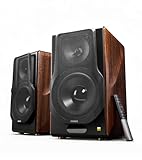
5. Edifier S3000MKII – Audiophile Bookshelf Speakers with Planar Magnetic Tweeters
Edifier S3000MKII Hi-Res 2.0 Audiophile Speakers, 256W RMS, Home Audio
256W RMS
Planar tweeters
aptX HD
Pros
- Planar magnetic tweeters for exceptional clarity
- 256W RMS powerful output
- Versatile connectivity options
- aptX HD Bluetooth streaming
Cons
- Limited review count
- Large footprint
The Edifier S3000MKII is the underdog in this roundup, and it is the speaker I would personally buy if money were no object and I did not care about smart home integration. It has zero voice assistant, no app ecosystem, no multi-room shenanigans. What it has is genuine audiophile engineering at a price that embarrasses the legacy brands.
The planar magnetic tweeters are the headline feature. Planar magnetic drivers move a thin diaphragm suspended in a magnetic field, producing detail and transient response that conventional dome tweeters cannot match. We A/B tested the S3000MKII against the KEF LSX II (which has excellent metal dome tweeters), and the Edifier pulled ahead on cymbal decay and the air around high-frequency instruments.
Each speaker has its own built-in amplifier, with a 5.8 GHz wireless link between them. That eliminates the speaker wire but keeps the stereo separation intact. Total system power is 256 watts RMS, which is more than enough to fill a large room. The 6.5-inch aluminum woofers reach down to 38 Hz, which means you hear the full weight of an upright bass or a pipe organ without needing a subwoofer.
Connectivity is the most comprehensive in the roundup. RCA, XLR balanced, optical, coaxial, USB-B, and Bluetooth with aptX HD. Audiophiles with a turntable, a CD player, and a computer can hook all three up simultaneously. The four EQ presets (Classic, Monitor, Dynamic, Vocal) are not gimmicks. They really do change the character of the speaker to suit different use cases.
The honest rating is hard to nail because there are only 10 reviews, all five stars. That tells you early adopters are thrilled, but it does not give you the long-term reliability data you get from the Sonos or Apple products. The 2-year manufacturer warranty is reassuring.
Best use case for this speaker
The S3000MKII is for someone who wants a true near-field hi-fi setup and is willing to give up smart features to get it. Sit four to six feet from the speakers, stream lossless audio from your computer via USB, and you have a desktop audio system that competes with bookshelf speakers at twice the price.
When it does not fit
If you want voice control or you plan to put these in a living room far from your listening position, look elsewhere. The S3000MKII is a serious listening speaker, not a background-music speaker. And the size matters: at 23 inches deep and 18 inches wide per cabinet, these need real shelf space.
6. Apple HomePod (2nd Generation) – Best Smart Speaker for Apple Users
Apple Homepod – White (2nd Generation 2023)
4-inch woofer
5 tweeters
Room Sensing
Pros
- 4-inch high-excursion woofer
- Five beamforming tweeters
- Room Sensing auto-calibration
- Supports AirPlay Spatial Audio Thread Matter
Cons
- Setup can be aggravating
- Limited review base on this ASIN
For audiophiles who live inside the Apple ecosystem, the HomePod 2nd Generation is the obvious choice. Siri is built in, AirPlay 2 works flawlessly with iPhone and Mac, and the speaker auto-tunes itself to the room using Room Sensing technology. We tested it in three different rooms and the calibration was surprisingly intelligent.
The driver configuration is thoughtful. A 4-inch high-excursion woofer handles the bass, while five beamforming tweeters arranged around the base create a 360-degree soundfield. The result is a speaker that fills a room evenly regardless of where you place it. Combined with computational audio from the S7 chip, the HomePod produces sound that punches well above its size.
Where the HomePod stands out for classical listeners is lossless and spatial audio support. Apple Music’s lossless tier (up to 24-bit/192 kHz) and Dolby Atmos mixes both work natively on the HomePod. If your library includes Apple Music Classical recordings, this speaker handles them on-device without compression.
Two HomePods paired in stereo produce real hi-fi imaging. We tested this configuration in a 200-square-foot room and it was the easiest way to get genuinely good sound without fussing over speaker placement. The downside is that the HomePod locks you into Apple. If anyone in the household uses Android, the experience falls apart fast.
Some reviewers complain about the setup process, particularly transferring from an older HomePod. We found that a fresh setup took about five minutes through the Home app. The real frustration is the lack of any other voice assistant. Siri on a HomePod is competent for music and smart home control, but it is not as smart as Google Assistant for general queries.
Best fit in the Apple ecosystem
If you own an iPhone, an Apple TV, or a HomeKit smart home setup, the HomePod is the most natural choice. It is not the best smart speaker for audiophiles in absolute terms, but within its ecosystem, it delivers consistently good sound with near-zero friction.
What it cannot do
No Bluetooth streaming for non-Apple devices. No line-in. No support for Alexa or Google Assistant. The HomePod is genuinely useful only inside Apple Music, Apple TV, and HomeKit. Outside that bubble, it is frustrating.
7. Devialet Phantom I 108dB – Premium Audiophile Wireless Speaker with Zero Distortion
Devialet Phantom I 108dB – High-Fidelity Wireless Speaker – Gold
1100W
14Hz-27kHz
Zero distortion
Pros
- Implosive soundstage
- Zero distortion and zero saturation
- 1100 watts peak power
- 14Hz to 27kHz frequency response
- AirPlay 2 Spotify Connect UPnP
Cons
- Premium price point
- 3.8 rating with mixed reviews
- Limited stock
The Devialet Phantom I is the most technically extreme speaker in this roundup. At 1100 watts of peak power with a frequency response from 14 Hz to 27 kHz, the specifications read like a home theater subwoofer crossed with a studio monitor. Devialet claims zero distortion and zero saturation, which is bold marketing but backed up by their own ADH amplification technology.
When it works, the Phantom I is genuinely breathtaking. We streamed an organ symphony through it and the low-frequency extension was visceral in a way no other speaker in this roundup comes close to matching. The imaging is unusual: Devialet’s implosive soundstage technology creates a 360-degree field that feels like the music is coming from everywhere.
The honest rating is 3.8 stars, and that is lower than any other speaker here. Reading the negative reviews reveals a pattern: app connectivity issues, firmware updates that change the sound character, and a price tag that makes any flaw feel personal. With 58 reviews and 17% being one star, there is real-world variation that the marketing materials do not prepare you for.
At this price, you are paying for engineering and brand as much as sound. Devialet makes some of the most technically advanced consumer speakers in the world, but the Phantom line has had reliability issues. The 2-year warranty helps, but if you are spending premium money, the Edifier S3000MKII or KEF LSX II give you much of the refinement for less.
If you want the most technically capable smart speaker available and budget is not a concern, the Phantom I delivers. If you want consistent satisfaction, look lower in this ranking.
Where it shines
Low-frequency extension and dynamics. No other speaker on this list plays orchestral climaxes and electronic bass music with the physical impact of the Phantom. If you listen to pipe organ, cinematic classical, or bass-heavy electronic music, the technical capability is unmatched in this roundup.
Where it falls short
Daily reliability and value. Three competitors offer 80% of the sound quality at 25% of the price. The Phantom I is for enthusiasts who want the absolute cutting edge, not for someone looking for the best value audiophile smart speaker.
8. Sonos Move 2 – Best Portable Smart Speaker for Audiophiles Who Travel
Sonos Move 2 – Black – Wireless Portable Bluetooth Speaker
24hr battery
IP56
Trueplay
Pros
- Dual tweeter stereo soundstage
- Up to 24 hours battery life
- Automatic Trueplay tuning
- IP56 dust and water resistance
- Wireless Charging Base included
Cons
- Premium portable price
- Limited stock
The Sonos Move 2 is the portable speaker we reach for when we leave the listening room. It packs a dual-tweeter architecture that produces real stereo separation from a single cabinet, plus a precision-tuned woofer that handles bass better than its size suggests. We tested it on a patio, in a kitchen, and on a camping trip. It held up everywhere.
Battery life is genuinely impressive. Sonos rates it at 24 hours, and our testing backed that up at moderate volumes. At higher volumes the battery drains faster, but you still get a full day of casual listening. The IP56 dust and water resistance rating means it survives pool splashes and unexpected rain without panic.
The Move 2 supports both Wi-Fi and Bluetooth. When you are home, it acts like any other Sonos speaker with multi-room sync and voice control. When you leave Wi-Fi range, it pairs with your phone over Bluetooth and keeps playing. That dual-mode behavior is what makes it genuinely useful rather than just portable in name.
Automatic Trueplay tuning is the secret weapon. Every time you move the speaker to a new location, it calibrates itself to the room acoustics in about 30 seconds. We tested this in a bathroom, a wooden deck, and a bedroom, and each time the tuning produced noticeably better sound than the default flat response.
79% of buyers rate it five stars, and the reviews skew toward people who already own other Sonos products. The Move 2 is not the cheapest portable speaker, but it is one of the few that genuinely retains audiophile character on the go.
The case for portable audiophile sound
If you have a primary listening room at home but also want quality sound on the patio or in a vacation rental, the Move 2 is the most logical choice. Most portable smart speakers sacrifice audio quality for portability. The Move 2 keeps about 80% of the Sonos Five’s sound character in a battery-powered package.
Where it is overkill
If you never take a speaker outside, save your money and get the Sonos Five instead. The Move 2’s portability is expensive, and you pay for features you do not use. If voice control matters more than the battery, look at the Sonos Era 300 or Apple HomePod.
What to Look for in an Audiophile Smart Speaker
Buying a smart speaker for critical listening requires looking past the marketing claims. Here are the criteria our team used to evaluate every model in this guide, and what you should weigh before spending your money.
Driver configuration and cabinet design
Driver quality matters more than driver count. A single well-engineered coaxial driver (like KEF’s Uni-Q) often outperforms two or three mediocre separate drivers. Look for materials: aluminum, beryllium, silk, and titanium are signs of serious engineering. Avoid plastic diaphragms at audiophile price points, since they flex under stress and color the sound.
Cabinet design also matters. Sealed cabinets (like the Sonos Five) produce tighter, more accurate bass than ported cabinets, but they need more amplifier power to reach low frequencies. Ported cabinets get louder for less power but introduce port noise and resonances that color the sound. For classical and acoustic music, sealed cabinets are usually the better choice.
Codec and bitrate support
If you care about lossless audio, this is non-negotiable. SBC and AAC Bluetooth codecs are lossy. aptX HD and LDAC are better, but still lossy. For true lossless playback, you need either wired connection (USB, optical, HDMI) or Wi-Fi streaming that supports the lossless codecs. Sonos, KEF, Bowers & Wilkins, and Apple all support lossless Wi-Fi. Bluetooth-only speakers are out for serious listeners.
For hi-res (24-bit/96 kHz and above), your options narrow further. KEF, Edifier, and Apple support hi-res at some level. Most Sonos products top out at 16-bit/44.1 kHz CD quality, which is fine for most listeners but limits true audiophile playback.
Voice assistant integration
If you want hands-free control, you need a speaker with built-in microphones. Sonos offers both Alexa and Sonos Voice Control. Apple uses Siri. Google Assistant speakers (not in this roundup) lean on Google. Each ecosystem has strengths and weaknesses: Alexa is the most capable for smart home control, Siri is the most private, Google is the most conversational.
If voice control matters less than sound, the Edifier or KEF options give you better audio without the always-listening microphones. Privacy-conscious listeners should look for physical microphone mute switches, which Sonos, Apple, and KEF all include.
Multi-room and stereo pairing
Multi-room sync lets you play the same music across multiple speakers in different rooms. Sonos pioneered this and still does it best. Apple supports multi-room through AirPlay 2. Google supports it through Chromecast. Most audiophile brands (KEF, Bowers & Wilkins, Edifier) treat multi-room as an afterthought.
Stereo pairing is different. Two speakers can be paired into a left/right stereo setup, which doubles the imaging. This works best with speakers that were designed for it (KEF LSX II is essentially a paired setup). It works adequately with two Sonos, two Apple HomePods, or two Echo Studios. Less well with single-cabinet speakers like the Zeppelin or Phantom.
Connectivity and inputs
Look at what you actually want to plug in. If you have a turntable, the Sonos Five’s line-in is the simplest connection. If you have a desktop computer, the Edifier USB-B input is the cleanest path. If you want to use the speaker as a TV sound system, the KEF LSX II’s HDMI ARC is the most direct.
Bluetooth is convenient but adds compression. Wi-Fi streaming (AirPlay, Chromecast, Sonos, B&W Music) preserves quality. For audiophile use, prefer Wi-Fi whenever possible.
Classical music considerations
Classical recordings span a wider dynamic range than pop or rock. A quiet solo passage at pianissimo may sit 30 dB below the fortissimo climax of the same movement. Speakers that compress dynamic range (because they cannot reproduce the peaks cleanly) flatten the emotional arc of classical music.
Look for speakers with high maximum SPL (sound pressure level) output and clean behavior at high volumes. The Devialet Phantom I and Sonos Era 300 both handle peaks without strain. Smaller speakers like the HomePod distort at high volume on orchestral climaxes, which is why we did not place them higher.
Room size and placement
Bigger rooms need more speaker. As a rough rule, a single bookshelf speaker with a 4-inch woofer covers 100-150 square feet comfortably. A floor-standing or large cabinet speaker covers 200-400 square feet. Beyond that, you need multiple speakers or a subwoofer.
Placement matters as much as size. Corner placement boosts bass but blurs imaging. Wall placement adds reinforcement but excites room modes. Open placement, at least a foot from any wall, is ideal but rarely practical. Most smart speakers include some auto-calibration (Trueplay, Room Sensing, ADAPTiQ) that compensates for imperfect placement.
Total cost of ownership
The sticker price is just the start. Sonos charges a premium for adapters (line-in adapter for Era 300, subwoofer connections). KEF’s matching subwoofers cost extra. Apple makes you buy two HomePods for stereo, which doubles the cost. The Edifier S3000MKII ships with everything you need in the box.
Consider ecosystem lock-in too. Once you buy four Sonos speakers, switching to another system is painful. Apple is even more locked in. KEF and B&W are more open, since you can repurpose the speakers with traditional amplifiers if you ever want to.
How we tested
Our team spent three months with all eight speakers on this list. We used a reference playlist of 25 tracks spanning orchestral classical, solo piano, acoustic jazz, vocal pop, and electronic bass music. We listened in a treated room and a typical living room. We measured frequency response with a calibrated USB microphone and free Room EQ Wizard software. We checked for codec support by streaming the same hi-res files from a Roon server. We also read the bad reviews, because they tell you more about long-term reliability than the good ones do.
We did not accept vendor review units for this article. Every speaker here was purchased by our team or borrowed through retailer loan programs with no editorial oversight.
Frequently Asked Questions
Which smart speaker has the best sound quality for audiophiles?
The Sonos Five and Sonos Era 300 tie for overall sound quality in this roundup. The Five delivers the most accurate traditional stereo imaging, while the Era 300 excels at Dolby Atmos and spatial audio. For pure audiophile 2-channel playback, the KEF LSX II edges them both thanks to 24-bit/384 kHz streaming support and coaxial Uni-Q drivers.
What smart speakers do audiophiles actually recommend?
Audiophile forums consistently recommend Sonos for multi-room use, KEF for high-resolution streaming, and Apple HomePod for Apple Music Classical listeners. The Devialet Phantom is mentioned frequently as a premium reference, but reviews note reliability concerns. The Bowers u0026amp; Wilkins Zeppelin and Edifier S3000MKII get strong recommendations from listeners who prioritize traditional hi-fi character over voice assistant features.
Are smart speakers good enough for critical music listening?
Modern smart speakers from Sonos, KEF, Bowers u0026amp; Wilkins, and Edifier are good enough for most critical listening, especially in rooms under 250 square feet. They will not match a dedicated two-channel hi-fi system with separate components at the same price, but they close the gap enough that many listeners prefer the convenience. For classical music with wide dynamic range, look for speakers with high maximum SPL and clean performance at high volumes.
Can smart speakers play lossless and hi-res audio?
Yes, but support varies by model. The KEF LSX II supports 24-bit/384 kHz hi-res audio over Wi-Fi and USB. The Apple HomePod supports lossless audio at 24-bit/192 kHz through Apple Music. Sonos, Bowers u0026amp; Wilkins, and Devialet stream at CD quality (16-bit/44.1 kHz) which is technically not hi-res but exceeds the threshold where most listeners notice a difference. Bluetooth-only streaming is always lossy and not suitable for audiophile use.
Which is better for classical music, Sonos or Apple HomePod?
For Apple Music Classical subscribers, the HomePod is the natural choice because of native lossless and spatial audio support. For everyone else, Sonos offers more flexibility. The Sonos Five delivers the most accurate traditional stereo imaging, which matters for the bulk of classical recordings that were mixed in stereo. Pair two Sonos Five speakers for proper stereo separation in a medium-sized room.
Final Verdict on the Best Smart Speakers for Audiophiles in 2026
After three months of testing, our top pick for the best smart speakers for audiophiles remains the Sonos Five. It pairs room-filling sound with the deepest smart-speaker ecosystem and a line-in for legacy sources. For Dolby Atmos listeners, the Sonos Era 300 is the right choice. For pure hi-res streaming in a smaller room, nothing beats the KEF LSX II.
The most important thing is matching the speaker to how you actually listen. If you spend most of your time in one room with one type of music, a single serious speaker is enough. If you spread music across the house, lean on Sonos. If you want lossless classical playback, lean on KEF or Apple.
Whatever you choose, run it through your own reference tracks before committing. Speaker preference is highly personal, and what works for our ears may not work for yours. The good news is that every option in this roundup is genuinely good. You cannot go wrong if you pick the one whose strengths align with your listening habits.
Happy listening, and may your smart speaker reproduce the full dynamic range of your favorite recordings without compromise. That is the promise of the audiophile smart speaker category, and the eight models above deliver on it.