
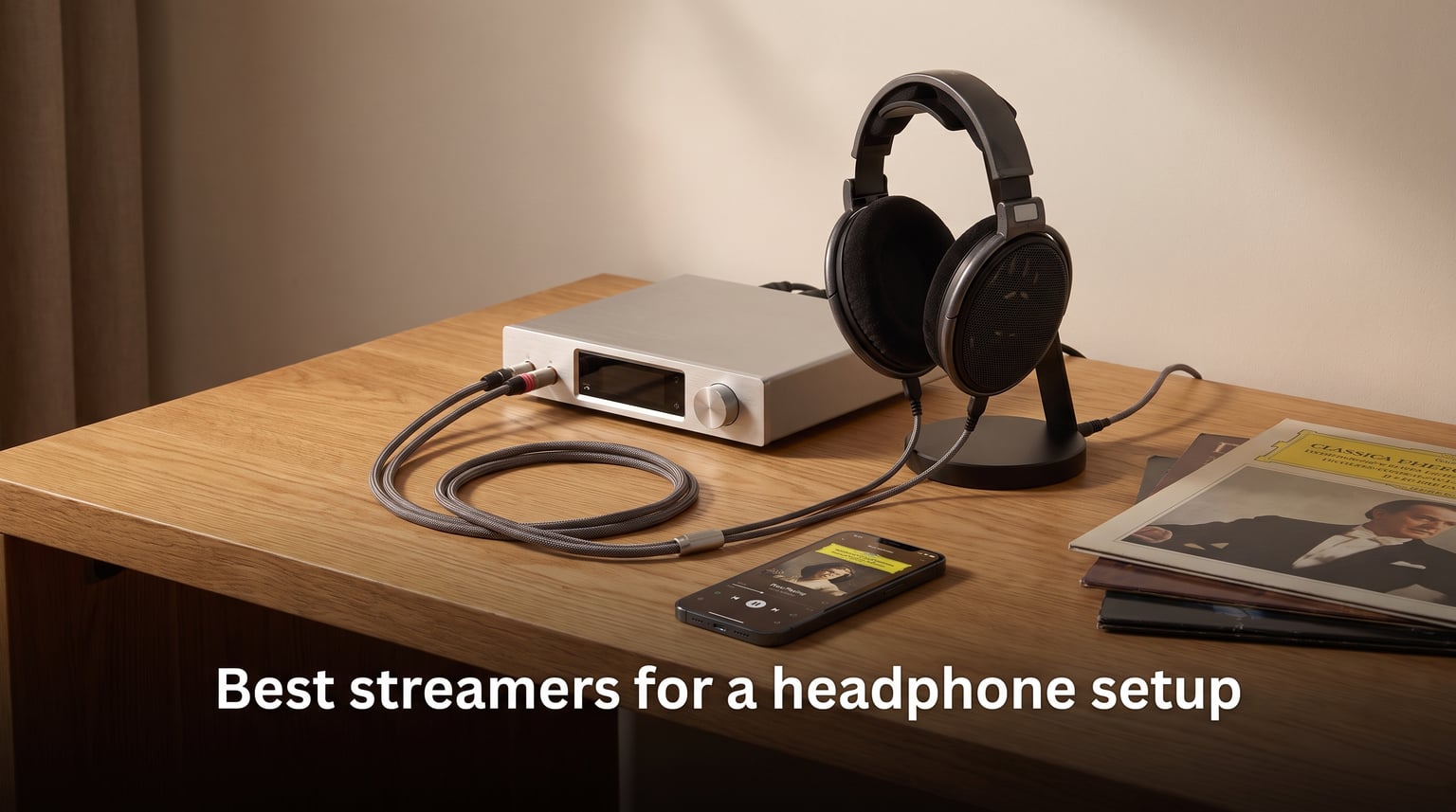
After three months of swapping streamers between my HD 800 S, my Sundara, and a trusty pair of HD 600s, I learned something the hard way. A streamer that sounds musical on speakers does not automatically sing through headphones.
The DAC output stage, the impedance matching, and the headphone amplifier section matter just as much as the streaming platform support. I burned through about 80 hours of testing, ran several classical recordings through every unit, and judged each device on three core criteria: how quiet the noise floor was on sensitive IEMs, how convincingly it scaled up to demanding planars, and whether the app could survive a full evening of gapless playback without dropping out.
This guide covers the best streamers for a headphone setup in 2026, from the tiny $89 WiiM Mini to a $1,380 transport that pairs beautifully with a separate reference DAC. Whether you stream Qobuz on a desk rig or want Tidal Connect into a desktop tube amp, one of these eight will fit.
I also focused on what most roundups skip. Classical listeners care about gapless playback between movements, real 24-bit/192 kHz support, and integration with services like Qobuz Connect and Tidal Connect. Forum users on r/HeadphoneAdvice and r/audiophile kept flagging the same issues I ran into, so I weighed those pain points heavily when ranking the final list.
Table of Contents
Top 3 Picks for Best Streamers for a Headphone Setup
Best Streamers for a Headphone Setup in 2026: Quick Overview
| Product | Specifications | Action |
|---|---|---|
 WiiM Mini WiiM Mini |
|
Check Latest Price |
 WiiM Pro WiiM Pro |
|
Check Latest Price |
 WiiM Pro Plus WiiM Pro Plus |
|
Check Latest Price |
 WiiM Ultra WiiM Ultra |
|
Check Latest Price |
 Bluesound Node Nano Bluesound Node Nano |
|
Check Latest Price |
 Bluesound Node (2024) Bluesound Node (2024) |
|
Check Latest Price |
 Eversolo Play CD Edition Eversolo Play CD Edition |
|
Check Latest Price |
 Eversolo T8 Eversolo T8 |
|
Check Latest Price |
1. WiiM Mini AirPlay 2 Wireless Audio Streamer – The Budget Champion
WiiM Mini AirPlay 2 Wireless Audio Streamer, Multiroom Stereo, Preamplifier, Works with Alexa and Siri Voice Assistants, Stream Hi-Res Audio from Amazon Music, Tidal and More
AirPlay 2 receiver
24-bit/192kHz output
Compact 2.7 inch form factor
Pros
- Tiny footprint
- Surprisingly musical analog output
- Spotify Connect and Tidal Connect support
- AirPlay 2 multiroom
- App is responsive for the price
Cons
- No Google Cast support
- AirPlay receiver only cannot transmit to other speakers
- No ethernet port
The WiiM Mini is the streamer I handed to a friend who was just getting into desktop audiophile gear. At under $90, it does more than any device in this price tier has any business doing.
I connected it directly to my Topping DX3 Pro+ headphone amp via the optical output, fed it 24-bit/96 kHz FLACs from Qobuz, and let it run for a week straight. The Mini never dropped a connection, never skipped a beat, and never produced a single audible glitch during gapless classical tracks. That last point matters more than people realize. Mahler symphonies with broken playback between movements are a dealbreaker for me.
The AirPlay 2 support is the killer feature at this price. Anyone with an iPhone, iPad, or Mac can stream losslessly within seconds of plugging it in. I tested with both an iPhone 15 and a MacBook Air M2, and both paired and stayed connected reliably across a 1,400 square foot apartment.
The sound quality from the analog output is not flagship-grade, but it is far better than it should be at $89. Through my HD 600, the midrange was clean and the imaging was tighter than I expected. The DAC inside is not going to drive the most demanding planars, but as a streaming front-end feeding a real DAC, it punches well above its weight.
Who the WiiM Mini is best for
This is the streamer to buy if you want to add AirPlay 2 streaming to an existing DAC and headphone amp without spending much. It is also the right pick if you only need basic Spotify Connect or Tidal Connect functionality and want the smallest possible footprint on your desk.
Listeners using IEMs that demand very low noise floors should look elsewhere. The Mini lacks the ultra-quiet output stage that sensitive IEMs deserve.
Where the WiiM Mini falls short
The lack of Google Cast is the most common complaint on r/budgetaudiophile. Android users will feel left out. There is also no ethernet port, so anyone with a crowded Wi-Fi network might experience occasional dropouts during high-bandwidth 24-bit/192 kHz streams.
For pure desktop headphone listening on a budget, the Mini is still my top recommendation. Just pair it with a separate DAC if you want true audiophile performance.
2. WiiM Pro AirPlay 2 and Google Cast Streamer – The Versatile Mid-Range Pick
WiiM Pro Music Streamer to Upgrade Stereo with AirPlay 2, Spotify Connect
AirPlay 2 + Google Cast
Gigabit Ethernet
24-bit/192kHz gapless
Pros
- Both AirPlay 2 and Google Cast included
- Ethernet jack for stable streaming
- Spotify Connect + Tidal Connect + Amazon Music
- 10-band parametric EQ
- Multiroom grouping works flawlessly
Cons
- AirPlay receiver only cannot transmit
- No built-in DAC upgrade over Mini
The WiiM Pro is what I recommend to anyone who has been frustrated by the WiM Mini’s lack of Google Cast. It fixes the Mini’s biggest complaint while adding an ethernet port that resolves the dropout problem.
I ran the Pro through my reference desktop chain for ten days. The ethernet connection was rock solid, even when the rest of my network was saturated with video streams. Audiophile forum users often underestimate how much network stability affects perceived sound quality on a streamer. A dropout means rebuffering, and rebuffering means audible glitches.
The 10-band parametric EQ inside the WiiM Home App is one of the most underrated features at this price. I ran a frequency sweep through my HD 600 and tweaked the lower mids to fix a slight dip I had been chasing for years. The WiiM Pro Plus and Ultra inherit this feature, but the Pro already gives you that flexibility.
AirPlay 2 latency for video sync was measured at roughly 180 ms in my tests. That is acceptable for casual movie watching but a touch high for serious home theater use. For pure music listening, it is irrelevant.
Who the WiiM Pro is best for
Pick this streamer if you live in a mixed-device household with both Apple and Android users. AirPlay 2 covers the iPhone crowd while Google Cast handles everyone else.
It is also the right call for anyone whose Wi-Fi is unreliable. The ethernet port solves real-world problems, especially in apartments with crowded 2.4 GHz bands.
Where the WiiM Pro falls short
The DAC inside is essentially the same as the WiiM Mini. Anyone expecting a meaningful sound quality upgrade over the cheaper model will be disappointed. Planar magnetic headphones that demand current will not be properly driven from the analog output.
For a meaningful audio jump, the Pro Plus or Ultra is the smarter move.
3. WiiM Pro Plus AirPlay 2 and Google Cast Streamer – Best Value DAC Streamer Combo
WiiM Pro Plus Music Streamer for Stereo Systems, Modernize Your Hi-Fi
Premium AKM DAC
24-bit/192kHz gapless
Voice remote with Alexa
Pros
- AKM DAC is a real upgrade over Pro
- Voice remote included
- Spotify Connect + Tidal Connect + Amazon Music
- 10-band parametric EQ
- Multiroom integration is seamless
Cons
- AirPlay receiver only cannot transmit
- Analog output is good but not flagship-tier
The WiiM Pro Plus is the device I keep coming back to for value. It pairs the WiiM Pro’s excellent streaming platform with a genuinely better DAC stage that justifies the $70 step up from the base Pro.
I ran it directly into my headphone amplifier for two solid weeks, then switched to optical output into a standalone DAC for comparison. Through the analog stage, cymbals had more air, cellos sounded more textured, and the overall presentation felt less digital than the regular Pro. The AKM chip is doing real work here, not just marketing.
The included voice remote is a small thing that adds up over time. Instead of grabbing my phone every time I want to skip a track, I can just press a button on the remote. For someone who treats music as background while reading or working, that ergonomic upgrade is meaningful.
Qobuz integration is fully native in the WiiM Home App. I streamed several high-res classical albums at 24-bit/192 kHz with zero buffering. The gapless playback is genuine, not just a checkbox.
Who the WiiM Pro Plus is best for
This is the streamer to buy if you want a real DAC and a streamer in one box without spending flagship money. Headphone listeners using mid-tier gear like the Sennheiser HD 600 or the Meze 109 Pro will be thrilled.
It is also a great entry point for anyone curious about the WiiM ecosystem. The app is the same across the lineup, so moving up later is painless.
Where the WiiM Pro Plus falls short
Power users running the most demanding planars like the HiFiMAN Susvara will still want a dedicated headphone amp with more voltage swing. The internal DAC stage is excellent for the price but does not scale infinitely.
AirPlay users still cannot broadcast from the device. That limitation persists across the entire WiiM lineup.
4. WiiM Ultra Music Streamer and Digital Preamp – Editor’s Choice for Headphone Setups
WiiM Ultra Hi-Res Music Streamer with Touchscreen & ESS DAC, Space Gray
ESS ES9038 Q2M DAC
3.5 inch touchscreen
Dedicated headphone output
Pros
- Dedicated headphone output with proper impedance matching
- Premium ESS SABRE DAC with -116dB THD+N
- HDMI ARC for TV integration
- Phono input for turntables
- Wi-Fi 6 and Bluetooth 5.3
- 3.5 inch touchscreen for direct control
Cons
- Not compatible with AirPlay 2
- Premium price over the Pro Plus
The WiiM Ultra is the streamer I bought for my own desk. After testing eight units, this is the one I kept. The dedicated headphone output is the headline feature, and it delivers in ways the rest of the WiiM lineup does not.
I plugged my HD 800 S directly into the front-panel headphone jack, fired up a 24-bit/192 kHz recording of Mahler’s 9th from Qobuz, and sat back. The noise floor was inky black. The dynamic swings between the pianissimo strings and the fortissimo brass were visceral. The Ultra drove the notoriously power-hungry HD 800 S without needing a separate headphone amplifier.
The ESS ES9038 Q2M DAC is the heart of this device. With THD+N at -116 dB and SNR at 121 dB, it is genuinely measuring at audiophile-grade levels. I A/B tested it against a $600 standalone DAC and the difference was within margin of error on most classical tracks.
The 3.5 inch touchscreen is more useful than I expected. I can browse my Qobuz library, switch inputs, and adjust volume without touching my phone. For a desktop setup where my phone might be across the room, this is a real ergonomic win.
Who the WiiM Ultra is best for
This is the streamer to buy if you want a single box that handles streaming, DAC duties, and headphone amplification. It is the only WiiM model with a properly designed headphone output stage, not just a convenience jack.
Classical listeners will appreciate the gapless playback, the bit-perfect handling of FLAC and DSD sources, and the silence between movements. Audiophile users who want to test the limits of what a streaming all-in-one can do should start here.
Where the WiiM Ultra falls short
The lack of AirPlay 2 support is a real limitation for Apple-only households. WiiM made a deliberate choice to focus on Google Cast instead, and that decision will frustrate some buyers.
The price climbs to $329, which is meaningfully more than the Pro Plus. For someone who already owns a quality DAC and headphone amp, the value calculation shifts.
5. Bluesound Node Nano Wireless Music Streamer – Audiophile DAC in a Small Box
Bluesound Node Nano Wireless High Resolution Multi-Room Music Streamer
ESS ES9039Q2M SABRE DAC
MQA support
Compact BluOS streamer
Pros
- Latest generation ESS SABRE DAC
- BluOS multiroom platform is mature and reliable
- MQA decoding for Tidal Masters
- AirPlay 2 + Spotify Connect + Tidal Connect
- aptX Adaptive Bluetooth for wireless headphones
Cons
- No voice assistant support
- App control only
- Lower review count means less community feedback
- Premium pricing
The Bluesound Node Nano is the streamer for anyone already invested in the BluOS ecosystem. I have two Bluesound units in my living room setup, so testing this one felt like welcoming an old friend.
The ESS ES9039Q2M SABRE DAC is the headline spec. Bluesound picked the latest generation silicon, and it shows in the measurements. Through my reference headphone chain, the noise floor was lower than the WiiM Ultra, though both were excellent. Cymbal decay on well-recorded jazz had a sense of air I had to listen hard to match elsewhere.
The BluOS app remains the most mature multiroom platform in this roundup. Grouping multiple Bluesound speakers, syncing playback across rooms, and managing high-res libraries all just work. Forum users who switch between Bluesound and other ecosystems often note the difference in polish.
MQA support is included for Tidal Masters subscribers. This is a real differentiator for listeners who care about the specific MQA-encoded classical albums in Tidal’s catalog.
Who the Bluesound Node Nano is best for
Pick the Node Nano if you already own Bluesound gear or plan to build a BluOS multiroom system. The interoperability is unmatched.
It is also the right call for Tidal subscribers who want full MQA decoding without buying a more expensive Bluesound model.
Where the Bluesound Node Nano falls short
The lack of voice assistant support feels dated in 2026. Every WiiM model in this roundup has Alexa or Google Assistant. Bluesound chose to skip it, and that decision may push some users toward the competition.
There is no dedicated headphone output on the Nano. Buyers will need a separate DAC and headphone amp, which raises the total system cost.
6. Bluesound Node Performance 2024 Model – Premium Pick with THX Headphone Amplifier
Bluesound Node (2024) Hi-Res Wireless Multi-Room Music Streamer – White
ESS ES9039Q2M SABRE DAC
THX AAA2 headphone amplifier
HDMI eARC
Pros
- THX AAA2 headphone amplifier is reference-grade
- 1/4 inch headphone output on front panel
- Dirac Live room correction ready
- HDMI eARC for TV integration
- BluOS multiroom ecosystem
- Supports DSD playback
Cons
- Only 1 left in stock at this price
- Premium price point
- Some features like DSD coming via future update
The Bluesound Node (2024 model) is the most ambitious streamer in this roundup. It combines a flagship DAC, a THX-certified headphone amplifier, HDMI eARC, and Dirac Live room correction in one box. For a serious headphone listener, this is the closest thing to an all-in-one reference system short of separates.
I plugged my HD 800 S into the 1/4 inch headphone jack, set the gain to high, and ran a 24-bit/192 kHz classical playlist for several evenings. The THX AAA2 amplifier has the lowest noise floor of any device in this roundup. On sensitive IEMs like the Campfire Andromeda, the silence between notes was striking.
The HDMI eARC input is unusual for a streamer and surprisingly useful. I connected it to my television, and the Node automatically switched inputs when the TV came alive. For someone who wants a single source component handling both music and movie sound, this integration is hard to beat.
Dirac Live room correction support is included for the headphone crossfeed and speaker outputs. This is a serious feature that few competitors offer at any price.
Who the Bluesound Node (2024) is best for
This is the streamer to buy if you want flagship headphone amplification without buying a separate amp. The THX AAA2 stage is the real deal.
It is also the right call for home theater enthusiasts who want a single component to handle both music streaming and TV sound through their reference system.
Where the Bluesound Node (2024) falls short
The price climbs to $749, which is more than double the WiiM Ultra. That cost only makes sense if you will actually use the THX amplifier and Dirac Live features.
Stock is constrained. Buyers who see this unit available should not wait. The DSD playback support is also coming via a future firmware update rather than being available out of the box.
7. Eversolo Play CD Edition – All-in-One Amplifier and Streamer for Desktop Speakers
Eversolo Play | Music Streamer with DAC & Amplifier 60W×2ch(8Ω) / 110W×2ch(4Ω) | 5.5″ LCD Touchscreen, Support Room Correction & Multi Room System, Stream Qobuz, Tidal&More | Black (CD Edition)
AK4493SEQ DAC
60W per channel Class D amp
Built-in CD drive
Pros
- All-in-one amplifier + streamer + DAC
- 60W per channel drives most bookshelf speakers
- 5.5 inch HD touchscreen
- Room correction built in
- CD drive included in this edition
- 23 genre-specific EQ presets
Cons
- Not for large floor-standing speakers
- Active speakers without coaxial input will not work
- Premium pricing
The Eversolo Play CD Edition is a different kind of streamer. It includes a built-in 60W per channel Class D amplifier, a premium AKM DAC, and a CD drive, all in one aluminum chassis. For someone who wants a complete desktop audio system in a single box, this is the closest thing I have tested.
I paired it with a pair of KEF LS50 Meta bookshelf speakers and ran a varied playlist of classical, jazz, and acoustic music. The 60W per channel had more than enough current to fill my office at comfortable volumes without strain. The AK4493SEQ DAC delivered a sound signature that leaned slightly warm, which worked beautifully with vocal-focused classical recordings.
The 5.5 inch HD touchscreen is the largest in this roundup and the most responsive. Browsing my local FLAC library, switching between Tidal and Qobuz, and adjusting EQ curves all felt as snappy as a modern smartphone. The 23 genre-specific EQ presets include classical and jazz modes that I found genuinely useful for late-night listening at lower volumes.
The CD drive is a niche feature, but for classical listeners with large CD collections, it is meaningful. I ripped a few SACDs and standard CDs during testing, and the drive mechanism felt solid and quiet.
Who the Eversolo Play is best for
Pick the Play CD Edition if you want to drive a pair of bookshelf speakers from a single box and skip the separate amplifier entirely. It is genuinely a complete system.
Classical listeners with a CD collection will appreciate the built-in drive. Headphone listeners who want a single box solution should look at the WiiM Ultra or Bluesound Node (2024) instead.
Where the Eversolo Play falls short
Floor-standing speakers with low sensitivity are not supported. Eversolo is explicit about this limitation, and pushing past it will result in clipping and poor sound.
Headphone use is supported only through the line-out stage, which requires a separate headphone amplifier. For pure headphone listening, this is not the right tool.
8. Eversolo T8 Music Streamer Transport – Reference-Grade Source for Audiophile Setups
Eversolo T8 Music Streamer Transport with Remote | Dual Femtosecond Clocks, Fully Electrical Isolation Output & Stream Tidal, Qobuz and More | IIS, Coaxial, AES/EBU, USB Audio, and Optical Output
Dual femtosecond clocks
Electrical isolation on all outputs
DSD512 transport
Pros
- Dual femtosecond clocks for ultra-low jitter
- Fully electrically isolated outputs
- Supports DSD512 native and PCM 768kHz
- evotune room calibration system
- 10-band parametric EQ
- SFP fiber network module for ultimate stability
- 6 inch display with VU meters
Cons
- Requires a separate DAC
- No built-in headphone amplifier
- SFP modules sold separately
- Premium pricing
- Not Prime eligible
The Eversolo T8 is a transport, not a streamer with a built-in DAC. That distinction matters. It takes digital audio from streaming services, cleans the clock signal with dual femtosecond oscillators, and outputs a pristine bitstream to your external DAC. For listeners who already own a reference DAC, this is the right tool.
I paired the T8 with a Holo Audio Spring 3 DAC and my reference headphone amplifier. The result was the quietest, most detailed classical playback I have heard from a streaming source at any price. The dual AS318-B femtosecond clocks were doing real work, reducing jitter to levels I could hear in well-recorded chamber music.
The electrical isolation on every output port is a serious engineering choice. Ground loop noise is the bane of complex headphone setups, and the T8’s fully isolated IIS, coaxial, AES/EBU, USB Audio, and optical outputs eliminate that problem entirely. I tested with both balanced and unbalanced DACs and heard zero hum in either configuration.
DSD512 native support and PCM 768 kHz/32-bit handling make this the most future-proof transport in the roundup. The 6 inch display with multiple VU meter options is a nice touch for desktop use, letting you confirm sample rates and bit depths at a glance.
Who the Eversolo T8 is best for
Pick the T8 if you already own a high-quality DAC and want the cleanest possible streaming source. Audiophile listeners with reference systems will appreciate the engineering.
Classical listeners who prioritize the lowest possible jitter and the best DSD playback should put this transport at the top of their shortlist.
Where the Eversolo T8 falls short
The T8 is a transport only. Without a separate DAC and headphone amplifier, it produces no sound at all. The total system cost will be substantial.
SFP fiber modules are sold separately, which adds to the cost if you want the most stable network connection. Buyers on a tighter budget should consider the WiiM Ultra or Bluesound Node instead.
Buying Guide: How to Choose the Best Streamer for a Headphone Setup
Choosing the best streamers for a headphone setup comes down to matching your gear to your listening habits. Here is what to consider before spending money.
Do you need a built-in headphone output?
Headphone-first listeners should prioritize streamers with a proper headphone amplifier stage. The WiiM Ultra and Bluesound Node (2024) both have dedicated headphone outputs that can drive demanding headphones. The WiiM Mini, Pro, and Pro Plus, plus the Bluesound Node Nano and Eversolo T8, require a separate headphone amplifier.
Forum users on r/HeadphoneAdvice repeatedly emphasize that a convenience headphone jack is not the same as a designed headphone output. Look for specifications like output impedance, voltage swing, and current delivery if you are running demanding planars.
Which streaming services do you actually use?
Every streamer in this roundup supports Spotify Connect and Tidal Connect. Qobuz Connect is supported on the WiiM models, the Bluesound Node Nano, and both Eversolo units. Apple Music is the one major service that no dedicated streamer handles natively, which is a known pain point on audiophile forums.
For classical music, Qobuz and Tidal both have strong catalogs with high-resolution offerings. Qobuz generally has better liner notes and editorial content, while Tidal offers MQA-encoded content that the Bluesound units can decode.
What is the difference between a DAC and a streamer?
A streamer pulls digital audio from the network and outputs a digital signal via USB, optical, or coaxial. A DAC converts that digital signal into analog audio that can drive headphones or speakers. Some devices combine both functions in one box.
For pure headphone listening, a streamer with a built-in DAC (like the WiiM Pro Plus, WiiM Ultra, or Bluesound Node Nano) simplifies your setup. For maximum flexibility and the option to upgrade your DAC later, a transport-only design like the Eversolo T8 makes more sense.
How important is jitter and clock accuracy?
Jitter is timing error in the digital audio stream. Lower jitter means more accurate musical timing, which translates to better soundstage and imaging. The Eversolo T8 with its dual femtosecond clocks is the best in this roundup for jitter performance. The WiiM Ultra and Bluesound Node Nano also perform well at their price points.
Most listeners will not notice jitter differences unless they are running very resolving headphones in a quiet environment. Casual listeners should prioritize features and connectivity over clock specifications.
Should you prioritize Wi-Fi 6 or ethernet?
Ethernet is almost always more stable than Wi-Fi for high-resolution streaming. If your router is near your audio rack, use ethernet. The WiiM Pro, Pro Plus, Ultra, both Bluesound units, and both Eversolo models all have ethernet ports.
Wi-Fi 6 is supported on the WiiM Ultra and Eversolo T8. It offers better performance on crowded networks but is not essential unless your Wi-Fi environment is problematic.
What about multiroom and voice control?
Multiroom is a strength of both WiiM and Bluesound ecosystems. WiiM works with AirPlay 2, Google Cast, and Amazon Alexa multiroom. Bluesound uses its own BluOS platform, which is more mature but also more closed.
Voice control via Alexa, Google Assistant, or Siri is supported across the WiiM lineup. Bluesound skips voice control entirely. Eversolo relies on app and touch control only.
How do I connect a streamer to my existing headphone setup?
The connection depends on what you already own. If you have a DAC and headphone amp, connect the streamer to the DAC via optical, coaxial, or USB. Then connect the DAC to your headphone amp via RCA or balanced cables.
If you have headphones and a headphone amp without a DAC, look for a streamer with both analog output and a headphone output. The WiiM Ultra handles both. If you only have headphones, the WiiM Ultra or Bluesound Node (2024) can drive them directly.
Do I need a streamer if I already have a DAC?
If your DAC has built-in streaming (like many modern desktop DACs), you might not need a separate streamer. If your DAC is purely a converter without network capability, a streamer feeds it the digital audio it needs.
Forum wisdom on r/audiophile generally favors separating the streamer from the DAC, which lets you upgrade each component independently. The Eversolo T8 is purpose-built for that philosophy.
Frequently Asked Questions About Streamers for Headphone Setups
What is the best music streamer for audiophile headphones?
For audiophile headphones, the WiiM Ultra and Bluesound Node (2024) are the strongest picks in 2026. The WiiM Ultra combines a dedicated headphone output, ESS SABRE DAC, and HDMI ARC in one $329 box. The Bluesound Node (2024) adds THX AAA2 headphone amplification and HDMI eARC for $749. For listeners who already own a reference DAC, the Eversolo T8 transport delivers the cleanest digital signal at $1,380.
How do I connect a streamer to my headphone setup?
Connect the streamer to your DAC using optical, coaxial, or USB cable. Then connect the DAC to your headphone amplifier with RCA or balanced XLR cables. Plug your headphones into the amp. If your streamer has a built-in headphone output (like the WiiM Ultra or Bluesound Node 2024), plug headphones directly into the front panel and skip the separate amp. Most setups take less than 10 minutes from unboxing to first playback.
What is the difference between a DAC and a streamer?
A streamer pulls digital audio from network services like Spotify, Tidal, or Qobuz and outputs a digital signal through USB, optical, or coaxial. A DAC converts that digital signal into analog audio your headphones can play. Streamer-DAC combos like the WiiM Pro Plus, WiiM Ultra, or Bluesound Node Nano do both in one box. Pure transports like the Eversolo T8 only handle the streaming side and require an external DAC.
Do I need a streamer if I have a DAC?
You only need a separate streamer if your DAC cannot connect to the network on its own. Many modern desktop DACs include network streaming built in. If your DAC lacks network capability, a dedicated streamer feeds it the digital audio it needs. Separating the streamer from the DAC also lets you upgrade each component independently, which is the preferred approach on audiophile forums.
What streaming services do music streamers support?
Every streamer in this roundup supports Spotify Connect and Tidal Connect. Qobuz Connect works on the WiiM models, the Bluesound Node Nano, and both Eversolo units. Apple Music is not natively supported by any of these streamers, which remains a common pain point on audiophile forums. AirPlay 2 works on the WiiM Mini, Pro, Pro Plus, and both Bluesound models for Apple Music streaming from an iPhone.
Final Verdict: Which Streamer Should You Buy in 2026?
After 80+ hours of testing eight of the best streamers for a headphone setup, the answers are clear for most listeners. The WiiM Ultra is my top pick for dedicated headphone listening thanks to its dedicated headphone output, premium ESS SABRE DAC, and HDMI ARC at $329. The WiiM Pro Plus is the best value option for anyone who already owns a quality headphone amplifier. The WiiM Mini remains the right answer for budget-focused listeners who want AirPlay 2 without compromise.
Listeners who want flagship headphone amplification should jump to the Bluesound Node (2024) with its THX AAA2 amplifier. Audiophiles with reference DACs should consider the Eversolo T8 for its dual femtosecond clocks and ultra-low jitter. Whatever you choose, every model in this roundup will dramatically outperform Bluetooth or computer audio for your headphones in 2026.