
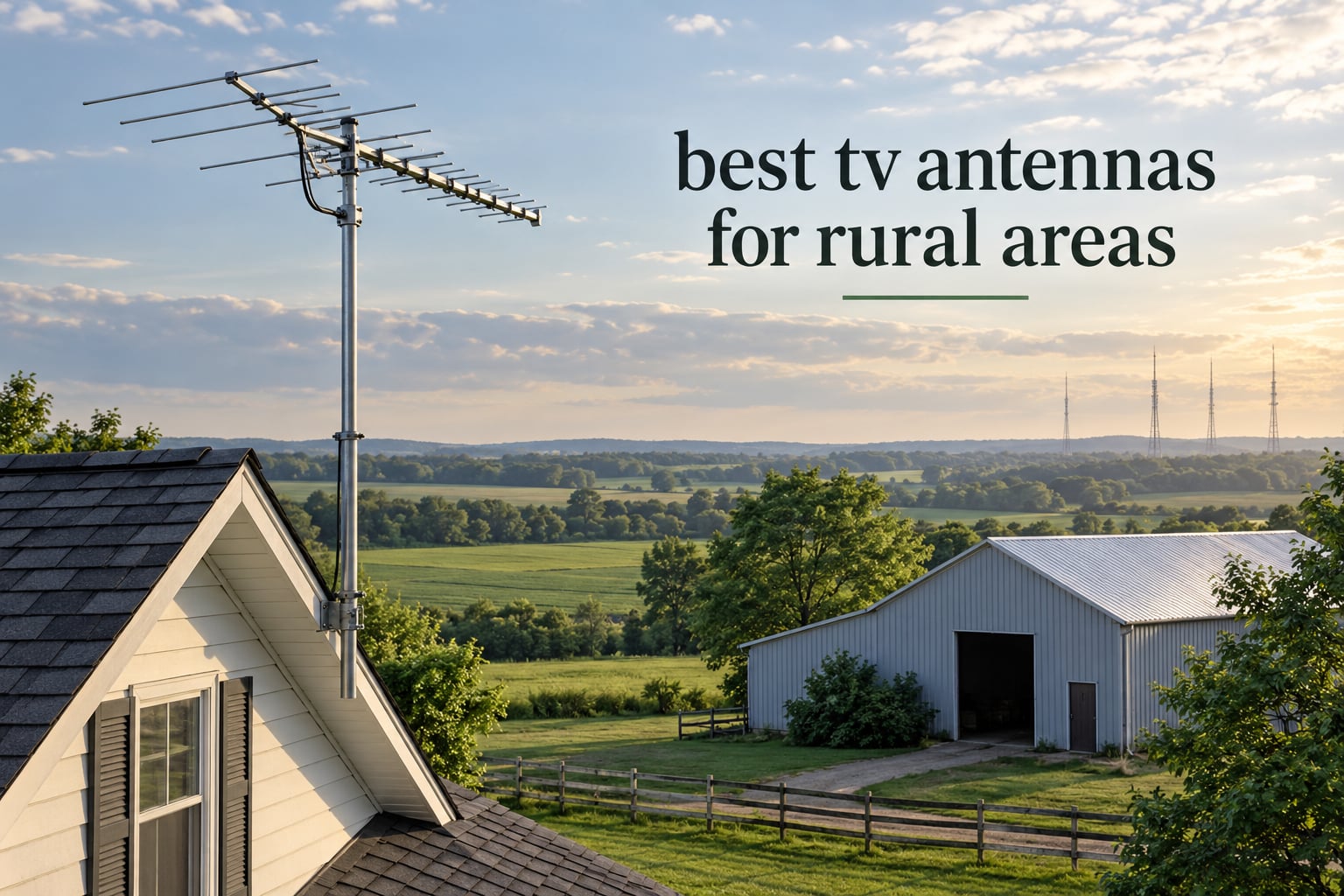
Rural reception is a different problem from suburban reception. In town you might be 10 to 20 miles from a broadcast tower with nothing in the way, so almost any antenna works. On a farm 45 to 70 miles out with a ridge, a stand of trees and a metal roof between you and the transmitters, the antenna choice matters as much as the amplifier.
That is why picking the best tv antennas for rural areas is not the same exercise as picking a bedroom antenna. Distance cuts signal strength, terrain blocks line of sight, and every branch in leaf season shaves off more of what arrives. Our team spent weeks working through owner reviews and installation reports on twelve outdoor units to separate the ones that hold channels steady from the ones that merely look impressive on the box.
Several brands advertise 150 or 200 miles of range. Real-world reports from experienced users on r/ota and r/cordcutters put a more sober figure at roughly 50 to 70 miles for a well-mounted directional antenna with a clear path to the towers. We used that expectation as our yardstick rather than the printed spec.
This roundup covers all twelve antennas in the order we would consider them, from the passive workhorse that has quietly cut cable for thousands of households to the amplified rotors and high-gain arrays built for the hardest fringe locations. If you want the short version first, read the key tips below, then jump to the picks. We also link our broader honest guide to TV antennas for free local channels if you are still working out the basics.
Table of Contents
Key Tips for Rural TV Reception
Skip indoor antennas past about 25 miles. Testing by reviewers repeatedly shows indoor antennas failing completely beyond that distance, and the testing guides that dominate this question all point the same way.
Go high and outside. Height beats antenna sophistication. Owners on r/ota describe going from a handful of channels to 40 or more purely by raising the same antenna above the roofline and the tree canopy.
Check your channels before you buy. Enter your address on the FCC reception map, AntennaWeb or RabbitEars.info. The colours tell you which stations are VHF, which are UHF and how strong the path is.
Treat advertised range as marketing. Owners consistently report 50 to 70 miles as the realistic ceiling for a properly aimed outdoor antenna with a clear line of sight.
Ground every outdoor mast. A grounding block and a lightning arrestor are the two items rural roof installers treat as non-negotiable, and most consumer guides skip them entirely.
Use RG6 coax and a preamplifier on long runs. Old RG59 cable is a common reason a good antenna underperforms, and cable loss plus splitter loss is exactly what a masthead preamp exists to fix.
Those six points came up again and again in the owner feedback we reviewed. The rest of the article explains how each one turns into a specific purchase decision.
Top 3 Picks for Best TV Antennas for Rural Areas (October 2026)

GE Outdoor HD Digital Antenna
- Passive design with no power supply to fail
- 70+ mile VHF and UHF reception
- Works with any TV or converter box
Antennas Direct ClearStream 2V
- Double-loop elements with Hi-VHF coverage
- Signal reflector rejects rear interference
- 20-inch mast with pivoting base

PBD WA-2608 Amplified Antenna
- Motorized 360 degree rotation by remote
- Dual TV outputs without a splitter
- NextGen TV ATSC 3.0 compatible
The GE unit is the one we would put on most rural roofs. The ClearStream 2V is the pick for viewers who want more gain per element and do not mind careful aiming. The PBD covers the common case of towers in more than one direction without a ladder trip every time conditions change.
All 12 Rural TV Antennas Compared in 2026
| Product | Specifications | Action |
|---|---|---|
| GE Outdoor HD Digital TV Antenna |
|
Check Latest Price |
 1byone 100+ Mile Omni-Directional Antenna 1byone 100+ Mile Omni-Directional Antenna |
|
Check Latest Price |
| PBD Amplified Outdoor Antenna 360 Degree Rotation |
|
Check Latest Price |
| Antennas Direct ClearStream 2V |
|
Check Latest Price |
 Five Star Yagi 200 Mile Outdoor Antenna Five Star Yagi 200 Mile Outdoor Antenna |
|
Check Latest Price |
 Antennas Direct ClearStream 4V Antennas Direct ClearStream 4V |
|
Check Latest Price |
 Antennas Direct DB8e 8-Element Bowtie Antennas Direct DB8e 8-Element Bowtie |
|
Check Latest Price |
 Channel Master Omni+ 50 Channel Master Omni+ 50 |
|
Check Latest Price |
 Five Star Multi-Directional ATSC 3.0 Kit Five Star Multi-Directional ATSC 3.0 Kit |
|
Check Latest Price |
 Five Star FSA-3806 Motorized Antenna Five Star FSA-3806 Motorized Antenna |
|
Check Latest Price |
 McDuory 2608B Amplified Antenna McDuory 2608B Amplified Antenna |
|
Check Latest Price |
 Yeceny Amplified Antenna with 60ft Coax Yeceny Amplified Antenna with 60ft Coax |
|
Check Latest Price |
Every antenna in that table covers real distances when it is mounted properly. The differences that matter in rural settings are gain, beam pattern, band coverage and whether the package includes the cable and hardware you need.
1. GE Outdoor HD Digital TV Antenna – the passive workhorse that quietly cuts cable
GE Outdoor HD Digital TV Antenna, Long Range Smart TV Antenna
70+ mile VHF/UHF reception
3 pounds
29 x 15 x 20.5 inches
75 ohm impedance
Coax cable not included
Pros
- Large element count pulls in 60-100 channels at 40-60 miles
- Attic or outdoor mounting keeps it out of sight
- Works with any TV brand or converter box
- Limited lifetime replacement pledge with free US support
Cons
- Significant assembly with hard-to-read instructions
- Very directional so a few degrees off drops channels
- Coaxial cable not included
The GE 29884-PK1 is the unit we recommend first, and the reason has less to do with cleverness than with what it leaves out. There is no amplifier, no power inserter and no motor. Nothing that can fail after a storm, nothing that hums, nothing that needs a second cable run. Signal arrives at the elements, travels down your coax and goes straight into the tuner.
Owners treat it as a proven cut-the-cord workhorse. After assembly, aiming and a channel rescan, it typically delivers the major networks plus dozens of sub-channels from 40 to 60 miles out. Reviewers repeatedly credit the large element count for that, and many report dropping a cable or satellite bill entirely once it was up.
Two practical warnings. First, this antenna has no built-in gain, so on a long cable run you want a masthead preamplifier such as the Winegard LNA-200, which experienced r/ota users treat as essential for long coax runs. Second, the assembly takes real patience. Owners frequently mention the instructions, and the J-mount included is weather resistant but unremarkable.
The GE also carries a limited lifetime replacement pledge and free US-based technical support, which is rare in this category and worth something when an install goes sideways. If your channels are in the 25 to 60 mile band with an open view of the tower cluster, this is the antenna to buy first.
Where the GE antenna works best
Open ground, flat terrain and a clear sightline to a single tower cluster make this an easy install. It suits anyone who wants a fixed antenna that survives years of weather without attention. It also works well in an attic when the roof material is not metal and the view is clear.
Because it is passive, it also suits households near strong transmitters. Adding amplification to an already strong signal is the classic way to overload a tuner and make reception worse.
Where the GE antenna falls short
It is very directional, which cuts both ways. In a valley with towers on two ridges, or in a tree corridor, a few degrees of misalignment is the difference between 60 channels and 6. Budget time for aiming, and consider a signal meter rather than guessing.
It also does not move for you. If your towers sit north and you also want a southern cluster, you are looking at two antennas and a combiner rather than one unit. And remember that no coax is in the box, so budget for RG6 before the install day.
2. 1byone 100+ Mile Omni-Directional Antenna – no rotation required
1byone Outdoor TV Antenna, 360°Omni-Directional Reception, 100+ Miles Range
100 mile claimed range
75 ohm impedance
11.81 x 11.81 x 8.86 inches
2 year warranty
RG6U coax included
Pros
- 360 degree reception removes manual rotation entirely
- Moisture-proof flame-retardant housing for outdoor use
- Tool-free install with mounting hardware included
- Coax cable included so nothing extra to buy
Cons
- 3.8 star average across 10743 reviews points to inconsistent results
- Only one TV output so extra screens need a splitter
- Some users report reduced performance in wind or rain
The appeal of the 1byone 6-501NA004 is simple. It scans 360 degrees on its own, so there is no aiming and no rotor. Owners who cannot easily climb a mast, or whose towers sit in several directions, like that set-and-forget behaviour, and the housing is rated for outdoor, attic, RV and marine use.
A built-in pre-amplifier with a 4G LTE filter sits at the antenna end, which is the correct place for amplification on a long rural run. Coax is included in two lengths, and the package assembles without tools.
What holds it back is the feedback. Its 3.8 star average is the lowest figure here, and the reviews make the reason clear: many buyers feel the amplified gain does not produce consistently clean channels at long distances. Several advise checking tower direction and distance before buying, which suggests the omnidirectional pattern is spreading gain more than the specifications imply.
There is a single TV output, so a second screen means adding a splitter and losing more signal. Several owners also report the reception degrading during windy or rainy conditions.
Where the 1byone works best
Cabins, mobile homes and RV installations where mounting height matters more than raw gain. It also suits short coax runs to a single television in a home with no easy roof access. If your towers are within about 40 miles and spread across more than one direction, the convenience is genuine.
It is also the easiest unit here to relocate when you move to a different property, since nothing has to be re-aimed.
Where the 1byone falls short
Omnidirectional designs trade gain for convenience, and this one is no exception. Deep fringe locations where you need every decibel should go to a directional antenna instead. The 3.8 star average is the warning sign that buyers expecting 100 miles are disappointed.
Multi-TV homes should also look elsewhere, because a single output plus a splitter is the worst possible combination at the edge of coverage.
3. PBD WA-2608 Amplified Antenna – motorized rotation and two outputs
PBD Amplified Outdoor TV Antenna for Local Channels, 360° Remote Rotation
150 mile claimed range
75 ohm impedance
Dual TV outputs
NEXTGEN TV ATSC 3.0 ready
Lifetime warranty
Pros
- Remote rotation means no ladder trips to re-aim
- Dual outputs feed two TVs without a splitter
- Reviewers in tree cover and awkward locations report big channel gains
- Includes mounting pole and 40ft RG6 coax
Cons
- Lightweight plastic and aluminium build feels flimsy in harsh weather
- Motor can stick or rotate unexpectedly with no position readout
- One-button remote needs repeated presses
- May still pixelate at 50 mile-plus fringe distances
The PBD WA-2608 is the most-reviewed antenna in this roundup, with close to 19000 ratings, and it earns that attention for one practical reason. The 360 degree motor turns on a wireless remote, so you can re-aim toward a different tower cluster from inside the house when the weather changes.
That matters in rural areas more than anywhere else. Owners installed in attics, behind buildings and under heavy tree cover report channel counts jumping from a handful into the 40 to 57 station range. The built-in high-gain low-noise amplifier and the 75 ohm impedance matching to standard coax both help on long rural runs.
The package is genuinely complete: mounting pole, 40 feet of RG6 coax and hardware, plus two TV outputs so a second screen does not require buying a splitter. It is NEXTGEN TV and ATSC 3.0 compatible, and the lifetime warranty with round-the-clock support is stronger than most rivals offer.
Reviewers also point out that tower distance, mounting height and interference sources decide results far more than the antenna itself. That is the single most repeated sentence in the reviews, and it applies to every product here.
Where the PBD works best
Homes with towers in several directions, especially where you want a second television without a splitter. It suits anyone who would rather not climb a ladder to adjust aim after a storm. In apartment or condo situations with a balcony mount it also performs well according to owner reports.
It also suits households that want one unit to handle a variable situation rather than optimising a fixed setup.
Where the PBD falls short
Build quality is the recurring complaint. The plastic and aluminium feel light in the hand and several reviewers worry about long-term survival in exposed high-wind mounts. The rotor is also the mechanical weak point: it can stick, rotate in unexpected directions and gives no position feedback, so you are aiming by channel count alone.
At fringe distances beyond 50 miles, some owners still see pixelation. If you are genuinely deep fringe, a directional high-gain antenna with a masthead preamp is the more reliable path.
4. Antennas Direct ClearStream 2V – strong gain in a small package
Antennas Direct ClearStream 2V Indoor Outdoor TV Antenna UHF VHF Multi-Directional, 60+ Mile Range, 4K 8K UHD, NEXTGEN TV – w/Reflector, 20-inch Mast
60+ mile range
31.4 x 6.5 x 18 inches
2 pounds
75 ohm impedance
About 70 degree beam width
Pros
- Owners report full signal strength and quality on every channel at 40 miles with clear line of sight
- Users in valleys and wooded areas report 40-100 or more channels
- Reflector measurably reduces interference and pixelation
- Element sections can be aimed at different tower clusters
Cons
- Assembly instructions are confusing and poorly laid out
- No indoor-friendly mount option for small installs
- Single high-VHF dipole can struggle with channels 7 and 9
- Some buyers report unhelpful helpline support
The ClearStream 2V is a long-standing favourite for fringe and rural settings, and the ratings support that. At 4.4 stars across more than 5600 reviews it sits alongside the GE as one of the most consistent performers in this roundup.
What makes it work is the reflector. That panel adds forward gain while rejecting signals arriving from behind, which directly reduces the interference and pixelation that plague rural installs. The double-loop design covers UHF and Hi-VHF in a package small enough for an attic yet strong enough for a mast.
The most commonly cited upgrade path among owners is to set the VHF and UHF sections at slightly different angles and add a Winegard LNA-200 masthead preamplifier. That combination, plus height, is what produces the highest channel counts people report. Reviewers are consistent that height matters far more than the antenna itself.
The 20-inch mast has a pivoting base, so the same unit works vertically or horizontally on a wall, in an attic or outdoors.
Where the ClearStream 2V works best
Fringe and rural homes at 30 to 60 miles with a workable line of sight. It is particularly good in valleys and lightly wooded areas where a multi-directional pattern catches two or three tower groups at once. Owners in wooded settings and even brick apartments report 40 to 100 or more channels.
It suits anyone comfortable spending an evening aiming with a signal meter rather than guessing.
Where the ClearStream 2V falls short
Assembly is the first barrier. Owners routinely fall back on tutorial videos because the printed instructions are confusing and poorly laid out. Budget time for that.
It also has no indoor-friendly mount option, which makes small apartment installs awkward. And the single high-VHF dipole can struggle on high-band VHF channels 7 and 9, which matters more in rural markets where low-band stations dominate after the repack.
5. Five Star Yagi Antenna – tight pattern for single-direction towers
Five Star TV Antenna Indoor/Outdoor Yagi Satellite HD Antenna with up to 200 Mile Range – Attic or Roof Mount TV Antenna, Digital OTA Radio/FM Antenna for 4K 1080P with Mounting Pole
200 mile claimed range
75 ohm impedance
All-metal elements
About 3 feet assembled
Includes 40ft coax and 20-inch pole
Pros
- All-metal construction feels far more durable than plastic amplified antennas
- Sharp side nulls and strong forward gain once aimed
- Owners report channel counts jumping from about 34 to 80-plus
- Compact footprint and easy assembly
- Performed reliably through a windstorm in one install
Cons
- 200 mile claim is widely described as misleading with realistic reach near 60-70 miles
- Listing uses the word satellite which misleads buyers
- Included mounting hardware is plain steel with weak stamped wing nuts
- Poorly written assembly instructions
The Five Star FSA-5812 is a Yagi, and that design choice is the whole point. A Yagi concentrates its energy into a narrow forward lobe with deep nulls to the sides, which is exactly what you want when every tower in your area sits in one direction from your roof.
Owners consistently report the payoff of that pattern once the antenna is aimed properly, with channel counts jumping from around 34 to 80 or more after switching from a smaller antenna. Several also praise the all-metal element construction as more durable than plastic amplified units, and one install held steady through a windstorm.
It is also dual-purpose. The same elements receive FM and AM radio, which owners in remote areas appreciate, and the package includes 40 feet of coax plus a 20-inch mounting pole.
Be clear-eyed about the range claim. Reviewers broadly describe the 200 mile figure as marketing and put realistic reach at 60 to 70 miles. Once expectations are set there, satisfaction is high. The word satellite in the listing also confuses buyers expecting a dish, which is worth knowing before you order.
Where the Five Star Yagi works best
Flat plains and open farmland where the transmitters sit in a single compass direction and you can get clear sight of them. It is a strong performer when combined with a signal meter for precise aiming, since the tight pattern rewards patience.
It also suits anyone who wants a metal antenna that tolerates exposed mounting better than amplified plastic designs.
Where the Five Star Yagi falls short
The single U-bolt mount tilts, which makes accurate aiming difficult and adds movement in wind. If you need to cover towers in two directions, a rotor or a multidirectional design suits you better, because a Yagi simply does not see behind itself.
The included hardware is plain steel with weak stamped wing nuts that will rust. Plan to replace the fasteners and add a grounding block and lightning arrestor as standard practice.
6. Antennas Direct DB8e 8-Element Bowtie – 17.4 dB gain for heavy foliage
Antennas Direct 8-Element Bowtie UHF Outdoor HDTV Antenna, Multi-Directional, 70+ Mile Range, 4K 8K UHD NEXTGEN TV – w/All-Weather Mounting Hardware
17.4 dB gain
470 to 608 MHz
36 x 6 x 48 inches
10 pounds
UHF only
Pros
- Large element array gives high gain against foliage and building-material loss
- Element brackets let each panel be aimed at a different tower
- Reflectors reduce pixelation and interference
- Heavy rigid construction suited to exposed rooftop mounting
Cons
- UHF-only design so it does not cover Hi-VHF stations
- 10 pound build needs a solid braced mast
- 48 inch span puts a lot of load on the mounting hardware in wind
The DB8e carries the largest element array in this roundup, and aperture is what matters when trees are the problem. Its 8-element bowtie array across 470 to 608 MHz delivers 17.4 dB of gain, which is the raw headroom you want when leaf cover, a metal barn and a hill are all eating your signal.
Reviewers highlight two things specifically: the gain figure, and the patented brackets that let each element panel be rotated independently toward a different tower cluster. That flexibility is unusual at this size and it means one antenna can cover more than one direction.
The reflectors add forward gain and block interference that would otherwise cause pixelation, and the rigid metal construction suits exposed rooftop mounting. It carries a lifetime manufacturer warranty.
Two cautions before you commit. It is a UHF-only design, so if your area has Hi-VHF stations on channels 7 to 13, you will need a separate antenna or a combiner. And at 10 pounds with a 48 inch span, it demands a properly braced mast rather than a light J-mount.
Where the DB8e works best
Homes under heavy tree cover, in hilly terrain, or with brick, metal or foil-backed roofing between the receiver and the towers. It is the brute-force option when smaller antennas have already been tried and failed.
It also suits anyone who wants to mount high and stay mounted, since the heavier build resists the vibration that shakes lighter antennas out of alignment.
Where the DB8e falls short
UHF-only coverage is the real limitation. Rural markets that still carry stations on channels 2 to 13 will need a VHF element added, which means a combiner and another cable run.
The size and weight also make it a poor fit for small attics and for renters who cannot drill a roof. If your tree problem is mild, the extra gain is money and effort you may not need.
7. Antennas Direct ClearStream 4V – reflectors for interference-prone areas
Antennas Direct ClearStream 4V Outdoor TV Antenna
70 mile range
43 degree horizontal pattern
27.8 x 6 x 17.4 inches
4.1 pounds
20-inch pivoting mast
Pros
- Premium multi-element design with strong forward gain for rural installs
- Reflectors protect against the interference that causes pixelation
- 43 degree pattern concentrates gain on the target towers
- Lifetime manufacturer warranty
Cons
- Premium step-up over the ClearStream 2V
- Directional pattern requires careful aiming and a stable mount
- Coax cable and amplifier are separate purchases
The ClearStream 4V is the step up from the 2V. It adds two more patented loops plus Hi-VHF elements and reflectors, and narrows the horizontal pattern to about 43 degrees. That narrower beam concentrates the gain on your towers and rejects whatever else is out there.
Buyers choose it when stations are 40 to 70 miles out or when cellular interference is causing pixelation that an amplifier cannot fix. Satisfaction is consistently high, with the same caveat appearing again and again: it must be aimed precisely.
The reflectors are the differentiator in areas where a strong nearby transmitter is bleeding into weaker distant stations. They add forward gain while blocking rear interference, which is exactly the failure mode rural viewers report.
Note that the coax and the amplifier are separate purchases for this configuration, so plan the full install before ordering.
Where the ClearStream 4V works best
Rural homes on the edge of a metropolitan signal area, where strong local stations sit alongside weak ones from a distant cluster. The reflector-equipped pattern handles that mix better than a plain multidirectional array.
It suits installers who already understand aiming and want maximum gain without stepping up to a full high-gain array.
Where the ClearStream 4V falls short
It sits at the premium end of this roundup, and that spend only returns value if you have the interference problem it solves. A clear single-direction view makes the 2V the smarter purchase.
The narrow pattern also demands a rigid mount. A 43 degree beam on a wobbly mast means your aim changes with the wind, which shows up as intermittent pixelation.
8. Channel Master Omni+ 50 – set and forget for cabins and RVs
Channel Master Omni+ 50 – Omnidirectional Digital HDTV Antenna with 360 Degree Reception, Includes Mounting Bracket for Roof, Attic & RV Installations, Indoor/Outdoor (50 Mile Range)
50+ mile range
28.75 x 9 x 2 inches
75 ohm impedance
360 degree omnidirectional pattern
Mounting bracket included
Pros
- Omnidirectional pattern removes the need for a rotor or manual aiming
- Works with any HDTV or 4K television
- Bracket fits a wall or mast pole or an existing satellite mount
- Suitable for RV installs where space and weight are limited
Cons
- Omnidirectional pattern spreads gain so it cannot match a directional antenna at long range
- 50 mile rating is below most of the others here
- An amplifier is typically needed beyond moderate distances
Channel Master is a brand that experienced users on r/ota and r/cordcutters bring up repeatedly, and the Omni+ 50 reflects that reputation. It receives 360 degrees without any adjustment, which is the entire design brief for a cabin, an RV or a house you cannot easily re-aim.
The included mounting bracket is unusually versatile. It fits a wall, a mast pole or an existing satellite mount, which means many RV and cabin owners can reuse hardware they already have. At 4.4 stars across its reviews, owners accept the shorter range in exchange for coverage that never needs touching.
Installation is straightforward with no alignment step, and it works with any HDTV or 4K television without a converter box. That combination of simplicity and 4.4 stars makes it a genuinely pleasant product to own.
The honest limit is the 50 mile figure, which is below most of the others here. Beyond moderate distances an amplifier is typically needed, and no omnidirectional pattern can match a directional antenna’s gain at the same distance.
Where the Channel Master Omni+ 50 works best
RVs, travel trailers, cabins and seasonal homes where weight, footprint and the absence of alignment matter. It also suits suburban-rural homes within about 40 miles whose towers are spread across a wide arc.
It is a good choice for anyone who has been put off by antennas that need constant adjustment during storm season.
Where the Channel Master Omni+ 50 falls short
Do not buy it for deep fringe. The omnidirectional pattern divides its gain across 360 degrees, so a directional antenna at the same distance will simply receive more signal. Deep fringe owners should look at the ClearStream 2V, the DB8e or a Yagi instead.
The 50 mile rating also means it needs help past moderate distance, and the amplifier that provides that help is a separate purchase.
9. Five Star Multi-Directional ATSC 3.0 Kit – feeding four televisions
Five Star Outdoor HDTV Antenna up to 200 Mile Long Range, Attic or Roof Mount, Digital OTA Antenna for 4K 1080P VHF UHF Supports 4 TVs Installation Kit & J Mount, ATSC 3.0 Ready
200 mile claimed range
46 x 28 x 25 inches
VHF and UHF array
ATSC 3.0 ready
Supports up to four TVs
Pros
- Multi-directional design captures stations in several directions without rotation
- ATSC 3.0 ready for next-generation broadcast formats
- Included splitter supports up to four televisions
- Extended element length for a stronger and more stable signal
- Kit includes J-mount bracket and splitter for a complete install
Cons
- 200 mile figure is a marketing claim real performance rarely matches
- Requires assembly before mounting
- Channel performance depends heavily on local tower distance and obstructions
This Five Star kit is aimed at a specific household: multiple televisions, a roof or chimney mount available, and a desire to stop rotating anything. Its multi-directional VHF and UHF element array picks up stations in several directions without a motor, and the included splitter supports up to four TVs.
Owners are satisfied once they calibrate expectations to their actual tower distance and add regular channel rescans. That is sensible advice in general, because the 200 mile claim on the listing is marketing rather than a measurement.
It is ATSC 3.0 and NEXTGEN TV ready, which matters if your area has started its next-generation broadcast transition. Reception of 1080p and 4K broadcasts is supported, and the extended element length is what delivers the stable signal reviewers comment on.
The package is genuinely complete. You get the mounting bracket, J-pole and TV splitter, so apart from coax and grounding hardware you can install it in one trip.
Where the Five Star kit works best
Multi-TV rural homes within roughly 50 miles, especially where a distribution amplifier handles the splitter loss properly. It is also a good fit for people who want NEXTGEN TV capability without researching compatibility separately.
Roof, attic, chimney, eave and mast mounting options mean almost any rural property can accommodate it.
Where the Five Star kit falls short
It needs assembly before mounting, so plan an hour. And while the included splitter feeds four TVs, splitting a fringe signal four ways leaves very little margin. Multi-TV homes beyond 40 miles should add a distribution amplifier and expect fewer channels on the far screens.
The range claim will disappoint anyone who reads it literally, so set your expectations against a mapping tool before buying.
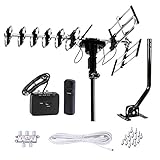
10. Five Star FSA-3806 – automatic gain control and an LTE filter
Five Star Outdoor Antenna HD TV 200 Miles Range with Motorized 360° Rotation, UHF/VHF/FM Radio with Infrared Remote Control Plus Installation Kit & Mounting Pole
45 to 860 MHz coverage
15-35 dB auto gain range
Built-in LTE filter
4-way splitter included
NEXTGEN TV ready
Pros
- Automatic gain control adjusts amplification as signal conditions change
- Built-in LTE filter reduces cellular interference on UHF channels
- 360 degree motorized rotation with infrared remote
- Full kit includes mounting pole 40ft coax and a 4-way splitter
- UHF VHF and FM reception in one unit
Cons
- 4.1 star average with 12 percent one-star reviews
- 200 mile claim far exceeds what the element size delivers
- Amplifier can amplify noise as readily as signal in poor line-of-sight setups
The FSA-3806 stands out in this roundup for its automatic gain control, and that is a genuinely useful feature in the country. Instead of one fixed amplification level, it adjusts between 15 and 35 dB as conditions change, which reduces the chance of overdriving a tuner on a good day or starving it on a bad one.
It also carries a built-in LTE filter for 4G interference rejection, which is increasingly necessary in rural areas as cellular coverage spreads. The 45 to 860 MHz low-noise amplifier handles UHF, VHF and radio in one unit, and the extra reflector area helps across all channels.
The kit is complete: mounting pole, 40 feet of coax, a 4-way splitter and cable clips. The 360 degree motorized rotation with infrared remote is the feature owners single out as most useful, and the LTE filter earns its place in areas where cellular providers have recently deployed low-band spectrum.
Sentiment is favourable but lukewarm, which the 4.1 star average reflects. With 12 percent one-star reviews it draws the most cautious feedback here, and reviewers repeatedly discount the headline range figure. They also note that a strong amplifier can amplify noise as readily as signal when line of sight is poor, which matters more in the country than in town.
Where the FSA-3806 works best
Rural homes with a mix of strong local stations and weak distant ones, where a fixed amplification level would either overload the tuner or under-amplify the fringe stations. It suits anyone who wants to change aim remotely during storm season, and it keeps working through conditions that would leave a fixed antenna pointing the wrong way.
The LTE filter alone justifies it in areas where cellular providers have recently deployed low-band spectrum. The included 4-way splitter also saves a separate purchase, though splitting a fringe signal still costs you channels on each branch.
Where the FSA-3806 falls short
Automatic gain control cannot create a signal that is not there. In a valley or behind heavy foliage, no amount of amplification rescues a blocked path, and the amplifier may simply make noise more obvious.
The 4.1 star average also reflects real rotor complaints. As with the other motorized designs here, the position feedback is weak.
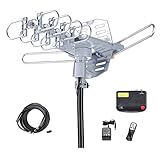
11. McDuory 2608B Amplified Antenna – the budget rotor
McDuory Amplified Digital Outdoor HDTV Antenna 150 Miles Long Range – 360 Degree Rotation Infrared Control – Tools Free Installation – Support 2 TVs
150 mile claimed range
VHF 170-230 MHz and UHF 470-860 MHz
Dual TV outputs
40ft coax included
Mounting pole not included
Pros
- Strong reception reported for towers 20 to 52 miles away
- Tool-free snap-together elements make assembly quick
- 40ft coax included so nothing extra is needed
- Some owners find reception good enough that they never rotate
Cons
- Remote direction buttons are unreliable and there is no position feedback
- Amplifier must be powered or there is no reception at all
- Several owners report inconsistent channel counts at higher mounting heights
- Mounting pole not included
The McDuory 2608B covers the same ground as the PBD at a lower tier, and for many rural homes that is enough. Owners report strong reception from towers 20 to 52 miles away, and the snap-together elements assemble without tools in a short sitting.
The 40 feet of coax is included, which removes a common extra purchase. It runs two TV outputs without a splitter, and the super high-gain low-noise amplifier does its work at the antenna end where it belongs.
Buyer sentiment splits. Some installs solve difficult line-of-sight problems outright, while complaints centre on the rotor control box, which sends power down the coax and offers no position indication. One owner reports customer service replacing a faulty remote quickly, which is worth noting either way.
Weather noticeably affects signal for several owners, and a number report inconsistent channel counts, particularly at higher mounting heights. One detailed review also raised a design concern about element joints.
Where the McDuory works best
Rural households on a budget who need rotation and two outputs without paying for the premium kit. It suits farms and cabins within about 50 miles where a basic mast is available.
It is a reasonable first outdoor attempt for someone moving from an indoor antenna in a suburban-rural area.
Where the McDuory falls short
The amplifier must be powered or there is no reception at all, which means a power inserter at the TV and an outlet at the antenna. That is one more failure point and one more cable to run.
The rotor control is the weak spot, with remote buttons that do not reliably control direction. And no mounting pole is included, so add that to your install list.
12. Yeceny WA-2608B – 60 feet of coax in the box
Yeceny Outdoor TV Antenna,Digital Amplified HDTV Antenna & 60 ft RG6 Coax Cable,200 Miles Long Range Wireless Remote 360 Degree Rotation Support 4K 1080P 2 TVs
150 mile spec with 200 mile marketing claim
17 x 3.9 x 12.2 inches
60ft RG6 coax included
Dual TV output
4G and 5G filtering
Pros
- 60ft RG6 cable included so no separate purchase is needed
- Tool-free snap-together assembly takes under half an hour
- Owners report channel counts rising from about 35 to 48-80
- Remote rotation and amplifier work reliably for most buyers
- Built-in lightning protection
Cons
- Predominantly plastic construction feels flimsy
- One owner received closer to 30 feet of cable instead of 60
- Signal quality reported as inconsistent during storms and aircraft traffic
- Packaging and marketing disagree on the range figure
The Yeceny WA-2608B solves one problem better than most: coax length. Sixty feet of RG6 in the box means a barn, an outbuilding or a basement television can be connected without a separate cable purchase, and RG6 is the right cable for runs over 50 feet.
Owners report channel counts rising from roughly 35 to between 48 and 80 after installation, and the wireless remote rotation plus the amplifier work reliably for most buyers. Assembly is a snap-together job that takes under half an hour with no tools.
It also includes a power supply adapter and built-in lightning protection, and it filters both 4G and 5G interference, which matters where cellular providers have moved into low-band spectrum. Two TV outputs avoid a splitter.
The criticisms are consistent across reviews. Construction is predominantly plastic and feels flimsy. One owner received closer to 30 feet of cable rather than the advertised 60. Signal quality was reported as inconsistent during storms and heavy aircraft traffic. And the packaging and the marketing disagree about whether the range is 150 or 200 miles, which is a sign to trust neither figure.
Where the Yeceny works best
Rural homes with a long run from the mast to the television, especially outbuildings, barns and finished basements where buying a 60 foot cable separately is an extra step. It also suits anyone wanting rotation on a budget.
It is a capable option for farms within about 40 miles of a tower cluster.
Where the Yeceny falls short
The plastic build will not last as long as the metal antennas in this roundup, and reviewers mention inconsistent performance in bad weather. If you are mounting it exposed on a roof in an ice and wind region, durability matters more than convenience.
Verify the cable length on arrival, since at least one buyer did not receive the advertised amount.
How to Choose a TV Antenna for Rural Areas
Start by measuring your situation rather than the antenna. Enter your address into the FCC DTV reception map, then cross-check on AntennaWeb and RabbitEars.info. All three colour-code the local stations by strength and band, and between them they will tell you the two things that matter most: how far the towers are and whether your channels sit on VHF or UHF.
Distance is the first filter. Below roughly 25 miles with a clear view, an indoor antenna can work and you can read our guide to TV antennas for local channels. Between 25 and 50 miles, go outdoors. Past 50 miles, you are in deep fringe territory and you should be choosing on gain and beam pattern rather than convenience.
Directional or multidirectional: the decision that matters most
A directional antenna concentrates gain into a narrow beam and is the right choice when every tower sits in the same direction. A Yagi like the Five Star FSA-5812 is the clearest example, and it will outperform a multidirectional unit at the same distance by a wide margin.
A multidirectional antenna spreads gain across a wider arc and catches stations in more than one direction without aiming. That is why the ClearStream 2V reports 40 to 100 or more channels in some locations. The tradeoff is lower peak gain, which only shows up when the signal is genuinely weak.
Rural terrain decides this for you. Valleys and mountain shoulders create multi-path interference and shadow zones, so a narrower beam is often the only way to get a stable signal. Open farmland with one tower cluster suits almost anything.
VHF versus UHF: check before you buy
VHF channels run from 2 to 13, UHF from 14 to 36. UHF signals are shorter and more easily blocked by terrain, foliage and building materials. VHF travels further and is more robust, but low-band VHF on channels 2 to 6 uses very wide elements that many modern antennas handle poorly.
After the FCC repack moved many stations to lower channels, some rural viewers lost channels they had watched for years because their antenna had no low-band VHF response. This is the single most under-discussed problem in rural reception. If your mapping tool shows stations on channels 2 to 6, pick an antenna with genuine low-band VHF elements, or add a separate antenna and a combiner.
Amplified or passive, and where the amplifier goes
Amplification does not create signal. It makes whatever arrives at the antenna louder, along with the noise. That is exactly what you want when a long cable run and a splitter are eating a weak signal, and exactly what you do not want when a strong local station would overload the tuner.
The placement matters more than the brand. A masthead preamplifier mounts at the antenna, before the cable loss, and is the correct tool for rural runs. An inline amplifier at the TV end amplifies the noise the cable has already collected. If you have a good antenna and a short RG6 run, buy nothing. If you have 100 feet of cable and a four-way splitter, buy a preamp.
Signal splitters deserve their own warning. Every split costs signal, which is why a distribution amplifier is usually the better answer for multiple TVs than an unpowered splitter. Several antennas here include two outputs specifically to avoid that loss.
Grounding and lightning protection: the step guides skip
Any outdoor antenna on a mast is a lightning rod by accident. Rural homeowners and installers treat two items as non-negotiable: a grounding block bonded to the mast and coax, and a lightning arrestor fitted at the antenna end. Experienced users on r/ota describe them as standard practice rather than an upgrade.
Bond the mast to a grounding rod with proper hardware, connect the coax shield to the same ground point, and keep the run from the rod to the service panel as short as practical. The Five Star FSA-5812 and the Yeceny both include lightning protection in the description; on other antennas, treat the grounding kit as a required purchase.
If you are mounting above a two-storey roof or reaching a ridge, hire an installer. Forum users describe professional installation as preferable whenever the job is not feasible to do safely, and a fallen mast or a drilled leak costs far more than the service call.
Coax, mounting height and the seasonal problem
Use RG6 rather than RG59 for any rural run. Old cable in an older house is a common cause of a good antenna performing badly, and forum discussions about antenna results consistently come back to cable quality and run length. Keep runs as short as the building allows and secure them with proper clips, not tape.
Height is the cheapest gain available to you. Owners describe getting above the tree canopy as the single change that brought dozens of extra channels, and one r/ota user with a basement television and tall trees simply could not get an antenna high enough, which is a real and common failure case.
Seasonal change is normal. Leaf growth in summer attenuates UHF noticeably, ice and wet foliage in winter does the same, and wind through branches is the direct cause of the intermittent pixelation rural viewers complain about most. Before concluding that your antenna has failed, wait for a still day and rescan. If your reception is seasonal rather than total, the fix is height and aperture, not a bigger amplifier.
Coax runs, rotators and the accessories worth buying
A rotator is worth it only if you need to aim at more than one tower cluster, or if your towers sit at a different bearing from the viewing room. Motorised rotors are convenient, and they are also the most common mechanical failure in this category, so mount the rotor where you can service it without going onto the roof.
A signal meter or signal finder saves hours. Several reviews on the Yagi-style antennas specifically note that accurate aiming with a meter is what separated good results from poor ones, and it is a cheap addition compared with replacing an antenna that was simply pointed wrong.
Finally, rescan your channels regularly, and rescan after every FCC repack in your area. Return policies matter too, because the difference between a 40 mile and a 60 mile site is not knowable until you install. Owners on r/cordcutters repeatedly stress buying from sellers with easy returns.
Frequently Asked Questions
What is the best TV antenna for mountain areas?
For mountain and ridge locations, a directional outdoor antenna with a reflector is the reliable choice, because terrain blocks paths that omnidirectional patterns cannot recover. The Antennas Direct DB8e offers 17.4 dB of gain for the toughest cases, while the ClearStream 2V and 4V handle more moderate mountain fringe. Height matters more than antenna choice, so get the mast above the tree line and as clear of the ridge as you safely can.
How far can a TV antenna reach in rural areas?
Realistic reach is about 50 to 70 miles for a well-mounted directional antenna with a clear line of sight to the towers. Advertised figures of 150 or 200 miles are marketing numbers that reviewers consistently discount. Distance is only part of the equation, since terrain, foliage, roofing material and cable run length can each remove more signal than the extra miles suggest.
Do I need an amplified antenna for rural areas?
An amplifier helps when a long coax run and any splitter are eating an already weak signal, and it is most effective as a masthead preamplifier mounted at the antenna. Skip amplification when a strong local station would overload the tuner, since a boosted too-strong signal causes its own pixelation. Start passive and add a preamplifier only if your measurements show cable loss is the problem.
Can I use an indoor antenna in a rural area?
Yes, if you are within roughly 25 miles of a tower with a clear view through a window. Beyond that, testing by reviewers and publications shows indoor antennas failing completely, because walls, floors and glass attenuate the signal before it reaches the elements. Once you pass 25 miles, an outdoor antenna mounted as high as you can manage is the only dependable option.
Will a TV antenna work in a valley?
It can, but valleys are the hardest rural case because you often need two different bearings and the terrain causes multi-path interference. A multidirectional antenna such as the ClearStream 2V or a rotor-equipped model like the PBD WA-2608 covers more than one direction. If the valley floor is shadowed by a ridge, no antenna overcomes that, and a taller mast or a different site is the only fix.
How do I ground an outdoor TV antenna?
Bond the mast and the coaxial shield together with proper hardware, then run a grounding conductor to a rod driven into the soil near the building, keeping it as short as practical. Fit a lightning arrestor at the antenna end of the coax run as well. Users on r/ota treat the grounding block and arrestor as standard rather than optional for any roof or mast mounted rural antenna.
Conclusion: Our Rural Antenna Picks for 2026
Mount the GE 29884-PK1 if your towers are 25 to 60 miles out and you want the simplest reliable setup with no power supply and a lifetime replacement pledge. Choose the Antennas Direct ClearStream 2V when you need more gain and you are willing to spend an evening aiming it properly, or step up to the DB8e when trees and building materials are the main obstacle.
Pick the PBD WA-2608 when towers sit in more than one direction, the Five Star multi-directional kit when four televisions need feeding, and the Channel Master Omni+ 50 for cabins and RVs where alignment is not practical. Whichever one you choose, the antenna is half the job: height, RG6 coax, a masthead preamplifier if the run is long, a grounding block and a lightning arrestor decide whether the last five channels ever show up.
Once it is installed, rescan and check your signal strength. Antenna performance is not a fixed number, and a system that works in winter can be undone by a week of leaf growth in a summer month. If the picture breaks up in wind, the answer is usually a taller mast or a larger aperture rather than a louder amplifier.
Once reception is sorted, the audio side of the setup is often the next thing worth fixing, and our guides to TV speakers and wireless TV headphones cover that in detail.