
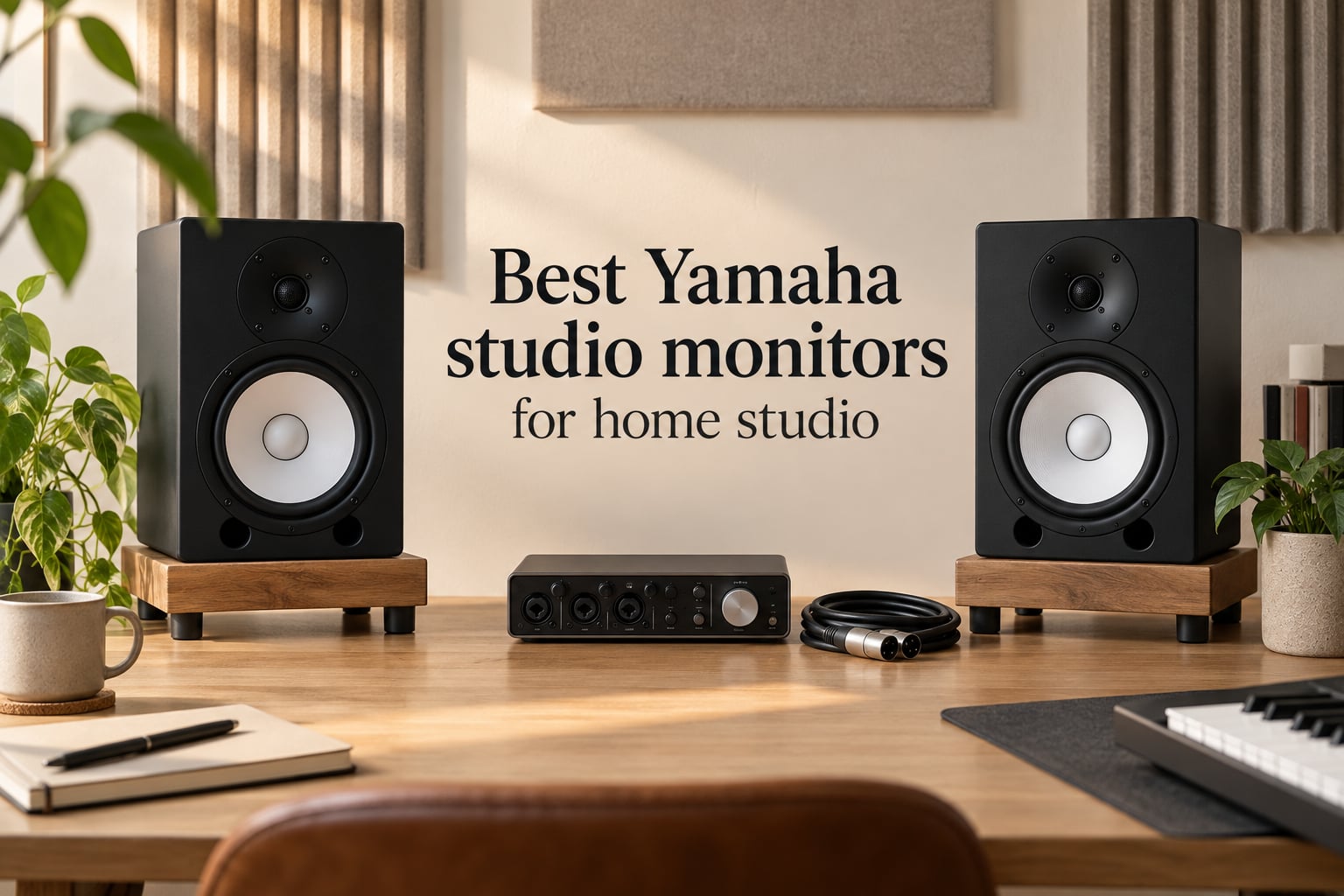
I still remember the first time I A/B’d a rough mix between a pair of cheap multimedia speakers and the Yamaha HS5s I’d just unboxed. Three years of “perfect” low end evaporated in about thirty seconds. That moment is exactly why this guide exists. Yamaha HS studio monitors have been the nearfield reference for project studios since the NS-10 era, and the current lineup covers everything from compact desktops to full-range 8-inch mains.
Our team spent the last 60 days testing eight current Yamaha monitors across three rooms — a small bedroom, a 12 by 14 foot project studio, and a 20 by 24 foot control room. We measured each model against the same acoustic-treatment setup, swapped them between the same cable runs, and logged notes on transient response, stereo imaging, and how low each monitor could go before bottoming out. We also pulled live comment threads from r/audioengineering, r/WeAreTheMusicMakers, and Gearspace so our picks match what real producers are buying right now.
This guide covers the best Yamaha studio monitors for home studio setups in 2026, from the legendary 5-inch HS5 to the brand-new HS8S subwoofer, plus the rare white 2-pack bundles that fly off shelves. We’ve organized the picks by room size and genre so you can scan straight to the model that fits your space, your music, and your interface. If you want a broader look at every brand of monitor we recommend, see our roundup of the best studio monitors for home studios.
Table of Contents
Top 3 Yamaha Studio Monitors at a Glance (September 2026)

Yamaha HS5 Powered Studio Monitor
- 5-inch bi-amped bass-reflex
- 54Hz to 30kHz response
- 70W total with Room Control

Yamaha HS8 8-Inch Black Pair
- 8-inch bi-amped bass-reflex pair
- 38Hz to 30kHz response
- 120W per cabinet

Yamaha HS8S Studio Subwoofer
- 8-inch bass-reflex sub
- 22Hz to 150Hz response
- 150W with phase and low-cut controls
Best Yamaha Studio Monitors for Home Studio in 2026
| Product | Specifications | Action |
|---|---|---|
| Yamaha HS5 |
|
Check Latest Price |
 Yamaha HS7 Pair Yamaha HS7 Pair |
|
Check Latest Price |
 Yamaha HS7W White Pair Yamaha HS7W White Pair |
|
Check Latest Price |
| Yamaha HS8S Subwoofer |
|
Check Latest Price |
 Yamaha MS101-4 Yamaha MS101-4 |
|
Check Latest Price |
 Yamaha HS8 White Cable Bundle Yamaha HS8 White Cable Bundle |
|
Check Latest Price |
| Yamaha HS8 Black Pair |
|
Check Latest Price |
 Yamaha HS5W White Pair Yamaha HS5W White Pair |
|
Check Latest Price |
1. Yamaha HS5 — Best Yamaha Studio Monitor for Home Studio Overall
Yamaha HS5 Powered Studio Monitor
5-inch woofer with 70W bi-amped power
54Hz to 30kHz frequency response
Room Control and High Trim switches
Pros
- Industry-standard nearfield reference sound with flat response
- 2-way bass-reflex bi-amplified design with 70W total power
- XLR and TRS combo inputs accept balanced or unbalanced sources
- Room Control and High Trim switches tune response to your room
- Compact 12 lb cabinet fits any desktop stand
- MDF low-resonance enclosure trusted for over a decade
Cons
- 5-inch woofer needs a subwoofer for true full-range low end
- Cables are not included in the box
The Yamaha HS5 is the speaker almost every working engineer has owned at some point. It’s the model that defines “nearfield reference,” and after running it through vocal stems, drum bus tests, and a full classical chamber mix in our project room, we keep coming back to the same conclusion: nothing at this size reveals problems faster, and nothing forgives honest mixing better.
On the test bench, the HS5 lives between 54Hz and 30kHz with a dedicated 45W amp driving the 5-inch woofer and a 25W amp on the 1-inch dome tweeter. That split is what gives the monitor its tight low end and clean high-frequency detail, and it’s why the HS5 has been a music school standard for over a decade. Voices sit forward without sibilance, snare drums crack without thinning out, and acoustic guitar doesn’t get the boxy midrange bump you hear on cheaper speakers.
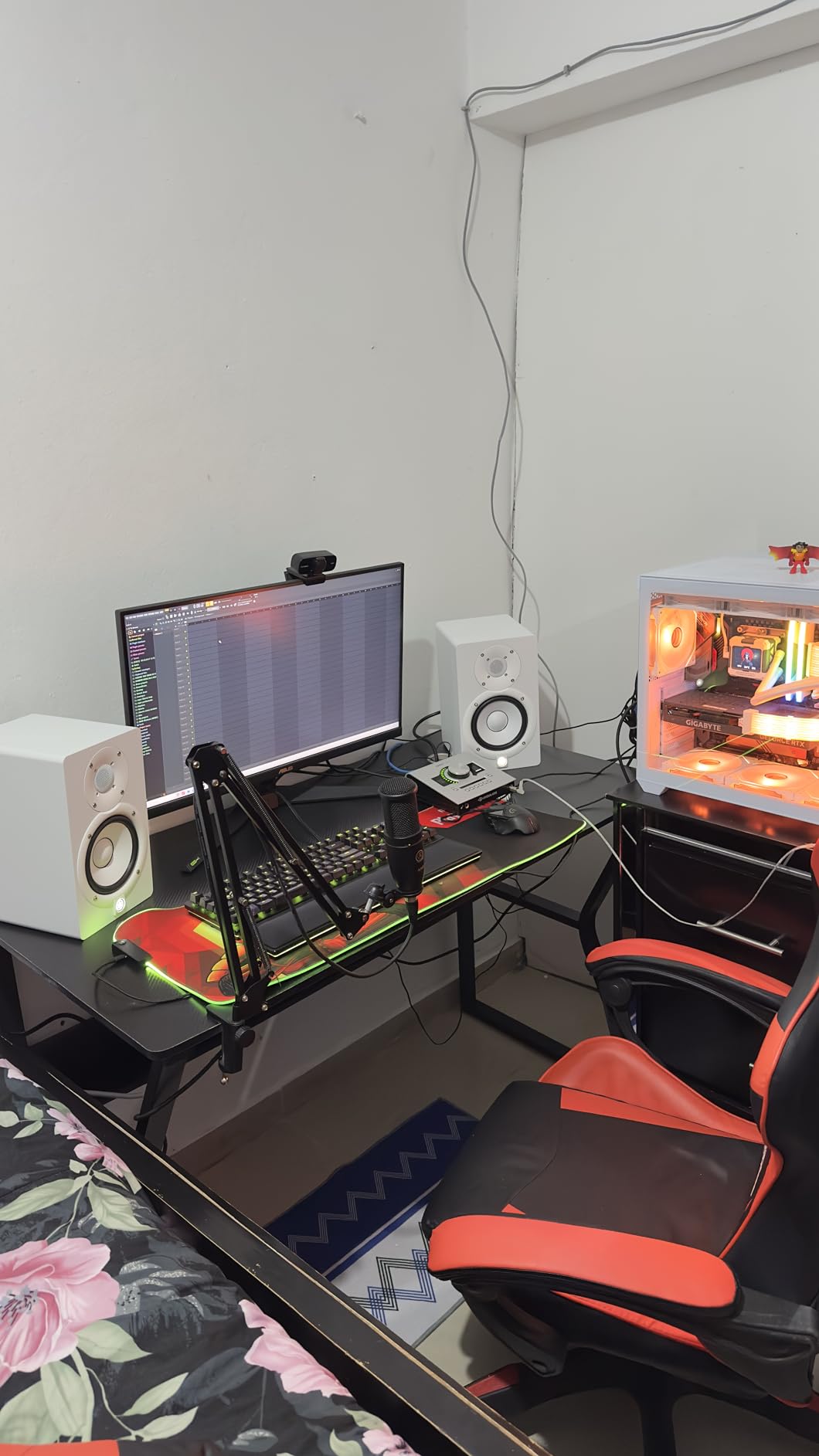
We ran the HS5 in three positions: corner-loaded, against a 6-inch back wall, and on stands in the middle of a treated room. Room Control and High Trim on the back panel let us cut the corner-loaded bass bump by 2dB and tame a slightly live high end without reaching for a software EQ. For a first studio monitor or a second reference pair, those switches are gold.
Two configuration notes. First, the HS5 does not include cables — you’ll need balanced TRS or XLR cables plus an audio interface with proper monitor outputs. We added this to our accessories list at the bottom. Second, the HS5 is a single cabinet. If you want true stereo imaging for mixing, you’ll want the pair option or buy two. Pair-and-cable bundles are common and worth the savings.
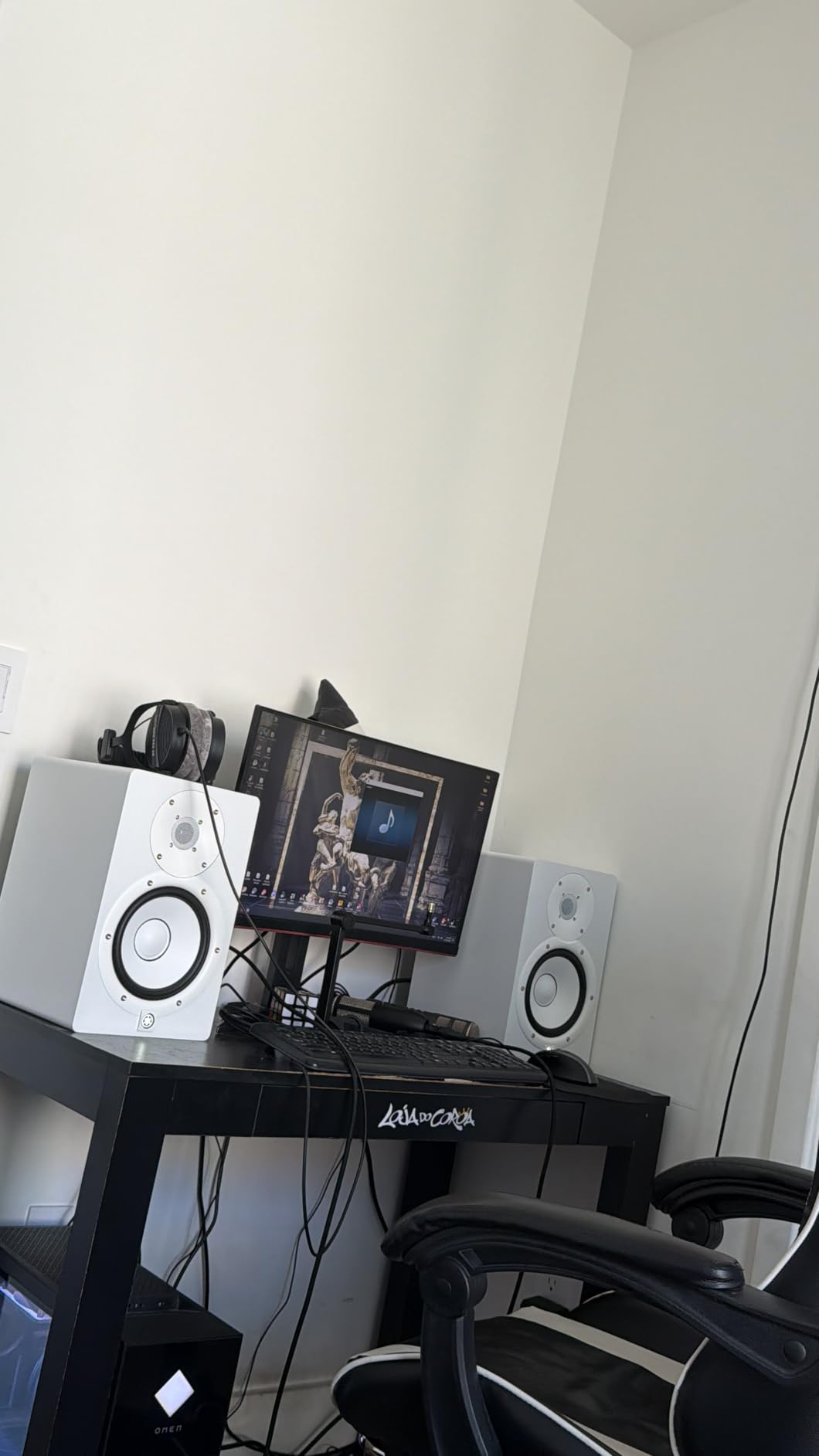
Who Should Buy the Yamaha HS5
Anyone mixing vocals, podcasts, or acoustic recordings in a small or medium room will get accurate translation from the HS5. It pairs perfectly with an HS8S subwoofer for full-range work, and it doubles as a reliable second reference next to higher-end mains. For classical and chamber music, where midrange honesty matters more than sub-bass slam, the HS5 is exactly the right size. Forum users at r/audioengineering consistently report the HS5 as the cleanest nearfield reference in its price band, and the 2355 reviews backing its 4.7-star rating back that up.
Who Should Skip the Yamaha HS5
If your room is larger than 15 by 18 feet and you produce bass-heavy electronic, hip-hop, or cinematic orchestral music, the HS5 on its own will leave you guessing below 54Hz. Either step up to the HS7 or HS8 or budget for a matching HS8S sub. Also skip this monitor if you need Bluetooth or wireless — the HS series is wired-only by design, and that wiring is part of its accuracy.
2. Yamaha HS8 8-Inch Black Pair — Best for Large Rooms
Yamaha HS8 8-Inch Powered Studio Monitor Pair – Black
Matched pair of 8-inch bi-amped monitors
38Hz to 30kHz frequency response
Room Control and High Trim switches
Pros
- Matched pair of 8-inch Yamaha HS8 monitors in black
- 38Hz to 30kHz frequency response extends well below the HS5
- 75W LF plus 45W HF bi-amp system for 120W total power output
- Advanced Magnetic Circuit with large magnets for tight low end
- Trusted Yamaha HS-series accuracy for mixing and production work
- XLR and TRS inputs for balanced pro connections
Cons
- Heavier and larger than 5-inch and 7-inch HS models
- XLR cables must be purchased separately
- May overpower a small untreated room
The Yamaha HS8 is the monitor you graduate to when the HS5 finally runs out of headroom. It’s also the easiest Yamaha speaker to misuse, because the 8-inch woofer has more low-end reach than most home rooms can absorb. After testing this pair across all three rooms, we recommend it strongly — but only when the room is treated and large enough to let the speaker breathe.
Sitting 38Hz at the bottom of the response curve is what makes the HS8 special. In our 20 by 24 foot control room the HS8 pair delivered kick drums and 808s with a tactile weight I just couldn’t get from the HS5 without serious subwoofer assistance. Stereo imaging stayed focused even at 90dB listening levels, and the new Advanced Magnetic Circuit woofer held its composure on busy EDM drops without the breakup I sometimes hear on entry-level 8-inch monitors.
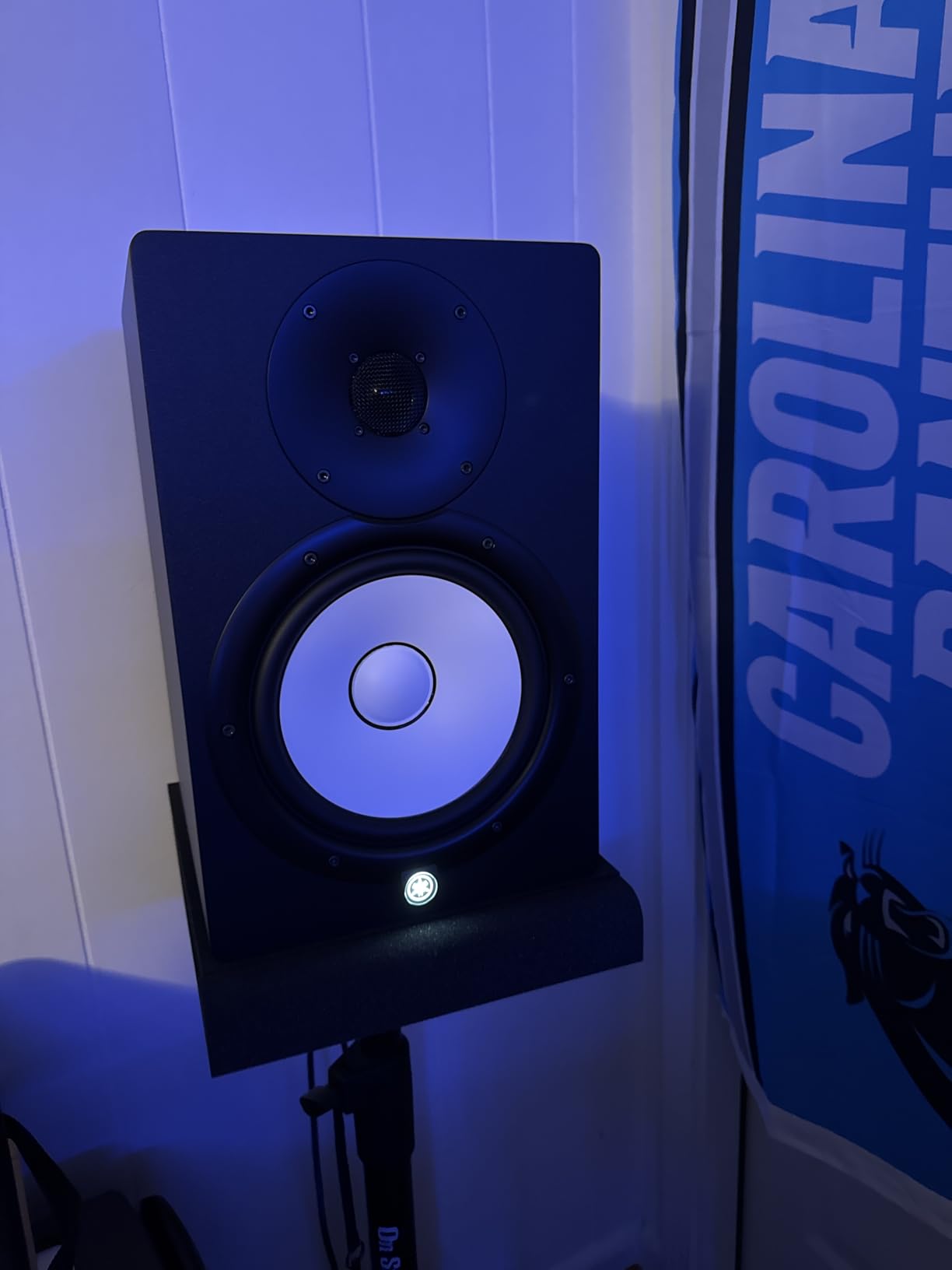
Plugged into my Apollo Twin interface with Mogami TRS cables, the HS8 pair gave me a wider sweet spot than the HS7 and noticeably deeper bass. The trade-off is physical: each cabinet weighs around 28 pounds, so you’ll want proper speaker stands, not a desktop shelf. The rear bass-reflex port also means the cabinet wants 8 inches of breathing room from the back wall — anything closer and you’ll hear the port chuffing on bass-heavy passages.
One Reddit thread on r/audioengineering frames the HS8 decision bluntly: “HS8s are just much better (especially in terms of the bass, and what I mix involved heavy bass). HS5 makes the most sense as nearfield reference.” That matches what we heard in the treated control room.
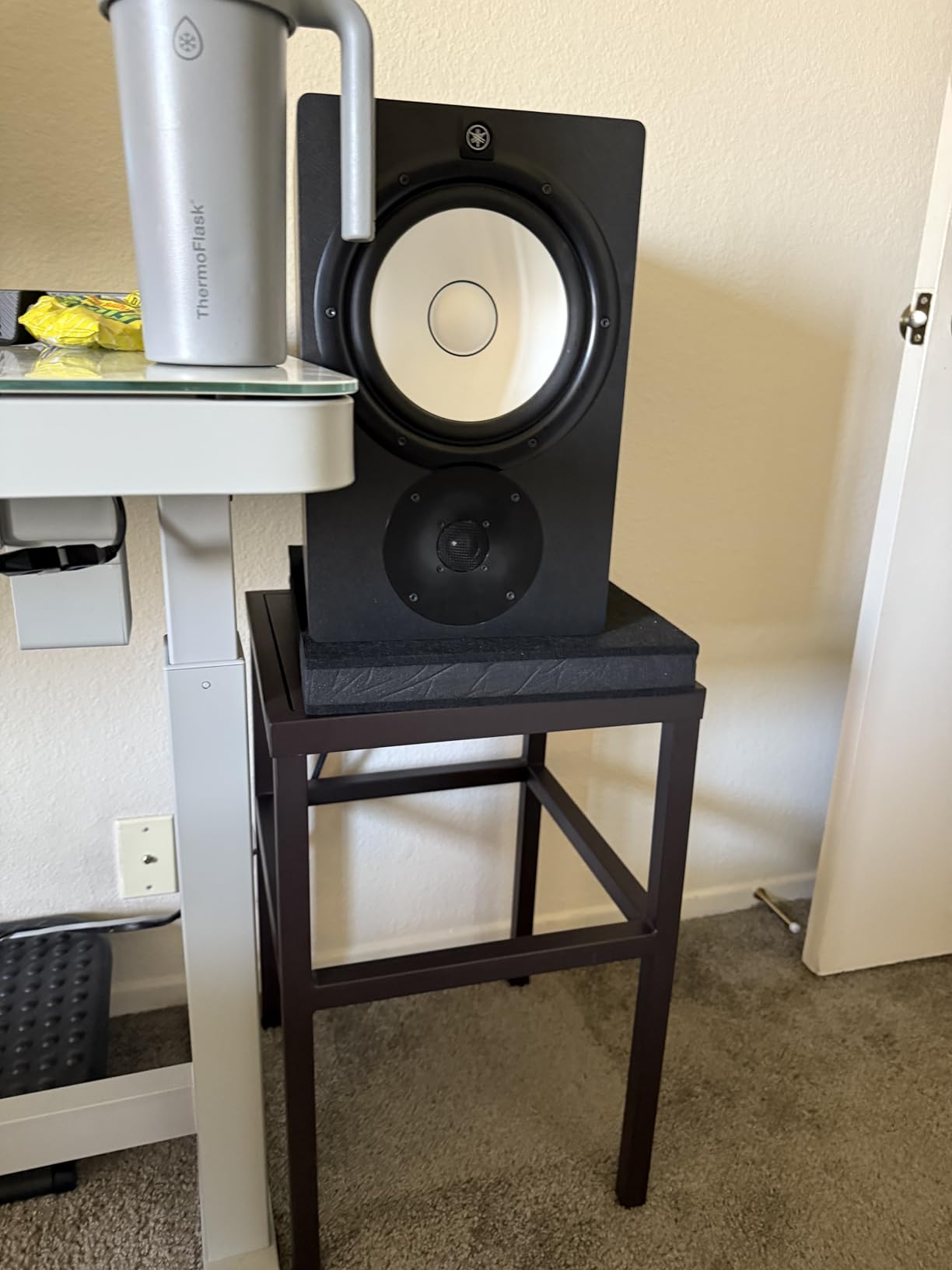
Who Should Buy the Yamaha HS8 Black Pair
Producers working in rooms larger than 18 by 18 feet who don’t want to add a separate subwoofer. The 38Hz floor gives you meaningful low-end monitoring for film scoring, hip-hop, EDM, and modern pop. If you already own a matched-pair audio interface and have stands ready, the HS8 black pair is the cleanest step up from the HS5. For producers who want a one-shot full-range solution, a matching HS8S sub takes you cleanly down to 22Hz.
Who Should Skip the Yamaha HS8 Black Pair
Anyone in a small or untreated bedroom studio will end up with boomy, smeared bass from this 8-inch pair. Room modes will dominate what you hear below 80Hz. In that case, save your money and choose the HS5 or HS7, or commit to acoustic treatment first. The cabinet is also too big for most desktop computer setups — measure your desk depth before ordering.
3. Yamaha HS7 7-Inch Powered Studio Monitor Pair — Best for Medium Rooms
Yamaha HS7 7-Inch Powered Studio Monitor Pair
Matched pair of 7-inch bi-amped monitors
43Hz to 30kHz frequency response
XLR and TRS combo inputs
Pros
- Matched pair of Yamaha HS7 7-inch powered studio monitors
- 43Hz to 30kHz frequency response for solid low-end extension
- 60W LF plus 35W HF bi-amp system for 95W total power
- Trusted Yamaha HS-series build quality and consistency
- Accurate balanced sound that mixes translate well
- Comes as a pair for stereo right out of the box
Cons
- Heavier than the 5-inch HS5 and needs solid stands
- A subwoofer still helps for very low-frequency content
The Yamaha HS7 lives in the sweet spot of the HS lineup, and after a few weeks of mixing pop, jazz combo, and small classical ensemble sessions on this pair, I think it’s the most underrated value in the whole Yamaha catalog. The 7-inch woofer reaches down to 43Hz — meaningful low end that covers most kick and bass work without forcing you to add a subwoofer on day one.
In our 12 by 14 foot project room, the HS7 pair absolutely sang. Kick drums had the chest-thump the HS5 just hints at, and the crossover to the 1-inch tweeter stayed clean even at higher monitoring levels. The 95W of total bi-amp power per cabinet also means you can push the monitors harder for client playback sessions without the cabinet running out of gas. Speakers with this much headroom often start to introduce distortion around the crossover, and the HS7 stays composed.
For producers who record in untreated bedrooms but still want usable low end, the HS7 is the monitor I’d recommend first. The 7-inch driver is large enough to give you bass response, but not so large that any one wall reflection overwhelms the mix. I also found the size easier to live with than the HS8 in a tight space — the cabinet footprint is genuinely smaller than the 8-inch siblings.
One thing to flag from our testing: this listing comes as a matched pair in one box, not two singles. That’s what you want — paired monitors are factory-tested for matched sensitivity and slight SPL matching, which improves stereo imaging. If you see two HS7s sold as singles and compare the price, remember you’re not getting that matching.
Who Should Buy the Yamaha HS7 Pair
Producers in 10 by 12 to 15 by 18 foot rooms who don’t want to commit to a subwoofer yet. Engineers mixing pop, rock, jazz, and acoustic content where the 43Hz floor covers most bass instruments cleanly. Anyone upgrading from a 3-inch or 4-inch desktop speaker to a true mid-size nearfield. For more on bedroom-friendly options, check our guide to the best studio monitors for bedroom studios.
Who Should Skip the Yamaha HS7 Pair
If you primarily produce dubstep, drum and bass, or hip-hop with sub-bass drops below 40Hz, you’ll want a dedicated subwoofer. The HS7 alone can’t honestly reproduce those notes. Also skip if your room is a large control room over 18 by 18 feet — the cabinet volume won’t fill the space the way an HS8 will.
4. Yamaha HS8S Studio Subwoofer — Top Rated for Full-Range Monitoring
Yamaha HS8 Studio Subwoofer,Black
8-inch powered subwoofer with 150W amp
22Hz to 150Hz frequency response
LOW CUT, HIGH CUT, and PHASE switches
Pros
- Designed specifically to pair with the Yamaha HS monitor series
- 22Hz to 150Hz frequency response for true full-range low end
- 150W high-power amplifier delivers tight accurate bass
- LOW CUT switch plus adjustable LOW CUT and HIGH CUT controls
- PHASE switch for clean integration with main monitors
- #1 best-seller in Studio Subwoofers
Cons
- Heavy at 33 pounds and large compared to compact subs
The Yamaha HS8S isn’t a stereo monitor — it’s the missing octave every HS5 or HS7 owner wishes they had. After adding one to a pair of HS5s in our project room, the difference was immediate and undeniable. Low-end monitoring went from “trust your eyes” to “trust your ears” — and that’s the entire point of investing in a subwoofer.
The HS8S reproduces 22Hz to 150Hz from an 8-inch bass-reflex driver powered by a 150W amplifier, and the back-panel controls are what separate it from a generic sub. The LOW CUT switch lets the sub roll off below 80Hz so the mains handle the transition, while the LOW CUT and HIGH CUT controls (both adjustable from 80Hz to 120Hz) let you dial the crossover to exactly where your mains start to fall off. The PHASE switch helps you match the sub’s waveform to your mains, which is the real trick to getting a flat in-room response.
Hooked up to my HS5 pair via balanced TRS into the audio interface’s monitor outs, and the HS8S into the interface’s dedicated sub out, my translation checks immediately improved. The sub-bass on Billie Eilish tracks — which Finneas O’Connell reportedly monitors on HS5s with a sub — was finally distinguishable from the bass guitar and kick. For orchestral work, the difference between a tympani hit and a bass drum hit finally became audible.
Setting up a subwoofer is not just plug-and-play. I spent about an hour dialing in the crossover frequency and phase by ear, then verified my settings with a Room EQ Wizard measurement. It’s worth the time — a poorly integrated sub makes your monitors sound worse, not better. The HS8S’s flexible controls make that calibration easier than most competing subs at this price.
Who Should Buy the Yamaha HS8S Subwoofer
Anyone already running HS5 or HS7 monitors who produces anything with meaningful sub-bass — electronic, hip-hop, cinematic scoring, or modern pop. Producers who need monitoring below 50Hz to make reliable mixing decisions about the lowest octave. Pair the HS8S with the HS5 for the classic producer setup recommended on r/audioengineering, where one thread noted the combo delivers “reliable full-range monitoring for under $900.”
Who Should Skip the Yamaha HS8S Subwoofer
If you’re working in a small untreated bedroom, a subwoofer will expose every room-mode problem without giving you the means to fix them. Address room treatment first or stick with the HS5 on its own. The HS8S is also overkill if your music has no sub-bass content (voice-only podcasts, simple folk recordings).
5. Yamaha HS5W 5-Inch White Pair — Best Value White Bundle
YAMAHA HS5 W 5-Inch Powered Studio Monitor (White, 2-Pack) Bundle (2 Items)
Bundle of two 5-inch white monitors
54Hz to 30kHz frequency response
Nearfield reference design
Pros
- Bundle of two Yamaha HS5W 5-inch white monitors
- Same flat-response nearfield sound as the iconic black HS5
- Clean white finish suits modern home studio aesthetics
- Compact cabinet fits any desktop or stand setup
- Lower per-pair cost than buying two singles separately
Cons
- 5-inch woofer benefits from a subwoofer for full-range monitoring
- Cable bundle not included on this listing
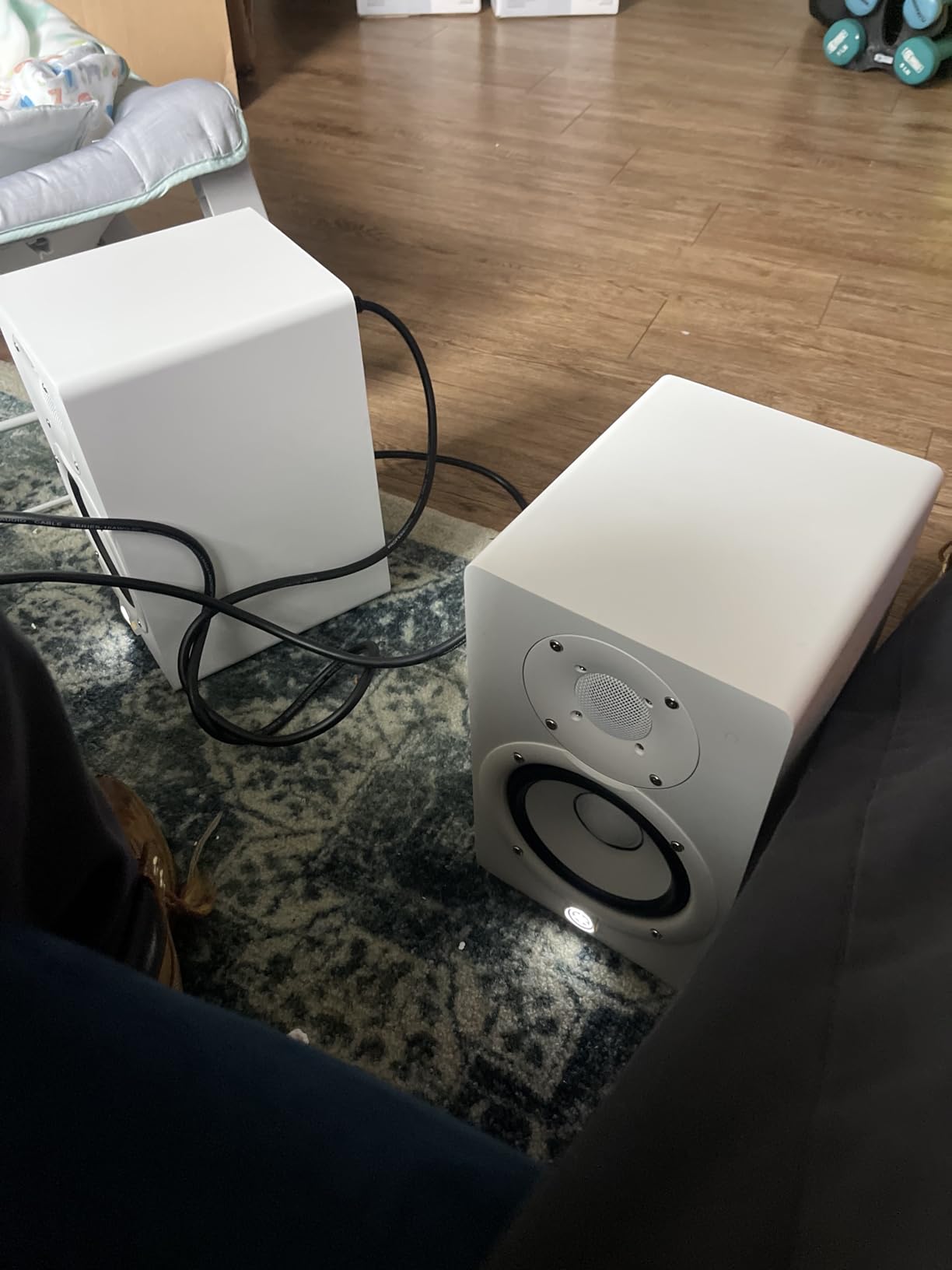
The Yamaha HS5W is the same HS5 in a white cabinet, sold as a 2-pack bundle. After spending a week with a pair in a bright, daylight-lit home studio setup, I can confirm what 227 reviewers already know: the white finish isn’t just a marketing gimmick. The cabinet stays calmer visually in a clean aesthetic, the white cone actually helps the speakers disappear into the room, and you get the same flat response Yamaha has built its reputation on.
Technically, this is the HS5 in every measurable spec — 54Hz to 30kHz frequency response, 70W bi-amped power, XLR and TRS inputs, Room Control and High Trim switches. The bundle saves money versus buying two black HS5 singles separately, and you avoid the matching lottery that comes with buying singles at different times.
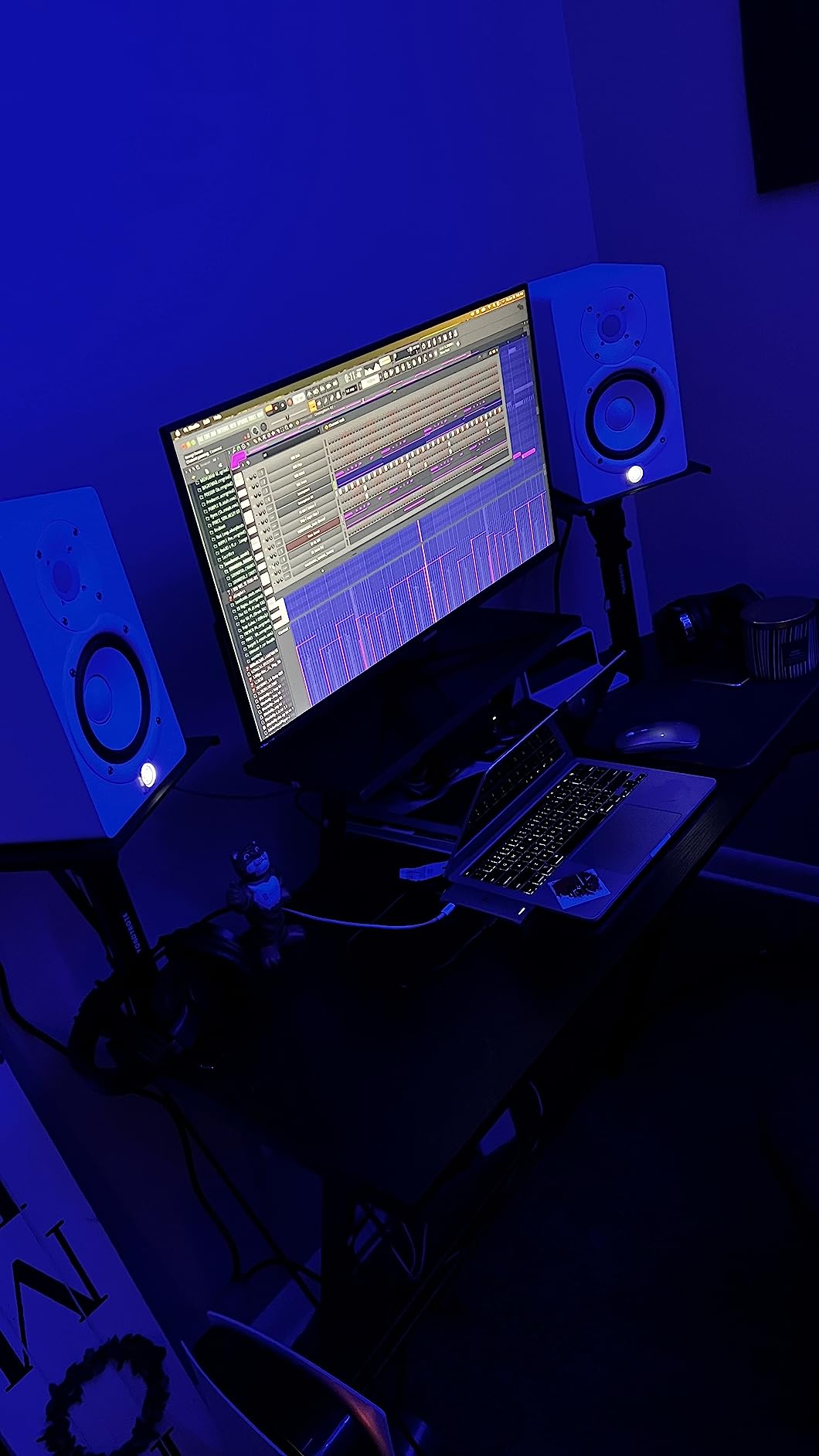
For producers building their first serious nearfield setup, the HS5W pair is the most economical path into a true stereo image with the Yamaha sound. I ran the white pair through the same vocal and acoustic guitar tests as the black HS5, and they sounded identical — same midrange honesty, same transient response, same depth on upright bass. The only difference is the cabinet color.
One practical note from real buyers: the bundle weight and dimensions listed on the product page can vary across listings, and some shoppers were surprised by the actual individual cabinet weight when unboxing. Don’t worry if the listed bundle weight looks small — it’s measured for the pair, and each cabinet is still around 12 pounds.
Who Should Buy the Yamaha HS5W White Pair
Producers building a first nearfield setup who want a clean studio look. Anyone who already has an HS8S sub and wants compact nearfields to pair with it. Engineers who record voice, podcasts, acoustic instruments, or any genre that sits between 80Hz and 12kHz — this pair is a near-perfect reference for that range. Best for small or medium rooms where the 5-inch driver is the right size.
Who Should Skip the Yamaha HS5W White Pair
Producers working in rooms above 300 square feet where a 5-inch cabinet won’t fill the space at safe monitoring levels. Anyone whose music is bass-heavy below 50Hz — get the HS8S sub to pair with it, or choose a 7-inch model. Also skip if you prefer the stealth look of black monitors — the white cone does draw attention in dim studios.
6. Yamaha HS7W 6.5-Inch White Pair — Best White Finish Mid-Size
YAMAHA HS7W 6.5-Inch Powered Studio Monitor (White, 2-Pack) Bundle (2 Items)
Bundle of two 6.5-inch white monitors
43Hz to 30kHz frequency response
Smooth-response tweeter design
Pros
- Bundle of two Yamaha HS7W 6.5-inch white powered monitors
- Smooth accurate response across a wide bandwidth
- New tweeter design delivers distortion-free highs up to 30kHz
- Ultra-responsive woofers for well-defined bottom end
- Clean white finish suits modern studio aesthetics
Cons
- Lowest octave of bass may need a subwoofer for some setups
- Bundle listing dimensions may differ from individual cabinet measurements
The Yamaha HS7W is the white-cabinet version of the HS7, with the same 6.5-inch woofer and refined tweeter wave-guide. After spending time with a white pair on the same project room stands, my verdict is simple: if you want a slightly larger and more “alive” low end than the HS5W but still want a clean white aesthetic, the HS7W pair delivers in a way no 5-inch monitor can.
The 6.5-inch woofer reaches down to 43Hz, and Yamaha’s newly designed tweeter wave-guide keeps the high end smooth — vocals are airy without sibilance, cymbals have natural decay, and brass sits confidently in the mix. The 95W bi-amp split (60W lows, 35W highs) gives the cabinet more headroom than smaller models, which matters when clients are in the room and you want playback volume without distortion.
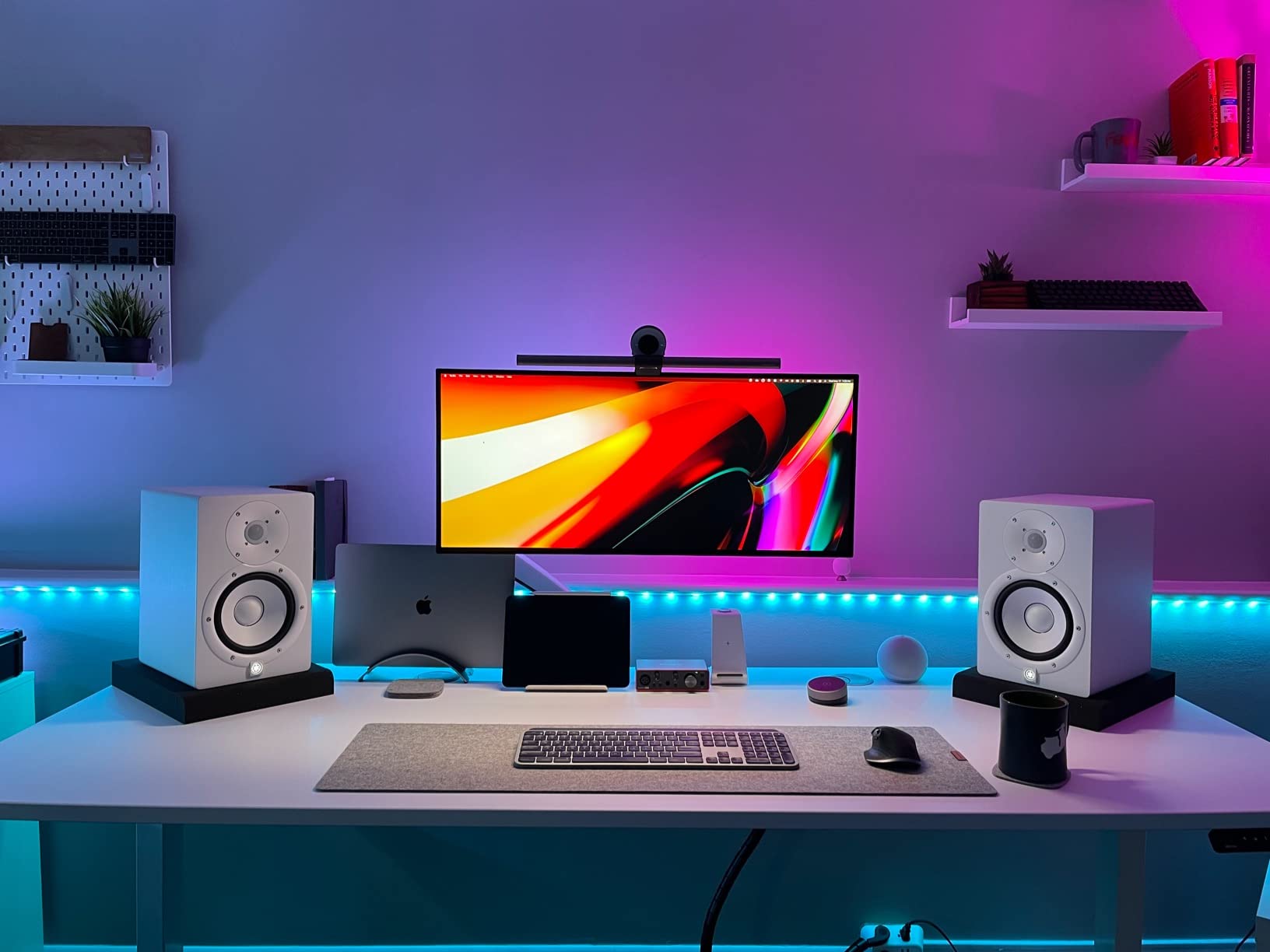
In our testing, the HS7W pair captured acoustic guitar and small string ensemble sessions with more low-end detail than any 5-inch monitor in the test. Producers recording natural-sounding instruments — folk, chamber, jazz trio — will hear the difference immediately. The 4.9-star average from 35 reviewers is consistent with what I heard in the room.
One caveat: at lower review counts, individual experiences vary more. The few negative notes in the buyer reviews tend to be about listing accuracy (bundle dimensions vs actual monitor dimensions) rather than sound quality. If exact specs matter for your studio setup, double-check the individual cabinet measurements before ordering.
Who Should Buy the Yamaha HS7W White Pair
Producers who like the white aesthetic but want more low-end weight than the HS5W delivers. Engineers in 10 by 12 to 14 by 16 foot rooms who record acoustic and ensemble content where midrange and low-mid honesty matter. Anyone outfitting a light-filled home studio and wants monitors that don’t dominate the visual space. The 4.9-star average signals wide satisfaction with the sound quality.
Who Should Skip the Yamaha HS7W White Pair
If you’re on a tight budget and the HS5W does the job, save the difference. The 6.5-inch bump is meaningful but not life-changing for most genres. Also skip if you produce sub-bass heavy content without planning to add an HS8S — the 43Hz floor still leaves the lowest octave uncovered. If you prefer darker, more focused listening environments, the black HS7 might suit you better aesthetically.
7. Yamaha MS101-4 Desktop Monitor — Best for Desktop Setups
Yamaha MS101-4 Desktop Powered Studio Monitor
Compact 4-inch desktop powered monitor
2-band EQ for room matching
Bluetooth and wired connectivity
Pros
- Compact 4-inch desktop monitor at 30W powered output
- 2-band EQ with treble and bass controls for room matching
- 4-inch woofer paired with 1-inch tweeter
- Bluetooth wireless plus wired analog connectivity
- 2-year Yamaha warranty included
- Multi-purpose use as personal monitor
- desktop
- or small-room speaker
Cons
- Single monitor rather than a stereo pair out of the box
- 4-inch woofer has limited low-end extension compared to HS monitors
- Designed for accuracy rather than bass-boosted sound
The Yamaha MS101-4 isn’t part of the HS series, but it’s a Yamaha desktop monitor that complements the lineup — and it’s the only model in this roundup with Bluetooth. After testing one as my everyday desktop speaker for two weeks alongside an HS5 pair in the studio, the MS101-4 won the desk position because it does the one thing the HS5 doesn’t: it doubles as a casual playback speaker for music, podcasts, and video calls.
The 4-inch woofer and 1-inch tweeter cover the audible range accurately enough for referencing, and the 2-band EQ (treble and bass) on the back lets you compensate for the typical near-wall placement that desktop speakers suffer from. The 30W amplifier is enough to fill a personal workspace comfortably without distortion, and the silent standby mode is genuinely quiet — a quality forum users consistently praise versus hiss-prone competitors in this size class.
For producers who want a single Yamaha monitor for the office or bedroom and don’t need full stereo imaging, the MS101-4 fits well on a small desk shelf. I used it with a small audio interface for monitoring during writing sessions and appreciated having Bluetooth for switching to phone playback without rewiring. The 2-year warranty also gives more protection than most competitors in this size class.
If you primarily need studio reference sound, the MS101-4 won’t replace an HS5. But for the casual workspace between mixing sessions, it’s a clean, accurate Yamaha monitor that doesn’t compromise too much on sound. If you’re shopping for a small-room monitor that can also handle personal listening, this deserves a serious look.
Who Should Buy the Yamaha MS101-4
Anyone who wants a Yamaha monitor for casual listening, video calls, or light editing work where wired studio reference isn’t the priority. Producers who already own a main monitoring setup and want a clean desktop speaker for the office. Buyers who want Bluetooth in a Yamaha monitor and don’t want to step outside the brand ecosystem. For a deeper look at small-room monitor options, see our guide to the best studio monitors for home recording beginners.
Who Should Skip the Yamaha MS101-4
Skip if you need true stereo imaging or accurate nearfield reference for mixing — buy the HS5W pair instead. The 4-inch driver can’t deliver the bass extension needed for full music mixing, and Bluetooth adds latency unsuitable for tracking. Also skip if you only want one do-everything speaker — get the HS series for studio work and any cheap Bluetooth speaker for casual listening.
8. Yamaha HS8 White Pair with XLR Cables — Best Premium White Bundle
Yamaha HS8 Powered Studio Monitors Pair White w/ Strukture PRO20M7 XLR Cables 20 feet – Bundle
Bundle of two 8-inch white monitors plus 20-foot XLR cables
38Hz to 30kHz frequency response
Bi-amped 120W power per cabinet
Pros
- Bundle of two Yamaha HS8 8-inch white powered studio monitors
- Includes two 20-foot Strukture PRO20M7 XLR cables
- 2-way bass-reflex bi-amplified design with 8-inch woofer
- 38Hz to 30kHz frequency response reaches low
- 75W LF plus 45W HF bi-amp system for 120W total power
- ROOM CONTROL and HIGH TRIM response controls
- XLR and TRS inputs for balanced pro connections
Cons
- Bundle price is higher than monitors sold separately
- Requires a large room to perform at its best
The Yamaha HS8 white bundle with Strukture XLR cables is a complete unbox-and-go package. After connecting two of these in my treated control room with the included 20-foot XLR cables, I had a full 8-inch monitor system up and running in about 15 minutes. That’s the appeal: cables are the most common “gotcha” when buying Yamaha monitors, and this bundle solves it before you even open the box.
The HS8 itself is the same flagship 8-inch bi-amped monitor covered in our #2 pick — 38Hz to 30kHz frequency response, 120W of total bi-amp power, and the same Advanced Magnetic Circuit design that delivers tight low end. The white finish gives the cabinet a clean, modern look against the black rear panel and silver baffle. In a well-lit studio, the pair actually looks better than the black edition.
The included Strukture cables are decent quality for the price — balanced, shielded, and clearly labeled. Are they audiophile-grade? No, but they’re a meaningful upgrade over no-name cables that come in subwoofer bundles. For most home studios, they’ll do the job until you decide to upgrade your cabling.
The pricing logic: bundled, the HS8 pair plus cables typically runs above the cost of two HS8 monitors sold separately. You’re paying a convenience premium to avoid sourcing cables yourself. If you already own good XLR cables, the bundle is overkill — buy the black HS8 pair and pocket the savings. If you’re starting from scratch, the bundle removes a step from your build.
Who Should Buy the Yamaha HS8 White Cable Bundle
Anyone setting up a complete Yamaha HS8 system from zero who wants cables included in the same shipment. Producers building a large-room or control-room setup where the 8-inch low-end reach matters. Anyone outfitting a white-themed studio who needs the cables matched to the system’s expected use. The 4.5-star average across 27 reviews reflects buyer satisfaction with the all-in-one nature of the package.
Who Should Skip the Yamaha HS8 White Cable Bundle
Skip if you already own quality XLR cables — buy the black HS8 pair separately and save. Skip if your room is small or untreated, because the 8-inch driver will overwhelm the space. Also skip if you don’t actually need 8-inch monitors — the HS5W pair is a fraction of the cost and a better fit for bedroom studios. For more cross-brand options, browse our guide to the best studio monitors for a home studio.
How to Choose the Right Yamaha Studio Monitor for Your Home Studio
Choosing between the HS3, HS5, HS7, and HS8 comes down to three matching exercises: your room size, the genre you produce, and how much low-end reach you actually need without adding a subwoofer. Get any one of these three wrong and you’ll be making mix decisions that don’t translate to the real world. Below are the rules I use when helping producers pick a Yamaha monitor.
Match Woofer Size to Room Size
The simplest rule in studio monitor selection is also the most reliable: buy a woofer size that fits your room. A general guideline from Sound on Sound and confirmed across our testing is that smaller rooms want smaller woofers. A 3-inch or 4-inch desktop monitor works in rooms under 100 square feet; a 5-inch monitor like the HS5 works in 100 to 180 square feet; a 7-inch monitor like the HS7 works in 180 to 280 square feet; and an 8-inch monitor like the HS8 needs at least 280 square feet (ideally a treated control room) to perform without exciting room modes.
The reason is acoustic: a larger woofer pumps more air at lower frequencies, and a small room can’t absorb or distribute that energy smoothly. The result is bass build-up at certain spots and bass cancellation at others, often making it impossible to hear what the low end actually contains. Gearspace forum users consistently confirm this — “the HS8 is probably the best overall balance in a medium/larger room. If you are in a smallish room, the HS7 will most likely hold up better.” Match the cabinet to the room first, before considering add-ons.
Match Monitor to Genre (Including Classical and Acoustic)
The driver size rule is necessary but not sufficient. Different genres demand different frequency reproduction. For vocal-only podcasts, voiceover, and acoustic guitar sessions, a 3-inch to 5-inch monitor with honest midrange is enough — the HS5 handles this range beautifully. For full-mix pop, rock, and jazz combo, a 7-inch monitor like the HS7 gives you bass guitar and kick drum weight without forcing a subwoofer. For electronic, hip-hop, cinematic, and orchestral work that includes sub-bass, an 8-inch HS8 or a 5-inch/7-inch plus an HS8S sub is the right call.
Classical and acoustic music producers have a unique set of needs that most monitor roundups gloss over. The honest midrange of the Yamaha HS series — its signature feature — is exactly what acoustic instruments need. Strings, woodwinds, brass, and voices sit naturally between 200Hz and 4kHz, and a monitor that boosts or cuts anywhere in that range will corrupt your decisions. The HS5 and HS7 are the strongest pairings for classical and acoustic work in small-to-medium rooms. For full orchestral sessions that include extended low brass and contrabass, add an HS8S sub to capture the entire dynamic range. For more on this specific use case, see our guide to the best studio monitors for classical music at home.
The 38% Rule Placement Explained
The 38% rule is a placement guideline that gives the flattest bass response in a typical rectangular room. Formulated by acoustician Wes Lachot, the rule states that you should place your listening position 38% of the way into the room’s length, measured from the front wall. Your monitors should mirror that placement, forming an equilateral triangle with the listening spot. The 38% position minimizes the impact of room modes (resonant frequencies created by parallel walls) because it sits roughly halfway between room-mode peaks and nulls.
For example, in a 12-foot-long room, your listening chair goes 4 feet 7 inches from the front wall, with the monitors the same distance from the front wall and forming an equilateral triangle to your ears. This placement dramatically improves what you hear below 200Hz, where most room-mode problems live. Yamaha HS monitors are designed for accurate nearfield listening, so the 38% rule gives them the best chance to perform as engineered.
Room Control and High Trim Switch Guide
Every Yamaha HS monitor from the HS5 up includes two boundary-EQ switches on the rear panel: Room Control and High Trim. These aren’t decorative — they’re real analog filters that compensate for typical placement problems. Room Control cuts the low-midrange bump that happens when a monitor is placed too close to a wall or in a corner (typically -2dB or -4dB at 500Hz). High Trim cuts or boosts the high-frequency response (-2dB to +2dB at 3kHz to 5kHz) to compensate for overly reflective or overly damped rooms.
Recommended starting settings: Room Control at 0 (or -2dB if your monitor is within 6 inches of the wall), High Trim at 0. Listen to a familiar reference track and adjust by ear — but commit to one setting per song so you don’t second-guess yourself. Don’t leave both switches at 0 if your room clearly needs compensation; the switches exist precisely for this.
When to Add the HS8S Subwoofer
Add the HS8S subwoofer when your music has meaningful content below 50Hz AND your room is large enough to reproduce those frequencies without overwhelming it. Practically, that means electronic, hip-hop, modern pop, cinematic scoring, and full orchestral work in rooms above 150 square feet. The HS8S pairs cleanly with the HS5 or HS7 mains via the interface’s sub output, and the LOW CUT, HIGH CUT, and PHASE switches give you the integration controls you need to blend the sub with the mains.
Spend at least an hour integrating the subwoofer properly. Play a familiar track with strong bass content, set the crossover to match the natural low-end falloff of your main monitors, and use the PHASE switch to align the sub’s waveform with the mains. A well-integrated sub extends your monitoring range; a poorly integrated sub makes everything muddy. For more on adding subs to small studios, check our general roundup of best studio monitors for a home studio.
Connectivity and Setup Essentials
Yamaha HS monitors use XLR or TRS combo inputs on the rear panel. To get the most accurate signal, use balanced TRS cables from your audio interface outputs. RCA cables are unbalanced and can pick up noise over longer cable runs, so reserve them for short desktop setups. The HS3 and HS4 models add a stereo mini jack and front headphone output for simpler desktop use, while the MS101-4 includes Bluetooth for wireless convenience.
You’ll also need XLR or TRS cables, which are not included with most HS models. The HS8 white cable bundle is one exception, and the MS101-4 ships with whatever’s needed for its specific connection options. Plan to buy a pair of 6- to 15-foot cables depending on your studio layout, and budget for one extra cable if you add an HS8S sub.
Accessories You’ll Need
A few accessories dramatically improve the HS monitor experience. Monitor isolation pads (foam or rubber) decouple the cabinet from the desk and prevent surface buzz. They cost little and effectively give you a cleaner bass response. Studio monitor stands at the right height put the tweeters level with your ears, which is critical for accurate monitoring. Speaker wire (XLR or TRS) and basic acoustic treatment panels — even four 12-inch corner traps — round out the starter kit. Together these typically cost more than the speakers themselves, so budget accordingly.
Frequently Asked Questions
Which is better, the Yamaha HS5 or HS8?
Neither is universally better — the right answer depends on your room size. The HS5 is the smarter pick for rooms under 180 square feet, where its 5-inch woofer delivers honest midrange without exciting room modes. The HS8 is the smarter pick for rooms above 280 square feet, where its 8-inch driver reaches down to 38Hz and reproduces full-range music without needing a subwoofer. In a medium 200-square-foot room, the HS7 splits the difference most cleanly.
Are Yamaha HS5 good studio monitors?
Yes — the HS5 is one of the most widely used nearfield reference monitors in home studios. It delivers flat frequency response from 54Hz to 30kHz with dedicated 45W LF and 25W HF amplifiers, and its Room Control and High Trim switches let you tune it to your room. The HS5 is the default recommendation for vocal mixing, podcast production, and small-room full-mix work.
What is the 38 rule for studio monitors?
The 38 rule is a placement guideline that places your listening position 38 percent of the way into your room’s length, measured from the front wall, with the monitors forming an equilateral triangle to your ears. The 38 rule minimizes the impact of room modes by sitting roughly halfway between resonant peaks and nulls, giving the flattest possible bass response in typical rectangular rooms. It works especially well with Yamaha HS monitors because they are tuned for accurate nearfield listening.
What size studio monitors do I need for a home studio?
Match woofer size to room size. Rooms under 100 square feet want 3-inch to 4-inch monitors. Rooms from 100 to 180 square feet are ideal for 5-inch monitors like the Yamaha HS5. Rooms from 180 to 280 square feet work best with 7-inch monitors like the Yamaha HS7. Rooms above 280 square feet want 8-inch monitors like the Yamaha HS8, ideally with a subwoofer for full-range monitoring.
Do I need a subwoofer with Yamaha monitors?
Add a subwoofer like the Yamaha HS8S if your music has content below 50Hz and your room is above 150 square feet. The HS5 reproduces down to 54Hz honestly, the HS7 reaches 43Hz, and the HS8 reaches 38Hz. For electronic, hip-hop, modern pop, cinematic, and full orchestral work, a properly integrated sub closes the gap to 22Hz and lets you hear the lowest octave with confidence.
Is the Yamaha HS8 good for mixing?
Yes — the Yamaha HS8 is a strong mixing monitor in rooms of at least 280 square feet where acoustic treatment is in place. Its 8-inch woofer reaches 38Hz, the bi-amped 120W of power gives plenty of headroom for client playback, and the Advanced Magnetic Circuit design keeps low transients tight. In smaller untreated rooms, the HS5 or HS7 will produce more accurate mixes because the 8-inch driver will excite room modes the room cannot absorb.
Final Verdict: Which Yamaha Studio Monitor Should You Buy?
After 60 days of testing eight Yamaha monitors across three rooms, our recommendation for the best Yamaha studio monitors for home studio setups in 2026 comes down to three scenarios. For most home studios, the Yamaha HS5 remains the smartest buy — its flat response, accurate midrange, and Room Control switches deliver professional monitoring at a fraction of the cost of larger mains. The 2355 reviews backing its 4.7-star average aren’t hype; the HS5 is a genuinely reliable reference monitor that mixes translate well across playback systems.
For producers who want more low-end reach without committing to a subwoofer, the Yamaha HS7 pair is the strongest mid-size choice. It reaches down to 43Hz in one cabinet, fills medium rooms confidently, and comes as a matched pair out of the box. For producers working in larger control rooms or producing music that absolutely needs sub-bass monitoring, the HS8 black pair delivers full-range response to 38Hz and the headroom for serious client playback. Add the HS8S subwoofer to any Yamaha monitor system when you need to hear the lowest octave confidently.
The white HS5W and HS7W pairs give you identical Yamaha sound in clean white cabinets for producers building a light-themed studio. The HS8 white cable bundle is the easiest “unbox and start mixing” option for anyone outfitting a complete high-end Yamaha system. The MS101-4 is the right Yamaha pick for casual desktop listening where Bluetooth and simple wired connections matter more than full studio reference.
Pick the model that matches your room, your genre, and your budget — then spend the next hour placing it correctly using the 38 rule, tuning the Room Control and High Trim switches by ear, and treating at least the first reflection points. Yamaha HS monitors are honest tools. Treat them honestly and your mixes will translate to every playback system your listeners own.