
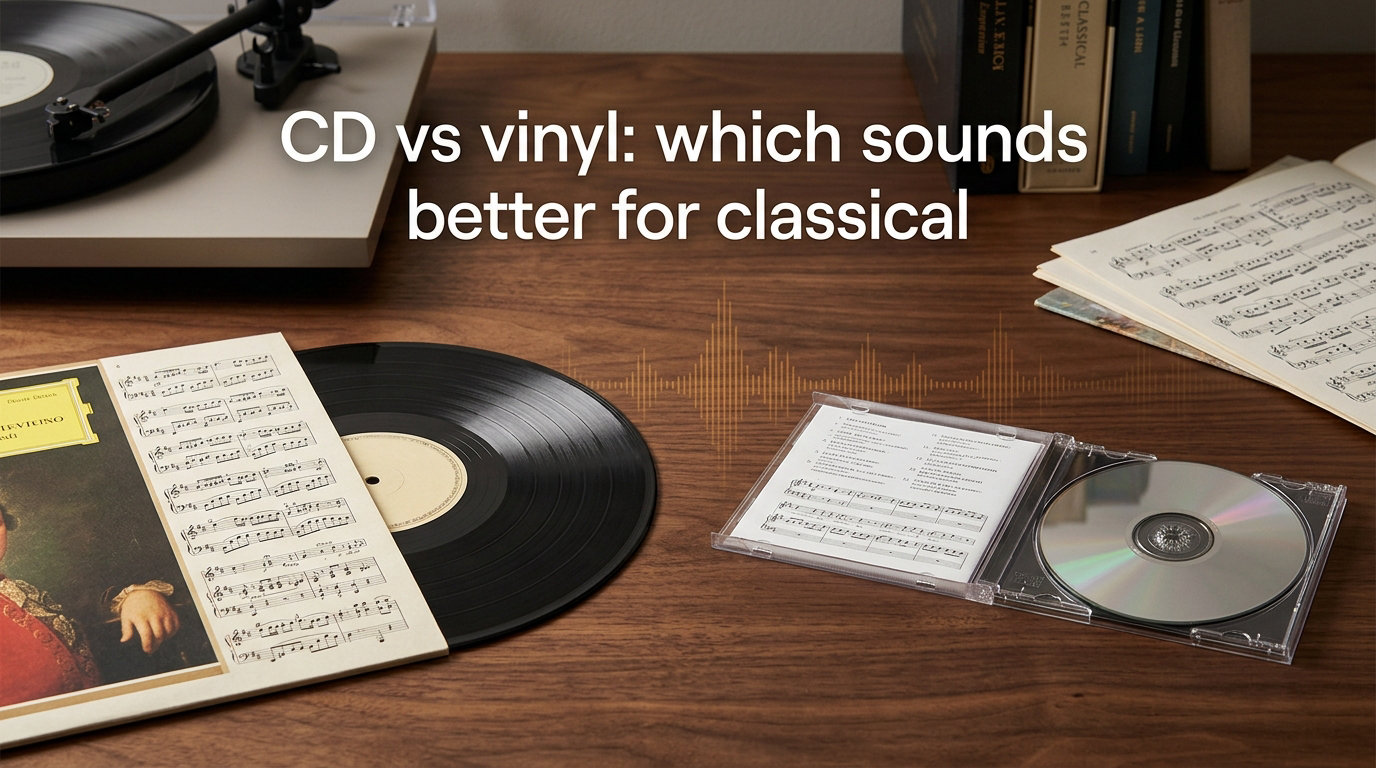
Every classical listener runs into the same question eventually: when you want to hear a Beethoven symphony or a Bach cello suite at its absolute best, do you reach for a CD or a vinyl record? The CD vs vinyl classical music debate has divided audiophiles, collectors, and casual listeners for decades, and the answers are more nuanced than most forum threads suggest.
I have spent years comparing both formats across hundreds of classical recordings, from delicate solo piano to thunderous orchestral climaxes. What I have learned is that neither format wins outright. The right choice depends on the specific repertoire, your equipment, and what you value most in the listening experience.
This guide breaks down exactly how each format handles the demands of classical music. You will find a technical comparison, genre-by-genre recommendations, and practical advice on choosing the right format for your collection in 2026. If you have ever wondered why your favorite concerto sounds different on each format, the answers are below.
Table of Contents
CD vs Vinyl Classical Music: The Core Difference
The fundamental difference comes down to analog versus digital. Vinyl records store sound as a continuous physical waveform pressed into grooves, while CDs store the same sound as a stream of numbers read by a laser.
That distinction shapes everything you hear. Vinyl captures the entire sound wave without interruption, which many listeners describe as warmer and more natural. CDs sample that wave 44,100 times per second at 16-bit depth, producing a precise, noise-free reproduction that reveals every detail.
For classical music specifically, both approaches have real strengths. The genre demands a wider dynamic range than almost any other, with quiet pianissimo passages sitting alongside fortissimo crescendos that can overwhelm a system. How each format handles those extremes determines which sounds better for your particular listening habits.
Neither format is objectively superior. CDs measure better on every technical specification, but measurements do not fully capture how music feels in a quiet room with the lights dimmed.
How Each Format Reproduces Classical Recordings
Understanding the mechanics behind each format helps explain why they sound so different with classical material.
How CDs Reproduce Classical Music
A CD stores audio as digital data encoded in microscopic pits on a reflective disc. A laser reads those pits and converts them back into an analog signal through a process called digital-to-analog conversion. The standard CD format samples audio at 44.1 kHz with 16-bit depth, which captures frequencies up to about 20 kHz and provides roughly 96 decibels of dynamic range.
That specification matters enormously for classical music. A full orchestra can produce sounds ranging from a single sustained note at 30 decibels to a tutti climax exceeding 110 decibels. CDs handle that entire span cleanly, with no added noise and no loss of detail in the quietest moments.
The result is a sound that many classical engineers describe as transparent. You hear the recording exactly as it was captured, with precise stereo imaging and no coloration from the playback medium itself.
How Vinyl Reproduces Classical Music
A vinyl record works on a purely mechanical principle. A cutting lathe engraves the audio waveform directly into the surface of a master disc as physical variations in a spiral groove. During playback, a diamond-tipped stylus rides through that groove, and a cartridge converts the physical vibrations into an electrical signal.
Because the waveform is continuous rather than sampled, vinyl captures the complete sound wave without any gaps. Many listeners find this produces a more organic, lifelike quality that suits the natural acoustics of classical instruments.
However, vinyl introduces its own imperfections. The playback process generates subtle harmonic distortion, surface noise is ever-present, and the format has a narrower dynamic range than CD. These characteristics are not flaws to vinyl enthusiasts. They are part of what gives records their distinctive character.
CD vs Vinyl Classical: The Technical Showdown
When you compare the two formats side by side on paper, the differences are striking. Here is how they stack up on the measurements that matter most for classical listening.
Dynamic Range
Dynamic range is the gap between the quietest and loudest sounds a format can reproduce. This spec matters more for classical than any other genre because classical pieces routinely span enormous volume shifts.
CDs offer approximately 96 decibels of dynamic range, while vinyl typically manages 55 to 70 decibels depending on pressing quality and playback setup. For a Mahler symphony with its extreme dynamic contrasts, the CD preserves the full impact of those swings. Vinyl, by contrast, may compress the loudest peaks slightly to keep the stylus tracking properly.
Frequency Response and High Frequencies
CDs reproduce frequencies from 20 Hz to 20 kHz with ruler-flat response. Vinyl rolls off at both extremes, particularly in the high frequencies where overtones from violins, flutes, and cymbals live.
This means CDs deliver more sparkle and air in the upper register. Vinyl compensates with a character that many find less fatiguing over long listening sessions, even if it sacrifices some high-frequency detail.
Noise Floor and Surface Noise
The noise floor is the background hiss and rumble present even during silence. CDs have an essentially silent background, which is critical for classical music where entire passages unfold at very low volumes.
Vinyl has a higher noise floor and produces pops, clicks, and crackles from dust and static. In quiet chamber music or solo piano, these imperfections can intrude on the most intimate moments. Some listeners find them charming. Others find them distracting enough to prefer the CD.
Warmth, Microdynamics, and Presence
Vinyl earns its reputation for warmth from a specific technical source. The playback process generates low-order harmonic distortion, which adds harmonically related overtones to the signal. The human ear perceives this distortion as richness and body rather than as a defect.
CDs reproduce sound more accurately, which can occasionally sound clinical or sterile by comparison. For classical music, this means vinyl often adds a pleasing roundness to strings and woodwinds, while CDs reveal more microdetail in articulation and hall acoustics.
Which Classical Genres Suit Each Format Best
Not all classical music interacts with each format the same way. The specific repertoire you listen to should influence your format choice more than any blanket recommendation.
Orchestral and Symphonic Works
Large-scale orchestral music is where the CD vs vinyl classical music debate gets most heated. Symphonies by Mahler, Bruckner, and Shostakovich demand enormous dynamic range and precise imaging across a full orchestra.
CDs generally have the edge here. The wider dynamic range preserves the full shock of a timpani strike or brass choir without compression. The lower noise floor keeps the quietest string passages clean and audible. For works like Holst’s The Planets, where the contrast between Mars and Venus hinges on dynamic control, you can hear the difference in our guide to the best recordings of The Planets.
Vinyl still has its defenders for orchestral music. The continuous waveform can produce a more convincing sense of a real ensemble playing in a real hall, and many classic orchestral pressings from the golden age of stereo sound magnificent.
Chamber Music and String Quartets
Chamber music presents a unique challenge. Works by Schubert, Bartok, and Beethoven for small ensembles unfold at lower overall volumes with long stretches of delicate interplay between instruments.
The CD’s silent background gives it a natural advantage. You hear every bow change and finger slide without competing surface noise. The clarity lets you follow individual lines through complex counterpoint.
Vinyl brings an intimacy that some listeners prefer for chamber works. The added warmth can make a string quartet sound more like four people playing in your room. Whether that benefit outweighs the surface noise is a matter of personal taste.
Solo Piano
Solo piano is arguably the most demanding repertoire for any format. The instrument spans the full frequency range, and its dynamic capabilities rival a full orchestra. Silence between notes is part of the music itself.
For these reasons, CDs usually win for solo piano. The noise floor stays completely silent during rests, and the wide dynamic range captures everything from a whispered pianissimo to a thunderous fortissimo. Surface noise from vinyl can be particularly intrusive during the long pauses in Debussy or the sustained pedaling in Chopin.
That said, some legendary piano recordings were mastered beautifully on vinyl and have never sounded quite right on digital reissues. The format can add a pleasing weight to the lower register of a concert grand.
Vocal and Choral Classical
The human voice sits primarily in the midrange, where vinyl performs at its best. This gives records a natural advantage for opera, art song, and choral music. The warmth of vinyl complements vocal timbres beautifully.
CDs offer superior clarity and detail, letting you hear diction and breath sounds with precision. For large choral works with dozens of voices, the CD’s ability to separate individual parts can reveal textures that vinyl blurs together.
Both formats excel here, which is why many vocal enthusiasts collect both. The choice often comes down to whether you prioritize the emotional warmth of vinyl or the analytical clarity of CD.
How to Choose Between CD and Vinyl for Classical
After years of comparing both formats, I can offer some practical guidance on which to choose for your classical collection. The decision should be driven by your listening habits, equipment, and priorities.
Choose CD if you value:
Silence during quiet passages. If surface noise distracts you during a pianissimo string section or a sustained piano note, the CD’s silent background will serve you well. This is especially true for chamber music, solo piano, and any recording with extended quiet sections.
Maximum dynamic range. For orchestral works with extreme volume swings, nothing preserves the full impact like a CD. You can hear this clearly in our analysis of the best 1812 Overture recordings, where cannon fire and quiet strings coexist on the same track.
Convenience and durability. CDs do not wear out from playback, they are easy to rip to a lossless digital library, and they require no cleaning or careful handling. For listeners who want their music available without fuss, the CD is hard to beat.
Choose vinyl if you value:
Warmth and engagement. If you find digital playback fatiguing over long sessions, vinyl’s added harmonics can make marathon listening sessions more comfortable. The format has a way of drawing you into the performance.
Ritual and connection. Playing a record is an active experience. You handle the sleeve, cue the stylus, and flip the disc halfway through. For many classical listeners, this ritual deepens their relationship with the music.
Access to historical pressings. Many of the greatest classical recordings of the twentieth century were mastered for vinyl first and sound extraordinary in their original pressings. Collecting these is part of the appeal.
Equipment considerations: Neither format reaches its potential on modest gear. A budget CD player through cheap speakers will not reveal the clarity advantage of digital. A poorly set-up turntable will produce more noise than music. Invest in the best source component and speakers or headphones you can afford, and let the format choice follow.
Many experienced classical collectors end up with both. CDs for analytical listening and convenience, vinyl for emotional engagement and historical pressings. There is no rule that says you must choose only one.
Frequently Asked Questions
Does classical music sound better on vinyl?
Classical music can sound wonderful on vinyl thanks to the warmth and continuous waveform that the format provides. Vinyl adds pleasing low-order harmonics that enrich strings and woodwinds. However, vinyl has a higher noise floor, narrower dynamic range, and surface noise that can intrude during quiet passages, so it is not universally better for every type of classical repertoire.
Does classical music sound better on CD?
CDs generally measure better for classical music, offering approximately 96 decibels of dynamic range, a silent noise floor, and flat frequency response to 20 kHz. These traits make CDs especially strong for orchestral works, solo piano, and any repertoire with wide dynamic swings or extended quiet passages. Many classical engineers prefer CD for its transparency and accuracy.
Do audiophiles prefer vinyl or CD?
Audiophile preference is split. Some favor vinyl for its warmth, engagement, and access to historically significant pressings. Others prefer CD or higher-resolution digital for its measurable accuracy, silence, and convenience. Many serious collectors maintain both formats and choose based on the specific recording and listening context.
What is the best sound system for classical music?
The best sound system for classical music prioritizes three things: a high-quality source component, speakers or headphones with wide dynamic range and accurate midrange reproduction, and a quiet listening room. Whether that source is a turntable or a CD player matters less than investing in clean amplification and transducers that can resolve the genre’s demanding dynamics and subtle microdetail.
The Final Note
The CD vs vinyl classical music debate does not have a single winner, and that is what makes it so enduring. CDs win on every measurable specification, delivering wider dynamic range, a silent background, and precise high-frequency detail that serves orchestral and solo repertoire beautifully.
Vinyl wins on engagement, warmth, and the irreplaceable character of historically significant pressings. For listeners who want to feel as much as analyze their music, the format offers something digital cannot fully replicate.
My recommendation for 2026 is simple: start with the format that matches your listening priorities, invest in quality equipment, and do not be afraid to collect both. The best format for classical music is the one that keeps you listening, and the greatest recordings sound extraordinary on either one when played with care.