
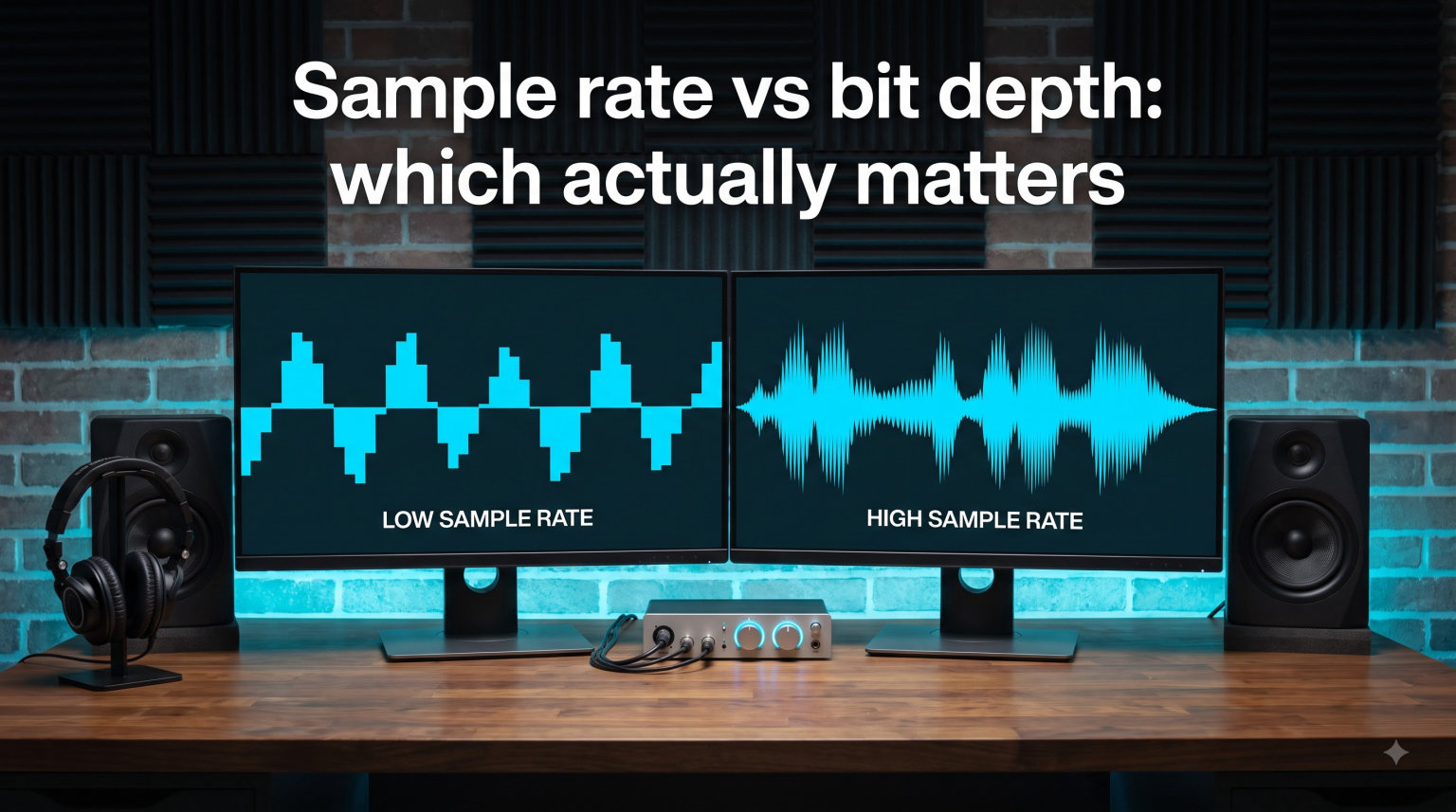
When you start exploring digital audio, two numbers show up everywhere: sample rate and bit depth. They are the settings that define the quality and character of every digital recording, from a streaming playlist to a studio master. But which one actually matters more for the sound you hear?
Our team has spent years recording and listening to classical music, where dynamic range and tonal detail matter more than in almost any other genre. This guide breaks down sample rate vs bit depth in plain language, explains what each one really controls, and gives you clear recommendations for recording, mixing, and listening in 2026.
You do not need a degree in signal processing to get this right. By the end, you will know exactly which numbers to choose and why.
Table of Contents
What Is Sample Rate in Digital Audio?
Sample rate is the number of times per second an analog audio waveform is measured, or sampled, to create a digital signal. It is expressed in kilohertz (kHz), where 1 kHz equals 1,000 samples per second.
A 44.1 kHz sample rate means the converter takes 44,100 snapshots of the waveform every second. Those snapshots are then played back in sequence to reconstruct the sound. The higher the sample rate, the more snapshots per second, and the higher the highest frequency the system can capture.
Here is the relationship that matters most: the highest frequency a digital system can record equals half its sample rate. That ceiling is called the Nyquist frequency. At 44.1 kHz, you can capture frequencies up to 22.05 kHz, which sits just above the upper limit of human hearing.
In short, sample rate controls frequency range – how high and how low the system can record.
What Is Bit Depth in Digital Audio?
Bit depth is the number of bits used to describe the amplitude, or loudness, of each individual sample. It controls how precisely each snapshot measures the volume of the sound wave at that instant.
A 16-bit recording uses 16 bits per sample, giving 65,536 possible amplitude values. A 24-bit recording uses 24 bits, giving over 16.7 million possible values. More values mean finer amplitude resolution and a lower noise floor.
The practical payoff is dynamic range. As a reliable rule of thumb, each bit adds about 6 dB of dynamic range. That means 16-bit gives roughly 96 dB, while 24-bit gives roughly 144 dB. For context, 96 dB already exceeds the usable dynamic range of most listening rooms.
But 144 dB gives engineers enormous headroom when recording and processing, which is exactly why 24-bit has become the studio standard. So bit depth controls dynamic range and the noise floor – how quietly and how loudly the system can capture sound.
Sample Rate vs Bit Depth: Which Actually Matters?
Both matter, but for different things, and for most listeners bit depth matters more than sample rate. Sample rate controls frequency range, and as long as your rate can capture everything up to about 20 kHz, going higher does not add audible frequencies. A 44.1 kHz rate already covers this with a safety margin.
Bit depth controls dynamic range and the noise floor. A higher bit depth lets you record quieter details and work with more headroom before noise becomes a problem. The jump from 16-bit to 24-bit is the single biggest practical improvement you can make for recording and production work.
Here is a side-by-side comparison to make the distinction clear:
| Aspect | Sample Rate | Bit Depth |
|---|---|---|
| What it measures | Samples taken per second | Amplitude precision per sample |
| Unit | kHz (thousands of samples per second) | bits |
| Controls | Frequency range | Dynamic range and noise floor |
| Common values | 44.1, 48, 88.2, 96, 192 kHz | 16-bit, 24-bit, 32-bit float |
| Rule of thumb | Highest frequency equals half the sample rate | About 6 dB dynamic range per bit |
The honest answer from our experience: if your sample rate is already at 44.1 kHz or higher, raising it produces a far smaller audible change than raising your bit depth from 16 to 24. Blind tests by working engineers and the well-known Xiph.org demonstrations by Monty Montgomery consistently show that most people cannot reliably distinguish sample rates above 44.1 or 48 kHz on normal playback.
Understanding Standard Sample Rates (44.1 kHz and 48 kHz)
44.1 kHz is the CD audio standard, and it remains the most common rate for music distribution. Its history comes from early digital recording on video tape, but the practical reason it stuck is simple: it captures everything up to 22.05 kHz, comfortably covering the full range of human hearing.
48 kHz is the standard for video production, film, and broadcast. It gives you a slightly higher Nyquist frequency of 24 kHz, which is useful when audio will sync with video or move through video pipelines.
For most music work, 44.1 kHz and 48 kHz are functionally equivalent in audible quality. The rule our team follows is to pick the standard that matches the delivery format. Music-only projects tend to use 44.1 kHz; anything touching video uses 48 kHz.
Higher rates like 88.2, 96, 176.4, and 192 kHz exist, and they earn their keep in specific situations covered below. But for delivery, 44.1 kHz at 16-bit remains the reference quality of CD audio, and most listeners cannot hear beyond it.
Bit Depth Standards: 16-Bit, 24-Bit, and 32-Bit Float
16-bit is the bit depth of CD audio and lossless streaming delivery. It offers about 96 dB of dynamic range, which is more than enough for finished music played back in a normal room. Properly dithered, 16-bit sounds excellent to nearly every listener.
24-bit is the working standard for recording, mixing, and mastering. Its roughly 144 dB of dynamic range gives you huge headroom. You can record at conservative levels without worrying about noise creeping in, and you can process aggressively without degrading the signal. We always recommend 24-bit for any production work.
32-bit float is a different beast. Instead of fixed amplitude steps, floating-point numbers store an exponent that effectively gives enormous dynamic range, far beyond what any analog converter can produce. The practical benefit is that a 32-bit float recording is essentially impossible to clip on input.
If you are recording unpredictable, high-dynamic-range sources (a live orchestral fortissimo, a sudden accent from a soloist), 32-bit float recorders can be a genuine safety net. Note that 32-bit float does not magically sound better on playback. Its advantage is operational, because it forgives mistakes in gain staging. Once you are mixing, working at 32-bit float internally, as most DAWs do by default, is simply good practice.
Nyquist Frequency, Aliasing, and Why Higher Rates Help
The Nyquist frequency is the highest frequency a system can accurately capture, equal to half the sample rate. Frequencies above the Nyquist limit cause aliasing, where they fold back into the audible range as false, inharmonic tones.
To prevent aliasing, converters use a low-pass filter, called an anti-aliasing filter, to remove frequencies above the Nyquist limit before sampling. At 44.1 kHz, that filter must be very steep to cut everything above 22.05 kHz while preserving 20 kHz. Steep filters can introduce phase shifts and ringing.
Higher sample rates push the Nyquist limit up. At 96 kHz it sits at 48 kHz, so the anti-aliasing filter can be gentler and work well above the audible range. This is the main technical argument for higher rates, and it matters most when you are doing heavy nonlinear processing like saturation, distortion, or aggressive compression.
Those processes generate ultrasonic harmonics that can alias back down into audible frequencies. The forum consensus from working engineers matches our experience: higher sample rates earn their keep during processing and in specific capture situations, not because you can hear ultrasonic content directly.
Dynamic Range, Noise Floor, and Classical Music
Classical music is the use case where bit depth truly shines. An orchestral recording can swing from a whisper-quiet pianissimo to a full-orchestra fortissimo, a dynamic range that can exceed 60 or 70 dB in live performance.
At 16-bit, that range has to fit within about 96 dB total, and the quietest passages sit close to the noise floor. At 24-bit, the same performance has oceans of headroom. The quietest details stay well above any noise, and you can record conservatively without sacrificing the softest passages.
This is why our team and most classical recording engineers reach for 24-bit, or 32-bit float for unpredictable live sessions, as a baseline. The music simply demands it.
Practical Recommendations: What Settings Should You Use in 2026?
Here is our straightforward decision guide for choosing your sample rate and bit depth. We have grouped it by what you are actually doing, because the right answer depends on the task.
For recording music: 48 kHz at 24-bit is our default for almost everything. It gives you a clean Nyquist margin, plenty of dynamic range, and works across video pipelines too. For unpredictable live classical recording, 32-bit float is worth the extra file size.
For mixing and mastering: work at your project’s sample rate in 32-bit float internally, which your DAW almost certainly does already. Deliver masters at the format the platform requires.
For delivery and streaming: most platforms accept 44.1 kHz at 16-bit (CD quality) or higher. Lossless tiers on major streaming services deliver 44.1 kHz at 16-bit as their baseline high-resolution format. Deliver at the highest quality the platform requests, but do not obsess beyond 24-bit and 96 kHz, because nothing downstream uses more meaningfully.
For casual listening: CD quality at 44.1 kHz and 16-bit is genuinely excellent. If you want headroom for processing or future-proofing, 24-bit files are worthwhile. Sample rates above 48 kHz are not worth it for most listeners.
For video production: 48 kHz at 24-bit, always. This is the universal standard and avoids sample-rate conversion headaches when audio moves between music and video tools.
A quick note on equipment. High sample rates and bit depths only matter if your playback chain can resolve them. A 192 kHz, 24-bit file played through entry-level converters or earbuds will not reveal its extra resolution. Match your settings to what your gear and your ears can actually use.
Streaming platform requirements as of 2026: most major platforms accept up to 24-bit at 192 kHz for their lossless tiers, but they commonly deliver 44.1 kHz at 16-bit or 48 kHz as the streaming format. Always check each platform’s current spec before you deliver a master.
FAQs
What should my sample rate and bit depth be?
For most music recording, use 48 kHz at 24-bit. For delivery and casual listening, 44.1 kHz at 16-bit (CD quality) is excellent. For video production, always use 48 kHz at 24-bit. For unpredictable live classical recording, 32-bit float offers an unclippable safety net.
Is sample rate the same as bit depth?
No. Sample rate measures how many times per second audio is captured and controls frequency range. Bit depth measures how precisely each sample’s amplitude is recorded and controls dynamic range and the noise floor. They are independent settings that together define digital audio quality.
Which is more important, bit depth or sample rate?
For most listeners and producers, bit depth matters more. As long as your sample rate covers the audible range up to about 20 kHz, which 44.1 kHz already does, raising it adds little audible benefit. Raising bit depth from 16 to 24 gives a real improvement in dynamic range, headroom, and noise performance.
Should I use 44.1 or 48 kHz?
Use 44.1 kHz for music-only projects and CD-quality delivery. Use 48 kHz for anything that will sync with video, film, or broadcast. The audible quality difference between the two is negligible, so choose based on your delivery format.
Is 24-bit 192 kHz better than 320 kbps?
Yes, significantly. 320 kbps is a compressed, lossy MP3 bit rate, not a recording format. 24-bit at 192 kHz is an uncompressed, high-resolution recording format with far greater dynamic range and frequency range. They are not comparable, because 320 kbps describes compressed delivery while 24-bit and 192 kHz describe the resolution of the recording itself.
The Bottom Line
When it comes to sample rate vs bit depth, bit depth is the setting that gives you the most real-world benefit, especially for recording and for dynamic music like classical. Sample rate matters up to the point where it covers the full audible range, and 44.1 or 48 kHz already does that comfortably.
Choose bit depth for headroom and noise performance. Choose sample rate to match your format. Then spend the rest of your energy on the musical decisions that actually shape the sound.