
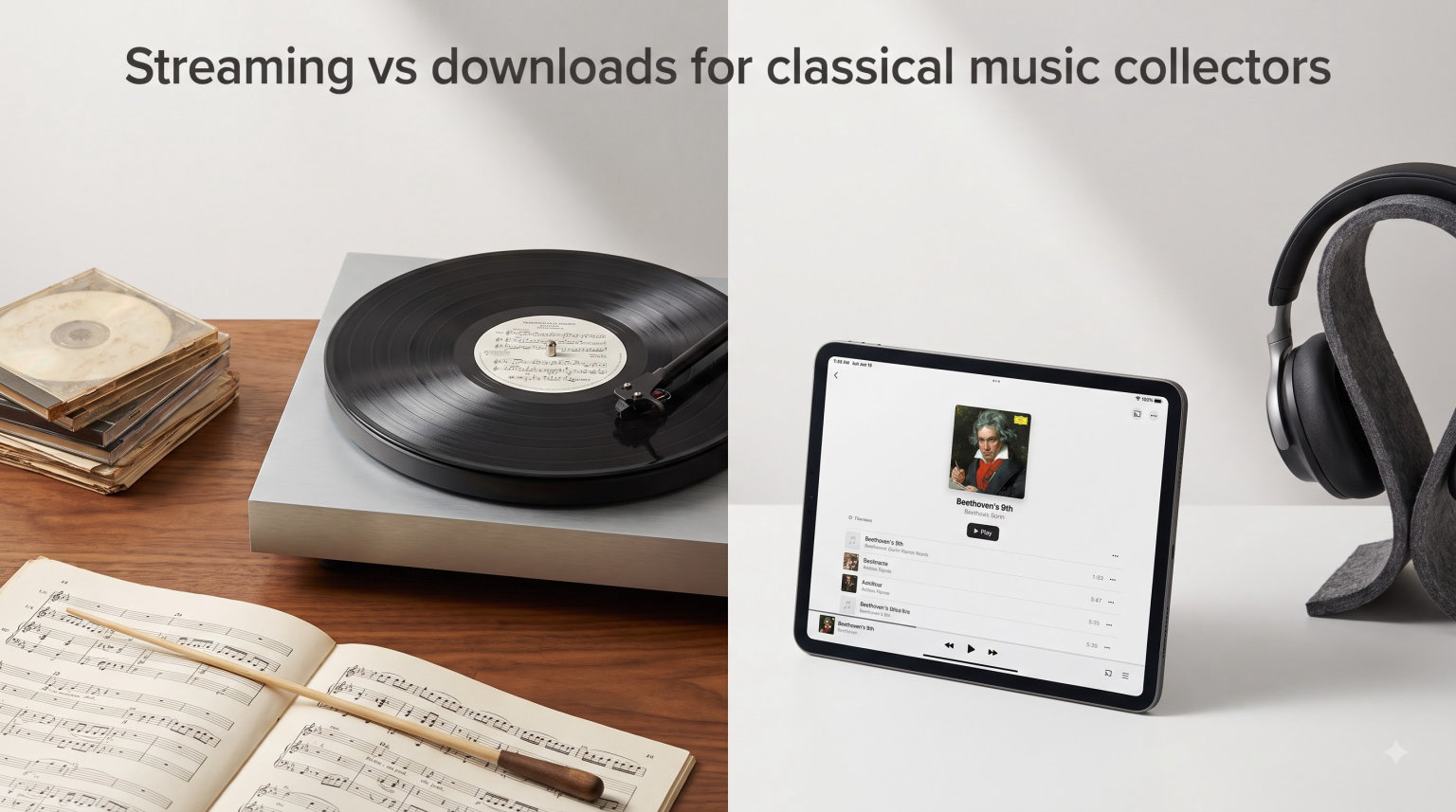
Every classical music collector faces the same fork in the road sooner or later. You stand at the crossroads between streaming and downloads, wondering which path serves your listening habits, your ears, and your wallet. The streaming vs downloads classical music collectors debate has only grown more heated as platforms like IDAGIO and Apple Music Classical have emerged specifically for our niche.
I have spent the better part of a decade building, refining, and occasionally tearing apart my own classical collection. I have subscribed to nearly every major streaming service, purchased hundreds of FLAC and DSD downloads, and ripped my entire CD shelf twice over. What I have learned is that this is not a simple either-or decision.
Classical music poses unique challenges that pop and rock listeners never think about. A Mahler symphony spans 80 minutes across five movements, and the metadata needs to tell you not just the composer but the conductor, orchestra, soloist, recording date, and label. Drop a single movement from a streaming playlist and the experience falls apart. These details matter to us in ways that algorithmic recommendations cannot always respect.
In this guide, I will walk you through every angle of the streaming vs downloads question specifically for classical collectors. We will cover audio quality differences, metadata headaches, long-term costs, platform recommendations, and a practical hybrid strategy. By the end, you will know exactly which approach fits your listening style and budget.
Table of Contents
What Streaming and Downloads Mean for Classical Collectors
Streaming for classical music collectors means accessing recordings through a subscription service like IDAGIO, Apple Music Classical, Qobuz, Tidal, or even mainstream platforms like Spotify. The music lives in the cloud, and you pay a monthly fee to listen on demand. Some of these services offer lossless or hi-res audio tiers that approach download quality.
Downloads involve purchasing individual albums or works as digital files, typically in FLAC, ALAC, or DSD formats, and storing them on your own hard drive or network server. You own these files outright. No subscription is required to keep listening, and no platform can remove them from your library.
The distinction sounds simple, but classical collectors know the devil is in the details. A streaming service might offer a Karajan recording at 320 kbps AAC, while the same album purchased as a 24-bit/96kHz FLAC download from Presto Music delivers dramatically more sonic information. Whether that difference matters depends on your equipment, your ears, and how seriously you take the listening experience.
There is also the ownership question. When a label pulls its catalog from a streaming service, which has happened with major classical labels, subscribers lose access overnight. Download owners keep their files regardless of licensing disputes. For collectors who treat their library as an archive, this distinction is everything.
Streaming vs Downloads for Classical Music Collectors: Audio Quality Comparison
Audio quality is where the streaming vs downloads classical music collectors debate gets the most heated. Classical music is dynamic by nature. A pianissimo passage in a Bruckner symphony might sit 60 decibels below the fortissimo climax that follows. Compression artifacts that go unnoticed in compressed pop become glaringly obvious in a string quartet’s exposed textures.
Let me break down the quality tiers you will encounter on both sides.
Streaming Audio Quality Tiers
Most mainstream streaming services compress audio to reduce bandwidth. Spotify Premium tops out at 320 kbps using the Ogg Vorbis or AAC codec, which is lossy compression. Apple Music offers 256 kbps AAC as its standard tier, though Apple Music Classical now includes lossless ALAC streaming at up to 24-bit/192kHz for subscribers at no extra cost.
The dedicated classical platforms go further. Qobuz offers FLAC streaming up to 24-bit/192kHz, which is genuinely high-resolution audio streamed directly from the cloud. Tidal provides MQA-encoded streams that claim hi-res quality at lower bandwidth, though the audiophile community debates whether MQA truly matches uncompressed FLAC. IDAGIO streams at 320 kbps on its standard plan and offers lossless CD-quality FLAC on its premium tier.
Here is the reality I have observed after years of A/B testing: lossless streaming at CD quality (16-bit/44.1kHz FLAC) is indistinguishable from a CD-quality download on virtually any system. The gap narrows to zero at that tier. The differences only become audible when you compare lossy streaming (320 kbps or below) against hi-res downloads (24-bit/96kHz or above), and only on resolving audio equipment.
Download Audio Quality Options
Downloads offer the widest quality range because there is no bandwidth constraint. Standard CD-quality FLAC files deliver 16-bit/44.1kHz resolution with zero compression loss. Hi-res downloads from stores like HDtracks, Presto Music, and ProStudioMasters offer 24-bit/96kHz and 24-bit/192kHz FLAC files that capture every detail the mastering engineer intended.
For the truly obsessive collector, DSD downloads take quality to another level entirely. NativeDSD offers DSD64, DSD128, DSD256, and even DSD512 files, which use a fundamentally different encoding method than PCM. These files are enormous, a single DSD64 album can exceed 2 gigabytes, but they represent the state of the art in digital audio reproduction.
I own the same Beethoven Ninth in three formats: a Spotify stream, a 24-bit/96kHz FLAC download from Presto, and a DSD64 download from NativeDSD. On my reference system with a quality DAC, the differences between the FLAC and DSD versions are subtle but real. The streaming version, at 320 kbps, is clearly compressed in comparison to both downloads.
The Bitrate Reality Check
Here is a comparison of what each format actually delivers in terms of audio data:
Spotify Premium: 320 kbps (lossy compression)
Apple Music Standard: 256 kbps AAC (lossy compression)
Apple Music Classical Lossless: Up to 24-bit/192kHz ALAC (lossless)
Qobuz Hi-Fi: 16-bit/44.1kHz FLAC (CD quality, lossless)
Qobuz Sublime: Up to 24-bit/192kHz FLAC (hi-res, lossless)
IDAGIO Premium: 320 kbps standard, lossless FLAC on premium tier
CD-quality FLAC download: 1,411 kbps (16-bit/44.1kHz, lossless)
Hi-res FLAC download: 4,608 to 9,216 kbps (24-bit/96kHz to 24-bit/192kHz)
DSD64 download: 2,822 kbps per channel (1-bit/2.8MHz)
The numbers tell the story. A 24-bit/192kHz FLAC download delivers roughly 30 times the audio data of a 320 kbps Spotify stream. Whether your ears and equipment can resolve that difference is a separate question, one we will address in the equipment section.
The Streaming Advantage for Classical Music
Streaming has real, undeniable advantages for classical collectors, and I would be dishonest if I pretended otherwise. The convenience factor alone has transformed how many of us discover new music. Let me walk through the specific benefits.
Catalog Depth and Discovery
No personal download library can match the catalog of a major streaming service. Qobuz claims over 100 million tracks. Apple Music Classical offers more than five million classical recordings with proper categorization. When a collector wants to compare 15 different recordings of the Brahms Violin Concerto, streaming makes that exploration instant and essentially free beyond the monthly subscription.
I use streaming as my discovery engine. When I read about a new recording of the Shostakovich string quartets, I can pull it up within seconds and spend an evening deciding whether it belongs in my permanent collection. The old model of buying a CD blind, based on a review, is replaced by informed exploration.
Classical-Specific Search and Organization
The dedicated classical platforms have solved one of the biggest pain points: search. IDAGIO lets you filter by composer, work, conductor, orchestra, soloist, label, and recording date. Apple Music Classical offers similar granular search. On mainstream services like Spotify, finding a specific Karajan recording among a dozen versions of the same work can be frustrating, but these specialized apps treat classical metadata as a first-class citizen.
This matters enormously for collectors. When I want to compare Furtwangler’s 1951 Bayreuth Beethoven Ninth against Karajan’s 1963 Berlin recording, IDAGIO surfaces both instantly with proper attribution. On Spotify, I would need to wade through search results that often mislabel or fragment classical releases.
Portability and Multi-Device Listening
Streaming follows you everywhere. Your phone, tablet, computer, smart speaker, and car stereo all access the same library. Offline downloads within streaming apps let you cache albums for flights or commutes without eating into your device storage the way permanent downloads do.
For collectors who listen on the go, this is a decisive advantage. A DSD download of a Mahler symphony occupies two gigabytes of storage. A cached lossless stream from Apple Music Classical uses a fraction of that and disappears when you are done with it.
Recommendations and Curation
The best classical streaming services now offer editorial curation that rivals music magazines. Qobuz employs staff reviewers who write dedicated classical content. IDAGIO produces playlists organized by mood, period, and composer. These discovery tools expose collectors to repertoire and performers they might never encounter otherwise.
I have discovered at least a dozen recordings through IDAGIO’s curated playlists that I later purchased as hi-res downloads. Streaming served as the gateway, and my permanent collection grew richer because of it.
The Download Advantage for Classical Collectors
For all its convenience, streaming has structural weaknesses that matter deeply to serious collectors. Downloads address every one of these weaknesses, and for many classical listeners, that makes downloads the superior choice despite the higher upfront cost.
True Ownership and Archival Permanence
When you buy a FLAC download, you own it. The file sits on your hard drive, your backup drive, and your network server. No licensing dispute, no platform shutdown, no catalog removal can take it away. This is the single most important advantage for collectors who view their library as a long-term archive.
I have lived through the shutdown of Primephonic, which was a dedicated classical streaming service that Apple acquired in 2021. Subscribers lost access to curated playlists, personal libraries, and listening histories overnight. Anyone who relied solely on streaming for their classical collection had to rebuild from scratch. Download owners lost nothing.
The classical recording industry is smaller and more volatile than pop music. Labels change distribution partners. Rights expire. Recordings go out of print. A download purchase is an insurance policy against all of these uncertainties.
Maximum Audio Resolution
Streaming services are improving, but downloads still offer the absolute highest audio quality available. DSD files at DSD256 and DSD512 resolutions simply cannot be streamed to most consumer devices. Hi-res FLAC at 24-bit/192kHz and above is available as a download years before some recordings appear on any streaming platform.
For audiophiles with revealing systems, this quality gap is meaningful. The decay of a concert hall reverberation, the texture of a bow on a string, the air around a woodwind solo: these details survive fully in a hi-res download and are approximated, sometimes compromised, in compressed streaming.
Complete Package: Liner Notes and Booklet Information
This is the advantage that classical collectors feel most deeply. A proper classical download from Presto Music or NativeDSD includes a digital booklet with the full liner notes. You get the recording session details, the essay about the work, the text of any vocal piece, and the cover art. Streaming services typically provide none of this.
The forum discussions on this topic are unanimous. Collectors on Reddit’s classical music community consistently cite the loss of liner notes as one of streaming’s biggest failures. When you are listening to a Schubert song cycle, you want to read the poetry in translation. When you are studying a historical recording, you want the engineering notes. Downloads preserve this contextual information. Streaming discards it.
No Internet Dependency
A downloaded FLAC library plays anywhere, anytime, without an internet connection. For collectors who travel, live in areas with unreliable connectivity, or simply value independence from the cloud, this is non-negotiable. Your network-attached storage server does not care whether your ISP is having a bad day.
Metadata Challenges Unique to Classical Music
Metadata is the invisible backbone of any digital music collection, and for classical music, it is where streaming services most frequently fail. The problem is structural. Pop music metadata is simple: artist, album, track title, year. Classical metadata is complex: composer, work title, catalog number, key, movement, conductor, orchestra, soloist, recording date, recording venue, label, and catalog number.
On Spotify, a Beethoven symphony might be credited to the conductor rather than the composer. Search for Beethoven’s Fifth and you might find it under Carlos Kleiss or Herbert von Karajan, not under Beethoven. The movements might be split across separate tracks with inconsistent naming. One movement might be labeled “I. Allegro con brio” while another uses “1. Allegro con brio” or simply “Allegro con brio.”
This inconsistency makes building playlists, comparing recordings, and organizing a collection incredibly frustrating. The dedicated classical platforms solve this problem, but mainstream services largely do not.
Downloads can have metadata issues too, but the key difference is that you control the files. When I buy a FLAC from Presto Music, the metadata is usually comprehensive and correctly formatted. If it is not, I can edit the tags myself using software like Mp3tag or MediaMonkey. With streaming, you are stuck with whatever the platform provides.
I have spent hours fixing metadata on downloaded FLAC files, standardizing composer names, adding conductor information, and ensuring consistent movement labeling. This effort pays off every time I browse my collection. With streaming, that level of control is simply not available.
Cost Analysis: Subscription vs Ownership
The cost question is more nuanced than it first appears. Streaming seems cheaper, but long-term math tells a different story.
A premium classical streaming subscription costs roughly $10 to $15 per month. Over five years, that is $600 to $900. Over ten years, $1,200 to $1,800. And at the end of that decade, you own nothing. Cancel the subscription and your entire library vanishes.
A hi-res FLAC download from Presto Music or HDtracks typically costs $12 to $20 per album. DSD downloads from NativeDSD run $20 to $35 per album. If you build a collection of 100 albums over five years at an average of $15 each, you spend $1,500. That is comparable to five years of streaming, but you own those 100 albums permanently.
The break-even analysis depends on your listening volume. If you consume 20 new albums per month across many different genres and periods, streaming is more economical. If you return to the same core repertoire repeatedly, downloads deliver better long-term value.
Here is the cost comparison in concrete terms:
Streaming (IDAGIO Premium): $14.99 per month, $179.88 per year, $1,798.80 over 10 years
Streaming (Apple Music): $10.99 per month, $131.88 per year, $1,318.80 over 10 years
Downloads (100 albums at $15 average): $1,500 one-time, owned permanently
Downloads (200 albums at $15 average): $3,000 one-time, owned permanently
Hybrid approach (streaming + 50 downloads over 5 years): $1,499 subscription + $750 downloads = $2,249
The hybrid approach, which I will detail shortly, often delivers the best overall value for collectors who want both discovery and permanence.
Classical-Specific Platform Recommendations
Not all streaming services and download stores are created equal for classical collectors. Here are my recommendations based on years of personal use and community feedback.
Best Streaming Platforms for Classical Music
IDAGIO is the purpose-built classical streaming service. Its metadata is the best in the industry, with proper attribution for every role. The search function lets you find recordings by conductor, soloist, or work with surgical precision. The premium tier adds lossless CD-quality streaming. If you are serious about classical music discovery, IDAGIO is the gold standard.
Apple Music Classical launched as a dedicated app for Apple Music subscribers at no additional cost. It offers over five million classical recordings with proper metadata organization and includes lossless audio up to 24-bit/192kHz. The interface is clean and the integration with the Apple ecosystem is seamless. For Apple users, this is an exceptional value.
Qobuz is the audiophile’s choice. It streams FLAC up to 24-bit/192kHz and offers the largest hi-res catalog among streaming services. Qobuz also functions as a download store, so you can purchase permanent files of recordings you discover through streaming. The editorial content is excellent, with dedicated classical reviews.
Tidal offers hi-res streaming via MQA encoding and has a solid classical catalog, though its metadata is less refined than IDAGIO or Apple Music Classical. Tidal is best for collectors who also listen to jazz and other genres and want a single subscription.
Best Download Stores for Classical Music
Presto Music is my top recommendation for classical downloads. Based in the UK, Presto offers an enormous classical catalog with excellent metadata, digital booklets included with most purchases, and competitive pricing. Their files are available in FLAC and sometimes DSD, with hi-res options clearly labeled.
HDtracks is the largest US-based hi-res download store. The catalog is extensive, covering major labels and audiophile reissues. Quality is consistently excellent, though pricing can be higher than Presto for the same recordings.
NativeDSD is the destination for DSD downloads. If you own a DSD-capable DAC and want the absolute highest quality, NativeDSD offers recordings from labels committed to direct-stream digital recording. The catalog is smaller than FLAC stores, but the quality is unmatched.
ProStudioMasters offers hi-res FLAC and DSD downloads from a range of labels, with a solid classical selection. Pricing is competitive and the file quality is consistently excellent.
Pristine Classical specializes in historical recordings, meticulously remastered from original sources. If you collect historical performances by conductors like Toscanini, Furtwangler, or Mengelberg, Pristine Classical is an essential resource.
Building a Hybrid Classical Collection Strategy
The most effective approach for most collectors is not streaming versus downloads but streaming plus downloads. A hybrid strategy uses each method where it excels, delivering both discovery and permanence.
Step 1: Use Streaming for Discovery
Subscribe to one streaming service for exploration. IDAGIO or Apple Music Classical are ideal because of their classical-specific metadata. Use streaming to audition recordings before committing to a purchase. When you read a review of a new Beethoven cycle or hear about a historical Karajan set, stream it first.
Spend two to four weeks with a recording before deciding whether it deserves a permanent place in your collection. This prevents impulse purchases and ensures your download library contains only music you truly love.
Step 2: Purchase Downloads for Keeper Recordings
When a recording passes your audition, buy the highest quality download you can afford from a reputable store. Presto Music is my default, with NativeDSD for recordings where DSD is available. This becomes part of your permanent archive.
Prioritize recordings you return to repeatedly. Your favorite Brahms symphonies, the Beethoven sonatas you study, the Bach cantatas you listen to every Sunday: these deserve download quality and permanent ownership.
Step 3: Organize with Proper Software
A download library is only as good as its organization. Invest time in proper metadata tagging from the start. Use software like Roon (premium but exceptional for classical), JRiver Media Center, or the free Mp3tag utility for tag editing.
Standardize your file naming convention. I use the format: Composer, Work, Performer, Year. For example: Beethoven_Symphony No. 9_Karajan_BPO_1963. This makes browsing and searching effortless.
Step 4: Implement a Backup Strategy
Your download library is an investment. Protect it with at least two backups. I maintain my primary library on a network-attached storage device, with an automatic mirror to a secondary drive and a quarterly backup to an external drive stored offsite.
Cloud backup services like Backblaze offer affordable insurance for large audio libraries. For the cost of a few albums per year, your entire collection is protected against drive failure, theft, or disaster.
Step 5: Rip Your Existing CDs
If you have an existing CD collection, rip it to FLAC using a secure ripper like Exact Audio Copy (free on Windows) or XLD (free on Mac). Use AccurateRip verification to ensure bit-perfect rips. This converts your physical library into a searchable, high-quality digital archive that integrates seamlessly with your purchased downloads.
I ripped 800 CDs over the course of several months, and the resulting FLAC library is indistinguishable from the original discs in audio quality. The convenience of having everything on a single server transformed my listening habits.
Equipment and DAC Considerations
The audio quality differences between streaming and downloads only matter if your equipment can resolve them. A $20 pair of earbuds will not reveal the gap between 320 kbps streaming and 24-bit/192kHz FLAC. But a quality system absolutely will.
The most important component for digital listening is the DAC, or digital-to-analog converter. Your computer’s built-in DAC is adequate at best. A dedicated DAC from brands like Topping, Schiit, or Chord extracts dramatically more detail from hi-res files and lossless streams alike.
If you invest in hi-res downloads or subscribe to Qobuz for hi-res streaming, pair them with a DAC capable of handling 24-bit/192kHz or higher. Entry-level audiophile DACs start around $150 and scale up from there. The improvement is immediate and obvious, even to listeners who claim they cannot hear differences between formats.
For DSD playback, you need a DAC that explicitly supports DSD. Many modern DACs do, but verify compatibility before investing in DSD downloads. The reward is a listening experience that approaches analog in its naturalness and lack of digital harshness.
Artist Compensation: An Often-Overlooked Factor
Classical musicians earn fractions of a cent per stream. A string quartet recording on Spotify might generate $0.003 per play. To earn the equivalent of a single album sale, the ensemble needs roughly 300 to 400 streams. For niche classical recordings with small audiences, this model is unsustainable.
Downloads compensate artists more directly. When you purchase a $15 FLAC album from Presto Music, the label and performers receive a meaningful payment. The exact split varies by contract, but it is orders of magnitude more per unit than streaming royalties.
Some independent classical labels have withdrawn from streaming entirely, arguing that the per-stream rates devalue their work. Hyperion Records, one of the most respected independent classical labels, was absent from Spotify for years over exactly this issue. For collectors who care about supporting the artists and labels that produce the music they love, downloads represent a more ethical choice.
This does not mean streaming is inherently exploitative. The best classical streaming services pay higher per-stream rates than mainstream platforms, and subscription revenue does reach artists. But the economics favor downloads for direct support.
FAQs
What is the best platform for classical music?
IDAGIO is the best dedicated classical streaming platform thanks to its superior metadata and search functionality. Apple Music Classical is the best value option since it includes lossless audio at no extra cost for Apple Music subscribers. Qobuz is the best choice for audiophiles who want hi-res FLAC streaming. For downloads, Presto Music offers the largest catalog with excellent metadata and digital booklets.
Do CDs actually sound better than streaming?
A CD and a CD-quality lossless stream (16-bit/44.1kHz FLAC from Qobuz or Apple Music Classical) sound identical because they contain the same audio data. CDs sound better than lossy streaming (320 kbps Spotify or 256 kbps Apple Music standard) because lossy compression discards audio information. The advantage of CDs over streaming is ownership and the ability to rip perfect FLAC copies, not inherent sound quality at equal resolutions.
Do musicians make more money from CDs or streaming?
Musicians make significantly more money from CD and download sales than from streaming. A single album purchase generates roughly 300 to 400 times the revenue of one stream on a major platform. Classical musicians, whose audiences are smaller, are particularly affected by low per-stream payouts. Purchasing downloads or physical media is the most direct way to support classical artists and independent labels.
Is it better to download or stream music?
For classical collectors, a hybrid approach works best. Use streaming for discovery and auditioning recordings, then purchase downloads of the recordings you want to keep permanently. Streaming offers catalog depth and convenience, while downloads provide ownership, maximum audio quality, complete liner notes, and protection against content removal. If you can only choose one, downloads offer better long-term value for serious collectors.
What audio format is best for classical music downloads?
FLAC (Free Lossless Audio Codec) at 24-bit/96kHz or 24-bit/192kHz is the best practical format for classical downloads, offering perfect sound quality with reasonable file sizes. DSD (Direct Stream Digital) at DSD64 or higher delivers the absolute highest quality but requires a compatible DAC and produces very large files. Avoid MP3 and other lossy formats for classical music, as compression artifacts are audible in the dynamic range and exposed textures of orchestral and chamber works.
Can streaming replace a classical music collection?
Streaming can supplement but not fully replace a dedicated classical collection for serious collectors. Streaming lacks permanent ownership, meaning recordings can disappear when licensing changes. It typically omits liner notes and booklet information that collectors value. However, streaming excels as a discovery tool and provides access to far more recordings than any personal library could contain. The best strategy combines both approaches.
Conclusion: Streaming vs Downloads for Classical Music Collectors
The streaming vs downloads classical music collectors debate does not have a single winner because the two approaches serve different needs. Streaming delivers unmatched catalog access, discovery, and convenience. Downloads provide permanent ownership, maximum audio quality, complete liner notes, and direct artist support.
After years of experimenting with both, I have settled on a hybrid strategy that uses streaming for exploration and downloads for the recordings I truly love. This approach gives me the best of both worlds without the weaknesses of either extreme.
My recommendation is to start with a streaming subscription to explore the vast classical catalog. As you identify recordings that become part of your permanent listening, purchase them as hi-res downloads. Over time, you will build a curated archive of recordings you own outright, while retaining streaming as a discovery tool. This is how the most satisfied classical collectors I know structure their listening lives in 2026.
The right choice depends on your priorities. If convenience and discovery matter most, streaming alone may suffice. If ownership, sound quality, and archival permanence define your collector identity, downloads are essential. For most of us, the answer is both.