
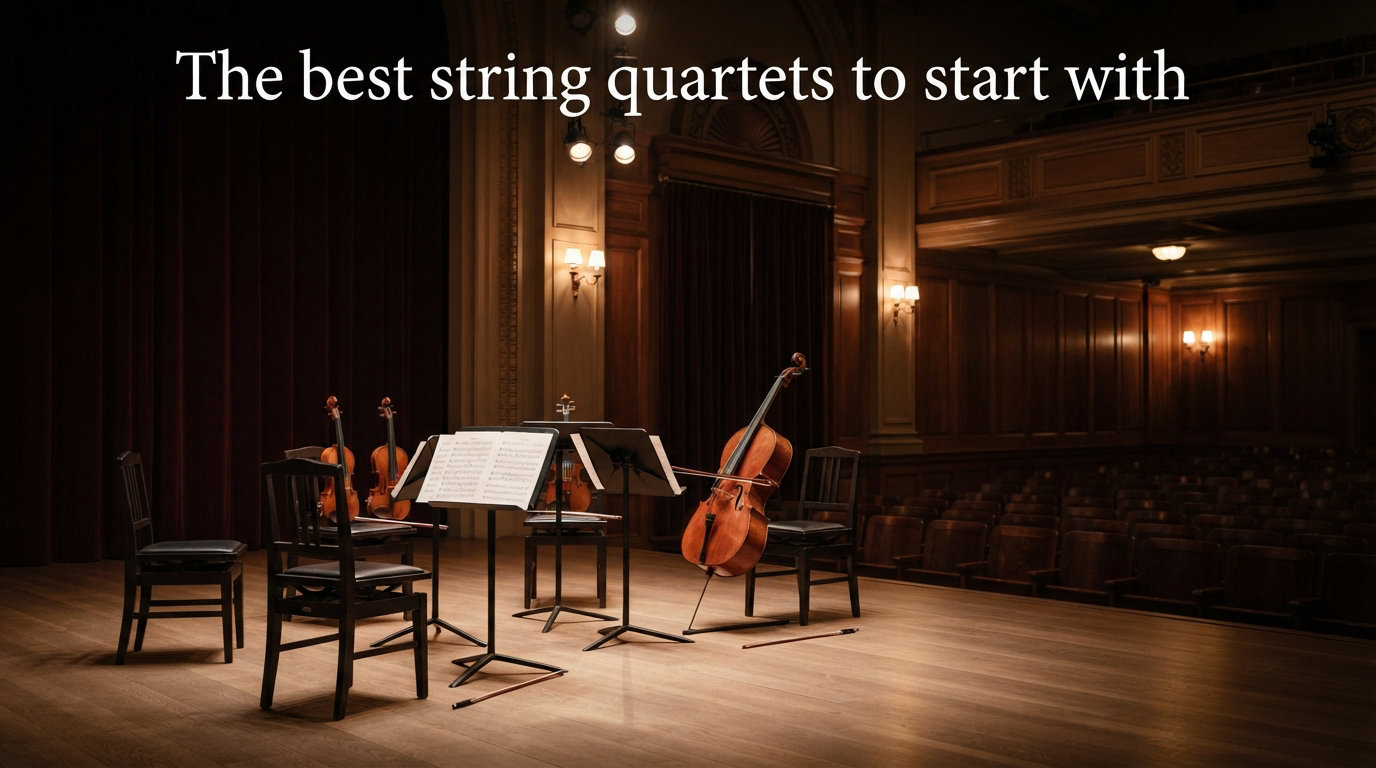
If you have ever wanted to get into chamber music but felt lost the moment someone mentioned an opus number, you are in exactly the right place. The best string quartets to start with are not buried in obscure catalogs. They are some of the most moving, memorable, and downright beautiful music ever written, and most of them are surprisingly easy to love on a first listen.
Our team has spent years guiding first-time listeners through the string quartet repertoire, and we kept running into the same problem. Beginners get handed a list of forty “essential” works with no sense of which one to press play on first. That is overwhelming, and it is the reason most people give up before they hear a single note.
So we built this guide differently. Below you will find a clear, ordered pathway. We start with the friendliest, most melodic quartets, work through a few that add a little more drama, and finish with one legendary challenge piece for when you are ready. Every recommendation comes with what makes it special, which movement to try first, and which recording to look for.
By the end, you will know exactly what a string quartet is, why this format produced some of the greatest music in history, and which specific pieces to queue up tonight. Think of this as your starter pack for chamber music, written for someone who has never had to think about sonata form.
Table of Contents
What Is a String Quartet, Exactly?
A string quartet is a chamber music ensemble of four string players: two violins, one viola, and one cello. That is the whole group. No conductor, no piano, no extra instruments. Just four musicians sitting close enough to read each other’s breathing.
The magic of the format is that all four voices are treated as equals. The first violin often carries the tune, but the second violin, viola, and cello constantly trade roles, sometimes supporting, sometimes arguing, sometimes taking over completely. Composers loved this setup because it let them write their most personal, most intricate music without anything getting lost in a big orchestra.
When people call the string quartet the deepest expression in chamber music, this is what they mean. Every note is exposed. Every conversation between the instruments is audible. Haydn basically invented the format in the 1750s, and nearly every major composer since has used it as a kind of musical diary.
Why Start With String Quartets?
String quartets are the ideal gateway into classical music for one simple reason: they are intimate. With only four instruments, you can actually follow what each one is doing. Nothing hides behind a wall of brass or a choir of strings.
They are also shorter and more digestible than symphonies. Most quartets run between twenty and forty minutes, split across four short sections called movements. You can listen to one movement on a coffee break and feel like you have heard a complete thought.
The emotional range is enormous. Within this single format you get Haydn’s wit, Mozart’s elegance, Beethoven’s struggle, Schubert’s heartbreak, and Debussy’s colors. Starting with quartets lets you sample many sides of classical music without ever leaving the same comfortable instrumentation.
And practically speaking, the recordings are everywhere. Streaming services have hundreds of versions of every piece below. You do not need to buy anything special to begin tonight.
How to Listen to a String Quartet for the First Time
Before the recommendations, a quick orientation. Every string quartet is divided into movements, usually four of them. The movements are like chapters in a short story. They contrast in speed and mood, but they belong together.
A typical quartet opens with a moderately fast first movement that introduces the main themes. The second movement slows down and gets lyrical. The third movement is often a dance, traditionally a minuet or scherzo. The fourth movement is fast and brings everything home. If you are short on time, the slow second movement is almost always the most beautiful place to start.
Listen actively the first time through. Pick one instrument and follow it for an entire movement. Then do the same with another instrument on your second listen. You will be amazed how much you notice when you stop trying to hear everything at once.
For recordings, quality matters more than in almost any other genre. Four experienced chamber musicians playing together for decades sound completely different from four soloists thrown together for a session. We name specific ensembles below, and we strongly suggest you seek those out rather than grabbing the first version you find.
One last tip: headphones make a real difference here. The whole point of a string quartet is the conversation between instruments, and good headphones let you place each voice in the room.
The Best String Quartets to Start With
Here is our ordered pathway. We arranged these from easiest to most challenging, so you can listen straight through the list and feel your ears gradually opening up. Start at the top. Do not skip ahead. Each piece prepares you for the next.
1. Haydn, String Quartet Op. 76 No. 3, “Emperor” (Easiest Starting Point)
Joseph Haydn invented the string quartet, so it makes sense to start with him. His Opus 76 set comes late in his career, when he had fully mastered the form, and No. 3 is nicknamed the “Emperor” because its slow second movement uses a melody so noble it became the German national anthem.
That second movement is the reason this quartet tops our list. Haydn writes the melody, then passes it gently from one instrument to the next, each time with a new accompaniment underneath. It is calm, clear, and almost impossible not to love on a first hearing.
The outer movements are full of Haydn’s signature good humor. He loves little surprises, a sudden pause or an unexpected loud note, and you do not need any theory to enjoy them. If you only try one piece from this entire guide, make it this one.
Recording to seek out: the Kodaly Quartet on Naxos is warm, affordable, and widely streamed. The Lindsay Quartet offers a more fiery alternative for your second listen.
2. Mozart, String Quartet No. 19 in C Major, “Dissonance” (Easy)
Mozart wrote six quartets dedicated to Haydn, and the last of them, K. 465, earned the nickname “Dissonance” for its strange, unsettling slow introduction. Do not let the nickname scare you. The dissonance lasts about ninety seconds, then resolves into one of Mozart’s sunniest, most graceful quartets.
That opening was so shocking to listeners in 1785 that some thought the score had been misprinted. Nowadays it sounds mysterious rather than ugly, and it makes the bright Allegro that follows feel even more rewarding.
Once the main section begins, everything is elegance. Mozart balances four voices with such ease that the music feels effortless, almost weightless. This is the piece to play for someone who insists classical music is stuffy.
Recording to seek out: the Quartetto Italiano sets the gold standard for Mozart quartets, with perfectly blended tone. The Hagen Quartet is a superb modern alternative.
3. Beethoven, String Quartet Op. 18 No. 4 in C Minor (Easy)
Beethoven’s first set of quartets, published as Opus 18, shows him learning the form that Haydn and Mozart perfected. Op. 18 No. 4 is the most immediately appealing of the six. It is dramatic, direct, and full of the restless energy that makes Beethoven unmistakably Beethoven.
The key of C minor is Beethoven’s stormy key, the same key as the Fifth Symphony, but here the drama is scaled down to four players. The first movement crackles with tension. The slow movement is tender. The finale races to a breathless finish.
This is the perfect bridge from Mozart to the Beethoven you may already know. It sounds like Beethoven, but it is still compact and approachable, not the dense spiritual terrain of his late quartets.
Recording to seek out: the Takacs Quartet brings out the drama without overplaying it. The Alban Berg Quartet is the classic choice for the complete Opus 18 set.
4. Schubert, String Quartet No. 14, “Death and the Maiden” (Easy to Intermediate)
Franz Schubert wrote the “Death and the Maiden” quartet in 1824, knowing he was dying. That backstory sounds heavy, but the music itself is overwhelmingly beautiful. The second movement is a set of variations on a song Schubert had written earlier, in which a young woman pleads with Death and Death gently answers “be of good cheer.”
That theme, passed slowly from instrument to instrument, is one of the most haunting melodies in all of chamber music. It is the reason forum after forum recommends this quartet as a first foray into deeper repertoire.
The outer movements are fast and fierce, with a driven energy that feels remarkably modern. This is the piece where you first start to feel how much emotional weight four stringed instruments can carry.
Recording to seek out: the Alban Berg Quartet’s recording is legendary for its intensity. The Takacs Quartet offers a more lyrical but no less powerful option.
5. Dvorak, String Quartet No. 12 in F Major, “American” (Easy)
Antonin Dvorak wrote the “American” quartet in 1893 while spending a summer in Spillville, Iowa, surrounded by Czech immigrants and birdsong. The result is the most immediately likeable quartet on this list. It is warm, tuneful, and soaked in folk-like melodies that stick in your head for days.
The first movement opens with a soaring viola tune, which is a nice touch since the viola rarely gets the spotlight. The slow movement is a gentle lament. The finale is pure joy, bouncing along with a rhythm that practically demands you tap your foot.
This quartet shows up constantly in beginner recommendations, and for good reason. There is not a difficult moment in it. If you want to fall in love with chamber music in a single sitting, start here.
Recording to seek out: the Prague Quartet captures the folk spirit beautifully. The Emerson String Quartet brings extra polish and precision.
6. Borodin, String Quartet No. 2 in D Major (Easy)
Alexander Borodin was a chemist by profession and a composer by night, and his Second String Quartet is a love letter to his wife. It is possibly the most romantic quartet ever written, full of long, singing lines that sound almost like operatic arias.
The third movement, a Nocturne, is the famous one. Its main melody has been borrowed for Broadway and pop songs, and you may recognize it even if you think you have never heard a string quartet before. It is lush, warm, and impossibly beautiful.
This is the quartet to play for someone who thinks classical music is cold or academic. Borodin wrote it from the heart, and you can hear that in every bar.
Recording to seek out: the Borodin Quartet, yes that is really their name, has this music in their blood. The Raphael Quartet is an excellent alternative.
7. Debussy, String Quartet in G Minor (Intermediate)
Now we step into slightly more modern territory. Claude Debussy’s only string quartet, written in 1893, sounds like nothing else on this list. Instead of clear tunes and clear endings, Debussy paints with sound. The music shimmers, shifts color, and dissolves into new textures before you can quite grasp it.
The first movement opens with a swirling theme that returns throughout the quartet in different forms. The second movement is a shimmering scherzo full of plucked strings. The slow third movement is pure atmosphere, like watching light move across water.
This is the piece that opens the door to twentieth-century music. It rewards repeat listening. The first time it may feel slippery, the second time it feels inevitable, the third time it feels like home.
Recording to seek out: the Juilliard String Quartet captures the colors vividly. The Ysaye Quartet offers a more fluid, French approach.
8. Beethoven, String Quartet Op. 131 in C-sharp Minor (The Challenge Pick)
We promised one challenge piece, and this is it. Beethoven’s Opus 131 is the summit of the entire string quartet repertoire, written in 1826 when the composer was completely deaf. It runs about forty minutes, plays as one continuous span of seven connected movements, and is widely considered one of the greatest pieces of music ever written by anyone.
Do not start here. Come back to it after you have lived with the other seven quartets on this list. When you do arrive, you will find a piece that is not just beautiful but almost spiritual. The opening slow fugue is desolate. The central variations movement is radiant. The finale is devastating.
Beethoven himself considered Op. 131 his favorite of his late quartets. Schubert’s last words were supposedly a request to hear it again. That is the company this piece keeps.
Recording to seek out: the Busch Quartet’s 1941 recording is still the reference point, raw and profoundly moving. The Quartetto Italiano and the Takacs Quartet offer superb modern versions for cleaner sound.
One note on the progression. If you have listened through all eight, you have just covered the entire historical arc of the string quartet, from Haydn’s invention of the form in the eighteenth century to Beethoven’s late, visionary masterpieces. That is a real achievement, and you now have the ear to explore almost anything in the chamber music catalog.
Recommended Recordings and Ensembles to Know
The same quartet can sound completely different depending on who plays it, so here are the ensembles worth searching for as you build your playlist.
The Takacs Quartet is probably the safest first choice for almost any piece on this list. Their Beethoven cycle is widely regarded as the best modern set, and they balance precision with genuine emotional warmth.
The Alban Berg Quartet recorded nearly the entire standard repertoire across a forty-year career, and their Schubert and Beethoven are essential. Their playing is clean, intense, and beautifully recorded.
The Emerson String Quartet brings a high-energy, almost orchestral approach that works especially well for dramatic pieces like Dvorak and Beethoven. Their Bartok cycle is also celebrated if you want to explore further.
The Quartetto Italiano is the classic choice for Mozart and Beethoven’s late quartets. Their tone is perfectly blended, and their recordings from the 1960s and 70s still sound wonderful.
For budget-friendly options, Naxos Records has recorded the complete quartets of Haydn, Mozart, Beethoven, and Schubert with solid ensembles at low cost, and these are all available on major streaming services. You do not need to spend a fortune to hear great playing.
FAQs
What are the best string quartets for beginners?
The best string quartets to start with are Haydn’s Emperor (Op. 76 No. 3), Dvorak’s American Quartet (No. 12), and Borodin’s Quartet No. 2. All three are melodic, short, and immediately likeable, making them the most accessible entry points into chamber music.
Which string quartet should I listen to first?
If you only listen to one, start with Haydn’s String Quartet Op. 76 No. 3, the Emperor. Play the second movement first, where the melody is passed gently from instrument to instrument. It is calm, clear, and almost impossible to dislike on a first hearing.
What are the most famous string quartets?
The most famous string quartets include Beethoven’s late quartets (especially Op. 131 and Op. 130), Schubert’s Death and the Maiden, Dvorak’s American Quartet, Debussy’s G minor Quartet, and Haydn’s Emperor. These works appear on nearly every essential repertoire list.
Are Beethoven’s late quartets too advanced for beginners?
Yes, Beethoven’s late quartets, Op. 127 through Op. 135, are challenging for newcomers. They are long, structurally complex, and emotionally dense. Save them until you have spent time with easier works like Beethoven’s Op. 18, Haydn’s Op. 76, and Dvorak’s American Quartet first.
What is a good introduction to string quartet repertoire?
A good introduction is to follow a clear progression from easiest to most challenging: start with Haydn’s Op. 76 No. 3 and Dvorak’s American, move through Schubert’s Death and the Maiden, then approach Beethoven’s Op. 18 before attempting his late quartets. Listen to the slow second movement of each piece first.
Where to Go From Here
You now have a complete starter pathway through the best string quartets to start with, from Haydn’s friendly Emperor to Beethoven’s towering Op. 131. The order matters. Each piece trains your ear for the next one, so work through the list rather than jumping around.
Begin tonight with the second movement of Haydn’s Op. 76 No. 3. Then add the Dvorak American and the Borodin No. 2. Those three alone will give you hours of music you will want to return to. From there, let your curiosity lead you through Schubert, Debussy, and eventually the Beethoven late quartets.
The string quartet has survived for over 250 years because it captures something no other format can: four human voices in close, honest conversation. Once your ears adjust, you will hear why composers saved their deepest thoughts for these four instruments. Press play, lean in, and enjoy the discovery.