
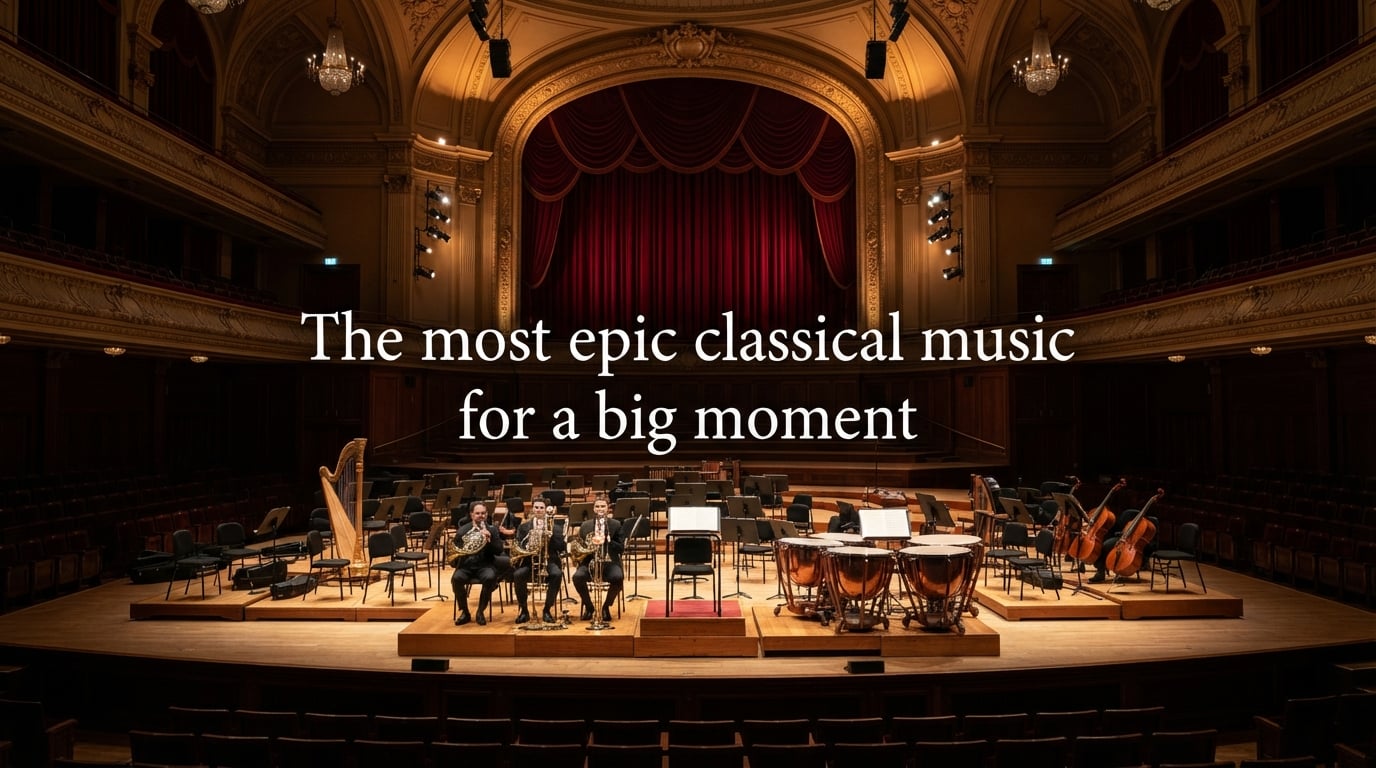
Some music whispers. The most epic classical music shouts, soars, and shakes the walls around you. When you need a piece that turns a quiet room into a cathedral of sound, classical music has been doing that job for over three centuries.
I have spent years listening to orchestras in person, on record, and through cheap earbuds on the subway. The pieces on this list never fail. They build tension, then crack it open with brass and choir, drums and strings working together like a single massive heartbeat. In 2026, when life throws you a graduation, a wedding, a movie scene that needs to land, or just a Tuesday that feels too small, these 12 works will make the moment feel real.
You will get the composer, the work, and most importantly, the exact moment inside each piece where the epic switch flips. I will also match pieces to the actual occasions people ask about, from wedding entrances to workouts. No fluff, no filler. Just the most epic classical music worth your hour.
Table of Contents
What Makes Classical Music “Epic”?
Epic classical music has four ingredients working together. Drop one and the spell breaks. Keep all four and you get the pieces that have survived 200 years of changing taste.
The first ingredient is scale. Epic pieces use large orchestras. Sixty, eighty, sometimes a hundred players plus a full choir. The second is dynamic contrast. Epic music gets whisper quiet, then explodes into full fortissimo. Your nervous system cannot ignore that swing.
The third ingredient is dramatic architecture. Epic pieces tell a story. They start somewhere small, build through conflict, and arrive at a climax that feels earned. The fourth is memorable melody. You can hum the Ode to Joy after one listen. That memory hook is what makes the climax hit so hard.
When you combine scale, contrast, story, and melody, you get pieces that film directors keep stealing. John Williams did not invent epic. He studied Tchaikovsky, Wagner, and Holst, then wrote his own version. That is why your favorite movie scene feels the way it does.
The 12 Most Epic Classical Pieces You Need to Hear
This list moves roughly in the order most listeners discover these pieces. Beethoven comes first because almost everyone starts there. Then we go deeper into the Romantic and 20th-century giants. Each entry tells you the composer, the work, why it earns the “epic” label, and the exact minute mark where the magic peaks.
1. Beethoven – Symphony No. 9 in D minor (“Choral”), 4th Movement
The most epic classical music of all time starts with silence. Then five notes crash in and the rest of the symphony fights to escape that opening chord. By the time the choir enters at minute 33 of the finale, the orchestra has already taken you through three movements of pure drama. When 200 voices sing “Ode to Joy” together with full orchestra, there is no bigger sound in the concert hall.
Beethoven wrote this when he was completely deaf. The choral finale was the first time a major composer used voices in a symphony. People cried at the 1824 premiere. They still cry now. If you only ever listen to one epic classical piece, this is the one.
The key moment is the final two minutes of the fourth movement. The choir sings “Freude, schöner Götterfunken” at full force, the tempo doubles, and Beethoven piles on every instrument he had. It is not subtle. It is not trying to be. It is the template that every epic piece since has tried to copy.
2. Verdi – Requiem: “Dies Irae”
If Beethoven’s Ninth is a mountain sunrise, Verdi’s “Dies Irae” is a volcanic eruption. The day of wrath, sung as Verdi imagined it. Eight bass drums pounding in unison. Brass screaming. The full chorus shouting “Dies irae, dies illa” at a tempo that feels like the world ending on schedule.
Verdi wrote his Requiem in 1874 as a tribute to the Italian writer Alessandro Manzoni. Most requiems are prayerful. Verdi’s is operatic. The “Dies Irae” chorus alone has more drama than most full operas. It is the piece that proves sacred music can also be terrifying.
The key moment is the opening 90 seconds. The double chorus hits you before you are ready. The bass drum pattern rumbles under the voices like distant thunder. By the third repetition of the “Dies irae” text, your heart is in your throat. This is what Hollywood has been ripping off since 1920.
3. Tchaikovsky – 1812 Overture
Tchaikovsky wrote the 1812 Overture to celebrate Russia’s defeat of Napoleon. He included an actual French melody, “La Marseillaise,” so the audience could boo it on cue. The piece builds for ten minutes, then ends with real cannon fire. Not synthesized. Not implied. Real cannons, sometimes 16 of them, fired live at outdoor performances.
The 1812 Overture is the most epic classical music you can play at a Fourth of July party, a graduation party, or any moment that needs absolute overkill. It is also one of the few classical pieces where you can talk about the composer winning a bet. Tchaikovsky hated the piece. He said it would be “without any artistic merit.” He was wrong. The public loved it from day one.
The key moment is the final minute and a half. The Russian Orthodox hymn “God Preserve Thy People” returns, the tempo cranks up, and then the cannons start. If your heart rate does not jump at the first boom, check your pulse. For deeper recordings, see our guide to the best 1812 Overture recordings.
4. Stravinsky – The Rite of Spring (Le Sacre du Printemps)
In 1913, the premiere of The Rite of Spring caused a riot in Paris. The audience physically fought in the aisles. The piece was too loud, too rhythmic, too strange. A century later, it still sounds like the future. The Rite is the moment classical music stopped being polite.
Stravinsky wrote about a pagan ritual where a young girl dances herself to death. The orchestra plays with brutal force, pounding out irregular rhythms that make your body want to move before your brain catches up. Stravinsky invented the modern epic sound here. Every action movie trailer since 1980 owes him money.
The key moment is the “Sacrificial Dance,” the final 4 minutes. One young girl dances until she collapses. The orchestra plays in irregular phrases that never quite resolve. The rhythms pile up, the trumpets stab, the bassoon plays in its highest register. You feel the exhaustion. By the end, a single timpani thump signals her death. It is brutal. It is unforgettable.
5. Holst – “Mars, the Bringer of War” from The Planets
Holst wrote “Mars” in 1914, just before World War One broke out. He said later the rhythm was inspired by “the menace of war.” The piece opens with a grinding five-note ostinato in the bass, then brass builds an unstoppable march. It is the most quoted classical piece in science fiction film. Star Wars, Star Trek, Gladiator, and dozens of war films have all borrowed from it.
“Mars” does not have a melody in the traditional sense. It has a rhythmic pulse that takes over your body. The off-beat accents in 5/4 time make it impossible to march in step. Holst knew what he was doing. The piece makes you feel like the ground is unstable, that something is coming and you cannot stop it.
The key moment is the first 60 seconds. The bassoons and contrabassoon grind out the ostinato, then the brass enters with the famous rising fifth theme. Your spine straightens. Your breathing changes. For more on this suite, check out our picks for the best Planets suite recordings.
6. Mozart – Requiem in D minor: “Dies Irae”
Mozart’s Requiem is the saddest story in classical music. Mozart was dying when he took the commission. He died before finishing it. The “Dies Irae” movement was sketched but never orchestrated. His students finished it. You can hear Mozart’s voice in the music, but also the silence where he stopped writing.
The “Dies Irae” here is nothing like Verdi’s. It is intimate. The strings play the day of wrath theme in unison, low and relentless. There is no chorus screaming. Just strings, bassoon, and the sense of inevitability. Mozart makes terror feel quiet, which is somehow worse.
The key moment is the opening string passage. The unison line cuts through the orchestra like a knife. The chromatic descents pull you downward. By the time the choir enters 30 seconds later, you already know you are in trouble. This is what epic sounds like when the composer trusts you to feel it without being hit over the head.
7. Mahler – Symphony No. 2 in C minor (“Resurrection”)
Mahler’s Second Symphony lasts 80 minutes and uses a full orchestra, two choirs, two solo singers, and an organ. It is the largest scale of any symphony on this list. Mahler wrote it as a meditation on death and what comes after. The final five minutes are the most overwhelming sound in classical music.
Some listeners find Mahler too sprawling. The Reddit threads about “most epic classical music” have users who skip Mahler entirely. They want Beethoven’s clarity, not Mahler’s wandering. That is fair. But if you give Mahler your full attention, the Resurrection finale hits harder than anything else in the repertoire. Two choirs and an organ in a cathedral will do that.
The key moment is the last five minutes of the finale. The choir sings “Auferstehn, ja auferstehn wirst du” (Rise again, yes you will rise again). Mahler piles on the organ, the brass, the strings, the timpani. It is the musical equivalent of standing in a sunrise. People cry. It is fine.
8. Richard Strauss – Also Sprach Zarathustra (opening)
You have heard the opening of Also Sprach Zarathustra even if you do not know it. Stanley Kubrick used it in 2001: A Space Odyssey. The sunrise fanfare. C natural, C natural, G natural, C natural. Three natural notes, then the full orchestra slams in with brass, organ, and timpani. It is the most recognizable 90 seconds of orchestral music ever written.
Strauss wrote the tone poem in 1896. It is based on the Nietzsche book of the same name. The opening is meant to sound like the beginning of the world. Nature, raw and massive, waking up. Strauss uses low C as a pedal point throughout. The orchestra builds on top of it like a skyscraper being constructed in real time.
The key moment is the first two minutes. The cellos and double basses set the pedal C. The trombones enter with the famous theme. By the time the trumpets join, you understand why Kubrick used it for a space sunrise. The music makes everything feel new.
9. Handel – Messiah: “Hallelujah” Chorus
Handel’s Messiah premiered in Dublin in 1742. King George II stood up during the “Hallelujah” chorus. The entire audience stood with him. Nobody knows if he was moved, distracted, or just needed to stretch. Either way, we still stand during that chorus 280 years later. It is the most epic standing ovation in classical music.
The “Hallelujah” chorus is short, just under four minutes. It is also one of the most copied chord progressions in Western music. The moment the choir hits “King of Kings, and Lord of Lords” on a perfect cadence, your body recognizes the pattern. It is hardwired into Western ears at this point.
The key moment is the first entry of the choir on “Halleluja.” Handel builds the orchestra for 22 bars first, then the voices enter in block harmony. The word “Halleluja” becomes a wall of sound. It is not subtle. It is not trying to be. It is joy, performed at maximum volume.
10. Wagner – Die Walküre: “Ride of the Valkyries”
Wagner’s “Ride of the Valkyries” is the most epic classical music piece most people whistle without knowing the name. It opens with a famous horn call that Francis Ford Coppola put in Apocalypse Now. Helicopter blades, Wagner horns. The match is perfect. Wagner was writing about war goddesses flying through the air. He got the music right.
The “Ride” is short, around five minutes. It is structured like a runaway train. The orchestra plays the same galloping rhythm, but Wagner keeps layering new melodies on top. The result is a piece that keeps building without ever losing momentum. By the end, you are breathless.
The key moment is the opening horn call. Four notes. C minor, then the galloping figure. Wagner was the first composer to use that pattern. Every battle scene in every film since has borrowed it. When you hear those four notes, you know something epic is about to happen.
11. Rachmaninov – Piano Concerto No. 3 in D minor (1st Movement)
Rachmaninov’s Piano Concerto No. 3 is famous because it is nearly impossible to play. The opening has more notes per second than almost any other piano concerto. Pianists call it the “Mt. Everest” of concerto repertoire. It is also one of the most epic pieces in the piano literature, full stop.
Rachmaninov wrote it in 1909 for his first American tour. He knew the audience wanted fireworks. He gave them fireworks. The first movement opens with a simple piano chord, then explodes into a torrent of octaves and chords. The orchestra is huge. The piano part is relentless. By the end of the 17-minute movement, your hands hurt from listening.
The key moment is the first 90 seconds. Rachmaninov starts soft, then unleashes the full orchestra while the piano hammers out huge chords above. It is the sound of a single musician fighting and winning against 80 players. If you want to feel powerful, this is your soundtrack.
12. Orff – Carmina Burana: “O Fortuna”
“O Fortuna” is the final boss of epic classical music. It is the piece that trailer editors have used more than any other in the past 40 years. The Exorcist used it. The Westworld intro used it. Old Spice used it. If a movie needs to feel like fate itself is knocking, this is the piece.
Orff wrote Carmina Burana in 1937. It is a setting of medieval poems about fate, love, drinking, and spring. The opening movement, “O Fortuna,” is the most quoted. It opens with a relentless minor-mode drum beat. The choir sings about the wheel of fortune crushing everything. It is loud, angry, and very 20th century.
The key moment is the very first chord. The timpani hits a low D. The choir enters with “O Fortuna” on a single sustained chord. From there, the music never lets up. The choir shouts, the brass screams, the orchestra pounds. By the time the piece ends, you understand why every trailer editor has a copy on hand.
Matching Epic Classical Music to Your Big Moment
The best classical piece is the one that matches your moment. Not every epic piece works for every occasion. Here is how I match them when friends ask.
For weddings, the processional wants something grand but not overwhelming. Handel’s “Arrival of the Queen” or Pachelbel’s Canon work for the entrance. For the recessional, you want pure joy. Handel’s “Hallelujah” chorus or the final movement of Beethoven’s 9th works perfectly. People will sing along even if they do not know the words.
For graduations, you need triumph. The final movement of Beethoven’s 9th is the gold standard. It has been played at graduations since the 1800s for good reason. If you want something with more brass, the 1812 Overture finale is your pick. Just check with the venue about cannons.
For movie scenes, the answer depends on the scene. Battle scenes want Holst’s “Mars” or Wagner’s “Ride of the Valkyries.” Emotional climaxes want Beethoven’s 9th or Mahler’s Resurrection finale. Terror scenes want Verdi’s “Dies Irae” or Orff’s “O Fortuna.” Epic science fiction wants Strauss’s Also Sprach Zarathustra. These are not coincidences. Film composers study these pieces in school.
For workouts and motivation, you want rhythmic drive. Stravinsky’s Rite of Spring is unbeatable for high-intensity training. The irregular rhythms force your body to stay alert. Rachmaninov’s Third Concerto first movement works for steady cardio. The piano drives you forward like a metronome with muscle.
For memorials and reflection, you want weight without despair. Mozart’s Requiem is intimate and profound. Faure’s Requiem is gentler if you need something less heavy. Beethoven’s 9th finale can work if you want the message of hope, but it can also feel over the top for quiet moments.
For personal listening when life feels small, start with Holst’s “Mars” or Orff’s “O Fortuna.” They are short, loud, and impossible to ignore. They reset your baseline for what “big” sounds like. From there, work your way into the longer pieces. Mahler will feel less sprawling once your ears are calibrated for scale.
If you are new to classical music, do not start with everything at once. Pick one piece from this list and listen to it three times in a row. The first time, you react. The second time, you hear the structure. The third time, you start to love it. For absolute beginners, our beginner Mozart guide is a good companion piece if you want a softer entry into the genre.
Frequently Asked Questions
What is the most epic classical music?
Beethoven’s Symphony No. 9 in D minor, fourth movement (Ode to Joy) is widely considered the most epic classical music. It combines a full orchestra, a 200-voice choir, and one of the most recognizable melodies ever written. The final two minutes of the finale are the single most overwhelming moment in classical music.
What is that one dramatic classical song everyone recognizes?
The piece most people mean is Orff’s O Fortuna from Carmina Burana. It opens with a pounding timpani beat and a choir singing about fate. It has been used in more movie trailers than any other classical work, including The Exorcist and countless modern trailers.
What is the big 3 in classical music?
The Big Three in classical music usually refers to the three most influential composers of the Viennese Classical era: Bach, Mozart, and Beethoven. Bach represents the Baroque period and counterpoint, Mozart represents the Classical period and melodic perfection, and Beethoven represents the transition into Romanticism and emotional intensity.
Which classical piece is best for a wedding entrance?
For a wedding entrance, Handel’s Arrival of the Queen or the opening of Wagner’s Lohengrin are popular choices. For the recessional, Beethoven’s Symphony No. 9 finale and Handel’s Hallelujah chorus are the most epic picks for pure joy.
Final Thoughts on Epic Classical Music
The most epic classical music has not changed in 200 years. The pieces on this list work because composers figured out how to combine scale, contrast, story, and melody into something that hits your nervous system directly. That is why we keep coming back to them.
Pick one piece. Block out 30 minutes. Turn the volume up. Let Beethoven, Verdi, Tchaikovsky, or Orff take over the room. In 2026, these are the works that still know how to make a moment feel big.