
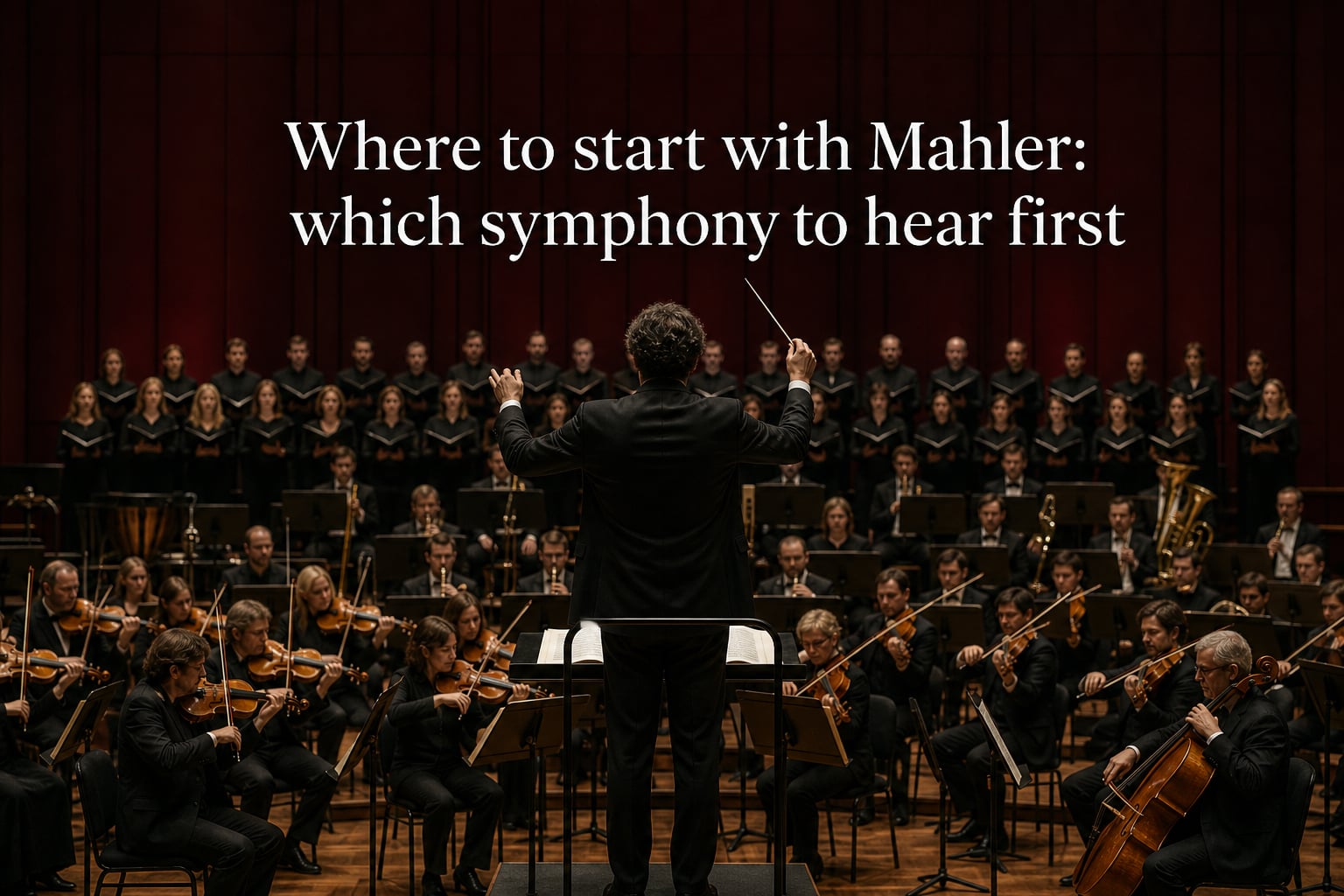
If you are wondering where to start with Mahler, begin with Symphony No. 2, “Resurrection.” It is the best Mahler symphony to start with because its path from unease and loss to an unmistakably communal, choral ending gives a first-time listener something clear to follow.
Mahler can feel intimidating on paper: huge orchestra, long movements, abrupt changes of mood, and titles that can carry a lot of cultural baggage. You do not need to understand every turn or hear the symphonies in numerical order; one attentive encounter with the right work is a better beginning than waiting until you feel ready.
This 2026 Mahler beginner guide gives you a first choice, a shorter alternative, and a practical route for what to hear next. It also answers the question behind many first listens: how can music sound tender, ironic, frightening, and ecstatic within the same symphony?
Table of Contents
Where to start with Mahler: Symphony No. 2 is the first symphony to hear
Symphony No. 2 is the strongest first recommendation because it makes Mahler’s large scale feel purposeful rather than random. Its overall idea is easy to hold onto: a movement through death, doubt, memory, and rebirth, ending with chorus and solo voices joining the orchestra.
That does not mean every minute arrives with a label. It means you have an emotional map while the music moves through marches, dances, stillness, eruptions, and the remarkable sense that a vast public space has opened around you.
Follow the Resurrection story rather than every musical detail
The opening movement begins in a grave, dramatic world, while later music keeps testing that weight from different angles. You may hear folk-like motion, tender reflection, and sharp interruptions before the finale gathers the work’s biggest questions into one long conclusion.
The finale is why this symphony stays with so many new listeners. The orchestra can sound overwhelming, then the human voice enters and changes the scale of the experience from private struggle to shared affirmation.
Some guides rightly flag Mahler’s startling effects, including huge cymbal crashes and a frightening cry-like outburst. Do not treat those as tests to pass; they are part of the contrast that makes the quiet passages and the final choral arrival matter.
Use a simple first-listen plan for the Second
Begin by deciding whether you want one long sitting or a pair of shorter sessions. Both choices are legitimate, and the work does not become less meaningful because you pause between movements.
On the first hearing, follow the changes in emotional temperature rather than the formal design. Notice when the orchestra seems to argue, when it pulls back, and when voices change the meaning of the sound; those landmarks are enough for a strong first encounter.
On a later hearing, return to one movement that stayed in your mind. This is the point at which music that once seemed enormous begins to show familiar shapes.
Choose a recording by comfort, not by a hunt for perfection
A performance will shape your first impression, but there is no single reading every newcomer must hear. Listener discussions often point to Leonard Bernstein, Bernard Haitink, and Claudio Abbado as conductors worth trying, which is more useful than treating one name as a gatekeeper.
Pick an available recording, play a few minutes, and stay if the pacing and recorded sound draw you in. A version you want to revisit is the right version to begin with.
I find it helpful to hear the opening of two versions before committing to a full listening session. The comparison is not about declaring a winner; it simply reveals whether you respond more to urgency, breadth, clarity, or a particular orchestral sound.
The Adagietto from Symphony No. 5 is the gentlest first excerpt
The Adagietto from Symphony No. 5 is the best first stop when the idea of a long Mahler symphony makes you hesitate. This slow movement for strings and harp is brief enough to absorb in one sitting, yet it contains the poised, yearning intensity that makes Mahler distinctive.
It is also a useful correction to the idea that Mahler is only loud or massive. The music works through restraint: long-breathed phrases, carefully held silences, and emotion that deepens rather than announces itself at once.
Let the Adagietto open the door, then hear the whole Fifth
The movement is widely recognized through its use in Death in Venice, so it may already sound faintly familiar even if you have never sought out Mahler. Familiarity is not a requirement, but it can make the first encounter less abstract.
After you know the Adagietto, listen to Symphony No. 5 from the beginning rather than jumping straight back to it. Its opening is far more forceful, and the distance between that opening world and the Adagietto shows how deliberately Mahler places contrast.
Symphony No. 5 has no chorus, which may make it less immediately explanatory than the “Resurrection.” In return, it gives you a vivid orchestral drama and one of Mahler’s most poignant slow movements.
Hear the Fifth as a contrast to the Second, not a replacement for it
The Second gives a first-time listener an unusually clear public arc because its ending brings singers into the orchestra’s argument. The Fifth is more self-contained and instrumental, with its famous slow movement serving as a calm center rather than a final destination.
That difference makes the two works excellent companions. If the Second’s chorus and large statement appeal to you, try the Fifth next; if the Adagietto is your entry point, keep the Second in reserve for the day you want Mahler at his most expansive.
Start with Mahler’s Symphony No. 1, “Titan,” for a clearer full-symphony alternative
Symphony No. 1, “Titan,” is the best alternative if you want to meet Mahler through orchestra alone and prefer a more compact arc than the Second. It still contains the surprises that mark his style, but its scenes of nature, dance, irony, and celebration are easier to take in as a first complete experience.
Listen for the way a distant, quiet beginning gradually becomes a living outdoor scene. Mahler lets familiar-sounding material appear at odd angles, so the symphony can feel both warmly Romantic and slightly uncanny.
Hear the First as a story told without words
The funeral-march atmosphere of one movement may sound strange beside the open-air brightness elsewhere. That oddness is the point: Mahler often puts the ordinary, the sentimental, the grotesque, and the noble beside one another instead of smoothing them into one mood.
For a Mahler Symphony No. 1 recording, begin with a performance from a conductor whose overall sound you enjoy rather than chasing a universal winner. The recurring beginner-friendly names in listener recommendations—Bernstein, Haitink, and Abbado—give you three sensible places to sample.
If the First catches you, it can lead naturally to the Second or Fifth. If it does not, try the Adagietto or the Second before deciding that Mahler is not for you; the symphonies show different faces of the same composer.
Choose the First when you want a less daunting commitment
Many people get stuck asking which Mahler symphony is more basic, as though there must be a prescribed order. The First offers a useful answer because it presents his humor, nature imagery, and emotional shifts without requiring you to begin with his most massive choral forces.
It is not “small Mahler,” and it should not be treated as a watered-down version of the later works. It is a complete statement with its own character, which is why it works so well for listeners who prefer to enter through orchestra rather than chorus.
Choose your next Mahler symphony by mood, not by order
You do not need to start at No. 1 and progress to No. 9. Mahler’s symphonies share a voice, but each creates a different kind of listening experience, so the most accessible Mahler symphonies depend on whether you want melody, drama, intimacy, or a large choral event.
This route ranks works by how easily their main character can register on a first encounter, not by artistic worth. A so-called difficult symphony may become your favorite once you have heard a few others.
Symphony No. 2, “Resurrection,” is the best all-round beginning. Its clear life-and-death trajectory, huge orchestra, and choral finale make it emotionally direct. Choose it when you want to understand why Mahler’s symphonic scale has such a devoted following.
Symphony No. 1, “Titan,” is the clearest orchestral next step. Its movement from nature-like stillness to forceful resolution is easier to track than some later works. Choose it when you want a full symphony without voices and with a strong sense of changing scenes.
Symphony No. 5 is the best route for listeners drawn to orchestral drama. The Adagietto offers an accessible entrance, but the entire work brings sharp contrast and a more complicated emotional course. Choose it when a famous slow movement has already made you curious.
Symphony No. 4 is the most intimate-sounding choice. Its lighter orchestral color and a vocal ending can feel less monumental than the Second or Eighth. Choose it when you prefer clarity and charm to sheer volume.
Symphony No. 6, “Tragic,” is the direct choice for listeners who want intensity. It is often associated with a dark, relentlessly driven emotional weight and famous hammer blows. Choose it later if you are comfortable with Mahler’s sudden turns and want a more severe experience.
Symphony No. 9 is the best choice after you know Mahler’s language. Its reflective, inward character rewards patience and repeated hearings. Choose it when you are ready for music that does not offer the immediate theatrical landmarks of the “Resurrection.”
Treat the ranking as a menu, not as homework
A ranking can free you from indecision, but it should not limit curiosity. If a description of the Sixth or Ninth sounds closer to your present mood than the “beginner” choices, listen to it; the right first Mahler symphony is the one you will return to.
Personal taste is especially important here. Some listeners want a singing line and a tender slow movement, while others want drama, irony, and large forces; neither preference is more serious or more correct.
Save the largest and most unusual works for later curiosity
Symphony No. 3 is expansive and often feels like an entire world rather than a quick introduction. Symphony No. 8, sometimes known as the “Symphony of a Thousand,” is a vast choral statement, while Das Lied von der Erde blends symphonic writing with vocal soloists in a more inward way.
None of these works is off-limits to a newcomer. They simply ask you to bring some trust in Mahler’s pacing, because their rewards can arrive through accumulation rather than an obvious first-listen hook.
Use songs to meet Mahler’s smaller-scale voice
Mahler also wrote song cycles, and they can be a useful side path if full symphonies feel daunting. Lieder eines fahrenden Gesellen, often called the Wayfarer songs, and settings connected with Des Knaben Wunderhorn introduce a vocal, folk-poetry side of his musical world.
Plain-language definition: “Wunderhorn” refers to a collection of German folk poetry that mattered greatly to Mahler. When you see the word in a Mahler context, expect songs and symphonic passages colored by simple, folk-like images that can turn suddenly strange or serious.
These songs are not a required preliminary course. They are an appealing option when you want to hear where some of the symphonic gestures—the marching rhythms, ironic dances, and plainspoken melodies—come from.
Listen in movements and follow one emotional thread
The easiest way to start listening to Mahler is to release the idea that a symphony must be mastered in one sitting. A movement is a complete chapter, and hearing one chapter with attention is more productive than playing a long work while worrying about the clock.
Take four simple steps on your first Mahler listening session
Choose one work and one reason for choosing it. Pick the Second for a choral arc, the First for an orchestral sequence of contrasts, or the Adagietto for a short, reflective entry. A clear reason gives your ear a starting point.
Read only the basic map before pressing play. Know the title, whether voices appear, and whether you plan to hear all of it or one movement. Avoid reading a detailed analysis first, because discovering surprise and contrast for yourself is part of the experience.
Follow one thing at a time. It might be a recurring melody, a shift from quiet to loud, a solo instrument, or the moment a chorus enters. You will hear far more by following one thread than by trying to name every instrument.
Return to one passage you remember. The second hearing is often the real beginning with Mahler, because a passage that seemed sprawling starts to feel like a place you recognize. Write down one moment you want to meet again and start there next time.
Use three listens to make a long symphony manageable
On the first listen, let the overall shape wash over you and make one or two notes about memorable moments. You are not trying to identify every theme or solve every change of mood; you are finding out whether the work speaks to you.
On the second listen, choose a single movement or passage and give it your undivided attention. You may notice how a quiet idea prepares a louder arrival, or how an orchestral color returns with a different emotional meaning.
On the third listen, hear the work again as a whole if you have time. The earlier landmarks can make the length feel less like a barrier and more like a sequence of connected places.
Expect contrast instead of a single steady mood
Mahler’s music can move from a dance-like tune to a funeral march, or from an almost chamber-like hush to the sound of a full orchestra. If that shift feels abrupt, do not assume you have missed the point; the collision of feelings is often exactly what the music is asking you to notice.
Plain-language definition: A scherzo is usually a fast, dance-related movement or section, often playful but not always cheerful. An adagio is a slow movement or passage, and an Adagietto is a little adagio, a slower, more compact piece such as the famous movement in Symphony No. 5.
Stop before fatigue turns into a verdict
A long symphony can be daunting, especially if you approach it as a challenge. Pausing is not failure, and Mahler does not require total concentration from the first bar to the last before he can mean something to you.
Give yourself permission to say, “I liked the finale,” “that march unsettled me,” or “the quiet opening stayed with me.” Those precise reactions are already a foundation for understanding Mahler’s music.
I would rather return to a movement with genuine curiosity than force a complete work through tired ears. That small permission can turn an intimidating first encounter into a habit of listening.
Expect Mahler to make more sense through contrast
Gustav Mahler was an Austrian composer and conductor known for massive, emotionally intense symphonies that unite Romantic expressiveness with sounds pointing toward modernism. That position between eras helps explain why a lush melody can coexist with music that seems to question or interrupt it.
Mahler may feel harder to understand than Beethoven or Tchaikovsky because he often refuses a single emotional register. A majestic climax may sit beside a popular-sounding tune, a grotesque dance, or an intimate solo line, and the friction is part of his expressive world.
Listeners coming from Tchaikovsky or Rachmaninov may recognize the long, emotionally charged lines and Romantic orchestra. Listeners who enjoy film music may also recognize how Mahler can create a scene, a distance, or a sudden shift of scale without needing a literal story.
Hear Mahler as a bridge between Romantic feeling and newer sounds
Mahler’s symphonies stand near the meeting point between nineteenth-century Romantic expressiveness and the more unsettled musical directions that followed. You do not need a biography lesson before listening, but this helps explain why a warm melody can coexist with sounds that seem to challenge it.
That mixture is why first reactions vary so much. One listener begins with the warmth of the Adagietto, another with the public drama of the “Resurrection,” and another with the strange storytelling of the First; all three are real ways into the music.
Use familiarity as a clue, not as a rule
If the Adagietto brings Death in Venice to mind, use that recognition as a first point of contact. If you hear an echo of folk song, a march, or a dance in another work, let that be a clue too; Mahler often makes familiar material feel newly fragile, distant, or unsettled.
There is no requirement to know the poetry behind the Wunderhorn settings, the history around a premiere, or the names of every instrument. Context can enrich a later return, but the immediate response of your ear is enough to start.
These answers solve common first-listen questions about Mahler
Which Mahler symphony should I start with?
Start with Symphony No. 2, Resurrection. Its life-death-rebirth arc, dramatic orchestral contrasts, and choral finale give beginners a clear emotional route through Mahler’s large scale. Choose Symphony No. 1 if you prefer an all-orchestral work, or hear the Adagietto from Symphony No. 5 first if you want a short introduction.
What is the most accessible Mahler symphony?
Symphony No. 2 is the most accessible all-round starting point because its overall dramatic direction is easy to follow. Symphony No. 1 is often the more approachable full orchestral alternative, while Symphony No. 4 can suit listeners looking for a lighter, more intimate sound.
Should I listen to Mahler’s symphonies in order?
No. Mahler’s symphonies are individual worlds, so begin with the one whose character appeals to you. A practical route is Symphony No. 2, Symphony No. 1, and Symphony No. 5, with the Adagietto from the Fifth as a shorter first encounter.
What is the easiest Mahler symphony to play?
Easiest to play is not the same as easiest to hear, since orchestral difficulty depends on the instrument, ensemble, and conductor. For listening, Symphony No. 1 and Symphony No. 2 are usually clearer beginner choices than the more inward Symphony No. 9 or the expansive Symphony No. 3.
Which is the most popular Mahler symphony?
Symphony No. 2, Resurrection, and Symphony No. 5 are among the Mahler works most often recommended to newcomers. The Fifth’s Adagietto is particularly familiar beyond concert halls, while the Second’s choral finale makes a powerful first impression.
What is the best recording for Mahler’s First Symphony?
There is no single best recording for every listener. For a first Symphony No. 1, sample available readings by Leonard Bernstein, Bernard Haitink, or Claudio Abbado and choose the one whose pacing and recorded sound make you want to continue listening.
What is Mahler’s most romantic symphony?
Symphony No. 5 is often the most natural answer for listeners seeking Mahler at his most yearning, especially because of the Adagietto. Symphony No. 2 is more public and choral in scale, while the Fifth offers an intimate slow movement inside an intense orchestral experience.
Start your Mahler listening with one clear first step
Where to start with Mahler is not a question with a secret answer. Put on Symphony No. 2, “Resurrection,” follow its movement from conflict toward its choral close, and let yourself respond before you try to explain it.
If that scale is not what you want today, begin with the Adagietto from Symphony No. 5 or take Symphony No. 1 as your first full experience. The useful next step is simply to return to the passage that caught your ear, because that is how a daunting Mahler symphony begins to feel like music you know.