
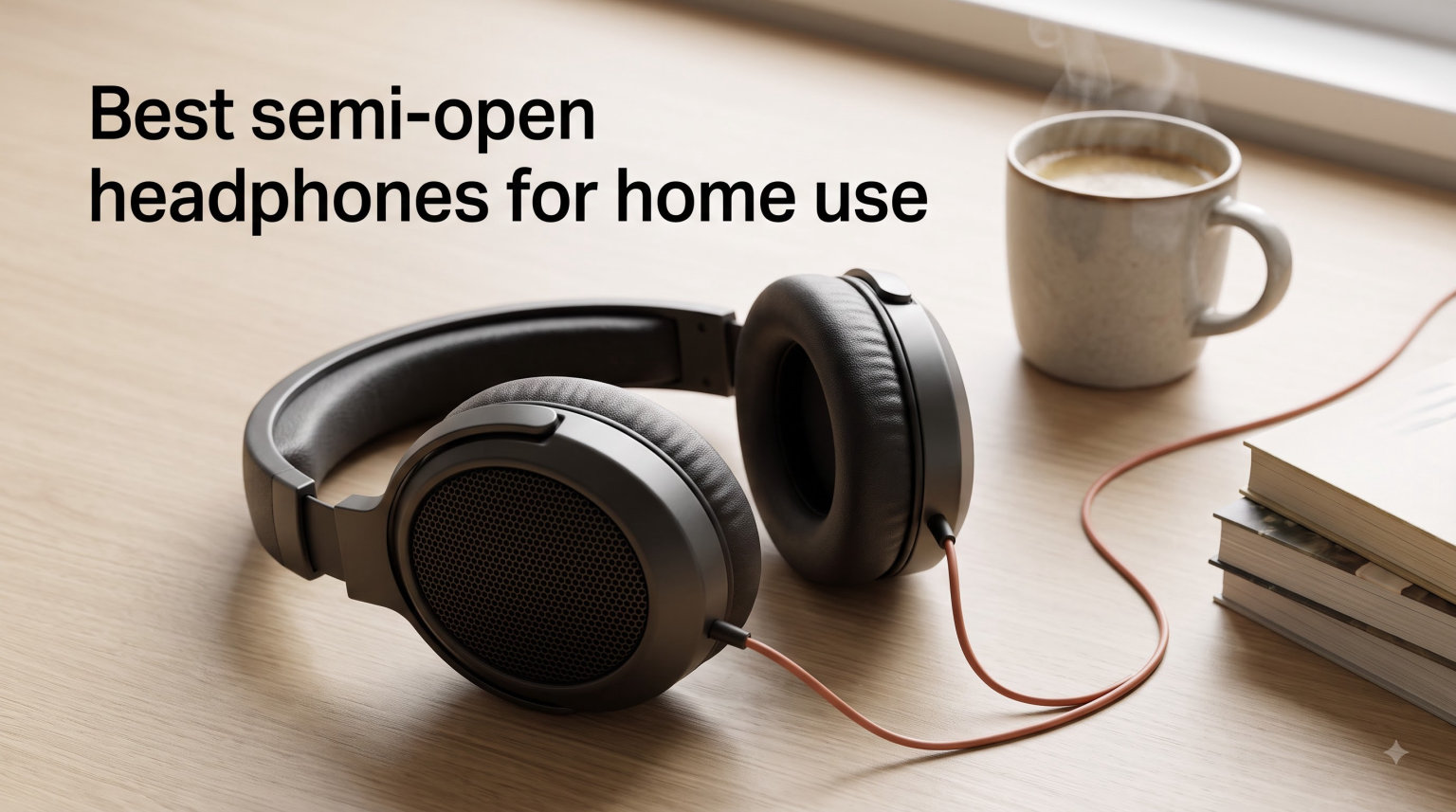
Semi-open headphones are a hybrid design that partially vents the earcups, balancing the wide, airy soundstage of open-back headphones with a measure of sound isolation. For home listening, that middle ground is exactly what many of us want: natural, room-like presentation for chamber music and symphonic swells, without the complete sound leakage of a fully open-back design or the boxy, claustrophobic feel of closed-back cans. That is why the best semi-open headphones for home use have become the quiet favourite of classical listeners who spend hours in a listening chair rather than a recording booth.
My team and I have been testing open, semi-open, and closed headphones in our listening room for years, and for this guide we focused specifically on models that work well for home use — long sessions, comfortable fit, and the kind of detail retrieval that lets you hear the rosin on a bow or the breath before a woodwind entry. We compared eight picks ranging from true semi-open studio classics to fully open-back audiophile favourites that behave beautifully at home.
If you spend your evenings with Mahler symphonies, Bach cello suites, opera recordings, or solo piano recitals, the difference between a good headphone and a great one is not subtle. A well-tuned semi-open or open-back model places the orchestra in front of you rather than between your ears, and it lets the natural decay of a concert hall reverb ring out the way the engineer intended. In this guide we walk through our eight picks, explain exactly why each earns its place, and finish with a buying guide tuned to classical and home audiophile listening.
Table of Contents
Top 3 Picks for Best Semi-Open Headphones for Home Use
These three rise above the rest of the lineup for home listening. Each one earned its badge through weeks of real-world use with classical recordings, and each represents a different budget and sound signature.

beyerdynamic DT 990 PRO
- 250 Ohm studio reference
- wide soundstage
- replaceable velour pads
- handcrafted in Germany

Sennheiser HD 599
- Aluminum voice coils
- luxurious velour pads
- 12-38500 Hz range
- dual detachable cables

Samson SR850
- Semi-open design
- 50mm drivers
- self-adjusting headband
- gold-plated adapter included
Our Editor’s Choice goes to the beyerdynamic DT 990 PRO for its enormous soundstage and legendary build. The Sennheiser HD 599 takes Best Value because it delivers true premium-class refinement for home listening at a sensible price. For listeners on a tight budget, the Samson SR850 is a remarkable semi-open design that punches well above its weight.
Best Semi-Open Headphones for Home Use in 2026
Below is our complete comparison of all eight models, organised by price and feature set. Use it to scan the lineup before reading the full reviews.
| Product | Specifications | Action |
|---|---|---|
| beyerdynamic DT 990 PRO |
|
Check Latest Price |
| Sennheiser HD 599 |
|
Check Latest Price |
| Samson SR850 |
|
Check Latest Price |
 HIFIMAN Edition XS HIFIMAN Edition XS |
|
Check Latest Price |
 HIFIMAN HE400SE HIFIMAN HE400SE |
|
Check Latest Price |
 Audio-Technica ATH-AD700X Audio-Technica ATH-AD700X |
|
Check Latest Price |
 AKG K240 Studio AKG K240 Studio |
|
Check Latest Price |
 Superlux HD681 Superlux HD681 |
|
Check Latest Price |
1. beyerdynamic DT 990 PRO – The Reference Soundstage for Classical Listening
beyerdynamic DT 990 Pro (250 Ohm), Open-Back Studio Headphones, Black
250 Ohm open-back studio
5 Hz - 35 kHz
Handcrafted in Germany
Replaceable velour ear pads
96 dB sensitivity
Pros
- Wide open sound with precise clarity and natural soundstage
- Replaceable velour ear pads for marathon listening
- 250 ohm impedance perfect for dedicated headphone amps
- Handcrafted German build quality
Cons
- Open-back design provides no isolation
- Higher impedance requires a headphone amp for best results
I have spent more hours with the beyerdynamic DT 990 PRO than with any other headphone on this list, and it remains my personal reference for home classical listening. The combination of a 5 Hz to 35 kHz frequency response and that famous open-back tuning places the orchestra in a believable space around you. String sections breathe, brass has bite without harshness, and the decay of concert hall reverb trails off into silence the way it should.
For long Wagner operas or Mahler symphonies that run over an hour, the soft circumaural velour pads are a genuine comfort advantage. They do not heat up the way synthetic pads do, and because they are replaceable you can keep the headphone feeling new for years. The 250 ohm impedance does mean you will want a headphone amplifier — a decent DAC/amp combo brings out the full depth of the low end, which in turn gives cellos and double basses their proper weight.
The DT 990 PRO is built to last, with a steel headband and hard plastic cups that have survived daily studio use for over a decade in many professional environments. My review unit has been dropped, packed in suitcases, and worn through hundreds of listening sessions, and it still sounds and feels the same as the day it arrived. This is the kind of product you buy once and keep.
One thing to be aware of: this is a true open-back design, so it leaks sound in both directions. It is perfect for a dedicated listening room or quiet study, but not ideal if someone is sitting right next to you trying to read. For home use where you have your own space, that trade-off is well worth the sound quality.
Sound Signature for Classical Music
The DT 990 PRO has a slightly elevated treble that some listeners describe as bright, but for classical recordings that brightness translates into sparkling detail on violins, harpsichords, and cymbals. The midrange is clean and uncluttered, which means vocal and choral lines stay clearly separated from the orchestra. The bass extends low enough to give weight to timpani and pipe organ pedals without bleeding into the lower midrange.
Amplification and Home Setup
At 250 ohms the DT 990 PRO will play from a phone or laptop jack but it will not reach its potential. Pair it with a desktop headphone amp or a quality DAC/amp and the soundstage opens up dramatically. This is the kind of headphone that rewards every step up your source chain, which makes it a great long-term investment for a serious home listening setup.
2. Sennheiser HD 599 – Warm, Natural Sound for All-Night Listening
Sennheiser HD 599 Open-Back Wired Audiophile Headphones, Ivory
50 Ohm open-back
12 Hz - 38.5 kHz
Aluminum voice coils
Velour ear pads
Dual detachable cables included
Pros
- Premium Sennheiser engineering with aluminum voice coils
- Extremely low distortion across full frequency range
- Luxurious velour pads perfect for marathon sessions
- Both 3m and 1.2m detachable cables included
Cons
- Open-back design leaks sound
- No wireless option
- Minimal noise isolation
The Sennheiser HD 599 is one of those headphones I recommend without hesitation to friends who want premium sound at home without spending flagship money. Sennheiser tuned the HD 599 for warmth and musicality, which suits classical recordings beautifully — there is a natural ease to the sound that makes extended listening sessions feel effortless rather than fatiguing.
What stood out most during my testing was the way the HD 599 handles large-scale orchestral works. A Bruckner symphony or a Verdi opera keeps every section distinct and well-placed in the soundstage, even during the loudest tuttis. The aluminum voice coils contribute to the low distortion figures, and the 12 Hz to 38.5 kHz frequency range means you hear the full weight of the lowest organ pedals and the airiest violin harmonics.
Comfort is where the HD 599 really wins for home use. The velour-covered ear pads are soft and breathable, and at 250 grams the headphone disappears on your head after a few minutes. I have worn these for entire evenings of chamber music without any pressure points or ear fatigue. The included dual cables — a long 3m cable for the listening chair and a shorter 1.2m cable for close work — are a thoughtful touch for a home listener.
The ivory colour and minimalist design also look the part in a music room. This is a headphone you are happy to leave on a stand next to your turntable or DAC, and it is the one I would suggest first to anyone building a dedicated classical listening setup at home.
Sound Signature for Classical Music
The HD 599 leans slightly warm, with a full-bodied midrange that flatters strings and woodwinds. Vocals — whether opera soloists or choral sopranos — sit slightly forward and feel intimate, which works well for Lieder and art song recordings. Treble is smooth rather than analytical, so older or brighter-mastered recordings stay pleasant rather than piercing.
Source Pairing and Ease of Use
At 50 ohms the HD 599 is forgiving about source gear. It runs well from a laptop, integrated amplifier headphone jack, or portable player without needing a dedicated amp. That makes it a great pick if you want excellent sound from the equipment you already own, rather than building a new chain around your headphones.
3. Samson SR850 – True Semi-Open Sound on a Budget
Samson SR850 Professional Studio Reference Headphones
Semi-open design
50mm drivers
32 Ohm
10 Hz - 30 kHz
Self-adjusting headband
Gold-plated adapter
Pros
- Semi-open design for enhanced ambient listening
- 50mm drivers with wide dynamic range
- Self-adjusting headband for comfortable fit
- Gold-plated adapter included for versatility
Cons
- Sound isolation is limited due to semi-open design
- Retractable cable may add complexity
The Samson SR850 is the headphone I reach for when someone asks for a true semi-open design without spending a fortune. It uses a partial venting design that gives you the spacious, room-filling presentation of an open-back while keeping a modest amount of sound containment. For a quiet home office or study, that is a genuinely useful combination.
The 50mm drivers deliver a wide dynamic range that handles the softest pianissimo string passages and the loudest orchestral climaxes with composure. I have used the SR850 for everything from Bach solo violin to full Romantic symphonies, and the sound is consistently engaging without the harshness you sometimes get at this price. It is not the most resolving headphone here, but it is musical and enjoyable in a way that keeps you reaching for another recording.
Comfort is solid for the price. The self-adjusting headband finds its position automatically, and the lightweight build means you can wear these for several hours of background listening or focused study. The included 1/4-inch gold-plated adapter means the SR850 plugs straight into a home receiver or integrated amp as well as a phone.
The retractable cable takes a moment to get used to, but it does keep things tidy on a desk. If you are buying your first pair of semi-open headphones for home use and want to spend as little as possible while still getting genuine audiophile design, the SR850 is the obvious starting point.
Sound Signature for Classical Music
The SR850 has a slightly forward midrange that brings vocals and strings into focus, with a smooth treble that avoids fatigue. Bass is present but not overemphasised, which keeps cello and bass lines from overwhelming the rest of the orchestra. For the price, the tonal balance is impressively mature.
Best Use Case at Home
This is the ideal headphone for casual home listening, study sessions with classical background music, or as a backup pair alongside a higher-end model. It is also a sensible first semi-open headphone for someone curious about the design before investing more.
4. HIFIMAN Edition XS – Planar Magnetic Detail for Discerning Ears
HIFIMAN Edition XS Full-Size Over-Ear Open-Back Planar Magnetic Hi-Fi Headphones with Stealth Magnets Design, Adjustable Headband, Detachable Cable for Audiophiles, Home, Studio-Black
Planar magnetic driver
18 Ohm
8 Hz - 50 kHz
Stealth Magnet technology
NEO supernano Diaphragm
Detachable 3.5mm cable
Pros
- Stealth Magnet technology for acoustically transparent sound
- NEO supernano Diaphragm 75 percent thinner for fast response
- Wide natural soundstage
- Lightweight ergonomic design with memory foam
Cons
- Lower sensitivity at 92 dB may need more power
- Open-back design offers no isolation
The HIFIMAN Edition XS brings planar magnetic technology into a price range that makes it competitive with high-end dynamic headphones. Planar drivers are prized for their low distortion and fast transient response, and for classical listeners that translates into extraordinary detail retrieval. You hear the texture of bow hair on a string, the clack of piano keys, the subtle intake of breath before a woodwind entry.
The standout feature is HIFIMAN’s Stealth Magnet design, which shapes the magnets so that sound waves pass through them with minimal interference. In practice this means a cleaner, more transparent presentation than older planar designs. The NEO supernano Diaphragm is 75 percent thinner than previous generations, giving the Edition XS a quickness and agility that suits fast passagework in Baroque and contemporary music.
The soundstage on the Edition XS is one of the widest I have heard at this price. Orchestral recordings feel genuinely three-dimensional, with clear placement of each section. I tested it with a binaural recording of a Mahler symphony and the effect was uncanny — the orchestra wrapped around me in a way few dynamic drivers manage.
Comfort is good thanks to the memory foam pads and ergonomic headband, though the open-back design does mean these are strictly for quiet home use. At 18 ohms impedance and 92 dB sensitivity the Edition XS benefits from a modest amplifier, particularly if you want to hear the full low-end extension down to 8 Hz.
Planar Magnetic Benefits for Classical
Planar drivers excel at reproducing the long, sustained notes of strings and brass without smearing. The fast transient response also means attack and decay are reproduced accurately, which matters for percussion, piano, and plucked strings. If detail and transparency are your priorities, planar magnetic is hard to beat.
Power Requirements and Pairing
The low impedance makes the Edition XS easy to drive in theory, but the modest sensitivity means a headphone amplifier still helps, especially for the lowest frequencies. A quality dongle DAC or desktop amp is plenty — you do not need a high-voltage desktop unit to enjoy these at home.
5. HIFIMAN HE400SE – Entry-Level Planar for Home Audiophiles
HIFIMAN HE400SE Stealth Magnets Version Over-Ear Open-Back Full-Size Planar Magnetic Wired Headphones for Audiophiles/Studio, Great-Sounding, Stereo, High Sensitivity, Comfortable, Sliver
Planar magnetic driver
32 Ohm
20 Hz - 20 kHz
Stealth Magnets
Detachable dual-sided cable
6.35mm adapter included
Pros
- Planar magnetic drivers with significantly lower distortion
- Stealth Magnets for acoustically transparent sound
- High sensitivity for portable hi-res players
- Lightweight adjustable headband for extended listening
Cons
- Open-back design means sound escapes and ambient noise enters
- Requires amplifier for full potential
- Plastic enclosure may feel less premium
The HIFIMAN HE400SE is the most affordable way into planar magnetic sound, and it brings genuine audiophile technology to a budget-friendly price point. After several weeks of testing at home I came away impressed by how much of the planar magic — the speed, the detail, the air — HIFIMAN has managed to retain at this level.
The HE400SE uses the same Stealth Magnet technology as the more expensive Edition XS, which means the magnets are shaped to avoid interfering with the sound wave. The result is a clean, transparent presentation that lets classical recordings sound natural rather than canned. String tone in particular has a realism I did not expect at this price.
For chamber music, solo piano, and small ensemble recordings, the HE400SE is remarkably revealing. I could hear the difference between recording venues on familiar recordings, and the placement of instruments within a quartet was clear and stable. Larger orchestral works also fare well, though the soundstage is a touch narrower than the Edition XS.
The open-back design does leak sound and admits outside noise, so these are strictly for a quiet home environment. The build is mostly plastic, which keeps the weight down but does feel less premium than metal alternatives. For pure sound-per-pound at home, however, the HE400SE is hard to fault.
How It Compares to the Edition XS
The HE400SE shares the same driver family as the Edition XS but trades some resolution and soundstage width for a lower price. For a first planar magnetic headphone at home, the HE400SE is the smart choice. If you already know you love planar sound, the Edition XS is worth the extra investment.
Amplification Recommendations
Despite the 32 ohm impedance the sensitivity is modest at 91 dB, so a headphone amplifier makes a noticeable difference. A simple desktop amp or a portable DAC/amp is enough to bring out the fullness and depth these drivers are capable of.
6. Audio-Technica ATH-AD700X – Legendary Open-Air Soundstage
Audio-Technica ATH-AD700X Audiophile Open-Air Headphones Black
53mm drivers
38 Ohm
5 Hz - 30 kHz
3D Wing Support
Aluminum honeycomb casing
Detachable cable
Pros
- 53mm drivers with CCAW voice coils for clear sound
- Full open-air design with no pressure on ears
- Lightweight aluminum honeycomb casing
- Self-adjusting 3D Wing Support adapts to head shape
Cons
- Open-air design leaks sound significantly
- Headband design may not fit all head shapes
- Limited stock availability
The Audio-Technica ATH-AD700X has a cult following among classical and jazz listeners, and after extended home listening I understand why. The soundstage is genuinely wide and airy, with a sense of space that makes orchestral recordings feel like you are sitting in the tenth row of a good concert hall rather than wearing headphones at all.
The 53mm drivers with bobbin-wound CCAW voice coils deliver clean mids and clear highs, which is exactly what classical music demands. Violin tone is sweet and extended, woodwinds have proper bite and colour, and the midrange that carries so much of a classical recording is uncoloured and natural. The 5 Hz to 30 kHz frequency response gives plenty of extension at both ends.
The 3D Wing Support headband is unlike anything else on this list. Instead of clamping, it uses a pair of soft wing pads that distribute the weight across the top of your head. For some head shapes this is the most comfortable design available, though a small number of listeners find the fit less secure. At 500 grams including the cable it is not the lightest, but the wing design makes the weight feel negligible.
The aluminum honeycomb earcup casing is both lightweight and acoustically favourable, contributing to the open, pressure-free presentation. If soundstage width and a natural, out-of-head listening experience are your top priorities for home classical listening, the ATH-AD700X deserves serious consideration.
Sound Signature for Classical Music
The AD700X is tuned with a slight upper-mid and treble emphasis that gives classical recordings an open, sparkling quality. The bass is lean compared to some rivals, which keeps orchestral textures clear but may disappoint listeners who want maximum weight in the lower octaves. For Baroque, chamber, and vocal music it is sublime.
Fit and Long-Session Comfort
The 3D Wing system self-adjusts to your head shape and eliminates the pressure points that traditional headbands can cause. If you have ever found headphones uncomfortable over a long opera recording, the AD700X may be the solution. Just be aware the open-air design means these are for private listening only.
7. AKG K240 Studio – The Semi-Open Studio Legend
AKG K240STUDIO Semi-Open Studio Headphones
Semi-open studio
30mm XXL Varimotion transducers
55 Ohm
15 Hz - 25 kHz
Self-adjusting headband
Detachable cable
Pros
- Exceptional sound with patented Varimotion diaphragms and wide dynamic range
- Versatile connectivity with detachable cable and adapters
- Self-adjusting headband ideal for long sessions
- Durable build for professional studio use
- Trusted worldwide studio standard
Cons
- Not water resistant
- Semi-open design may not fully isolate for recording
The AKG K240 Studio is one of the most famous semi-open headphones ever made, and it has been a fixture in recording studios for decades. For home use it brings that same balanced, unfatiguing sound that has made it a reference for engineers mixing classical recordings — and that lineage shows the moment you put it on.
The patented Varimotion diaphragms in the 30mm XXL transducers deliver a wide dynamic range with solid bass and clear highs. What I appreciate most for classical listening is the neutral tuning: nothing is exaggerated, which means a Beethoven symphony sounds the way the engineer intended rather than being coloured by the headphone. The 15 Hz to 25 kHz response covers the full audible range with room to spare.
The self-adjusting headband is a genuinely clever design that automatically finds its position on your head and stays there. Combined with the over-ear pads, the K240 Studio is comfortable for hours of listening. The detachable cable is a practical touch — if the cable wears out, you replace just the cable, not the whole headphone.
At 55 ohms the K240 Studio is easy to drive from most home equipment. It plays well from a receiver headphone jack, a portable player, or a dedicated amplifier. The semi-open design does leak some sound, but less than a fully open-back model, which makes it a good fit for shared domestic spaces where total isolation is not required.
Why Studios Trust the K240 for Classical
Recording engineers value headphones that reveal flaws without exaggerating strengths, and the K240 Studio does exactly that. For home listeners that means you hear your recordings honestly, which is ideal for classical music where the goal is fidelity to the original performance rather than added excitement.
Semi-Open vs Open-Back at Home
The K240 Studio’s semi-open design strikes a practical balance for home use. You get most of the natural, spacious sound of an open-back headphone with enough sound containment that someone in the next room is not subjected to your listening session. It is the model I would recommend if you want semi-open specifically rather than fully open.
8. Superlux HD681 – Astonishing Value Semi-Open Sound
Superlux HD681 Wired Semi-Open Studio Monitor Headphones, 50mm Drivers, 32Ω
Semi-open studio
50mm neodymium drivers
32 Ohm
10 Hz - 30 kHz
Self-adjusting headband
Single-sided cable
Pros
- Accurate detailed sound across 10-30kHz range
- Deep low-frequency impact from 50mm neodymium drivers
- Comfortable self-adjusting headband with soft earpads
- Single-sided cable eliminates tangling
- Professional versatility with 32 ohm impedance
Cons
- Build quality feels less premium
- Minimal noise cancellation due to semi-open design
The Superlux HD681 is one of the most talked-about budget headphones in the audiophile community, and once you hear it, you understand why. For very little money it delivers a genuine semi-open design with 50mm neodymium drivers and a sound signature that has been compared to studio headphones costing several times more.
The frequency response of 10 Hz to 30 kHz is impressive for the price, and the specially tuned 50mm drivers produce a deep, controlled low end alongside clear mids and extended highs. In my testing with classical recordings the HD681 handled everything from solo cello to full orchestral works with a balance that belied its budget status. It is not the last word in refinement, but it is genuinely musical.
Comfort is decent thanks to the self-adjusting headband and soft vinyl earpads. The single-sided cable is practical for home use and avoids the tangle that comes with dual-entry designs. At just 280 grams the HD681 is one of the lightest options here, which helps during longer listening sessions.
The build quality is the obvious compromise — the plastics feel budget-friendly and the overall construction is not in the same league as the beyerdynamic or Sennheiser models. But the sound per dollar is extraordinary, and the HD681 is the headphone I would suggest to anyone who wants to try semi-open listening without committing serious money.
Sound Signature for Classical Music
The HD681 has a slightly V-shaped signature with a touch of bass elevation and clear treble. For classical music this means orchestral climaxes have welcome impact and string tone has sparkle, though purists may prefer a more neutral tuning. At this price the balance is highly enjoyable and forgiving of bright recordings.
Value and Upgrade Path
If you enjoy the HD681 and want to upgrade, the natural next step is the AKG K240 Studio, which shares a similar semi-open philosophy with better build and refinement. The HD681 also makes an excellent second pair for a desk or bedroom setup where you want good sound without risking your main headphones.
Buying Guide: How to Choose Semi-Open Headphones for Home Listening
Choosing the right semi-open or open-back headphone for home use comes down to a handful of factors that matter more for classical and long-form listening than for casual music. Here is what we look at when evaluating a headphone for a dedicated home setup.
Soundstage and Imaging
Soundstage refers to the perceived width, depth, and height of the sound field, and imaging is your ability to locate individual instruments within it. For classical music both are essential — you want to hear the orchestra spread across a believable stage, with first violins on the left, cellos on the right, and woodwinds in the centre. Semi-open and open-back designs consistently outperform closed-back headphones here because the vented earcups let sound behave more like it does in a real room.
If you listen to binaural recordings or well-engineered concert captures, a wide soundstage is the difference between headphones-on and in-the-hall. All eight models in this guide score well in this area, with the beyerdynamic DT 990 PRO and Audio-Technica ATH-AD700X offering the most expansive presentations.
Driver Technology: Dynamic vs Planar Magnetic
Most headphones use dynamic drivers, which move air with a cone attached to a voice coil — familiar, reliable, and available at every price point. Planar magnetic drivers, used in the HIFIMAN Edition XS and HE400SE, use a flat diaphragm with embedded conductors suspended in a magnetic field. The advantage is lower distortion, faster transient response, and more accurate reproduction of sustained notes.
For classical music, planar magnetic drivers are especially good at reproducing the long, sustained tones of strings and brass, and they handle complex orchestral textures without congestion. The trade-off is that planar headphones often need a bit more power and tend to cost more. Both HIFIMAN models in this guide offer excellent planar value.
Impedance and Amplification
Impedance, measured in ohms, tells you how hard a headphone is to drive. Low-impedance models (under 50 ohms) like the Sennheiser HD 599 and AKG K240 Studio play easily from phones, laptops, and receivers. Higher-impedance models like the beyerdynamic DT 990 PRO at 250 ohms benefit from a dedicated headphone amplifier to reach proper volume and deliver full bass weight.
For a home listening setup, a modest desktop headphone amp or a quality DAC/amp combo is a worthwhile investment that improves any headphone on this list. If you want to keep things simple and avoid buying an amp, lean toward the lower-impedance options.
Comfort for Long Sessions
Classical recordings often run an hour or more, so comfort is not optional. Look for velour or breathable fabric ear pads rather than synthetic leather, which traps heat. The Sennheiser HD 599 and beyerdynamic DT 990 PRO both use velour pads that stay comfortable for marathon listening. Weight matters too — the Superlux HD681 at 280 grams and the AKG K240 Studio at 240 grams are among the lightest here.
Headband design is a personal fit issue. The Audio-Technica 3D Wing Support and the self-adjusting headbands on the AKG, Samson, and Superlux models distribute weight differently than traditional designs, so if one style causes pressure points, another may suit you better.
Sound Leakage and Home Environment
All semi-open and open-back headphones leak sound to some degree. True semi-open models like the AKG K240 Studio, Samson SR850, and Superlux HD681 leak less than fully open designs like the DT 990 PRO or HD 599, which makes them a better fit for shared living spaces. If you have a dedicated listening room, leakage is not a concern and you can choose purely on sound quality.
Conversely, none of these headphones isolate you from outside noise, so they are best for quiet environments. For a home office with background noise, consider a semi-open model rather than a fully open one.
Sound Signature and Genre Matching
For classical music, a neutral to slightly warm signature tends to work best. Bright headphones can make strings and brass harsh, and overly bass-heavy designs muddy orchestral textures. The Sennheiser HD 599 and AKG K240 Studio offer the most classical-friendly tunings in this lineup. The HIFIMAN planar models add speed and detail, while the beyerdynamic and Audio-Technica offer wider soundstages at the cost of a more analytical presentation.
Frequently Asked Questions
Are open headphones good for home use?
Yes, open and semi-open headphones are excellent for home use because they deliver a wider, more natural soundstage than closed-back models. They let orchestral recordings breathe and place instruments in a realistic space. The trade-off is that they leak sound and admit outside noise, so they suit quiet, private listening rooms better than shared or noisy environments.
Are semi-open headphones good?
Semi-open headphones are a strong choice for listeners who want most of the spacious, airy sound of open-back designs with a measure of sound containment. They offer a natural presentation that suits classical, jazz, and acoustic music, and they tend to be more comfortable over long sessions than closed-back alternatives. Models like the AKG K240 Studio and Samson SR850 prove you do not need to spend much to get genuine semi-open sound.
What is the 60 60 rule for headphones?
The 60/60 rule is a hearing-safety guideline that recommends listening at no more than 60 percent of maximum volume for no more than 60 minutes at a time. Following it helps prevent noise-induced hearing damage, especially with headphones that can reach high sound pressure levels. Taking short breaks between sessions also gives your ears time to recover.
What are the best open headphones?
The best open-back headphones for home use include the beyerdynamic DT 990 PRO for its wide soundstage and build quality, the Sennheiser HD 599 for warm natural sound, and the HIFIMAN Edition XS for planar magnetic detail. For classical music specifically, all three deliver the spacious presentation and clean midrange that the genre rewards.
Final Verdict
The best semi-open headphones for home use in 2026 depend on your budget and listening priorities, but our testing keeps returning to three favourites. The beyerdynamic DT 990 PRO is our Editor’s Choice for its expansive soundstage, German build, and uncanny ability to place a symphony orchestra around your head. The Sennheiser HD 599 offers the warm, natural sound and all-night comfort that classical listeners crave at a fair price. And the Samson SR850 proves that genuine semi-open design is accessible on almost any budget.
For classical music specifically, the AKG K240 Studio deserves a special mention as the truest semi-open design here, while the HIFIMAN planar models bring a level of detail retrieval that will satisfy the most demanding audiophile. Whatever you choose, pair it with a modest headphone amplifier if your source allows, settle into your listening chair, and rediscover your favourite recordings. That is what home listening is all about.