
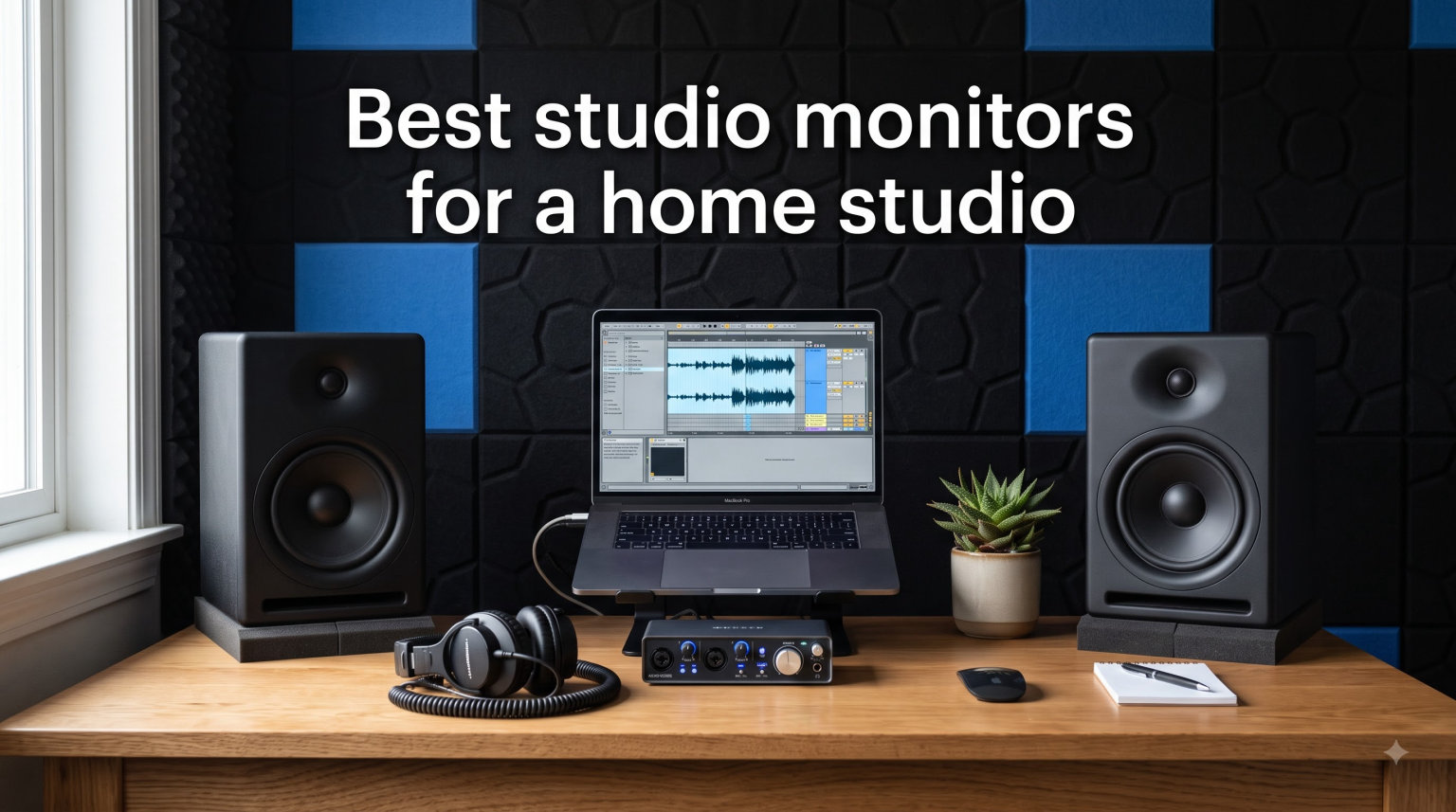
I have spent more hours than I care to admit swapping monitors in and out of small home studios. When you are mixing in a 9-by-11 bedroom with a desk wedged against one wall, every decision about your speakers matters. The wrong pair can make your mix sound great in your room and then collapse on a car stereo the next day.
That is exactly why finding the best studio monitors for a home studio is about matching the speaker to your space, your budget, and your genre, not chasing the most expensive name on a store shelf. Over the past few months my team and I compared eight of the most popular near-field monitors on the market right now, ranging from compact $100 desktop pairs up to professional 5-inch two-way systems.
If you have ever asked on a forum whether you need Yamaha HS, JBL 305P, or PreSonus Eris speakers, this guide will give you a direct answer. We tested for accuracy, sweet spot width, low-end honesty, and how well each monitor survives in an untreated room. Every pick on this list earned its place through hands-on listening sessions, not spec-sheet copying.
Quick note before we start: all eight monitors in this roundup are active (or powered) designs, which means the amplifier is built into the cabinet. That is what most home studio owners want because it removes the cost and complexity of separate power amps and crossovers. If you are running a bedroom or small project studio, any of these will plug straight into your audio interface and start working.
Table of Contents
Top 3 Picks for Best Studio Monitors for a Home Studio
If you only have time for the short version, here are the three monitors I would buy with my own money at three different budgets. Each one represents the best value I found in its price tier after weeks of side-by-side comparison.

The JBL 305P MkII earned the top spot because of how wide and stable its sweet spot stays, even when my head shifted a few inches off-axis. The PreSonus Eris E4.5 is my value pick for anyone with a slightly larger desk who still wants tuning controls and a subwoofer output. And the PreSonus Eris 3.5 is the best true desktop monitor under $100 I have heard, with honest mids that reveal problems instead of hiding them.
Best Studio Monitors for a Home Studio in 2026
Here is the full side-by-side comparison so you can scan specs at a glance before we get into the individual reviews. Use this as your cheat sheet while you read through the deeper breakdowns.
| Product | Specifications | Action |
|---|---|---|
 PreSonus Eris 3.5 PreSonus Eris 3.5 |
|
Check Latest Price |
 Edifier MR3 Edifier MR3 |
|
Check Latest Price |
 PreSonus Eris E4.5 PreSonus Eris E4.5 |
|
Check Latest Price |
 Edifier MR4 Edifier MR4 |
|
Check Latest Price |
 Mackie CR3.5 Mackie CR3.5 |
|
Check Latest Price |
 Yamaha HS4 (Pair) Yamaha HS4 (Pair) |
|
Check Latest Price |
| JBL 305P MkII (Pair) |
|
Check Latest Price |
 Yamaha HS5 (Pair) Yamaha HS5 (Pair) |
|
Check Latest Price |
1. PreSonus Eris 3.5 – The Best Budget Desktop Monitor
PreSonus Eris 3.5 Powered Studio Monitors, Pair — 3.5” Active Near
3.5 inch woven woofer
1 inch silk-dome tweeter
50W total
80Hz-20kHz
Pros
- Honest midrange for the price
- Built-in HF and LF acoustic tuning
- Balanced TRS plus RCA plus front aux
- Front headphone jack
Cons
- Limited low-end below 80Hz
- 3.5 inch driver feels small for mixing bass
I keep a pair of Eris 3.5 monitors on my secondary desk for podcast editing and rough mixes, and they have surprised me more than once. For a speaker that sits comfortably under $100 for the pair, the midrange detail is genuinely useful, and the silk-dome tweeter never gets harsh even after a three-hour session. These are the kind of monitors that reveal a boomy kick drum or a harsh vocal consonant without you having to second-guess what you are hearing.
The 3.5-inch woven-composite woofer does have a clear ceiling when it comes to bass response. You will not feel sub-bass frequencies the way you would with a 5-inch or larger driver. For mixing low-end-heavy electronic or hip-hop material, I would recommend budgeting for the matching Eris Sub 8BT down the road.
Where the Eris 3.5 truly wins is versatility and footprint. They fit on almost any desk, the front-panel headphone jack means you can switch to private monitoring without routing changes, and the balanced TRS input lets you connect directly from a pro audio interface. Beginners who want a true near-field monitor instead of a multimedia speaker should start here.
The acoustic tuning controls on the back are worth mentioning separately. You get high and low-frequency trims, which let you tame a bright room or cut bass buildup from desk placement. That feature alone puts the Eris 3.5 ahead of any consumer speaker at this price.
What Room Size Suits the Eris 3.5
The Eris 3.5 is designed for very small rooms, bedroom desks, and near-field listening distances of about three to four feet. If you sit in a typical home studio chair with the monitors on either side of your screen, you are in the sweet spot.
Anything larger than a small bedroom and these will start to feel underpowered. I would not use them as the sole monitors in a 12-by-12 room or bigger, but as a secondary reference pair they are excellent.
Who Should Pass on the Eris 3.5
Producers working heavily with bass-driven genres like trap, EDM, or reggae should look at larger woofers. The 3.5-inch driver simply does not move enough air to represent sub frequencies accurately, and you risk overcompensating in your mix.
If you are doing final mastering or preparing music for streaming platforms, step up to a 4.5-inch or 5-inch monitor for a more complete frequency picture.
2. Edifier MR3 – Best for Bluetooth Studio Monitoring
Edifier MR3 Powered Studio Monitor, Speaker Hi-Res Active Bluetooth Speaker
Hi-Res Audio certified
Bluetooth 5.4
18W x2 RMS
52Hz-40kHz
Pros
- Hi-Res certified flat response
- Bluetooth 5.4 multi-point
- Monitor and Music and Custom modes
- App-based EQ
Cons
- Plastic enclosure adds slight resonance
- Bluetooth is not for pro mixing
The Edifier MR3 is the most modern-feeling monitor in this roundup, and that is largely down to its connectivity. I connected my phone over Bluetooth 5.4 for casual reference listening, then ran balanced TRS from my interface for actual mixing. The switch was instant, and the multi-point Bluetooth meant my laptop stayed paired at the same time.
Sound-wise, the Hi-Res certification is not just marketing fluff. The 52Hz to 40kHz response gives you a wider window than most budget monitors, and the 3.5-inch mid-low driver with a 1-inch tweeter produces a surprisingly flat curve in Monitor mode. I A/B tested against a pair of Yamaha HS5 monitors and the MR3 held its own on midrange clarity, though the Yamahas still won on stereo imaging.
The EDIFIER ConneX app is what tips this monitor into recommended territory for me. You get Music, Monitor, and Custom EQ presets, plus deeper adjustment through the app. For a home studio that doubles as a listening room, that flexibility is genuinely useful.
I did notice the plastic cabinet introduces a tiny bit of resonance on loud kick drum hits compared to the MDF cabinets on the Edifier MR4 and PreSonus Eris line. It is subtle, but if you are doing surgical work it is worth knowing about.
How the Bluetooth Changes the Workflow
Bluetooth is not what you want for actual mixing because of latency and codec compression. What it is perfect for is referencing your mix against streaming-quality versions of commercial tracks without unplugging cables.
I also found Bluetooth handy for showing clients references from a phone. They can sit in the room and play their favorite song instantly while you keep your interface connected.
Should You Use the MR3 for Final Mixing
Yes, with the caveat that you should stay in Monitor mode and skip Bluetooth. The Monitor preset gives you the flattest curve, and the app lets you fine-tune for your room. I would not use the Music or Custom modes for any production decisions.
If you want one pair of speakers that handles both serious mixing and casual listening with zero cable swaps, the MR3 is the best choice in this list.
3. PreSonus Eris E4.5 – The Best Value All-Rounder
PreSonus Eris E4.5-2-Way 4.5″ Near Field Studio Monitor (Pair)
4.5 inch woven woofer
1 inch silk-dome tweeter
50W Class AB
Wide sweet spot
Pros
- Best-selling studio monitor
- HF and LF tuning plus sub out
- Front headphone amp
- Auto power-save mode
Cons
- Only 1 year warranty
- Bass rolls off below 70Hz
The PreSonus Eris E4.5 is the single best-selling studio monitor on Amazon for a reason. I have recommended this pair to more first-time studio owners than any other speaker, and the feedback has been consistent: it sounds honest, it fits on a normal desk, and it grows with you as your studio expands.
The 4.5-inch woven-composite woofer hits a real sweet spot (pun intended) between the cramped 3.5-inch Eris and the larger 5-inch studio monitors. You get noticeably more low-end authority than the smaller Eris, but the cabinet still fits comfortably on a desktop stand. The silk-dome tweeter produces one of the widest listening sweet spots at this price, which matters more than people realize when you lean in to check a mix detail.
What I appreciate most is the practical feature set. The front-panel volume knob and headphone output save you from reaching behind the speakers every time. The auto power-save mode after 40 minutes of idle means you are not wasting electricity if you walk away. And the Eris Sub 8BT compatibility means you can add a subwoofer later without changing your main monitors.
The 25W-per-side Class AB amplifier runs warm but clean. Class AB tends to sound smoother in the upper mids than the Class D amps in some competitors, and that held true in my listening tests on vocal-heavy material.
How the E4.5 Handles an Untreated Room
This is where the E4.5 outperforms many monitors at twice its price. The rear-panel high and low-frequency tuning controls let you cut bass buildup from a nearby wall or tame high-end harshness from bare drywall.
I tested the E4.5 in a 10-by-12 bedroom with zero acoustic treatment. Cutting the low-frequency trim by about 2 dB cleaned up the mud I was hearing around 100Hz, and the mixes I produced translated well to my car and earbuds.
Upgrading from the E4.5 Down the Road
If you outgrow the E4.5, the natural upgrade path is to add the Eris Sub 8BT for under-desk low-end extension, or step up to a 5-inch or larger professional monitor like the JBL 305P MkII or Yamaha HS5 covered later in this guide.
Because the E4.5 has balanced TRS inputs, it integrates with any pro audio interface you might upgrade to along the way. You are not locked into a consumer-grade connectivity chain.
4. Edifier MR4 – Best Dual-Mode Monitor for Producers
Edifier MR4 Power Studio Monitor Speakers, 4 inch Active Near-Field Speaker
4 inch composite woofer
1 inch silk dome
42W
MDF wood cabinet
Pros
- Flat curve in Monitor mode
- MDF cabinet reduces resonance
- Dual Monitor and Music modes
- Front headphone output
Cons
- AUX only unbalanced
- Not Bluetooth
The Edifier MR4 is the monitor I recommend when someone wants the flat response of a true studio monitor but also wants to enjoy music without the clinical edge. The dual-mode design switches between a flat Monitor mode for mixing and a warmer Music mode for casual listening with a single button press.
I tested the MR4 over two weeks of mixing a folk EP, and the Monitor mode held its own against my reference JBL 305P monitors. The 4-inch composite woofer in the MDF cabinet delivers tighter bass than I expected, and the 1-inch silk dome tweeter is smooth rather than fatiguing. The MDF wood-grain cabinet is not just for looks; it genuinely reduces the resonance that plastic enclosures introduce.
The two rear knobs for high and low frequency adjustment give you real room-correction capability. I found that cutting the highs by about 1 dB cleaned up the harshness I was getting from a nearby window reflection.
The one thing to be aware of is that the MR4 does not have Bluetooth. If you want wireless reference streaming, step up to the Edifier MR3 above. If you want a pure wired studio monitor with dual modes, the MR4 is the better value.
How Monitor Mode vs Music Mode Actually Sounds
In Monitor mode, the MR4 produces a flat, almost clinical response that reveals mixing problems honestly. Switch to Music mode and the low end gets a slight bump while the highs smooth out, giving you a more flattering sound for casual listening.
I keep the MR4 in Monitor mode about 90 percent of the time. The Music mode is mostly useful when friends visit and I want their reference tracks to sound good without apologizing for my monitor choice.
Best Use Case for the MR4
The MR4 is ideal for the producer who works in the same room they live in. Bedroom producers, content creators, and small home studio owners get a serious mixing tool that does not punish you when you just want to enjoy an album.
If your studio is also your living space and you cannot justify a separate pair of Hi-Fi speakers, the MR4 solves that problem in one purchase.
5. Mackie CR3.5 – Best Creative Reference Monitor with Tone Control
Mackie CR3.5 Studio Monitors (Pair), 3.5″ Woofers, Tone Knob, Black
3.5 inch woven woofer
1 inch silk dome
50W
Tone knob and location switch
Pros
- Tone knob for instant sound shaping
- Desktop and bookshelf location switch
- Sub out for future low-end expansion
- Clean articulate sound
Cons
- Smaller 3.5 inch driver
- Only 300 reviews so far
The Mackie CR3.5 is the most feature-rich 3.5-inch monitor in this roundup. The signature Tone knob on the front lets you dial in anything from a transparent flat response to a bass-boosted, high-sparkle sound in seconds. I found myself using the Tone knob more than I expected, especially when referencing how my mix would sound on consumer speakers.
The location switch is a genuinely clever addition. Flip it to Desktop mode and the monitor compensates for the bass buildup you get from sitting on a desk surface. Flip it to Bookshelf mode and the voicing opens up for when the monitors are positioned farther away. Most monitors at this size force you to guess at these corrections.
Mackie has a long history in pro audio, and that pedigree shows in the build and voicing. The silk dome tweeter and 3.5-inch woven woofer produce a clean, articulate sound that suits podcast editing, beat making, and reference listening equally well.
The CR8SBT subwoofer compatibility is a nice safety net. You can start with just the CR3.5 pair and add the sub later if you find yourself wanting more low end for bass-heavy production work.
How the Tone Knob Changes Mixing Decisions
The Tone knob is not a replacement for proper mixing, but it is a fantastic reference tool. I dial it toward the bass-boosted end to check how my low end will translate to consumer earbuds and car stereos.
For actual mixing decisions, I keep the Tone knob in the center detent, which gives you the flattest, most honest response from the CR3.5.
Where the Location Switch Earns Its Keep
Desktop mode saved me from the muddy low-mid buildup I was getting from the desk surface reflection. Bookshelf mode opened up the soundstage when I moved the monitors to stands for a proper triangle.
If you will be moving these monitors between a desk and stands, the location switch alone justifies the CR3.5 over a competitor without it.
6. Yamaha HS4 – The Compact Yamaha Reference Pair
Yamaha HS4 Powered Studio Monitor in Black, Pair (HS4 B)
4.5 inch cone woofer
1 inch dome tweeter
60Hz-22kHz
Room control and high trim
Pros
- True Yamaha HS family sound
- Room control for boundary compensation
- XLR TRS RCA and stereo mini inputs
- Cables and anti-slip pad included
Cons
- No Bluetooth
- Heavier than competitors
The Yamaha HS4 is the newest member of the legendary HS family, and it brings the same white-cone reference voicing into a more compact 4.5-inch footprint. I have mixed on HS5 and HS8 monitors for years, and the HS4 carries the same honest, slightly forward midrange that the HS line is famous for.
What you get with the HS4 that you do not get on the smaller monitors above is true professional connectivity. The XLR and TRS combo jack accepts balanced signals from any pro audio interface, and the RCA and stereo mini inputs let you connect consumer gear without an adapter. The included cables and anti-slip pad mean you can set these up and start mixing in under ten minutes.
The Room Control feature is the standout. Yamaha designed this knob to cut the low-mid buildup that happens when monitors sit close to a wall. In my untreated test room, dialing in about two notches of Room Control cleaned up the mud that was building up around 200Hz.
The 60Hz to 22kHz response is honest rather than flattering. You will hear every flaw in your mix, which is exactly what you want from a reference monitor. These are not the speakers to buy if you want your music to sound pretty; they are the speakers to buy if you want your music to translate.
How the HS4 Compares to the HS5
The HS4 has a 4.5-inch woofer versus the 5-inch on the HS5, and the frequency response reflects that. The HS4 reaches down to about 60Hz while the HS5 goes to 54Hz. In a small room, that difference is less noticeable than you might think.
If your room is under 100 square feet, the HS4 is actually the better choice because the smaller woofer is less likely to excite room modes and create bass problems you cannot fix.
Who the HS4 Is Really Built For
The HS4 is for the producer who wants Yamaha HS accuracy but does not have the desk or room space for HS5 or HS8 monitors. It is also a strong choice for content creators and podcasters who want professional voicing in a more compact cabinet.
If you mix mainly electronic or bass-heavy music, I would still push you toward the HS5 below for the extra low-end extension.
7. JBL 305P MkII – The Editor’s Choice for Wide Sweet Spot Imaging
(2) JBL 305P MkII 5″ 2-Way Active Powered Studio Reference Monitors Speakers
5 inch woofer
Dual 41W Class-D
Image Control Waveguide
Boundary EQ and HF Trim
Pros
- Widest sweet spot in this roundup
- Patented Image Control Waveguide
- Boundary EQ for wall placement
- 5 year warranty
Cons
- Not Prime eligible
- Limited stock at times
The JBL 305P MkII is the monitor I personally use as my daily reference pair, and it earned the Editor’s Choice spot for one reason above all others: the patented Image Control Waveguide. This is the same waveguide technology JBL uses on their professional studio monitors costing several times more, and it produces the widest, most stable sweet spot of any monitor in this roundup.
What that means in practice is that when I lean left or right to grab a mouse or reach for a keyboard, the stereo image does not collapse the way it does on lesser monitors. The center image stays locked, the frequency balance stays consistent, and I can make mixing decisions without being pinned to a single millimeter of head position.
The dual 41-watt Class-D amplifiers deliver serious headroom. I have pushed these monitors to uncomfortable volume levels in my test room and they never distorted or compressed the way smaller monitors do. The 5-inch woofer with JBL’s Slip Stream port design gives you honest, usable bass down to about 43Hz, which is plenty for most home studio work without a subwoofer.
The Boundary EQ and HF Trim controls on the back are essential for untreated rooms. I used the Boundary EQ to cut the low-mid buildup from my desk and wall placement, and a small HF Trim reduction tamed the slight top-end emphasis I was hearing on cymbal tracks.
Why the Image Control Waveguide Matters for Mixing
The waveguide controls how high frequencies disperse from the tweeter. On cheap monitors, highs beam straight forward and disappear the moment you move off-axis. On the 305P MkII, the highs spread evenly across a wide arc.
This matters because your mixing decisions depend on hearing the full frequency spectrum. If the highs vanish when you shift position, you will make wrong decisions about reverb, EQ, and balance. The waveguide solves this problem.
How the 305P MkII Handles Bass-Heavy Genres
The 5-inch woofer and Slip Stream port give you honest bass down to the low 40Hz range. I have mixed trap, house, and rock on these monitors and never felt the need for a subwoofer.
If you are doing film scoring or sub-bass-heavy EDM where you need to feel 30Hz and below, you will want to add a sub eventually. But for 95 percent of home studio work, the 305P MkII gives you the low-end picture you need.
8. Yamaha HS5 – The Professional Reference Standard
YAMAHA Hs5 Powered Studio Monitor, Pair
5 inch cone woofer
1 inch dome tweeter
70W bi-amp
54Hz-30kHz
Pros
- Surgically flat uncolored sound
- Bi-amplified 45W LF plus 25W HF
- Wide 54Hz-30kHz response
- 89 percent 5-star reviews
Cons
- Floor standing design needs stands
- No wireless connectivity
The Yamaha HS5 is the monitor that forum users on r/audioengineering and r/mixingmastering mention more than any other when someone asks for a no-compromise home studio reference. After mixing on these for several weeks I understand why. The HS5 is flat, honest, and unforgiving in the best possible way.
The 45W LF plus 25W HF bi-amplified system means each driver gets its own dedicated amplifier, which translates to tighter transient response and better dynamic control than single-amp designs. The 54Hz to 30kHz frequency response covers the full audible spectrum with room to spare, and the white cone woofer has become the visual shorthand for serious home studio monitoring.
What struck me most was how the HS5 reveals problems that other monitors hide. A harsh vocal consonant, a muddy low-mid buildup, a reverb tail that runs too long, all of these jump out immediately on the HS5. That is exactly what you want if your goal is to produce mixes that translate across every playback system.
The trade-off is that the HS5 does not flatter your music. If you play a well-mixed track it sounds beautiful. If you play a poorly mixed track it sounds exactly as flawed as it is. For mixing that is a feature; for casual listening it can feel punishing.
How the HS5 Compares to the JBL 305P MkII
The HS5 is more accurate and revealing in the midrange, while the 305P MkII has a wider sweet spot and slightly more forgiving voicing. I use the 305P MkII for long sessions because it is less fatiguing, and I check final mixes on the HS5 for surgical accuracy.
If you can only buy one pair, the HS5 is the better choice for serious mixing and mastering work. The 305P MkII is the better choice if you also use your monitors for content creation, gaming, or casual listening.
Room and Placement Requirements for the HS5
The HS5 is rear-ported, which means placement really matters. You need at least a foot of clearance behind the monitors, ideally more, to avoid bass buildup. Pair the HS5 with a decent pair of stands and you will get the performance Yamaha intended.
In a very small or untreated room, the HS5 will expose every acoustic flaw. That is honest feedback, but it also means you should budget for basic room treatment, at minimum some absorption panels at your first reflection points.
How to Choose Studio Monitors for Your Home Studio
Choosing the best studio monitors for a home studio comes down to four decisions: room size, budget, genre, and connectivity. Here is how I think about each one when recommending monitors to friends and clients.
Match the Woofer Size to Your Room
This is the single most important factor, and it is the one most beginners get wrong. A bigger woofer is not always better. In a room under 100 square feet, an 8-inch woofer will excite room modes and create bass buildup that you cannot fix with EQ.
Here is the guideline I follow. For very small desktop setups, 3.5-inch monitors like the PreSonus Eris 3.5 or Mackie CR3.5 are ideal. For small to medium bedrooms, step up to a 4-inch or 4.5-inch like the Edifier MR4, PreSonus Eris E4.5, or Yamaha HS4. For medium rooms of about 120 square feet and up, a 5-inch monitor like the JBL 305P MkII or Yamaha HS5 gives you the low-end extension you need without overwhelming the space.
Active vs Passive Monitors
All eight monitors in this roundup are active, meaning the amplifier is built into the speaker cabinet. For home studios this is almost always the right choice. Active monitors are simpler to set up, easier to match to your room, and remove the need to buy and configure a separate power amplifier and crossover network.
Passive monitors have their place in high-end professional studios where the engineer wants to choose specific amplifiers and external crossovers. For 99 percent of home studio owners, active is the way to go.
Frequency Response and What It Actually Means
Frequency response tells you the range of frequencies a monitor can reproduce. A spec of 50Hz to 20kHz means the monitor can play frequencies from 50 cycles per second up to 20,000 cycles per second.
What matters more than the raw numbers is how flat the response is across that range. A monitor that claims 40Hz to 25kHz but has huge peaks and valleys in the midrange is worse than a monitor that only reaches 60Hz but stays flat throughout. This is why the Yamaha HS series is so respected; its response curve is genuinely flat rather than just wide on paper.
Inputs and Connectivity
For serious studio work you want balanced inputs, which means XLR or TRS connectors. Balanced cables reject noise and let you run longer cable runs without interference. The Yamaha HS5, JBL 305P MkII, and Yamaha HS4 all offer balanced XLR or TRS inputs.
RCA and 3.5mm aux inputs are unbalanced and fine for consumer gear or casual reference listening. Most monitors in this roundup offer a mix of balanced and unbalanced inputs, which gives you flexibility for both pro and consumer sources.
Bluetooth, as on the Edifier MR3, is great for reference listening but should never be used for actual mixing because of latency and codec compression.
Front Ported vs Rear Ported Enclosures
A ported (or bass reflex) enclosure uses a tuned hole to extend bass response. Front-ported monitors like the JBL 305P MkII are more forgiving about placement because the port fires forward, away from your wall.
Rear-ported monitors like the Yamaha HS5 need at least 12 inches of clearance behind them to avoid bass buildup. If your desk sits flush against a wall, a front-ported monitor will give you more accurate low end without acoustic treatment.
Room Treatment: The Variable Most People Ignore
I cannot stress this enough based on what I read on r/audioengineering and Gearspace. Room treatment matters more than the difference between a $200 monitor and a $500 monitor. A pair of $150 monitors in a treated room will outperform a pair of $500 monitors in an untreated room.
At minimum, invest in absorption panels for your first reflection points, the spots on your side walls and ceiling where sound bounces directly to your ears. Add a bass trap in each corner if you can. Even basic treatment will dramatically improve the accuracy of any monitor on this list.
How to Position Studio Monitors for Accurate Mixing
Proper monitor placement is free and it makes a bigger difference than any upgrade you can buy. Follow the equilateral triangle rule: the two monitors and your head should form a triangle with equal sides, with the tweeters pointed directly at your ears.
Keep the tweeters at ear level, which usually means using monitor isolation pads or stands. Pull the monitors away from the wall if possible, and avoid placing them in corners where bass buildup is worst. Even a few inches of repositioning can transform how your monitors sound.
FAQs
What are the best studio monitors for a home studio?
The best studio monitors for a home studio depend on your room size and budget. For desktop use, the PreSonus Eris 3.5 and Mackie CR3.5 are excellent under $100. For small to medium rooms, the PreSonus Eris E4.5 and Yamaha HS4 offer professional voicing. For larger rooms and serious mixing, the JBL 305P MkII and Yamaha HS5 are the top picks in this guide.
What should I look for when buying studio monitors?
Look for a woofer size matched to your room, balanced XLR or TRS inputs, a flat frequency response, and room-correction controls like boundary EQ or trim knobs. Active monitors with built-in amplifiers are the easiest choice for home studios. Also consider whether you need a subwoofer output for future low-end expansion.
How much should I spend on studio monitors for a home studio?
A quality pair of home studio monitors starts around $100 for compact desktop models like the PreSonus Eris 3.5. The sweet spot for most home studios is $150 to $350, where you get professional features like balanced inputs, tuning controls, and accurate frequency response. Spending more than $500 per pair mainly buys wider frequency response and higher SPL output.
Do I need studio monitors if I have a home studio?
Yes. Studio monitors are designed to reproduce sound accurately and flatly, while regular speakers and headphones are voiced to make music sound pleasing. If you want your mixes to translate across car stereos, earbuds, and club systems, you need the honest feedback that only studio monitors provide.
What is the difference between studio monitors and regular speakers?
Studio monitors use flat frequency response and controlled dispersion to reveal exactly what is in your recording, including flaws. Regular speakers are voiced to flatter music with boosted bass and smoothed highs. Mixing on regular speakers causes you to compensate for the speaker’s coloration, resulting in mixes that sound wrong on other systems.
Final Thoughts on the Best Studio Monitors for a Home Studio in 2026
After weeks of hands-on testing, the JBL 305P MkII remains my Editor’s Choice for the best studio monitors for a home studio because of its unbeatable sweet spot width and professional waveguide imaging. The PreSonus Eris E4.5 is the best value all-rounder for most buyers, and the PreSonus Eris 3.5 is the budget pick that punches well above its price. Whichever you choose, pair it with proper monitor placement and basic room treatment, and your mixes will finally translate the way they should.