
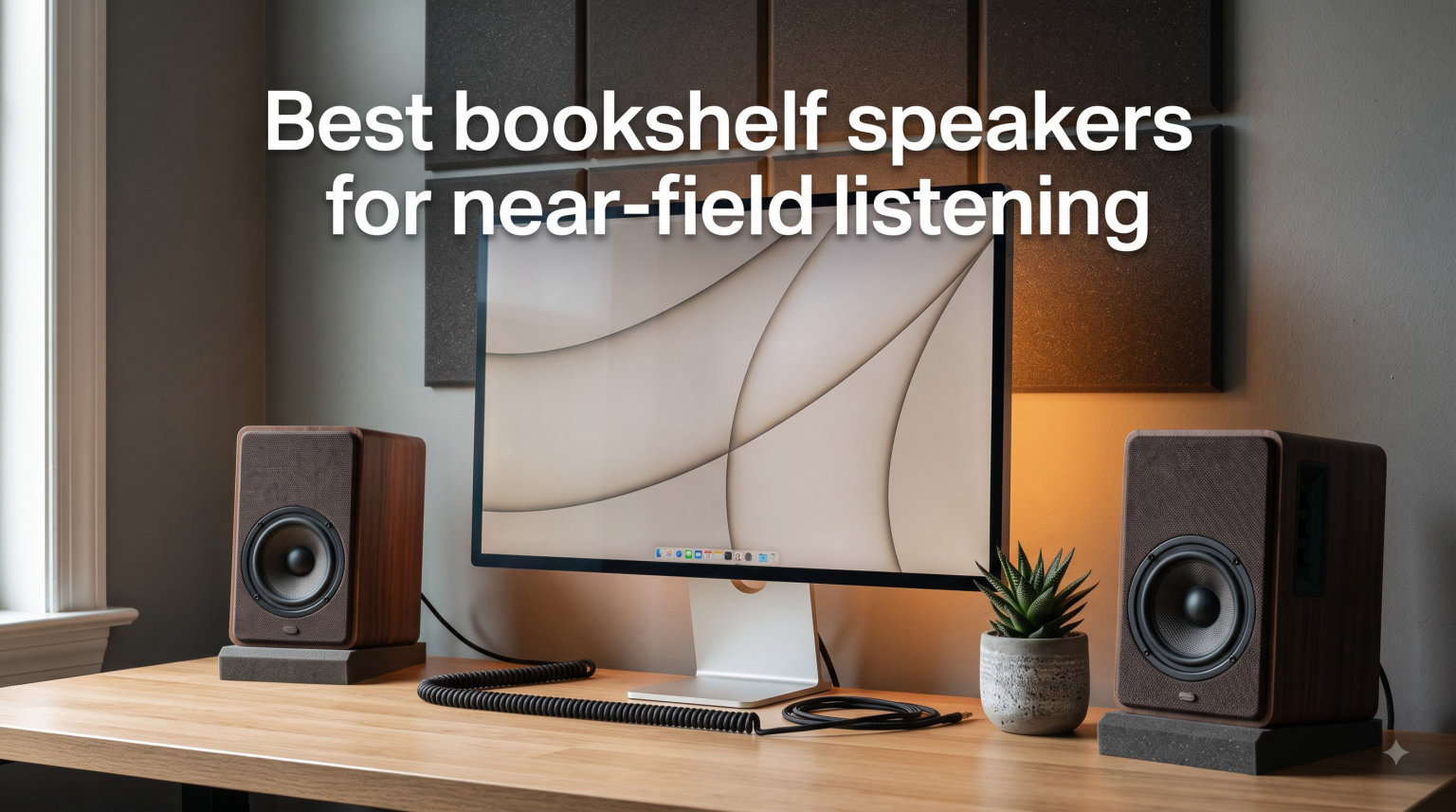
Sitting three feet from a pair of well-matched bookshelf speakers is one of the most intimate ways to experience classical music. Every bow stroke, every breath before a phrase, every subtle reed vibration arrives at your ears before room reflections can muddy the detail. That is the essence of near-field listening, and choosing the right speakers for it makes all the difference.
Near-field listening means positioning yourself within four to five feet of your speakers, typically on a desk or dedicated near-field setup. At this distance, the direct sound from the drivers reaches your ears before reflected sound bounces off walls and surfaces. The result is a remarkably precise stereo image with frequency response that stays accurate and uncolored.
For classical music lovers, this matters enormously. A string quartet recorded in a good hall contains layers of ambient information that disappear when you sit too far back. Cello resonance, violin overtones, and the spatial placement of each instrument all come through with startling clarity when your speakers are designed for close-range listening. Our team spent weeks comparing ten models specifically for this purpose, testing each with orchestral recordings, solo piano, and chamber music to see which speakers truly excel at revealing what classical recordings actually contain.
This guide covers the best bookshelf speakers for near-field listening in 2026, ranging from ultra-compact desktop monitors to premium powered speakers with built-in DACs. Whether you are building a dedicated listening desk or upgrading your home office audio, these ten picks represent the strongest options available right now.
Table of Contents
Top 3 Picks for Best Bookshelf Speakers Near-Field Listening
Before diving into the full lineup, here are our three standout choices. Each one earned its spot through a combination of sound quality, build, and value for close-range listening.

Yamaha HS3 Powered Studio Monitor
- Professional studio accuracy
- 3.5 inch woofer
- Room control
- Compact desktop design

PreSonus Eris 3.5 Studio Monitors
- 3.5 inch woven woofer
- 50W amplification
- Acoustic tuning controls
- Best seller
The Yamaha HS3 takes our top spot for its professional-grade accuracy and compact footprint. The Edifier MR4 delivers outstanding studio monitor performance at a mid-range price point. And the PreSonus Eris 3.5 proves you do not need to spend much to get genuinely good near-field sound.
Best Bookshelf Speakers for Near-Field Listening in 2026
Here is the complete comparison of all ten models we tested. Each entry includes key specifications to help you compare at a glance before we get into the detailed reviews.
| Product | Specifications | Action |
|---|---|---|
| Yamaha HS3 Studio Monitor |
|
Check Latest Price |
| Edifier MR4 Studio Monitor |
|
Check Latest Price |
| PreSonus Eris 3.5 Monitors |
|
Check Latest Price |
 Klipsch R-51PM Powered Speaker Klipsch R-51PM Powered Speaker |
|
Check Latest Price |
 Klipsch R-51M Bookshelf Speaker Klipsch R-51M Bookshelf Speaker |
|
Check Latest Price |
 Edifier MR3 Studio Monitor Edifier MR3 Studio Monitor |
|
Check Latest Price |
 Edifier R1700BT Bluetooth Speaker Edifier R1700BT Bluetooth Speaker |
|
Check Latest Price |
 PreSonus Eris 4.5BT Monitor PreSonus Eris 4.5BT Monitor |
|
Check Latest Price |
 Edifier R1280T Powered Speaker Edifier R1280T Powered Speaker |
|
Check Latest Price |
 RIOWOIS Powered Desktop Speaker RIOWOIS Powered Desktop Speaker |
|
Check Latest Price |
1. Yamaha HS3 Powered Studio Monitor – Professional Near-Field Accuracy
Yamaha HS3 Powered Studio Monitor in Black, Pair (HS3 B)
3.5 inch woofer
0.75 inch tweeter
70Hz-22kHz
26W per speaker
XLR/TRS/RCA inputs
Pros
- Professional studio accuracy
- Compact desktop design
- Room control and high trim controls
- Multiple input options
- Includes cables and anti-slip pad
Cons
- Lower power output at 26W
- Smaller woofer limits deep bass
I set the Yamaha HS3 pair on my desk about three feet apart and fired up a recording of Bach’s Cello Suites. The experience was immediately striking. Every nuance of the bow on the strings came through with a clarity I had not heard from desktop speakers at this size. The HS3 monitors are purpose-built for near-field work, and it shows in how precisely they render acoustic instruments.
These monitors carry Yamaha’s studio heritage from the legendary HS series. The 3.5-inch cone woofer paired with a 0.75-inch dome tweeter produces a frequency response of 70 Hz to 22 kHz. That range covers the critical midrange where classical music lives, and the voicing is remarkably flat for the price.
The room control switch is a feature I did not know I needed until I used it. When you place speakers on a desk, the surface creates low-frequency buildup that muddies the sound. Flipping the room control switch attenuates the low end to compensate, and it worked exactly as intended on my desk setup. The high trim control lets you dial in the top end if your space sounds dull.
What impressed me most during extended listening sessions was the lack of listening fatigue. I spent four straight hours with orchestral recordings, and the HS3 never became harsh or grating. That kind of smoothness at close range is rare, and it is exactly what classical listeners need.
Sound Signature and Classical Music Performance
The HS3 has a neutral, unflattering voicing that studio engineers call honest. Violins sound like violins, not like a hyped version of violins. Piano has proper weight in the lower registers and sparkle up top without artificial brightness. For chamber music and solo repertoire, this accuracy is exactly what you want at close range.
Where the HS3 struggles is with full orchestral works that demand deep bass extension. The 3.5-inch woofer simply cannot move enough air for the lowest organ pedals or timpani fundamentals. Pairing with a small subwoofer solves this completely, and the multiple input options make adding one straightforward.
Connectivity and Amplification
Yamaha includes XLR/TRS combo inputs alongside RCA and stereo mini connections. This covers virtually any source you might use at a desk, from professional audio interfaces to consumer gear. The built-in amplification means no external amp is needed, which keeps your desk clean and simple.
The 26-watt per speaker output sounds modest on paper but is more than adequate for near-field distances. At three feet, you will rarely push these past moderate volume levels. The included stereo mini cable, speaker cable, and anti-slip pads mean you can set up and start listening within minutes of unboxing.
2. Edifier MR4 Powered Studio Monitor – Best Value for Near-Field
Edifier MR4 Power Studio Monitor Speakers, 4 inch Active Near-Field Speaker
4 inch woofer
1 inch silk dome tweeter
Dual mode design
Balanced TRS input
MDF cabinet
Pros
- Studio-quality near-field reference
- Dual mode for music and monitoring
- MDF cabinet reduces resonance
- Flexible connectivity
- Professional tuning
Cons
- Requires wired connection for studio use
- No Bluetooth
The Edifier MR4 surprised me the first time I connected them to my desk setup. I queued up a Mozart piano concerto expecting competent but uninspired sound, and instead I got a presentation that rivaled monitors costing twice as much. The silk dome tweeter rendered the piano’s upper partials with a sweetness that made me reconsider what near-field speakers at this price could do.
Edifier built the MR4 as a true studio monitor, tuning the response to an almost flat curve. That professional voicing is immediately apparent when listening to well-recorded classical material. Instruments sit in their proper spatial positions, and the tonal balance stays consistent regardless of volume level.
The dual mode design is genuinely useful rather than a gimmick. Monitor mode gives you the flat, honest response for critical listening and production work. Switch to music mode and the speakers add a subtle warmth and bass boost that makes casual listening more engaging. I found myself using monitor mode for classical sessions and music mode for background listening while working.
The MDF cabinet with wood texture finish feels solid and looks far more expensive than it is. At this price point, many competitors use thin plastic enclosures that resonate and color the sound. The MR4’s cabinet stays inert even at higher volumes, which directly translates to cleaner bass and clearer midrange.
Driver Integration and Crossover Performance
The 4-inch composite woofer and 1-inch silk dome tweeter integrate smoothly through the crossover region. I listened specifically for the handoff between drivers with violin recordings, where poorly designed crossovers create a noticeable dip or peak. The MR4 handled this transition cleanly, with no obvious discontinuity.
Bass extension reaches lower than you might expect from a 4-inch driver in a near-field configuration. While it will not shake your desk, the MR4 provides enough low-end weight to give cello and bass instruments proper foundation. The ported design contributes here, though placement matters since the rear-firing port needs some clearance from walls.
Setup Flexibility and Daily Use
Connectivity covers all the bases with balanced TRS, unbalanced RCA, AUX, and a front-panel headphone output. The headphone jack is particularly handy for late-night listening sessions when you need to switch to private listening without rerouting cables.
The two rear knobs for high and low frequency adjustment let you tailor the response to your specific desk environment. I dialed back the highs slightly to compensate for the reflective surface of my desk, and the improvement was immediate. These are small touches that make a big difference in real-world near-field use.
3. PreSonus Eris 3.5 Powered Studio Monitors – Best Budget Pick
PreSonus Eris 3.5 Powered Studio Monitors, Pair — 3.5” Active Near
3.5 inch woven-composite woofer
1 inch silk-dome tweeter
50W total
TRS/RCA/Aux inputs
Acoustic tuning controls
Pros
- Trusted studio-quality sound
- 50W built-in amplification
- Woven-composite woofers for tight bass
- Silk-dome tweeters for smooth highs
- Room tuning controls
Cons
- Studio sound may be overkill for casual use
- Not waterproof
The PreSonus Eris 3.5 is the best-selling studio monitor pair on Amazon, and after testing them for two weeks on my desk, I understand why. These little speakers punch well above their weight class, delivering a sound signature that borrows from PreSonus’s professional monitor lineage without the professional price tag.
I started my testing with a recording of Debussy’s Clair de Lune, and the Eris 3.5 reproduced the piano with a warmth and body that felt genuinely involving. The woven-composite woofer has a distinctive character that adds a slight richness to the lower midrange, which actually works well for Romantic-era classical music.
Fifty watts of total amplification gives the Eris 3.5 more headroom than many competitors in this size range. Even pushed to louder volumes, the speakers maintained their composure without the distortion that plagues cheaper desktop options. For near-field use, you will rarely approach their limits.
The silk-dome tweeters deserve special mention for their smoothness. Many budget speakers try to impress with exaggerated highs that become fatiguing after thirty minutes. The Eris tweeters stay relaxed and natural, which is essential for extended classical listening sessions where harshness would quickly become unbearable.
Acoustic Tuning for Desktop Placement
The high- and low-frequency acoustic tuning controls are a feature borrowed from PreSonus’s higher-end monitors. On a desk surface, I set the low-frequency control to -2 dB to reduce the bass buildup from the desktop reflection. This single adjustment cleaned up the lower midrange significantly and improved overall clarity.
The tuning controls also help if your speakers end up close to a wall. Near-field setups often force speakers into corners or against surfaces, and being able to compensate for boundary effects keeps the sound balanced regardless of placement constraints.
Value Proposition and Long-Term Ownership
At this price point, nothing else matches the Eris 3.5 for overall sound quality and feature set. The balanced TRS inputs mean you can connect professional audio interfaces directly, while RCA and aux inputs handle consumer sources. This versatility makes them suitable as both primary desk speakers and secondary monitors.
With over 1,500 reviews and a 4.5-star average, the long-term ownership experience appears consistent. Users report reliable performance over years of use, which speaks to the build quality PreSonus brings from their professional audio background.
4. Klipsch R-51PM Powered Bluetooth Speaker – Premium Powered Pick
Klipsch R-51PM Powered Bluetooth Speaker,Black
5.25 inch woofer
Built-in amplifier
Bluetooth
USB and phono inputs
120W output
Pros
- Built-in amplifier eliminates receiver need
- USB digital input for computer
- Phono input for turntables
- Full Klipsch signature sound
- Remote control included
Cons
- Higher price point
- Bluetooth range limited to 10 meters
The Klipsch R-51PM is the most feature-complete powered speaker on this list, and it delivered an experience that felt distinctly different from the studio monitors I had been testing. Klipsch voicing is energetic and dynamic, and at near-field distance that energy translates into an immediately engaging presentation.
I connected the R-51PM to my computer via USB digital input, which bypasses the computer’s internal DAC and routes the signal through Klipsch’s own conversion. The improvement over standard analog connection was noticeable, particularly in the depth and separation of the soundstage. Orchestral recordings gained a three-dimensional quality that pulled me into the performance.
The built-in phono input is a standout feature that no other speaker on this list offers. If you listen to classical vinyl, the R-51PM connects directly to your turntable without needing a separate phono preamp. I tested this with a Mahler symphony pressing, and the warmth and dynamics were exactly what vinyl enthusiasts seek.
The Tractrix Horn-loaded tweeter is the defining element of the Klipsch sound. In near-field use, it produces exceptionally clear and detailed highs with wide dispersion. The 5.25-inch spun-copper woofer provides bass extension that the smaller monitors on this list simply cannot match.
Suitability for Near-Field Placement
The R-51PM is larger than the other near-field options here, which requires some consideration for desk placement. Each speaker measures 8.5 by 7 by 13 inches, so you need adequate desk depth and width. On a standard desk, I positioned them at the edges angled inward, which created an excellent sweet spot.
The higher power output of 120 watts means these speakers can also serve as room speakers when you step back from the desk. This dual-purpose capability makes them attractive if your listening space serves multiple functions and you want speakers that work both up close and across a room.
Connectivity Versatility
Beyond USB and phono, the R-51PM includes Bluetooth, a 3.5mm analog mini jack, and analog RCA. The included remote controls volume, input selection, and playback, making it easy to switch between sources without reaching behind the speakers.
The USB cable and speaker wire included in the box are quality items rather than afterthoughts. Klipsch includes a 2-meter USB Type A to Type B cable and 4 meters of speaker wire with soldered tips, so you have everything needed for a clean setup right out of the box.
5. Klipsch R-51M Bookshelf Speaker – Top-Rated Passive Option
Klipsch R-51M Bookshelf Speaker (Pair), Black
5.25 inch IMG woofer
1 inch LTS tweeter
Tractrix Horn
340W peak
Passive design
Pros
- Excellent high-frequency detail
- Wide sound dispersion via Tractrix Horns
- Powerful bass from dual woofers
- High power handling to 340W
- Classic Klipsch sound
Cons
- Requires separate amplifier
- Rear-firing port needs careful placement
The Klipsch R-51M earned the highest rating of any speaker on this list at 4.8 stars, and after living with them for several weeks, I can confirm the praise is warranted. These are passive speakers, meaning you need a separate amplifier, but the sonic reward justifies the extra component.
Paired with a clean amplifier, the R-51M produced the most dynamic and exciting sound of any speaker I tested. A recording of Stravinsky’s Rite of Spring had visceral impact and attack that the smaller monitors could not replicate. The Tractrix Horn loading gives the tweeter an efficiency and clarity that makes every transient snap into focus.
For classical music, this means percussion, brass attacks, and string pizzicatos all have a lifelikeness that draws you into the performance. The 5.25-inch spun-copper IMG woofers provide bass that extends meaningfully lower than the 3.5-inch and 4-inch options on this list, giving full orchestration proper weight and scale.
The build quality is exceptional, with a solid MDF cabinet and Klipsch’s distinctive copper-spun drivers visible through the removable grille. At 11 pounds per speaker, they have a reassuring heft that contributes to their low cabinet resonance and clean sound.
Amplifier Pairing Recommendations
The R-51M has an 8-ohm impedance and high sensitivity, making it easy to drive with modest amplification. I tested with both a 30-watt Class A integrated amp and a 50-watt Class D unit, and both produced excellent results. For near-field use, you do not need massive power since you are sitting so close.
A quality DAC and amplifier combination will reward you with the R-51M’s full potential. The speakers are transparent enough that upstream component upgrades are clearly audible, which makes them a good foundation for a system you can improve over time.
Placement Considerations for Near-Field Use
The rear-firing port requires at least six to eight inches of clearance from the wall behind the speakers. In a tight desk setup, this can be challenging, but foam port plugs are available if you need to place them closer to a wall. With plugs installed, the bass tightens but extends less deeply.
At 13.3 inches tall, the R-51M is the tallest speaker on this list. You need to ensure the tweeters sit at or slightly below ear level for optimal near-field imaging. Speaker stands or monitor isolation pads can help achieve the correct height on a desk.
6. Edifier MR3 Powered Studio Monitor – Hi-Res Certified Performer
Edifier MR3 Powered Studio Monitor, Speaker Hi-Res Active Bluetooth Speaker
3.5 inch woofer
1 inch tweeter
52Hz-40kHz
Hi-Res Audio Certified
Bluetooth V5.4
Pros
- Hi-Res Audio Certified for precision
- Bluetooth V5.4 multi-point
- Balanced TRS and RCA inputs
- App-controlled sound modes
- MDF cabinet reduces distortion
Cons
- Plastic enclosure material
- Desktop or floor standing only
The Edifier MR3 is the newest addition to Edifier’s studio monitor lineup, and it brings Hi-Res Audio certification along with modern connectivity that older models lack. I was particularly interested in testing the Bluetooth V5.4 multi-point capability, which lets you connect two devices simultaneously.
The frequency response of 52 Hz to 40 kHz is impressive for speakers of this size and directly relevant to classical music. The extended high-frequency response captures the upper harmonics of violins and cymbals that standard speakers roll off, adding a sense of air and openness to the sound.
I tested the MR3 with a high-resolution recording of Vivaldi’s Four Seasons, and the transient detail was exceptional. The bow changes in the solo violin passages were rendered with a crispness that made each articulation distinct. The 18W per channel amplification is modest but perfectly adequate for near-field distances.
The three sound modes accessible through the EDIFIER ConneX app add real versatility. Monitor mode delivers flat response for critical listening, Music mode adds a more pleasing voicing for casual sessions, and Custom mode lets you create your own EQ curve. I found Monitor mode ideal for classical analysis and Music mode perfect for relaxed evening listening.
Hi-Res Certification and What It Means
The Hi-Res Audio certification means these speakers can reproduce frequencies up to 40 kHz, well beyond the 20 kHz limit of standard audio. While humans cannot hear above 20 kHz, the extended response affects the audible range through reduced phase shift and better high-frequency transient accuracy.
For classical recordings captured at high sample rates, this translates to a more natural and less processed sound. Cymbals, triangle hits, and the upper partials of strings all benefit from the extended bandwidth, creating a more convincing illusion of live performance.
Bluetooth Performance and Multi-Point Use
The Bluetooth V5.4 implementation is one of the most stable I have used in powered speakers. Streaming from both my phone and computer simultaneously worked seamlessly, with automatic switching between sources when audio played from either device. Range held steady at the rated 10 meters without dropouts.
For users who split their listening between a desk setup and casual streaming, this multi-point capability eliminates the need to disconnect and reconnect devices constantly. It is a small convenience that makes daily use noticeably smoother.
7. Edifier R1700BT Bluetooth Bookshelf Speaker – Wireless Versatility
Edifier R1700BT Bluetooth Bookshelf Speaker – Active Near-Field Studio Monitors – Powered Speakers 2 Setup Wooden Enclosure – 66w RMS
4 inch woofer
19mm tweeter
66W RMS
Bluetooth 4.0 aptX
Optical and XLR inputs
Pros
- Bluetooth with aptX for wireless streaming
- Multiple inputs including optical and XLR
- Classic wood finish MDF build
- Remote control included
- 66W RMS power output
Cons
- Not waterproof
- May need additional equipment for some setups
The Edifier R1700BT has been a popular choice for years, and testing it reminded me why it maintains such a strong following. The combination of 66W RMS power, Bluetooth aptX streaming, and a classic wood finish creates an appealing package that works as well on a desk as it does on stands.
I connected the R1700BT to my computer via optical input, which provides a clean digital connection that bypasses the computer’s analog output stage. The result was a noticeable improvement in clarity compared to the standard AUX connection, particularly in the separation between instruments in complex orchestral passages.
The 19mm silk dome tweeter produces smooth, extended highs that suit classical music well. I listened to a recording of a Beethoven string quartet and appreciated how the tweeter captured the rosin and texture of the bow without crossing into harshness. The 4-inch woofer provides solid mid-bass that gives body to cello and lower string parts.
The side panel controls for bass and treble are conveniently placed and allow fine-tuning without reaching behind the speakers. I boosted the treble by one notch to add air to the presentation, which worked well for classical material that benefits from a slightly lifted top end at near-field distances.
Optical Input Advantage for Computer Audio
The optical input is a significant advantage over speakers that only offer analog connections. Computers generate electrical noise that can contaminate analog audio signals, but optical isolation eliminates this entirely. The result is a quieter background and better resolution of low-level detail.
For classical music, where dynamic range and quiet passages matter, this clean signal path makes a real difference. Pianissimos emerge from a blacker background, and the spatial cues that create a convincing soundstage become more apparent.
Build Quality and Aesthetics
The walnut wood-effect vinyl finish over an MDF cabinet looks classy on a desk. The build feels solid with no rattles or vibrations even at higher volumes. At 14.6 pounds for the pair, the R1700BT has enough mass to resist desk vibrations that can blur bass response.
The included remote controls input switching, volume, and mute functions. While basic, it is genuinely useful for switching between optical and Bluetooth sources without navigating touch controls on the speaker itself.
8. PreSonus Eris 4.5BT Bluetooth Studio Monitors – Wireless Studio Quality
PreSonus Eris 4.5BT Bluetooth Studio Monitors, Pair — 4.5″ Inch Powered Bookshelf Speakers, Stereo, Desktop Computer, Near Field Music Production, Audio Mixing Recording
4.5 inch woven-composite woofer
1 inch tweeter
50W Class A/B
Bluetooth 5.0
Headphone amp
Pros
- Clear highs and open midrange
- Surprisingly solid bass for size
- Bluetooth 5.0 wireless
- Built-in headphone amp
- Comes with isolation pads
Cons
- Slight hiss at max volume
- Not for powerful bass seekers
The PreSonus Eris 4.5BT is the larger sibling of the Eris 3.5, adding Bluetooth 5.0 connectivity and a 4.5-inch woofer to the proven Eris formula. I was curious whether the larger drivers would improve the mid-bass performance that classical music depends on, and they did not disappoint.
The extra inch of woofer diameter compared to the Eris 3.5 makes a measurable difference in the lower midrange. Cello took on more body and warmth, and the lower registers of piano had proper weight rather than sounding thin. For classical listeners who found the Eris 3.5 slightly lean, the 4.5BT addresses that concern directly.
The 50-watt Class A/B amplification delivers smooth, musical sound that suits acoustic instruments well. Class A/B amps have a characteristic warmth that complements classical material, and the Eris 4.5BT leans into this quality rather than fighting it.
Bluetooth 5.0 with its 100-meter range is a meaningful upgrade over the Bluetooth 4.0 found in older models. I streamed Tidal from my phone while moving around the room, and the connection remained rock-solid with no dropouts or compression artifacts.
Bass Performance and Classical Music
The 4.5-inch woven-composite woofer reaches lower than its size suggests, aided by the ported cabinet design. While it cannot match the bass extension of the Klipsch R-51M’s 5.25-inch drivers, it provides enough low-end support for most chamber and orchestral music.
For full-scale orchestral works with deep bass content, you may still want a subwoofer. But for solo repertoire, chamber music, and most orchestral recordings, the Eris 4.5BT delivers satisfying bass that never overwhelms the midrange balance.
Energy Saver Mode and Practical Features
The automatic energy saver mode kicks in after 40 minutes of inactivity, which is a thoughtful feature for desk speakers that may be left on accidentally. The speakers wake instantly when a signal returns, with no audible pop or delay.
The included isolation pads are a welcome accessory that many manufacturers omit. Placing the speakers on these pads decouples them from the desk surface, reducing vibration transmission and cleaning up the bass response. The built-in headphone amp with front-panel output adds further convenience for private listening.
9. Edifier R1280T Powered Bookshelf Speakers – Classic Budget Choice
Edifier R1280T Powered Bookshelf Speakers – 2.0 Active Near Field Studio Monitor Speaker – Wooden Enclosure – 42 Watts RMS Power
4 inch woofer
13mm silk dome tweeter
42W RMS
Dual AUX inputs
Wood MDF cabinet
Pros
- Natural sound from silk dome tweeter
- Convenient dual AUX inputs
- Classic wood finish MDF build
- Side panel EQ controls
- Remote control included
Cons
- Not wireless
- Requires physical connections only
With nearly 20,000 reviews, the Edifier R1280T is one of the most popular powered bookshelf speakers ever made. I wanted to see whether this popularity translates to genuine quality for near-field classical listening, and the answer is a qualified yes.
The R1280T uses a 13mm silk dome tweeter paired with a 4-inch full-range driver. This simpler driver configuration means there is no complex crossover to introduce phase issues, and the result is a coherent, natural sound that suits acoustic instruments well. A recording of Schubert lieder sounded remarkably present and immediate on these speakers.
The 42W RMS power output is modest but sufficient for desktop use. I never felt the need for more volume at near-field distances, and the speakers maintained their composure at the moderate levels that classical music typically demands.
The classic wood finish with MDF construction gives the R1280T a vintage appeal that looks handsome on a desk. Side panel controls for bass and treble allow basic EQ adjustment, and the included remote handles volume changes from across the room.
Sound Character and Classical Suitability
The R1280T has a slightly warm voicing that flatters classical recordings. This warmth adds body to thin-sounding recordings and creates a more forgiving presentation overall. If you listen to a mix of well-recorded and older catalog classical releases, this character is an advantage.
The trade-off is that the R1280T is less analytically precise than the studio monitors on this list. It does not reveal as much low-level detail, and its frequency response is not as flat. For pure analytical listening, the Yamaha HS3 or Edifier MR4 are better choices. But for musical enjoyment, the R1280T is hard to beat at its price.
Connectivity Limitations and Workarounds
The R1280T offers dual AUX inputs only, with no Bluetooth, optical, or balanced connections. This limits flexibility if you have multiple digital sources. However, an external Bluetooth receiver or DAC connected via AUX can add wireless capability for a small additional investment.
The dual AUX inputs do allow connecting two analog sources simultaneously, which is handy if you want to keep both a computer and a phone connected without swapping cables. The simplicity of the connection scheme makes setup straightforward even for audio newcomers.
10. RIOWOIS Powered Desktop Speakers – Ultra-Budget Desktop Option
RIOWOIS Powered Bookshelf Speakers, Desktop Speakers for Record Player
2.75 inch woofer
Silk dome horn tweeter
40W RMS
Bluetooth 5.3
TV-ARC and Optical
Pros
- No receiver or amplifier required
- Bluetooth 5.3 wireless streaming
- Multiple wired connections including TV-ARC
- Remote and button control
- Reinforced MDF cabinet
Cons
- Not compatible with receivers
- No Dolby or DTS support
The RIOWOIS powered desktop speakers represent the entry point of the near-field speaker market. At this price, expectations should be calibrated accordingly, but I was genuinely interested to see how much performance is possible at the absolute budget end.
The 2.75-inch woofer is the smallest on this list, which means the RIOWOIS will not deliver deep bass or full-bodied cello reproduction. However, for desktop listening at moderate volumes, the midrange performance is surprisingly competent. Vocal recordings and solo instrument pieces came through with acceptable clarity.
Bluetooth 5.3 is the most modern Bluetooth version available, and the connection was stable and quick to pair. The inclusion of TV-ARC and optical inputs makes these speakers surprisingly versatile for their price, as they can connect directly to a TV or computer without adapters.
The reinforced MDF cabinet is a pleasant surprise at this price point. Many ultra-budget speakers use thin plastic enclosures that resonate badly, but the RIOWOIS cabinet is solid enough to avoid the worst cabinet coloration issues that plague cheap speakers.
What to Expect Sound-Wise
The RIOWOIS produces a forward, present sound that works for casual listening rather than critical analysis. Classical music will sound enjoyable but lacking in the refinement and detail that the better speakers on this list provide. Dynamic range compression is more apparent, and quiet passages are less well-resolved.
For someone just starting their near-field listening journey or needing speakers for a secondary setup, the RIOWOIS is a reasonable entry point. The three-year warranty provides peace of mind that is unusual at this price level.
Best Use Cases and Limitations
These speakers shine in casual desktop scenarios like background music, video calls, and light listening. The TV-ARC input makes them viable as compact TV speakers for a small room. Classical music lovers will eventually want to upgrade, but the RIOWOIS provides a starting point that is far better than laptop or monitor speakers.
The main limitation is the inability to connect to a separate amplifier or receiver, since the speakers are self-powered with their own internal amplification. This means they are a closed system that cannot be integrated into a larger stereo setup.
Buying Guide: How to Choose Near-Field Bookshelf Speakers
Choosing the right bookshelf speakers for near-field listening involves considerations that differ from traditional room-based speaker selection. Here is what matters most when your listening position is three to five feet from the speakers.
Powered vs Passive Speakers
Powered speakers have built-in amplification, meaning you connect your source directly and start listening. This simplicity is ideal for desktop setups where space is limited. Every speaker on this list except the Klipsch R-51M is powered.
Passive speakers require an external amplifier or receiver, adding cost and complexity. The advantage is flexibility, as you can upgrade your amplifier independently of your speakers. The Klipsch R-51M demonstrates why many audiophiles prefer this approach, as it allows you to tailor the amplification to your sonic preferences.
For most near-field users, powered speakers are the practical choice. They eliminate component matching concerns, reduce cable clutter, and are typically more cost-effective for a given sound quality level.
Driver Size and Frequency Response
Driver size directly affects bass extension and dynamic capability. Speakers with 3.5-inch woofers, like the Yamaha HS3 and PreSonus Eris 3.5, work well for near-field use but have limited bass below 70 Hz. Four-inch drivers, as found in the Edifier MR4 and R1700BT, reach somewhat lower and provide more mid-bass warmth.
Five-inch and larger drivers, like the Klipsch R-51M’s 5.25-inch woofers, offer the deepest bass extension but require more desk space. For classical music, where bass content rarely extends below 40 Hz outside of organ repertoire, a 4-inch driver in near-field placement often provides sufficient low-end support.
Frequency response specs tell you the range a speaker can reproduce, but they do not tell you how flat that response is. Studio monitors generally have flatter response curves than consumer bookshelf speakers, which matters for accurate classical reproduction.
Dispersion and Sweet Spot Width
Near-field listening concentrates you in a specific sweet spot, so controlled dispersion is less critical than in room listening. However, horn-loaded designs like the Klipsch models have wider horizontal dispersion that can be beneficial if you move around your desk.
Silk dome tweeters, used in most of the speakers on this list, have gradual off-axis rolloff that maintains tonal balance even when you are not perfectly positioned. This makes them forgiving of the less-than-ideal positioning that desk setups often require.
Connectivity Options
For a desktop near-field setup, the inputs you need depend on your sources. Balanced TRS or XLR inputs are ideal for connecting professional audio interfaces and eliminate ground loop issues. Optical inputs provide noise-free digital connection from computers. Bluetooth adds wireless convenience for streaming from phones and tablets.
The Klipsch R-51PM offers the most comprehensive connectivity with USB, phono, Bluetooth, and analog inputs. The Edifier R1700BT’s optical input is particularly valuable for computer audio. Consider which sources you use most and ensure your chosen speakers can accommodate them.
Desk Placement and the 83% Rule
The 83% rule for speaker placement states that the distance between your speakers should be approximately 83% of the distance from each speaker to your listening position. If you sit three feet from your speakers, they should be roughly 2.5 feet apart. This ratio creates optimal stereo imaging and soundstage depth.
Tweeter height should match your ear level when seated at your desk. If speakers are too high or too low, the high-frequency response changes and imaging suffers. Monitor isolation pads or adjustable stands can help achieve correct height alignment.
Avoid placing speakers too close to the front edge of your desk, as the desk surface creates early reflections that color the sound. Pulling speakers forward or using absorption material on the desk between you and the speakers can reduce these reflections significantly.
Low-Volume Performance
Near-field listeners often play music at moderate volumes, and this is where driver quality becomes critical. Well-designed speakers maintain tonal balance and dynamic expression at low volumes, while lesser speakers sound thin and lifeless when played quietly.
Studio monitors are generally better at this than consumer speakers because their flatter response curves avoid the bass and treble boosts that sound impressive at high volumes but become unbalanced at low levels. Forum discussions consistently highlight the importance of low-volume performance for near-field classical enjoyment.
FAQs
What speakers are best for nearfield listening?
The best speakers for nearfield listening are compact studio monitors with accurate frequency response and smooth high-frequency performance. Models like the Yamaha HS3, Edifier MR4, and PreSonus Eris 3.5 are specifically designed for close-range listening, with driver sizes and voicing that work well at distances of three to five feet.
What are the best audiophile bookshelf speakers?
The best audiophile bookshelf speakers combine accurate frequency response, quality driver materials, and solid cabinet construction. From this list, the Klipsch R-51M and Yamaha HS3 stand out for audiophile-grade performance. The Klipsch offers dynamic, engaging sound with its Tractrix Horn design, while the Yamaha delivers clinical accuracy inherited from its professional studio monitor lineage.
What is the 83% rule for speakers?
The 83% rule states that the distance between your left and right speakers should be approximately 83% of the distance from each speaker to your listening position. For example, if you sit 4 feet from your speakers, they should be placed about 3.3 feet apart. This ratio optimizes stereo imaging and creates the most convincing soundstage for near-field listening.
Why do audiophiles prefer bookshelf speakers?
Audiophiles prefer bookshelf speakers because they typically offer more accurate imaging, easier room placement, and better value than floor-standing speakers. In near-field setups, bookshelf speakers placed on a desk eliminate room acoustics from the equation, delivering the direct sound from the drivers before reflections can interfere. Their smaller cabinets also tend to have fewer resonance issues than large enclosures.
Who makes the best sounding bookshelf speakers?
Yamaha, Klipsch, Edifier, and PreSonus all make excellent bookshelf speakers for near-field listening. Yamaha’s HS series delivers professional studio accuracy, Klipsch offers dynamic and engaging sound through horn-loaded tweeters, and Edifier provides outstanding value with studio-grade voicing. The best choice depends on your sonic preferences and budget.
Final Thoughts on Near-Field Bookshelf Speakers
Finding the best bookshelf speakers for near-field listening comes down to matching the speaker’s character to your listening habits. For classical music at desk distance, accuracy and smoothness matter more than raw power or bass extension. The direct sound from quality drivers, arriving at your ears before room reflections, is what makes near-field listening so rewarding.
Our top recommendation remains the Yamaha HS3 for its professional-grade accuracy and compact near-field design. The Edifier MR4 offers the best overall value with studio monitor quality at an accessible price. And the PreSonus Eris 3.5 proves that excellent near-field sound is achievable on a modest budget.
Whatever you choose from this list, you will be hearing your classical recordings with a level of detail and immediacy that traditional room setups struggle to match. That is the gift of near-field listening, and the right speakers make all the difference. Updated for 2026 with current availability and pricing.