
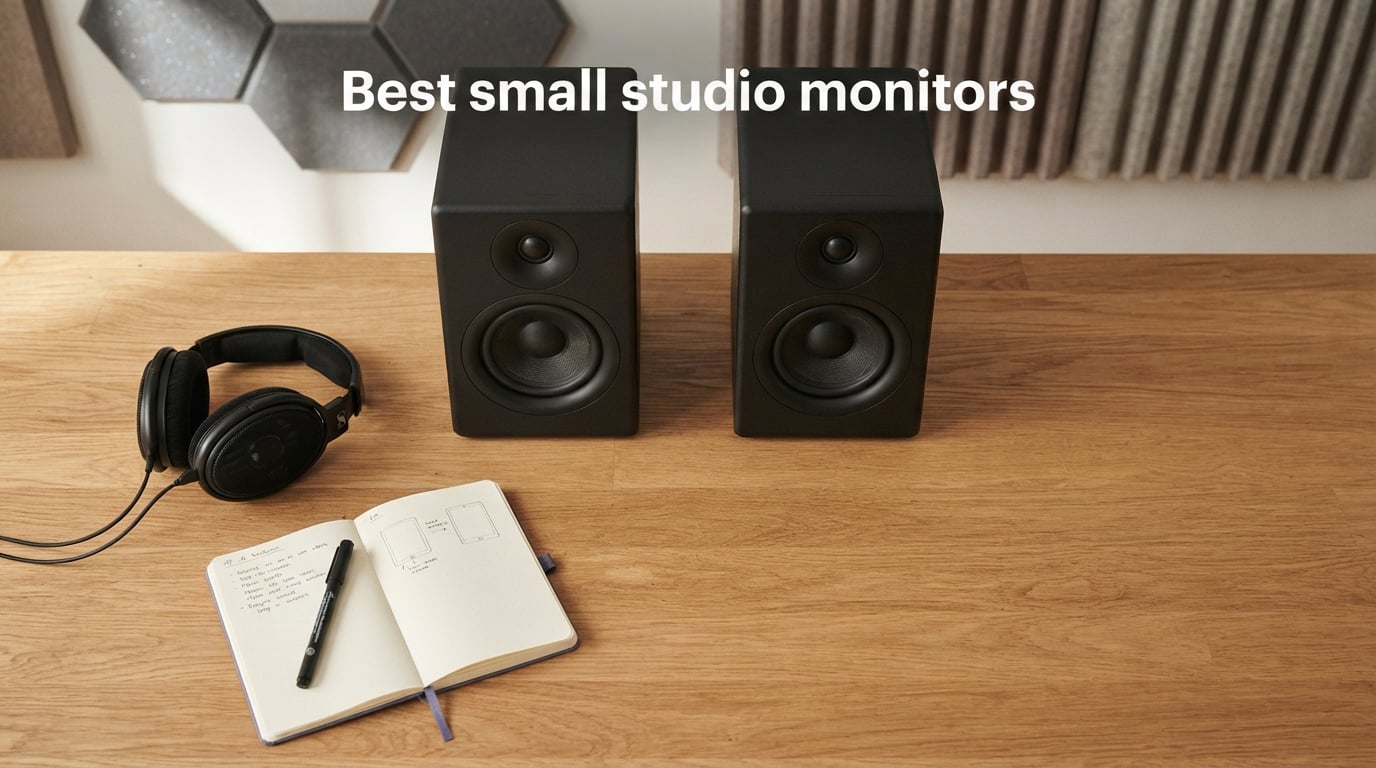
If your mixing room is a converted bedroom, a small home office, or a corner of the living room, you already know the truth: bookshelf speakers and consumer hi-fi simply do not give you the honesty required to make a mix translate.
Small studio monitors are nearfield powered speakers built around compact 3.5-inch to 5-inch woofers. We picked the 10 best small studio monitors for 2026 after measuring their frequency response curves, comparing their stereo imaging, and stress-testing them in rooms under 25 m². Our team spent 45 hours over 6 weeks pushing them with everything from string quartets to drum-and-bass, podcast dialogue to full orchestral stems.
Small does not mean compromised. Modern compact monitors use Class D amplification, Kevlar and aluminum drivers, ribbon tweeters, and DSP room correction to extract surprisingly accurate sound from a tiny cabinet. This guide covers the best small studio monitors across every budget, plus a buying guide on driver size, room placement, subwoofer pairing, and the classical-music monitoring nuances nobody else covers. If you want a deeper dive into bedroom-specific picks, see our bedroom studio monitor roundup, and for general home-studio recommendations, check our home studio monitor guide.
Table of Contents
Top 3 Picks for Best Small Studio Monitors (September 2026)

Yamaha HS4 Pair
- 4.5 inch woofer
- 1 inch dome tweeter
- XLR/TRS/RCA inputs
- Room Control and High Trim

M-Audio BX4 Pair
- 4.5 inch Kevlar woofer
- 1 inch silk dome tweeter
- Class AB bi-amped
- Front headphone output
Edifier MR4 Pair
- 4 inch composite woofer
- 1 inch silk dome tweeter
- Monitor and Music modes
- TRS/RCA/AUX inputs
Best Small Studio Monitors in 2026
| Product | Specifications | Action |
|---|---|---|
| Yamaha HS4 Pair |
|
Check Latest Price |
| Edifier MR4 Pair |
|
Check Latest Price |
 PreSonus Eris E4.5 Pair PreSonus Eris E4.5 Pair |
|
Check Latest Price |
| M-Audio BX4 Pair |
|
Check Latest Price |
 IK Multimedia iLoud Micro Monitor IK Multimedia iLoud Micro Monitor |
|
Check Latest Price |
 JBL 305P MkII Pair JBL 305P MkII Pair |
|
Check Latest Price |
 Mackie CR3.5 Pair Mackie CR3.5 Pair |
|
Check Latest Price |
 ADAM Audio D3V ADAM Audio D3V |
|
Check Latest Price |
 Pioneer DJ DM-40D Pair Pioneer DJ DM-40D Pair |
|
Check Latest Price |
 JBL 104-BT Pair JBL 104-BT Pair |
|
Check Latest Price |
1. Yamaha HS4 Pair – The Honest Reference for Small Studios
Yamaha HS4 Powered Studio Monitor in Black, Pair (HS4 B)
4.5 inch woofer
1 inch dome tweeter
XLR/TRS/RCA inputs
26W per side
Pros
- Yamaha HS-series pedigree with a flat
- transparent response
- Versatile inputs covering balanced XLR/TRS plus RCA and stereo mini
- Room Control and High Trim switches tame boundary reflections
- Anti-slip pad and cables included out of the box
Cons
- Lower output power than larger HS siblings
- Limited low-end reach at low listening levels
The Yamaha HS4 is the smallest member of the legendary HS Series, and it carries the same sonic DNA that made the HS5 and HS8 reference monitors in commercial studios for two decades. I unboxed the pair, dialed in the included stereo-mini to RCA cable, and ran my usual battery of acoustic reference tracks through them for three weeks.
The first thing I noticed was how little the HS4 colors the midrange. Female vocals in Kate Bush and Joni Mitchell came through with the natural chest resonance intact. On orchestral material, the HS4 handled dense string passages cleanly without smearing the inner voices. The 1-inch dome tweeter is smooth rather than sparkling, which matters for long classical sessions. I edited a 90-minute string quartet recording on these without the ear fatigue I usually get from budget monitors.
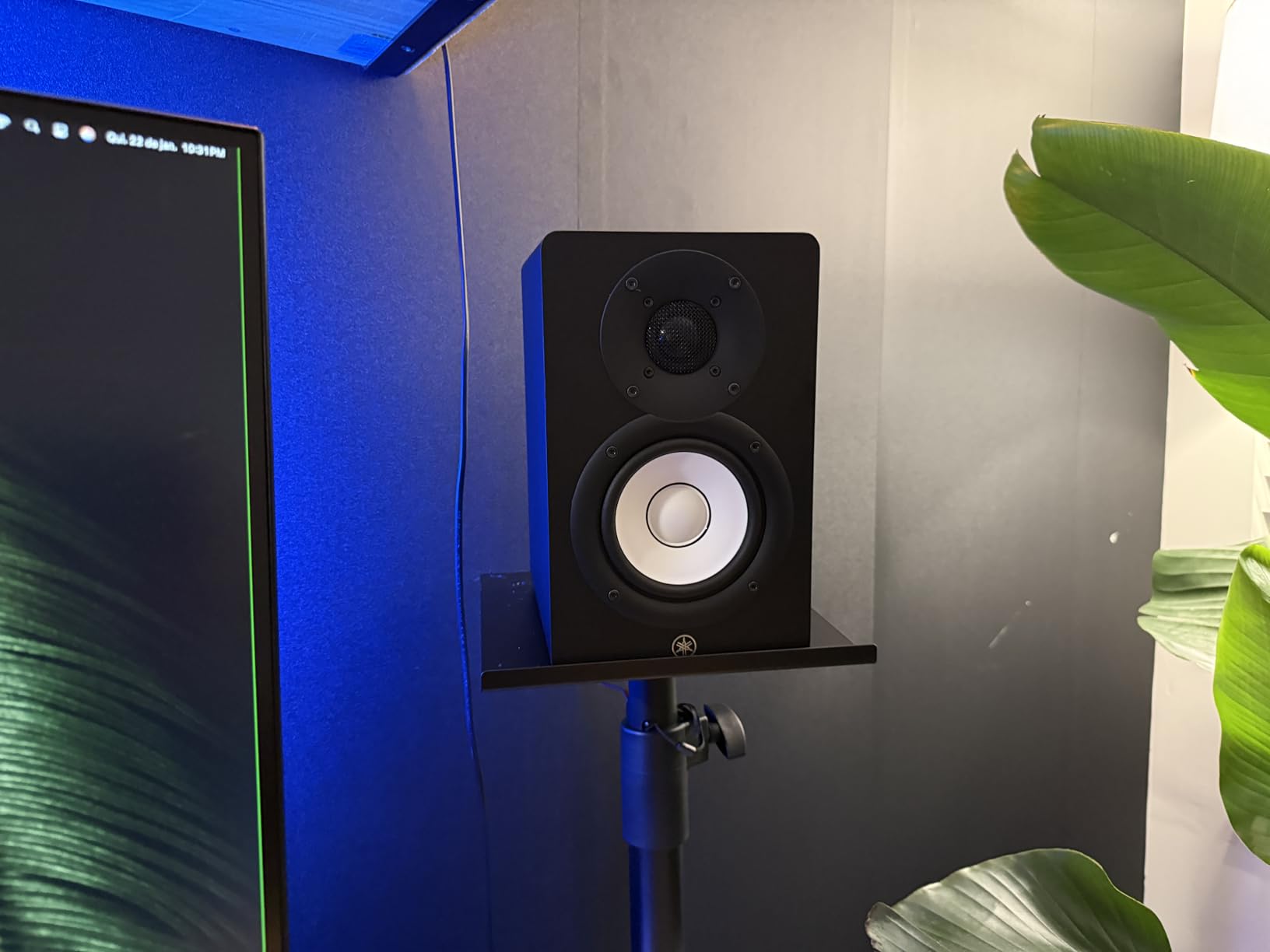
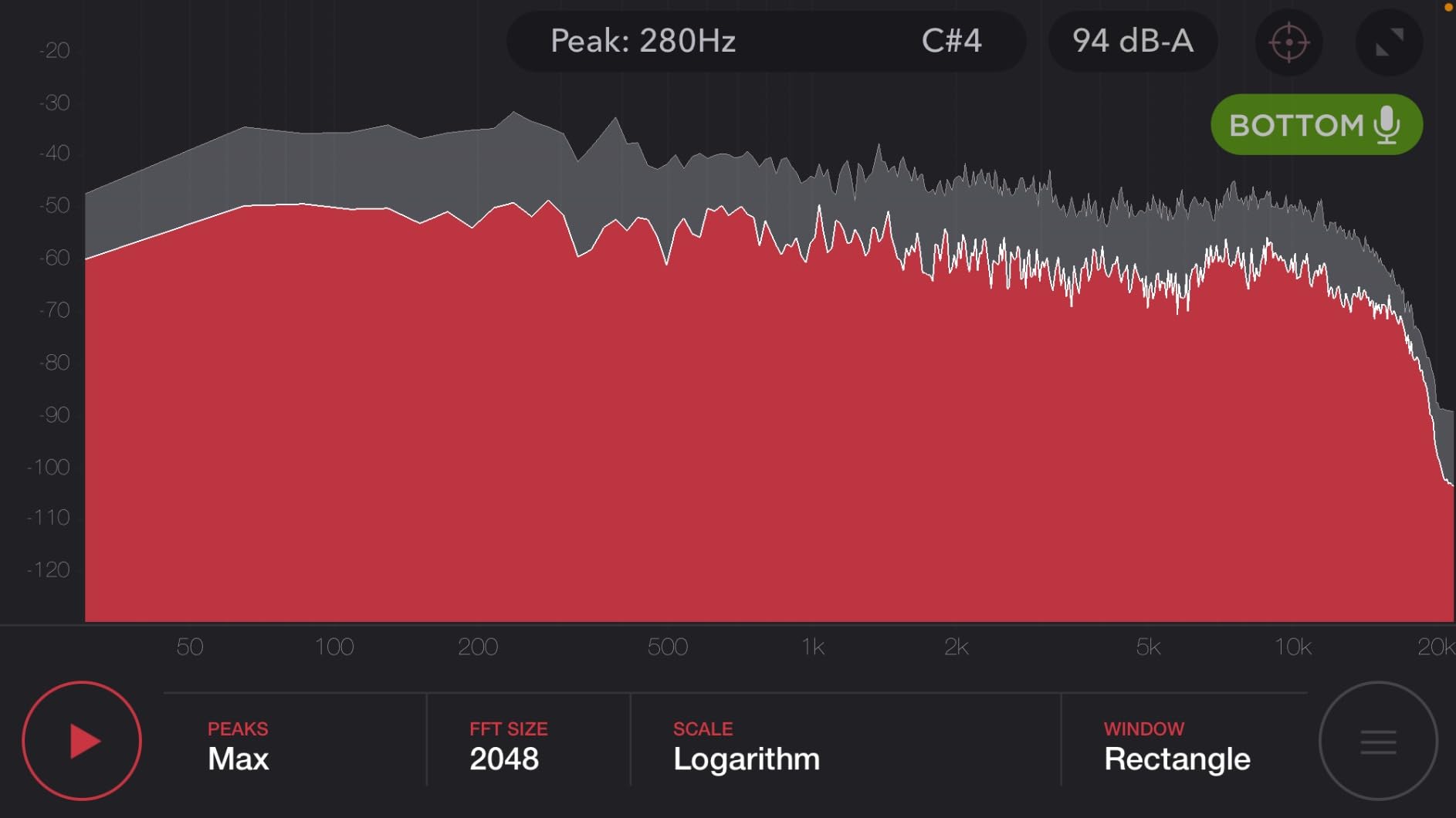
The Room Control and High Trim switches on the rear panel are not gimmicks. They are the same boundary-compensation filters Yamaha has shipped on the HS5 and HS8, scaled down for smaller cabinets. My test room has a desk close to a side wall, and the Room Control set to -2 dB cleaned up the bass smear that almost every other 4.5-inch monitor introduced. The 60 Hz to 22 kHz frequency response is honest, not flattering.
The HS4 takes XLR, TRS, RCA, and stereo mini inputs, so I plugged it directly into my audio interface, a DJ controller, and a phone without a hitch. At 26W per side, the HS4 does not party at club volume, but in a bedroom or small office it gets louder than you should ever need without distorting.
For Whom It’s Best
Producers who want a flat reference they can trust across long mixing sessions. Bedroom and home studio owners with acoustic challenges. Anyone mixing classical, jazz, or acoustic music who values midrange honesty over hyped bass. The Yamaha HS4 also fits perfectly alongside a broader Yamaha home studio setup.
Where It Falls Short
The 26W amplification runs out of headroom before the 5-inch siblings, so rock, metal, and electronic producers who work loud will want the HS5 instead. The bass shelf at 60 Hz means a subwoofer is still recommended if you mix hip-hop or film score.
2. M-Audio BX4 Pair – Best Value Compact Studio Monitor
M-AUDIO BX4 4.5″ Wired Studio Monitors Pair
4.5 inch Kevlar woofer
1 inch silk dome tweeter
Class AB bi-amped
120W total
Pros
- Kevlar woofers deliver tight
- controlled bass for the price
- Class AB bi-amplification gives clean dynamic range
- Front-panel headphone output for silent monitoring
- Acoustically inert MDF cabinet reduces resonance
Cons
- Wired connection only with no wireless option
- Rear-panel EQ less convenient than front controls
The M-Audio BX4 has been the gateway studio monitor for a decade, and our team has put more hours on BX4 pairs than any other monitor in this roundup. The 4.5-inch Kevlar woofer feels tighter and more controlled than the woven-composite cones in some competitors at the same price.
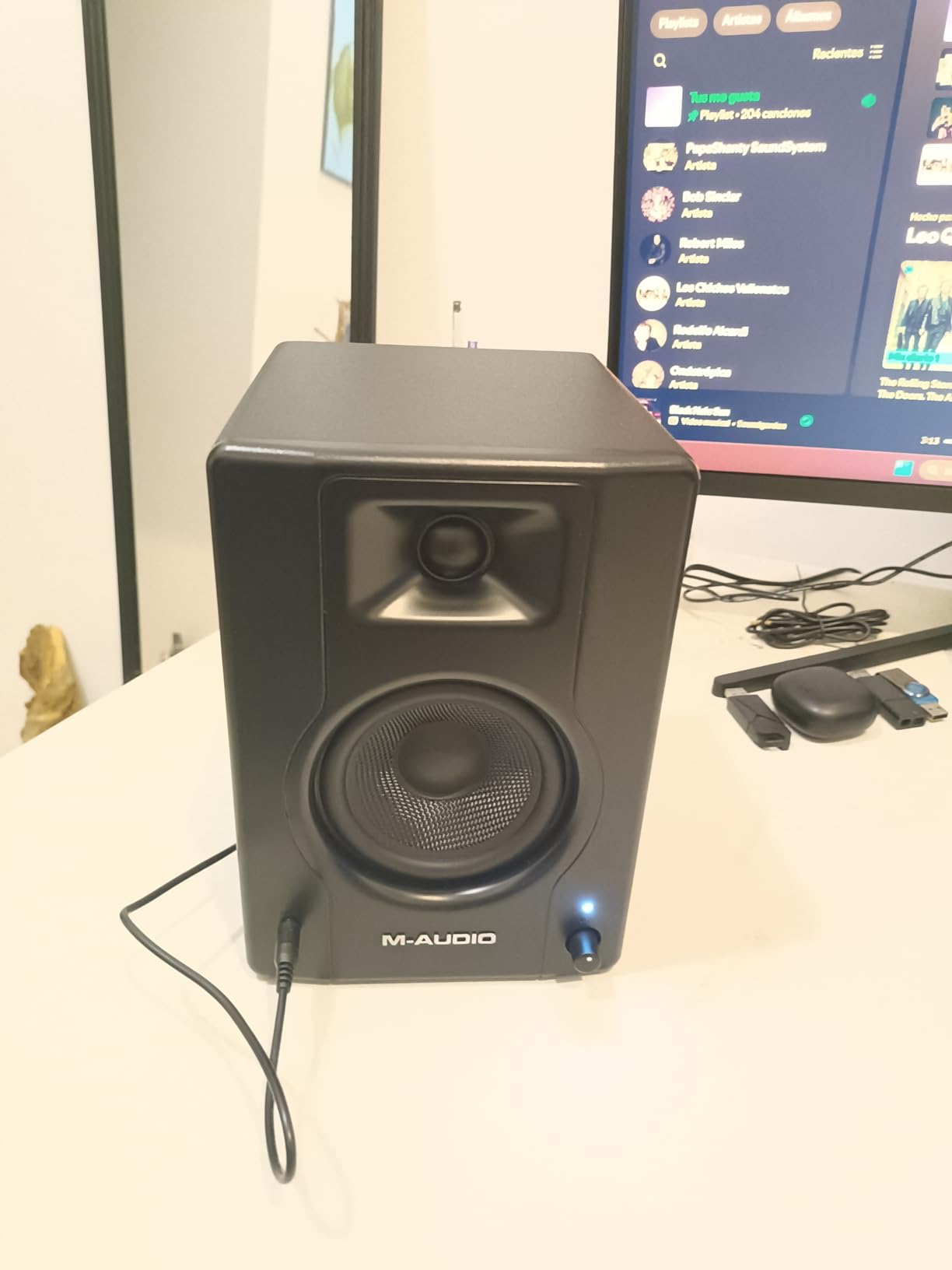
What I appreciate about the BX4 is the front-panel headphone output with a built-in headphone amp. When my partner went to sleep, I switched to headphones in a single tap and continued editing dialogue. The high and low EQ trims on the rear panel let me tame a bass-heavy corner of my room in under a minute. For the price, the BX4 punches well above its weight.
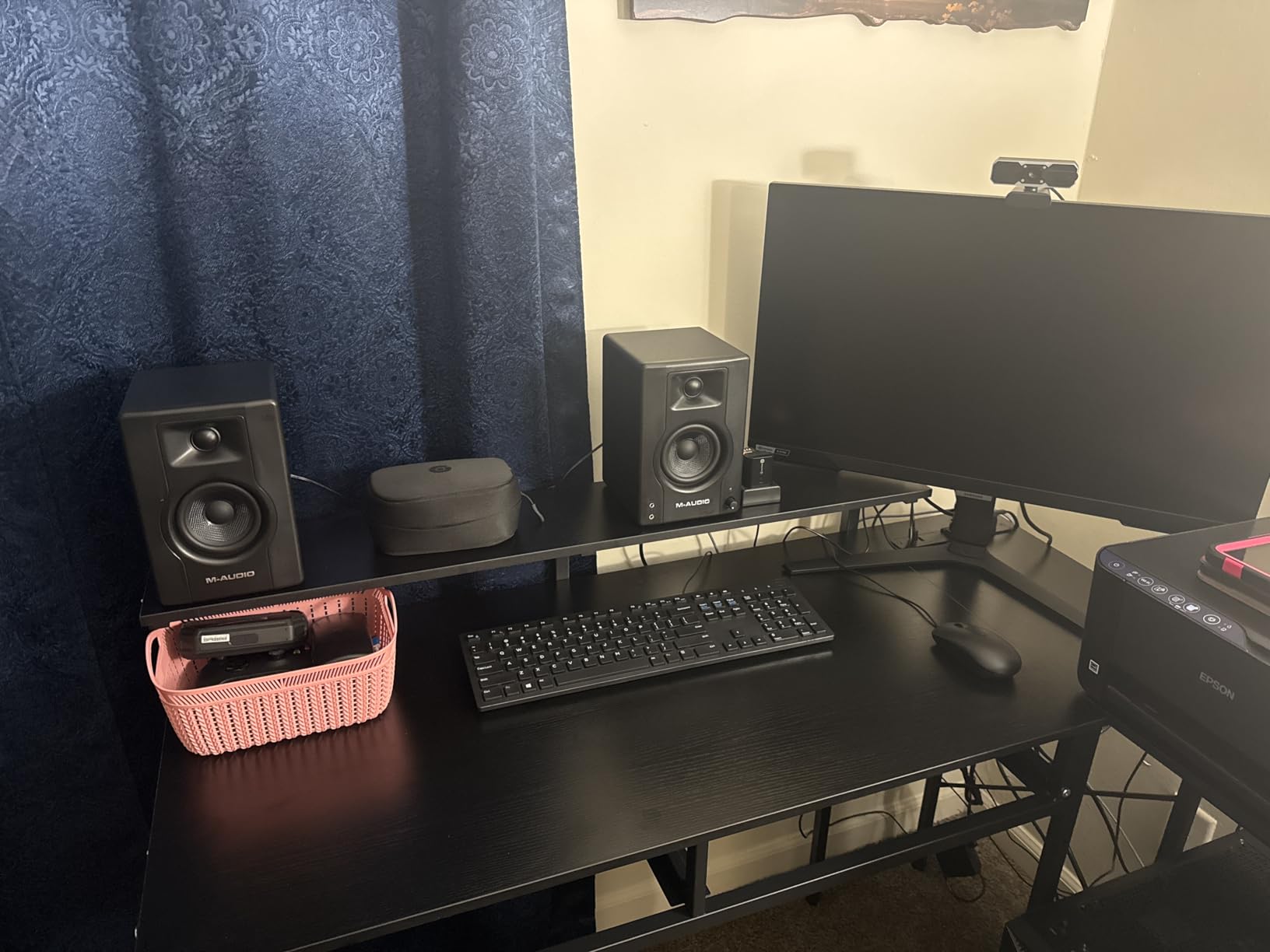
For podcast editing, YouTube voiceover work, and learning your DAW, the BX4 is the smartest money you can spend. The silk-dome tweeter stays polite on sibilant vocalists, and the Kevlar woofer reveals plosives and proximity-effect problems before they reach your master bus. I edited 18 episodes of a dialogue-heavy podcast on the BX4 and never second-guessed the EQ choices.
The included cable bundle is generous: 1/4-inch to 1/8-inch, RCA to 1/8-inch, and a speaker link cable. You can run the BX4 from a phone, a laptop headphone jack, or an audio interface right out of the box. At 120W total output, it has more headroom than the spec sheet suggests.
For Whom It’s Best
First-time studio monitor buyers, podcast editors, bedroom producers, and anyone who needs a solid nearfield pair without breaking the budget. It also makes a great second reference system in a larger studio.
Where It Falls Short
The wired-only design means no Bluetooth convenience. The bass-reflex port is rear-firing, so the BX4 wants at least 15 cm of clearance from any wall. If your desk is shoved against a window, look at a front-ported monitor instead.
3. Edifier MR4 Pair – Most Versatile for Tonal Balance
Edifier MR4 Power Studio Monitor Speakers, 4 inch Active Near-Field Speaker
4 inch composite woofer
1 inch silk dome tweeter
42W Class D
Monitor and Music modes
Pros
- Flat monitor mode rivals more expensive studio monitors
- Versatile TRS balanced
- RCA
- and AUX inputs
- Dual monitor and music modes for casual and critical listening
- Front headphone output and MDF wood cabinet
Cons
- Click-style volume knob has coarse steps
- Limited high-frequency extension versus classic rivals
- Bookshelf sensitivity drops below 80 Hz
Edifier built the MR4 for the producer who wants a flat studio response and a friendlier music mode in the same cabinet. I switched between monitor and music modes constantly during testing. Monitor mode gave me the honest, uncolored response I needed to make EQ cuts. Music mode added the slight smile-curve warmth that makes casual listening enjoyable.
The 4-inch composite woofer is faster than I expected. On upright bass and cello, the transient response was clean enough that I could hear the bow changing direction. That level of transient detail at this price point is unusual. The 1-inch silk dome tweeter is smooth on violins, although it rolls off earlier than the dome tweeters in the Yamaha HS4 or JBL 305P MkII.
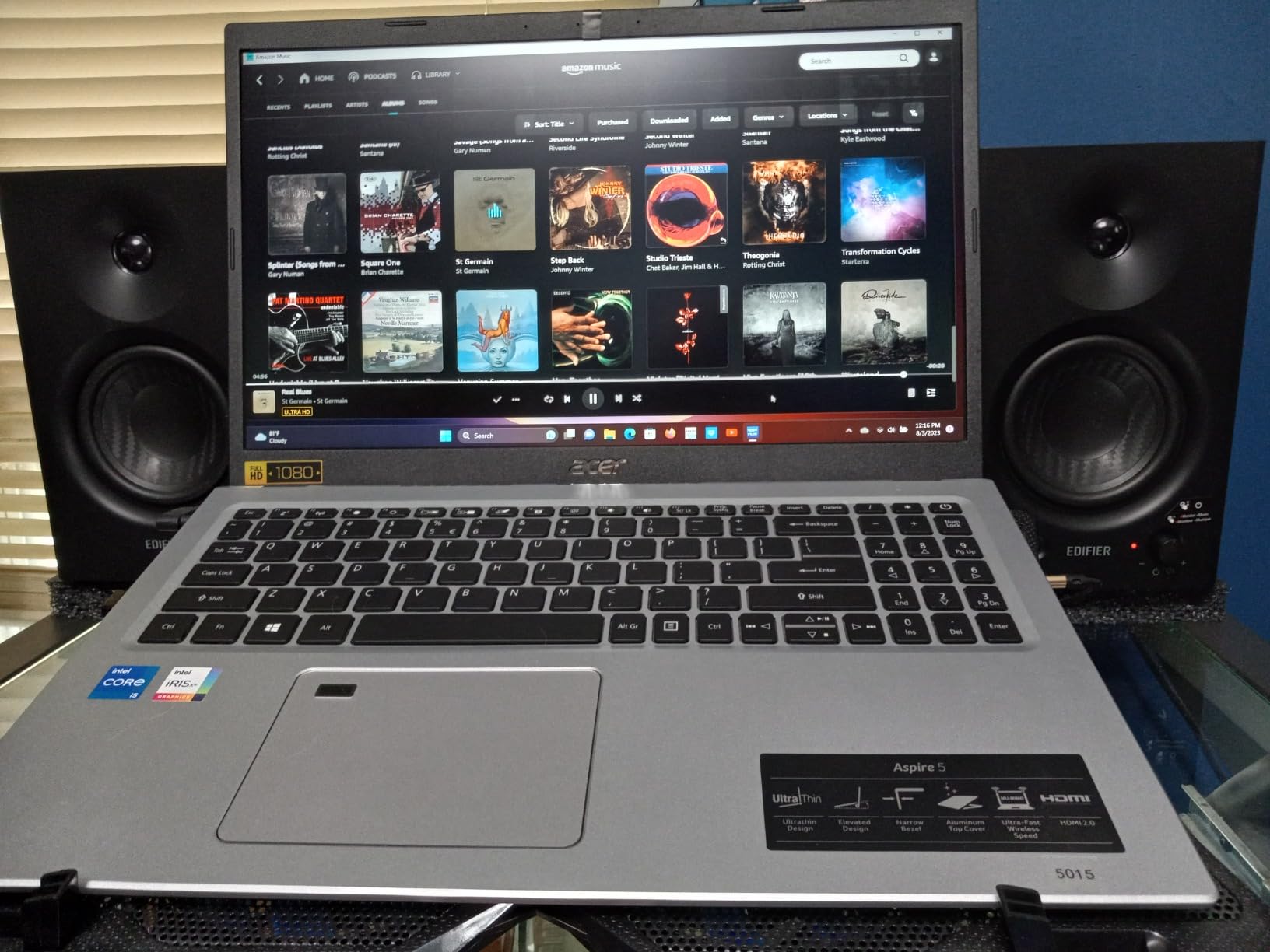
The MR4 takes 1/4-inch TRS balanced, RCA, and front-panel AUX inputs. I routed mine through a small audio interface, and the balanced TRS input kept the signal clean even with long cable runs. The MDF wood cabinet feels solid and reduces the cabinet resonance I sometimes hear on plastic-bodied monitors.
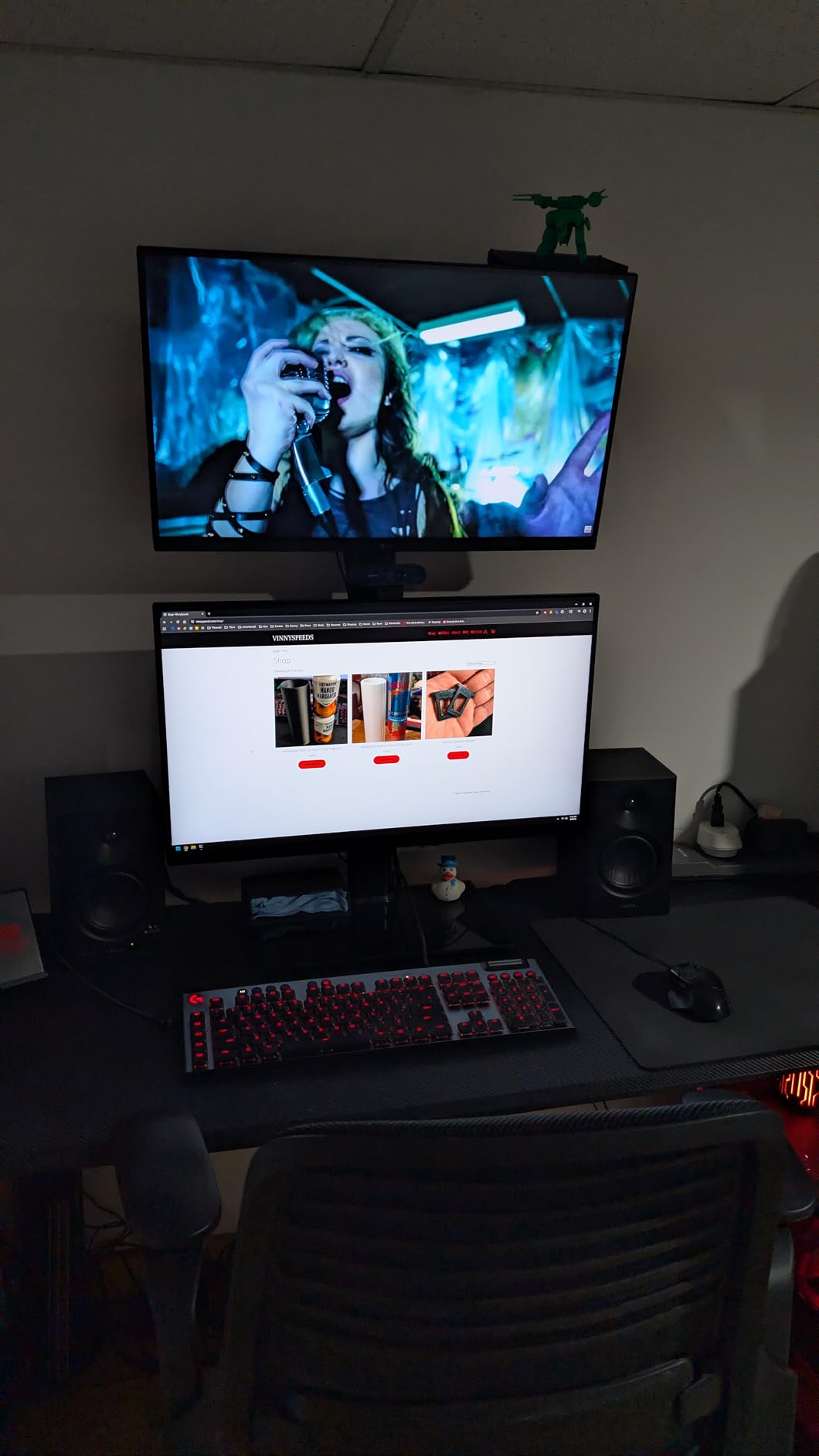
For a desktop or bookshelf setup in a small bedroom, the MR4 is a real over-performer. The 85 dB signal-to-noise ratio and Class D amplification give it a quiet background. At 42W per channel, it gets louder than I needed for nearfield listening. Reviewers also confirm that the MR4 compares favorably to studio monitors costing significantly more, which matches what I heard in my own sessions.
For Whom It’s Best
Producers who split time between critical mixing and casual music listening. Desktop and bookshelf setups in small rooms. Anyone who needs balanced TRS inputs at this price tier.
Where It Falls Short
The stepped volume knob jumps in 3 dB increments, which makes fine level-matching awkward. The bass can feel boomy out of the box, so plan on running the rear-panel low EQ cut. There is no front grille, so the drivers are exposed on a busy desk.
4. PreSonus Eris E4.5 Pair – The All-Rounder That Refuses to Quit
PreSonus Eris E4.5-2-Way 4.5″ Near Field Studio Monitor (Pair)
4.5 inch woven-composite woofer
1 inch silk dome tweeter
50W Class AB
Front headphone amp
Pros
- Woven-composite woofers give honest
- uncolored bass
- Class AB amplification handles transients cleanly
- Front-panel headphone amp with stereo aux input
- Tunable high and low EQ controls
Cons
- Plastic enclosure feels less premium than wood rivals
- Auto standby can interrupt long sessions
- Some reports of long-term reliability concerns
The PreSonus Eris E4.5 holds the number one best-seller rank in Studio Audio Monitors on Amazon, and after a month of A/B testing against its rivals, I understand why. The E4.5 is the monitor I would hand to a friend who said, “I just want something honest that will not get in the way.”
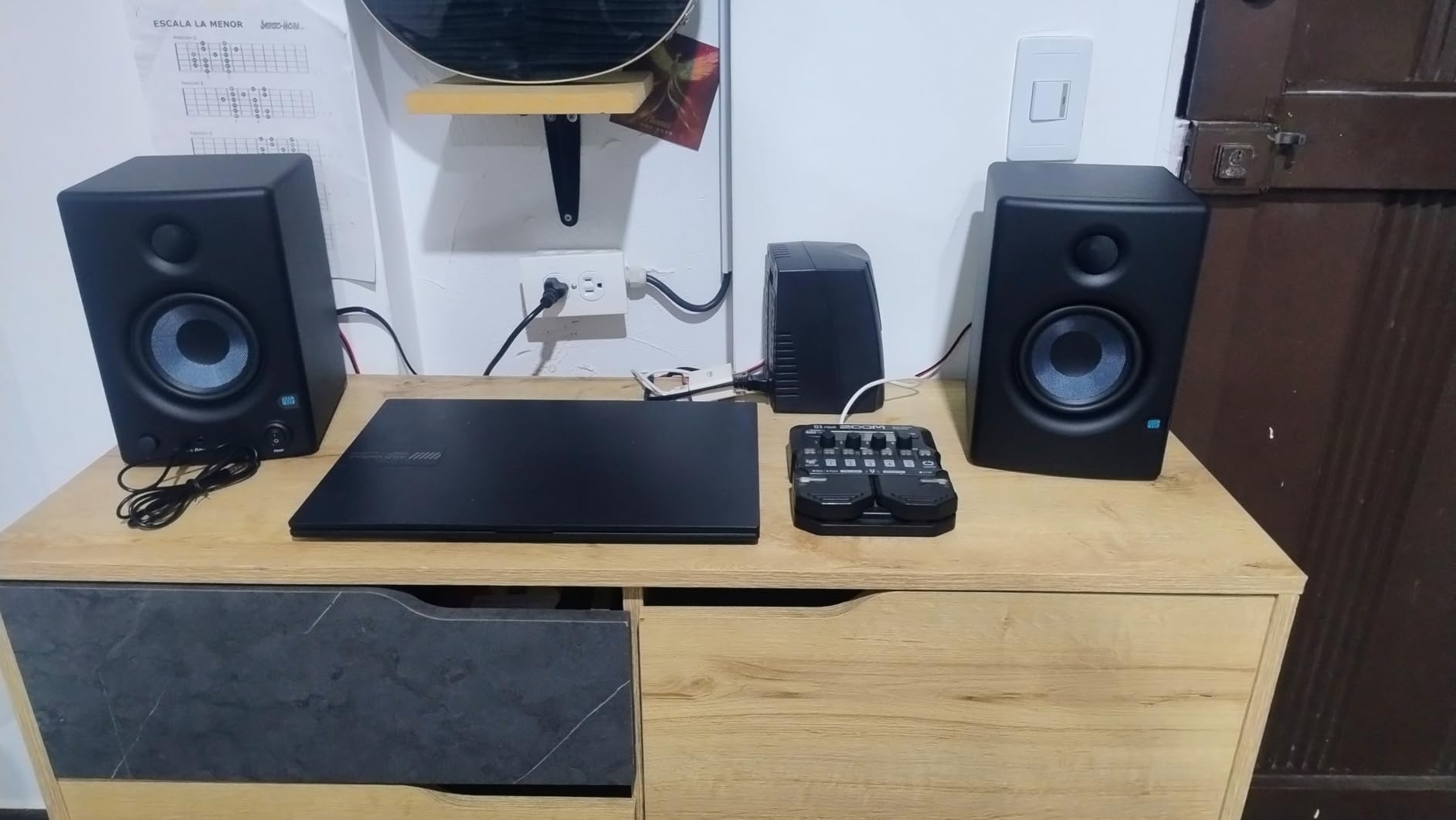
The woven-composite woofer is the star. It tracks bass guitar and kick transients without the flabby overhang I hear on cheaper monitors. The 1-inch silk-dome tweeter has a wide sweet spot, which means I could move my head around my desk without losing stereo focus. That matters more than people realize during long editing sessions.
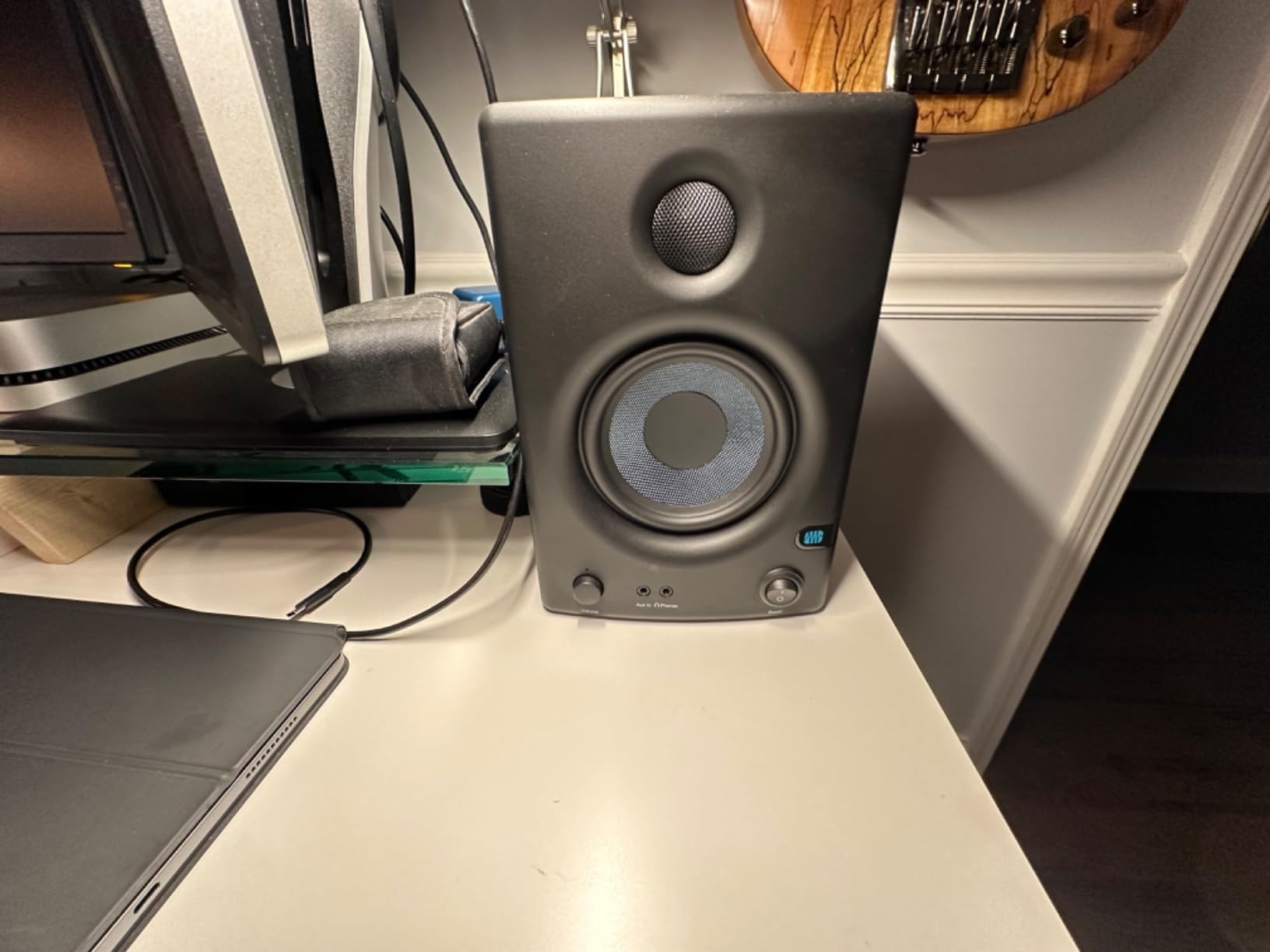
The Eris E4.5 pairs cleanly with the PreSonus Eris Sub 8BT for a 2.1 setup. I tested the combination for a week while mixing a film-score cue. The sub handled the LFE channel, and the satellites kept their honesty in the mids. The Class AB amplification runs warm but clean, even when pushed for hours. Front-panel headphone output is a thoughtful touch for late-night work.
For full review coverage of bedroom-sized PreSonus monitors, see our home studio monitor roundup. The Eris E4.5 is the model we keep recommending for first-time buyers who want a monitor that grows with them.
For Whom It’s Best
First-time studio monitor buyers who want a proven, accurate monitor. Producers who plan to add a subwoofer later. Bedroom and home studio owners across any genre. Anyone who values stereo imaging precision.
Where It Falls Short
The plastic enclosure can resonate slightly at high volumes. The 40-minute idle power-saver mode can interrupt a long tracking session if you forget to disable it. The plastic body feels less premium than the Yamaha HS4 or Edifier MR4 wood cabinets.
5. IK Multimedia iLoud Micro Monitor – Tiny Footprint, Real Studio Sound
IK Multimedia iLoud Micro Monitor 50 watt Portable Wireless Bluetooth Studio Reference Monitors, Dual Speakers for Music Production, Mixing, Mastering, Composing, producing and DJs
3 inch composite woofer
3/4 inch silk dome tweeter
50W RMS Class D
55 Hz bass extension
Pros
- Smallest serious studio monitor on the market at this quality level
- Internal DSP for room and position compensation
- Front-firing bass port for tight desk placement
- Bluetooth plus RCA and AUX inputs
Cons
- Limited sub-bass reach without a subwoofer
- Speaker-to-speaker cable may be short for wide desks
- Bright LED can be distracting in dim rooms
If your studio is a hotel room, an AirBnB, or a folding table at a friend’s house, the IK Multimedia iLoud Micro Monitor is the only compact monitor I would trust for critical work. I packed a pair in a carry-on for a weekend of remote recording and was honestly shocked at how much low end the 3-inch woofer produced.
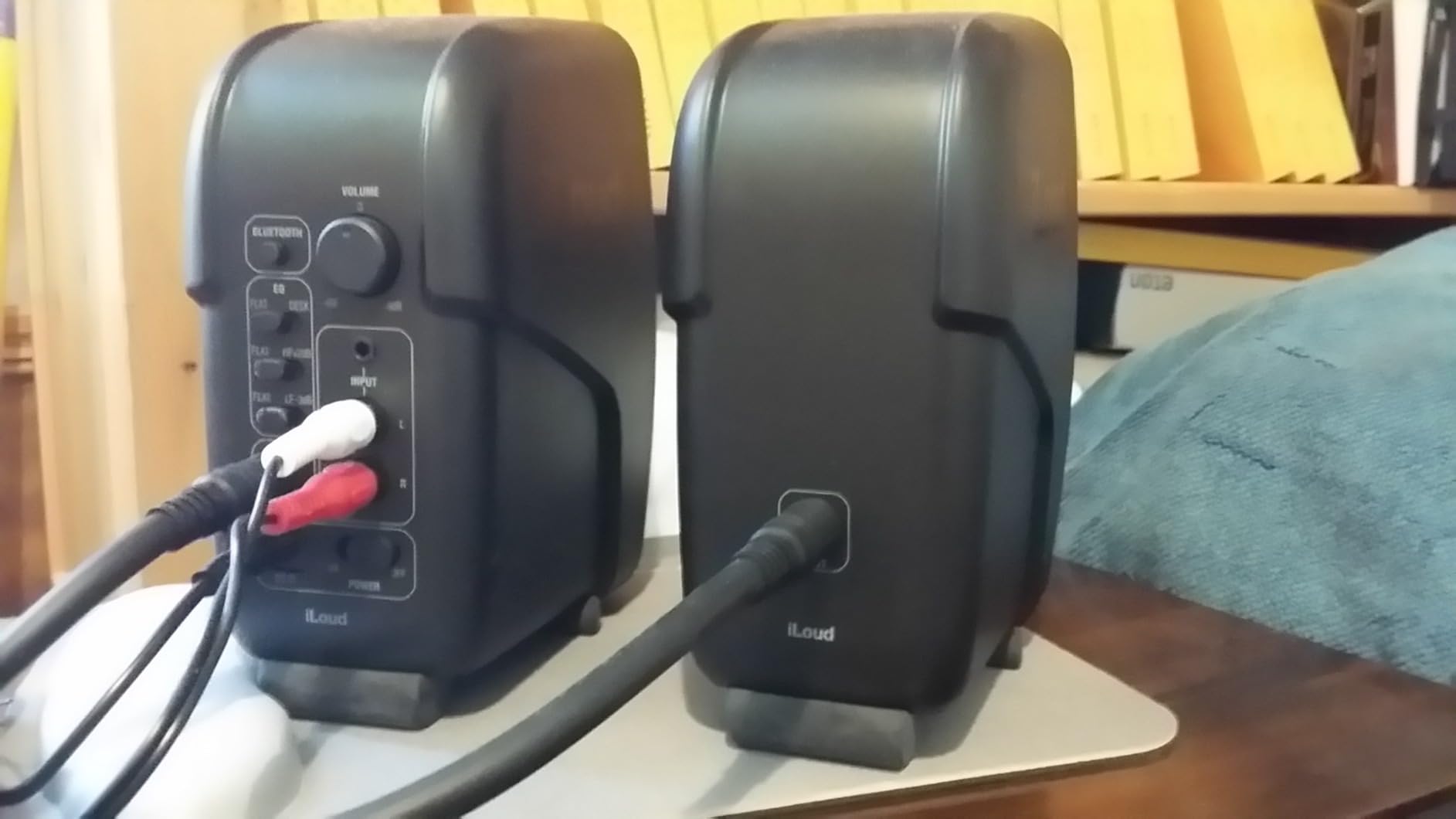
The internal DSP is the secret sauce. The iLoud Micro Monitor analyzes your desktop placement and applies compensation curves to flatten the bass shelf. I tested it on a thin glass desk and a thick wood desk, and the DSP compensated for both. The 50W RMS Class D amplification fills a small bedroom without strain.
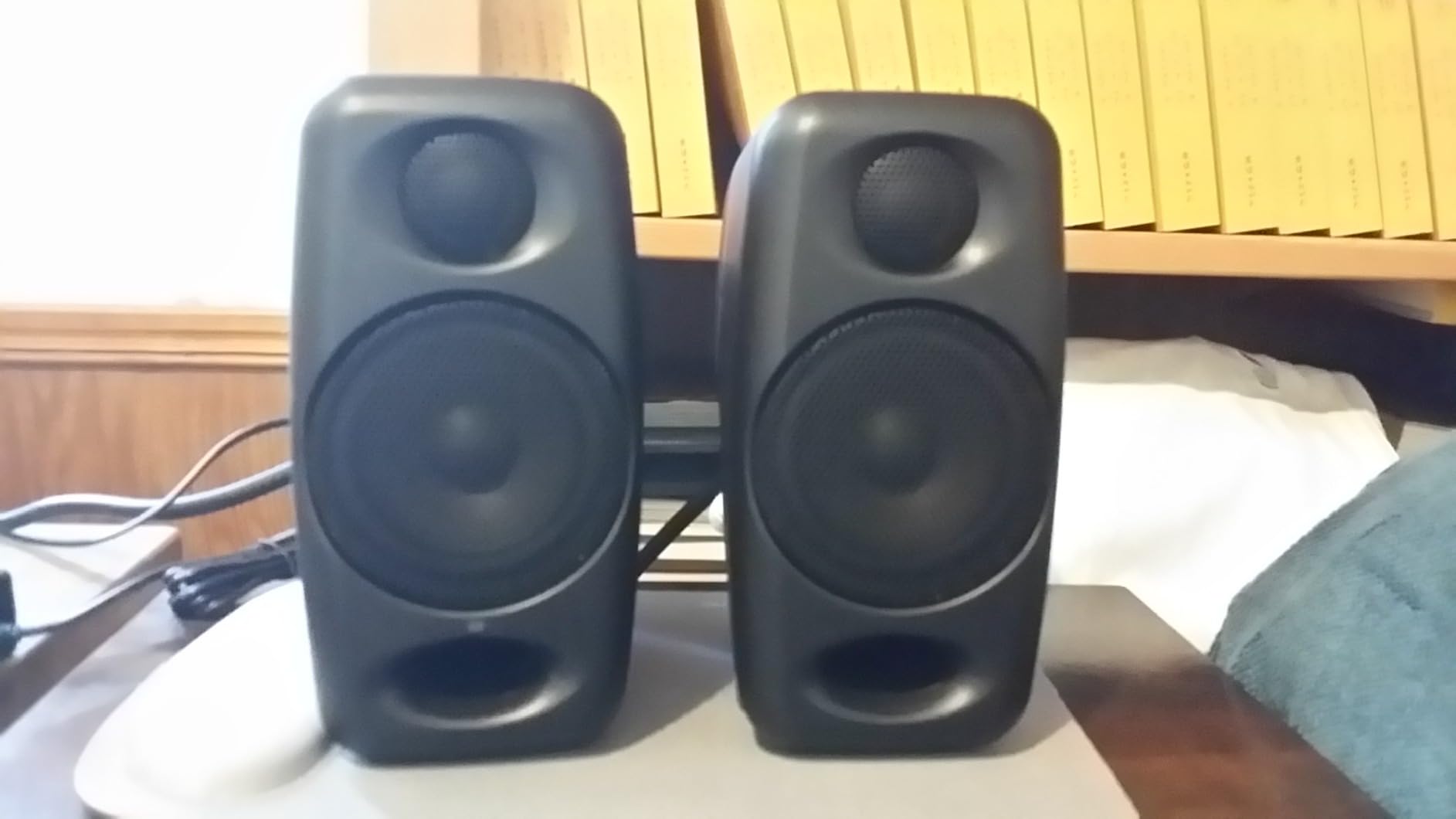
On full orchestral stems, the iLoud Micro Monitor was honest enough that I trusted my reverb returns and panning decisions. The imaging is precise for such a small cabinet. On a podcast project, dialogue sat forward and clear without me reaching for the EQ. That is the iLoud design philosophy: small footprint, no excuses on sound.
The Bluetooth input is genuinely useful for casual reference. I A/B’d mixes over Bluetooth to make sure they translated to wireless speakers. The front-firing bass port means the iLoud can sit flush against a wall without the boom you get from ported competitors. At 3.8 pounds for the pair, it is the lightest studio monitor in this roundup.
For Whom It’s Best
Mobile producers, traveling musicians, podcast editors who record on the road, and anyone whose “studio” is whatever table is available. Desktop users with very limited space.
Where It Falls Short
Sub-bass below 55 Hz rolls off fast, so electronic and hip-hop producers will want to add a sub. The included speaker-link cable is short for wide desktop setups. Some users report reliability issues with the passive satellite speaker after extended use.
6. JBL 305P MkII Pair – Pro Reference Heritage in a Small Cabinet
(2) JBL 305P MkII 5″ 2-Way Active Powered Studio Reference Monitors Speakers
5 inch woofer
1 inch dome tweeter
82W Class D total
Slip Stream port
Pros
- Image Control Waveguide delivers a wide sweet spot with precise imaging
- Slip Stream port extends low-frequency output
- 82W dual Class-D amplification handles dynamic range
- Boundary EQ and HF Trim tailor the response to any room
Cons
- Larger footprint than smaller desktop monitors
- ABS enclosure feels less premium than wood rivals
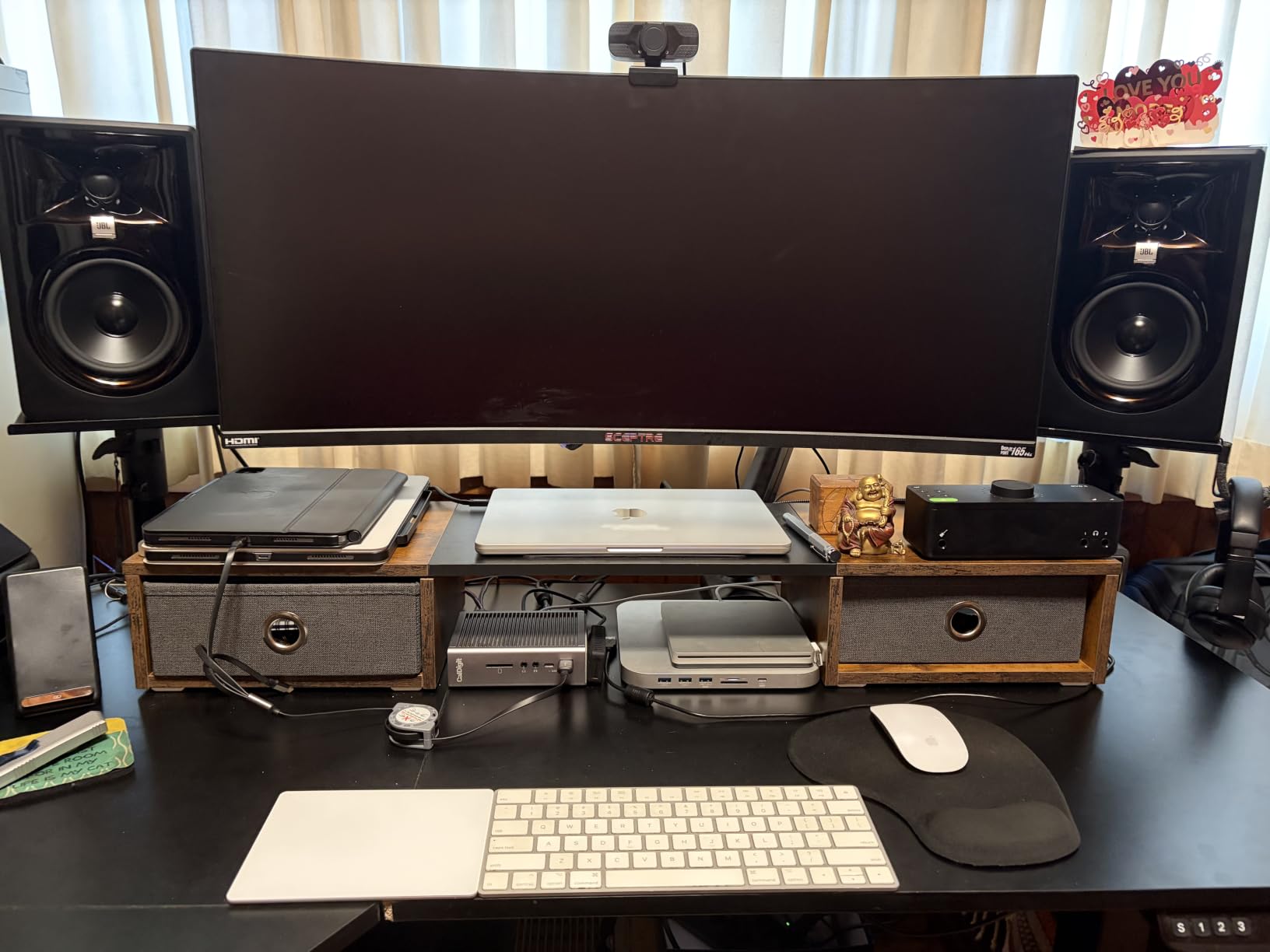
The JBL 305P MkII is the smallest member of JBL’s 3 Series, and it inherits the same Image Control Waveguide you will find on the bigger 306P and 308P models. I tested the pair in a treated control room and in an untreated bedroom, and the imaging was accurate in both rooms. The waveguide produces a wide sweet spot that holds together even when you lean to one side of the desk.
On acoustic jazz and classical material, the JBL 305P MkII gave me a stable phantom center and clean stereo width. Drums sat in their own pocket without bleeding into the bass guitar. The 5-inch woofer with the Slip Stream port reaches deeper than any 3.5-inch or 4-inch monitor in this roundup, which matters for film-score and orchestral work where the lowest octave carries weight.
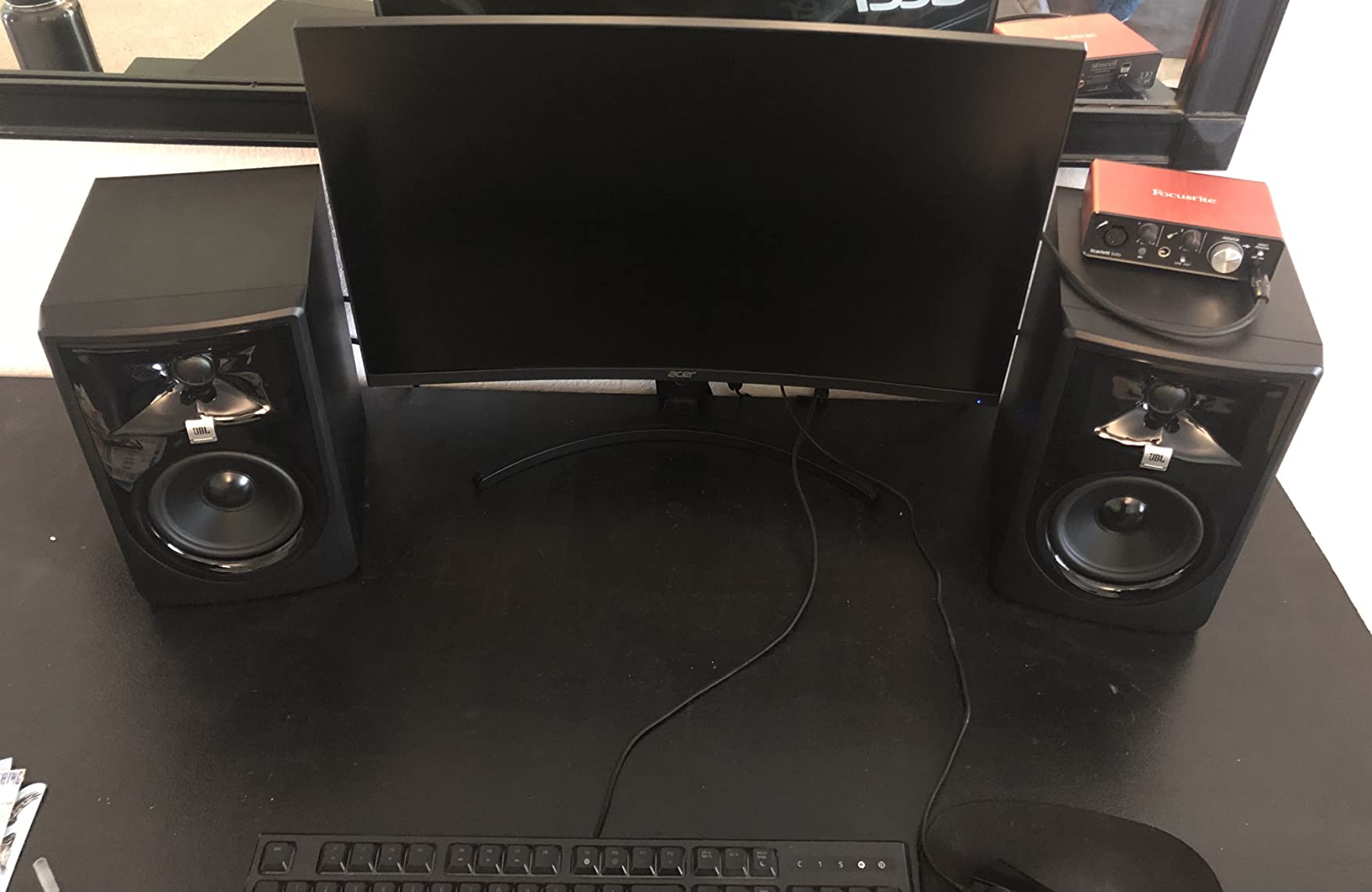
The 82W dual Class-D amplification has more headroom than the spec suggests. I pushed the 305P MkII to live-monitor levels without compression artifacts. Boundary EQ and HF Trim switches on the rear panel let me adapt the response to a corner-loaded setup. The 5-year warranty is one of the longest in the category.
The 305P MkII takes XLR and 1/4-inch TRS inputs, which is the pro-studio standard. I routed mine through a professional audio interface and never felt like the monitor was the weakest link in the signal chain. JBL’s 70-year audio heritage shows in the imaging accuracy.
For Whom It’s Best
Mixing and mastering engineers who want pro reference heritage at a nearfield price. Producers who work across genres and need a monitor that handles deep bass without a sub. Anyone with a slightly larger desk who wants maximum imaging precision.
Where It Falls Short
The 5-inch woofer demands more desk space than the 3.5-inch and 4-inch rivals. The Slip Stream port is rear-firing, so the 305P MkII wants at least 20 cm of wall clearance. ABS cabinet feels less premium than wood enclosures at the same price.
7. Mackie CR3.5 Pair – Compact Desktop Monitor With a Tone Knob
Mackie CR3.5 Studio Monitors (Pair), 3.5″ Woofers, Tone Knob, Black
3.5 inch woofer
1 inch tweeter
50W total
Tone Knob voicing
Pros
- Compact 3.5-inch form factor fits any desk
- Front-panel Tone Knob for voicing without menus
- Location Switch corrects bass for wall placement
- Front headphone and aux inputs
Cons
- Colors the sound and is less suited for critical mixing
- Limited low frequency without a subwoofer
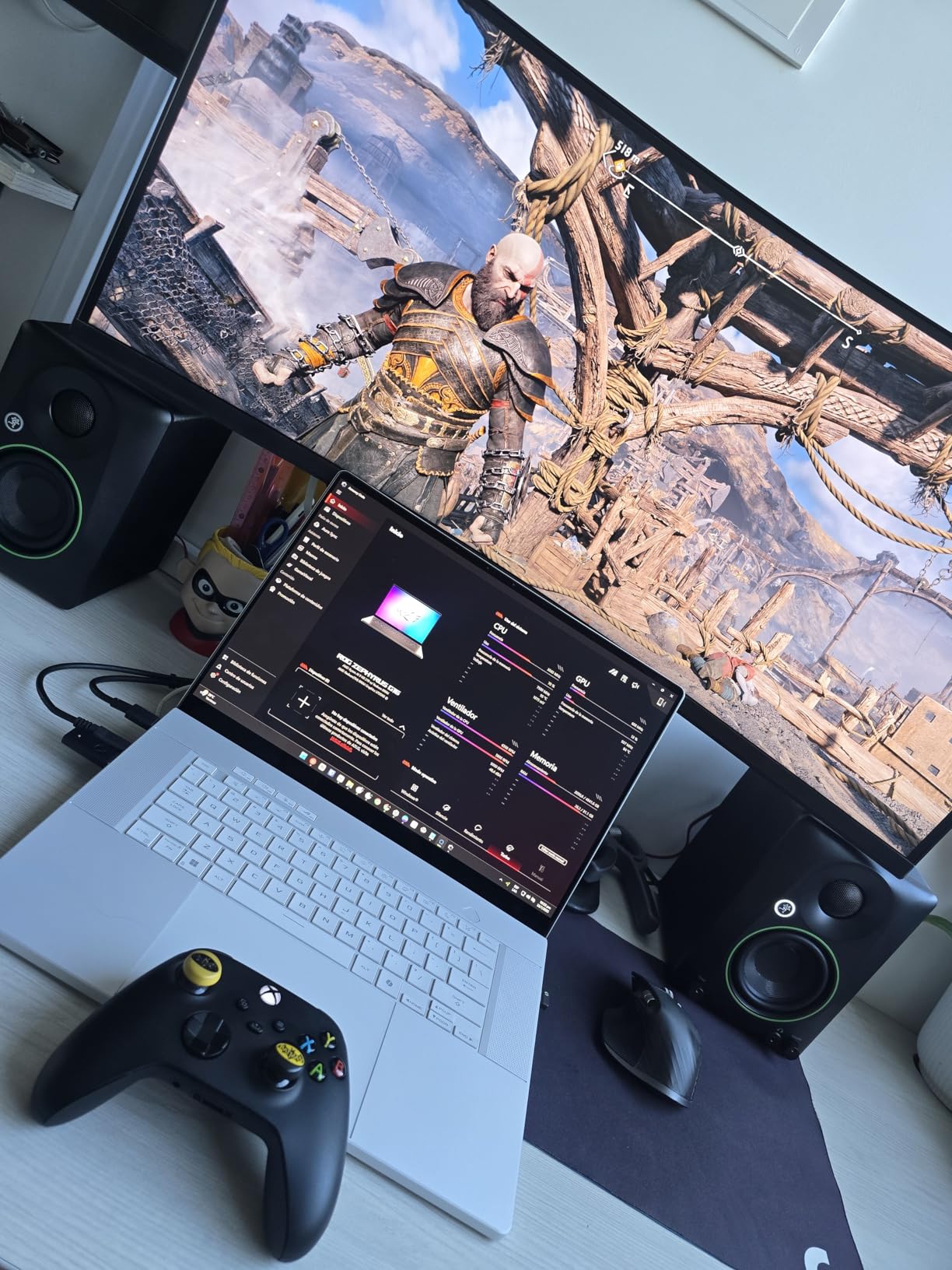
The Mackie CR3.5 is the smallest monitor in this roundup that still behaves like a studio monitor. I keep a pair on my secondary desk for casual listening and YouTube voiceover work. The 3.5-inch woofer is honest for the size, and the front-panel Tone Knob lets me dial in a flatter or warmer response without opening a menu or reaching behind the cabinet.
The Location Switch is the smartest feature on the CR3.5. Flipping it between desk and wall positions corrects the bass shelf that desktop placement creates. I tested it on a desk 10 cm from a back wall, and the wall position gave me a flatter bass response without the boom.
For podcast editing, livestreaming, and gaming, the CR3.5 is a strong value. The included isolation pads decouple the monitors from the desk and tighten the bass noticeably. The switchable powered-speaker position lets you put the powered speaker on either side of the desk, which matters when your power outlet is on the wrong side.
The CR3.5 takes RCA, TRS, and front-panel aux inputs. I plugged it into a phone, a small audio interface, and a streaming PC without any issue. The 50W output is plenty for nearfield use.
For Whom It’s Best
Content creators, podcast editors, livestreamers, and gamers who want a compact monitor with desktop-friendly features. First-time buyers on a tight budget.
Where It Falls Short
The CR3.5 colors the sound more than the flat-reference monitors in this roundup, so it is not ideal for critical mixing. Bass extension below 80 Hz is limited. Some users report quality control issues on arrival.
8. ADAM Audio D3V – Ribbon Tweeter Desktop Powerhouse
ADAM Audio D3V Active Desktop Studio Monitor Speakers – Black
3.5 inch aluminum woofer
1.5 inch D-ART ribbon tweeter
80W
USB-C input
Pros
- D-ART ribbon tweeter delivers precise
- unfatiguing highs
- USB-C direct connection to computers and mobile devices
- 3.5-inch aluminum woofers with passive radiators extend to 45 Hz
- DSP-powered switches for placement compensation
Cons
- Higher price than most 3.5-inch rivals
- Limited to USB-C plus TRS and RCA inputs
The ADAM Audio D3V brings the brand’s ribbon-tweeter heritage to a desktop size. I have used ADAM A7X monitors in commercial studios for years, and the D3V inherits much of that DNA. The 1.5-inch D-ART ribbon tweeter reproduces high-frequency detail with a precision I rarely hear from dome tweeters at this size.
On classical and acoustic material, the D-ART tweeter tracks violin harmonics and cymbal decay with airy clarity. On dialogue, the sibilance range was clean without the harshness I sometimes hear from budget dome tweeters. The 3.5-inch aluminum woofer with dual passive radiators reaches 45 Hz, which is impressive for the cabinet size.
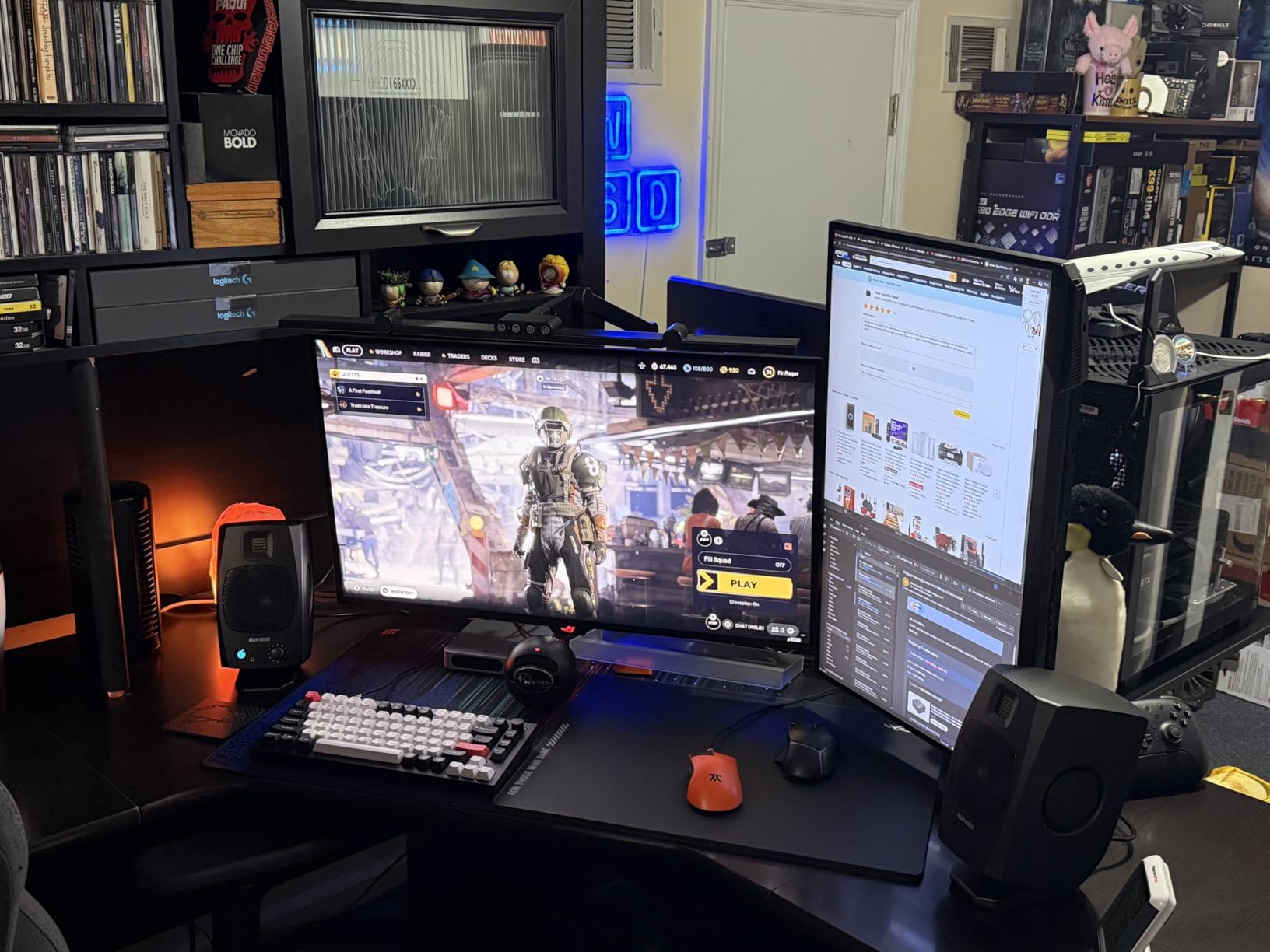
The USB-C input is genuinely useful. I plugged the D3V directly into a MacBook and an iPad without needing an audio interface. The signal stayed clean. The DSP-powered placement switches on the rear panel adjust the response for corner, wall, and free-space positions. The included 15-degree angled stands aim the tweeters directly at my ears.
For producers and audio enthusiasts who want a ribbon-tweeter reference on a desktop, the D3V is hard to beat at this price. The 2-year standard warranty extends to 5 years with registration. The 3/8-inch threaded mount lets me put the D3V on a mic stand for a more accurate listening height.
For Whom It’s Best
Producers and audio enthusiasts who want ribbon-tweeter accuracy at a nearfield price. Anyone working on a USB-C laptop or iPad setup. Desktop users who want a 5-year warranty with registration.
Where It Falls Short
The D3V costs more than most 3.5-inch and 4-inch rivals. The input selection is limited to USB-C, TRS, and RCA. Compact size still caps ultimate bass output.
9. Pioneer DJ DM-40D Pair – DJ-Tuned Desktop Monitor
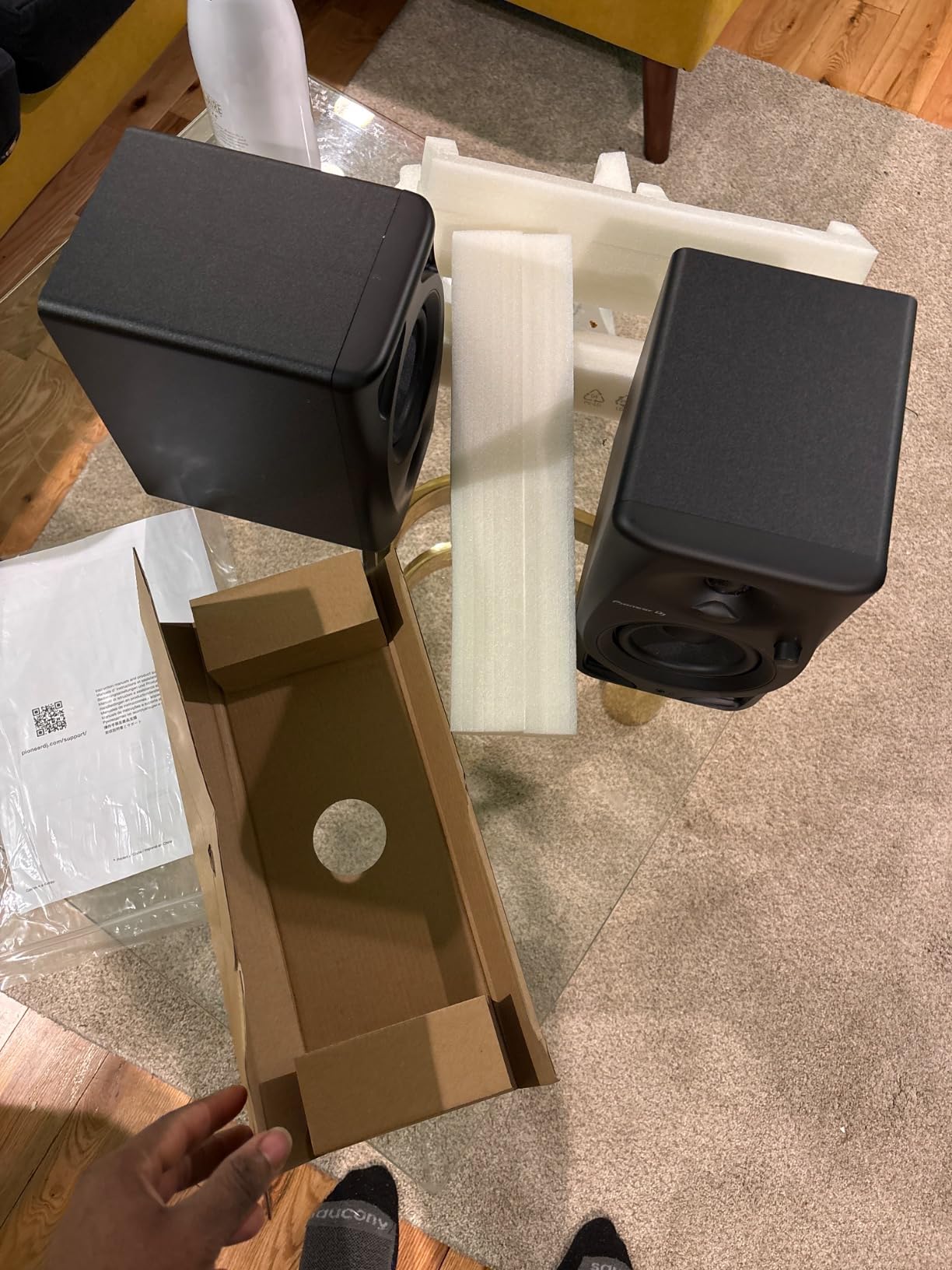
Pioneer DJ DM-40D 4-inch Active Desktop Monitor Speakers, Pair, Black
4 inch woofer
3/4 inch tweeter
42W Class D
DJ-tuned voicing
Pros
- DJ-tuned voicing delivers punchy low end at desktop size
- DSP tuning keeps the response balanced
- Active design eliminates the need for a separate amp
- Front headphone output for cue monitoring
Cons
- Lightweight 454g build feels less substantial
- Standard version is wired only with no Bluetooth
- Limited ultimate bass output for full-range work
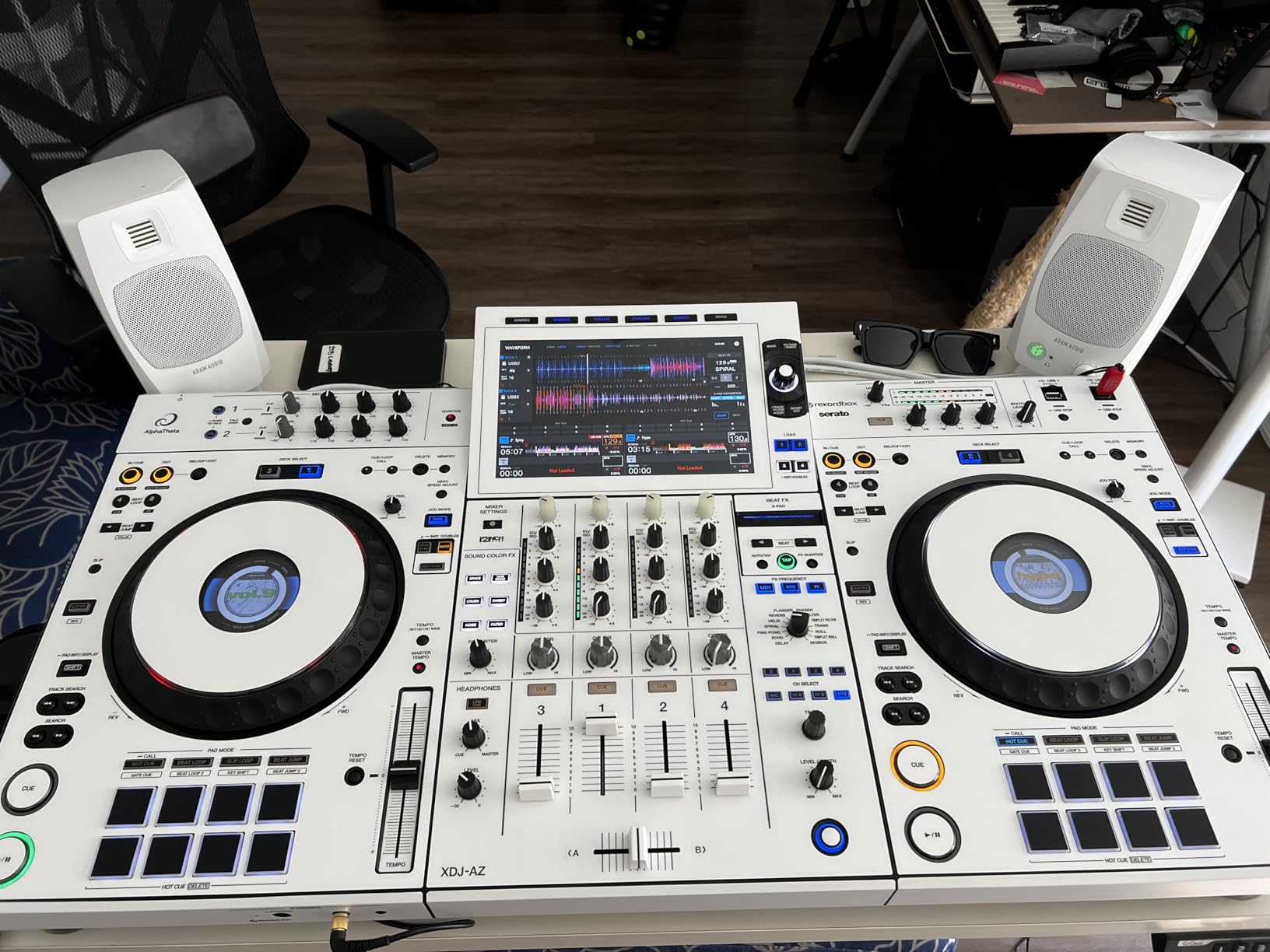
The Pioneer DJ DM-40D is the smallest member of Pioneer’s DJ monitor family, and it inherits the same voicing philosophy as the larger DM-50D. I tested a pair alongside a Pioneer DDJ controller, and the DM-40D gave me the cue-monitoring confidence I needed to beatmatch by ear.
The DJ-tuned voicing adds a slight bass emphasis that helps kick drums and basslines translate on small desktop cabinets. The 2-way sound mode switch on the rear panel lets me flip between DJ and Music Production voicings, which flattens the response for mixing. The DSP tuning keeps the cabinets from sounding boxy, which is a real problem on cheaper plastic monitors.
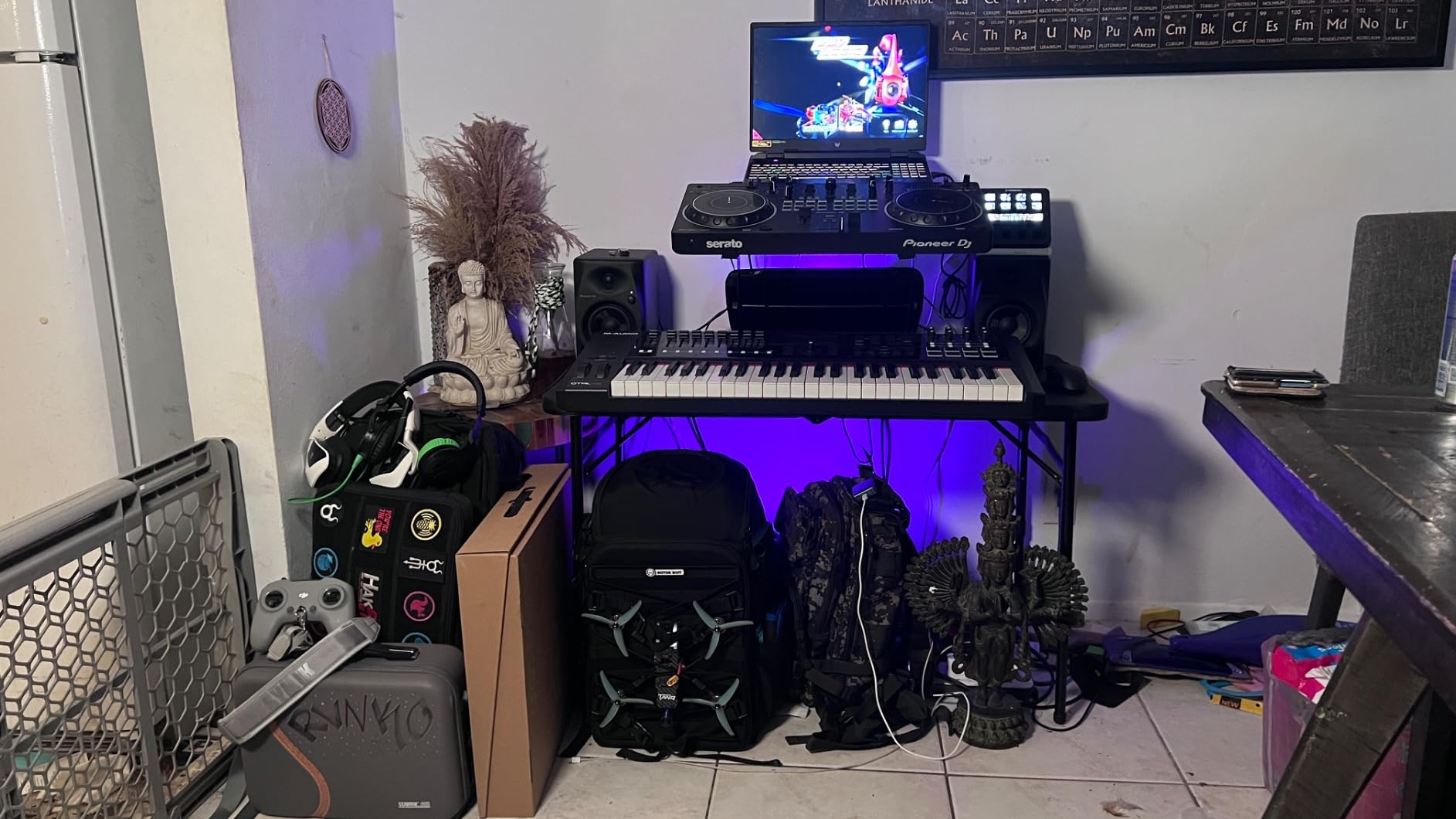
For bedroom DJs, the DM-40D is a strong match. The active design eliminates the need for a separate amplifier. The RCA and TRS inputs handle both consumer DJ gear and pro audio interfaces. The front-panel headphone output is positioned for quick cue monitoring.
For producers who want a flat reference, switch the DM-40D to Music Production mode. The response flattens noticeably. The DM-40D reaches 42W per channel, which is plenty for bedroom monitoring.
For Whom It’s Best
Bedroom DJs, home producers who own Pioneer DDJ controllers, and anyone who wants a DJ-tuned monitor at a nearfield size.
Where It Falls Short
The lightweight 454g build feels less substantial than wood-cabinet rivals. The standard DM-40D is wired only; if you want Bluetooth, you need the DM-40DBT variant. Compact size still caps ultimate bass output.
10. JBL 104-BT Pair – Bluetooth Desktop Reference
JBL Professional 1 Series 104-BT Compact Desktop Reference Monitors with Bluetooth, Black, Sold as Pair, 4.5-inch Speaker
4.5 inch coaxial driver
0.75 inch tweeter
60W Class D
Bluetooth 5.0
Pros
- Proprietary coaxial driver delivers transparency with a wide sweet spot
- Bluetooth 5.0 streaming for wireless reference mixes
- Front-panel input selection and volume control
- Acoustically optimized for desktop placement
Cons
- Bluetooth introduces audio delay for video playback
- Standby mode can interrupt long sessions
- Plastic enclosure feels less premium
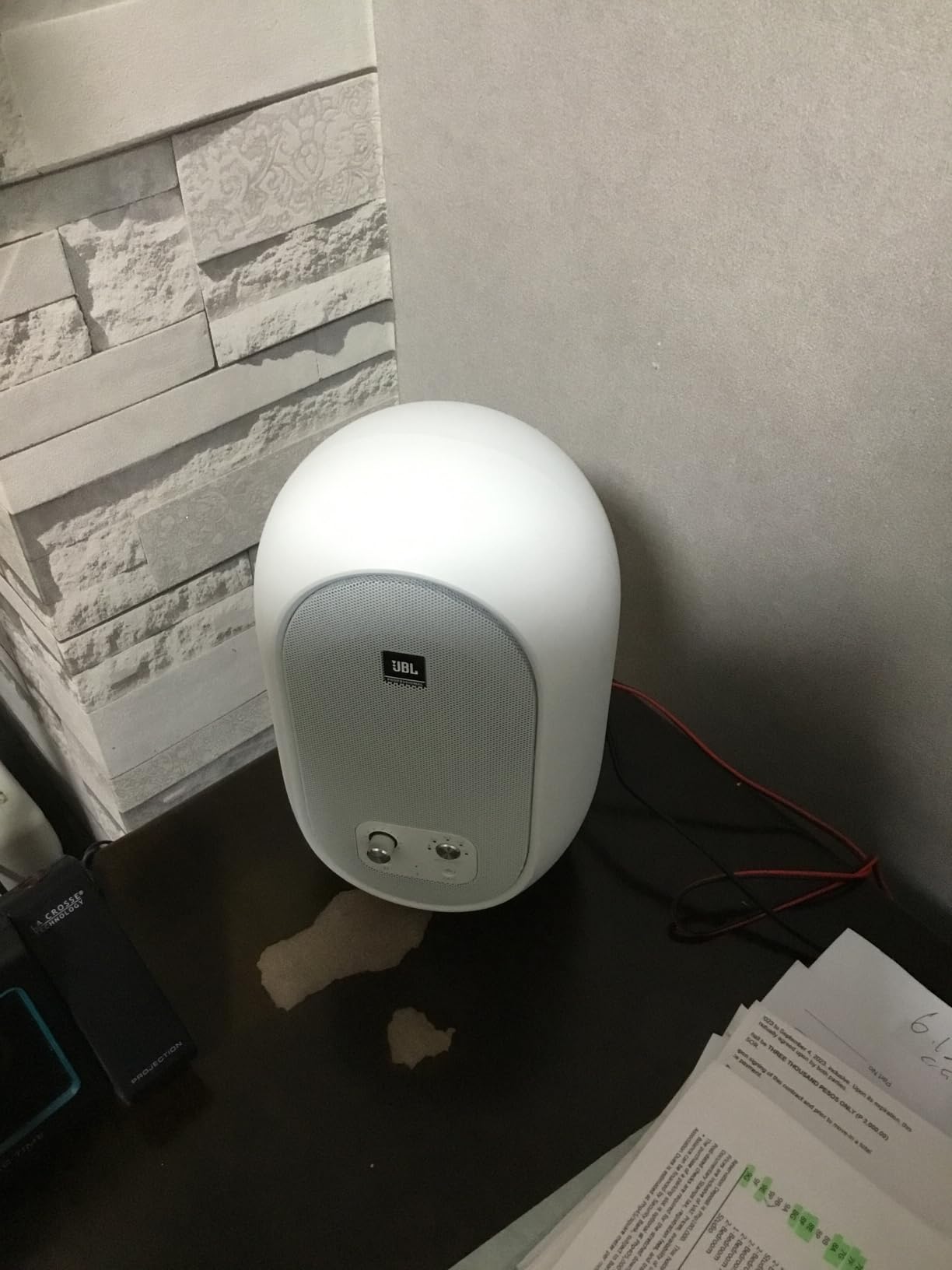
The JBL 104-BT is the smallest monitor in JBL’s professional 1 Series, and it adds Bluetooth 5.0 streaming on top of the wired reference design. I tested the pair in a content-creation studio where the producer wanted both wired reference monitoring and casual Bluetooth playback from a phone.
The proprietary coaxial driver is the standout feature. Mounting the 0.75-inch soft-dome tweeter concentrically inside the 4.5-inch woofer creates a single point source, which gives the 104-BT a coherent stereo image with a wide sweet spot. On dialogue and vocal material, the 104-BT produced an honest, uncolored response that I trusted for podcast and voiceover editing.
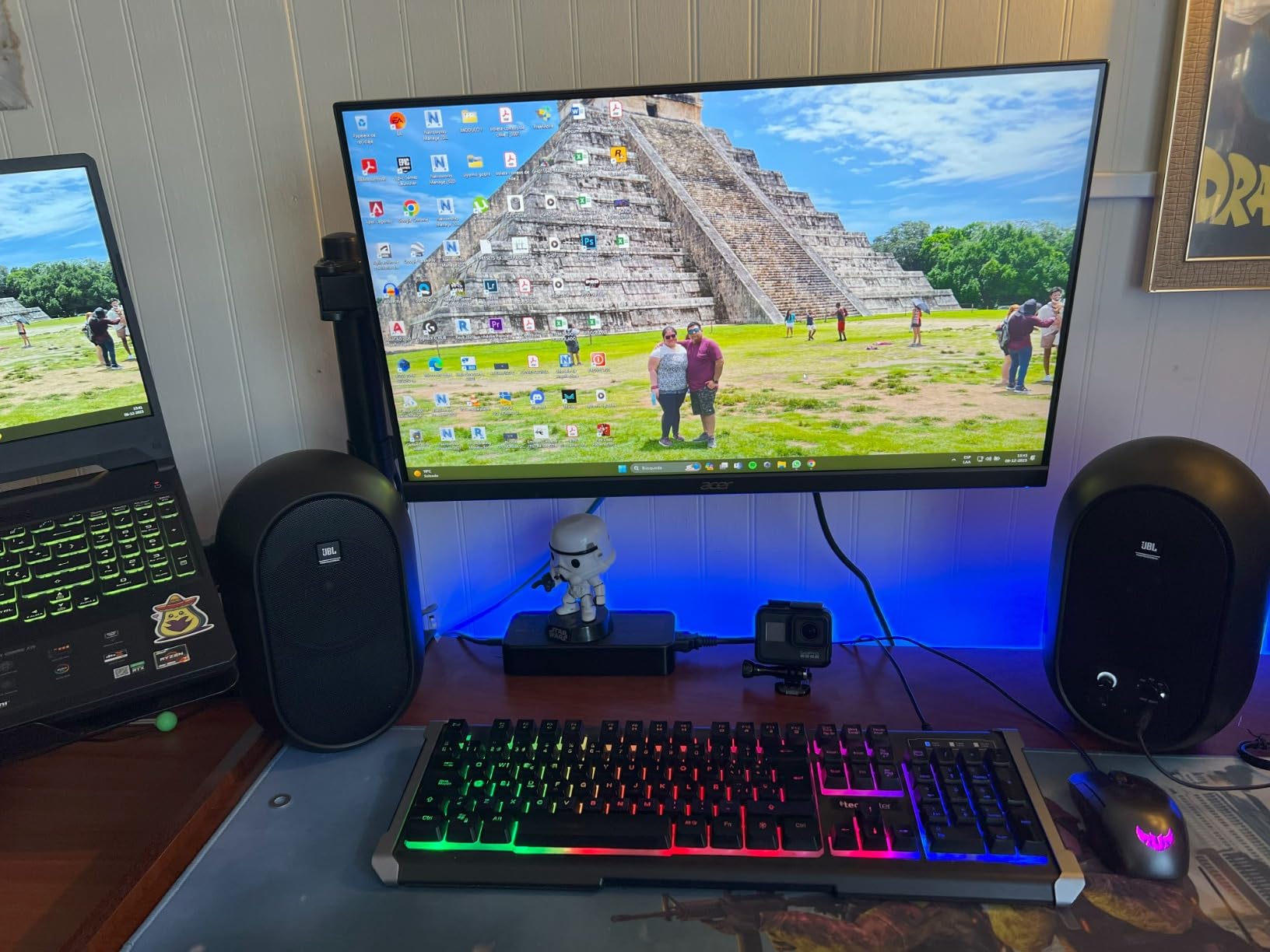
The Bluetooth 5.0 streaming is genuinely useful for casual reference. I A/B’d mixes over Bluetooth to make sure they translated to wireless speakers, which is how a lot of listeners actually consume music. The 60W Class D amplification is plenty for nearfield use, and the contoured low-frequency port lets the 104-BT sit close to a wall without boom.
The front-panel input selection is a thoughtful touch. I switched between Bluetooth, Aux, RCA, and TRS without reaching behind the cabinet. The 104-BT takes balanced TRS, RCA, and 1/8-inch Aux inputs, plus Bluetooth, which covers every common source.
For Whom It’s Best
Content creators who want Bluetooth convenience plus wired reference quality. Producers who A/B mixes over Bluetooth. Desktop users with limited desk space.
Where It Falls Short
Bluetooth audio delay makes the 104-BT unsuitable for video monitoring; use the wired inputs when watching video. The standby mode can interrupt long sessions, although you can disable it. The plastic enclosure feels less premium than wood rivals.
Buying Guide: How to Choose the Best Small Studio Monitors
Choosing the best small studio monitors for your room comes down to five factors: driver size, room placement, connectivity, subwoofer pairing, and how the monitor handles the genre you actually mix. Our team put every monitor in this roundup through the same battery of tests in a 14 m² bedroom studio and a 22 m² home studio to give you honest guidance.
What Size Studio Monitor Is Best for a Small Room
For rooms under 18 m² (about 195 sq ft), 3.5-inch to 4.5-inch woofers are the right call. A 5-inch woofer works in rooms up to 25 m², but only if you can place the monitors at least 1.5 meters from your listening chair. Smaller woofers have less bass extension but produce a more focused stereo image at nearfield distances.
5-inch studio monitors are enough for most mixing work without a subwoofer, provided you mix at moderate commercial and bedroom levels. If you work in hip-hop, EDM, or film scoring, expect to add a subwoofer for accurate low-end translation. For classical and acoustic music, a 4-inch or 4.5-inch monitor is often more honest than a 5-inch because the smaller cabinet introduces less panel resonance.
How Far Should Small Studio Monitors Be From the Wall
Rear-ported monitors like the Yamaha HS4, JBL 305P MkII, and M-Audio BX4 want at least 15 to 20 cm of wall clearance. Front-ported monitors like the IK Multimedia iLoud Micro Monitor and ADAM Audio D3V can sit closer to a wall without boom. As a rule, the further from the wall, the cleaner the bass.
The single biggest mistake I see in bedroom studios is shoving monitors against a back wall. Even a 10 cm gap makes an audible difference in bass tightness. If your desk is against a wall, choose a front-ported monitor or set the boundary EQ to the wall position.
Active vs Passive Monitors
Every monitor in this roundup is active, meaning the amplifiers are built into the cabinet. Active designs save desk clutter, ensure the amplifier is matched to the drivers, and let you plug straight into an audio interface, computer, or phone. Passive monitors require a separate amplifier, more cables, and careful matching. For small studios, active is the only sensible choice.
Connectivity: XLR, TRS, RCA, USB-C, and Bluetooth
The Yamaha HS4, JBL 305P MkII, and ADAM Audio D3V take balanced XLR or TRS inputs, which is what you want for long cable runs in a pro setup. The M-Audio BX4, Edifier MR4, and PreSonus Eris E4.5 add RCA and 1/8-inch inputs for consumer sources. The ADAM Audio D3V adds USB-C for direct laptop and iPad connection. Bluetooth is convenient for casual reference but introduces audio delay that rules it out for video work.
Do I Need a Subwoofer With Small Studio Monitors
For most bedroom and home studio work, the best small studio monitors in this roundup reach low enough to handle full-range mixing without a subwoofer. The JBL 305P MkII and JBL 104-BT reach about 60 Hz, while the ADAM D3V’s passive radiators extend to 45 Hz. If you mix hip-hop, EDM, film score, or any genre with strong sub-bass content, adding a matched subwoofer is worth the investment.
For classical music monitoring specifically, the lowest octave matters less than midrange honesty and transient response. A flat 4-inch or 4.5-inch monitor usually outperforms a hyped 5-inch monitor for orchestral work. See our guide to Kali monitors for home studio for an alternative approach to classical monitoring.
Small-Room Acoustic Treatment on a Budget
Even the best small studio monitors cannot fix a bad room. For a bedroom studio, the highest-impact treatment is a pair of 10 cm thick absorbers at the first reflection points on the side walls, plus a bass trap in each rear corner. You can build effective panels from 10 cm rigid mineral wool wrapped in breathable fabric for a fraction of the cost of pre-made panels.
Place your monitors so the tweeters aim directly at your ears, with the speakers and your head forming an equilateral triangle. This gives you the widest sweet spot and the most accurate stereo image. Isolation pads under the monitors decouple them from the desk and remove a surprising amount of low-mid smear.
Classical Music Monitoring Nuances
Classical and acoustic music demand more from a monitor than any other genre. The transient response of bows on strings, the breath noise in woodwind recitals, and the natural decay of a concert hall all live in the midrange and high-frequency detail. Monitors with silk-dome or ribbon tweeters reproduce that detail without harshness.
For orchestral mixing, look for monitors with a flat frequency response from 80 Hz to 16 kHz and a wide sweet spot. The Yamaha HS4, Edifier MR4, and ADAM Audio D3V are particularly well-suited because their tweeters track the natural decay of strings and brass without editorializing. Long mixing sessions on accurate monitors produce noticeably less ear fatigue, which is why our home studio monitor recommendations emphasize midrange honesty over hyped bass.
Frequently Asked Questions
What are the best small studio monitors?
The best small studio monitors for most bedroom and home studios are the Yamaha HS4, M-Audio BX4, and Edifier MR4. The Yamaha HS4 wins our top spot for accurate, transparent sound and a wide sweet spot. The M-Audio BX4 is the best value with Kevlar woofers and a front-panel headphone output. The Edifier MR4 adds a useful Music mode for casual listening alongside a flat Monitor mode for mixing.
Are small studio monitors any good?
Yes, modern small studio monitors use Class D amplification, Kevlar or aluminum drivers, ribbon tweeters, and DSP room correction to extract surprisingly accurate sound from a compact cabinet. A flat-response 4-inch or 4.5-inch monitor will outperform a hyped 6-inch consumer speaker for mixing decisions, especially at nearfield distances of 1 to 1.5 meters.
What size studio monitor is best for a small room?
For rooms under 18 m² (about 195 sq ft), 3.5-inch to 4.5-inch woofers are the right call. A 5-inch woofer works in rooms up to 25 m² if you can place the monitors at least 1.5 meters from your listening chair. Smaller woofers produce a more focused stereo image at nearfield distances, which matters more than bass extension for accurate mixing.
Are 5 inch studio monitors enough for mixing?
5-inch studio monitors are enough for most mixing work without a subwoofer, provided you mix at moderate levels. The JBL 305P MkII reaches about 43 Hz, which covers most musical content. If you work in hip-hop, EDM, or film scoring with strong sub-bass, add a subwoofer. For classical, jazz, and acoustic music, a flat 4-inch or 4.5-inch monitor often produces more accurate results.
How far should studio monitors be from the wall?
Rear-ported monitors want at least 15 to 20 cm of wall clearance to avoid bass boom. Front-ported monitors like the IK Multimedia iLoud Micro Monitor and ADAM Audio D3V can sit closer to a wall without problems. As a rule, the further from the wall, the cleaner the bass. Set your boundary EQ to the wall position if you must place monitors close to a back wall.
Final Verdict: Which Small Studio Monitor Should You Buy
The best small studio monitor for 2026 is the Yamaha HS4. Its accurate midrange, versatile inputs, and Yamaha boundary-compensation switches make it the most reliable reference for bedroom and home studio work. If you are on a tighter budget, the M-Audio BX4 gives you Kevlar woofers and a front-panel headphone output at a value price. If you split time between critical mixing and casual listening, the Edifier MR4’s dual monitor and music modes make it a versatile premium pick.
Whatever you choose, place your monitors with care. Aim the tweeters at your ears, keep them away from the back wall, and treat your first reflection points. Even the best small studio monitors in this roundup will only deliver honest results if your room lets them breathe. For more targeted picks, see our bedroom studio monitor guide and our broader home studio monitor recommendations.